

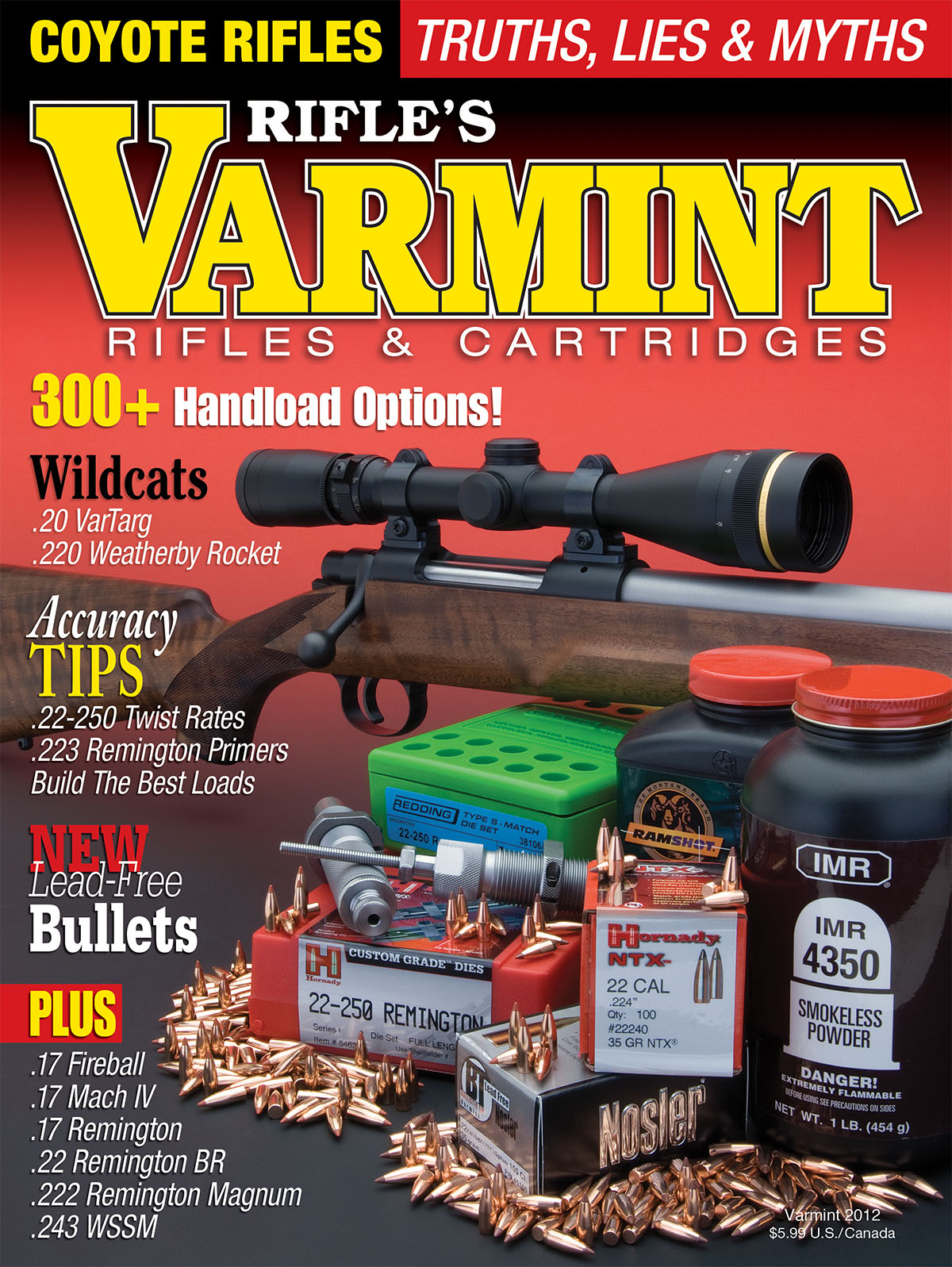
Varmint 2012
On the Cover: This Cooper Firearms’ Model 22 .22-250 Remington is fitted with a Leupold VX-3 4.5-14x40 riflescope.
Volume 2, Number 2 | ISSN:
Article Bites
Coyote Rifles
Fact vs Fiction
feature by: John Haviland
Hunters had better study up on proper coyote rifles before examination day with Professor Coyote, the master of maneuver and masquerade. A coyote might slink into a call only to scram when it discovers there is no such thing as a free meal. That close shot will be at a greased streak hightailing it out of the country. The next chance at a coyote, though, might come across a wide stretch of country. To connect, a hunter must take a long shot that requires a quick and accurate estimate of range and a flat-shooting rifle. Hunters better be prepared for all the possibilities in between, too, because there is no grade inflation in the coyote’s class of life and death. ...Read More >
.17 Remington Fireball
Mach IV Is a Factory Standard!
feature by: John Haviland
Seventeen-caliber centerfire cartridges have been neglected so long that to find even the slightest enthusiasm for them you have to go way back to 1971, when Remington introduced its .17 Remington. But that might well change with Remington’s new .17-caliber cartridge called the .17 Fireball, which is actually an old .17-caliber cartridge. ...Read More >
.22 Remington BR
An Unheralded Wildcat
feature by: Stan Trzoniec
Although the .22 BR (BenchRest)Remington cartridge has never been that popular with hard-core varmint or small game shooters, it is, nevertheless, easy to load and fun to use. I call it my “no-sweat” wildcat. ...Read More >
.222 Magnum Remembered
The Other .22!
feature by: Ken Waters
Once again, if I seem to be plugging for the revival of a near-dormant cartridge, it’s only in the sense that one definition of revival is: “To bring back into use or attention,” while dormant refers to something that is “inactive; as if asleep.” The latter comes close to describing the Remington .222 Magnum and the former my attempt here to speak for a round too good to die. ...Read More >
Latest Lead-Free Bullets
Surveying a New Breed of Varmint Options
feature by: Brian Pearce
In July 2008 California began enforcing new legislation requiring the use of non-lead ammunition for most hunting activities in an area of central and southern California known to be inhabited by the protected California condor – theoretically to prevent the condors from being poisoned when ingesting lead fragments while scavenging animal waste parts left in the field. ...Read More >
Accurate Varmint Loads
Fine Tuning Handloads
feature by: John Haviland
Hitting a prairie dog across the plains or a coyote the moment before it disappears over a far ridge requires good handloads as much as good marksmanship. Accurate handloads start at the loading bench with case preparation, powder and bullet selection, cartridge assembly and shooting – to select the best load for a given rifle. ...Read More >
The .20 VarTarg
A Varmint Cartridge with Potential
feature by: Stan Trzoniec
Introduced to American shooters in 1963, the .221 Fireball was offered in the Remington XP-100 single-shot pistol. Basically a .222 Remington shortened to 1.40 inches, it was the perfect item for a short-barreled handgun complete with its B--uck Rogers design and a stock made out of space-age DuPont Zytel, including white inlays and a ventilated rib. It was a major milestone for Remington with around 2,650 fps out of the 101⁄2-inch barrel and a receiver drilled and tapped for scope mounting. ...Read More >
.22 Caliber Twist Rates
What’s best, faster or slower?
feature by: John Haviland
Varmint hunters shooting .22-caliber cartridges face the dilemma of which rifling twist to choose. Should they select a rifle barrel with a twist rate on the slow side for standard weight bullets, go with a sharper twist to accurately shoot heavy, sleek bullets or meet in the middle in an attempt to shoot the majority of bullet styles and weights? ...Read More >
Primers and .223 Accuracy
Charlie takes an inside look.
feature by: Charles E. Petty
For many if not most shooters, the primer is simply a sparkplug. It gets things started so we can have the big bang we all know and love. But for accuracy nuts like me and folks afflicted with OCD – also known as benchrest shooters – primers might mean .10 inch when groups are measured. ...Read More >