

Primers and .223 Accuracy
Charlie takes an inside look.
feature By: Charles E. Petty | August, 12
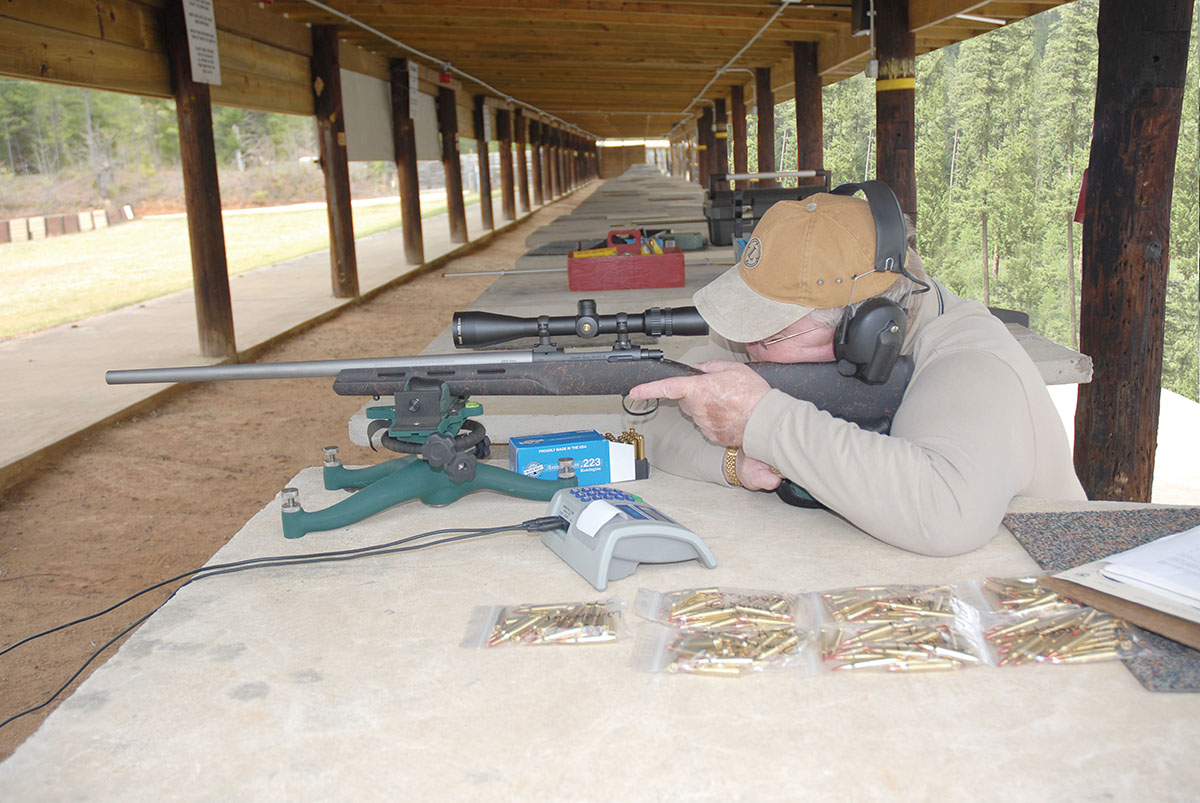
For many if not most shooters, the primer is simply a sparkplug. It gets things started so we can have the big bang we all know and love. But for accuracy nuts like me and folks afflicted with OCD – also known as benchrest shooters – primers might mean .10 inch when groups are measured.
Over the years I’ve looked at the topic of primers several times in both rifles and handguns, and more often than not the results have either been contradictory or led me to think primers don’t matter very much. But none of those tests have been extensive enough to convince me I’ve found a universal truth. This one won’t either, but I’ve tried to devise a test that will give a clue for one of the most popular cartridges around today: the .223 Remington. The ob-vious solution is to work up a good load and then shoot a lot of them with primer make and type as the only variable.
I have had a Cooper Phoenix .223 for several years now and have used it for load development and component testing on several occasions. In other words I’ve got a lot of history with this gun. The only drawback it has is a one-in-14-inch twist that sorely limits the choices of bullets it will like. I’m sure it is no accident that the label for Hornady’s 52-grain A-MAX says, “twist rate 1:14,” and it has been a good performer in the Cooper, so that decision was easy. The scope is a Bushnell Elite 4200 6x24 with side focus. It has become a real favorite.
The choice of powder was not nearly as easy, and there are lots of them that will do well in the .223, so I reviewed my notes and chose three that had done well in previous tests. They were Alliant Reloder 10x, Ramshot TAC and Vihtavuori N133. The next step was to work up loads that were comparable to the 3,250 fps of the Black Hills 52-grain load I was using as a control. Some of the powders gave higher velocities, but I worked up to the maximum in one-grain increments and compared accuracy at the different levels.
The issue of velocity is important only as it applies to accuracy in this context. While it is often true – with small-caliber, centerfire cartridges – that higher velocities give better accuracy, that does not seem to be the case here. In the powder test, neither TAC nor VV-N133 showed very much difference in accuracy between the three charges, but 10x showed a distinct preference for the middle charge, and that combination was selected for further tests. (See Table I.)
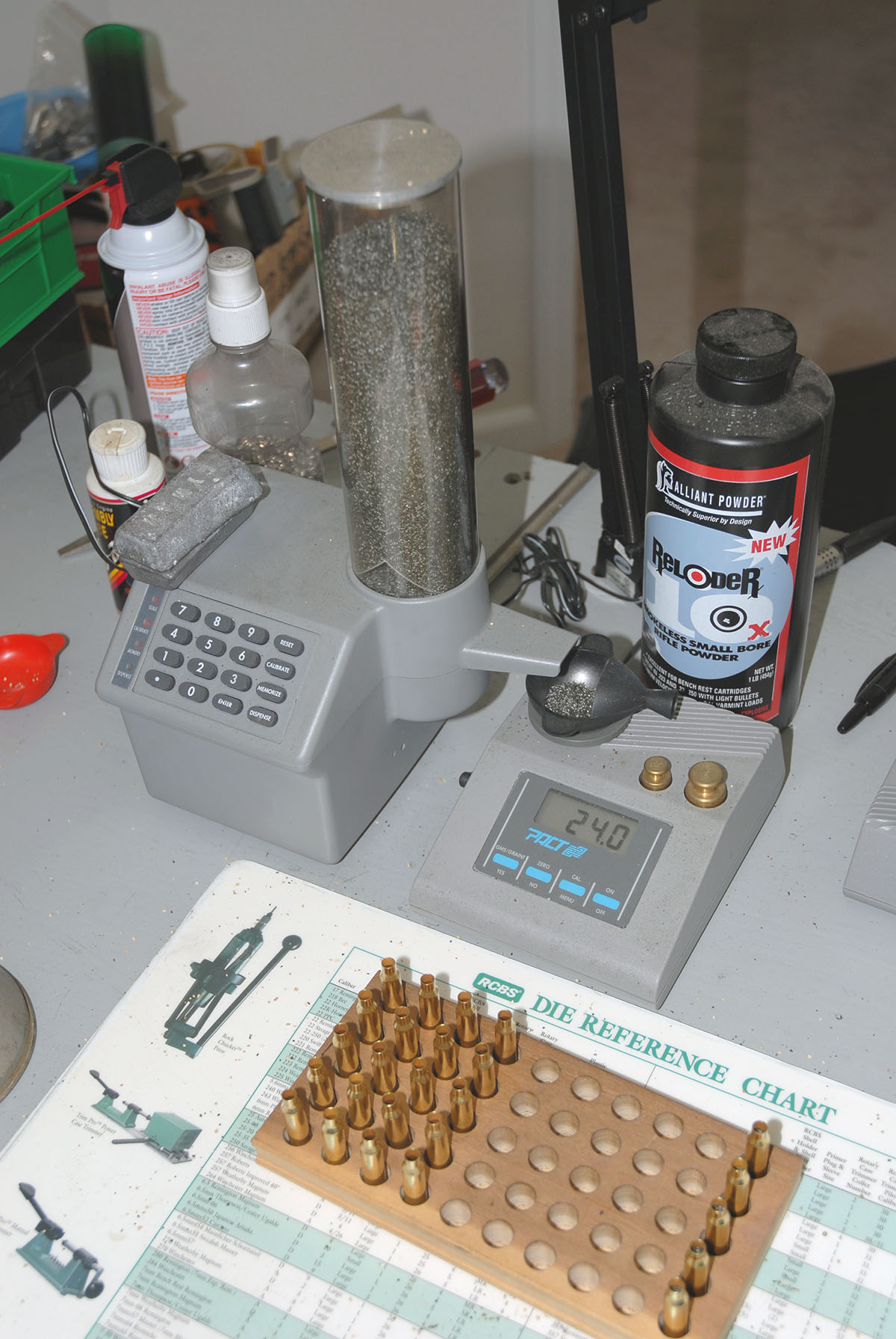
Previous results with 10x had been very promising so that choice was made. Keep in mind that the purpose of this exercise is not to shoot the smallest group ever seen but rather to evaluate the effect of a variety of primers when all other conditions are the same. A charge of 24.0 grains of 10x was the standard. One significant observation about this load is that it fills the case right up to the neck, so when a bullet is seated, loading density is right about 100 percent. While this is far from ironclad, my experience has been that loads like this frequently are good performers.
A total of seven U.S.-made Small Rifle primers were available: standard and benchrest (or match) primers were chosen from CCI, Federal and Remington along with a single standard Small Rifle primer from Winchester. Since 10x is an easily ignited small-grain, extruded powder, magnum primers were not even considered.
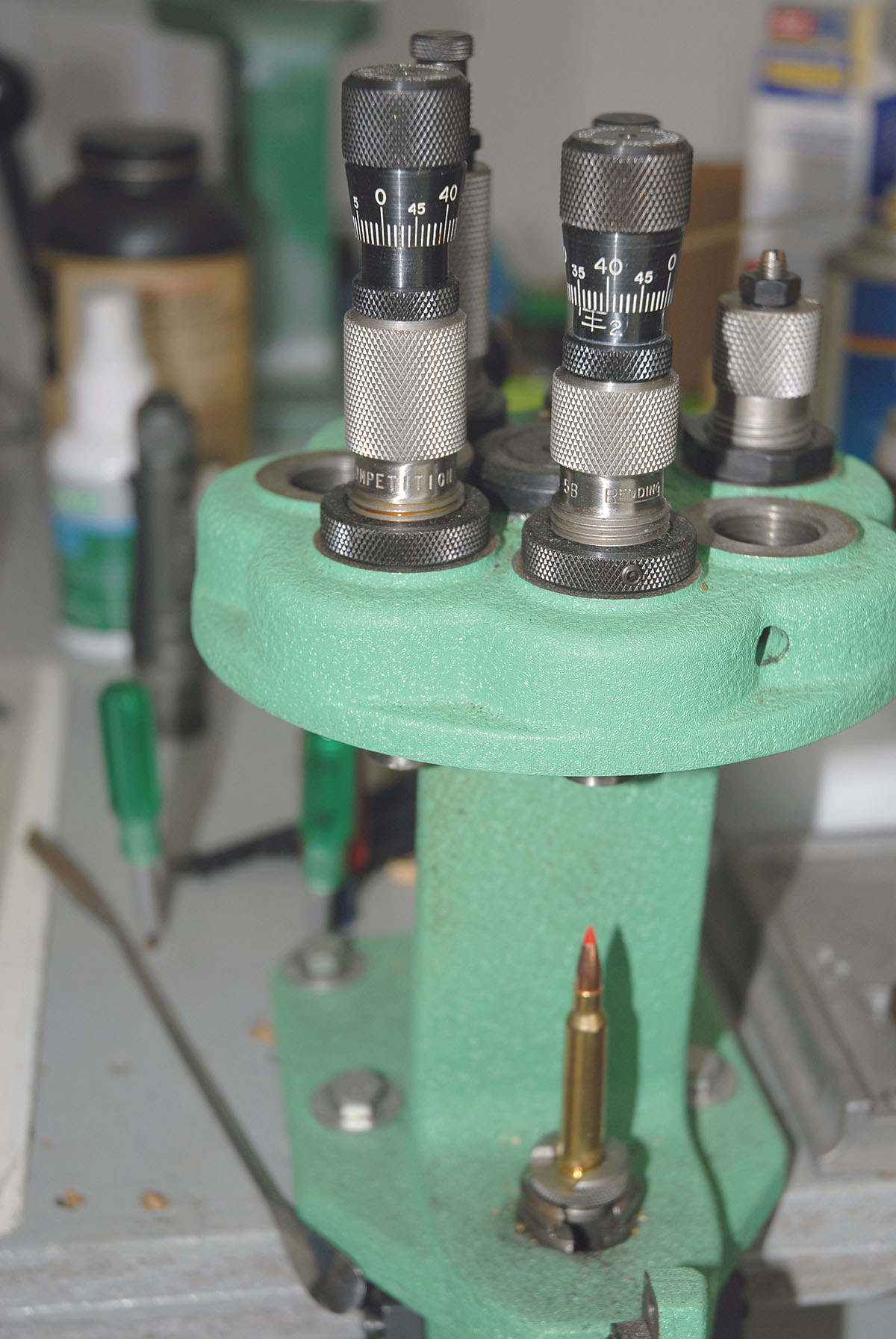
The plan was to shoot five, five-shot groups at 100 yards with each combination. New brass was neck sized and primed, and powder charges were thrown using a PACT digital powder dispenser. All bullets were seated to the same overall loaded length established earlier. Redding Benchrest dies were used.
The only thing left to do was shoot. I think it is important in a test like this for all shooting to be done under the same weather and wind conditions, and you may have noticed that the months of March and April produced one storm after another in the eastern half of the country.
After several false starts, there was finally a day – between storms as it turned out – when winds were calm, the skies slightly overcast and temperatures in the high 60s. I set up a wind flag and watched it closely. The plan was to shoot in 25-round strings at a moderate pace so the rifle wouldn’t overheat. All rounds were chronographed using a PACT Professional Chronograph, and each five-shot group was printed out for later study. I purposely did nothing more than check to see everything was working.
After each 25-shot string, the rifle was carefully cleaned and allowed to cool to near ambient temperature. Then I shot two fouling/warming rounds and returned to the test ammunition. With this system it took about four hours to shoot all 125 rounds.
One of my basic testing principles is to make sure the data gathering system is working properly and then leave well enough alone. I’ve found that if I try to study the results as they are collected, it doesn’t let me focus on the job. Instead I’m trying to figure out what’s happening – especially if it isn’t what I expected to see. That, coupled with the fickle winds at my range, made it wise to press on with all delib-erate speed. There would be plenty of time for number crunching and head-scratching when I got home. So the actual shooting was uneventful, and other than obviously looking at the groups as they built, there was no effort to jump to conclusions. It was a great day – winds were calm and easily read and the chronograph didn’t flash error messages.
Going through all the other data, there was nothing comparable except for one group with Winchester primers that had an extreme ve-locity spread (ES) of 121 fps. Now here’s the kicker: With the Winchester primers I got both the smallest and largest groups of the day, a magnificent 0.180-inch group and one 10 times larger at 1.191 inches. Go figure.
Actually I don’t think there’s anything to figure at all; it’s just a perfect example of the law of random distribution, better known as the bell curve. But we can still draw a couple of conclusions. First of these is that, once more, there is no relationship between standard deviation and accuracy. None! Nor can we say much about velocity and accuracy because some of the most erratic velocity sets recorded delivered some of the best groups.
I’m sure everyone who studies this data (see Table II) can come away with varying opinions, and maybe that’s the best news of all, because it proves the cussed randomness of our shooting hobby; but there are a couple of easy observations – or maybe questions.
First, I can only say that conditions were good, and I am confident of the results. When shooting from the bench with a high-power scope, it is not too hard to see when you do something wrong and influence the accuracy; and in the examples I am going to cite, I feel that the
results are real. So the first question is how can one set of five groups contain both the two best and two worst of the whole session? I do not know and when you look at the average of all five, it’s right in there with the rest.
The comparison of standard and benchrest primers strongly suggests that the benchrest primers offer an across-the-board benefit. Even with the huge velocity spreads, CCI Benchrest primers showed an 11 percent improvement over the standard primer. In the case of Federal, the advantage was 17 percent, but the most dramatic difference was with the Remington primers that showed a 42 percent advantage for the benchrest product.
lots to be designated as benchrest. In the case of CCI, I did not get a very specific answer, but since each primer is clearly marked with a lit-tle “BR,” it is obvious they meant
for them to be that way from the beginning.
And we don’t have to look far to find good evidence to support the conclusion that the primers are chemically the same. If we look at the average velocity values in my data, the differences between the standard and bench-rest primer velocities is small: no greater than the extreme spread within any single five-shot group in the series. The same data shows how worthless standard deviation is as a predictor of accuracy. We’ve been told that we must have tiny SDs if we ever expect to go down the path of righteousness, and that simply isn’t so. I wouldn’t have bothered to even calculate it if the PACT hadn’t given it to me free. It does tell us how the five rounds in a string compare with one another, but all the data shows the total lack of correlation between SD and accuracy.
The next question is whether or not one should spend extra for match primers. For hunting ammunition or general purpose stuff, my answer would be no because the small potential gain is likely to be lost on the average hunting rifle. But for varmint hunters or accuracy nuts like me, the answer would be different. I learned a long time ago to avoid talking about specific costs, because market factors are so variable across the country that there is no single right answer; but with the availability and major countrywide sellers such as MidwayUSA, we can get a reasonable comparison. I found that CCI Bench-rest Small Rifle primers were $13.50 per thousand higher. For Federal the difference was $5.50, but Remington’s prices were identical. That would seem to make them a great bargain.
But, as it is with all nice fairy tales, there is a moral to this story. The data is as good as I can make it, but it really only applies to my rifle on that particular day. The odds are excellent that you will find something helpful here and maybe your rifle will behave just like mine. Lordy, I hope so, but please don’t hold your breath, because guns are laws unto themselves, and the only way we will ever know is to shoot and see. Of course, that’s why we’re here, isn’t it?
.jpg)
.jpg)