.243 Winchester
The Last of the 6mm’s
feature By: John Haviland | August, 11

The fashion today is to put down established and popular cartridges, enabling the critics to feel superior to the masses. The .243 Winchester especially has been the target of this criticism. Among other failings, the .243 has been accused of producing wide swings in pressure and being barely adequate for shooting a half-starved deer.
After recently shooting a .243 Winchester with a variety of powders and bullets with outstanding ac-curacy and over the years using and seeing .243s shot in the field on game from prairie dogs to big mule deer bucks, perhaps those critics should take up golf.
Popularity
The .243 Winchester falls in the class of cartridges loosely defined as useful for deer and small game. In my Hunter Education class, more girls show up with rifles chambered in .243 Winchester than any other centerfire cartridge – maybe more than all other centerfire cartridges combined.
The fathers and grandfathers who picked out these .243 rifles know the girls are not taking up hunting to prove they can carry a heavy load or take hard recoil. They also know if the girls are going to enjoy hunting and continue to hunt, they need a rifle they can carry and one with a modest amount of recoil. The .243 fills that requirement.
The .243 Winchester has been building its good name since it was introduced in 1955. The fact it came wrapped in several versions of the popular Model 70 Winchester certainly helped the cartridge. Only a short time was required for the .243 to run over other cartridges in its class, like the .250 Savage and .257 Roberts. The 6mm Remington came along soon after but has never come anywhere close to the .243’s popularity. Today the .243 is chambered in single shots, pumps, autoloaders and bolt-action rifles. These rifles range from light and skinny, like the 53⁄4-pound Ruger Model 77 Compact for the hiking hunter, or the 93⁄8-pound Reming--ton VLS for shooting distant small targets.
Varmints
I’ve used the .243 Winchester on a few prairie dog and ground squirrel shoots. With Winchester’s 55-grain Ballistic Silvertip at 3,900
fps, it shoots as flat as the .22-250 Remington with 55-grain bullets. The .243’s recoil is not objectionable, but it’s enough to cause the loss of your sight picture and requires a spotter to tell you where the bullets hit.
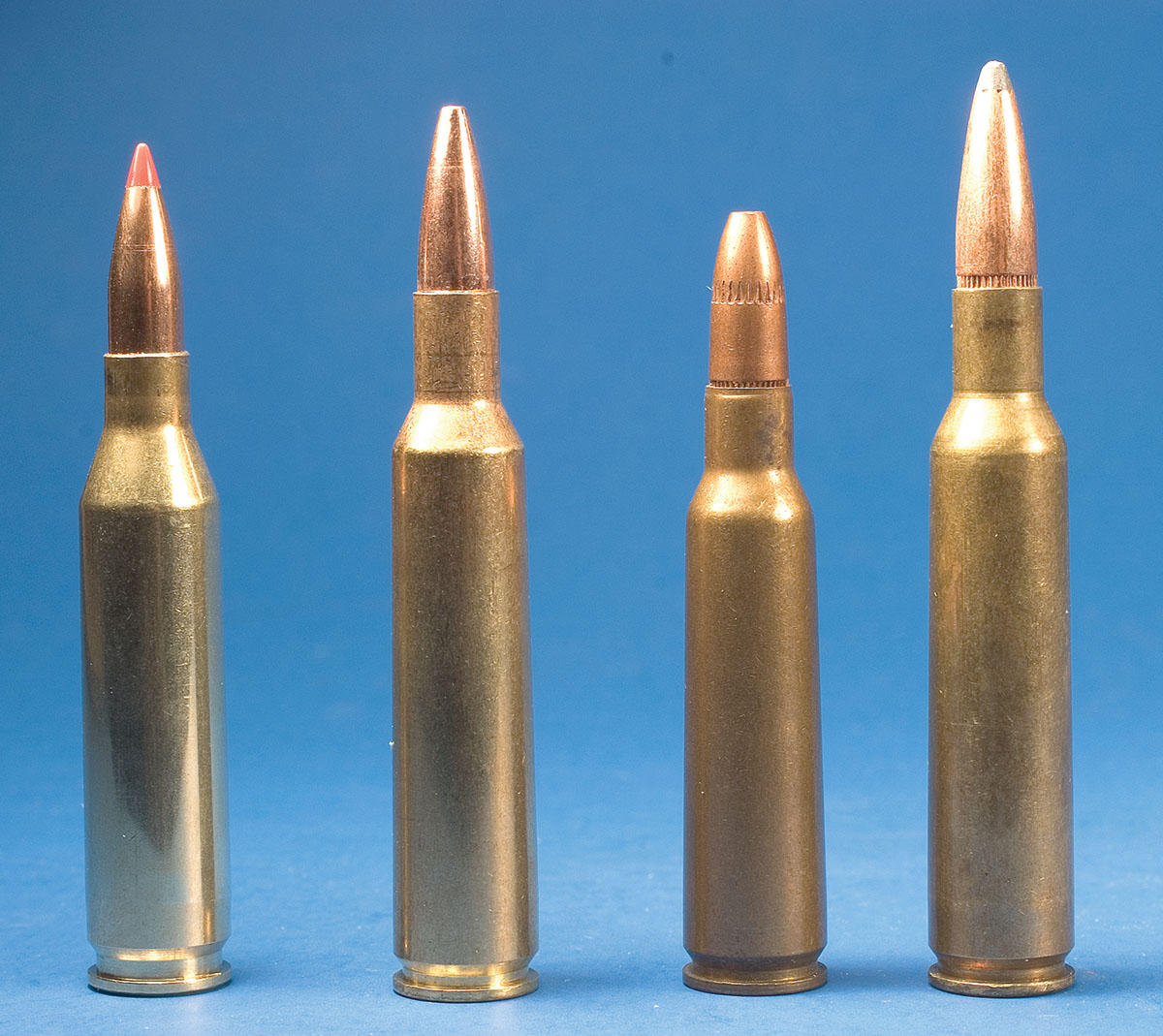
This is easily fixed by hand-loading the 55-grain bullet with a reduced load, say 42 grains of Hodgdon Varget or Alliant Reloder 15. The 300 fps or so reduction in bullet speed with the lighter amounts of powder sounds like it would really increase bullet drop, but it sags only 2 inches more out at 350 yards.

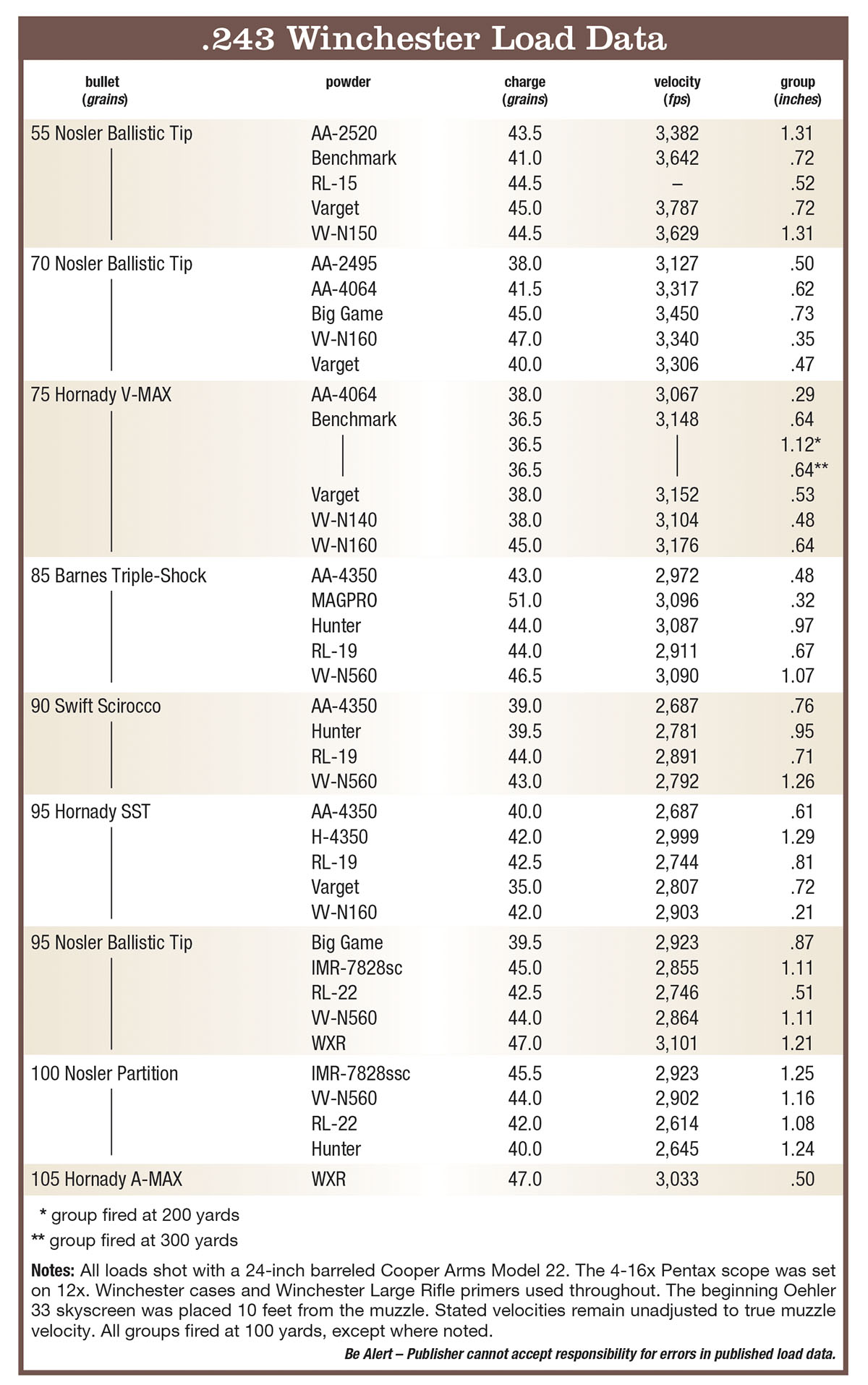
For marmots, fox and coyotes, a heavier bullet works best. Not because it shoots any flatter, but because it hits them harder. My favorite for years was the Sierra 75-grain hollowpoint. It accounted for lots and lots of rockchucks, a couple of red fox and about 10 coyotes. Not long ago, though, I switched to the Hornady 75-grain V-MAX. Its sharp, red plastic tip gives the bullet a racy appearance. A check of the groups it shot in the load table shows it is also a very accurate bullet.
My son had a Cooper Arms Model 22 Phoenix rifle and his 12-gauge shotgun close at hand when he started after ducks last October. The first thing he saw was a coyote loping across a field carrying the backbone of a fawn deer in its jaws. A couple of magpies and a raven circled close overhead and kept the coyote distracted long enough for my son to send a 75-grain V-MAX on its way. The coyote was about 250 yards out, and when the bullet hit, the coyote made a mad dash through a flat of water then flopped over with a splash. One 75-grain bullet with the red plastic tip was well worth the price to end that coyote’s fawn-killing days.
Speaking of bullets with plastic tips, I just noticed that all the bullets, except two, listed in the load table wear plastic tips.
Big Game Hunting

My brother and I used a Winchester Model 100 .243 Winchester for years on our annual deer and antelope hunts. Some years the limit was three antelope and six deer apiece. What is there to say? We’d shoot from 50 to 200 yards and see a blossom of red appear on the side of the deer or antelope. Sometimes in the excitement our aim was a little less than straight and we had to shoot again, but with little delay the game fell.
We shot Sierra or Speer 100-grain plain lead-tipped, flatbase bullets. I recently found a box of those cartridges in the back of a drawer. They had probably been there for 20 years. The powder charge was 41.5 grains of IMR-4350. That amount of powder gave the bullets about 2,900 fps of velocity from the Winchester’s 22-inch barrel. The bullets worked well at that speed because we never found any sign they had torn apart or failed to penetrate.
A few hunters shoot elk with the .243 Winchester, but that’s stretching it. My friend Debbie Morvac has shot several elk with her .243. She hunts in the timber where shots are close and waits for a broadside shot to put a bullet through the lungs. If I remember correctly, Debbie shoots Remington 100-grain Core-Lokt bullets.
Loading and Shooting
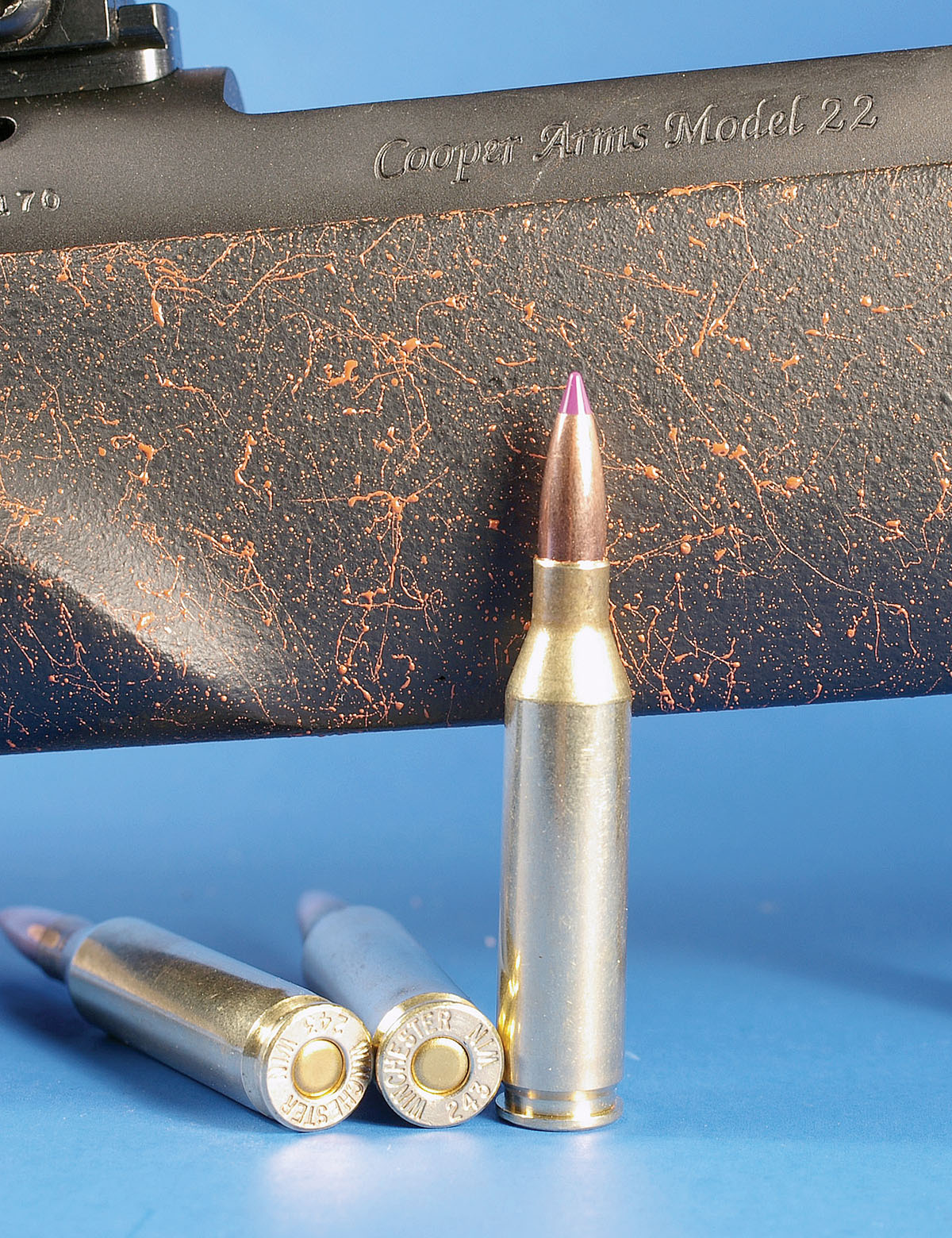
For the shooting part of this article, I borrowed a Cooper Arms Model 22 Phoenix bolt action from Cooper Arms of Stevensville, Montana. This rifle has a 24-inch heavy contour stainless steel barrel and Cooper Arms’s new synthetic stock. Dan Cooper, Cooper Arms president, is less than thrilled with any synthetic stock, but recently bowed to customer demand for such a handle. The small size of the groups in the load table shows it would be an understatement to say the rifle shot extremely well.

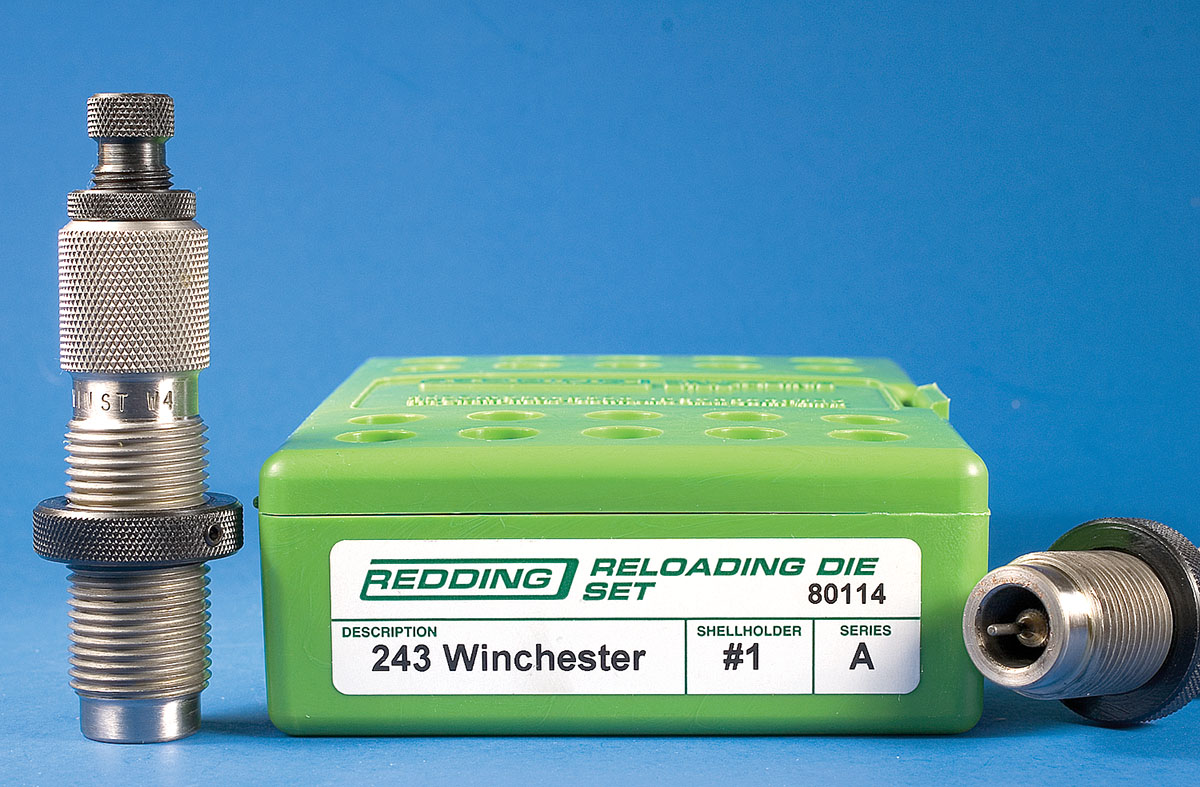
New Winchester brass was used to shoot the first go-round of loads in the Cooper .243 rifle. I ran the sizing button in the Redding sizing die in and out of the case necks to round out the necks. Then the cases were slightly trimmed and chamfered to remove any burrs.
After loading the cases in a Redding seating die, I ran a sample of the cartridges through a Sinclair Concentricity Gauge. Bullet runout hovered around .006 inch. Moving the gauge’s indicator tip to rest on the case necks and then the bodies showed they were out of round, causing the inconsistency.
“That doesn’t surprise me,” said Patrick Ryan of Redding. Ryan said he always preps new cases by at least running the necks over a size button or, better yet, neck sizing them. “A better way may be to run the cases into a Sinclair expand-ing die or a Lyman M die for the first loading,” he said. “I’ve heard that forcing the necks onto an expander produces more concentric necks than pulling them over a size button.”
After the cases had been fired, they were run into a Redding sizing die to full-length size them, with the shoulders bumped back .001 inch, so they fit snugly in the chamber of the Cooper rifle. This time bullets seated in the cases showed next to no runout on the Sinclair Concentricity Gauge.
The velocity of many of the loads listed in the table are from 100 to 200 fps slower than those listed in some loading manuals. Part of that difference could be a result of the pressure barrels with their relatively tight chambers that bullet and powder companies use for their tests. These tight chambers produce somewhat higher velocities than the relatively larger chambers reamed in commercial barrels, like the Cooper’s.
An extreme example of this lower bullet speed is 43.5 grains of Accurate 2520 gave the Nosler 55-grain Ballistic Tip only 3,382 fps when the temperature was 60 degrees on a nice fall day. That’s about 500 fps slower than the velocity stated in loading manuals. The Nosler bullet was also about 200 fps slower with Vihtavuori N150 than stated.
I returned to the loading bench and loaded some more cartridges with Accurate 2520 and the 55-grain Ballistic Tip. Their re-corded velocity was 3,372 fps when the temperature was 45 degrees. So I guess AA-2520 is just on the slow side.
On the other hand, the loads using Ramshot Big Game and Hunter are only a little slower than what is stated in the Ram-shot Load Guide Edition III.
Maybe the Cooper rifle just has a slow barrel. But I’ll gladly take that slower speed for the Model 22’s great accuracy.


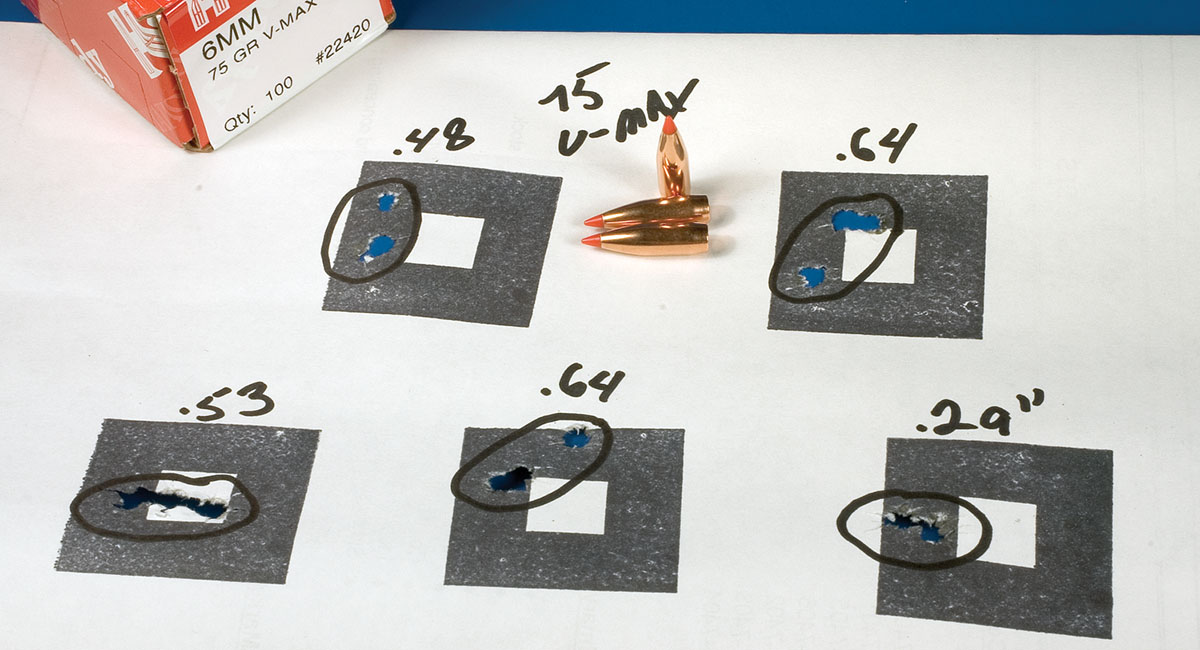
In fact, I’m not so sure I gave the Cooper rifle all that fair a shake. Ever so often a shot got away from me, and I knew it the moment I pulled the trigger. Sure enough, when the Pentax 4-16x scope came back onto the target, there was a bullet hole right where the crosshairs had been when the rifle fired. Still, overall I did fairly well shooting the Cooper. The average group size was .534 inch at 100 yards with Nosler 70-grain Ballistic Tips with five different powders. Hornady 75-grain V-MAX bullets averaged .516-inch groups.
Even with a newly cleaned barrel, the Cooper placed its bullets in a tight group and in the same place as a fouled barrel. After every 20 rounds or so, I stopped to clean the Model 22’s barrel. Before returning to shooting groups, I fired one cartridge to foul the bore and remove any remaining bore cleaner. The load used for that was 36.5 grains of Hodgdon Benchmark with the Hornady 75-grain V-MAX. Three of these shot-one-at-a-time bullets hit right on the 1⁄2-inch aiming square at 100 yards and grouped in .65 inch.

When that load’s turn came up for testing, it hit in the same spot and grouped in .64 inch. At 200 yards, the load grouped in 1.12 inches. Surely my wiggles compensated somewhat for my wobbles, because at 300 yards the load once again grouped in .64 inch. That’s pretty good accuracy.
The Cooper rifle has a one-in-10-inch rifling twist. Hornady states a one-in-9-inch twist or faster is required to stabilize its 105-grain A-MAX bullets. To see if they would fly at least somewhat straightly, I fired the A-MAX bullets with Winchester WXR. The first five shots grouped in .5 inch at 100 yards. I’d say that’s adequately stabilized.
I fired several hundred rounds through the Cooper rifle with no problems. Cases were easily resized and only required trimming after the first firing. All the powders that were fired gave uniform velocities. Hodgdon Varget, Accurate 4064 and Vihtavuori N160 delivered velocity spreads of less than 10 fps. Bullets from 55 to 105 grains certainly cover shooting from ground squirrels to coyotes to big mule deer.
I have only kinds words for the .243 Winchester and hope it stays around for another 50 years.