

Varmint 2014
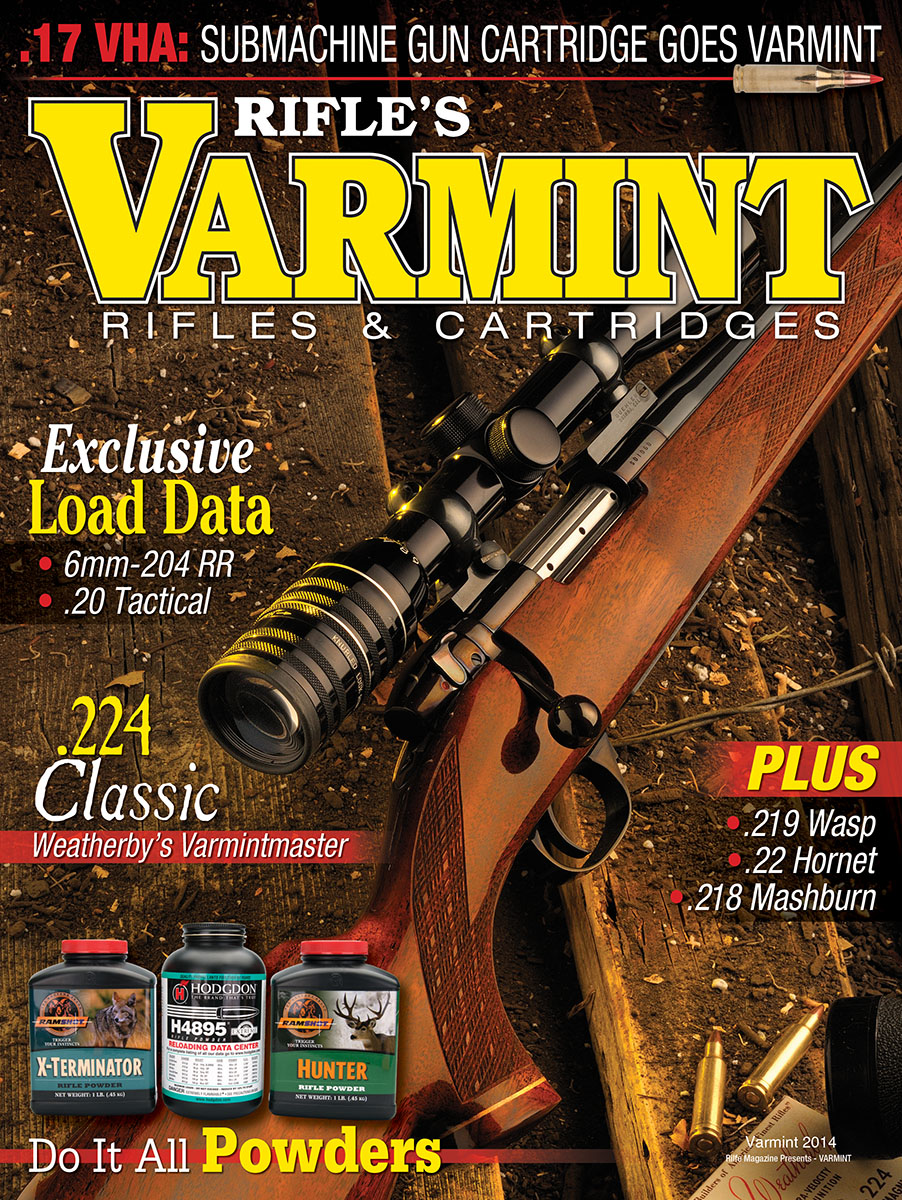
On the Cover: This issue’s cover rifle is an early 1980’s Weatherby Varmintmaster with its original Weatherby Premier 3-9x scope. Photo by Stan Trzoniec. Inset by Chris Downs.
Volume 3, Number 1 | ISSN:
Article Bites
17 VHA
A Submachine Gun Cartridge Turned Varminter
feature by: John Anderson
Several years ago I was introduced to the Heckler & Koch MP7A1 submachine gun, a light, compact design for bodyguards and law enforcement types. It was chambered for the new 4.6x30 HK, a small cartridge for close-quarters encounters. I fired only short bursts, choosing to make the 24 rounds the magazine held last as long as possible. When finished, I looked around at all the empty cases on the ground. They were small . . . even smaller than Hornet brass. No one seemed interested in the brass, so I loaded my jeans pockets as full as I could, thinking, These cases might, when necked down to .17 caliber, make a fine small cartridge for ground squirrels. ...Read More >
20 Tactical
Handloads for a Wildly Popular WIldcat
feature by: R.H. VanDenburg, Jr.
Devotees of .20-caliber cartridges know that early examples appeared as much as a century ago. Back in the 1950s and 1960s, P.O. Ackley and others mentioned such cartridges in writings but, as before, little came of the idea. There have been, however, isolated pockets of sub-.22-caliber shooters operating here and there with growing success. That there are now at least a dozen .20-caliber cartridges with as many custom rifle makers ready to chamber guns for them stands as testimony to their labors. Reloading dies are likewise available for most of them, and almost all major bullet manufacturers turn out an array of .20-caliber options. To cap off this progression, we now have a factory cartridge, the 204 Ruger. ...Read More >
22-250 Improved
Higher Velocity Handloads in a Sisk STAR Rifle
feature by: John Haviland
The 22-250 Remington is a nearly perfect cartridge. It provides fairly long barrel life yet shoots bullets about as fast as any other .22-caliber cartridge. It also responds well to reduced-velocity loads that duplicate lesser .22-caliber cartridges. Accuracy is always acceptable, and with a relatively fast rifling twist it handles bullets from 40 to 80 grains. The 22-250’s only flaw is the taper of its case body that causes it to stretch an excessive amount when fired and resized. ...Read More >
6mm-204 RR
An Efficient Wildcat Suitable for Varmints or Deer
feature by: Brian Pearce
The primary motive for “wildcatting” is usually geared toward creating a cartridge that performs a particular task better than any existing factory round. The goal is not necessarily to make a more powerful or faster cartridge, although that is often the result. Rather, the focus is often to improve accuracy, efficiency or perhaps create a specialized cartridge for match competition or hunting. Another reason is the satisfaction associated with experimenting and developing new loads. In many instances, wildcat cartridges have resulted in designs that ammunition companies ultimately adopted and offered to the public as an industry standard cartridge. Two examples are the 22-250 Remington and 243 Winchester. ...Read More >
A Top Trio
Powders to Cover the 223 and 22-250 Remingtons and the 243 Winchester
feature by: Richard Mann
The term “varmint rifle” can be a bit subjective. Part of the problem is that, to some, a varmint is nothing more than a gopher or prairie dog, while to others it might be anything from a ground squirrel to a feral hog. The same confusion can apply to rifles. My first centerfire “varmint rifle” was a 270 Winchester, mostly because it was the only rifle I had. I handloaded 100-grain bullets, and it worked admirably on groundhogs. Today varmint shooters use much smaller calibers and cartridges. ...Read More >
Weatherby's Varmintmaster 224 Magnum
The Ultimate Rodent Rifle
feature by: Stan Trzoniec
In 1981 three Weatherby Varmintmaster rifles were noticed on the rack in a store, so the one with the darkest wood was purchased. It was equipped at the factory with Weatherby’s Premier 3-9x scope. That year just over two dozen handloads were tried, some of which grouped as well as .5 inch at 100 yards, and are still used today. ...Read More >
22 Hornet
Top Loads for the Littlest 22 Centerfire
feature by: Ross Seyfried
The 22 Hornet is a wonderful little cartridge with a whole lot going for it, but it is not without its compromises and shortfalls. What the Hornet lacks the most is a deep desire to be accurate. I have little belief in what I call “gun writer magic.” That is, wearisome load development that pretends to make the inaccurate, accurate. In the case of the Hornet, we will break the rules. This one likes to be coddled. A skilled handloader can perhaps do more for a Hornet’s accuracy than any other cartridge. Here you will see attention to fine detail and powder weights quoted in tenths of a grain, not because it makes me look smart, but because it matters to the Hornet. We will also explore some interesting, often surprising details that can make a big difference in how your rifle shoots. ...Read More >
219 Donaldson Wasp
A Benchrest Classic
feature by: Stan Trzoniec
As a teenager taking summer vacations on a family farm in upper New York state, the woodchucking duties were mine. Outfitted with only a Winchester Model 67 single-shot rifle with open sights, I had to get in close to keep the ’chuck population under control. ...Read More >
Cheap Shots!
Cast bullets provide inexpensive varmint loads.
feature by: John Haviland
For years I’ve shot ground squirrels with centerfire rifles loaded right to the maximum in velocity. Lately, though, I’ve wondered whether all that zip is wasted, because most of my shots range from 60 to 150 yards. A proper cast bullet load in .22-, .24- and .25-caliber cartridges is just right for shots at those ranges and saves a few pennies and wear and tear on rifles. ...Read More >
218 Mashburn Bee
The "Improved" Bee
feature by: Stan Trzoniec
In the quiet times, one often wonders just why a so-called “popular” cartridge doesn’t quite make it to commercial or even best-selling wildcat status. Maybe it’s the lack of publicity or the fact many gunsmiths or even shooters don’t know of the round or, worse yet, even care to tinker with it. Back in the beginning of the last century, many cartridges were out there in force, and through the space of time, the best of the best simply rose to the top. ...Read More >