

17 VHA
A Submachine Gun Cartridge Turned Varminter
feature By: John Anderson | April, 14

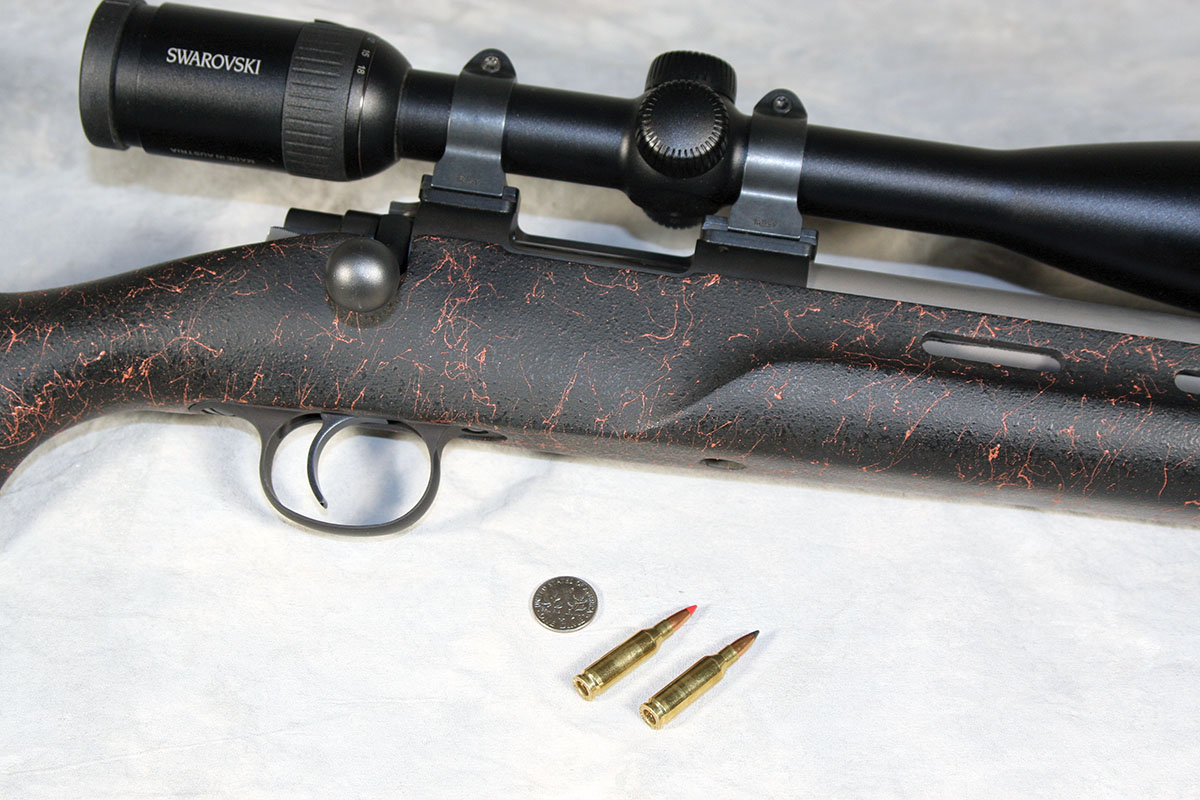
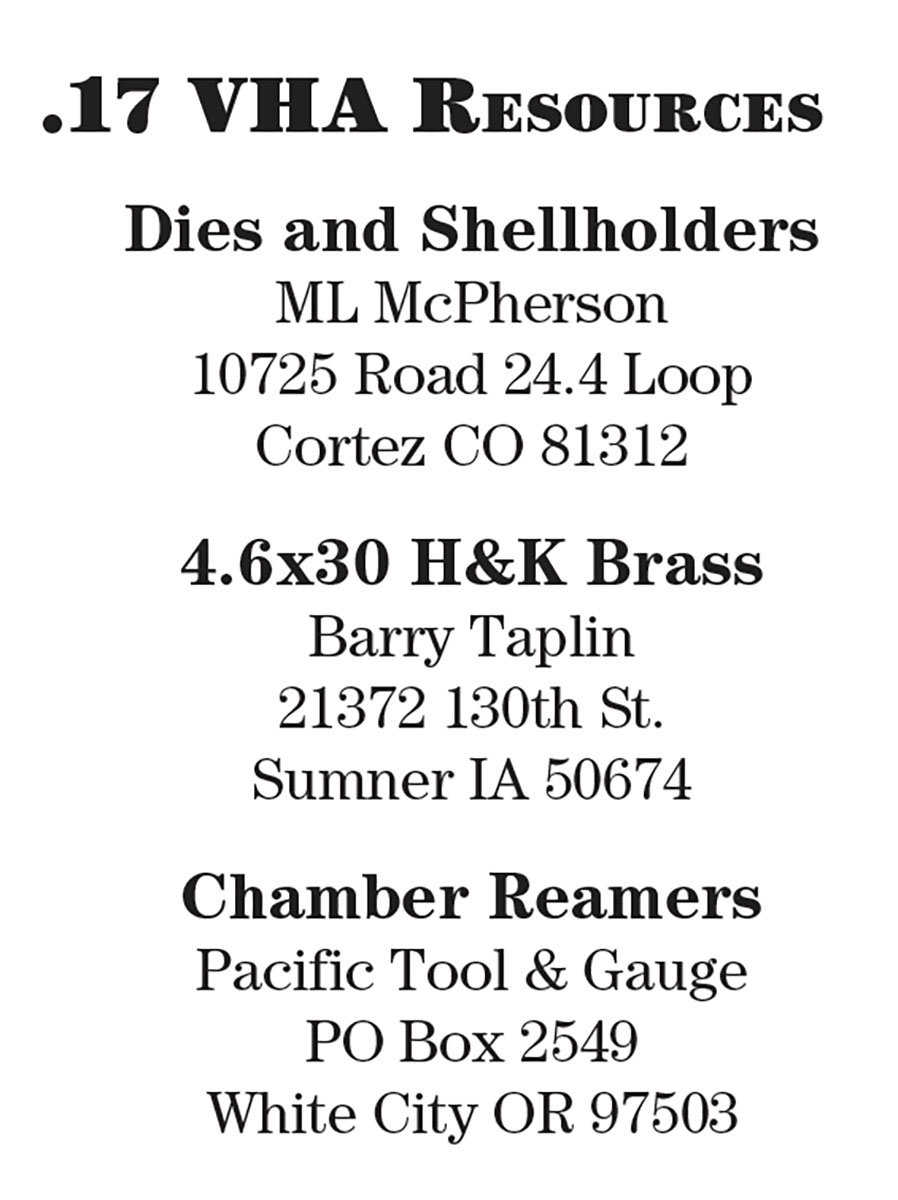
Upon returning to South Dakota, a sketch was made of how the cartridge would look when modified. That drawing, along with a bunch of cases, was sent to Dave Kiff at Pacific Tool & Gauge. He made a technical drawing of the cartridge, and from that designed chamber reamers for barrels and reamers for loading dies. The die reamers were sent to Redding.
During this time I stayed in touch with Matt Babb, a gunsmith in Nevada, who was interested in chambering rifles for the cartridge. While Matt and I were visiting on the phone, I mentioned that I hadn’t come up with a name for the cartridge. “I thought you could simply name it the 17 VHA,” he suggested. Aha! Now why didn’t I think of that – the first letters of the Varmint Hunters Association.
Not everything progresses speedily with such a project, but in time a Thompson/Center Contender 17 VHA carbine barrel arrived, and friend M.L. (Mic) McPherson used QuickLOAD to begin developing loading data. One thing Mic rapidly learned was that working with such a small case has its own set of rules. A very small change in the amount of powder used can result in a significant change in pressure and velocity, according to QuickLOAD.
Meanwhile, a set of three loading dies (a full-length sizer, neck sizer and seater) and No. 34 shellholder arrived from Redding. Necking down the cases to form the new cartridges could begin. These cases are so small that it doesn’t take a lot of muscle on the loading press handle to change the original 4.6x30 HK cases to 17 VHA cases. In fact, it is easy to make 17 VHA cases, and they come out very near to exact finished dimensions. Just put a little (very little) lubricant, such as Imperial Sizing Die Wax, onto the 4.6x30 HK case and run it into the full-length sizing die. Wipe off the case lube and deburr the inside of the case mouth, then prime, drop powder and seat a bullet. The first shot will serve to push out the case to its final shape.
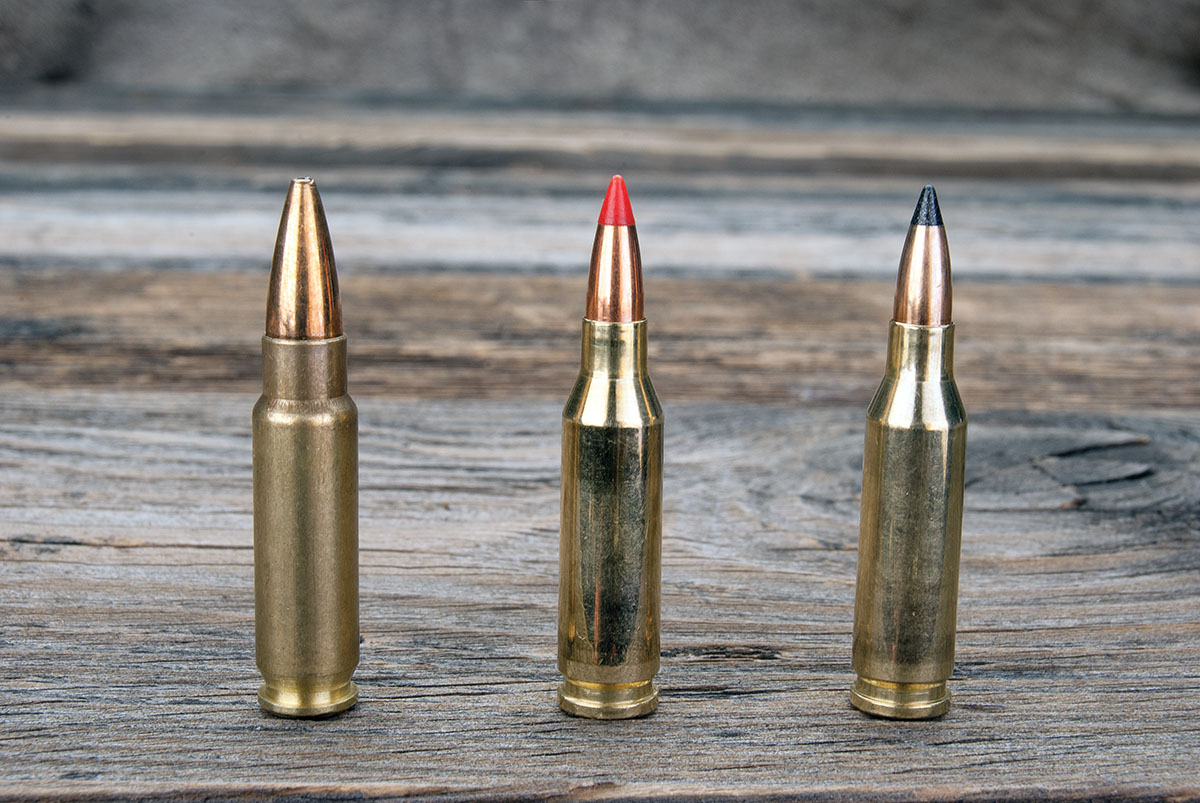
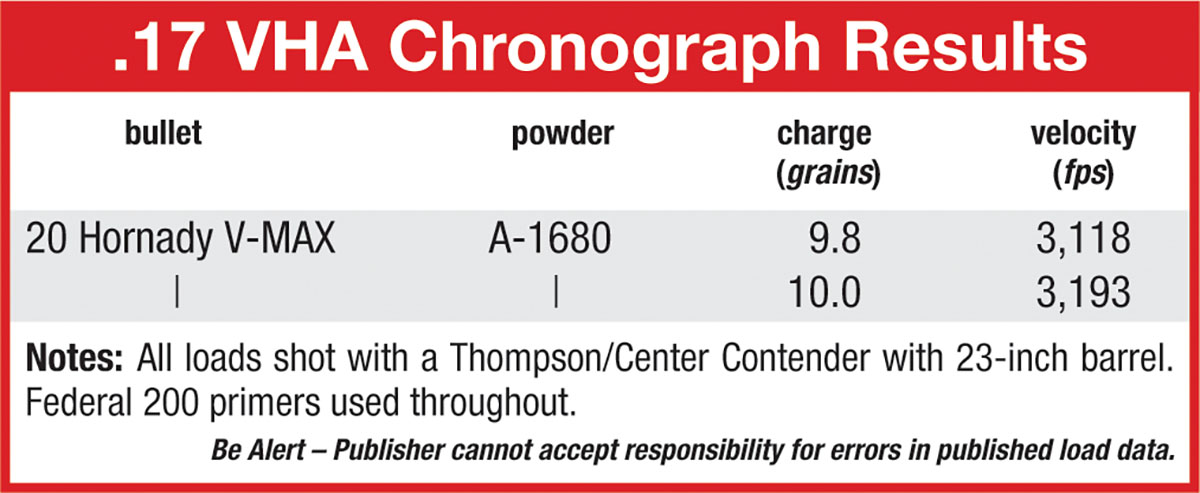
The powder I have used most is Accurate 1680. As examples of the 17 VHA’s performance, average velocity of the 20-grain V-MAX in the Contender carbine with 10.0 grains of A-1680 is 3,193 fps. With this powder and the Hornady bullets, I have been quite pleased with the 17 VHA’s performance on Wyoming ground squirrels. Other powders may produce similar velocities, but no formal laboratory pressure testing has taken place yet with this cartridge.
According to Mic, the 17 VHA, perhaps due to its small powder capacity, is very sensitive to primers and suggests using Federal 200 primers for the best consistency. When substituting primers, he recommends a reduction of 2.0 grains of powder, then proceed working up accordingly.
Recently, when I received a 2014 catalog from Nos-ler, I checked out the information about its two new .17- caliber (0.172-inch) Varmageddon bullets. One is a 20-grain flatbase hollowpoint. The other is a 20-grain flatbase streamlined, polymer-tipped bullet. Both bullets are available in boxes of 100 or 250 count.
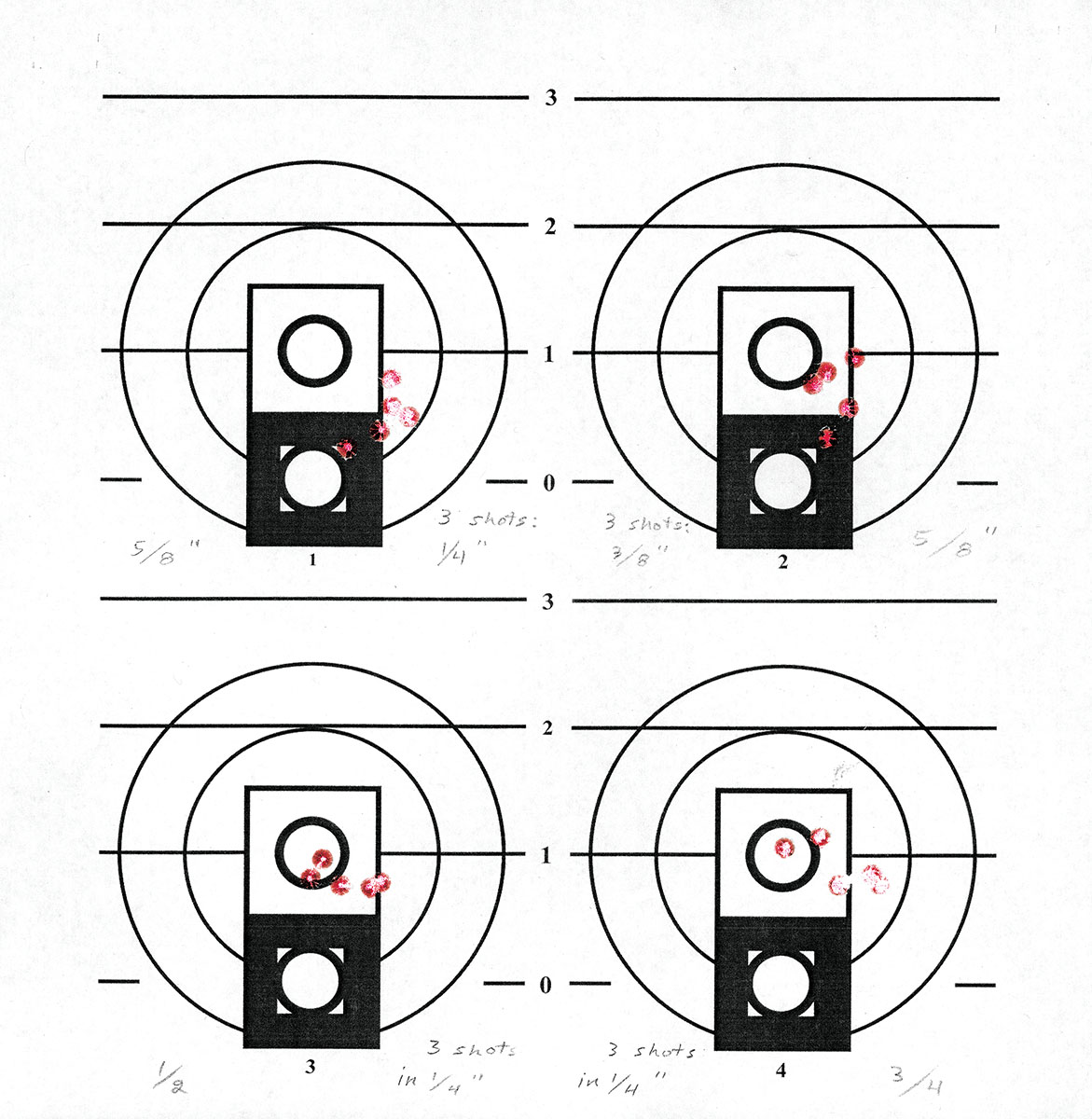
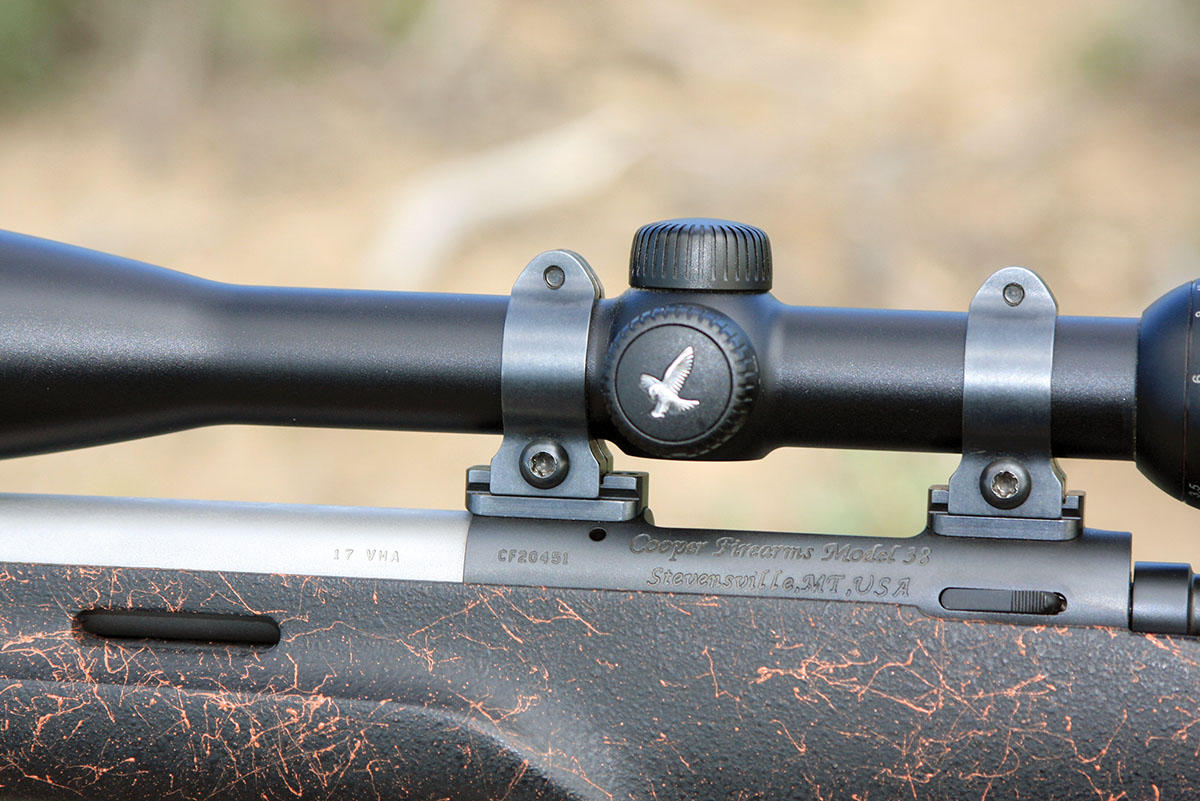
The 17 VHA Contender carbine barrel I have is quite accurate, and I’m betting the Cooper bolt action also will prove to be very accurate. One of the nice things so far is that A-1680 in conjunction with the Hornady 20-grain V-MAX bullet produces groups that hover under .75 inch, with some groups very close to .5 inch at 100 yards. That’s “minute of squirrel” accuracy in my view.
As I write this in late February, it is still snowing here in South Dakota. That, unfortunately, is going to put off additional load testing of the new Nosler bullets and perhaps some others, as well as additional powder options, not to mention sighting in the new Cooper rifle. High on my list of testing will be determining if loads that worked well in the Contender barrel will also work well in the Cooper. So far, from target range and field experience in Wyoming alfalfa fields, A-1680 is doing the job well. It would be helpful to determine that two (or more) bullets also give the performance expected on ground squirrels.
If a hunter is new to such critters as ground squirrels but would like to give it a try, consider the following as an introductory “how-to” list. You don’t need a big boomer of a cartridge. In general, most shots at ground squirrels are shorter than shots at prairie dogs, which are more likely to be found in wide open pastures with generally shorter grass.
In my experience, ground squirrels are more often found in crops like alfalfa, which provides much thicker cover, resulting in shorter shots for the hunter, because you simply won’t see many squirrels at longer distances. I would choose a cartridge no larger than the 221 Fireball or 17 Fireball. Of course, nowadays the 17 VHA is becoming my cartridge of choice.
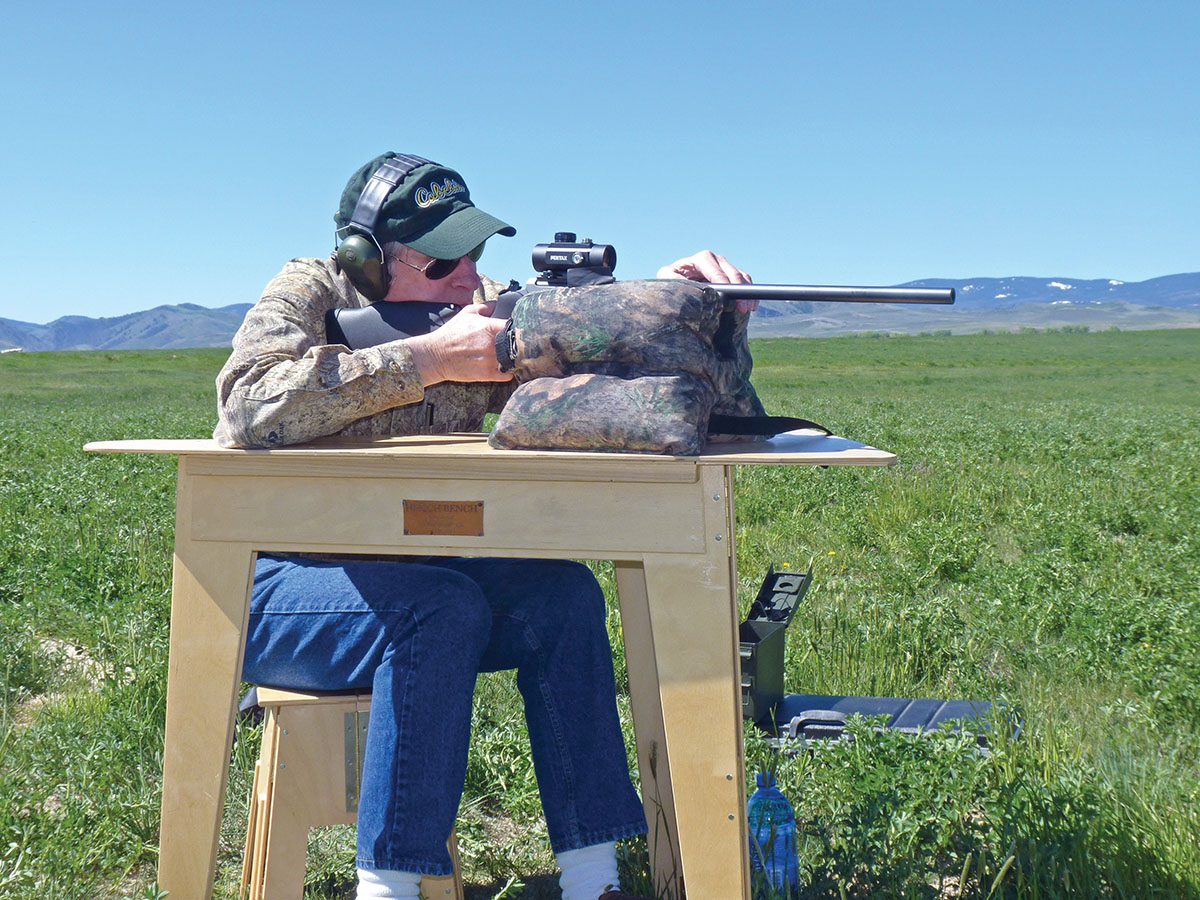
Mic and I set up folding tables and seats (available from Tower Stool in Faith, South Dakota), put sandbags on the table and the rifles on the bags. Then we start glassing for targets. With such small cartridges most shots are kept within about 300 yards.
One of the nice things about our ground squirrel shooting expeditions is that we have been doing this together for so long it’s all a matter of having a good time. I think the 17 VHA cartridge is only going to enhance our shooting fun.