22 ARC (224 Grendel) Varmint Loads
A New and Ultra-Efficient Cartridge
feature By: S. Maroon | April, 24
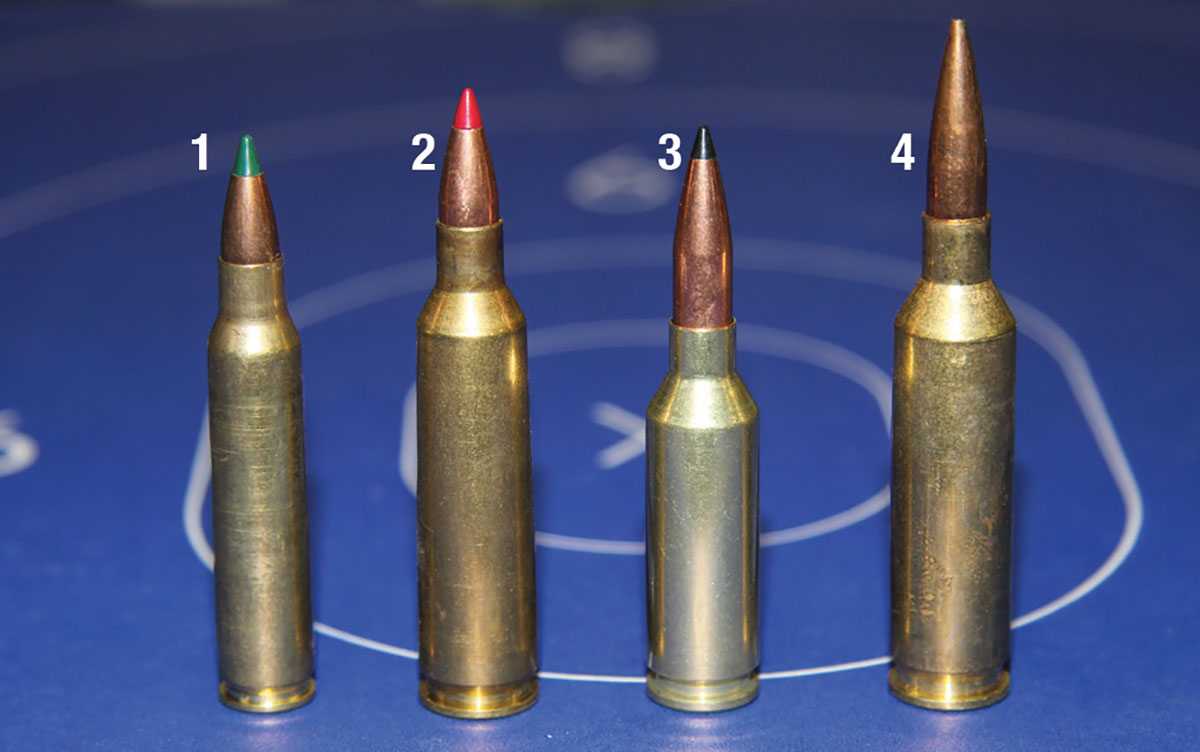
While many varmint shooters are happy to plink the low-hanging fruit of close-range targets with a 22 Long Rifle, 17 HMR or 22 Hornet, more shooters today seek the added challenge of long-range engagement involving wind meters and carefully constructed ballistics charts. Several venerable varmint rounds will certainly do this, though increasingly modern varmint snipers strive to take things to extremes or at least remain in contention when inevitable prairie breezes stir to push bullets with low-ballistic coefficients (BC) compatible with slow traditional rifling twist rates astray.
This has made cartridges such as the 22 and 6mm Creedmoors, 22 Nosler and 224 Valkyrie increasingly popular, as well as the new trend of rebarreling classic varmint rifles with faster-twist barrels to accommodate long-for-caliber bullets carrying higher BCs.
To this trend, you can add the 224 Grendel, a cartridge created by necking the efficient 6.5 Grendel down to 224 caliber without any additional alterations and giving it a fast 1:7 rifling twist to accommodate bullets up to 90 grains. The 224 Grendel is what we have been calling this cartridge for the past several years. However, Hornady recently adopted the round with identical case specifications and labeled it the 22 ARC to complement its already-released 6mm ARC. So, in the interests of getting with the times, we’ll go with the Hornady label here.
The 22 ARC provides a Goldilocks balance of ample velocity without getting too deep into the overbore dynamic of, say, a 22 Creedmoor. This creates a very efficient cartridge that sends 90-grain bullets with G1 BCs in the low .500s at around 2,850 feet per second (fps), and 80-grain bullets in excess of 3,000 fps – while using an average of just 28 to 30 grains of powder.
The 22 ARC mirrors the 22 PPC in many respects, but includes a small increase in body length and a slightly shorter neck. What decisively sets the 22 ARC apart is the use of standard 1:7 rifling twist, as opposed to the 1:14 used in most 22 PPCs, which limits them to 55-grain bullets. The 22 ARC also eliminates the tedious task of turning necks to fit various chambers.
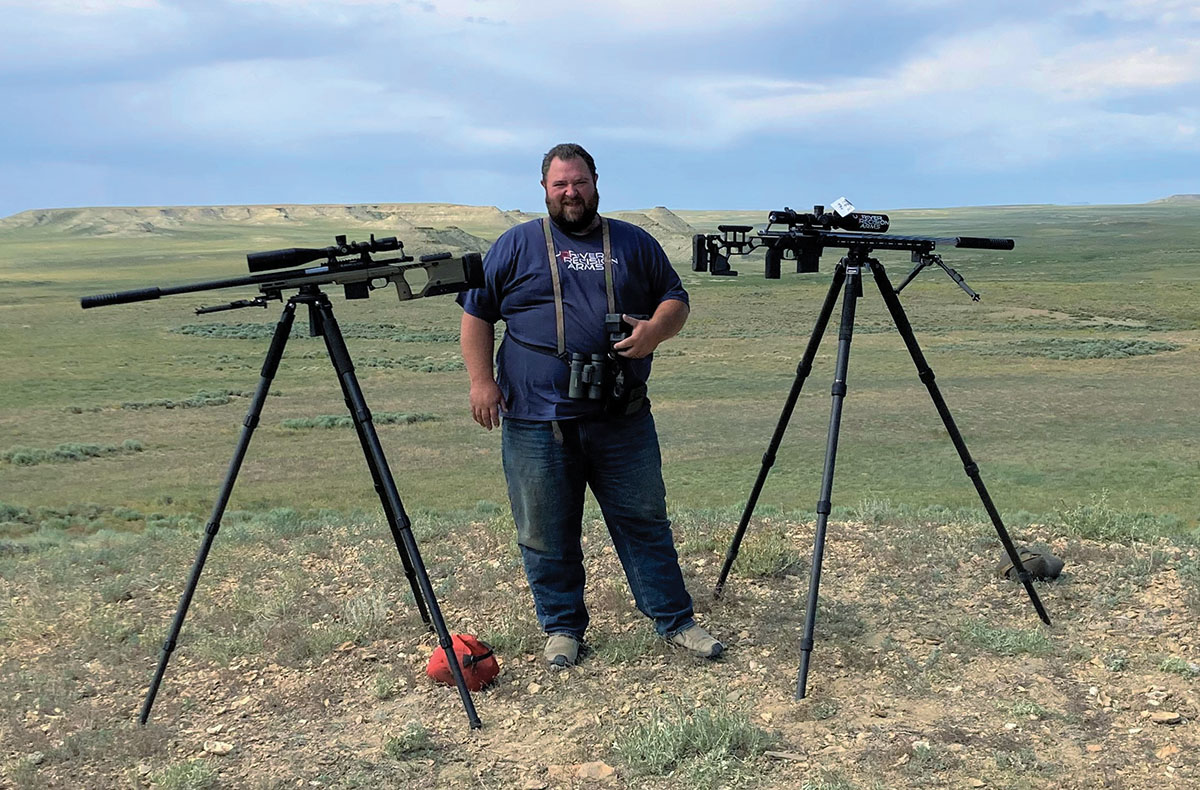
Jack Allman, co-owner of Upriver Precision Arms in Santa, Idaho, is well ahead of the 22 ARC curve. He was an early advocate and has invested extensive preliminary work in developing accurate loads, and building the rifles to help the round shine. Justin Stout, production manager at RMR Bullets in Lewiston, Idaho, introduced me to both Allman and the 22 ARC. Stout is a serious PRS competitor and a huge 22 ARC fan. Allman and Stout also share my varmint-shooting obsessions.
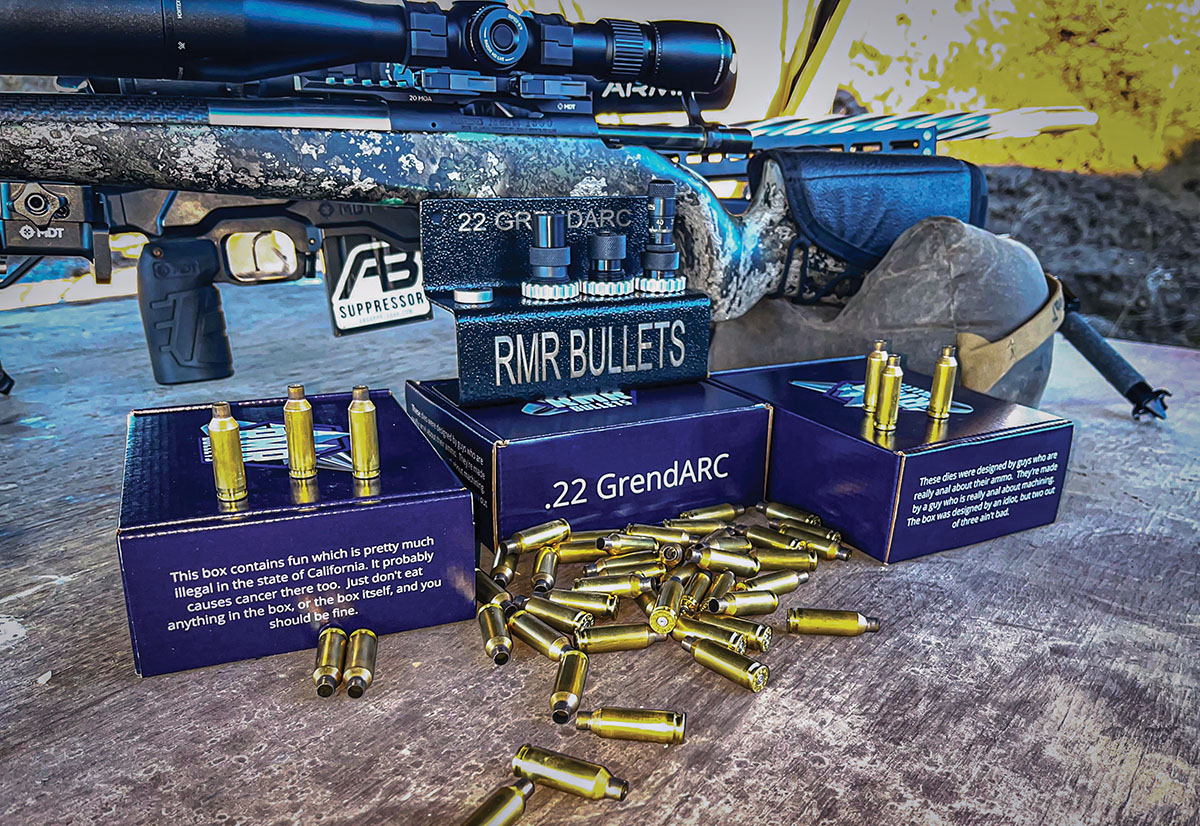
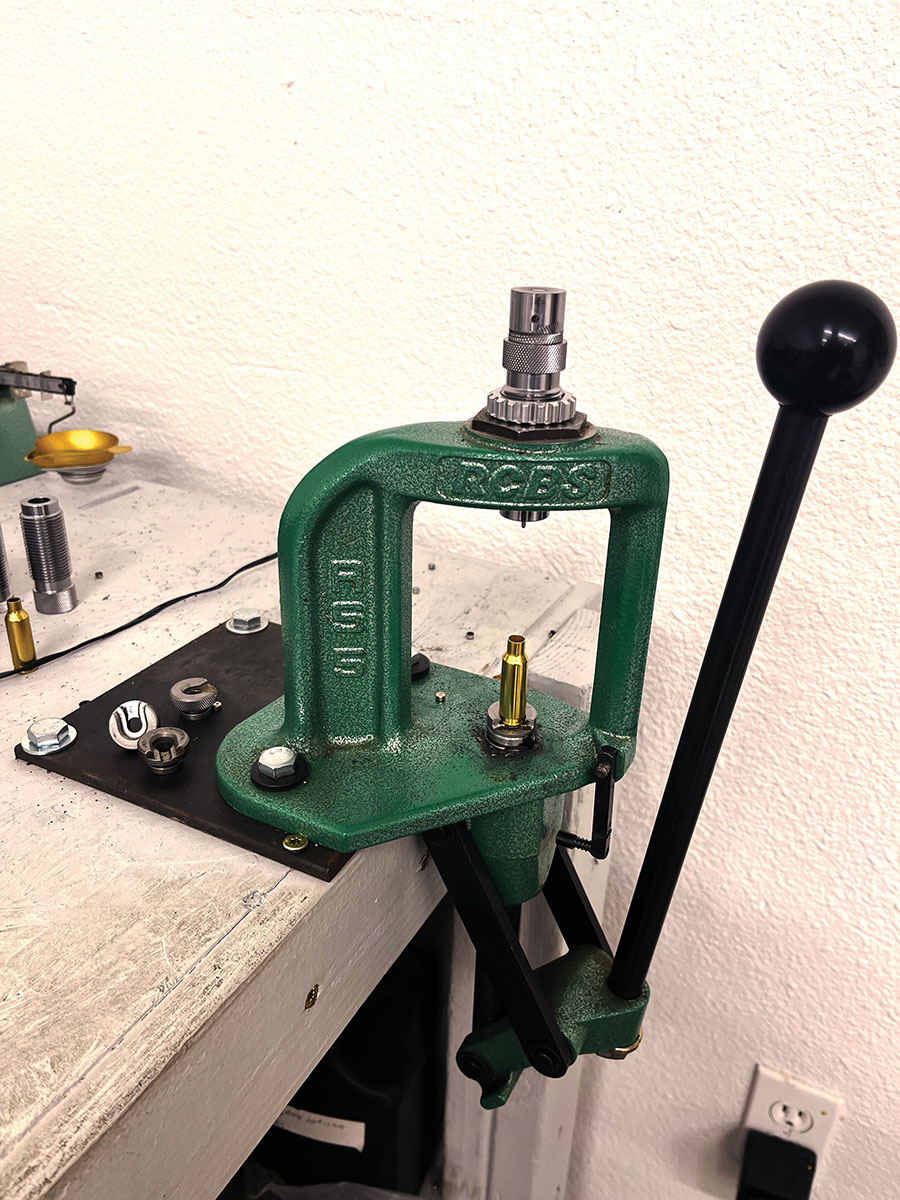
The introduction of the 22 ARC involved one of Allman’s Upriver Precision Arms PRS-style chassis rifles and was covered in Handloader No. 344 (June – July 2023) by Patrick Meitin under the 224 Grendel moniker. Using a mix of Allman and Stout’s proven powders, and introducing some new options to the mix, essentially doubled the existing 22 ARC data at the time and revealed the huge potential of the round as a long-range varmint zapper. Since that initial work, Rocky Mountain Reloading (RMR) has developed a 22 GrendARC die set including a hardened sizing die, neck mandril die, micro-head seater and shellholder (dies are obviously available from Hornady, but do not include the mandril die). The dies from RMR Bullets allow single-pass 22 ARC sizing from quality 6.5 Grendel brass like Lapua or Starline. Ready-made, properly-headstamped brass is obviously available from Hornady.
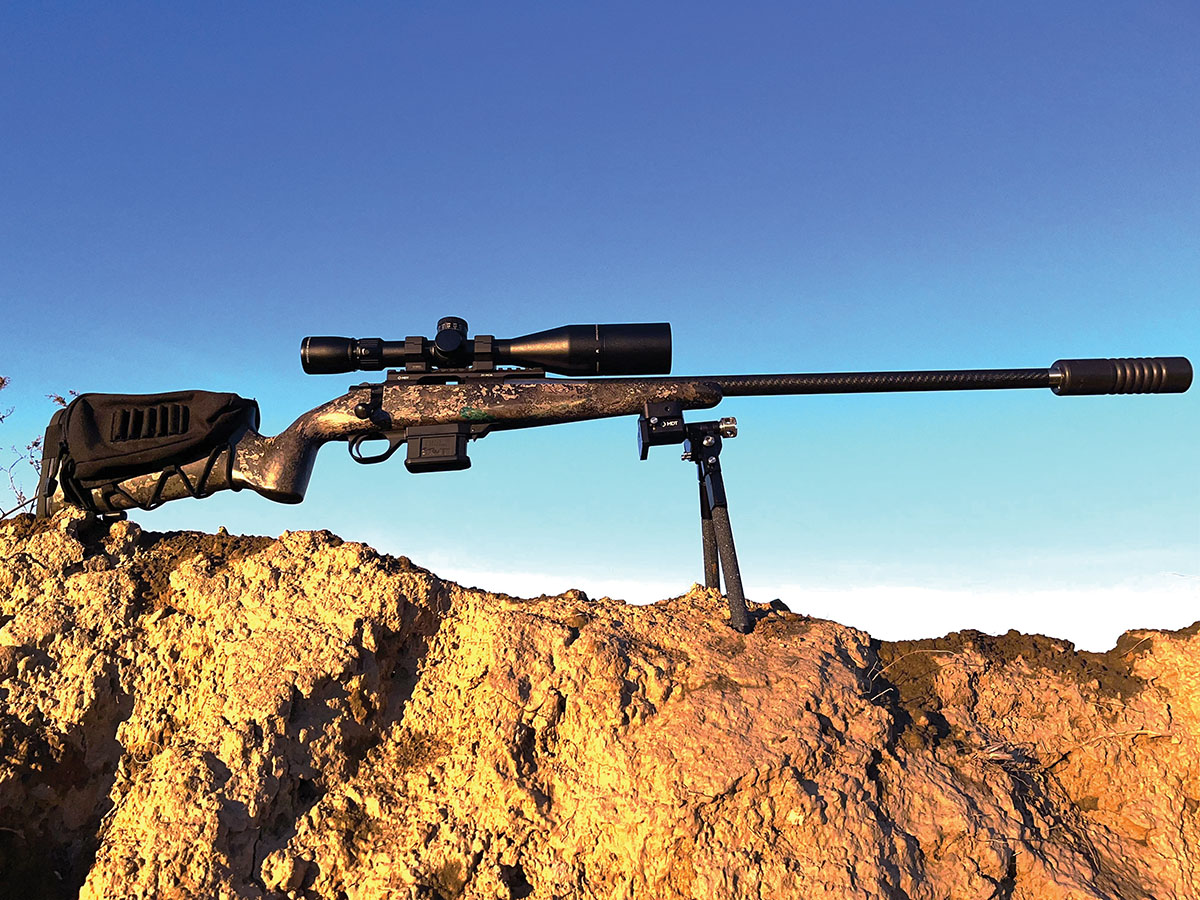
Stout’s newest Upriver Precision Arms 22 ARC rifle was designed to be lighter and easier to handle for the kind of walkabout Columbia ground squirrel shooting and coyote calling we conduct on local logging clear-cuts in northern Idaho behind locked gates where motor vehicles aren’t permitted.
The new rifle was based on HOWA’s sleek Mini Action fitted with a 24-inch IBI Carbon Hunter barrel, Rifle Basix Varmint trigger and Stockys feathery NextGen Ultra Carbon Hunter VG (Vertical Grip) Composite AccuBlock Stock. HOWA’s slick-running actions include tight tolerances so they rarely require “truing” during a build, though this one was blueprinted. The Mini Action makes a perfect companion to the 22 ARC, which feeds reliably from Mini Action polymer 6.5 Grendel mags. The carbon barrel mics out at .83 inch just behind the muzzle threads, and includes 1:7 rifling twist. The trigger broke crisply at 1 pound. This new Upriver Precision creation tips the scales at 8.2 pounds, including the addition of a sleek Vortex Viper 4.5-22x 50mm HD LHT FFP optic set in a BoBro Engineering one-piece mount.
The availability of compatible dies eliminates the past effort of getting a 22 ARC up and running. Allman prefers Starline 6.5 Grendel brass with small primer pockets, saying these cases include thinner walls that mitigate neck/shoulder junction donuts during resizing. We also experienced no issues with the Lapua 6.5 Grendel cases used for my loads. The trim-to length is 1.51 inches. Note that 6mm ARC brass includes shoulders that are pushed back too far for 22 ARC compatibility.
After extensive testing, Allman and Stout determined CCI 450 Magnum Small Rifle primers provided the most consistency in the 22 ARC, with Remington No. 7½ running a close second. During initial testing, I assembled two sets of identical loads with a single bullet using Winchester WSR and CCI 450 primers. The latter clearly posted lower extreme velocity spreads and, in most cases, smaller groups.
For that initial trial, I chose target-style bullets weighing from 75 to 90 grains, typical of those used in PRS matches, plus a single 75-grain controlled-expansion hunting design with wild boars in mind. Some of those bullets would undoubtably suffice for varmint shooting, particularly coyotes, so I encourage readers to reference that article to gain additional insight. For this round of testing, burrowing rodents was the primary objective, with bullets mostly chosen for explosive terminal performance on ground squirrels, prairie dogs and rockchucks, and for no-exit performance on coyotes. Allman and Stout did all of the heavy lifting in determining ideal seating depths, as the 22 ARC is sensitive in that respect.
As a result, loads are broken into two groups – proven load recipes worked out by Allman and Stout and experimental loads I devised to create a baseline for alternative powders while sticking to established seating depths. As serious PRS and varmint shooters, Allman and Stout place heavy emphasis on maximum velocities combined with low extreme velocity spreads – and of course, accuracy. Shooting was conducted on a fairly breezy day, which might account for some groups spoiled by single fliers. All were recorded as shot, with Allman shooting five-shot groups with his loads, my groups were the result of three-shot strings.
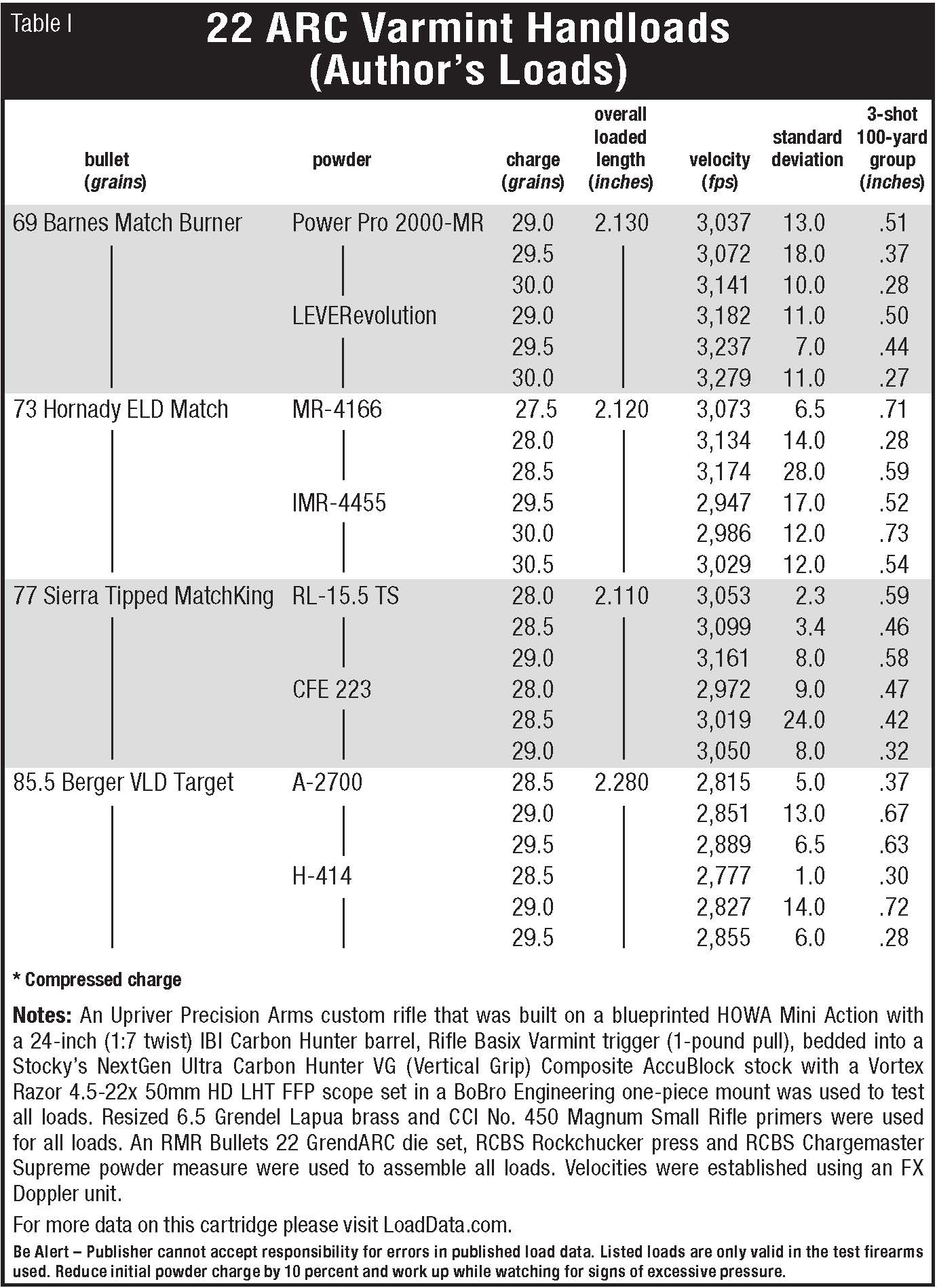
For my part, I chose four bullets weighing from 69 to 85.5 grains to explore compatible powders. Allman and Stout have not had the opportunity to test extensively, and that might prove easier to find in these strange times. In many cases, load data was not available for these powders, charges were conservatively extrapolated from 22 Nosler, 224 Valkyrie and 6mm ARC data. None of my listed loads showed signs of excessive pressure in the test rifle.
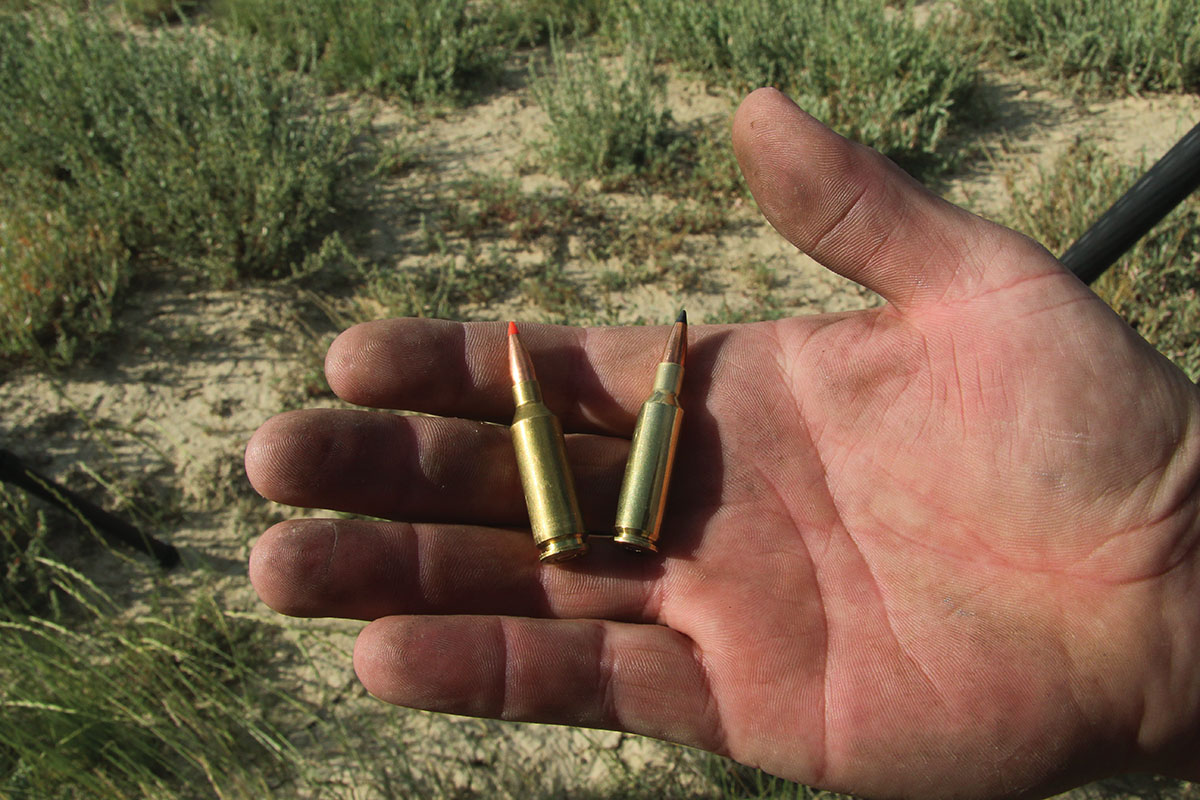
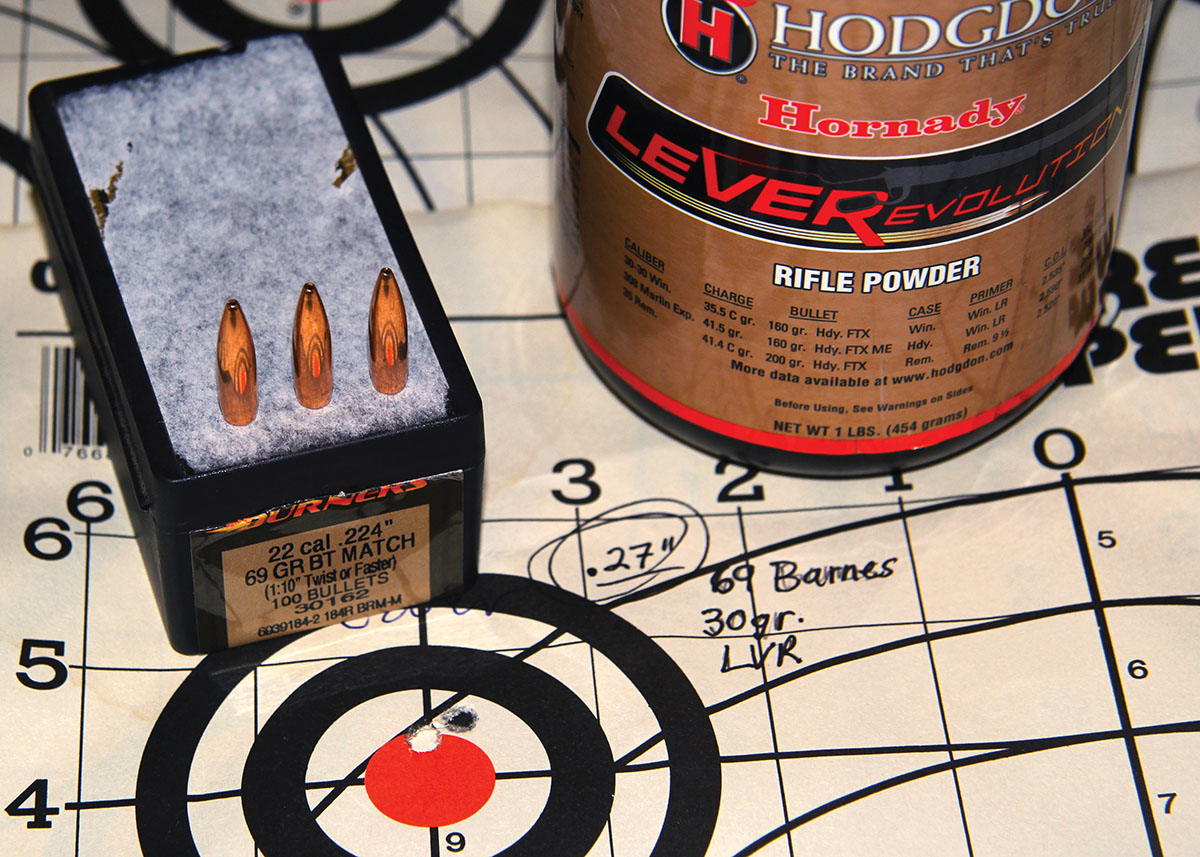
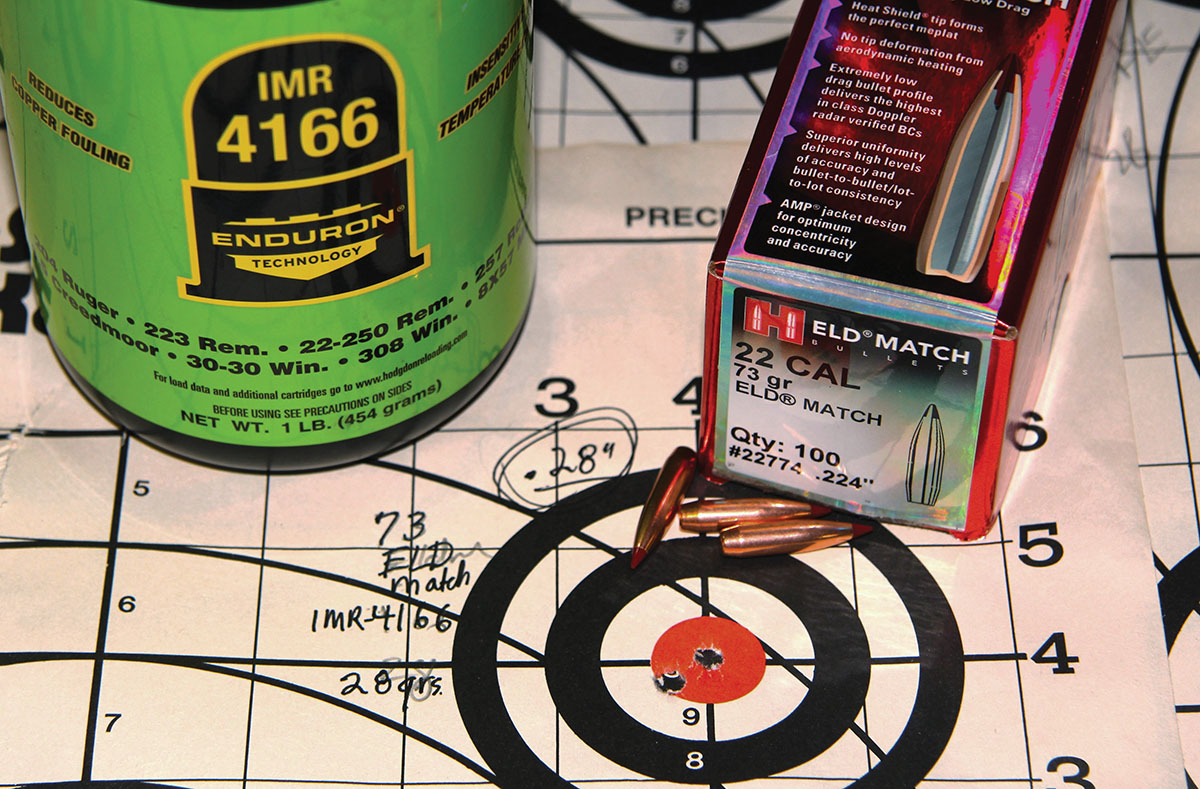
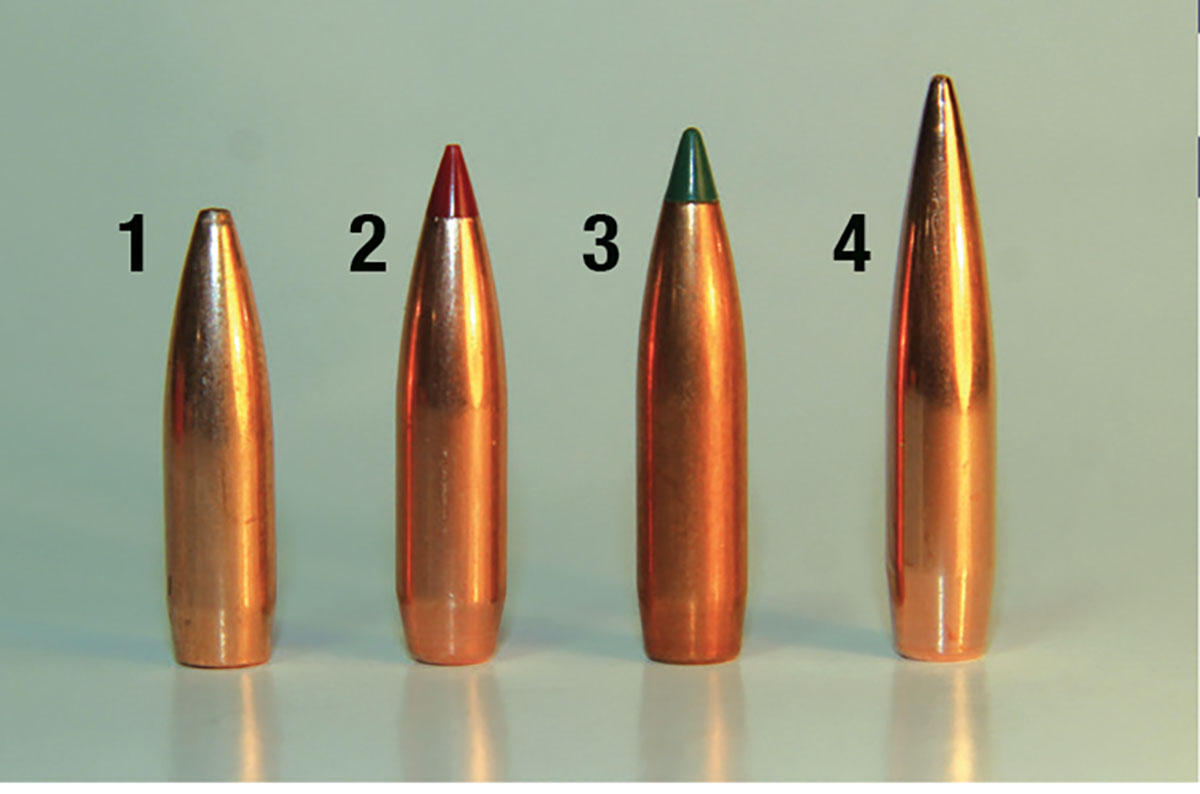
My bullet choices started with Barnes’ 69-grain BTHP Match Burner that included a G1 BC of .339 and provides explosive terminal performance. Hornady’s 73-grain ELD Match includes a red Heat Shield tip that initiates ample expansion on burrowing rodents and provided a wind-cutting .398 G1 BC. The ultra-sleek Sierra 77-grain Tipped
MatchKing approaches true long-range ground with its .420 G1 BC, the green polymer tip initiating decent expansion on even small ground squirrels, and certainly larger rockchucks, groundhogs and coyotes. Finally, Berger’s 85.5-grain Long Range Hybrid Target included an awesome .524 G1 BC. Experience has shown this bullet expands aggressively on small varmints.
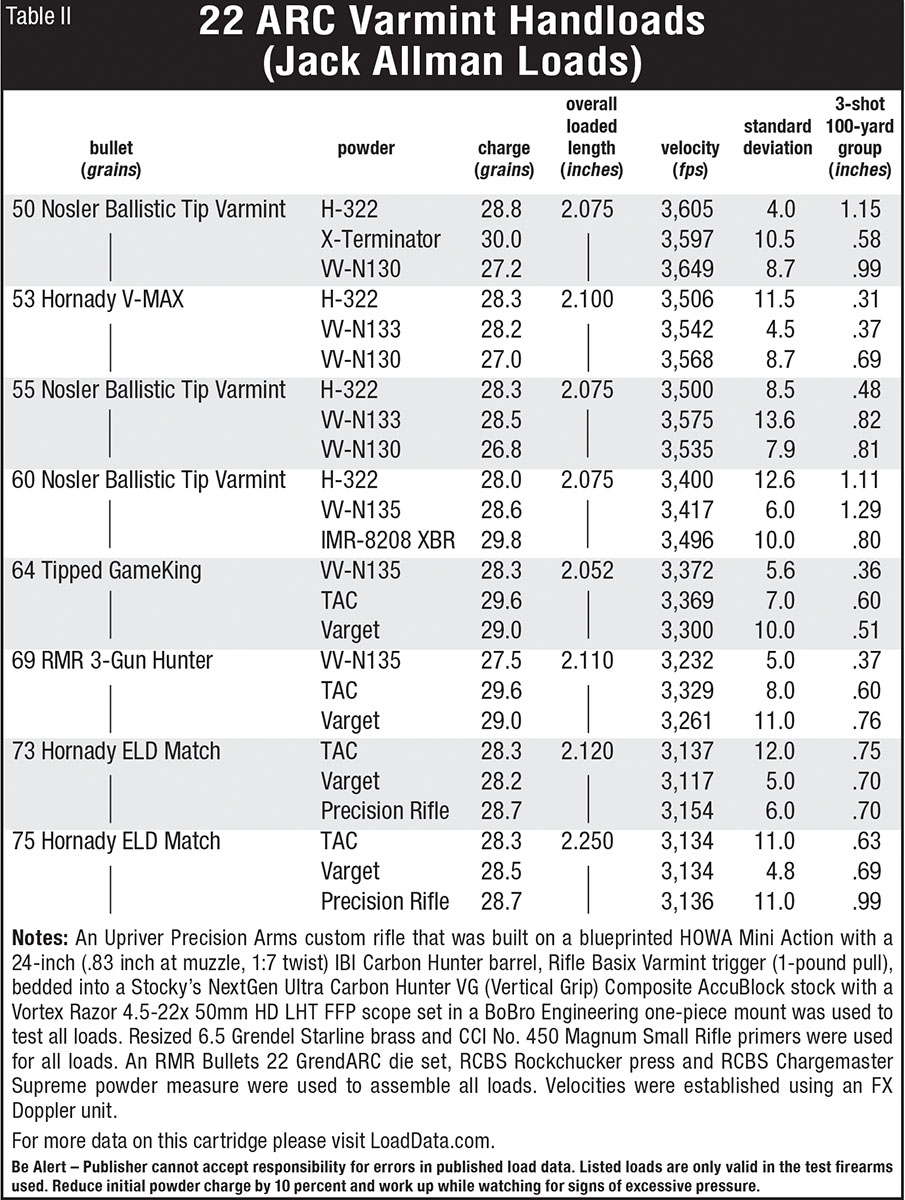
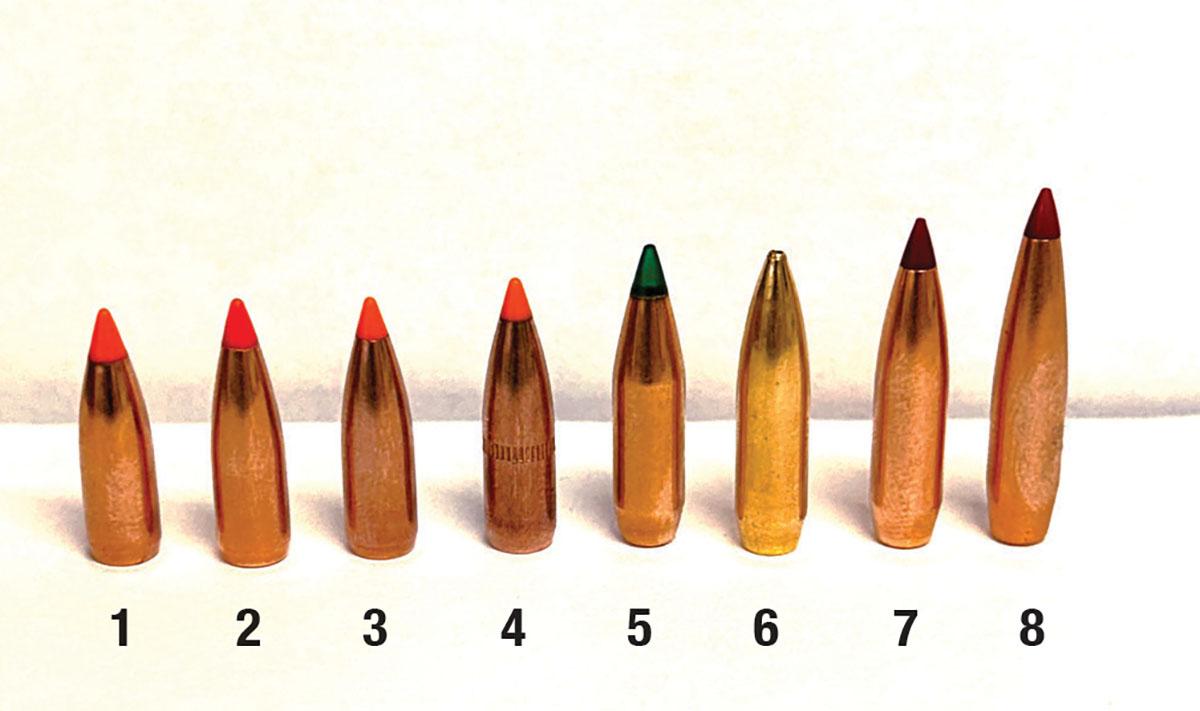
After solving the heavy-bullet riddle, Allman and Stout turned to lighter varmint bullets, looking for varmint-specific loads. Their newest loads included Nosler’s 50-, 55- and 60-grain Ballistic Tip Varmint (BTV), and Hornady’s 53-grain V-MAX – in addition to Sierra’s 64-grain Tipped GameKing, 69-grain RMR 3-Gun Hunter and 73- and 75-grain Hornady ELD Match bullets. The polymer-tip varmint bullets have been found to hold up to the 1:7 twist rate, while some other brands’ lightweights spin apart, when given that much spin.
In an attempt to expand on Allman and Stout’s work, I added Alliant Power Pro 2000-MR and Reloder 15.5 TS, Hodgdon’s LEVERevolution, CFE 223 and H-414, IMR-4166 and 4455 Enduron and Accurate A-2700. Some of these were chosen due to excellent results in the 6mm ARC (Power Pro 2000-MR, LEVERevolution, Reloder 15.5 TS and CFE 223 in particular), IMR-4455 and A-2700 because of limited experiences during my last 22 ARC test, and IMR-4166 and H-414 because they seemed suited. There have been rumors of Enduron powders being discontinued, but I’ve been assured Hodgdon is working toward a solution to the supply issues. Swedish-made Reloder 15.5 TS has been quite difficult to find lately, but it performs so well that it cannot be ignored.
Powders that have emerged as Allman and Stout’s favorites for light varmint bullets include Hodgdon 322, Ramshot X-Terminator, Vihtavuori N-130, N-133 and N-135, IMR-8208 XBR and Shooters World Precision Rifle. These are in addition to Hodgdon Varget and H-4350, Vihtavuori N540, Ramshot TAC and Big Game, and Alliant Reloder 16 used for heavier bullets.
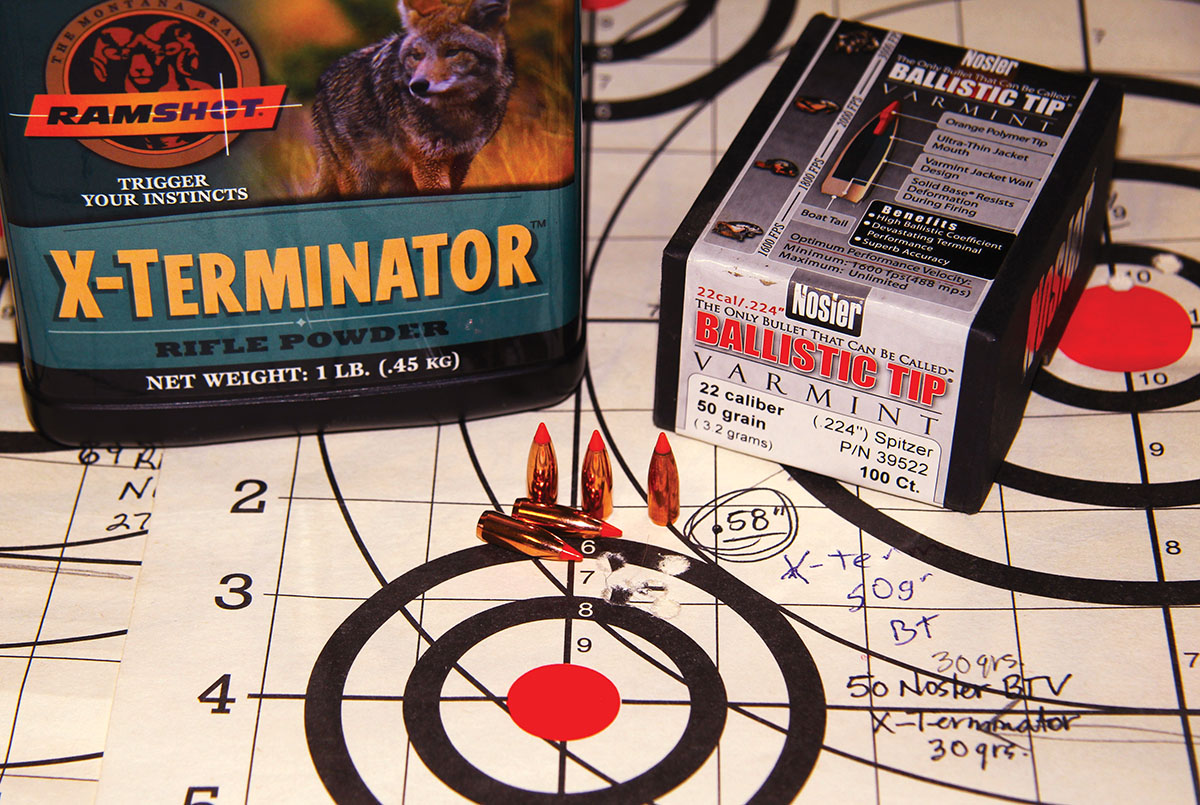
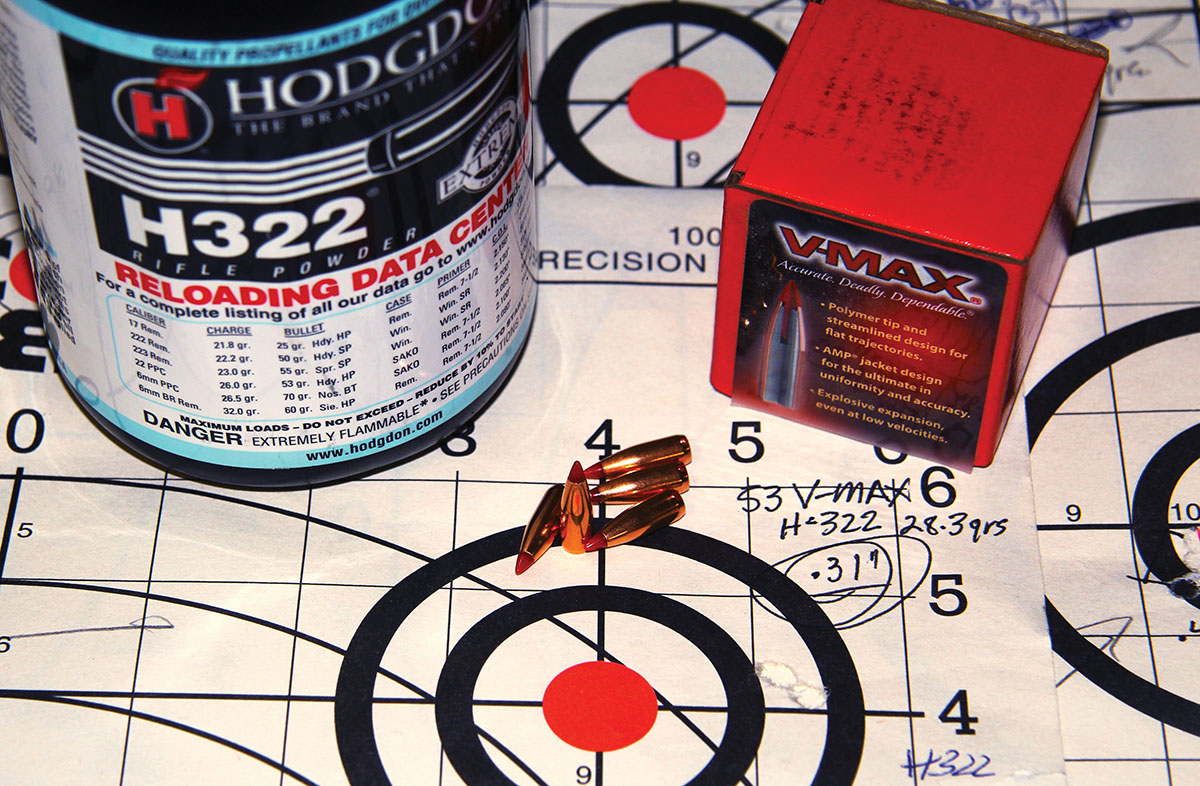
The listed 22 ARC light-bullet loads shoot remarkably well on burrowing rodents. Shooting Nosler’s 50-grain BTV, a true standout, included a near half-inch group resulting from 30 grains of Ramshot X-Terminator and sent at 3,597 fps. This rifle really liked Hornady’s 53-grain V-MAX, 28.3 grains of Hodgdon 322 producing a .31-inch group at 3,506, and 28.2 grains of Vihtavuori N-133 with a .37-inch group at 3,542 fps. The 55-grain BTV did best with 28.3 grains of Hodgdon 322, printing a group measuring less than a half-inch at 3,500 fps.
Sierra’s 64-grain Tipped GameKing would make a fine hog or pelt-shooting option, 28.3 grains of Vihtavuori N-135 (.36 inch at 3,372 fps) and 29 grains of Hodgdon Varget (.51 inch at 3,300 fps) doing especially well from this rifle. RMR’s 69-grain 3-Gun Hunter produced a .37-inch group at 3,232 fps, a bullet I’ve used to successfully shoot everything from ground squirrels to wild boars. The heavier bullets did not shoot as well in this test relative to past trials, but these were five-shot groups in the wind.
My experimental loads impressed, with not a single load printing outside of ¾-inch (three-shot groups), though some powders produced pokey velocities relative to proven formulas. For instance, Alliant Power Pro 2000-MR produced .28-, .37- and .51-inch groups (30, 29.5 and 29 grains of powder, respectively) at 3,141 to 3,037 fps with 69-grain bullets, compared to the 3,232 to 3,329 fps Allman produced with his 69-grain loads. That said, LEVERevolution ran up to 3,279 fps using a maximum load of 30 grains of powder, while also producing a .27-inch group. Shooting the Hornady 73-grain ELD Match, IMR-4166 kept pace with Allman’s loads, also producing a .28-inch group at 3,134 fps. IMR-4455 peaked at 3,029 fps with essentially all the powder that could be stuffed into the case (30.5 grains), though it produced respectable groups.
Alliant Reloder 15.5 TS appears to be a 22 ARC juggernaut, producing good velocities, tight groups and extreme velocity spreads in the low single digits. The best group measured .46 inch at 3,099 fps. With that same bullet, Hodgdon CFE 223 reached just 3,050 fps with a maximum load of 29 grains, but all groups in the ladder were exceptionally tight – the best .32 inch at 3,050 fps. Accurate 2700 and Hodgdon 414 (same as Winchester 760) were 150 to 200 fps off the established pace, though accuracy was excellent and standard deviations mostly in the single digits. The best showing for A-2700 was a .37-inch group at 2,815 fps, while H-414 produced a .30-inch group at 2,777 fps (28.5 grains) and .28-inch at 2,855 fps (29.5 grains). These powders were also approached conservatively and we felt charges could be increased by a touch (using all due caution and monitoring closely for pressure signs, obviously).
I predict the 22 ARC, like the 6mm ARC, is going to stick. The fact that Hornady is standardizing it is a big part of this, but I’m also hearing murmurings from several rifle manufacturers about chambering the round – though Upriver Precision Arms can build a 22 ARC rifle right away. There is a lot of potential here, from fine accuracy and high velocities wrung from small measures of powder, to the versatility to take everything from small varmints while shooting light bullets, to hogs and deer with heavier controlled-expansion or monolithic copper numbers.