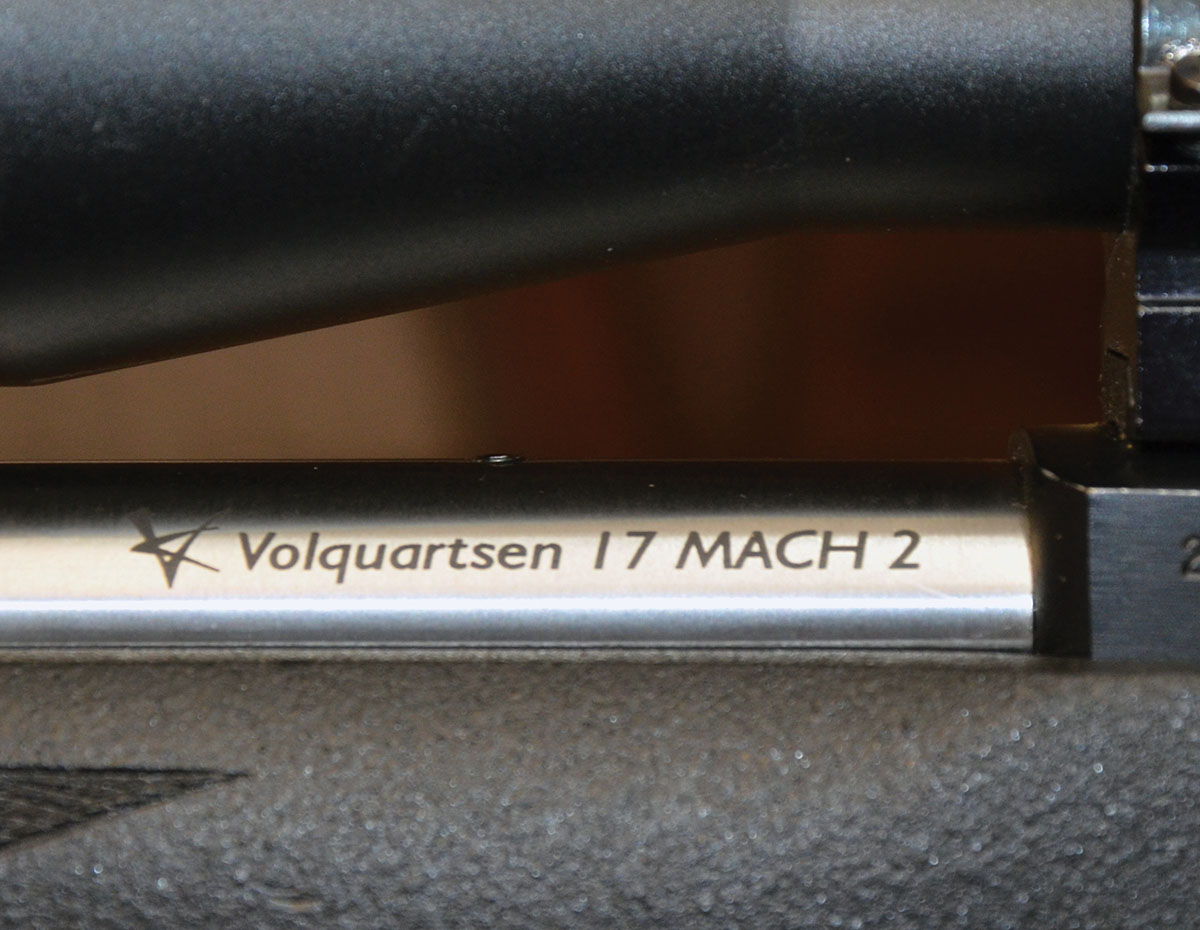
This engraving on the barrel of a rifle has always indicated excellent accuracy and quality.
In 2002, Hornady necked down the 22 Winchester Magnum Rimfire (WMR) cartridge to 17 caliber and called it the 17 Hornady Magnum Rimfire or 17 HMR for short. The interesting new cartridge pushed a 17-grain V-MAX bullet along at 2,550 feet per second (fps) and in addition to being quite accurate in rifles, it was great fun to shoot. Manufacturers that were already offering rifles in 22 WMR wasted no time in adding the 17 HMR option and by the end of 2003, close to 150 million rounds had been sold.
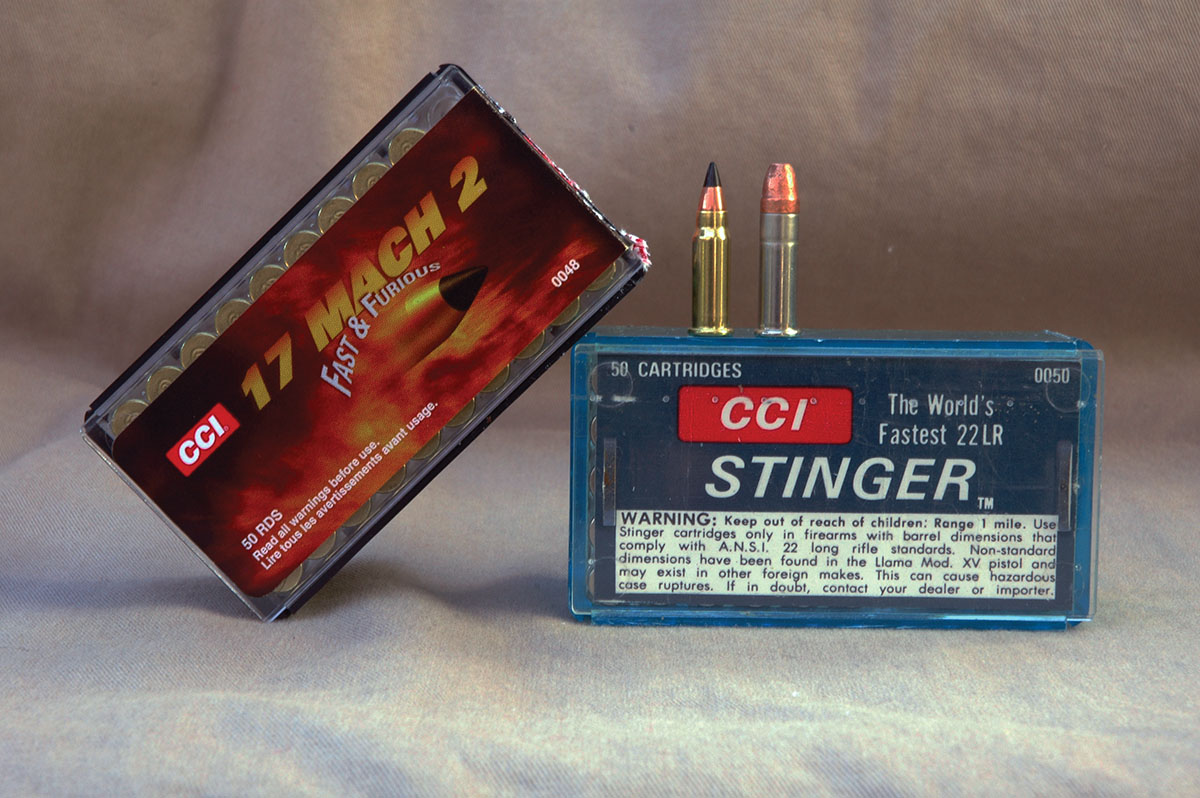
To give the 17 Mach 2 as much powder capacity as possible without exceeding the length of the 22 Long Rifle cartridge, Hornady technicians used the 22 Stinger case, which is .100-inch longer than the standard 22 Long Rifle case.
It then dawned on decision makers at Hornady that the number of rifle types and models being offered in 22 Long Rifle by various manufacturers greatly outnumbered those that would handle the 22 WMR and 17 HMR, so a .17-caliber cartridge short enough to work in them would surely be even more successful than the 17 HMR. One official opined that annual sales of such a cartridge could exceed 500 million rounds. Introduced in 2004, the new cartridge would be called 17 Mach 2 and to give it as much powder capacity as possible while keeping the overall cartridge length the same as for the 22 Long Rifle, the CCI Stinger case which is .100-inch longer than the standard Long Rifle case was used. When necked down for the same 17-grain V-MAX bullet being loaded in the 17 HMR, the new 17 Mach 2 generated a velocity of 2,100 fps. Extensive testing revealed that the optimum barrel length for velocity ranged from 18 to 20 inches, about the same as for the 22 Long Rifle.
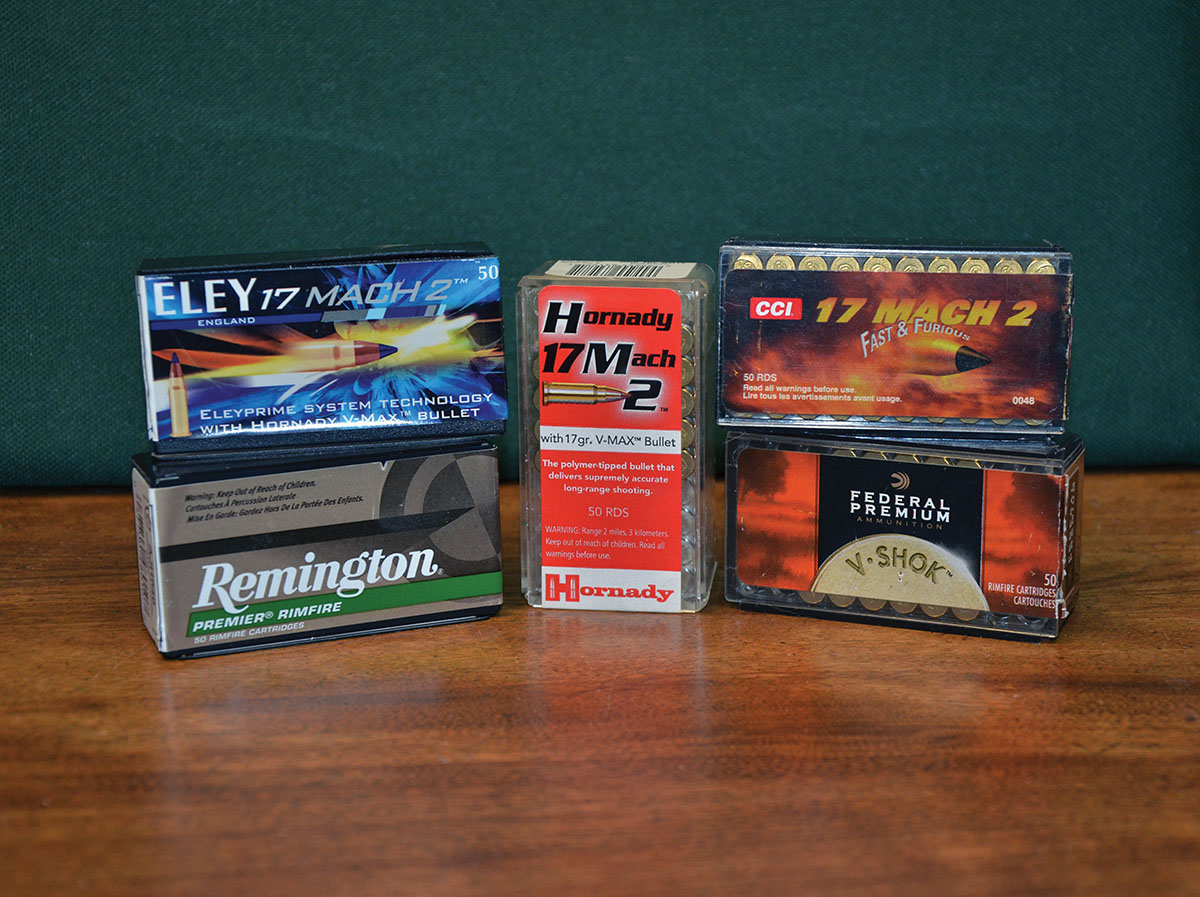
Regardless of which company name is on the box, all 17 Mach 2 ammunition is loaded with a 17-grain V-MAX bullet made by Hornady.
Single-shot, bolt-action, lever-action, slide-action and autoloading rifles made by various companies were soon available in 17 Mach 2. A number of handguns were also chambered for it. For those who might be interested in performance loss when the little cartridge is fired in a handgun, years ago, I shot loads from four companies in a Kimber 1911 with a 5-inch barrel and velocity averaged 1,662 fps. A 17-grain bullet at that velocity was shot into 1-gallon plastic jugs filled with water and placed at 50 yards, it barely expanded. Those same loads fired in a rifle with a 19-inch barrel averaged 2,114 fps with explosive bullet expansion at 50 yards. There were also a few rifle conversions with the very best of which were offered by my longtime
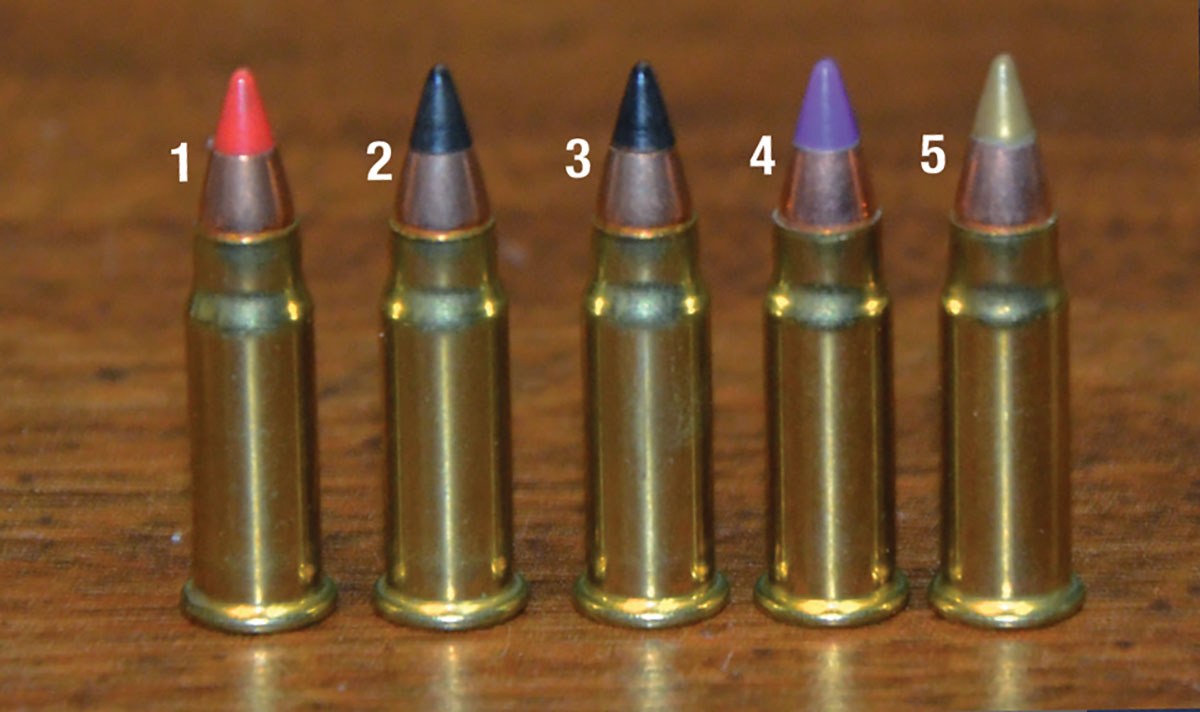
V-MAX 17-grain bullets, made by Hornady for various companies, have polymer tips of different colorations. The color is the same for bullets in Federal and CCI ammunition, but the headstamps on their cases differ. Cartridges shown include: (1) Hornady, (2) Federal, (3) CCI, (4) Eley and (5) Remington.
friend, Tom Volquartsen, who founded Volquartsen Custom. Before introducing his own line of rifles, Tom sold precision-machined parts for the Ruger 10/22. He also built extremely accurate custom rifles around the 10/22 receiver and the one I have has interchangeable bolts and barrels in 17 Mach 2 and 22 Long Rifle. In addition to a Volquartsen trigger group and heavy match-grade barrel, it has a McMillan Kevlar-reinforced synthetic stock. The time/pressure curve of the 17 Mach 2 differs from the 22 Long Rifle. If the initial bolt movement is not delayed for a semiautomatic rifle of blow-back operation, blown cases are quite likely. Volquartsen eliminated that by precision-machining a heavier bolt and he quickened lock time by using a titanium firing pin. For a good reason, marking on the 17 Mach 2 barrel of my rifle warns against using it in a 10/22 without the heavier bolt installed.
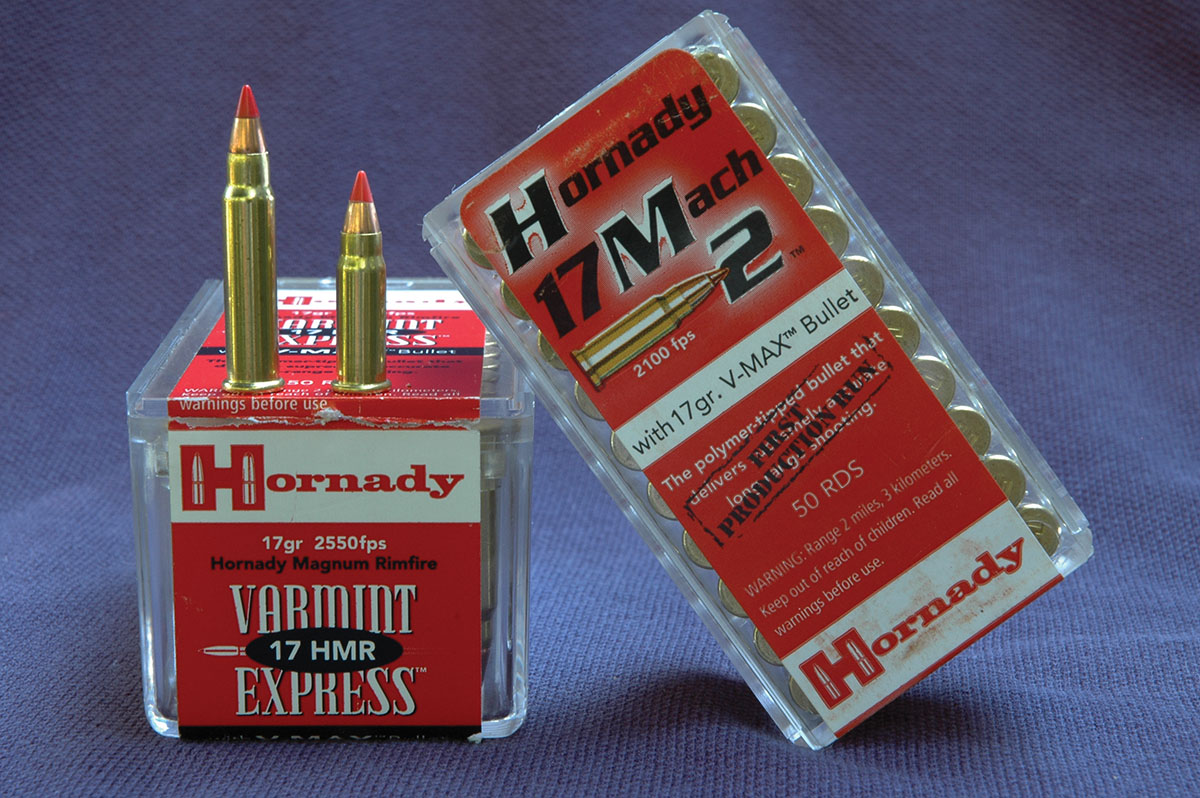
Hornady introduced the 17 HMR in 2002, followed by the 17 Mach 2 in 2004. While the Mach 2 is still alive, its popularity does not approach that of the HMR.
Around 1998, Volquartsen started building complete rimfire rifles around a semiautomatic action of his own design, with each action built from the ground up for a specific cartridge. He was actually the first to offer autoloading rifles capable of trouble-free functioning with the 22 WMR and 17 HMR and the 17 Mach 2 was eventually added as well. I own Volquartsen rifles in all three calibers and in addition to being totally reliable, they are extremely accurate. The CNC-machined, stainless steel receiver is threaded for a heavy match-grade barrel and trigger quality has to be tried to be believed. An integral Picatinny rail atop the receiver simplifies scope attachment. From the very beginning, Volquartsen’s goal was to build a semiautomatic rifle capable of delivering the accuracy of a top-level, bolt-action rifle and he achieved that with flying colors. Each rifle was and still is built from start to finish by a single craftsman.
The 17 Mach 2 became quite popular and remains so but as fate and other reasons would have it, the cartridge is not as popular as it should have become. The biggest strike against it was the phenomenal overnight success of the 17 HMR. It took off like a rocket and 20 years later, it has not slowed down. So a common question was and still is; why buy a rifle chambered for a .17-caliber cartridge that is 450 fps slower than the 17 HMR and delivers less energy to distant targets? Also, how much difference between the two is there? When both are zeroed 2 inches high at 100 yards, a bullet from the 17 HMR strikes about 4.5 inches below point of aim at 200 yards versus 10 inches for the 17 Mach 2. Energy delivery at 200 yards is 72 foot-pounds for the 17 HMR and 48 foot-pounds for the 17 Mach 2.
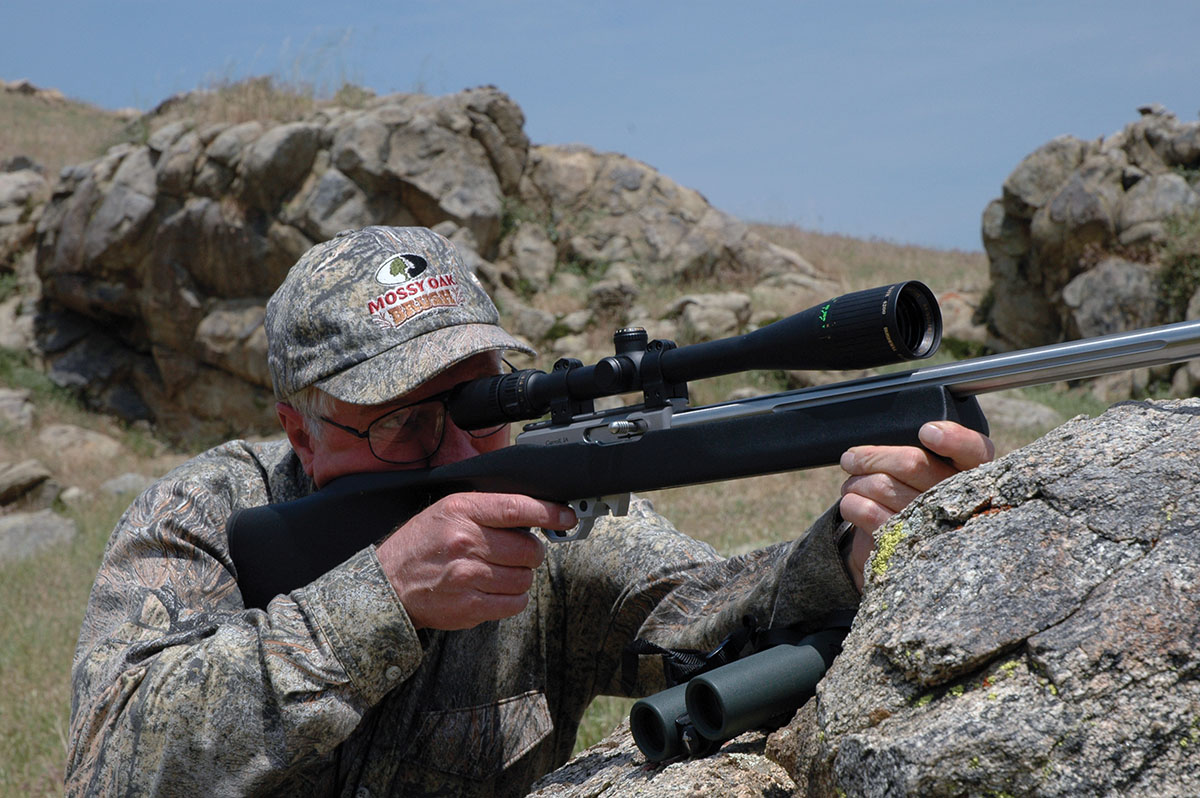
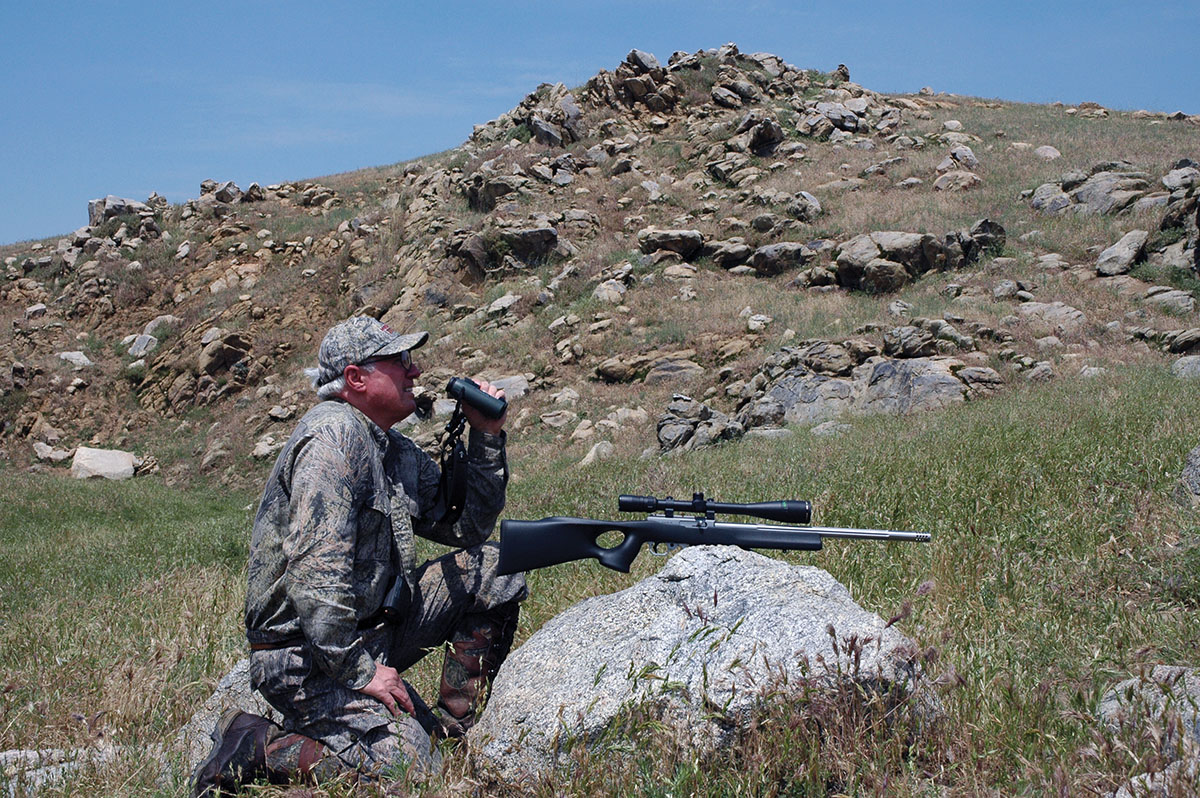
When shooting ground squirrels with the 17 Mach 2, Layne prefers a variable-power scope with plenty of magnification at the top for reasonably long shots along with sufficient field at the lower end of its magnification range for close shots. An excellent example is this Bushnell Elite 4200 6-24x on a Volquartsen Deluxe rifle.
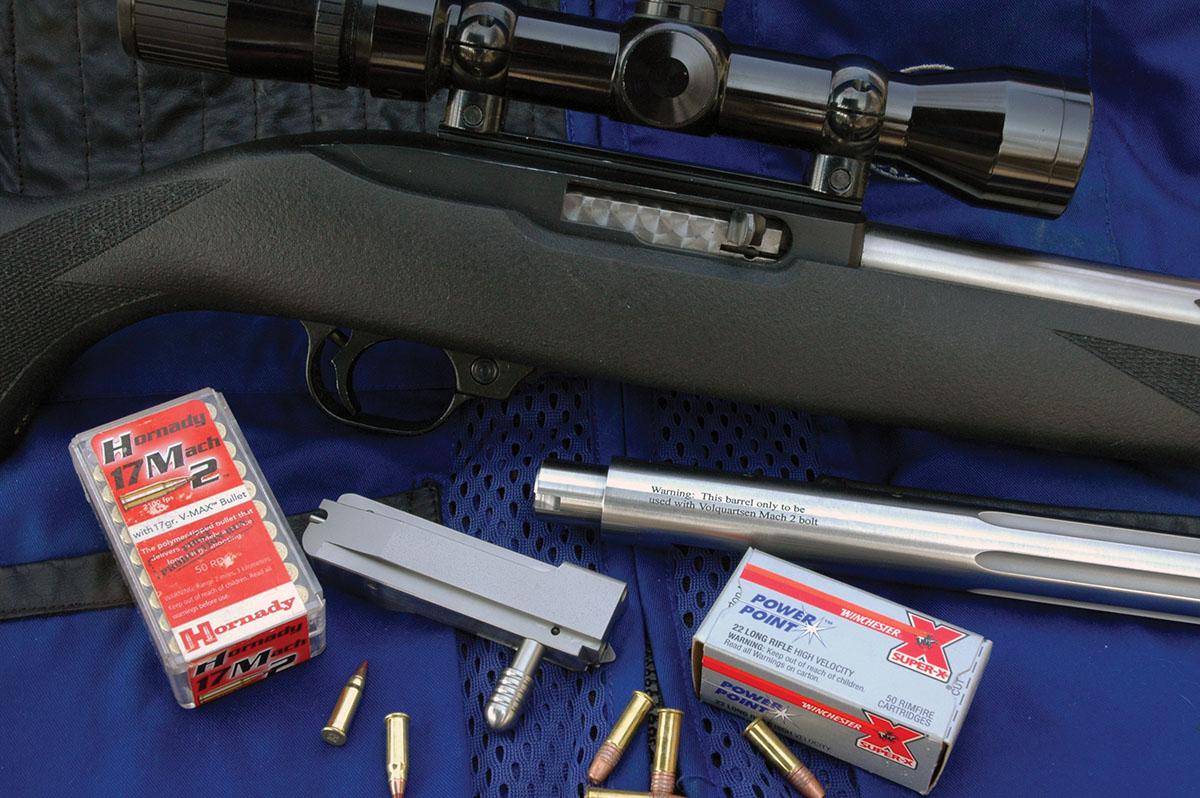
Prior to introducing rifles of his own design, Tom Volquartsen built extremely accurate rifles around the Ruger 10/22 receiver. This one, built by him for Layne, has his trigger group and a McMillan stock, along with interchangeable bolts and barrels for the 22 Mach 2 and 22 Long Rifle cartridges. The lettering seen here on the 17 Mach 2 barrel warns that it should be used only with the heavier bolt designed for that cartridge.
There is also the matter of downrange bullet expansion. Regardless of which company’s name is on the box, all 17 Mach 2 and 17 HMR ammunition is loaded with the same Hornady 17-grain V-MAX bullet. That bullet pretty much ceases to expand on soft targets once velocity drops below 1,600 (fps), which occurs at about 150 yards for the 17 HMR and 100 yards or so for the 17 Mach 2.
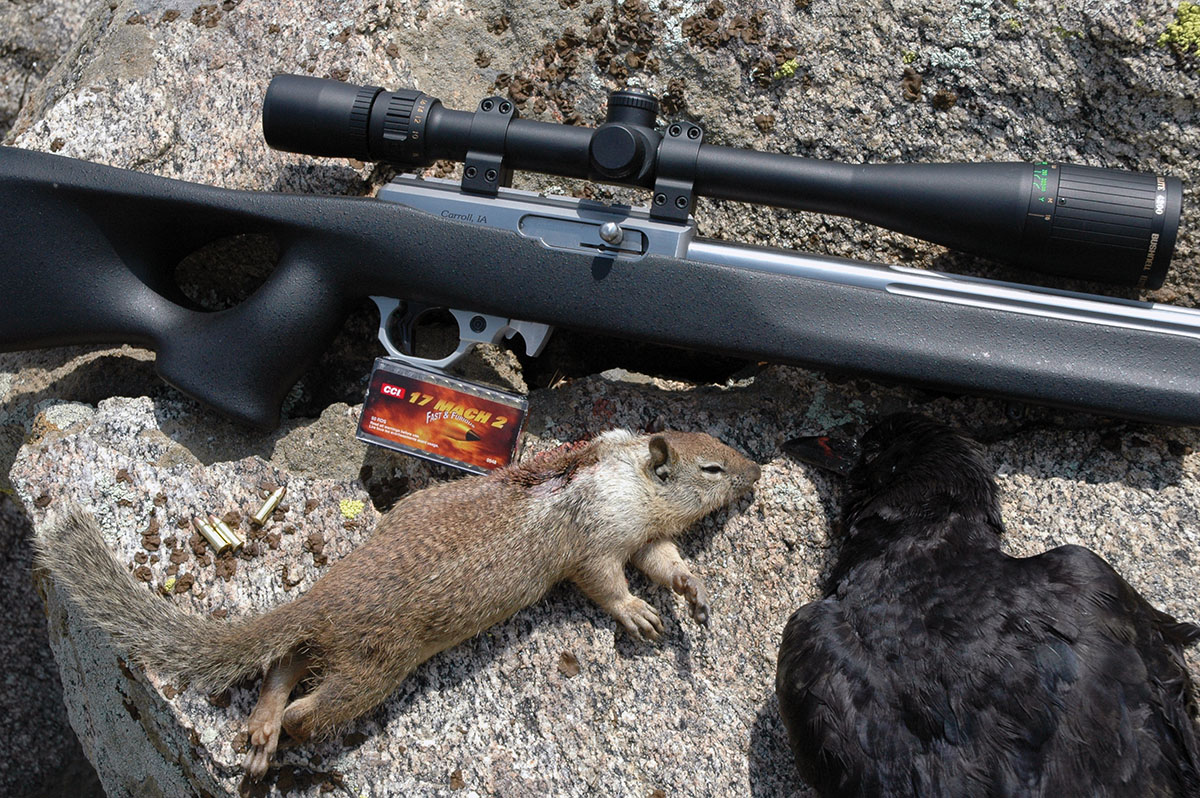
A rifle in 17 Mach 2 is an excellent choice for use on small targets such as ground squirrels and crows.
While the performance of the 17 Mach 2 is often compared to that of the 17 HMR, as I have done here, it was actually intended to compete with the 22 Long Rifle so we will take a look at how those two compare as well. For starters, the 40-grain bullet of the 22 Long Rifle has a ballistic coefficient of .140 compared to .125 for the 17-grain bullet of the 17 Mach 2. But since the 17-grain bullet exits the muzzle of a rifle 800 fps or so faster than the 40-grain bullet from high-velocity 22 Long rifle ammunition, it shoots noticeably flatter. More specifically, with both zeroed dead-on at 100 yards, a bullet from the 17 Mach 2 strikes 4.5 inches low at 150 yards compared to 10.5 inches for a bullet from the 22 Long Rifle. Continuing on with the comparison, the 17 Mach 2 and the 22 Long Rifle deliver about 90 foot-pounds to a 100-yard target and around 80 foot-pounds at 150 yards, so the comparison is even-Steven there.
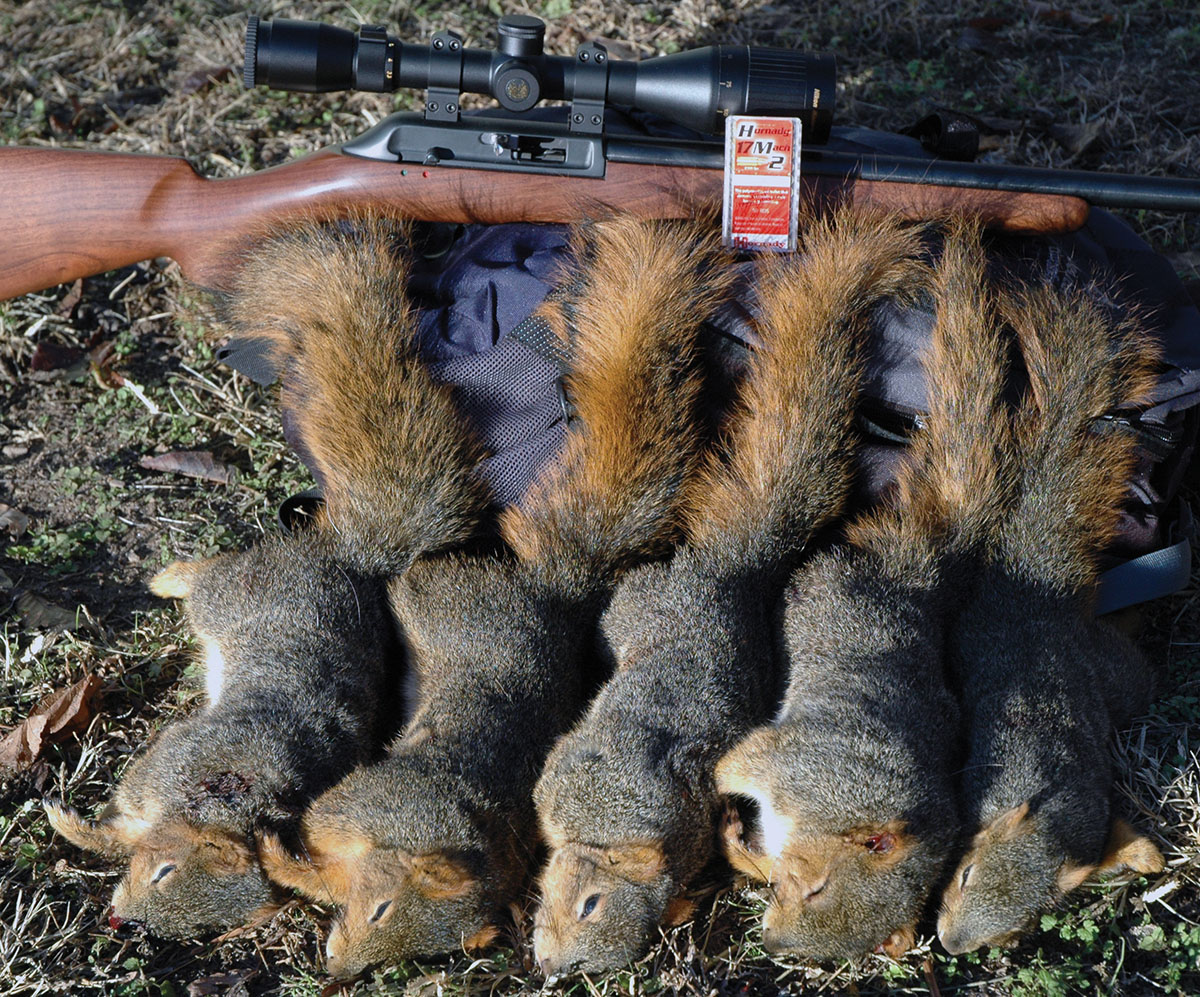
Using a superbly accurate rifle in 17 Mach 2 is a great way to avoid damage to the eating part of small edible game. Layne used a Thompson/Center R55 rifle to make head-shots on these Kansas fox squirrels at just over 100 yards.
I first used a rifle in 17 Mach 2 while on a spring turkey hunt in a western state. A couple of friends who worked at the Federal factory in Minnesota accompanied me. Prior to the trip, I learned that the ranch also had an infestation of Douglas ground squirrels so in addition to a shotgun for bumping off a gobbler, I took a rifle in 17 Mach 2 built by Tom Volquartsen. While the turkey hunt was great fun, several days of shooting ground squirrels with a generous supply of Federal 17 Mach 2 ammunition was even more so. I have also used the little cartridge numerous times when shooting flicker tails, with North Dakota being my favorite place to go for them. Richardson’s ground squirrel is the official name for that little critter and they are perfect targets for a good rifle in 17 Mach 2.
While the 17 Mach 2 was designed for shooting varmints, it is an excellent choice for shooting cottontails and other edible small game. When fired in an accurate rifle, it is headshot accurate out to surprising distances and proper use of its accuracy avoids damaging the eating part. I first used the 17 Mach 2 on small game not long after the cartridge was introduced. While on a whitetail deer hunt in Kansas with a couple of friends who worked at Thompson/Center, I used a Contender carbine in 30-30 Winchester to take a very nice buck. The company had just introduced a semiautomatic rifle in 17 Mach 2 called the R55. We were there a couple more days after I took my deer, and while shooting groups on paper with the rifle, I was greatly impressed by its accuracy, so I decided to take it hunting. While hunting deer, I had noticed fox squirrels busy feeding on acorns in a massive oak tree so I left the farmhouse early and was sitting in a ground blind when shooting light arrived. As a dozen or so squirrels appeared and began feeding, my rangefinder indicated most were 109 yards from where I sat. A steady rest along with no wind, allowed me to take five bushy tails, all with shots to the head.
There was a time when most companies that built rifles in 22 Long Rifle also offered them in 17 Mach 2 but such is no longer the case. Savage is keeping the little cartridge alive with the A17 autoloader as well as the Mark II bolt action, the latter available with light and heavy barrels. A friend who owns one of the heavy-barrel rifles describes it as a tack-driver. The last time I looked, Volquartsen was offering its straight-pull Summit rifle in 17 Mach 2 but I have not shot one. There may be others that I am not aware of. While the good old days are long gone, finding a used rifle is not difficult, although the price of a good one can be a bit steep.
In the ammunition department, 17 Mach 2 is far more expensive than 22 Long Rifle and considerably less expensive than 17 HMR. While writing this, I checked online prices and 500 rounds of CCI Mini Mag HP 22 Long Rifle was $38 or 7.6 cents per trigger squeeze. Moving on to 17 Mach 2, it ranged from 20 cents to 26 cents per round while 17 HMR ranged from 40 cents to 44 cents.
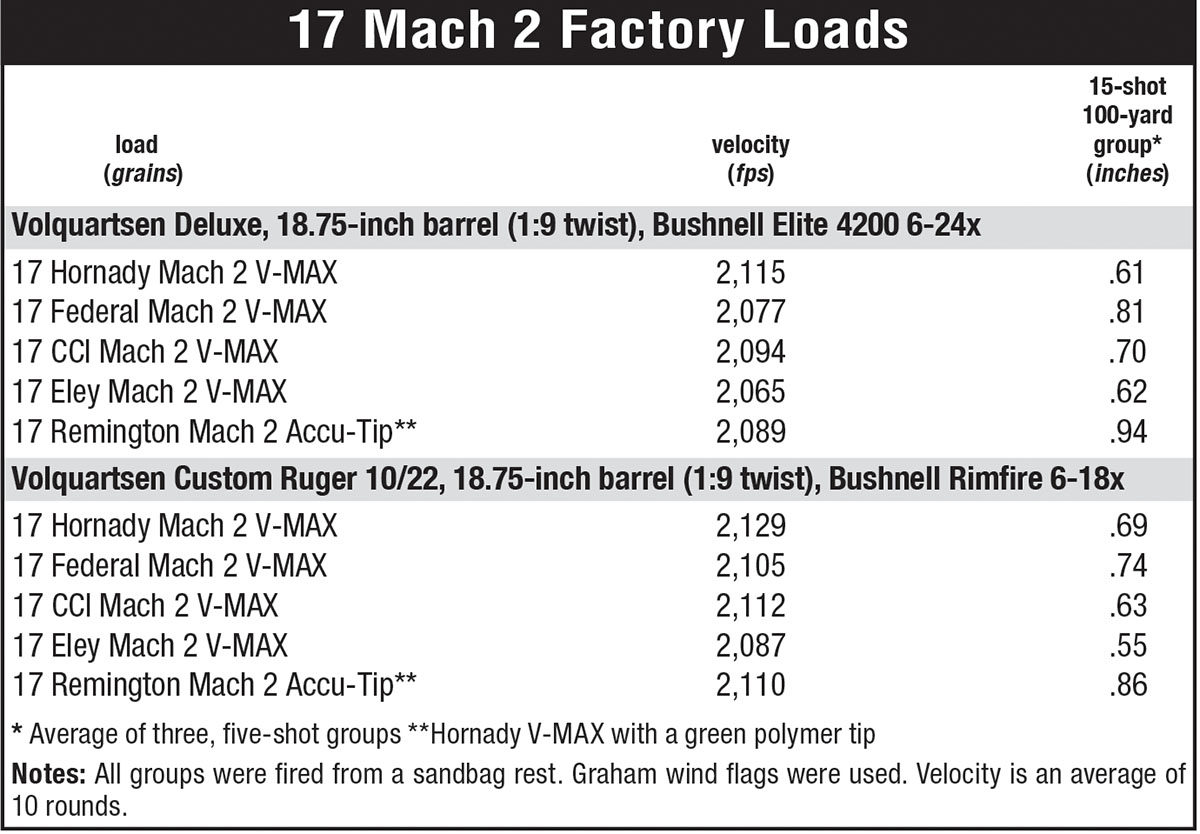
In a good rifle, the 17 Mach 2 can be extremely accurate, but as to be expected, it is quite wind sensitive. In a 10 mph cross breeze, the 17-grain bullet drifted 4.2 inches at 100 yards and 19 inches at 200 yards. When shooting the two Volquartsen rifles for accuracy from a benchrest, I set out two Graham wind flags and observed them until I spotted a condition that came around most often. Each time my chosen condition arrived, I immediately sent bullets down range and if the condition held for 2.5 seconds, I got off five rounds.