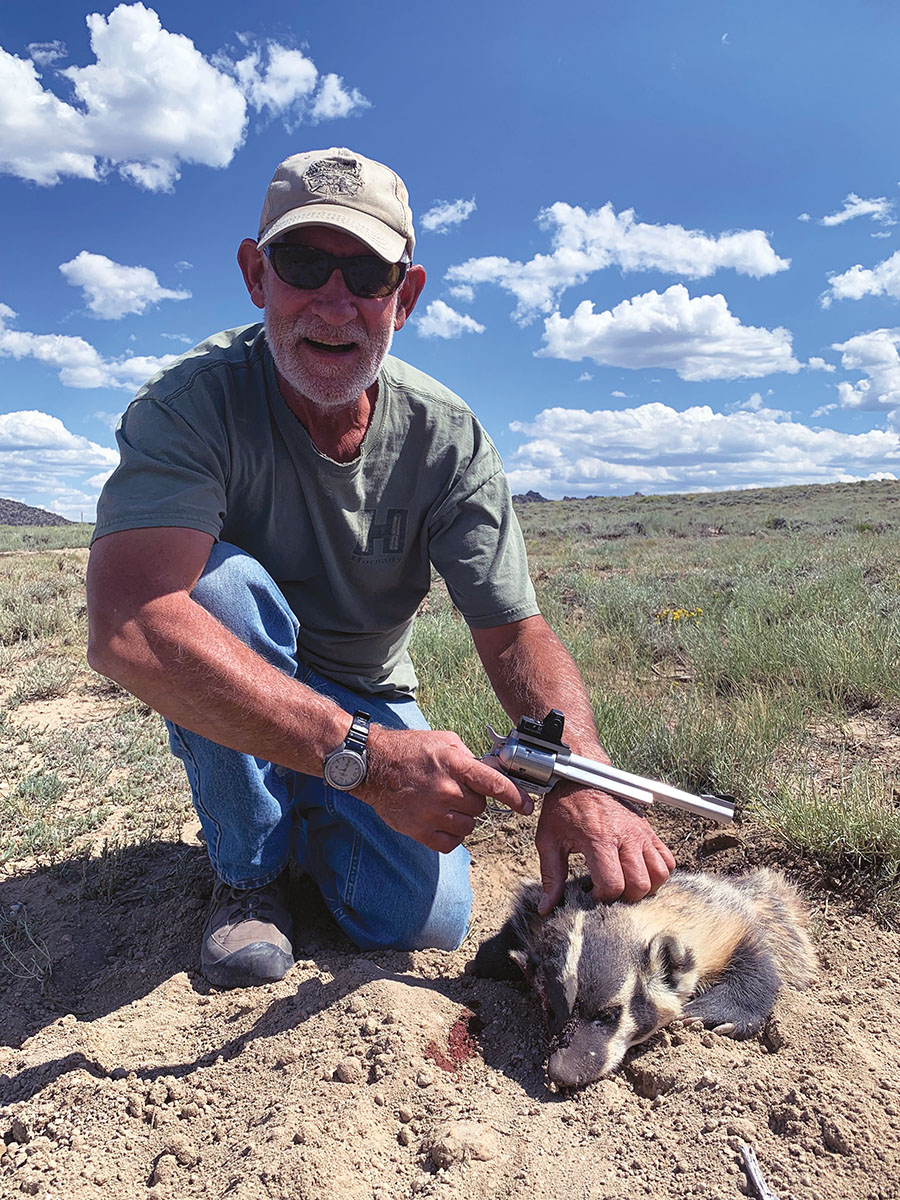
Dave Sturm, Hunting Operations Manager for Spur Outfitters, dropped this Wyoming badger with a perfect brain shot from his Freedom Arms 17 HMR at 50 yards.
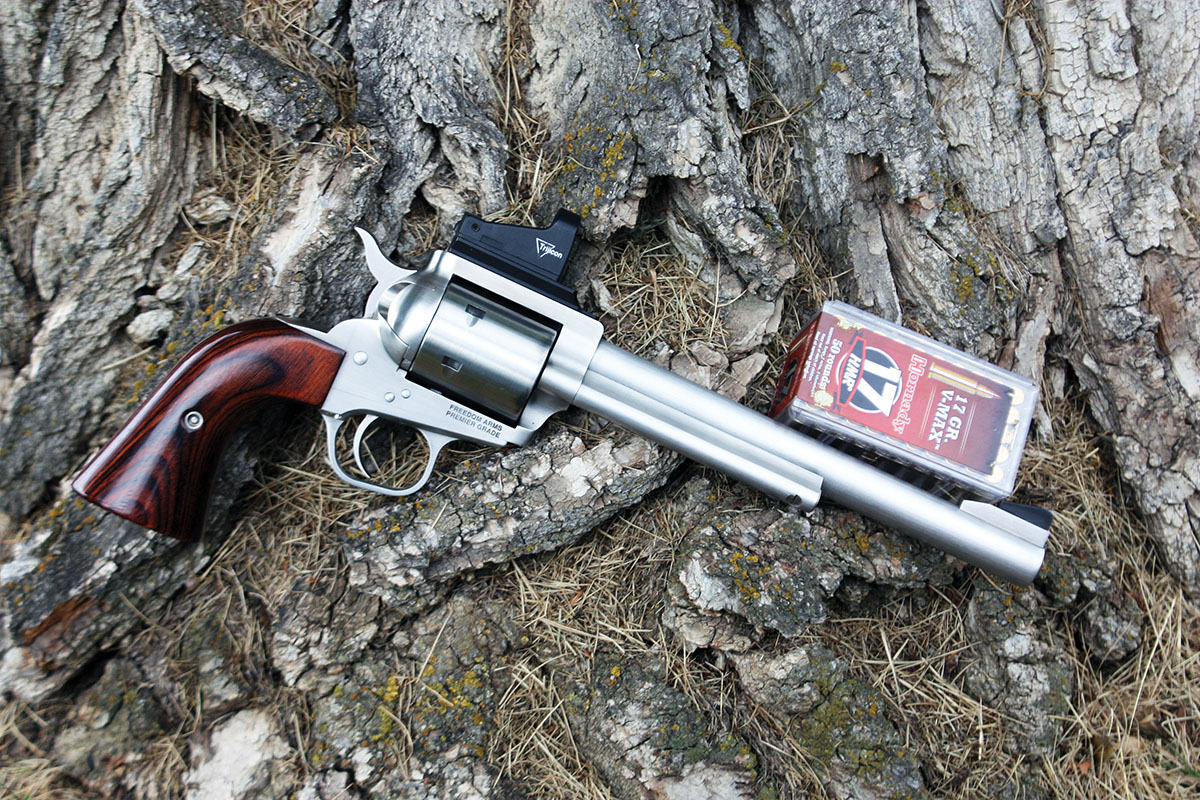
There is no massive amount of gear or reloading time required for a handgun varmint hunt, just a revolver and some 17 HMR ammunition.
As a lifelong handgunner, I don’t get all worked up every time a new rifle cartridge is announced. That said, when the 17 Hornady Magnum Rimfire (HMR) was introduced, it got my attention on several levels. First, since the cartridge is based on a 22 Winchester Magnum Rimfire case necked down to .17 caliber, I knew it would fit into a variety of revolvers that I’ve used with great pleasure throughout my life. Second, even after downgrading the 2,500 fps velocity touted for rifles, handgun velocities could be expected to run around 2,000 fps, thus extending the hunting range capabilities over existing rimfire .22-caliber revolvers. Finally, being a rimfire, the new 17 could be purchased at reasonable prices, meaning a varmint hunt would not require days of preparation at the reloading bench. If an opportunity arose, I could simply stuff a handgun and a couple cartons of 17 HMR ammunition in a bag and head up to the Spur Outfitters ranch in Wyoming for a few days of serious shooting.
In fact, my first exposure to a 17 HMR handgun was at the Spur, when Bob Baker of Freedom Arms showed up with one of his smaller frame Model 97 single-action revolvers so chambered, equipped with a 7.5-inch barrel and topped with a variable power 2x6 Bushnell handgun scope. Freedom Arms builds two different size revolvers, both with incredibly tight tolerances, both meticulously assembled and both line bored for superb accuracy. These are the qualities that made them the dominant revolvers in metallic silhouette shooting – and make them superb for varmint shooting. The smaller frame Model 97s are six-shot revolvers when chambered in calibers less than .40, five-shot revolvers when chambered in .41, .44 and .45 calibers. Standard factory barrel lengths are 4.75, 5.5 and 7.5 inches, but a custom barrel length can be ordered from the factory if you so desire. Baker’s performance with that first scoped 17 revolver was truly impressive. The man doesn’t just build guns – he seriously hunts with them.
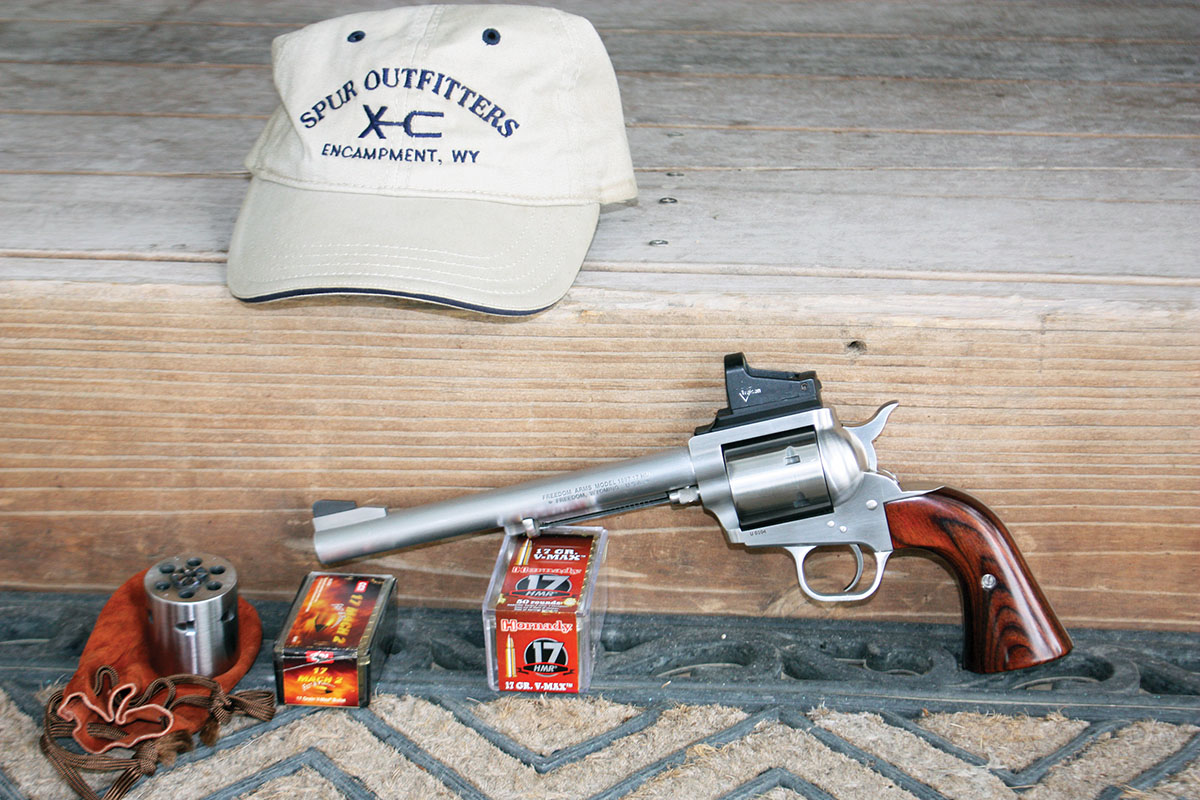
Freedom Arms originally offered to fit an extra cylinder chambered in 17 Mach 2 on the Model 97. A revolver with matching cylinders might be found, but the factory no longer offers the package.
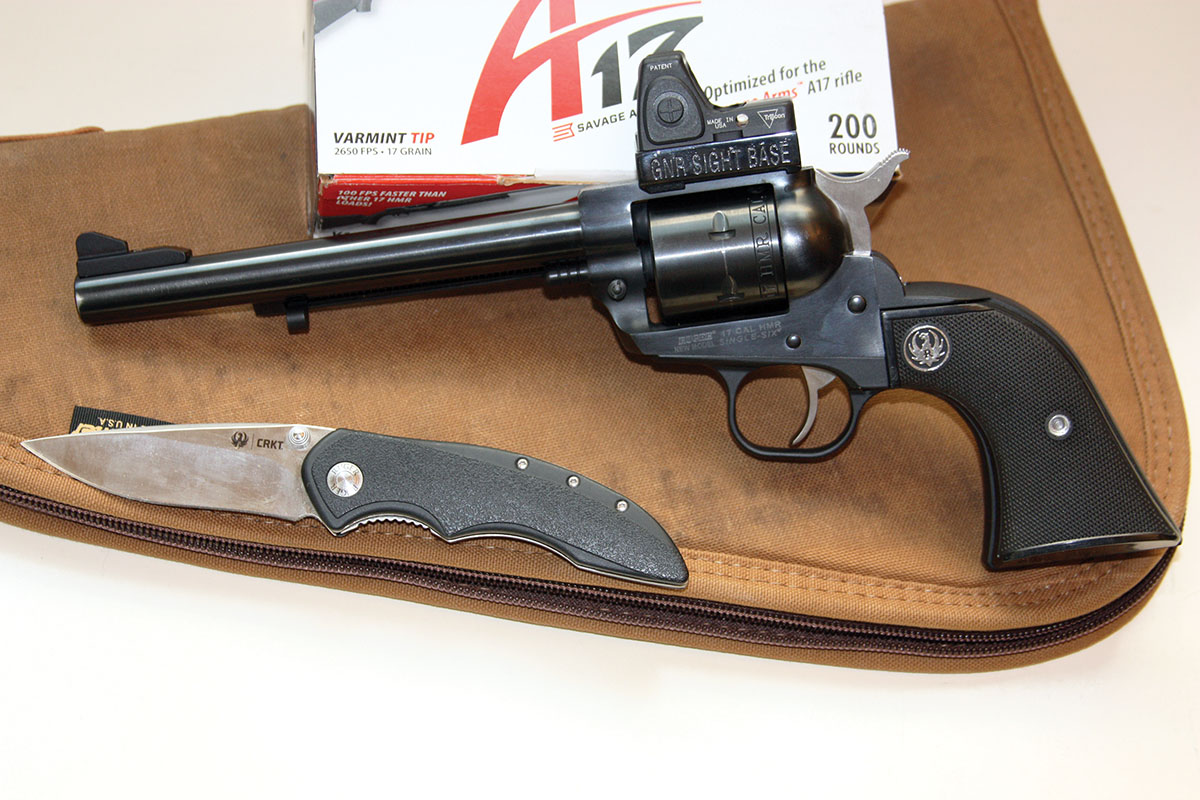
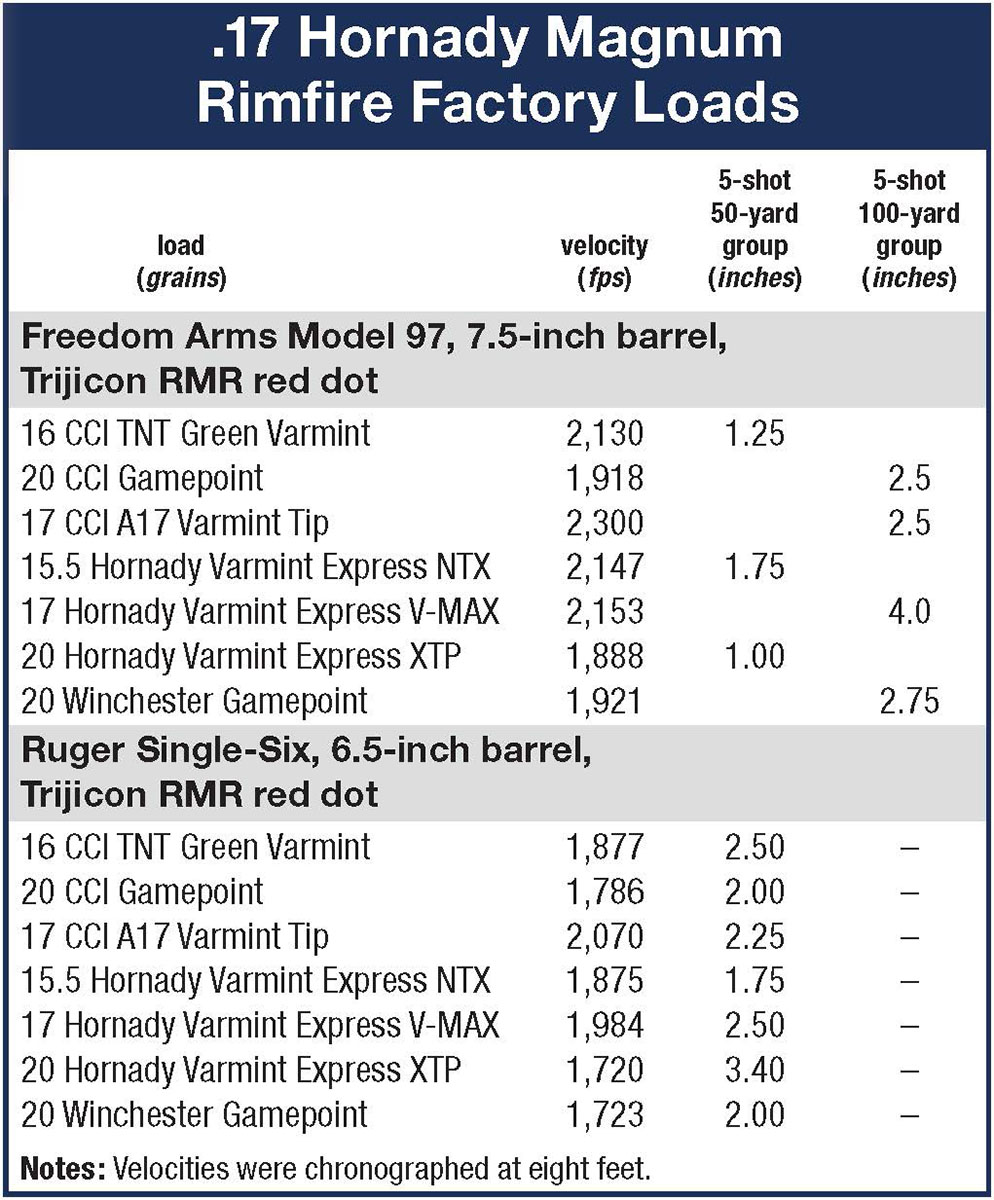
Although the 200-round box of CCI 17-grain loads states this round was optimized for a Savage rifle at 2,650 fps, its velocity in the Ruger was almost 2,100 fps.
Having acquired my first 22 Long Rifle Ruger Single-Six at the age of 16 and using it for decades, transitioning to Ruger’s new 17 HMR was a no-brainer. For me, picking up any single-action Ruger is like taking a drink from the fabled “fountain of youth.” The only noticeable changes from my first Single-Six are the 6.5-inch barrel, the transfer bar system, the adjustable sights and the loading gate release mechanism of the cylinder – nothing that changes the original revolver’s ergonomics. While the adjustable sights can be used as issued for pursuing varmints, my aging eyes do much better with some sort of optical assistance for precise shooting at tiny targets.
I ordered a Freedom Arms 17 HMR long before receiving this writing assignment and had decided to equip it with a Trijicon red dot sight. For me the red dot setup offers a couple of advantages over a scope on a handgun. When the handgun is raised to eye level, I can see downrange through the red dot’s housing regardless of whether or not the gun is precisely aligned with the intended target. With a handgun scope, a slight misalignment means you have little field of view through the tube and the scope has blocked your view of the target. Additionally, if I have to shoot a revolver offhand, the pistol scope magnifies my “wobble,” and without the steadying assistance of a shoulder anchor point and cheek weld provided by a rifle, I tend to jerk the trigger. Finally, I find a revolver much handier and more manageable when equipped with the smaller red dot than a larger scope. Freedom Arms provided a compact adaptor mount for the Trijicon RMR sight and I was in business.
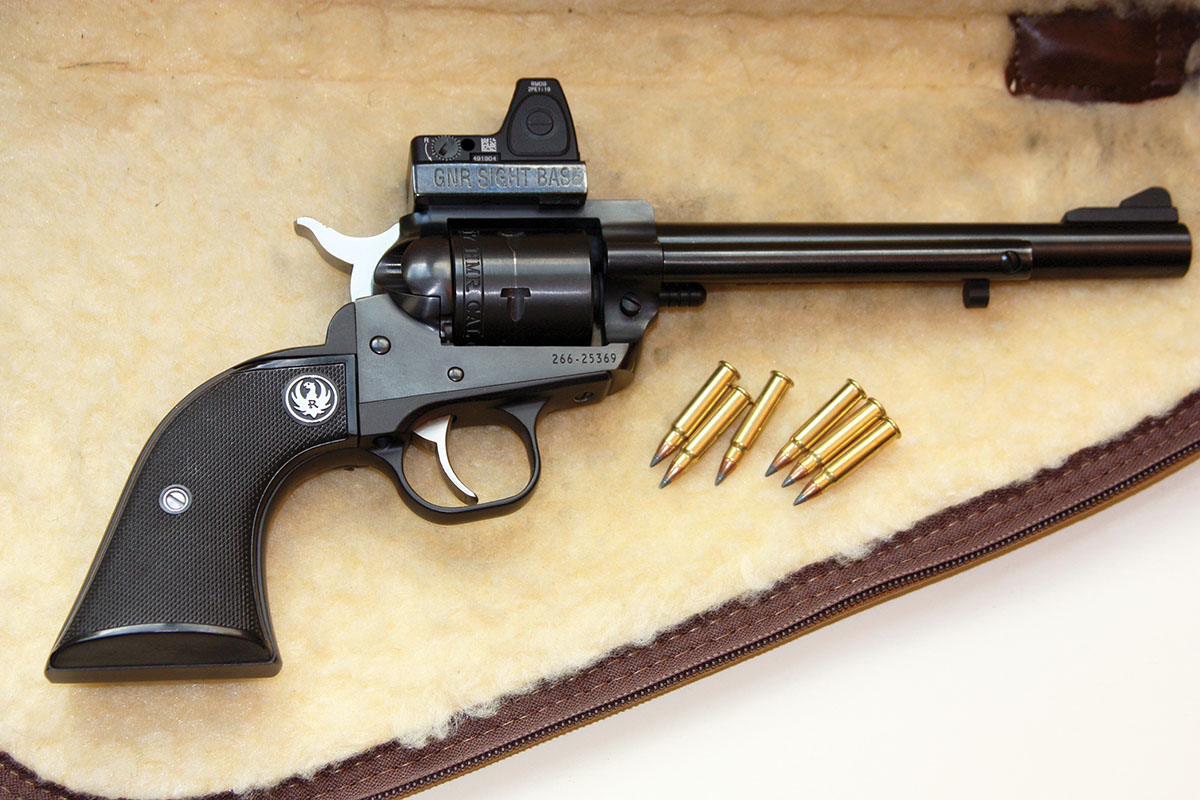
While six rounds in a revolver may be “low capacity” in today’s handgun world, those six rounds provide more fun than any “wondernine” full capacity pistol Dick has fired.
By the time Ruger announced its Single-Six in the 17 HMR caliber, I had spent several enjoyable days with the Freedom Arms successfully pursuing varmints at the Spur and knew how I intended to equip the Ruger. With a 6.5-inch barrel (one inch shorter than the Freedom,) it made no sense to install a larger optic. Easy choice; I ordered a current model Trijicon RMR with a small minute of angle (MOA) dot. Note: the larger dots, e.g. more than 5 MOA, popular for self-defense oriented handguns will completely cover and obscure a rodent-sized varmint at longer ranges. I encountered a minor setback when I realized that neither Trijicon nor Ruger made adaptor mounts for the Single-Six. A visit to Reeder Custom Guns in Flagstaff, Arizona, resulted in the Trijicon mounted on a GNR sight base that Gary Reeder builds in-house expressly for the small framed Ruger. Gary specializes in custom hunting handguns and builds sight bases for the larger caliber handguns as well.
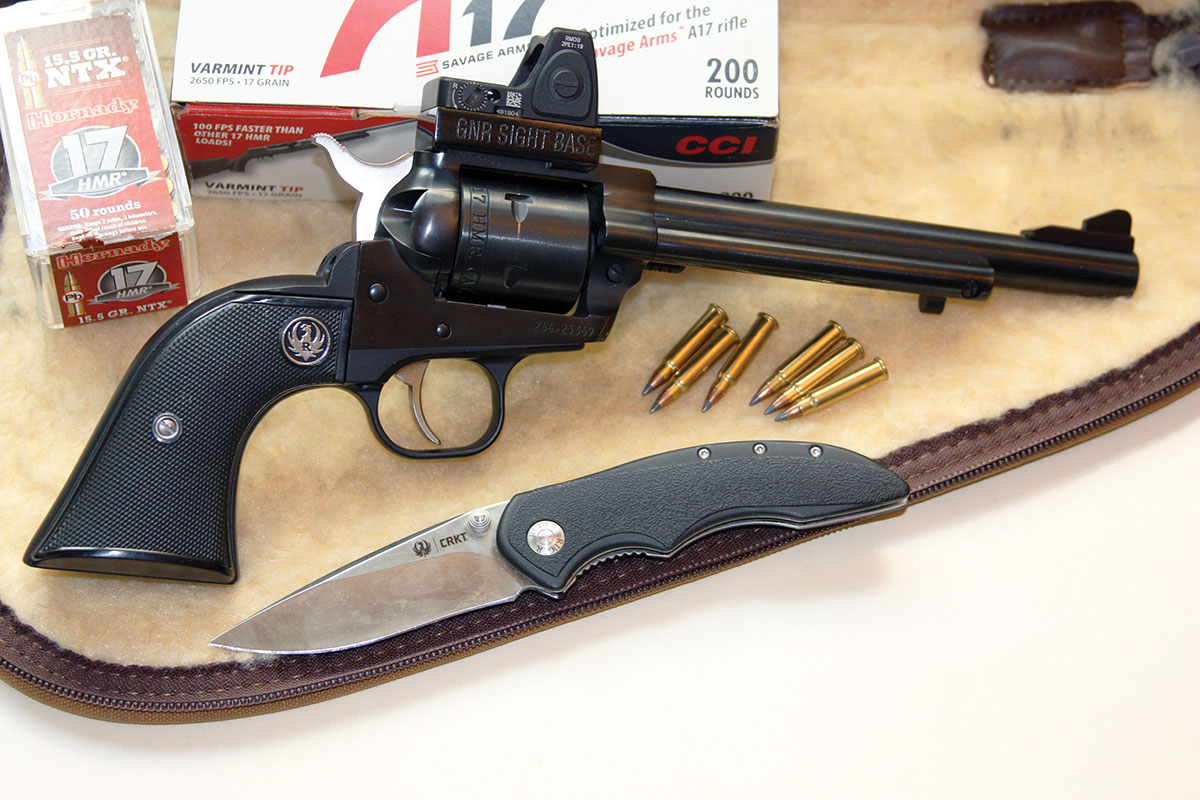
The 15.5-grain Hornady load was the most accurate in Dick’s Ruger but chronographed almost 200 fps slower than the CCI 17-grain load.
Since both these 17 HMRs are single-action six-shooters, there were no hiccups in transitioning from one gun to the other on the test range. The Freedom has an extra inch in barrel length, a longer cylinder, a different shaped grip and a smoother, lighter trigger pull. The Freedom also retails for nearly three times the price of the Ruger. I expect the increased velocities of the Freedom can be attributed to the longer barrel and its extremely tight barrel/cylinder gap. I would also suspect that it’s the trigger/action job and overall tighter tolerances of the Freedom Arms revolver that account for its enhanced accuracy. It’s what handgunners have expected for years when they buy a Freedom Arms revolver. That said, the little Ruger performed superbly, and with a professional trigger job would be expected to give excellent performance at ranges beyond 50 yards. Left with just the factory iron sights, the Ruger makes a great “walkabout” revolver for small game.
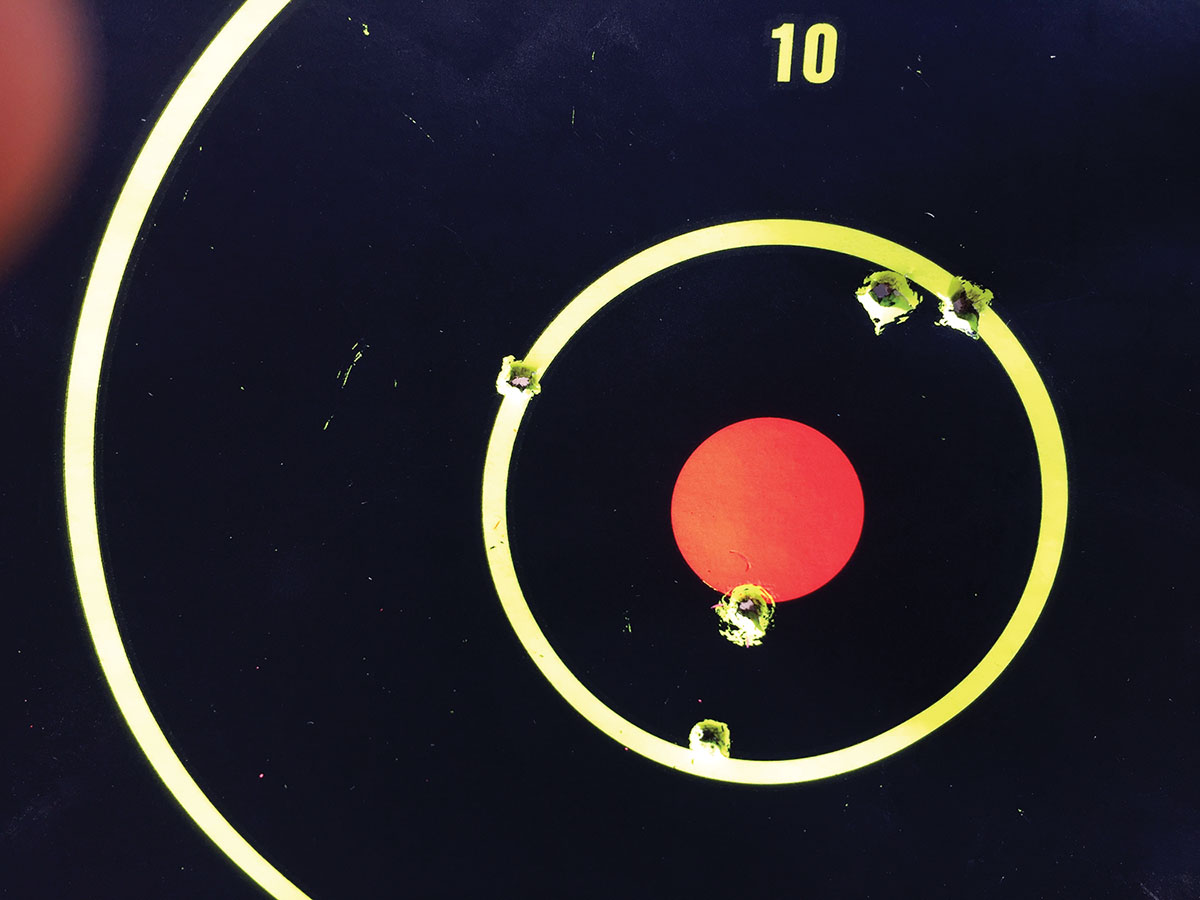
A typical 17 HMR group at 100 yards shows you won’t take a varmint on every shot, but the probabilities of a hit are high.
Many rifle hunters think varmint shooting consists of setting up benches and spending an afternoon working over targets out to 500 yards and beyond. This is understandable, particularly given the current interest and trend in specialty long-range rifles and ammunition. I too have spent more than a few hours sitting on the edge of a prairie dog town with my 223 Remington hardware shooting out to maximum ranges. But this is not an optimal scenario or technique for handgunners, particularly those using rimfire handguns. As a kid with 20/20 vision, I considered 22 rifles as small-game hunting tools good to 50 yards and slightly beyond, depending on the shooter’s level of skill. Rimfire handguns were utilized at significantly closer ranges. Back then, I could not have conceived of using a rimfire handgun in locations such as Wyoming’s vast terrain. The 17 HMR has changed that thinking.
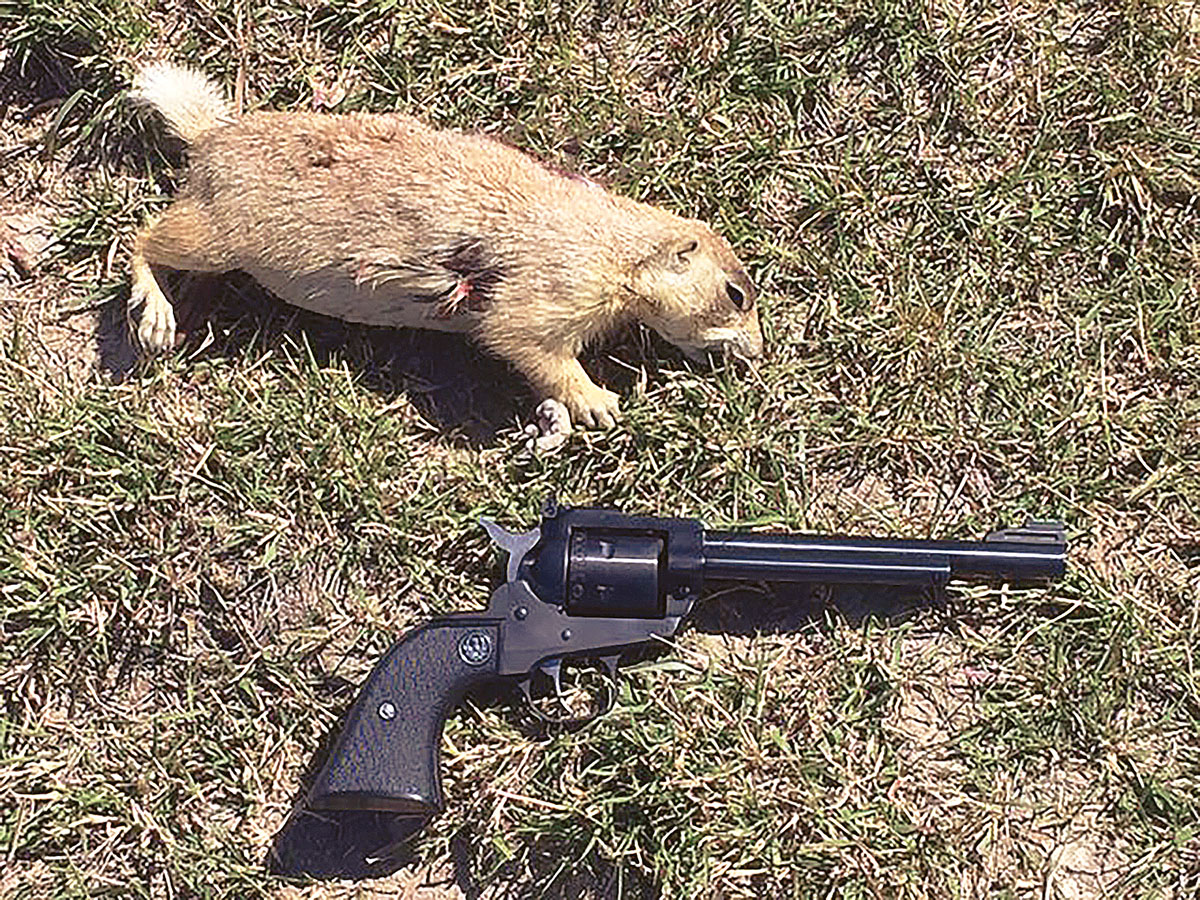
This prairie dog was taken with an iron-sighted Ruger 17 HMR.
Spur Outfitters does have large concentrations of prairie dogs and can cater to the “bench” shooters with long-range rifles. The big attraction for handgunners is the opportunity to work smaller pastures that offer hunters many shots at prairie dogs between 50 and 100 yards. In addition, the Spur ranches grow much of the feed needed to get its cattle through the winter. These crops attract incredible numbers of ground squirrels up through harvest time, and it is not at all unusual to have these critters pop up less than 25 yards from your vehicle. When the grass gets long, smaller squirrels are hard to see, but early in the growing season and after harvest, these critters offer great opportunities for rimfire shooters. Don’t think small; a mature ground squirrel at the Spur can approach the size of a healthy prairie dog. When shooting from a truck (check regulations for legality) or frequently getting in and out of a vehicle, I found the two 17 HMR handguns much easier to handle safely and manipulate than any rimfire rifles.
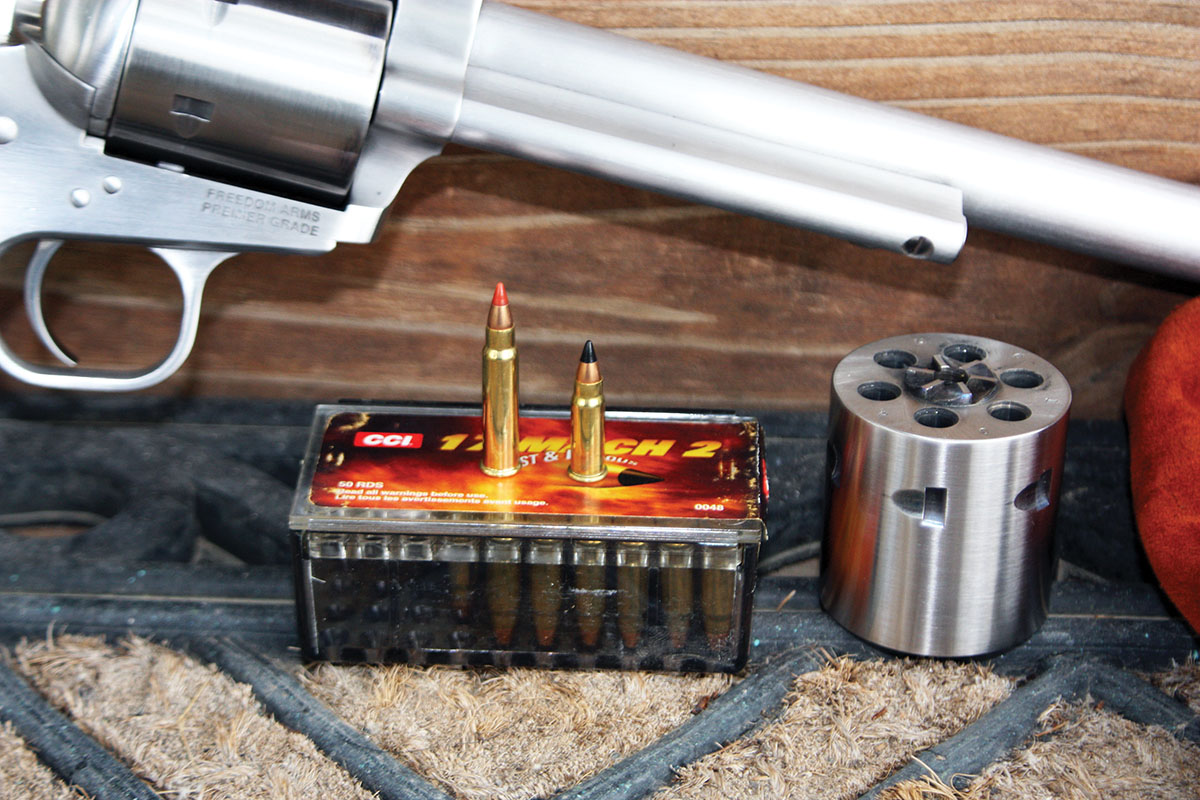
The 17 Mach 2 (right) is considerably smaller than its big brother but uses the same bullets. As expected, velocities (and terminal performance) are considerably reduced.
A couple of comments on the shooting results shown in the tables: On the only day I had access to a 100-yard range with a shooting bench, the weather started out windy and got steadily worse. On that occasion, I only had the Freedom Arms and the four loads that I tested at 100 yards. By the time I got to the 17-grain Hornady loads, the wind was moving the targets and threatening to knock over the small chronograph. If the Hornady groups strike you as being a bit large, please keep in mind that all my shooting at the Spur had been done with the Hornady 17-grain loads, and that round had accounted for a lot of prairie dogs, including a couple taken at over 100 yards. By the time I made my second visit to the local range, I had received the Ruger along with additional ammunition but only had access to 50-yard targets. Fortunately it was a calm day with light cloud cover that allowed steady targets and reliable velocity measurements. Be wary of drawing any final conclusions regarding ammunition performance until you have tried a variety of brands and loads in your revolver.
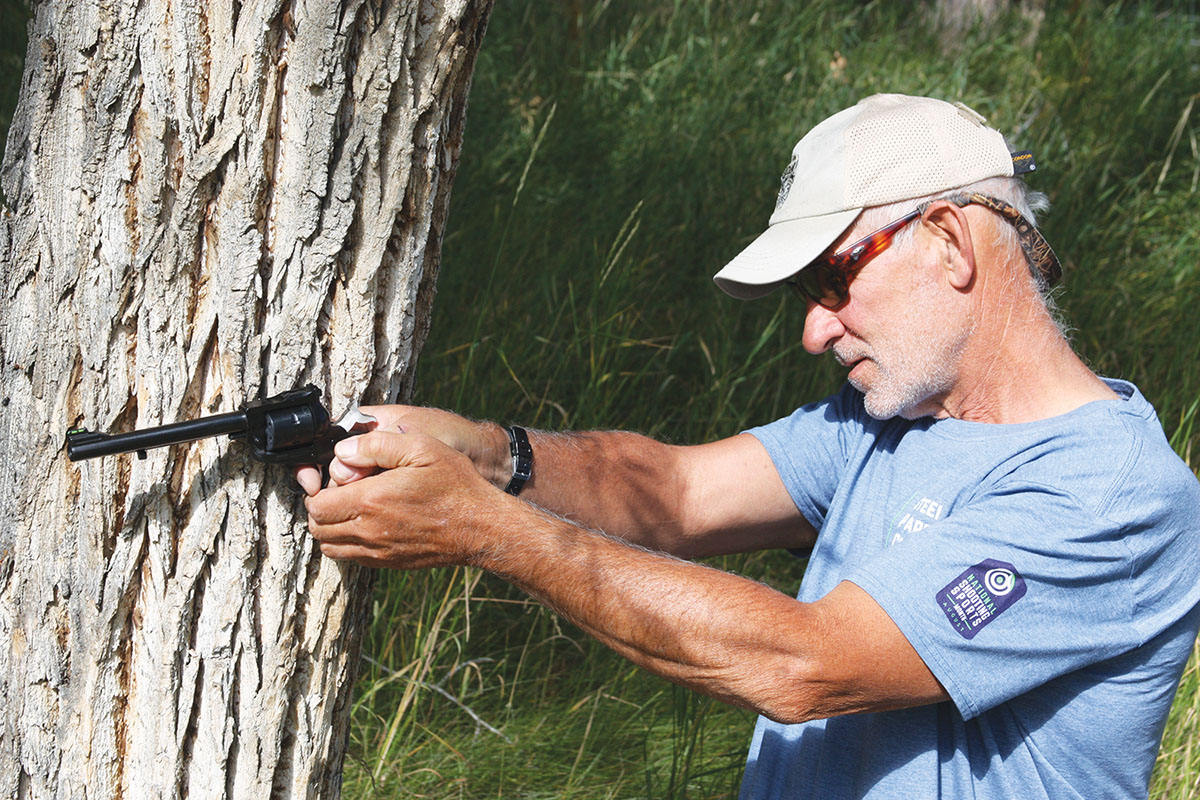
In the wooded sections of the ranch by streams, the iron-sighted Ruger 17 HMR makes a nice companion for closer range varmints.
Obviously, any comments I might make on killing power would be based on field observations using only the 17-grain Hornady ammunition rather than on any laboratory gel penetration tests and wound cavity measurements, but here goes. The 17 HMR, which I believe was
designed specifically for use in rifles, produces 2,500 fps in a rifle barrel. That’s roughly 500 fps more velocity than most of the ammunition I fired in my two revolvers. Ammunition designed to provide explosive terminal ballistics at 2,500 fps won’t do the same thing at other velocities. Compared to varmint shooting I’ve done in the past with the 22 LR and 22 Magnum, I think the 17 does more flesh damage than either of the 22s, but lacking the weight of the 22s, doesn’t seem to provide any additional “stopping power” on a solid hit to the body cavity, perhaps even less. The smaller diameter, lighter weight, higher velocity bullet seems to be more destructive on a marginal hit, which may allow you more time for a follow up shot. What the 17 does is give you flatter trajectories facilitating longer range hits. And hits translate to increased success, misses don’t.
I still take a couple of centerfire rifles on my visits to Spur, but over 90 percent of my varmint shooting is done with handguns, and most of that is with rimfire ammunition. I haven’t sold my 22 LR or 22 Magnum handguns, and when my Wyoming visits coincide with high numbers of ground squirrels, I’ll go to work with an assorted mix of
fun .22-caliber pistols. But when the ranges grow longer, I reach for one of my two “Super Rimfire Sixguns.” The 17 HMR is definitely the revolver caliber king of the prairie!