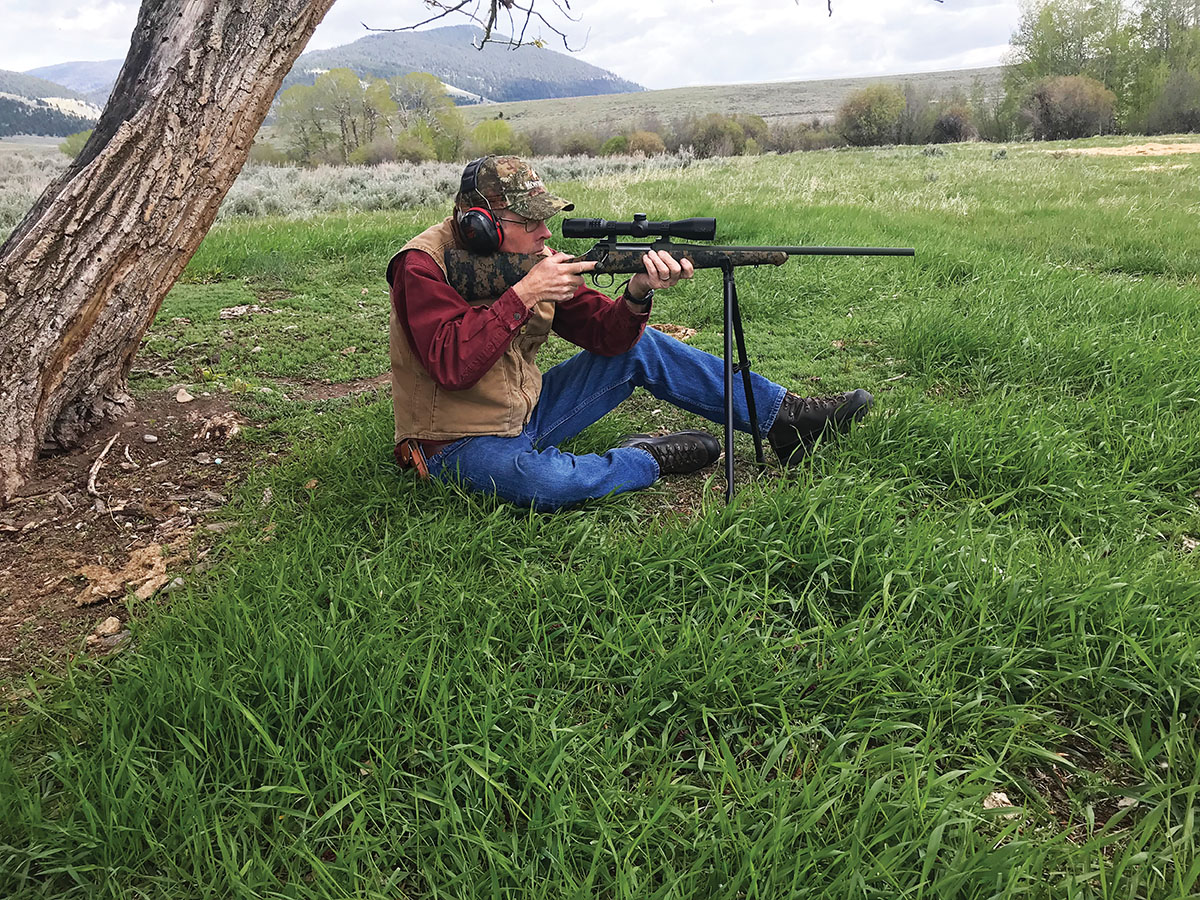
A lazy afternoon is best spent shooting ground squirrels with a 6.5 Creedmoor.
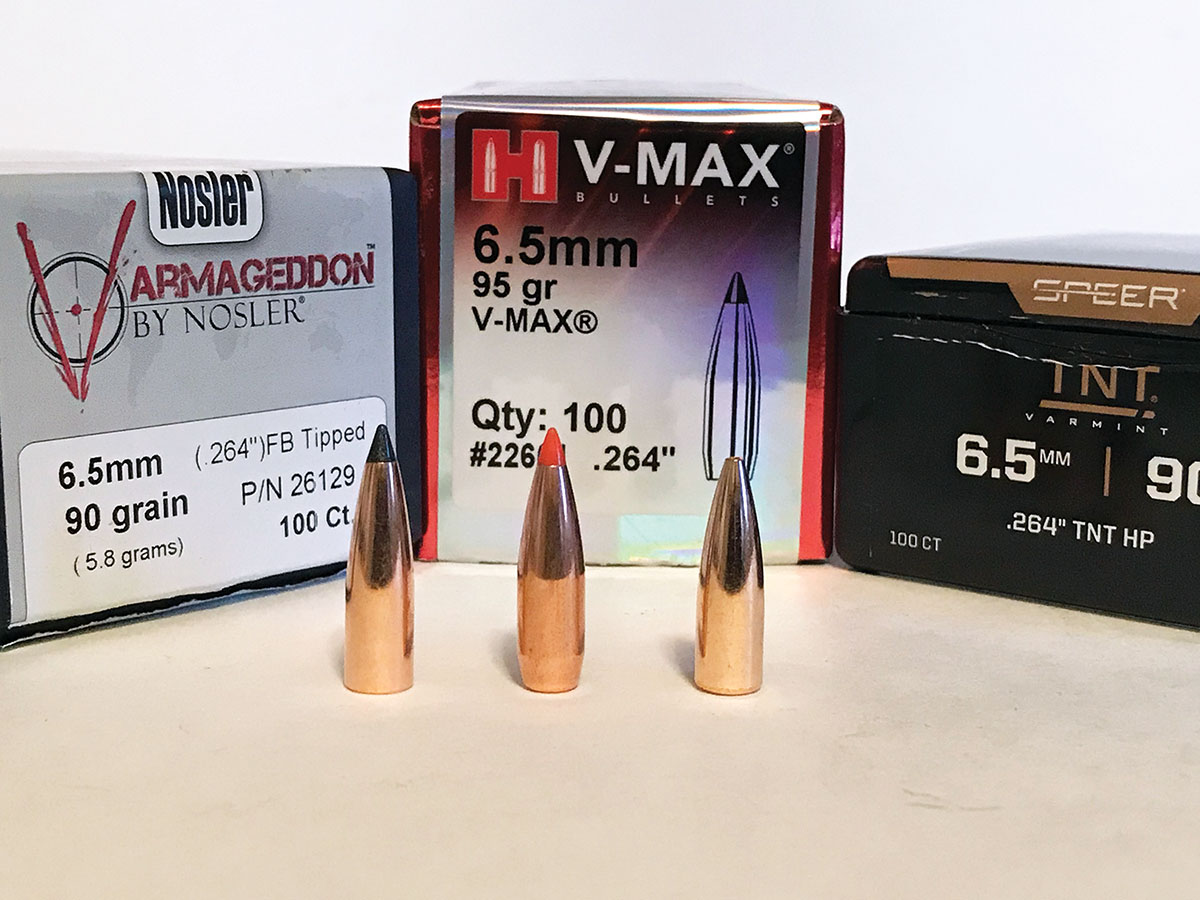
The selection is rather thin for true varmint bullets for the 6.5 Creedmoor. These representative bullets include (from left) the Nosler 90-grain Varmageddon, Hornady 95-grain V-MAX and Speer 90-grain TNT HP.
The 6.5 Creedmoor has seen a meteoric rise in popularity the last several years. The majority of that acceptance has been for long-range target shooting and big-game hunting. However, there is every reason a Creedmoor rifle should spend at least part of its time in the field pursuing varmints from ground squirrels to coyotes and the occasional fox that comes to a call.
Selecting a 6.5mm bullet for this shooting means a trade-off. On the one hand, the much faster velocity of a relatively lightweight bullet supplies a flatter trajectory than a longer and heavier bullet carrying a higher ballistic coefficient (BC) fired at a slower speed. That flatter-shooting bullet is a great benefit when a coyote comes to a call only to suspiciously halt, and you have only a couple of seconds to estimate range and shoot before it makes a U-turn to head out of the country. On the other hand, bullets carrying a higher BC slip through the air with wind deflection that can be as much as a third less at 500 yards and farther than lighter and faster bullets. That can spell the difference between a hit and miss on the prairie, where the wind only stops to change direction.
Let’s look at the fast bullets first. The selection of true 6.5mm varmint bullets is rather
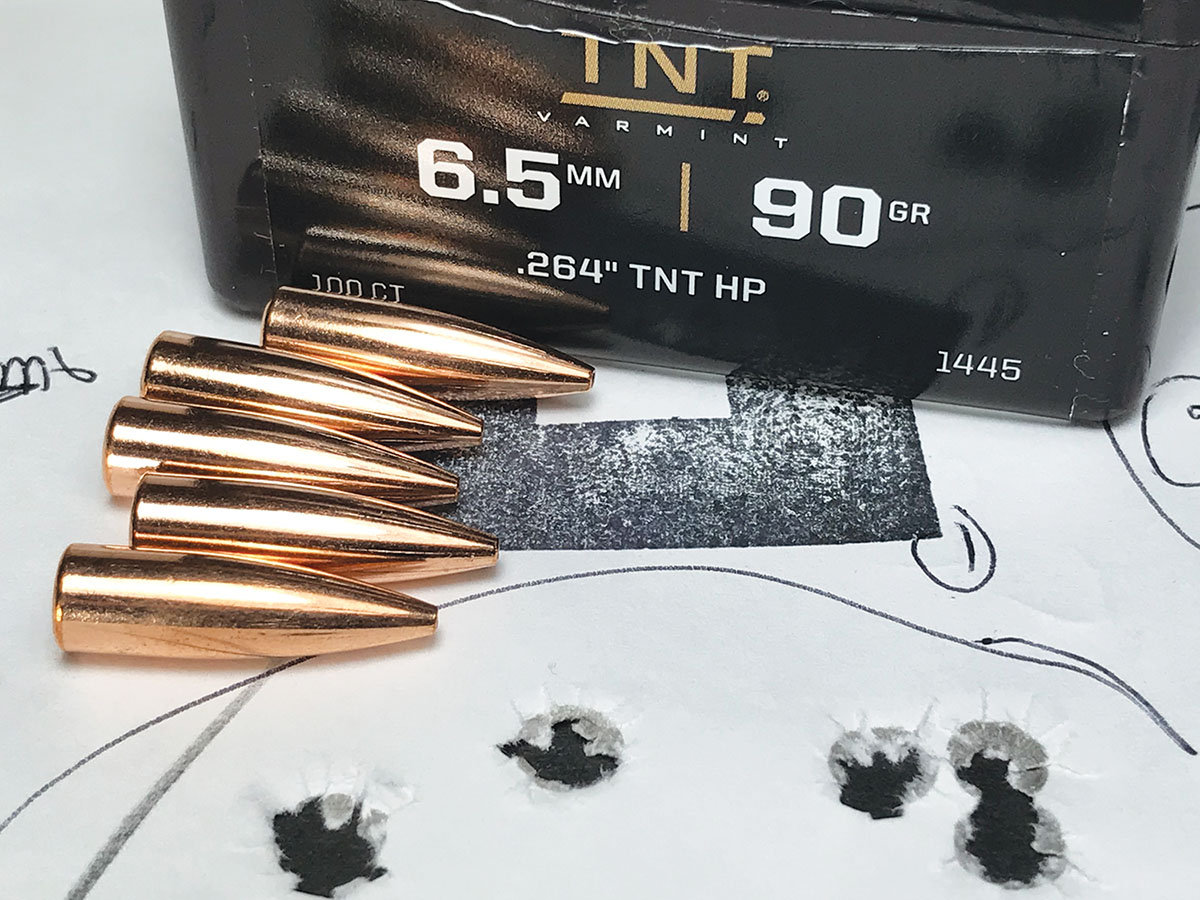
Speer 90-grain TNT HP bullets provided this group at 100 yards fired from a Sauer Model 100 bolt rifle.
thin. The Speer 90-grain TNT HP contains a soft lead core held in a thin jacket constructed with flutes along its ogive and a hollowpoint to maximize expansion. The flatbase TNT has a G1 BC of .281. Hornady 95-grain V-MAX bullets carry a .365 BC produced by a polymer tip and slight boat-tail. Hornady states V-MAX bullets fragment on contact at velocities as slow as 1,600 fps due to the polymer tip slamming rearward into the lead core. Nosler’s new 90-grain flatbase Varmageddon has a polymer tip, resulting in a .350 BC. A thin jacket at the junction of the hollowpoint and tip assures violent expansion. The jacket gradually thickens at the bullet’s midsection to keep Varmageddon bullets intact at any velocity, until impact. The BCs of these bullets are comparable to similar-shaped .25-caliber 85-grain bullets, .24-caliber 80-grain bullets and .22-caliber 60-grain bullets.
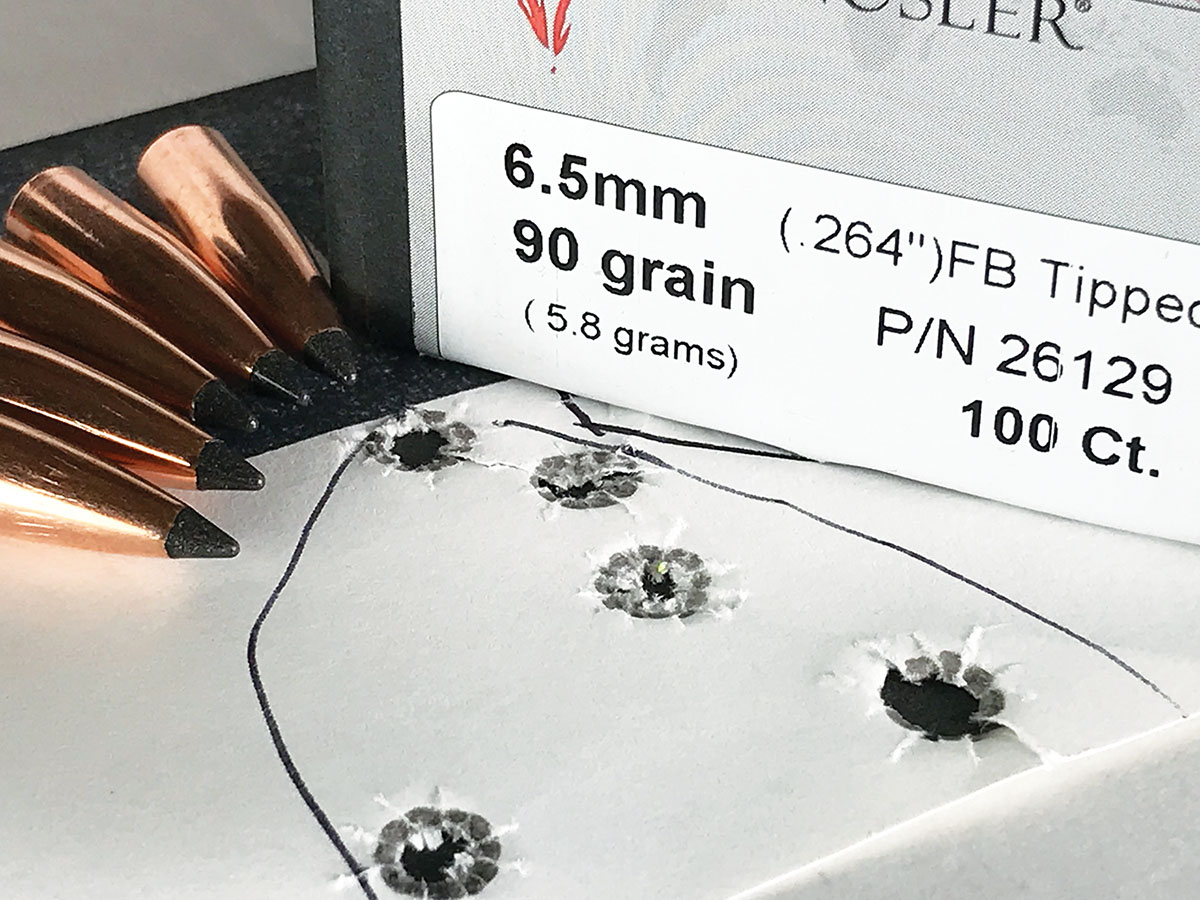
Nosler 90-grain Varmageddon bullets shot well at 100 yards.
Some varmint hunters who shoot a 6.5 Creedmoor take a perspective outside of the label on a bullet box. They shoot bullets intended for target shooting, such as Sierra 107-grain MatchKing or Tipped MatchKing bullets. Others shoot bullets like Nosler 100-grain Ballistic Tips, considered more suitable for deer hunting. I take another step up in weight and shoot Nosler 120-grain Ballistic Tips from my Sauer Model 100.
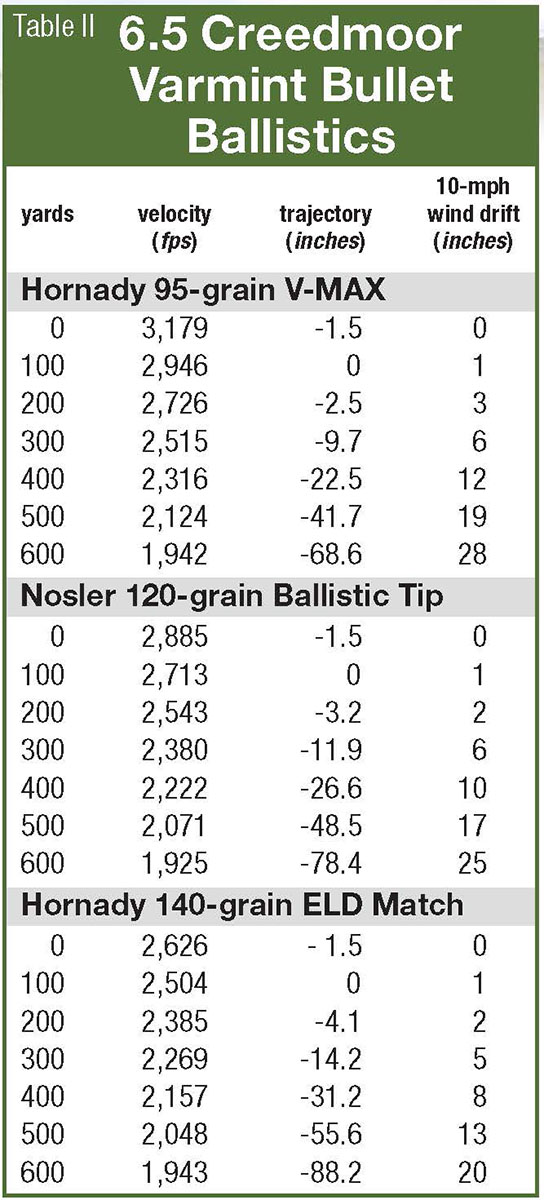
More than any other shooters, people who shoot the 6.5 Creedmoor are infatuated with ballistics. So let’s get down to the dope on trajectories of different bullet weights and shapes. One of the better loads my Sauer Model 100 shot was Hornady 95-grain V-MAX bullets fired at 3,179 fps paired with 42.5 grains of Varget. At that velocity, V-MAX bullets have the drop and wind drifts listed in Table II.
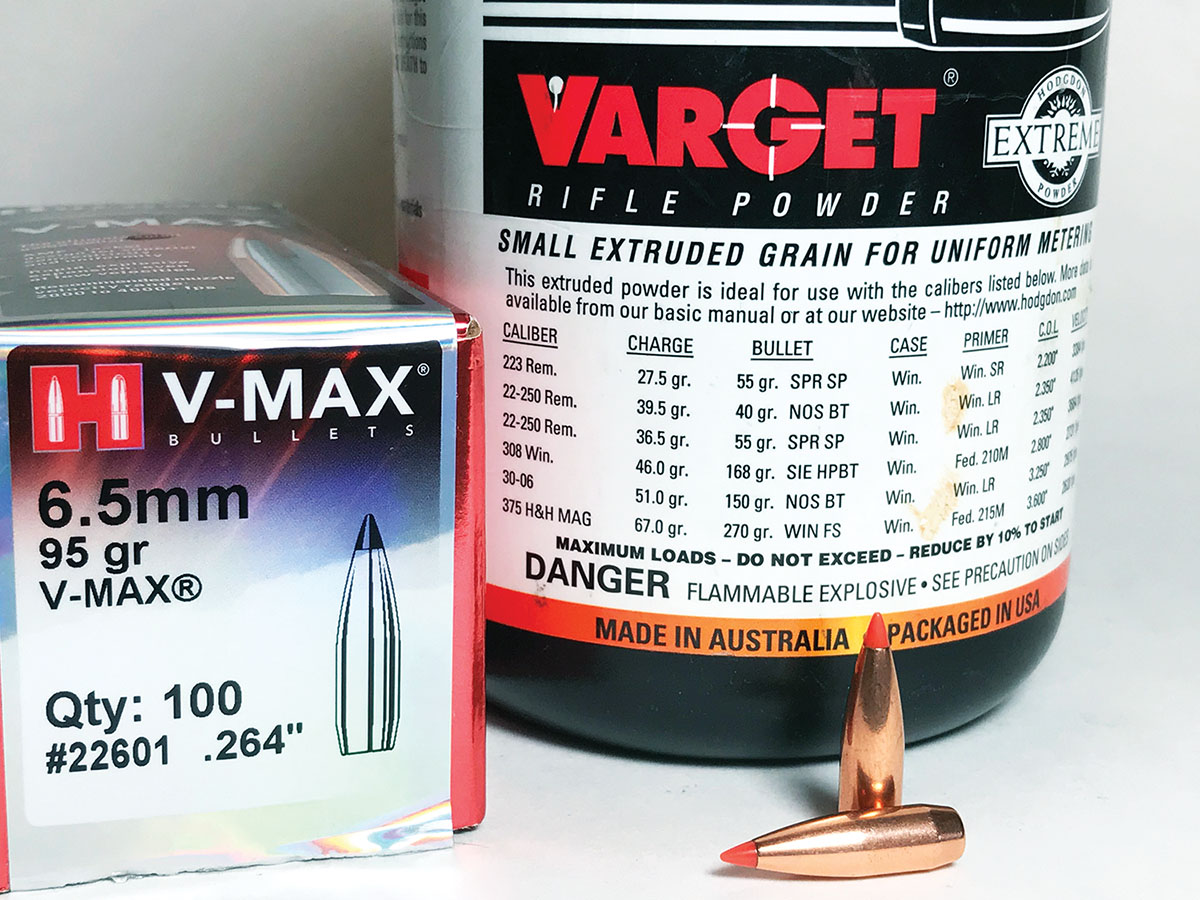
Varget powder and Hornady 95-grain V-MAX bullets make a potent pair for varmint hunting with a 6.5 Creedmoor.
In comparison, the Sauer 6.5 rifle accurately shot Nosler 120-grain Ballistic Tips loaded with 47.5 grains of Ramshot Hunter powder at 2,885 fps. That combination’s trajectory and wind drift are also listed in Table II.
Previously, Hornady 140-grain ELD Match bullets averaged .88 inch for two, three-shot groups and 2,626 fps fired by 44.5 grains of Reloder 23 from the Sauer. The ELD Match bullet’s BC is .620 and its trajectory and wind drift are listed in Table II.
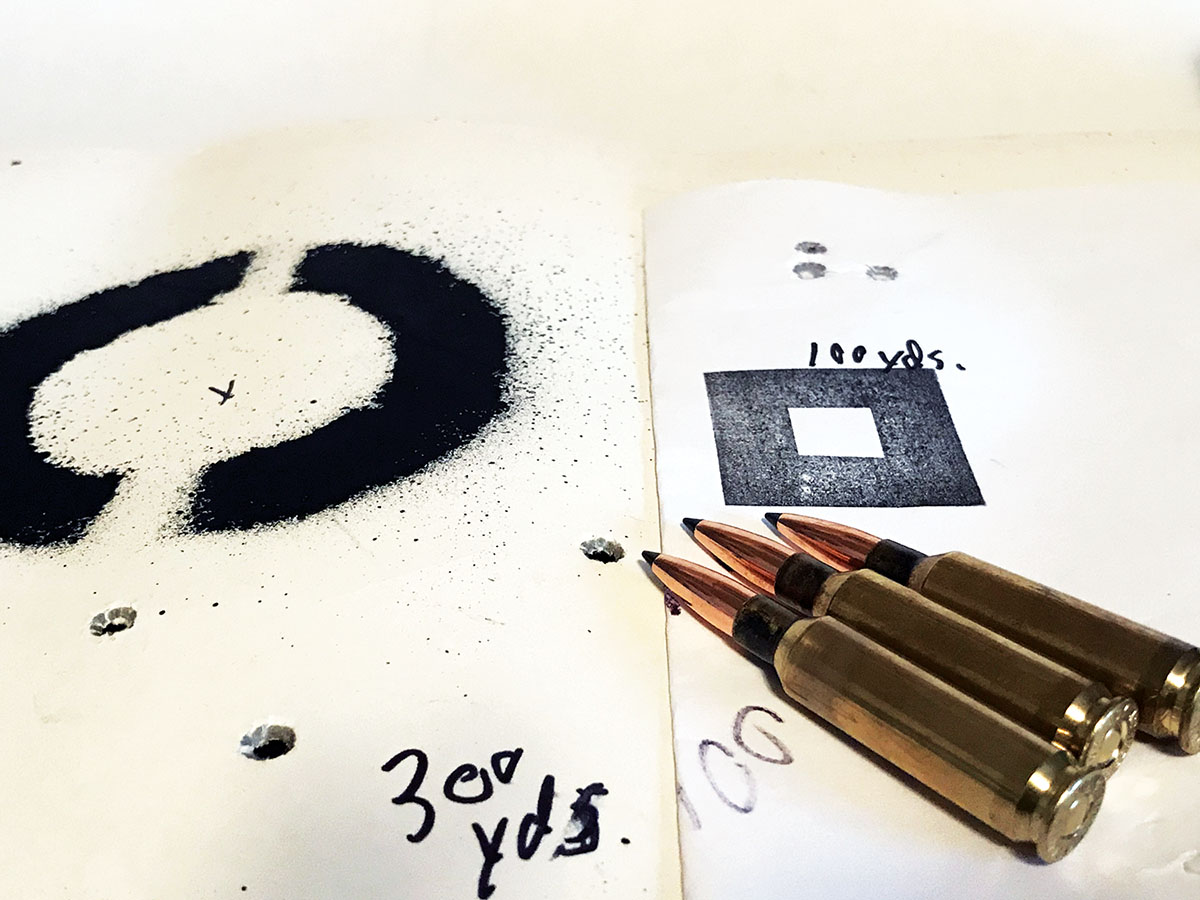
Nosler 90-grain Varmageddon bullets provided these groups at 100 and 300 yards.
Take your pick. The V-MAX drops 4 inches less than the Ballistic Tip at 400 yards. In exchange, Ballistic Tips drift two inches less in the wind than the V-MAX. ELD Match bullets really drop off, with nearly 10 inches more drop at 400 yards than V-MAX bullets. In trade, ELD Match bullets drift half as much. Unfortunately, Ballistic Tips and ELD Match bullets will tear a large hole out of the far side of a valuable coyote hide. The V-MAX, TNT and Varmageddon might disintegrate inside a coyote. Then again, from shooting marmots with V-MAX and TNT bullets, most likely the bullets will tear holes in valuable furs even Singer could not repair.
The Creedmoor is a flexible cartridge when it comes to suitable powder. Appropriate powders range between relatively slow-burning Hodgdon H-4350 to IMR-8208 XBR on the fast-burning end; H-4350 is a popular powder for handloading heavy bullets in the Creedmoor. It also fires V-MAX 95-grain bullets about as fast as any of the 12 powders listed in the Hodgdon 2019 Annual Manual. However, three to five additional grains of powder are required to reach that velocity compared to other powders such as IMR-4166 and Varget.
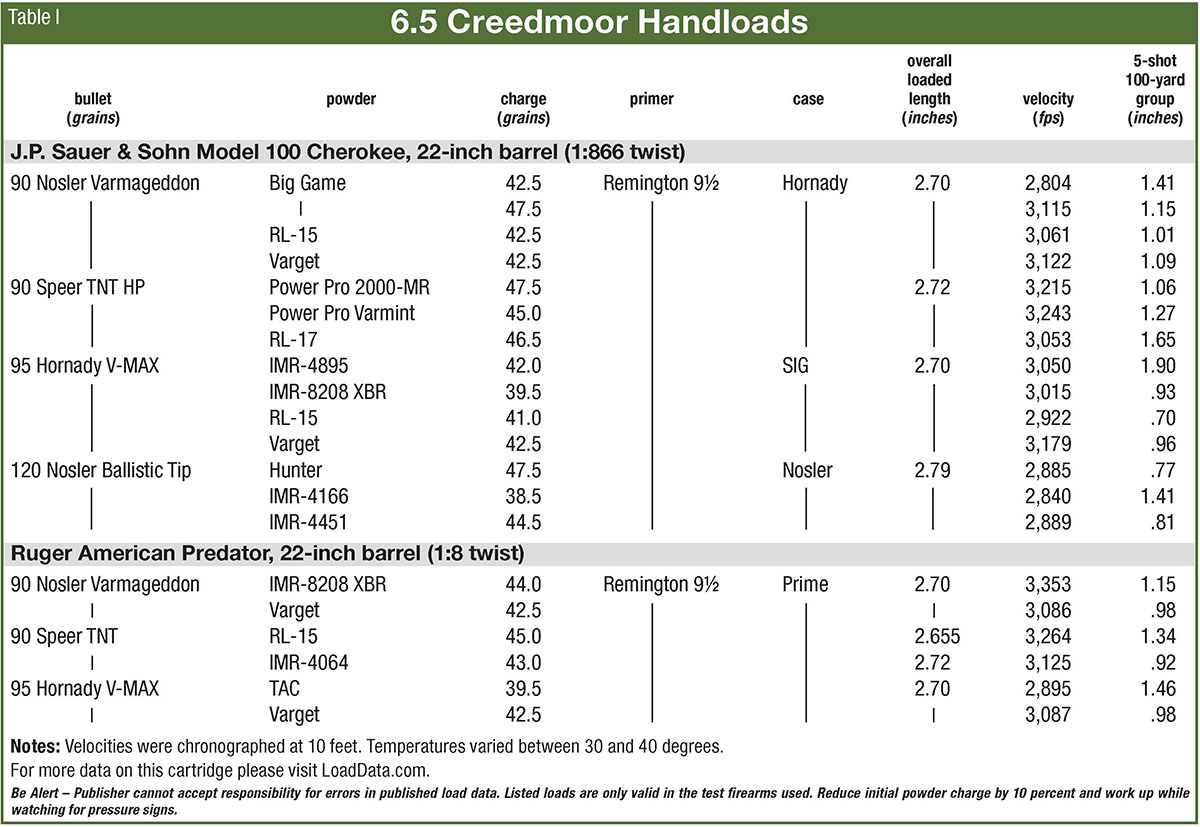
A few powders delivered low extreme velocity spreads over five shots. Nosler 90-grain Varmageddon bullets varied only 33 fps fired with Reloder 15 and 36 fps paired with 47.5 grains of Big Game. Velocity of V-MAX 95-grain bullets differed 24 fps shot with IMR-8208 XBR and three fps with Varget. Shooting the V-MAX/Varget load a second time resulted in an extreme spread of 19 fps for 10 shots.
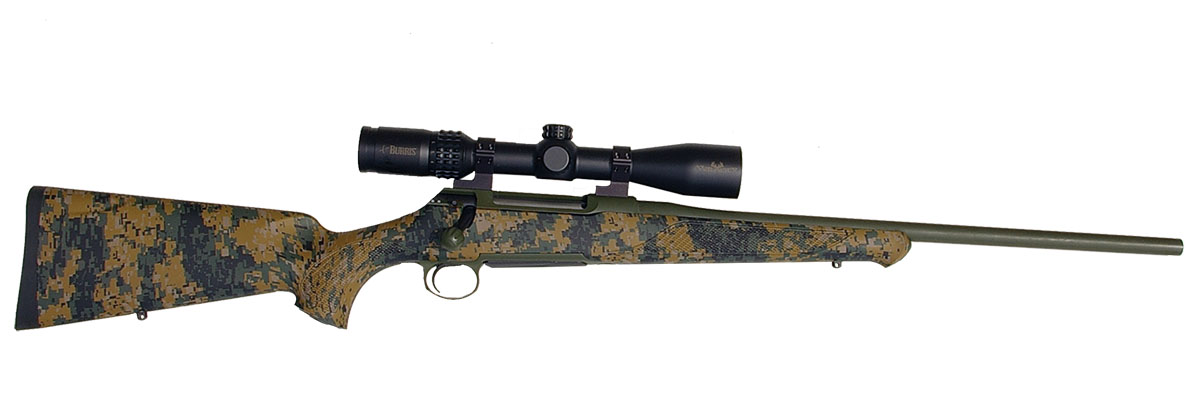
A Sauer Model 100 Cherokee rifle chambered in 6.5 Creedmoor was used to shoot some of the loads listed in the load table.
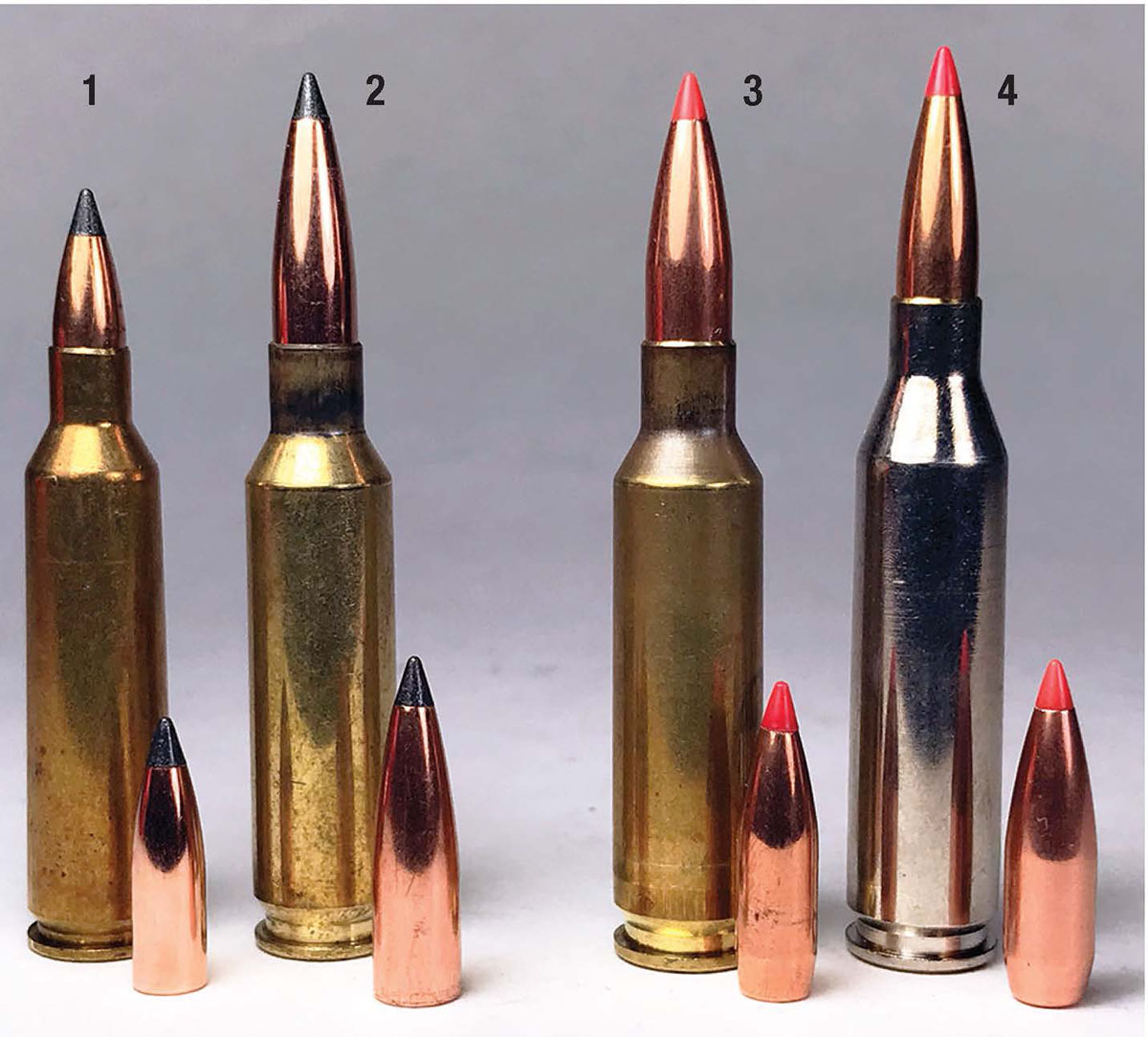
Varmint bullets for 6.5mm cartridges have a similar ballistic coefficient as .22- and .24-caliber varmint bullets. From left, the (1) 22-250 Remington is loaded with a Nosler 55-grain Varmageddon Tipped bullet that has a comparable ballistic coefficient to Nosler (2) 6.5mm 90-grain Varmageddon bullets. Hornady (3) 6.5mm-caliber 95-grain V-MAX bullets have a comparable BC to Hornady (4) .24-caliber 75-grain V-MAX bullets.
Creedmoor cartridges look deceptively short with these lightweight bullets seated. It would be
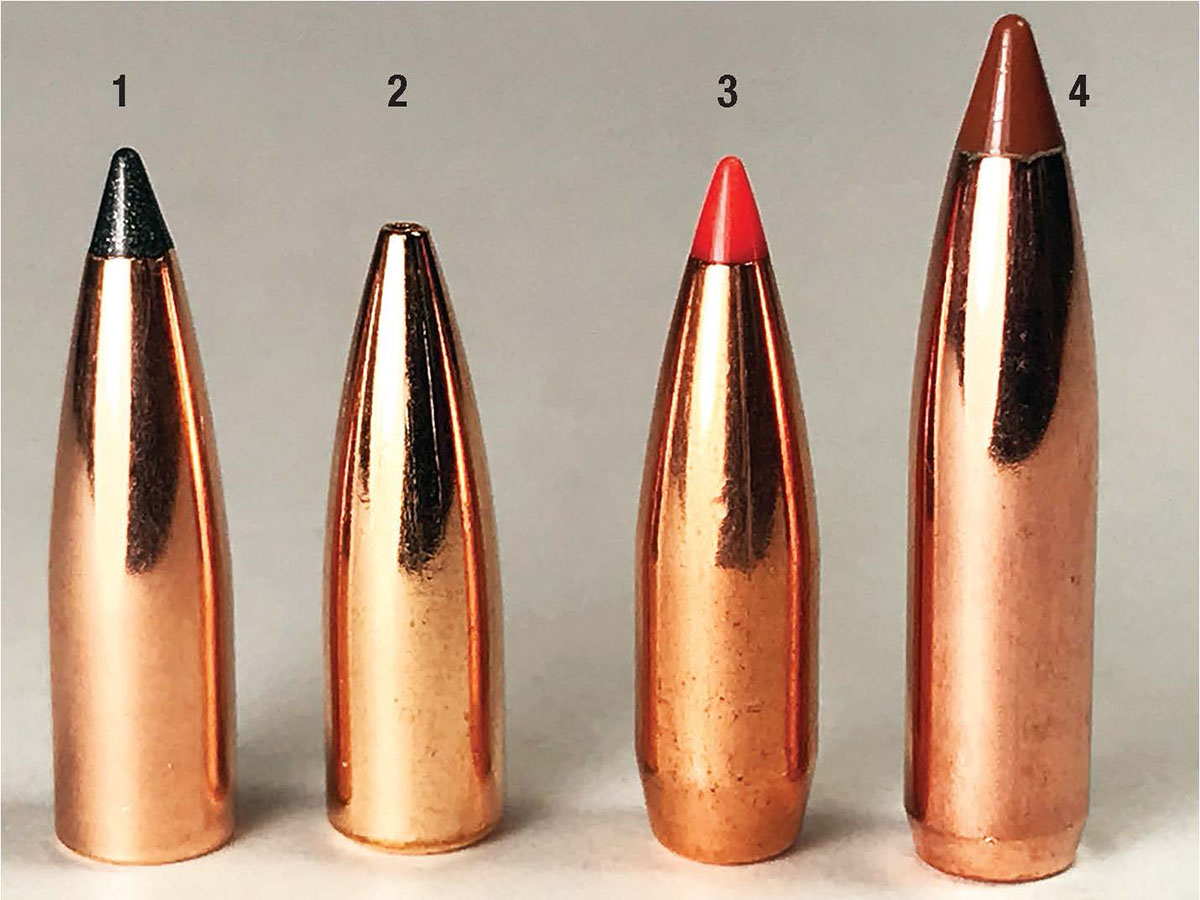
Bullets tested include the (1) Nosler 90-grain Varmageddon, (2) Speer 90 TNT HP, (3) Hornady 95 V-MAX, and for long-range shooting the (4) Nosler 120-grain Nosler Ballistic Tip.
tempting to seat these bullets so they were close to a cartridge length of 2.80 inches and contacting the rifling. But the base of Varmageddon bullets are only .225 inch inside case necks with a cartridge length of 2.70 inches, and the base of Hornady 95-grain V-MAX bullets are only .220 inch inside case necks with a cartridge length of 2.71 inches. That slight case neck hold on the bullets is fine for bolt-action rifles that gently shove cartridges from the magazine straight into the chamber. However, the bullets would most likely require deeper seating to securely hold them during the jarring ride from an autoloading rifle’s magazine into its chamber.
Actually, the cartridge lengths for the lightweight Hornady, Nosler and Speer bullets positioned the bullets quite close to the start of the rifling in the Sauer and Ruger American Predator rifles. Hornady V-MAX bullets sat .023 inch from contacting the Sauer’s rifling with a cartridge length of 2.71 inches, and Speer TNT bullets were .010 inch short of the rifling lands seated for a cartridge length of 2.70 inches.
I assembled 90-grain Varmaged-don and 95-grain V-MAX bullets with 42.5 grains of Varget. The Sauer 100 rifle shot three Varmageddon bullets in a .60-inch group and three V-MAX bullets .41 inch at 100 yards. Both bullets hit 2.25 inches above aim. At 300 yards, three Varmageddon bullets landed in 2.60 inches and V-MAX bullets in 3.5 inches, both dropping 3 inches below aim.
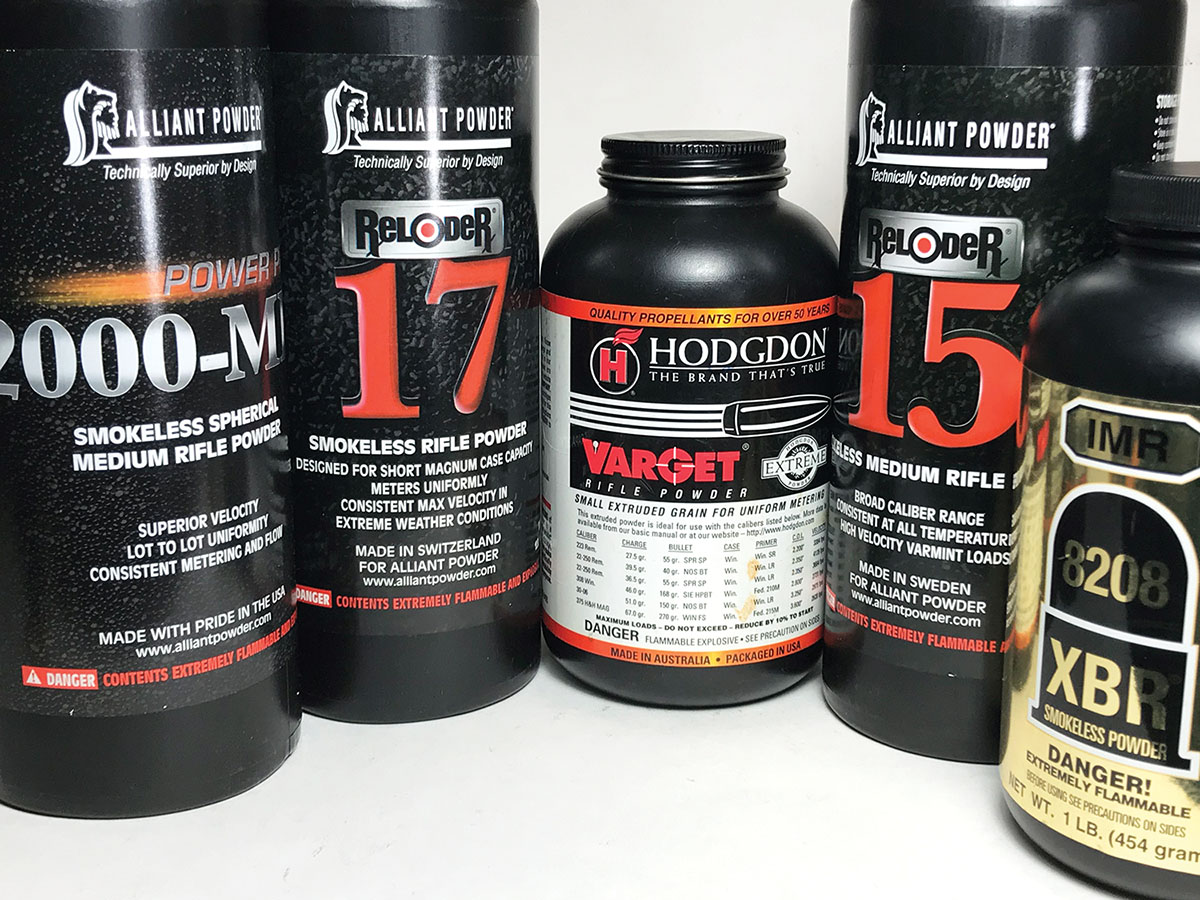
These powders worked well paired with varmint bullets in the 6.5 Creedmoor.
In comparison, my 22-250 Remington fires Varmageddon Tipped 55-grain bullets out of its 22-inch barrel at 3,750 fps. With the same sight setting at 100 yards for the 22-250, 55-grain Varmageddon and 6.5 Creedmoor shooting 90-grain Varmageddon bullets at 3,122 fps, the .22-250’s trajectory is 3 inches flatter at 300 yards, 9 inches flatter at 400 yards and has 16 inches less drop at 500 yards than the Creedmoor.
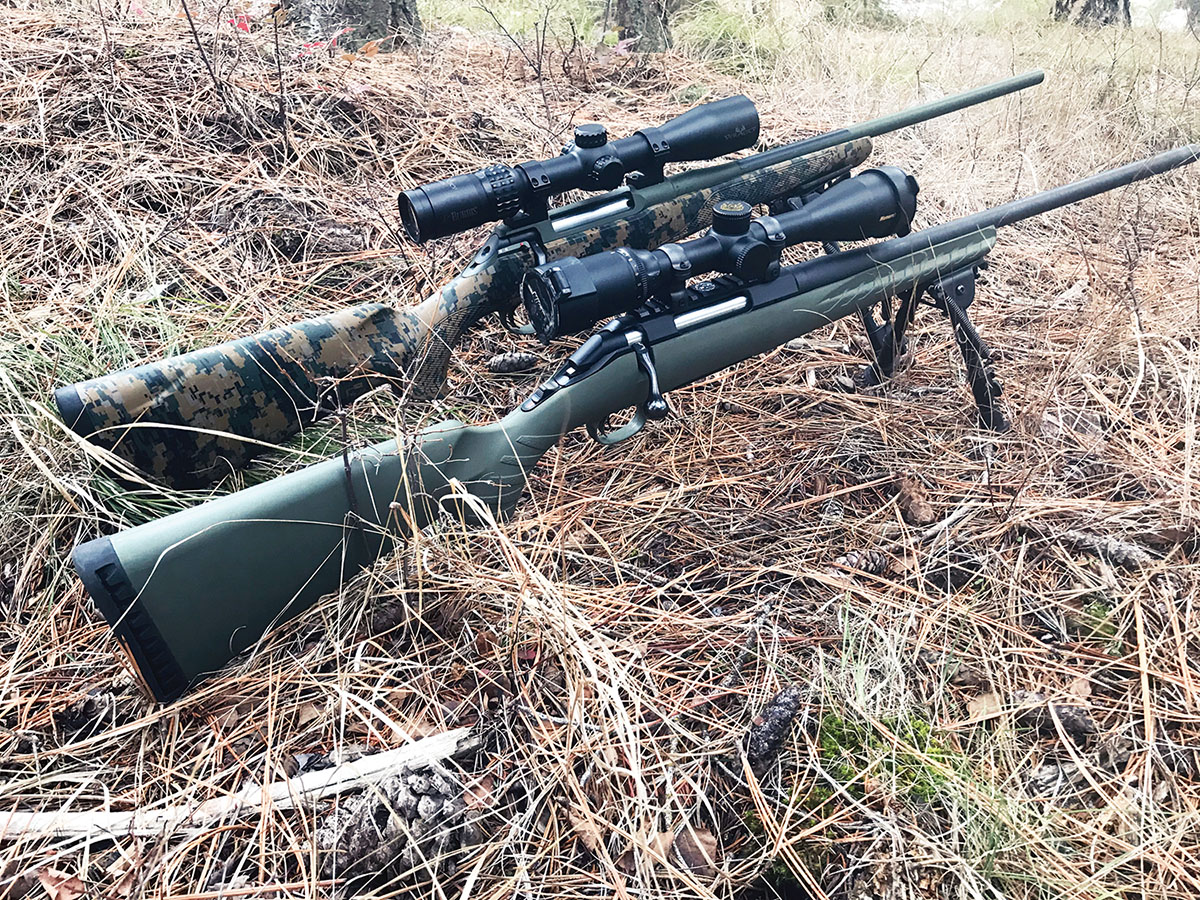
A Sauer Model 100 Cherokee (top) and Ruger American Predator were used to test the accompanying handloads.
In further contrast, my 243 Winchester fires 75-grain V-MAX bullets from its 24-inch barrel at 3,450 fps. Measuring the trajectory of the 75-grain V-MAX bullets to the 95-grain V-MAX at 3,179 fps, the 243’s bullet drops an inch less at 300 yards, 3 inches at 400 yards and 6 inches at 500 yards. Those fewer inches of bullet drop fail to provide the 243 with all that much of an advantage over the 6.5. The 6.5’s recoil is more noticeable than the 243’s, but that’s okay as the 6.5 Creedmoor is not a cartridge for all-day shooting at ground squirrels overrunning farm fields, although such shooting is fun. A slower pace of shooting marmots or a few shots at coyotes during a day is more the 6.5’s use.
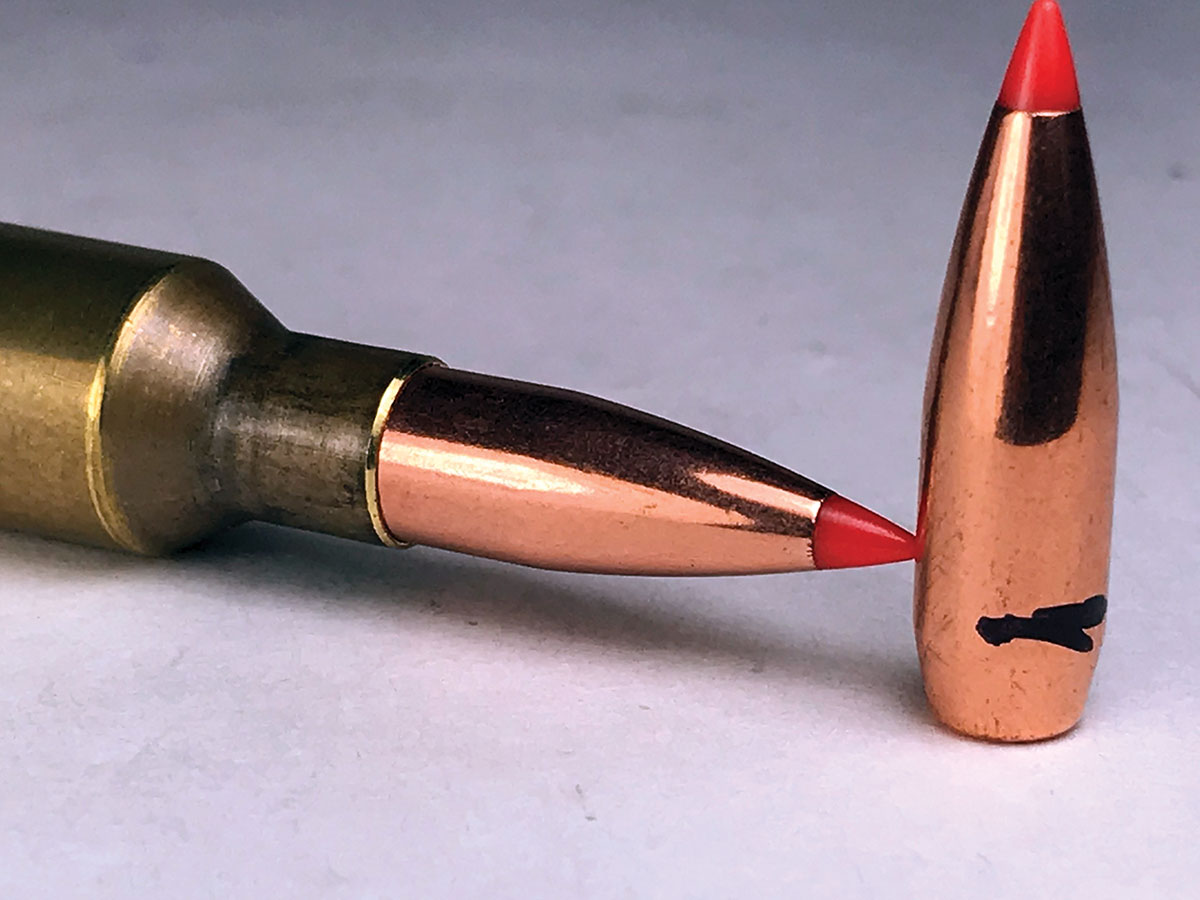
The base of Hornady 95-grain V-MAX bullets is only .220 inch inside case necks with a cartridge length of 2.71 inches.
Last spring when mountain valleys turned green, I packed my Sauer and fly rod and headed to the hills. Marmots chirped from a thinly-timbered hillside across a creek. Marmots ducked in and out of piles of old logging slash and perched for a moment at the tops. A clear shot between gaps in the trees at a sitting marmot at distances from 200 to 250 yards required some patience. The Sauer was steady with its forearm supported on my coat folded over a boulder. When a shot appeared, I sent a 95-grain V-MAX bullet on its way. Over a couple of hours I shot four marmots. That was enough shooting to keep my hand and eye polished.