22 Long Rifle
Ballistics Comparison
feature By: Patrick Meitin | October, 18
During an average eastern Oregon Belding’s ground squirrel shoot, for instance, while friends and I are generally there to put our latest centerfire rifles and/or loads through their paces, fresh 22 LR bulk packs – ripped open and set on the truck – are exhausted daily. We shoot the .22s between portable-bench setups. Thumbs develop blisters from loading high-capacity magazines.
Rimfire offerings in .22 caliber range from diminutive CB caps and Shorts to the nearly-defunct 22 Long, and the darling 22 Long Rifle. LR rounds are further divided into standard (around 1,150-1,250 fps), hyper (velocities beyond, say, 1,400 fps) and subsonic velocities (less than 1,050 fps). I’m most interested in faster hollowpoint loads – with some exceptions. I have shot small critters with roundnose 22 LR loads, but decisively anchoring burrowing rodents is preferable. Shoot a “gopher” or prairie dog, even terminally, with a roundnose bullet while it perches at a burrow entrance and odds are great it will reach its expiration date underground – they are hardwired that way. Hollowpoints just work better.
I am regularly asked which 22 LR ammunition is best for small varmints. Not so long ago I would say whatever you could get your hands on! The worm has turned, however, and sporting-goods shelves are once more graced with LR ammunition that remains available for more than hours. Yet 22 rifles are decided individuals. A particular load might shoot poorly from one rifle but cluster tightly from another. So I tested 15 varieties of ammunition from two rifles and three different barrel lengths.
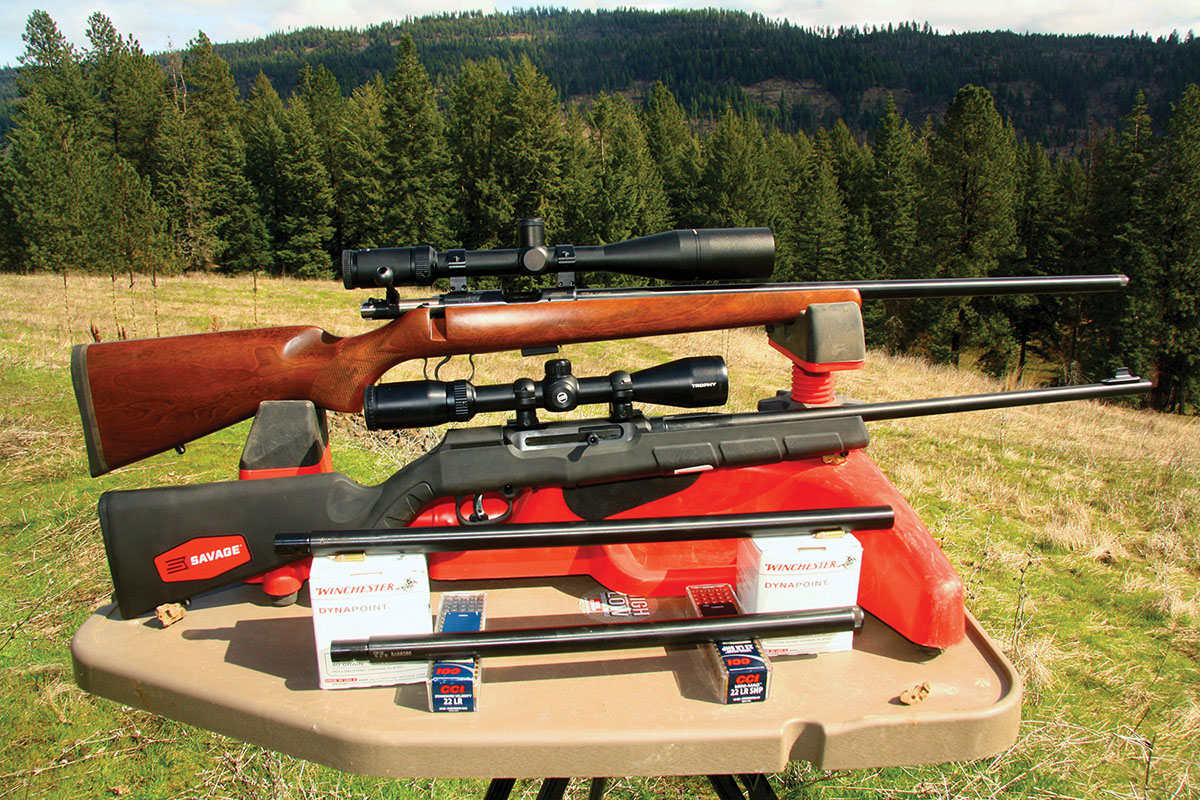
My biggest question was how 22 LR barrel length changes velocity. There are two schools of thought: One suggests rimfires function exactly like centerfires; longer barrels develop more pressure to boost velocities. The other is that the 22 LR, due to limited starting energy/velocity, sheds velocity by friction in barrels longer than a given optimum – say, 16.5 to 18.5 inches. Looking for a definitive answer I secured a bolt-action rifle with three different barrel lengths (16.5, 20.5 and 24 inches). An autoloading rifle with a 20.5-inch barrel was also included to determine if autocycling perceivably influences 22 LR performance.
The bolt rifle was a CZ 455 Varmint. It arrived with a heavy-contour, .866-inch varmint barrel (20.5 inches, 1:16 rifling twist), the novel interchangeable barrel system accommodating barrel-length velocity testing. Additional barrels used included 24-inch (“medium contour,” .71-inch) and 16.5-inch (.866-inch bull barrel) options.
The 455 Varmint features an integral 11mm steel dovetail scope rail and a five-round detachable magazine. The rifle weighed slightly more than 7 pounds and included a handsome Turkish walnut stock with a 13.75-inch length of pull. The user-adjustable trigger included a two-position safety that will prove “backward” to American shooters. The firing position is achieved by pulling back on the safety while the forward position is “safe.” The CZ was fitted with Weaver’s Kaspa 6-18x 44mm scope with side parallax adjustment and a superfine Varmint Fine Dual-X reticle for precision aiming. The one-inch scope includes covered turrets for easy range dialing.
The autoloader used was Savage’s A22, a sleek rifle operating by way of a straight-blowback system. It uses the same accuracy-enhancing, threaded headspace system as the company’s centerfire rifles, and its 20.5-inch barrel (.60-inch diameter at the muzzle) features a 1:16 rifling twist. Cartridges are fed from a 10-round rotary magazine. The synthetic stock and aluminum receiver make it lightweight (5.63 pounds) and easy-handling; its AccuTrigger provided a crisp, user-adjustable trigger pull. A Bushnell Trophy 4-12x 40mm scope with a one-inch tube and side parallax adjustment was used on this rifle. The Multi-X Reticle allows various hold-overs and .25-inch windage/elevation adjustments.
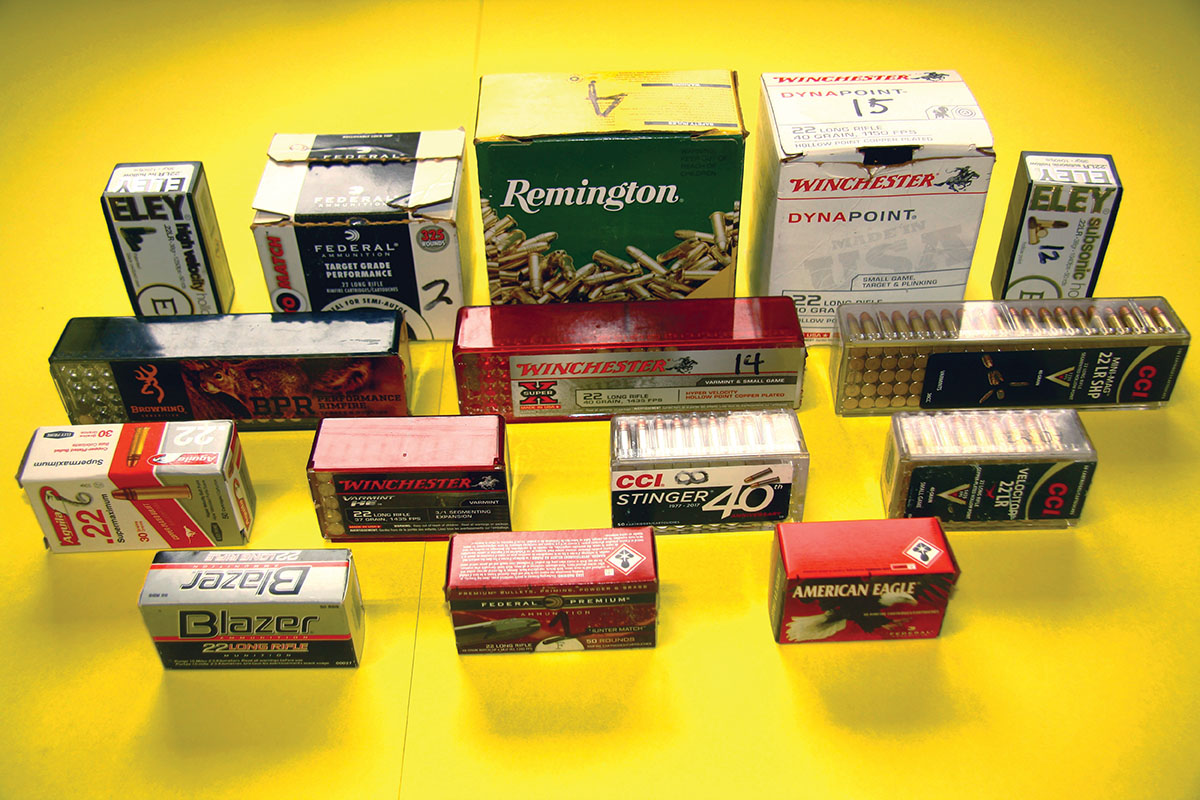
Fifteen 22 LR loads were chosen to reflect common velocities and price points. Included were “standard velocity” American Eagle, Federal, Blazer, Winchester and Remington ammunition, “high velocity” rounds from CCI, Browning and ELEY and “hyper velocity” loads from Aguila and CCI, and an ELEY subsonic load.
Hollowpoints dominate with exceptions including Aguila’s superfast Supermaximum with a light, flatpoint bullet, and Federal Auto Match and Blazer roundnose loads. The latter are included because they’re highly popular with budget-conscious shooters.
Testing simulated spring varmint shooting with a highly variable breeze blowing 5 to 12 mph and five-shot strings fired fairly rapidly (during wind lolls when possible). The barrel was allowed to cool while labeling target groups and/or changing targets, a 100-yard round trip. All shooting was conducted from an MTM Case-Gard K-Zone rifle rest.
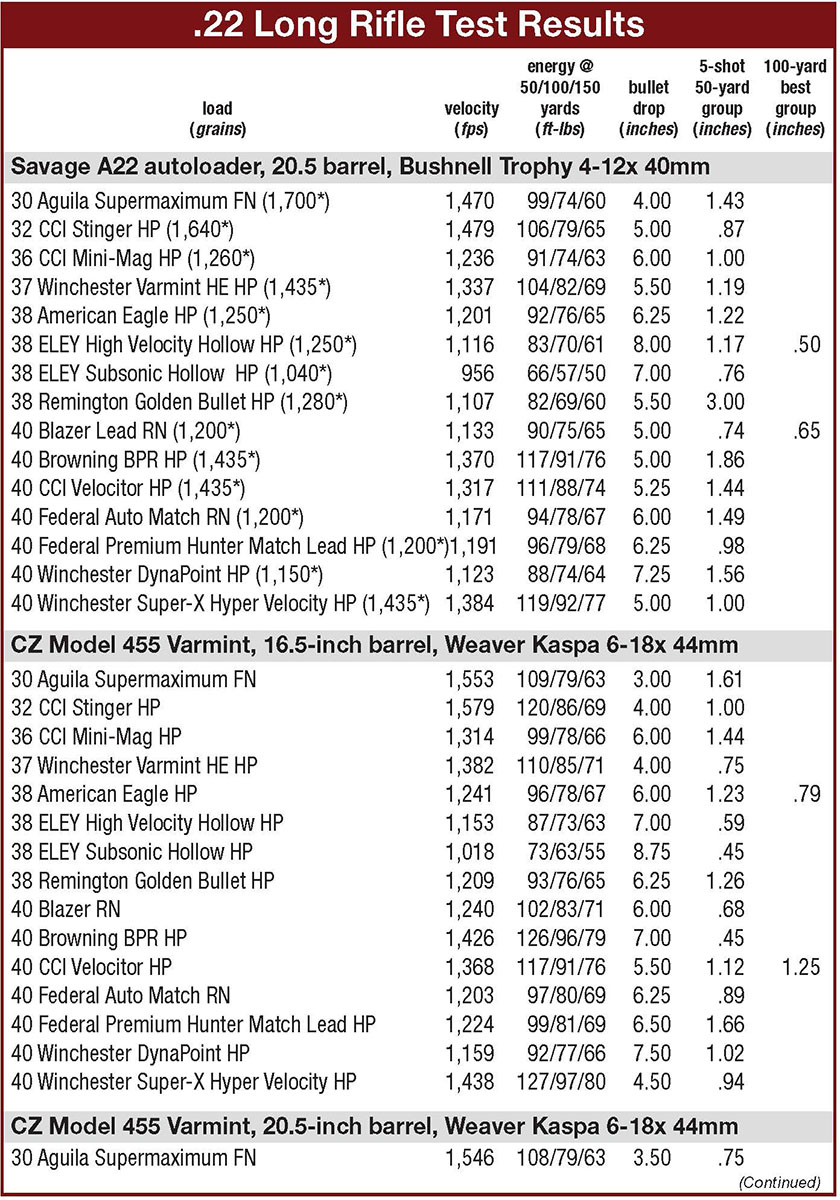
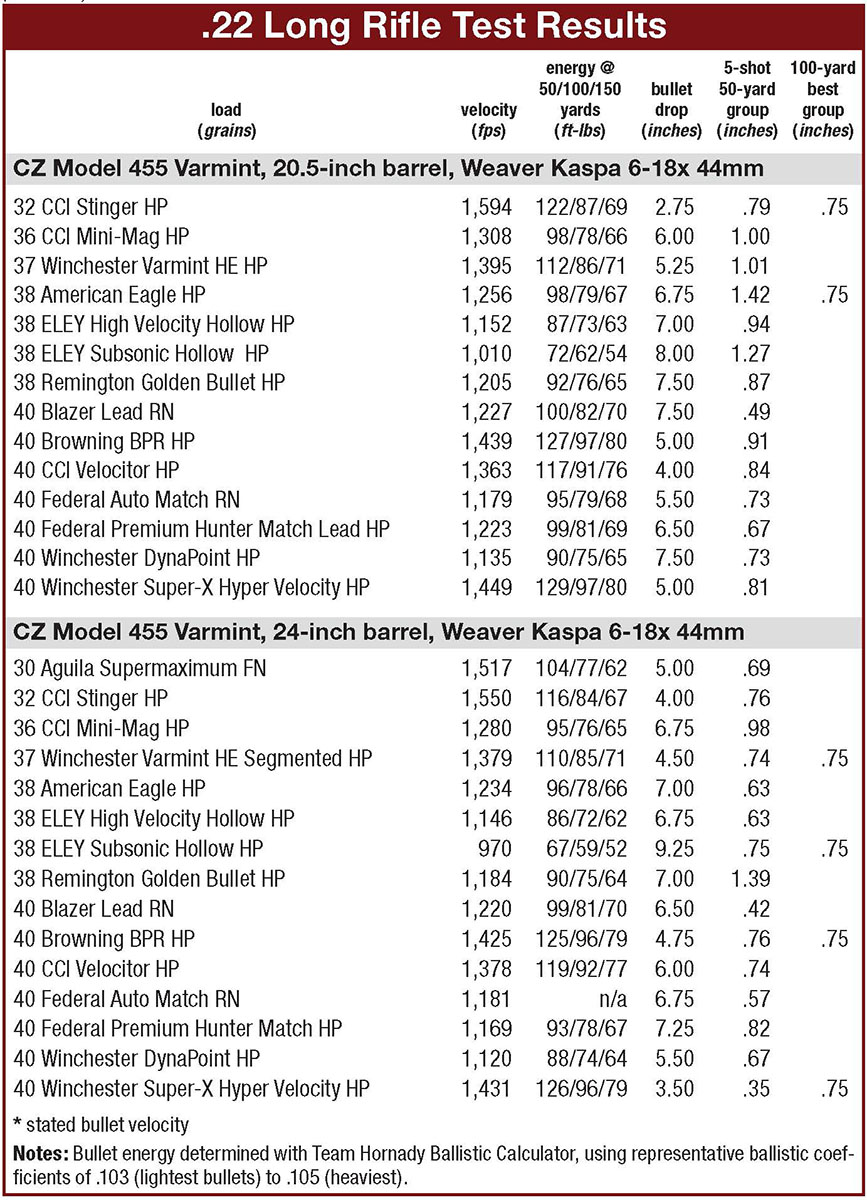
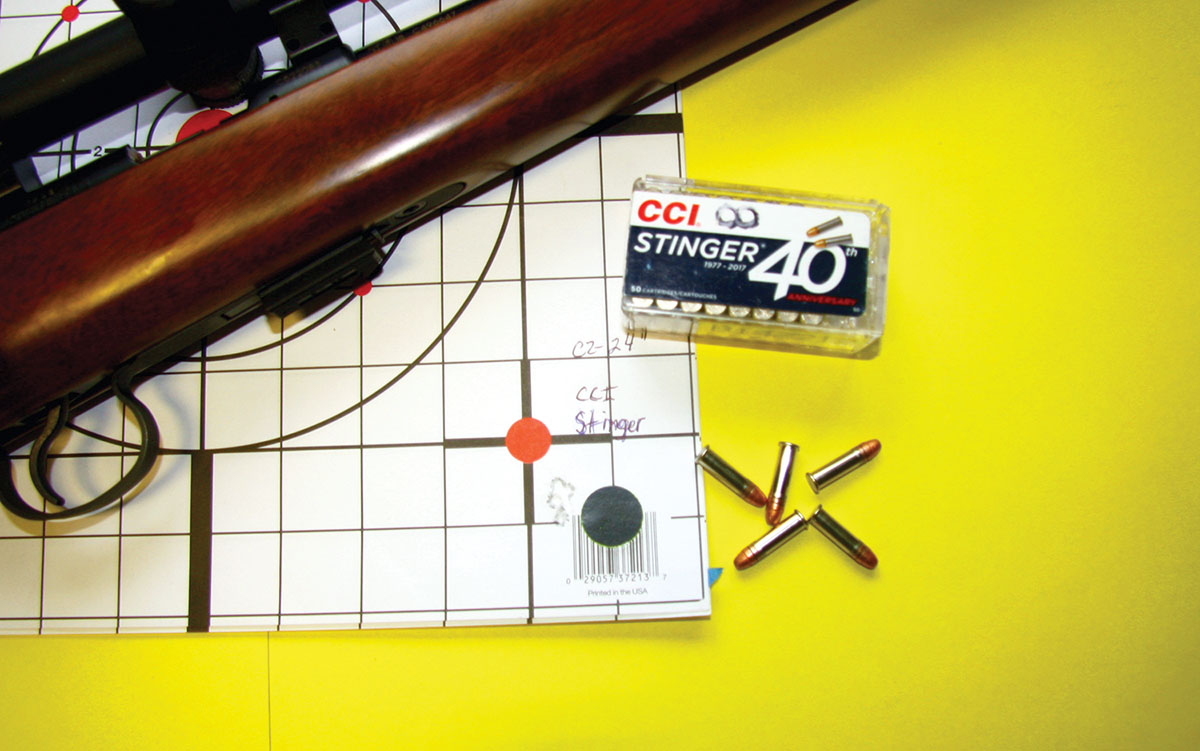
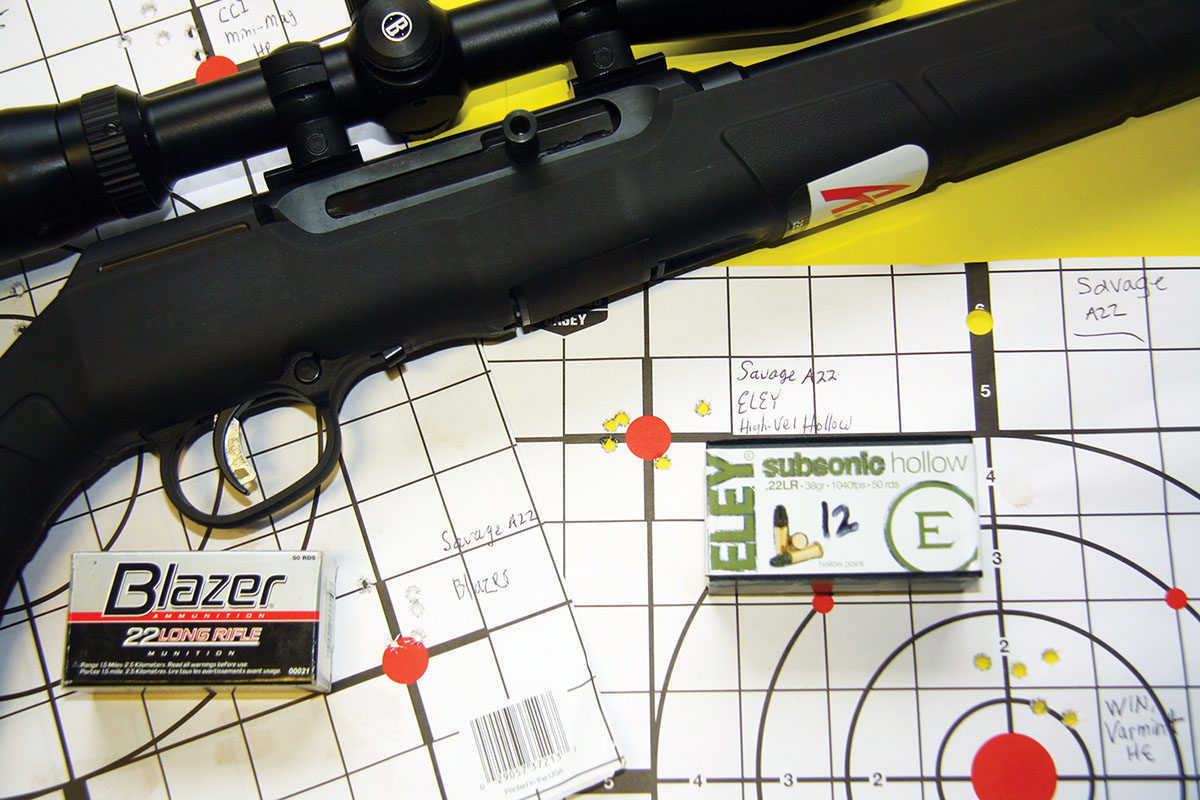
From the 20.5-inch CZ barrel Federal’s Hunter and Auto Match ammunition lived up to their labels; the latter, a roundnose, was accurate enough that I would confidently take head shots with this load/rifle combination. Overall, the 20.5-inch CZ barrel tolerated a broad spectrum of ammunition, from bargain-priced Remington Golden Bullet (which did not do well in the Savage A22) to the ultra-fast loads like Aguila’s Supermaximum, CCI’s Stinger and Velocitor or Winchester’s Varmint HE.
There were exceptions, like American Eagle hollowpoint loads that strung vertically. The Savage A22 printed a round, five-shot group well within ground-squirrel-vital parameters with the same load. Surprising, too, was the CZ 20.5-inch barrel’s lackluster accuracy with ELEY loads while the A22 assembled tighter groups. The CZ and Savage consumed all Winchester loads equally well. Second only to Remington’s Golden Bullet, the A22 performed disappointingly with Aguila’s Supermaximum, with which the CZ assembled decent groups.
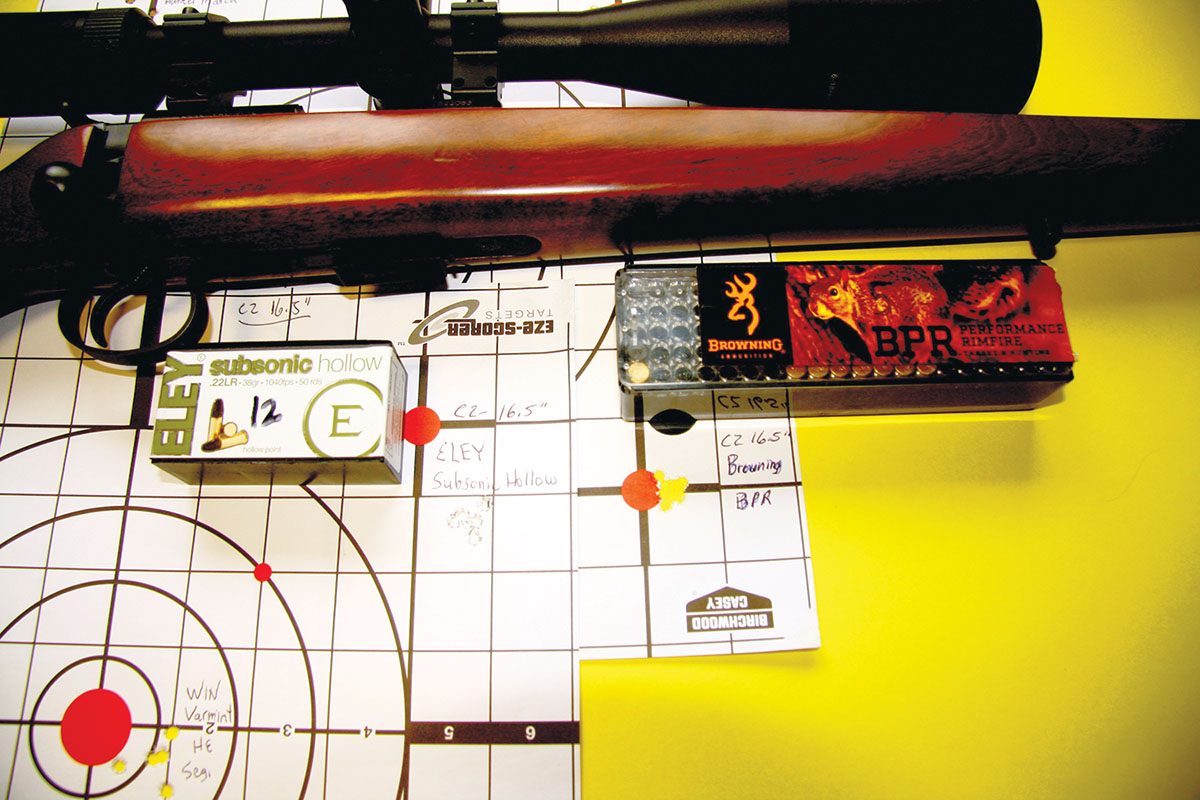
The 16.5-inch CZ barrel shot “minute-of-squirrel” groups with all loads, and bragging-sized groups with Browning BPR, Blazer and ELEY Subsonic Hollow. Decent groups were printed with all of Winchester’s loads, CCI’s Velocitor, Federal’s Auto Match and Remington Golden Bullet HP loads.
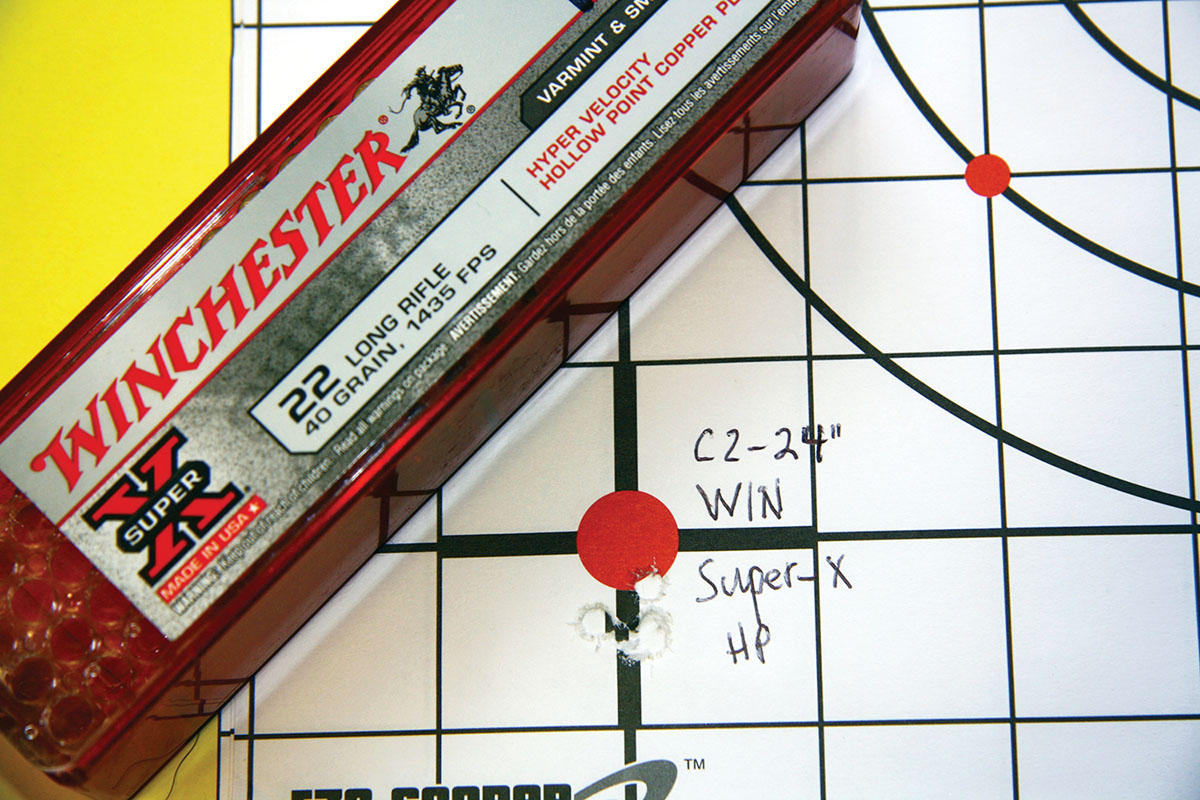
Switching to the 24-inch barrel, the CZ truly dazzled, printing tight groups with Federal Hunter Match, American Eagle, Browning BPR, Aguila Supermaximum and ELEY High-Velocity Hollow; acceptable groups with CCI Mini-Mag, Stinger and Velocitor, ELEY Subsonic Hollow, Winchester Varmint HE and DynaPoint; and awesome groups with Federal Auto Match, American Eagle, Winchester Super-X and, again, Blazer, which produced an honest one-hole group.
This convincingly demonstrates how different rifles/barrels show a decided preference for particular ammunition. Overall, top-five accuracy averages with all rifles/barrels included Blazer (.58-inch), Winchester Super-X HP (.78), ELEY Subsonic Hollow (.81), ELEY High-Velocity Hollow (.83) and CCI Stinger (.86).
Velocity testing involved two chronographs set end to end. Six shots of each ammunition type were fired from each rifle/barrel. The two chronographs did not provide identical numbers with each shot, so all were averaged. Rifles/barrels were not cleaned between test stages, again mimicking field conditions. Ammunition and rifles/barrels were shot in the order listed. Extreme velocity spreads were what I would deem suspect with reloaded centerfire ammunition, but not unusual. Again, I believed I would discover a notable velocity change in relation to barrel length, offering some easy rules of thumb to apply. This did not occur.
Generally, the Savage A22 posted lower average velocities than all of the CZ barrels. The highest average velocities were also generally delivered by ammunition with velocities of less than 1,300 fps from a 16.5-inch barrel, the 20.5-inch barrel averaging faster with ammunition producing velocities of more than 1,300 fps. Nearly all ammunition – CCI’s Velocitor being the single exception – were slower from the 24-inch barrel. Exceptions were seen in all areas.
Federal Hunter and Auto Match retained essentially the same velocities with like-length barrels between the Savage and bolt actions. Winchester DynaPoint ammunition lost 12 fps between the 20.5-inch A22 and 20.5-inch bolt rifle. With the remaining ammunition, velocity loss between the Savage and the CZ (with identical barrel lengths) ranged from -36 to -46 fps (ELEY High Velocity Hollow and CCI Velocitor, respectively) to -100 to -115 fps (Remington Golden Bullet and CCI Stinger, respectively). This can possibly be attributed to auto cycling, rifling diameter or barrel dynamics.
Velocity differences between the CZ’s 16.5- and 24-inch barrels offered more general trends with exceptions. Browning BPR loads posted nearly identical numbers while CCI Velocitor actually gained 10 fps with the longer barrel. The lowest losses between shortest and longest barrels occurred with Winchester HE (-3 fps), ELEY High Velocity Hollow and Winchester Super-X HP (-7 fps) and American Eagle (-10 fps). The greatest velocity losses occurred with Federal Hunter Match (-55 fps), ELEY Subsonic Hollow (-48 fps) and Winchester DynaPoint (-39 fps) loads, indicating that, for the most part, slower ammunition had more velocity loss in longer barrels than faster loads – though the two fastest loads lost 29 fps (CCI Stinger) and 36 fps (Aguila Supermaximum) in the longest barrel.
As a quick aside, out of curiosity I ran ELEY Subsonic Hollow and Winchester Super-X HP – slow and fast loads – through a suppressor to determine if velocity would be affected. There was no difference in average velocity.
Just for the sake of argument, assume a minimum of 65 foot-pounds (ft-lbs) of kinetic energy for convincingly anchoring ground squirrels, and 75 ft-lbs minimum for larger prairie dogs. On ground squirrels, Aguila’s Supermaximum, with its light 30-grain bullet, and ELEY High Velocity Hollow and Winchester DynaPoint loads were out at 150 yards. ELEY Subsonic Hollow was out at 100 yards.
When targeting prairie dogs, Remington’s Golden Bullet HPs were pushing the very limit at 150 yards. Aguila’s Supermaximum and ELEY High Velocity Hollow were out at 100 yards, and Winchester’s Dyna-Point just hung on at that range. ELEY Subsonic Hollow is barely adequate at 50 yards. Browning’s BPR, CCI Velocitor and Winchester Super-X HP were the hardest-hitting rounds at all ranges, especially at extended yardages.
After shooting more than 1,600 rounds of various 22 LR ammunition, I really believed I would be able to offer more definitive conclusions. That’s not the case, but I did come away with basic insights. On average the “shorter barrel boosts velocity” theory stands up. Still, I would lean toward accuracy when making buying decisions. In direct relation, when it comes to accuracy it is important to test as many different loads as possible to find that literal “magic bullet” an individual rifle prefers.
Most surprising was discovering that hyper-velocity ammunition is not as inherently inaccurate as I once believed. That’s good news – though some of the fastest, lightest bullets bled velocity and energy more quickly, proving no more potent than standard-velocity ammunition at extended ranges. Finally, it’s important to determine how much energy is available at the ranges you realistically expect to shoot in relation to the targets involved – tiny ground squirrels versus chubby prairie dogs or tough jackrabbits.