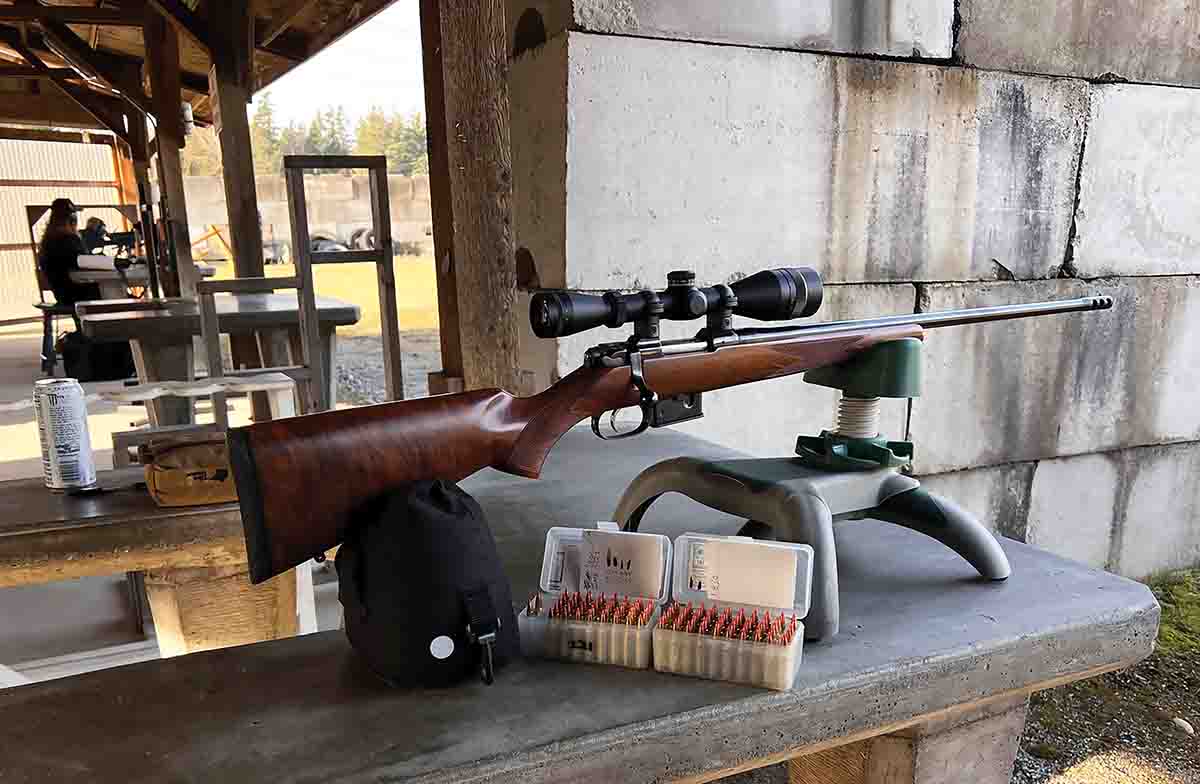
The CZ 527 chambered in 221 Fireball with Hornady 40-grain V-MAX bullets.
With the popularity of varmint hunting over the last few years, the 221 Remington Fireball has been coming back with some demand. Remington Arms Company created this special cartridge for its single-shot, bolt-action pistol, the XP-100. Remington had the 222 Remington but decided it did not need
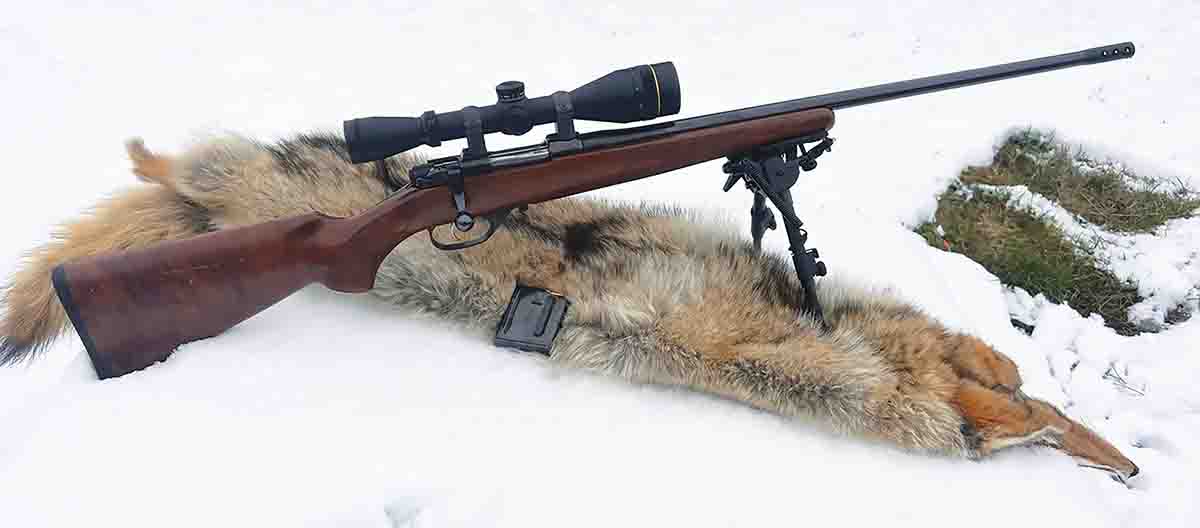
The CZ 527 with a coyote shot with a Hornady 40-grain V-MAX bullet.
as much powder capacity for a firearm with a shorter barrel to perform. Most pistol barrels ranged from 10 to 12 inches, but there are some up to 16 inches for use in competition. Therefore, Remington came out with the 221 Fireball to optimize performance in the pistols to help achieve complete powder burn in the shorter barrels. They did so by shortening the case length from 1.700 inches on the 222 Remington to 1.400 inches on the 221 Fireball, which reduces the case capacity by 5 grains of powder compared to the parent case, the 222 Remington… and just like that, Remington has a new cartridge! Rumor has it that they got the name for the cartridge from the fireball that was coming out of the shorter pistol barrels.
In 1985, Remington halted production of the XP-100 in 221 Fireball. Thompson/Center made a few various single-shot pistols chambered for the 221 Fireball as part of its Contender and Encore series. These were break-action pistols and rifles, different than the Remington XP-100, which was a bolt-action handgun.
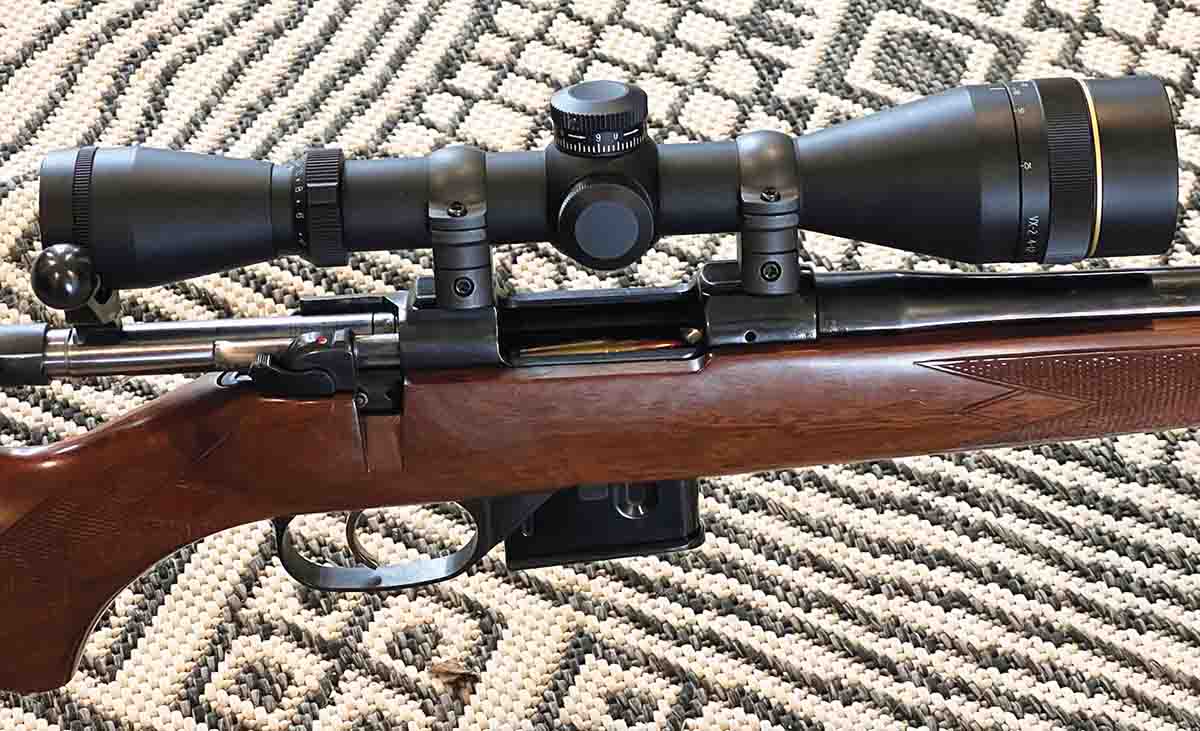
Zak uses a CZ 527 221 Fireball in its hunting setup with a Leupold VX-2 rifle scope 4-12x 40mm and its bipod.
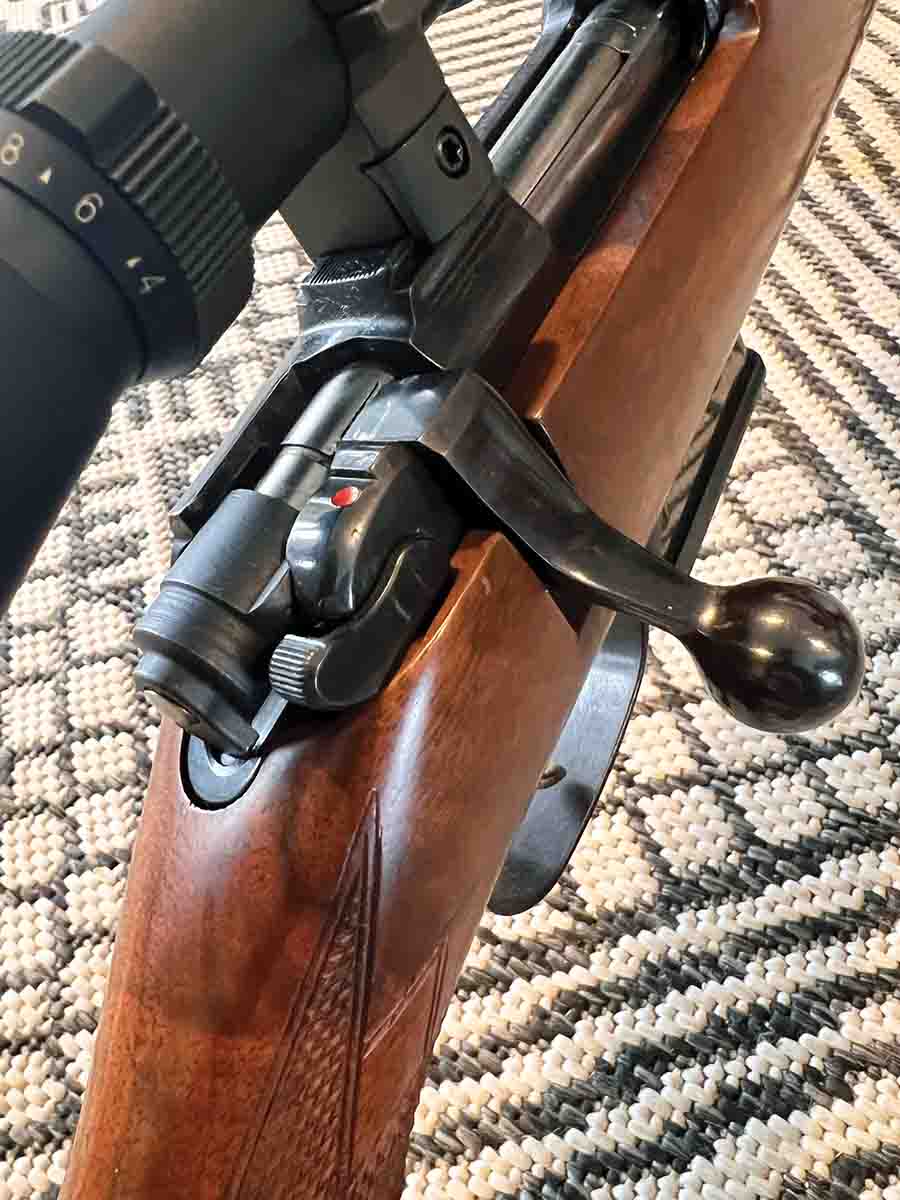
The safety on the CZ 527 is nice and quiet when going from safe to fire and is in a great place to use with your thumb.
Rifles chambered for the 221 Fireball include the Remington 700 with a few options for barrels, and CZ made a 527 featuring a micro-Mauser action with a Turkish walnut American pattern stock, along with a five-round detachable-box magazine and a barrel length of 21.8 inches. As far as I know, those are the two rifle manufacturers that ever made the 221 Fireball factory option. It would be really sweet if Howa chambered this in its Mini Action, but as of now, if you want that option, you will have to work with a gunsmith. But I do believe that’s how the bolt-action market is going these days with more and more custom rifles being made up each day.
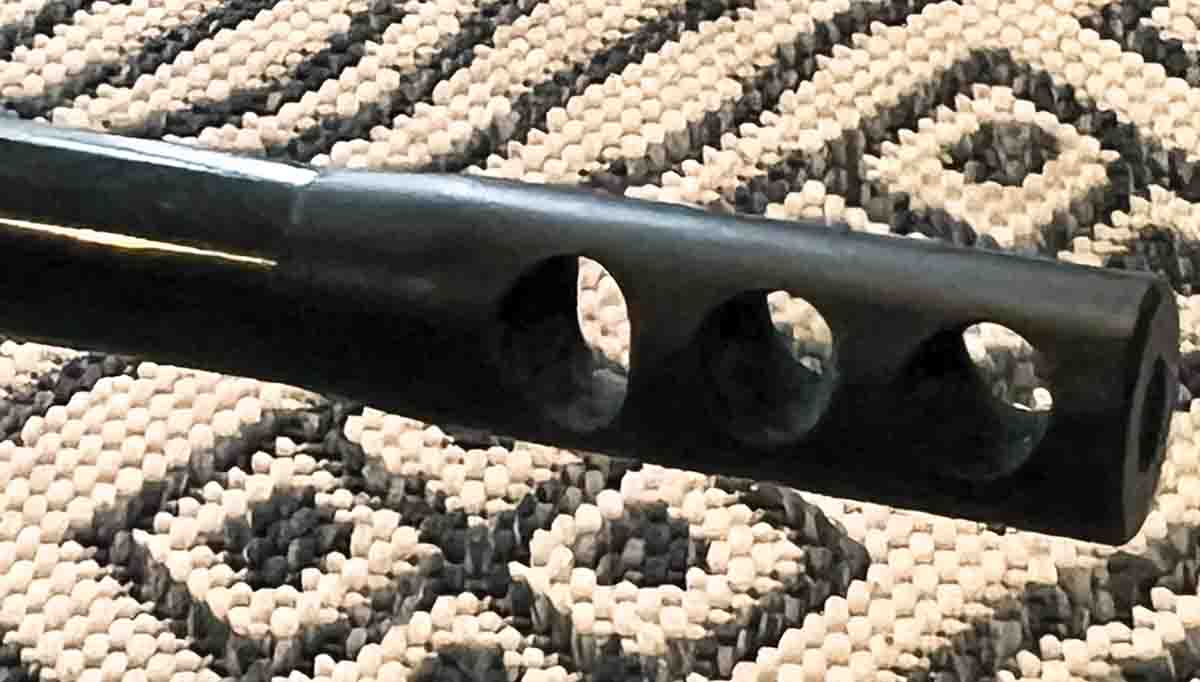
A three-port brake from Bench Mark barrels was installed and worked great. While the recoil is light, the brake allows the shooter to self-spot hits or misses.
When thinking about what cartridge to pick for varmint hunting, there are a lot of great ones to choose from, like 204 Ruger, 22-250 Remington and 223 Remington. But if you want a little cartridge that is efficient and can push 35-grain bullets to a 55-grain max and use little amounts of powder and still pick off groundhogs at 250 yards, then the 221 Fireball is a great option, the cool name is just an added bonus.
There are a few factory ammunition options on the market, Hunting Shack Munitions (HSM) loads 221 Fireball using the 55-grain Hornady V-MAX. This is one of the heavier bullet options for factory ammunition with a velocity advertised at 2,750 feet per second (fps) and muzzle energy of 924 foot-pounds. This is a great bullet option that is highly accurate and will expand at velocities as low as 1,600 fps, it’s also a great option for those who want to keep the pelt on a coyote, as I have only
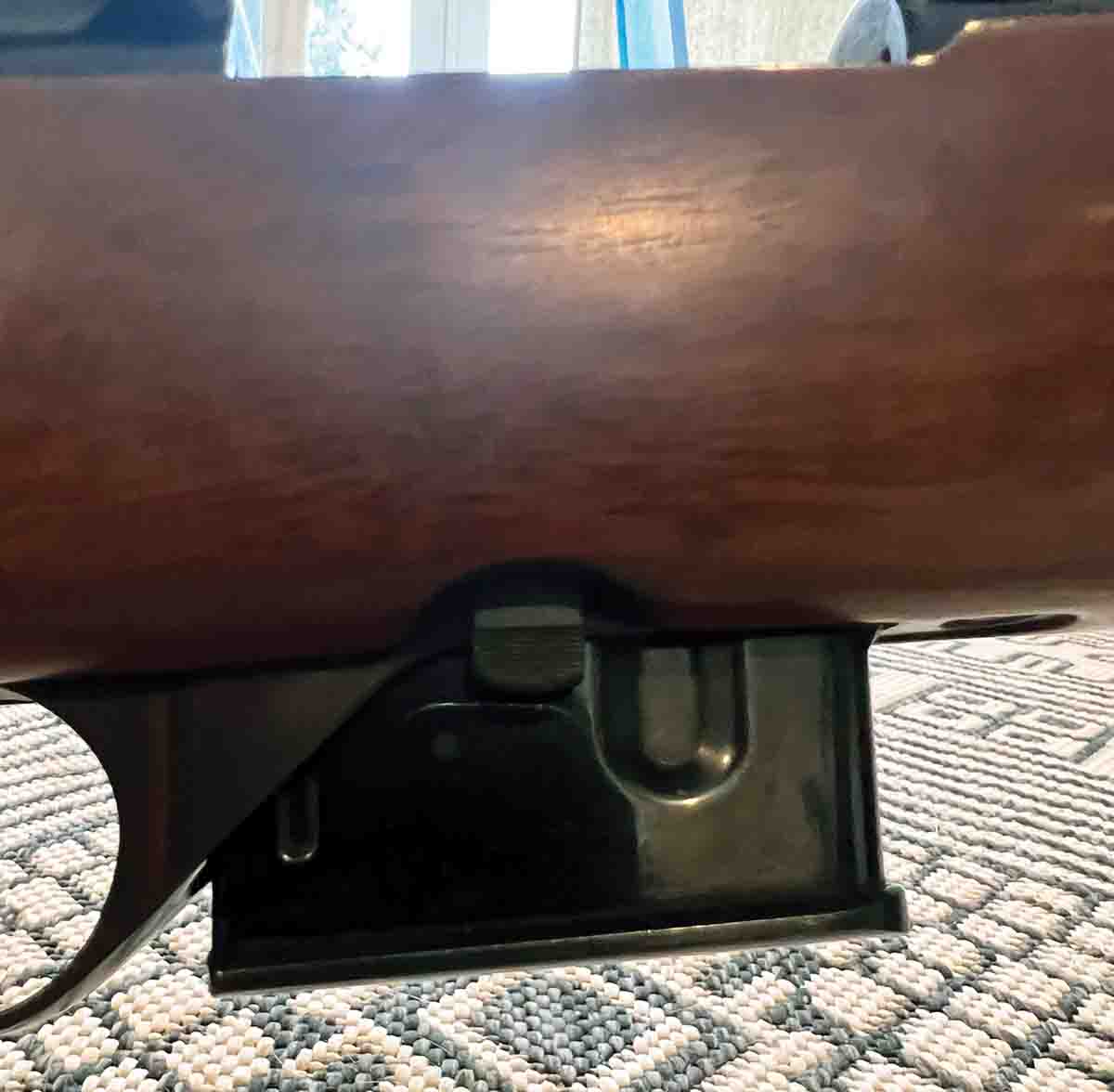
The CZ 527 features a detachable-box magazine that makes it ideal for long shooting sessions. Reloading is as easy as swapping magazines.
seen this bullet exit a few times. The second option is Remington Premier Varmint Ammunition using the 50-grain AccuTip boat-tail, which is the second heaviest factory option that I am aware of. Remington advertises velocities at the muzzle of 2,995 fps and muzzle energy of 996 foot-pounds. I have not shot this ammunition as it’s been impossible to get the last three years, so I can’t say how they perform. Nosler offers two options for the 221 Remington Fireball, which are my choice for factory offerings. They are a go-to for
.jpg)
varmints out to 250 yards. The first option is the Nosler Varmageddon using the 40-grain polymer tipped flatbase Varmageddon bullet with muzzle velocities advertised at 3,100 fps and muzzle energy of 853 foot-pounds. Option two for Nosler is the Varmageddon 221 Remington Fireball 40-grain hollowpoint flatbase with muzzle velocities advertised as at 3,100 fps and muzzle energy of 853 foot-pounds. The main difference between the two factory-loaded options is the ballistic coefficient (BC). The Nosler 40-grain polymer tip flatbase has a G1 BC of .211 and the 40-grain hollowpoint flatbase has a BC of .158. Therefore, if you will be shooting in any wind with any distance past 100 yards or more, you will be slightly better off going with the Nosler 40-grain polymer tip flatbase because that bump in BC will help fight the wind from pushing it off target.
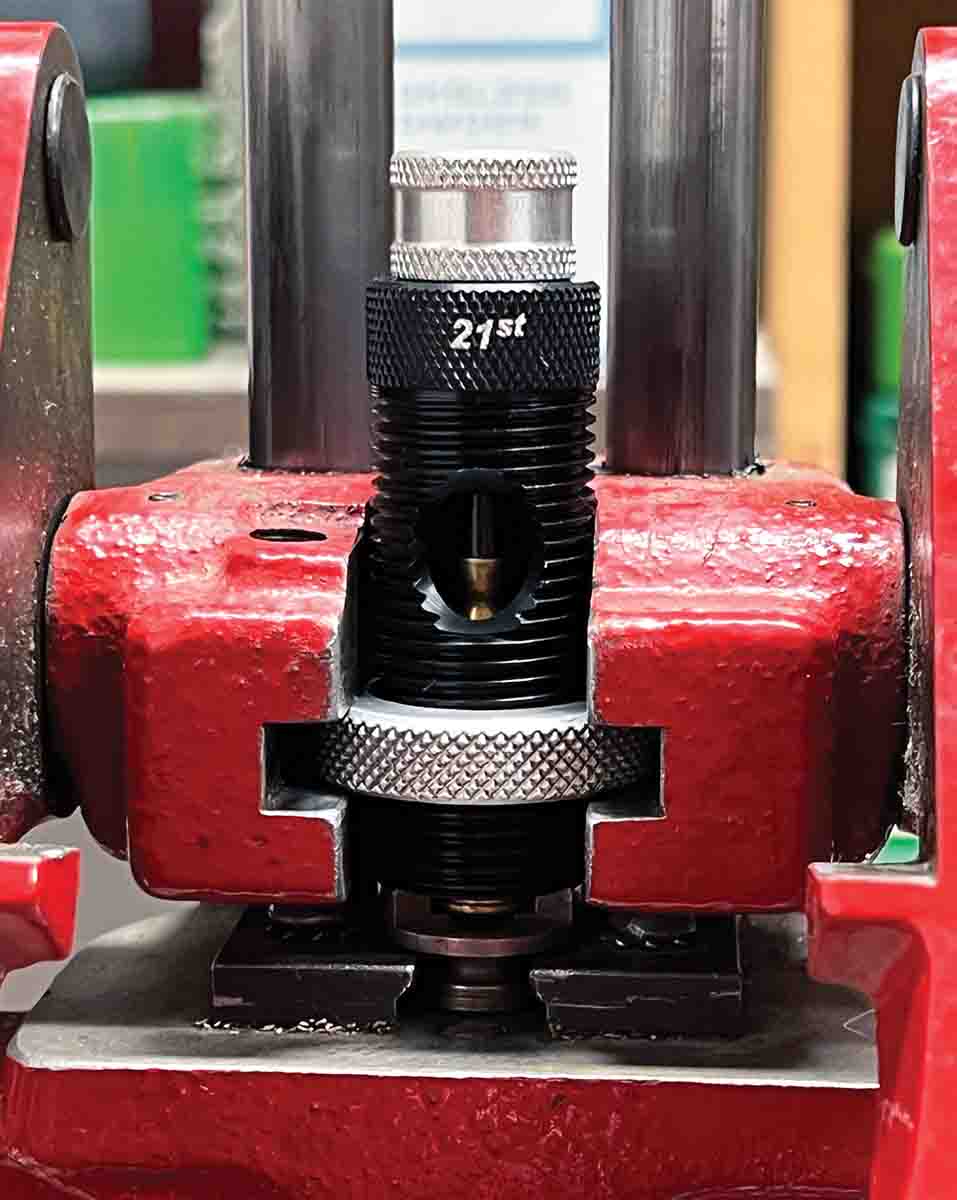
Setting the neck tension with a 21st Century expander mandrel die on the Forster Co-Ax press.
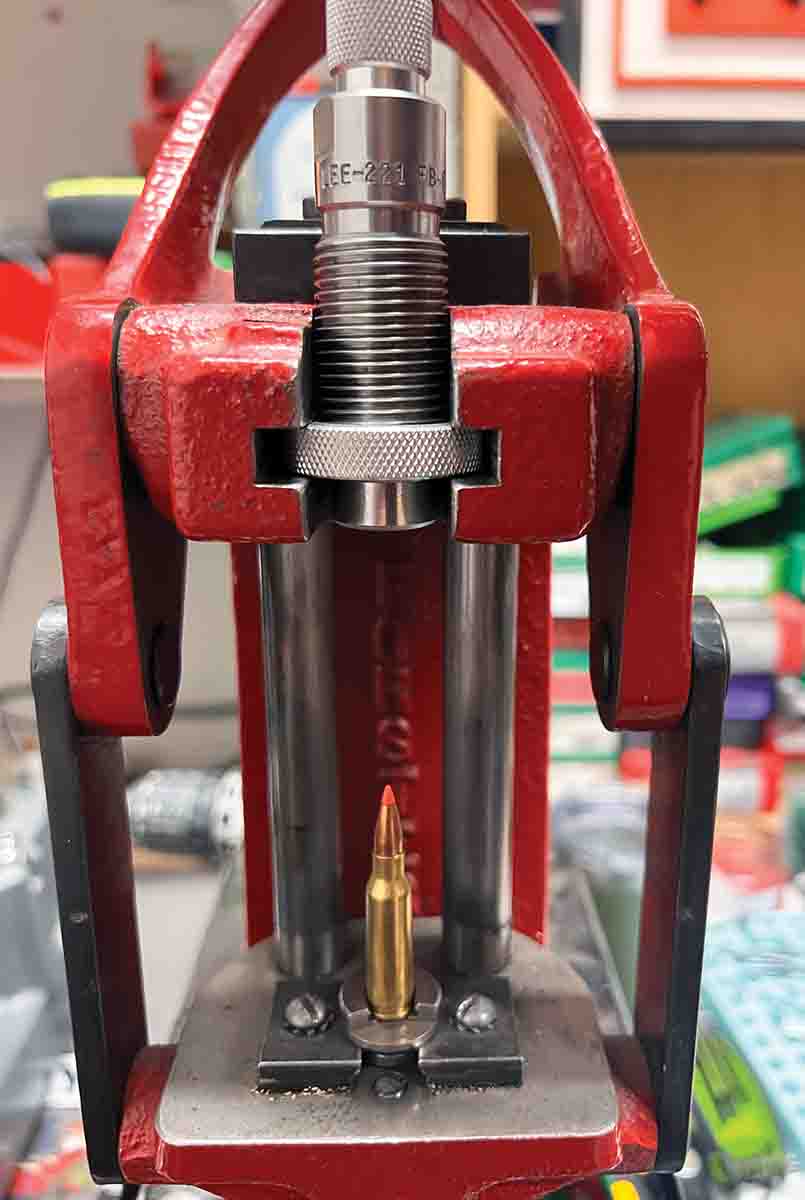
Seating a Hornady 40-Grain V-MAX in a Forster Co-Ax Press. The same press was used to prime all cases, which makes for great control when seating all primers to the same depth.
The 221 Fireball is just a speedy, sweet little cartridge that is fun to shoot. The CZ 527, retains all of the features that made it famous, from its forged square bridge receiver and controlled-round feed claw extractor to its single-set trigger by pushing the trigger forward until it stops. At that point, it’s a hair trigger to what the user has set it at and the hammer-forged barrel comes free-floated from the factory. The barrel has a 1:12 rifle twist, so it can stabilize the 35- to 55-grain bullets. I had a three-port break from Benchmark Barrels put on the end of it. With that on the end of the barrel, it keeps the gun on target so the shooter can spot impacts and watch that groundhog take a dirt nap and move on to the next one. Having the five-round detachable box magazine is nice for sitting on a bench and picking off groundhogs at 200 yards, when the magazine is empty, just slap a new loaded one in the gun and back to shooting groundhogs. Topping off the rifle is a Leupold VX-2 rifle scope 4-12x 40mm matte finish, this is a great optic for the use of the rifle. It allows me to engage targets up close and at practical ranges for most varmint hunting and predator-calling situations.
Handloading for the 221 Fireball is where the cartridge can shine. With a great variety of varmint bullets to choose from like Hornady V-MAX, Nosler Varmageddon, Barnes VARMIN-A-TOR, Berger FB Varmint, and Sierra SPT Varminter. However, this last bullet is a little hard and will not expand well at lower velocities. There is also a good amount of load data out there for pistols and rifles in the Hornady Handbook of Cartridge Reloading 11th Edition. There are two different sections for pistol and rifle data. A great source for data is also LoadData.com. It’s a go-to
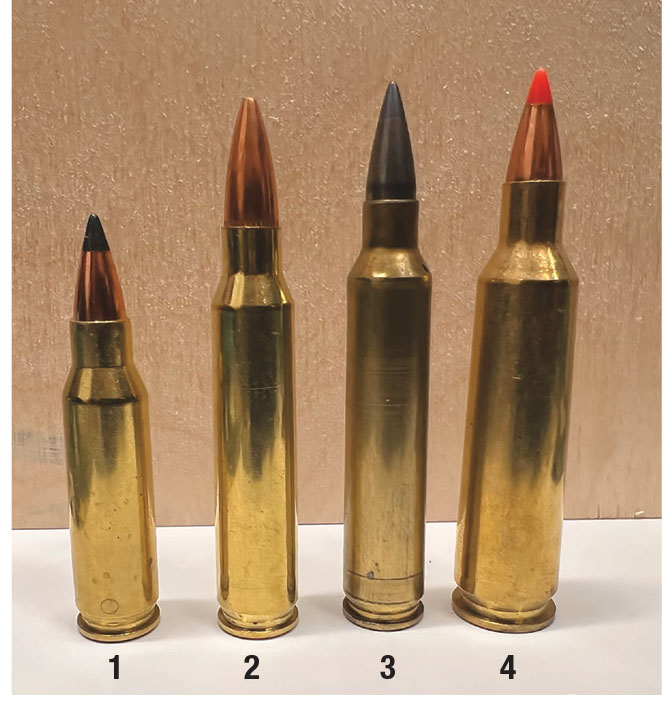
The lineup of varmint cartridges in comparison to the 221 Fireball: (1) 221 Fireball Nosler 40-grain flatbase tipped, (2) 223 Remington Nosler 62-grain flatbase hollowpoint, (3) 204 Ruger Hornady 32-grain V-MAX molly-coated and (4) 22-250 Remington Hornady 55-Grain V-MAX.
source for me when I need to start looking at what powder I might want to try. There are a lot of great powders for this cartridge, but the two I have had the best luck with are Alliant Reloder 7 and IMR-4198. Reloder 7 has proven to be a great shooting powder with all bullet weights for 35 to 55 grains. It also produces the best velocities, but IMR-4198 is right behind it. Shooters World offers a few great powder options as well. When it comes to brass, Remington, Lapua and Nosler make it and all are great options. I have seen some people use 300 Blackout brass when they have not been able to get factory bass. I have found that when it comes to primers, this cartridge is not too sensitive as I have tested five different well-known brands and the only thing it impacted was the point of impact on a developed load. Brass life, so far as I have seen, lasts a long time as long as you anneal, primer pockets have stayed nice and tight from my loading. In my experience, the point of failure has been splitting of necks, after several firings.
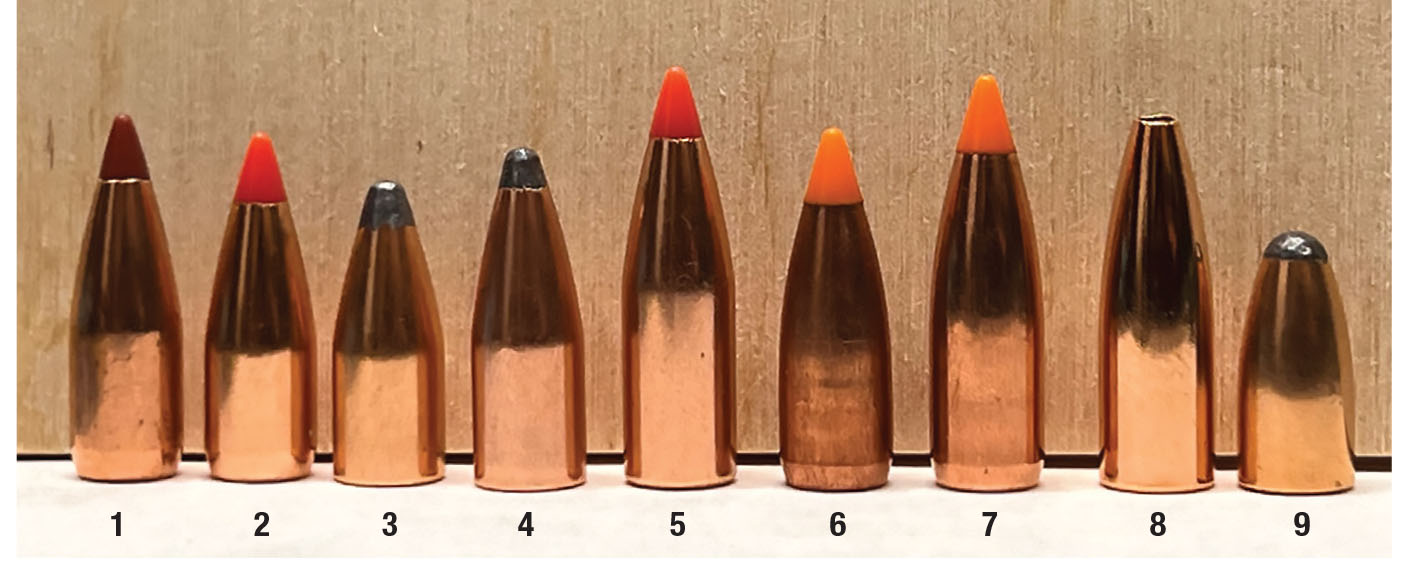
Bullets tested included: (1) Hornady 35-grain NTX, (2) Hornady 40-grain V-MAX, (3) Hornady 45-grain Hornet, (4) Hornady 50-grain SX, (5) Hornady 55-grain V-MAX, (6) Nosler 40-grain Ballistic Tip Varmint, (7) Nosler 50-grain Ballistic Tip Varmint, (8) Berger 52-grain flatbase Varmint, (9) Sierra 40-grain Hornet.
Reloading the 221 Fireball is pretty straightforward. I start the same way no matter if I am starting with new brass or fired. I start by inspecting the case for any nicks, cracks, or dents that might concern me. Then I anneal each case mouth and wet tumble for one hour to get any contaminant off the case, then it goes into the air dryer for two more hours. After drying, I put all my clean and shiny brass into trays and they’re ready for sizing. To complete this operation, a full-length sizing die from Lee Precision was used but the expander ball was removed, cases must be lubed prior to resizing.
After all the cases have been full-length sized, it’s time to switch over to an expander mandrel from 21st Century Innovation, there are a lot of great
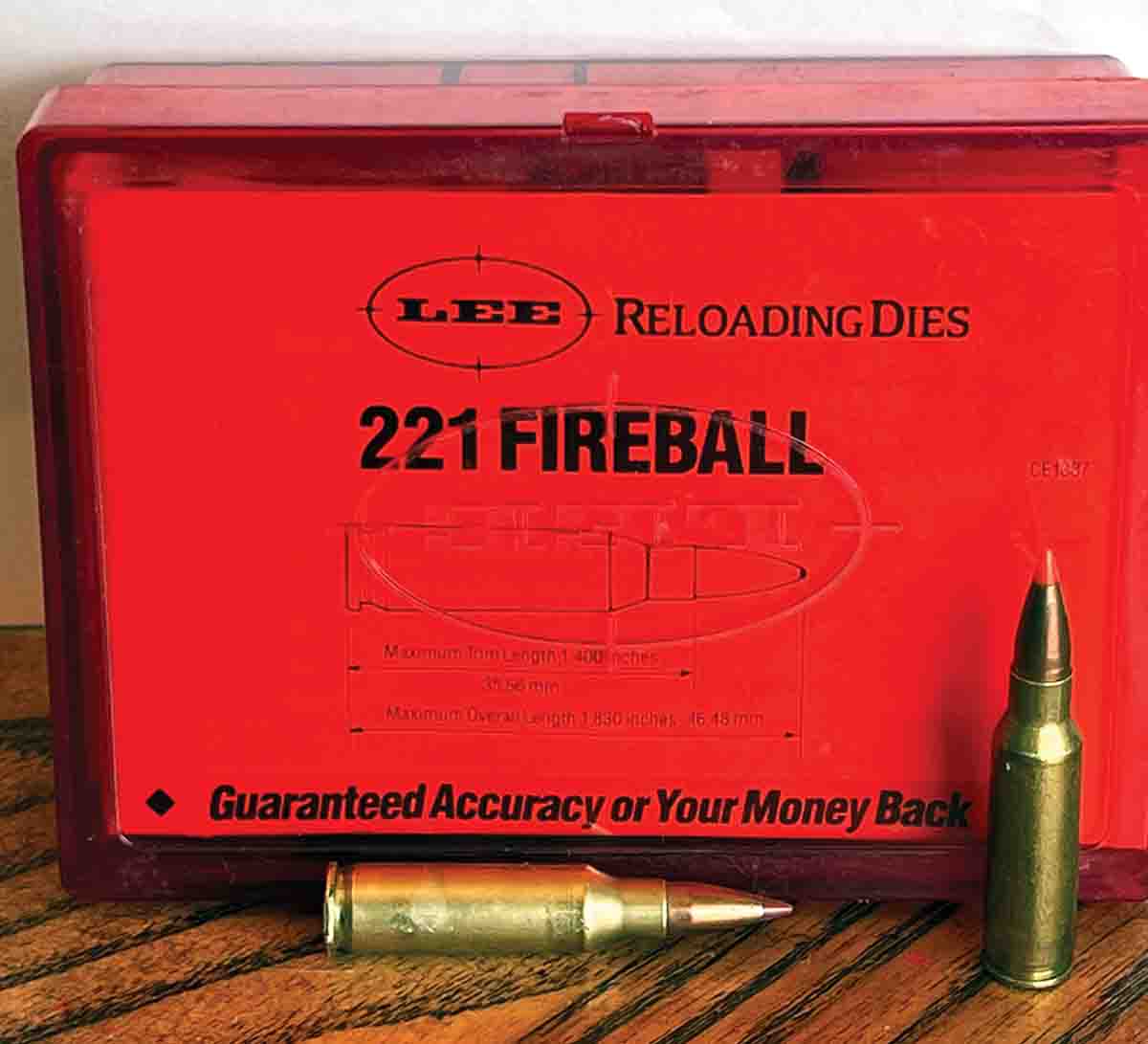
A set of Lee Precision Reloading Dies was used for sizing the brass and seating the bullets.
companies that make these. I use a .222-inch sized mandrel for most .224 caliber cartridges that I
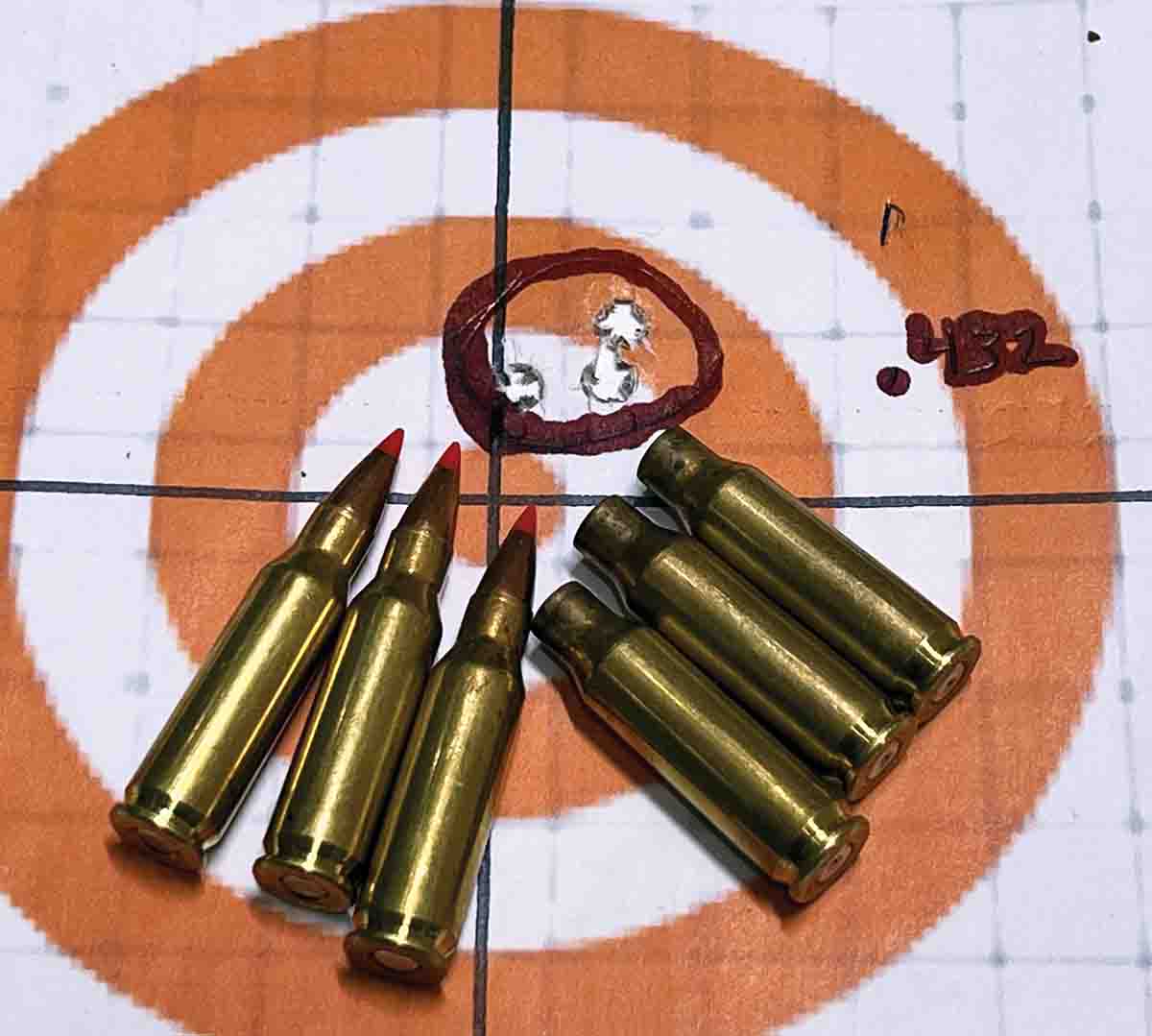
A target of the best group shot with Hornady V-MAX 40-grain bullet using Alliant Reloder 7 and CCI Small Rifle No. 400 primers. It produced a .432-inch group and an average of 3,067 fps.
load as it seems to work out to be the best overall. Once those have been run through the mandrel, it’s time to check with a pin gauge to make sure the brass is set right. After we confirm that all case mouths are properly expanded, it’s time to check case length to see if trimming is required. After trimming, the case mouth is deburred and chamfered. I then put the brass into a dry tumbler with large grain rice for 30 minutes to clean the lube off the brass and inside of the necks. This saves time from wiping each case individually with a rag to remove the lube. Once the 30 minutes are up it’s time to prime each case. As stated previously, this cartridge does not seem to be too picky when it comes to primers. However, the best results in the test rifle were with CCI 400 primers in regard to consistent velocity and group size. Once primed, the cases are ready to be charged and a bullet is seated on top of that. No crimp is needed as the neck tension is already set using the expander mandrel and all loads were tested using a bolt-action rifle.
A few loads stood out to me during testing and they are as follows. Using the Hornady 35-grain NTX with 15.5 grains of IMR-4227 powder and a case overall length of 1.750 inches, the average velocity was 3,345 fps. This was below Hornady load data maximum, and there were no pressure signs. With the Hornady 40-grain V-MAX with 18.5 grains of Alliant Reloder 7 powder and case overall length of 1.830 inches, average velocities were 3,067 fps. The load using the Hornady 45-grain Hornet with 17.3 grains of IMR-4198 powder, and case overall length of 1.825 inches, average velocities was 3,078 fps. This is at Hornady max load data and I did notice a little primer cratering with this load. The load, using the Hornady 50-grain softpoint with 18.5 grains of Alliant Reloder 7 powder, and case overall length of 1.825 inches, average velocities were 3,050 fps. This load is a maximum load and did not exhibit any pressure signs. This brings us to the Hornady 55-grain V-MAX with 13.5 grains of IMR-4227 powder and case overall length of 1.830 inches that had average velocities of 2,681 fps. This was below Hornady’s max load data, there were no signs of pressure.
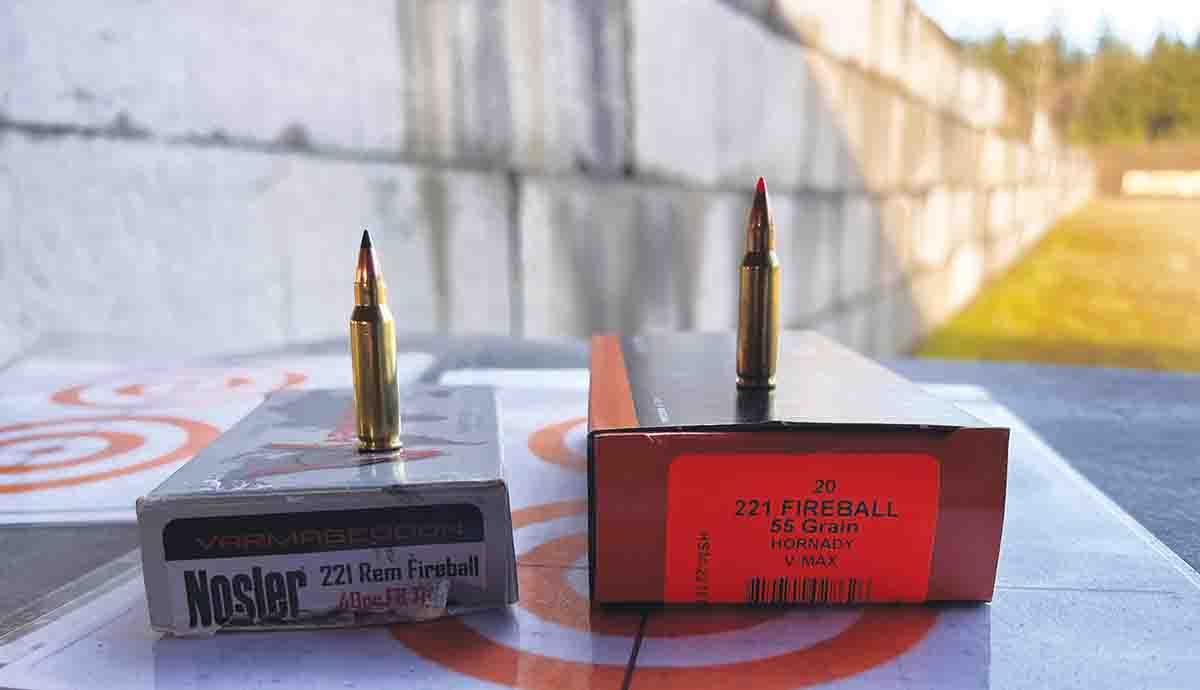
Factory ammunition was chambered in 221 Fireball Nosler 40-grain flatbase tipped (left) and HSM 55-grain Hornady V-MAX (right).
Moving on from Hornady bullets to Nosler bullets. The Nosler 40-grain Ballistic Tip Varmint with 14 grains of Winchester 296 powder and case overall length of 1.830 inches, the average velocity was 3,012 fps. This was at Nosler max load data, but in my gun, I saw no signs of pressure. The addition of a crimp with this load may help more consistent powder burn. Switching over to the load containing the Nosler 50-grain Ballistic Tip Varmint with 18 grains of Alliant Reloder 7 powder, and case overall length of 1.830 inches. The average velocity was 2,922 fps. This is a max load, I did start to see some mild pressure signs with these loads, so use caution when approaching the maximum charge weight.
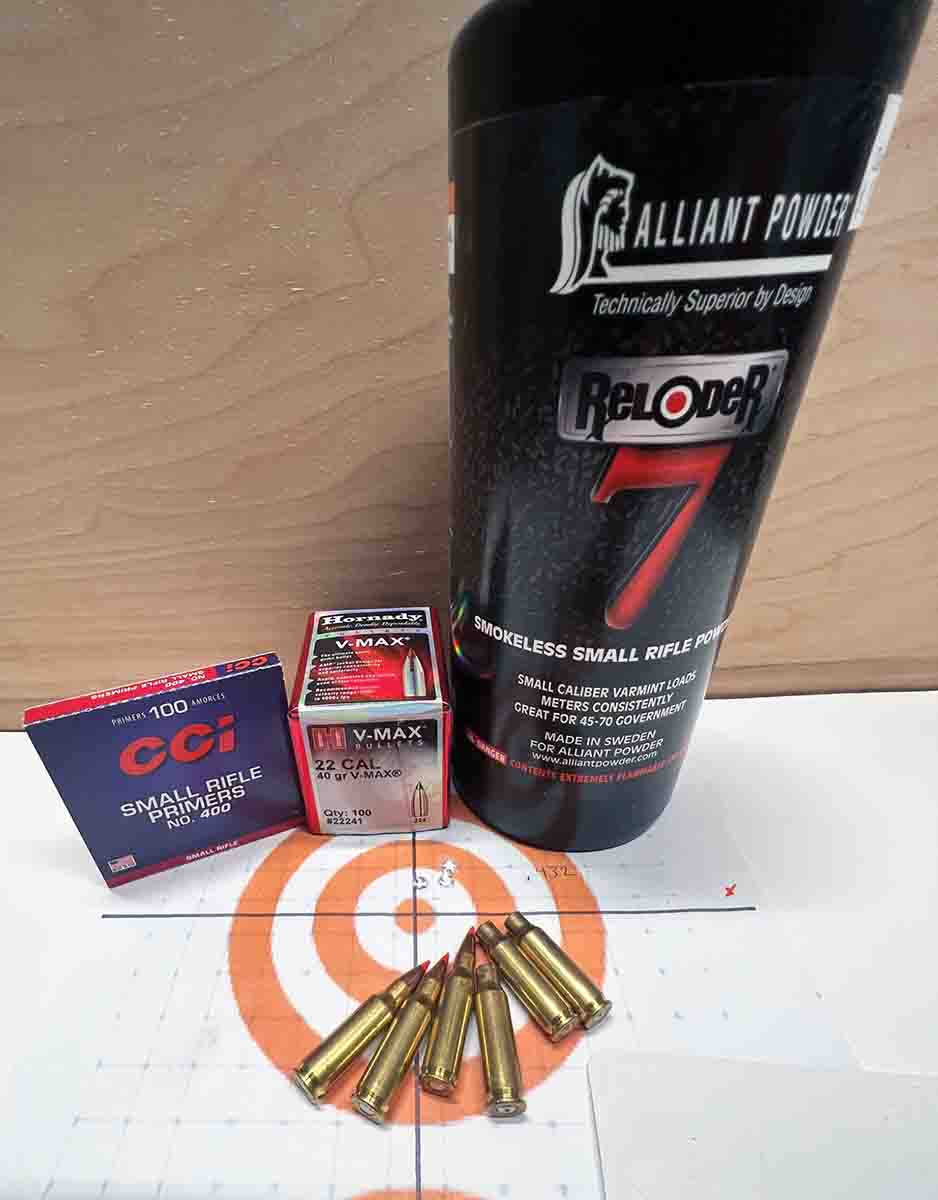
The target and the components used resulted in this three-shot group at 100 yards. Components consisted of Alliant Reloder 7, CCI Small Rifle No. 400, Hornady 40-grain V-MAX and Remington brass.
With the Berger 52-grain flatbase Varmint with 17.5 grains of Ramshot X-Terminator powder and an overall length of 1.830 inches, average velocities were 2,680 fps. This was right in the midrange between the minimum and maximum charge weights and could allow for some room for experimentation.
Switching to the Sierra 40-grain Hornet Varminter with 13 grains of Ramshot Enforcer powder and an overall length of 1.825 inches, average velocity was 2,910 fps. Out of all the powder and bullets listed, two powders were tested per bullet. The ones listed are what I would take into the field for use in the varmint-hunting world. If I had to just pick one, I would probably pick, Hornady V-MAX 40 grain with Alliant Reloder 7 combo.


.jpg)