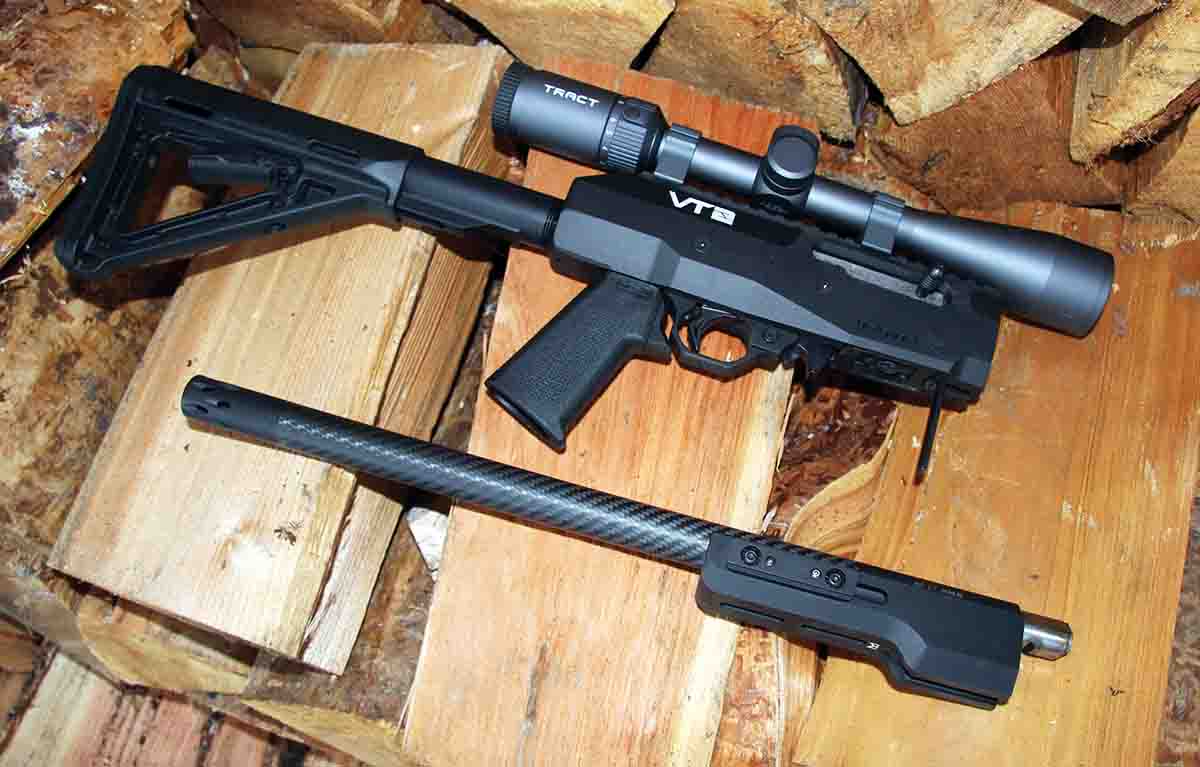
Volquartsen’s VT2 Takedown Rifle can be disassembled and reassembled in a matter of seconds using an ingenious integral system requiring no tools.
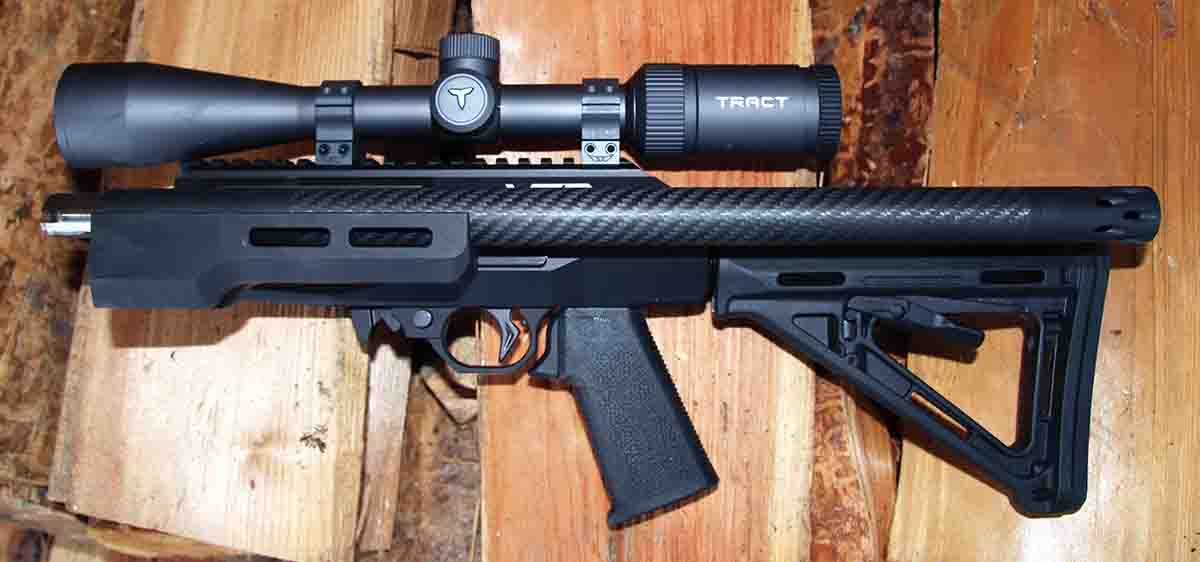
Dovetails on the receiver and forearm allow joining the two pieces of the Volquartsen VT2 Takedown Rifle to create a neat package.
Volquartsen is to the rimfire world what Ferrari is to sports cars – performance-driven and truly iconic. Hornady’s 17 HMR, affectionately labeled the “Hummer” by many fans, is indisputably the king of magnum rimfires, at least based on popularity, if not sheer velocity. Combine all these elements and we have something wonderfully special. Add the ability to quickly break that rifle down for more compact transport or storage, while also maintaining Volquartsen’s renowned rimfire accuracy and you have something truly extraordinary. That is the relatively new Volquartsen VT2 Takedown Rifle.
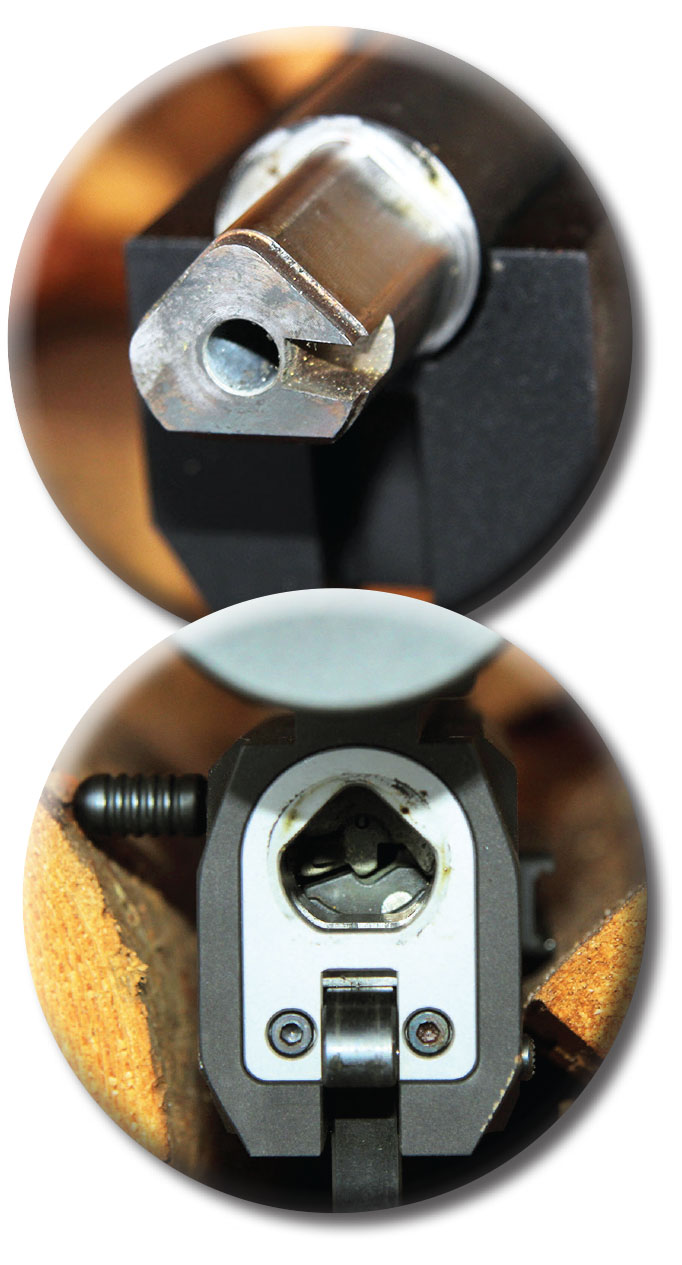
A triangular barrel stem and matching inletting on the receiver allow for quickly reassembling the VT2 Takedown Rifle by Volquartsen while ensuring proper alignment of key working mechanisms.
Quite honestly, when it comes to Volquartsen wares, price is the largest hurdle to ownership. This level of workmanship and accuracy comes at a price – a price many serious shooters are willing to pay, leading to Volquartsen’s continued leadership role and business growth. My Volquartsen experience was limited to Ruger 10/22 replacement barrels until this time, a heavy, 20-inch stainless steel barrel, and a more recent, 16.5-inch carbon-fiber tensioned barrel. After literally thousands of rounds directed at various ground squirrel subspecies, they have proven to be sound investments, demonstrating a penchant for stellar accuracy with a wide variety of 22 Long Rifle (LR) ammunition brands and types.
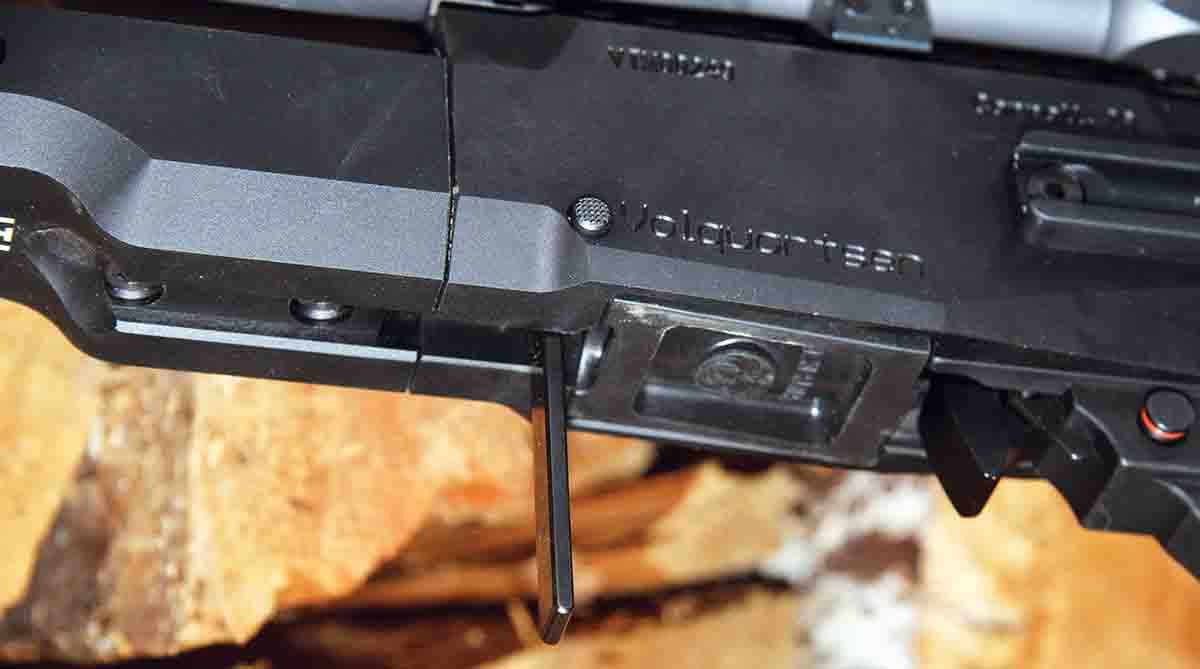
The takedown system on the Volquartsen VT2 requires no tools. A side release button allows a bottom lever to swing downward and unlock the barrel/forearm for disassembly.
The 10/22 connection is no mistake, as Volquartsen made its name by producing 10/22 clones introducing new levels of reliability and accuracy to the platform. After conquering the 22 LR, Volquartsen entered the realm of more powerful rimfires, most notably the 17 Hornady Magnum Rimfire, or HMR. Along with Savage and Alexander Arms, Volquartsen was one of only a few to overcome the challenges of running the high-pressure Hummer through a self-loading system.
When it comes to rimfires, we have the 22 Short, nearly defunct Long and the darling Long Rifle, the 22 Magnum (WMR), the tiny 17 Mach II (CCI Stinger case necked to 17 caliber), 17 HMR and the newer 17 Winchester Super Magnum (WSM). Outside the 22 LR, the HMR remains the most popular rimfire in varmint-shooting circles. The 22 Magnum retains ardent fans, who often insist it is the superior cartridge. Inside 50 yards this may be true, but at longer ranges, the 17 HMR – itself derived from the 22 magnum case – is a far superior cartridge, shooting flatter, delivering more on-target energy and extending rimfire range well beyond the capabilities of the 22 WMR through superior velocity and ballistic coefficients.
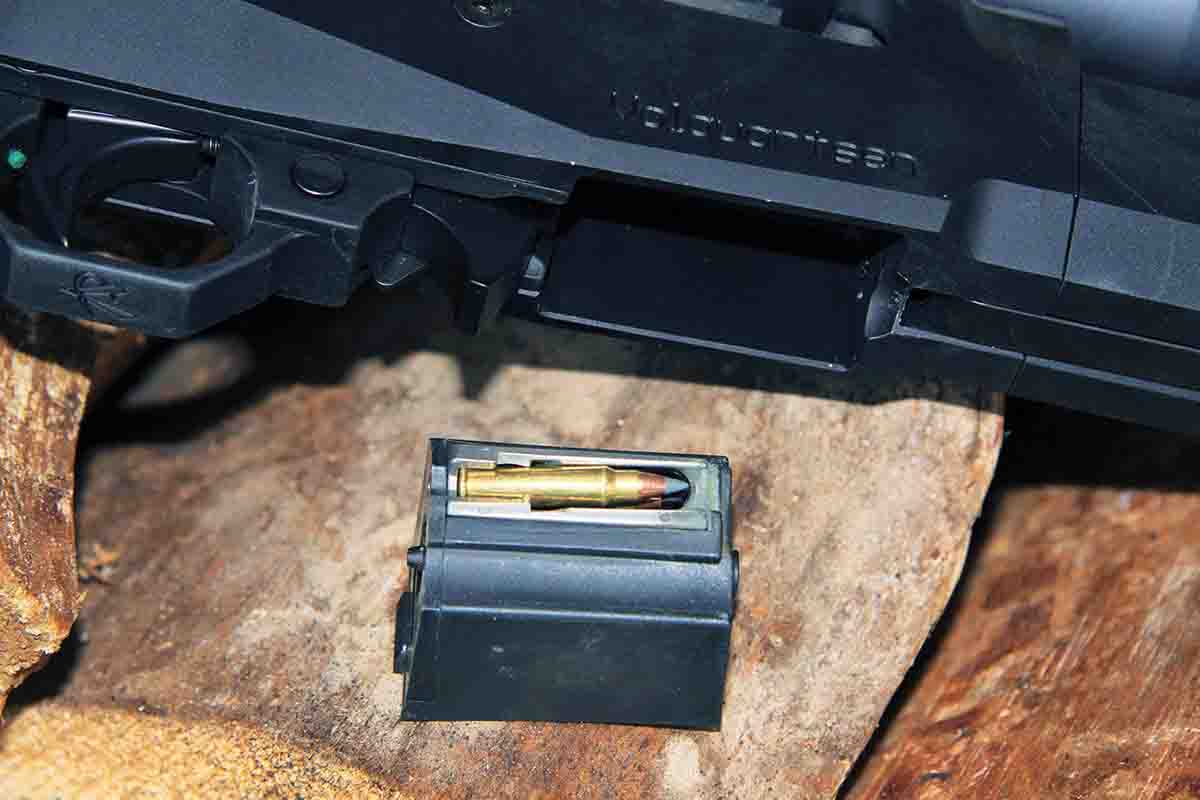
The Volquartsen VT2 Takedown Rifle feeds from a quality nine-shot Ruger 17/77 rotary magazine. Patrick experienced zero jams or stoppages while shooting hundreds of rounds of different ammunition.
I have owned a 17 HMR since shortly after its introduction in 2002, an affordable Marlin XT-17 that shoots impressively well. My HMR is a favorite while shooting tiny Belding’s ground squirrels that assemble in locust-like numbers in eastern Oregon and southern Idaho. With a quality turret scope attached, and on a calm day, I have used my Hummer to pick off the tiny “rats” out to 300 yards, with 200 yards as my self-imposed range limit when used on larger, more tenacious prairie dogs. In general, I’ve not experienced the difficulty of securing ammunition during periodic ammunition droughts, which I cannot say about the more popular 22 LR shells.
The VT2 Takedown Rifle, like all Volquartsen firearms, is made in the U.S. from top-quality materials. This is a decidedly rock-solid shooting platform, but the obvious distinction here is the rifle’s takedown design. The 18-inch barrel/handguard assembly is quickly and easily removed from the receiver without tools. The AR-style stock instantly collapses to create a 16½-inch rear section. Dovetailed bars on the handguard and receiver, holding spring-loaded bearings and click-in indents, allow the two rifle halves to be jointed and stored as a single, secure unit. This system proved tricky at first but smoothed out with use. Once taken down, the rifle easily slips into an average daypack or duffle while traveling. The VT2 is also the consummate survival rifle, compact enough to stash in a boat, bush plane, or “bug-out” bag, and powerful enough in a pinch to keep yourself fed in the bush or use for self-defense during civil unrest. As a varmint rifle, it makes a great traveling companion, or the perfect option while trekking into alpine marmot haunts or for predator calling, leaving the hands free after a successful set to deal with downed furbearers.
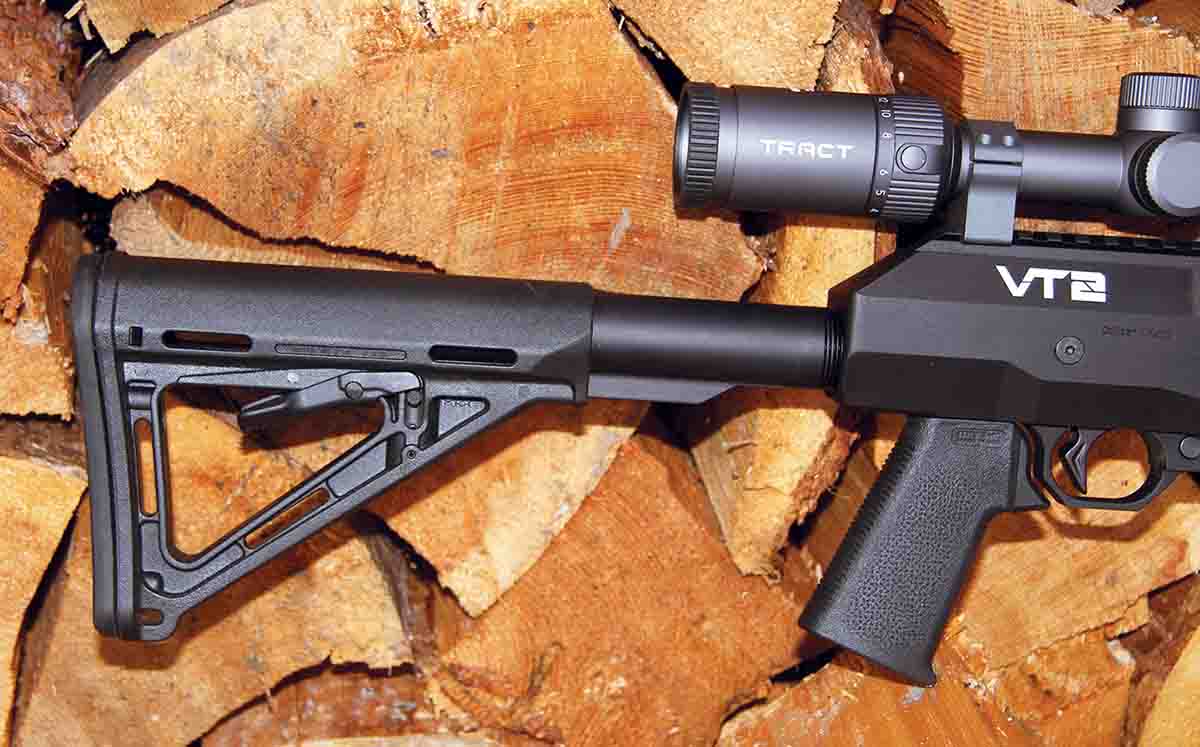
The buttstock and pistol grip of the Volquartsen VT2 are Magpul products, including an MOE Milspec collapsible stock and plain MOE-K AR grip.
The takedown mechanism consists of a release button found on the left flat of the receiver and an underlever located in front of the magazine well. Depress the knurled release button and swing the underlever downward and the barrel/armguard is unlocked. Initially, separating the two halves of the rifle required some jiggling and muscle. Once apart I rubbed a drop of gun oil around the barrel stem, which smoothed things out immediately.
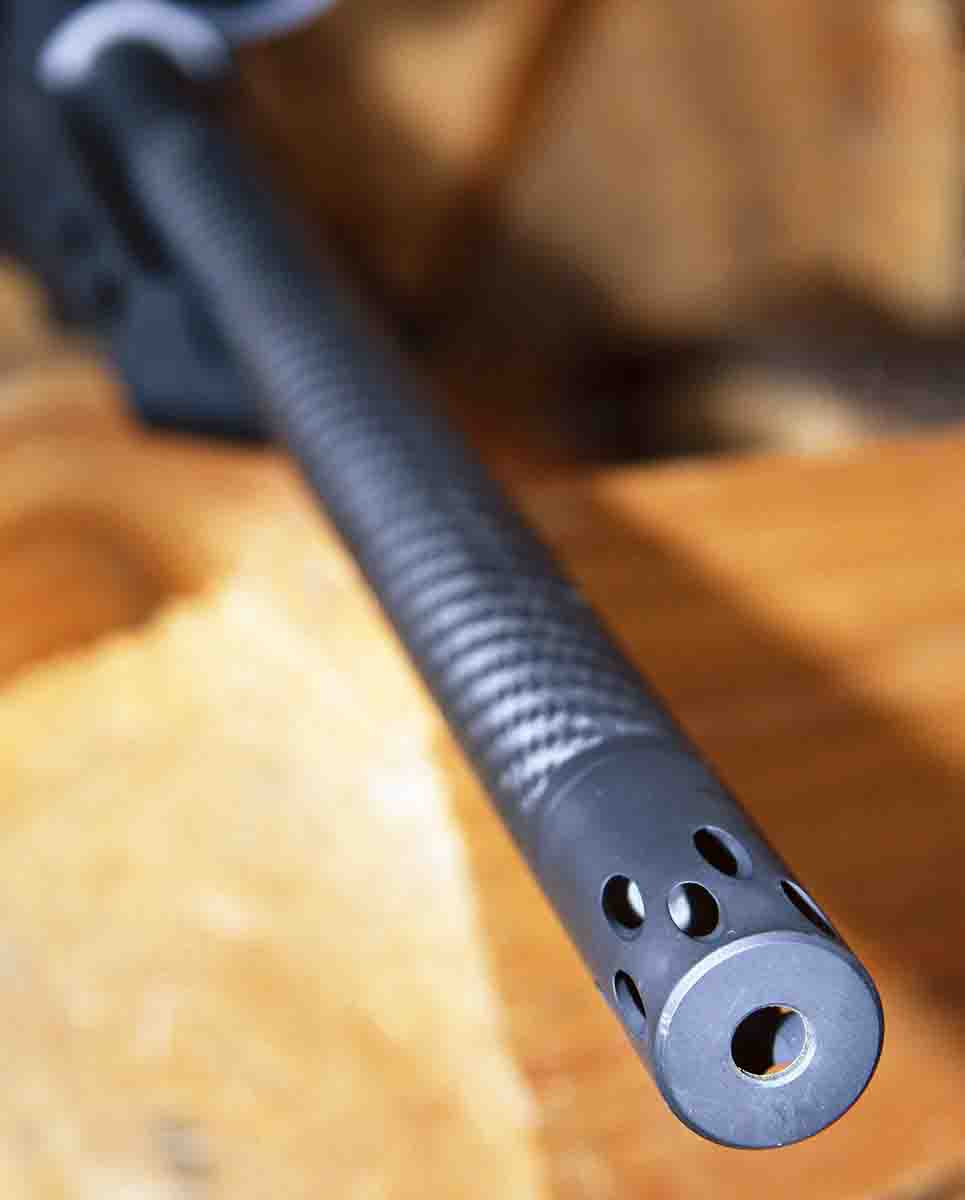
Volquartsen added a 2-inch aluminum-alloy “forward-blow” compensator to the VT2 Takedown Rifle’s carbon tension barrel to minimize muzzle movement during shooting.
Assembling the rifle, locking the underlever into place, and then fully extending the AR-style stock creates an overall length of 36¾ inches. Collapse the AR stock completely and the rifle measures 33½ inches. A 13¾-inch length of pull (LOP) is created when the stock is fully extended, four stop-clicks controlled by a standard spring-loaded underlever allowing adjusting LOP for smaller shooters.
The VT2 is offered in 22 WMR and 17 HMR chamberings, with each barrel/handguard assembly offering seamless compatibility with a single receiver and magazine. Handguards are available in 6- (as tested) and 12-inch lengths, again both styles are compatible with a single receiver. The VT2 holds a 16.5-inch free-floated barrel and the threaded compensator brought the overall barrel length to 18 inches. The barrel is Volquartsen’s carbon-fiber tensioned design, which reduces mass to place carry weight between the hands for excellent balance. The carbon barrel was also slow to warm, even 25-shot strings between target changes leaving it cool to the touch.
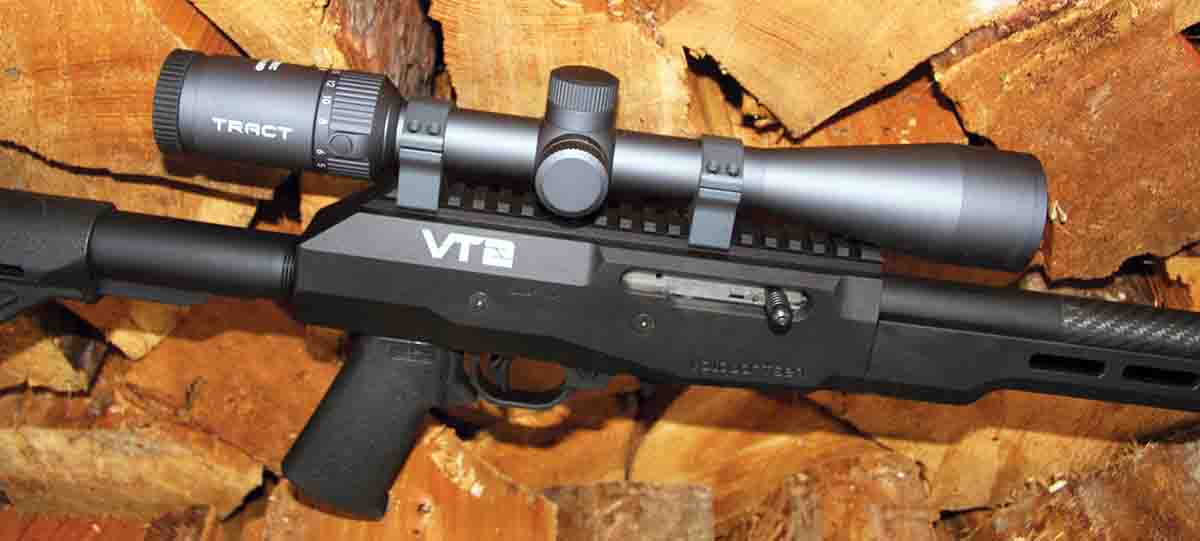
Testing was conducted with a Tract TORIC 3-15x 44mm HD T-Plex scope, a quality optic with a fully multi-coated, Ultra High Definition optical system with ED lenses and Schott HT (High Transmission) glass.
I found a couple aspects of the VT2’s barrel surprising. My own 17 HMR has a 20-inch barrel, as did an Anschutz 1762 tested for another issue of
Varmint Rifles & Cartridges and shot extensively over ground squirrel colonies through an entire spring. Both these rifles also include(d) conspicuously slower rifling twist. These rifles provide(d) excellent accuracy (sub-½-MOA at 50 yards) with standard-issue 17-grain bullets and generally matched advertised
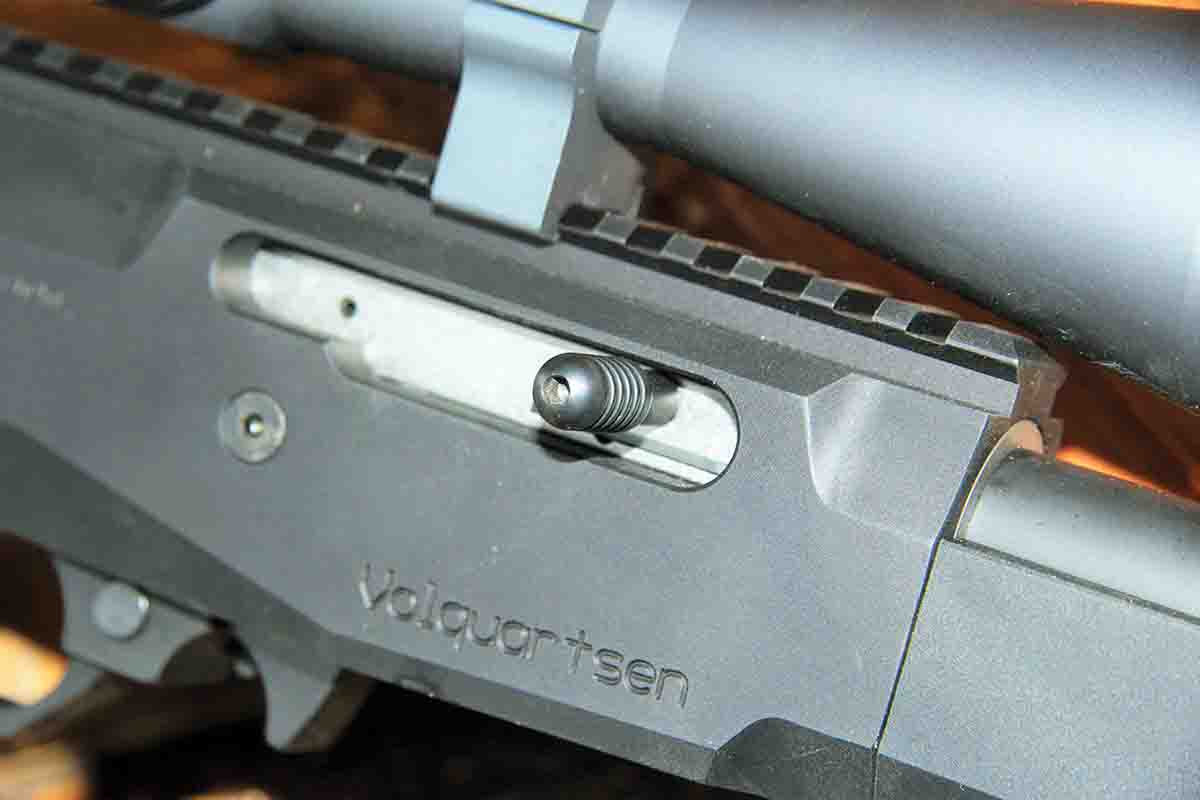
The bolt of the Volquartsen VT2 Takedown uses a direct blow-back system and stout tungsten construction to withstand the high pressures of the 17 HMR round.
factory ammunition velocities. So, I found the 16½-inch barrel length somewhat suspect before shooting began, despite Volquartsen engineers reporting velocity gains with the shorter barrel. As a takedown rifle designed for maximum portability, the short barrel made sense, but I was curious to see how it would affect performance. The barrel includes ½x28 threads, so its short length will accept a suppressor without becoming unwieldy. The VT2’s 1:9 rifling twist is the fastest I have encountered in an HMR. The 2-inch aluminum-alloy “forward-blow” compensator minimized muzzle movement during shooting.
The milled-aluminum handguard (6 inches on the test rifle) features six M-LOK slots – two on the bottom, two per side – allowing mounting compatible accessories or adding a section of Picatinny rail for clamp-on lights or bipods. The receiver is milled from a single block of aluminum alloy to include an integral 0-MOA Picatinny rail – a very nice touch. The works received Type-3 hard anodizing. The effect is a somewhat blocky and seemingly overbuilt appearance, but this does not affect ergonomics. An AR-style buffer tube is threaded into the rear of the receiver, the standard AR crown nut is replaced by a single robust set screw. The buffer tube holds a Magpul MOE Milspec adjustable stock controlled with a spring-loaded underlever for storage or LOP adjustments. The lower receiver holds a very plain Magpul MOE-K AR-style pistol grip.
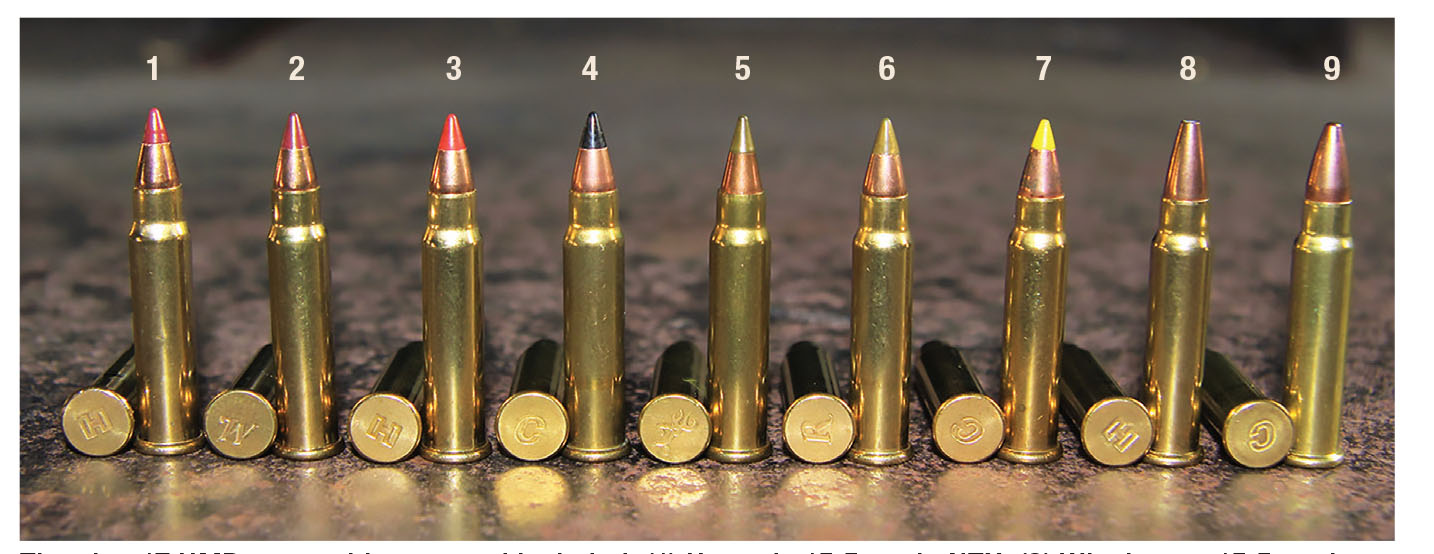
The nine 17 HMR ammunitions tested included: (1) Hornady 15.5-grain NTX, (2) Winchester 15.5-grain Varmint LF, (3) Hornady 17-grain V-MAX, (4) CCI 17-grain Polymer Tip, (5) Browning 17-grain BPR Polymer Tip, (6) Remington 17-grain Premier Magnum Rimfire AccuTip-V BT, (7) CCI 17-grain VNT Polymer Tip, (8) Hornady XTP hollowpoint and (9) CCI FMJ Small game.
Ruger and some other companies found the high pressures of the Hummer difficult to harness safely in a semiauto system. Savage solved the issue with a delayed-ejection system, while Volquartsen uses a direct blowback design sporting a rugged tungsten bolt to manage the high pressures of the 17 HMR (and 22 WMR) cartridge. The VT2’s trigger is excellent, using Volquartsen’s TG2000 modular design. The trigger group included a standard forward-positioned, push-button safety and broke crisply at 2.5 pounds. Volquartsen used a proven Ruger-brand rotary magazine holding nine rounds, flush fit and released by a wedge of aluminum sitting in front of the metal trigger guard. The only annoyance here was the empty magazine had to be pried out for reloading, though it drops into the hand on release when fully loaded. Out of the box, the complete rifle weighed a few ounces shy of 7 pounds – finished weight after adding a 20.1-ounce Tract TORIC UHD 3-15x 42mm T-Plex scope and steel, four-screw Warne Maxima Horizontal rings, 9.63 pounds.
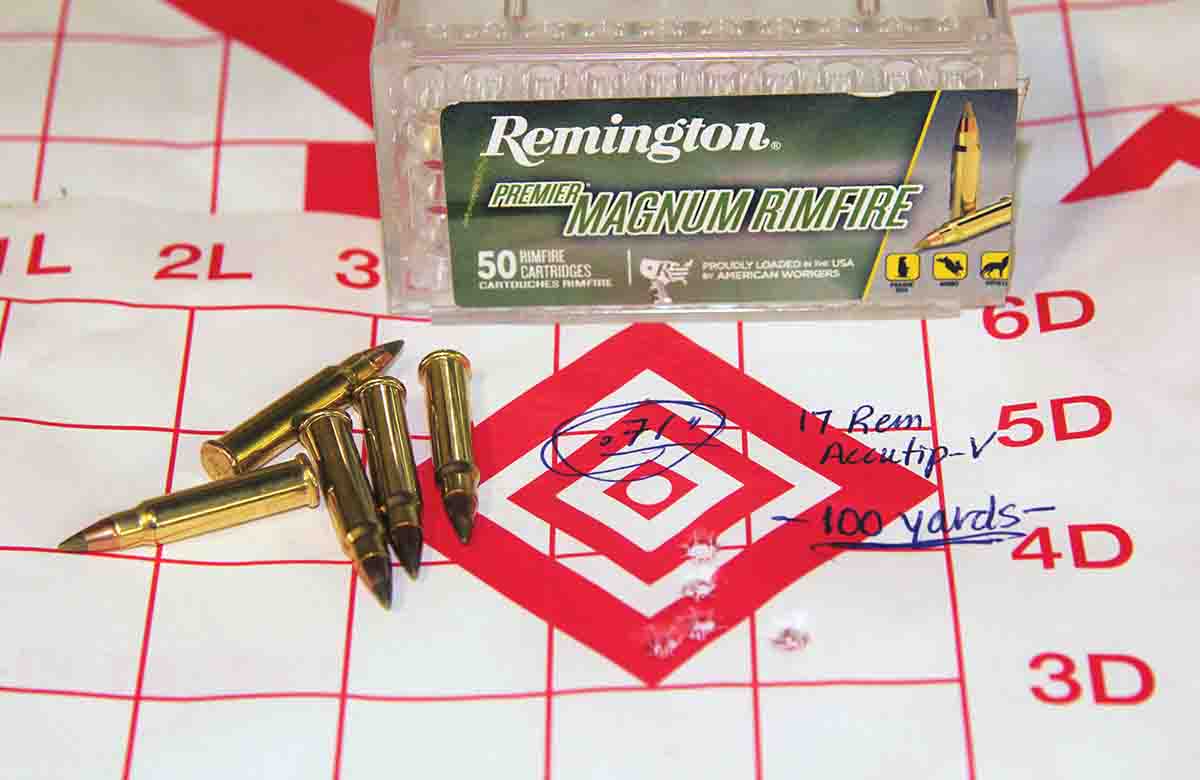
The best 17 HMR group of the test resulted from Remington Premier Magnum Rimfire AccuTip-V BT ammunition. That group measured .71 inch at 2,703 fps.
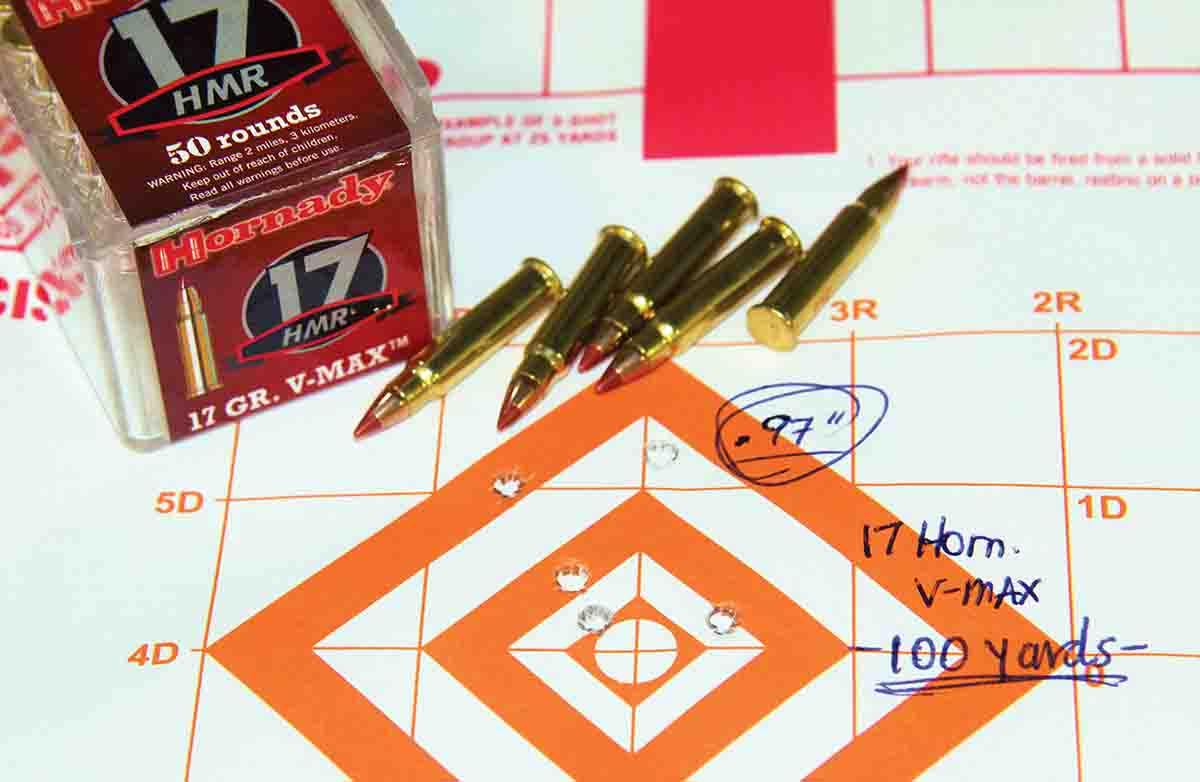
Hornady’s 17-grain V-MAX ammunition assembled the second best group of the test, measuring .97 inch at 100 yards and sent at 2,673 fps.
The all-metal TORIC 3-15x 44mm and T-Plex reticle proved ideal for the Volquartsen, in addition to including a fully multi-coated, Ultra High Definition optical system utilizing extra-low dispersion (ED) lenses and Schott HT (High Transmission) glass that provided clear viewing. The 1-inch, second focal plane (SFP) scope includes ¼-MOA adjustments and 50 MOA of total corrections. The T-Plex included a thin top post to open the sight picture and thicker side and bottom posts to offer faster target centering. The one-piece tube, O-ring seals and Argon purging make it fog and waterproof. The side parallax allows focusing targets from 15 yards to infinity and includes a click in/out locking feature. Turrets can be set to zero without tools, and a high-profile MOA turret kit with zero stop and lock is provided.
Scrounging through my 17 HMR ammunition stocks, I discovered nine different options, ranging from two light 15.5-grain lead-free loads to two heavy 20-grain loads, with five different loads holding the standard 17-grain slots. Noting the VT2’s stellar accuracy while sighting-in, and presented with a dead-calm day for shooting, I decided to conduct accuracy testing at 100 yards to truly separate ammunition capabilities from this rifle. It should be noted, most groups shot at 50 and 75 yards during sight-in and getting-acquainted shooting grouped well, the best less than ½-MOA. Too, I could not help but notice the numbers spinning out of the LabRadar Doppler unit all exceeded advertised velocities. The 16½-inch barrel length obviously holds merit.
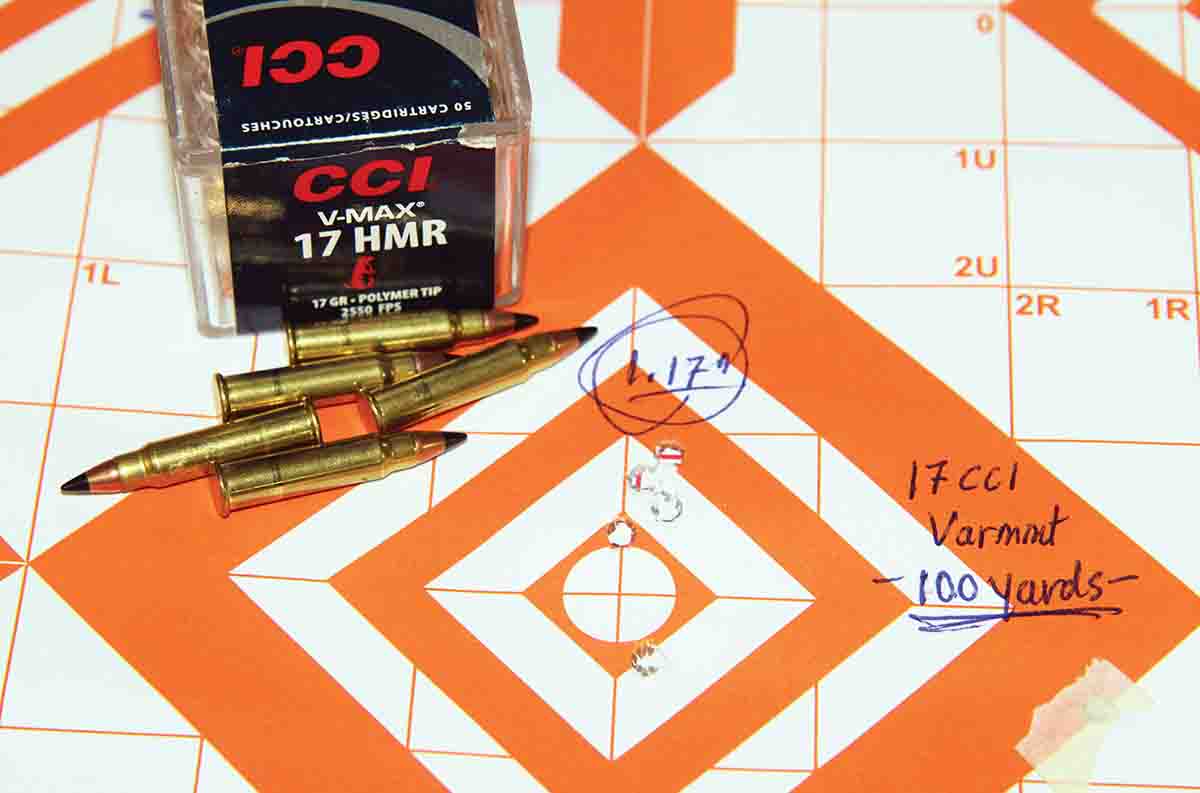
This 1.17-inch group was the result of five shots at 100 yards with CCI 17-grain Polymer Tip ammunition that left the muzzle at 2,680 fps.
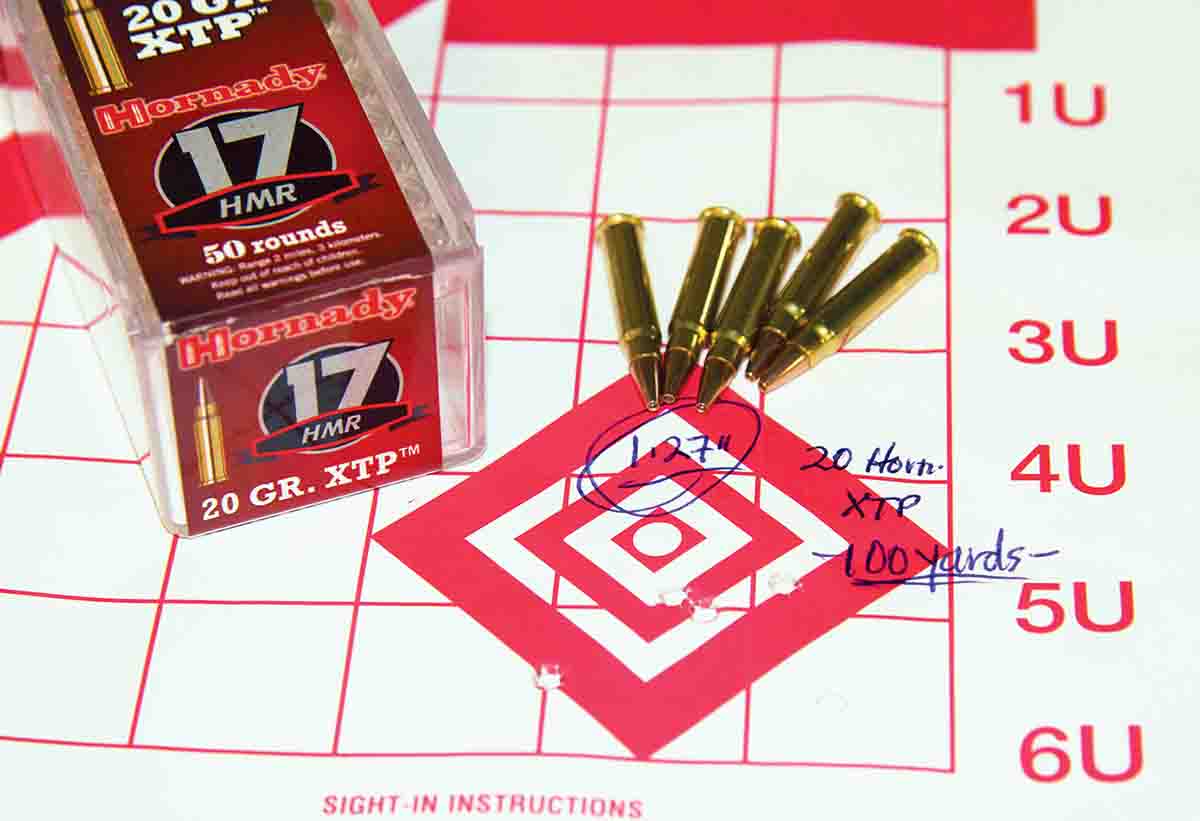
Hornady’s 20-grain XTP hollowpoint Hummer ammunition printed into 1.27 inches at 100 yards, with a muzzle velocity of 2,659 fps.
The light, nontoxic loads included Hornady’s 15.5 NTX (Varmint Express Rimfire) and Winchester’s 15.5-grain Varmint LF (Lead-Free). The heavier 20-grain loads consisted of Hornady XTP hollowpoints and CCI Full Metal Jackets. Standard 17-grain ammunition included Hornady’s V-MAX, CCI’s Polymer Tip Varmint and VNT Polymer Tip, Browning BPR Polymer Tip and Remington’s Premier AccuTip-V BT. That’s as good a cross section of Hummer ammunition as you will find today.
Things started badly, shooting the 15.5-grain loads at 100 yards. Hornady’s NTX load did best (1.72-inch group), or at least on par with the worst heavy-bullet loads. The Winchester loads were a true disaster, producing patterns instead of groups (3.08 inches). The 20-grain bullets, which shot some of the tightest groups at 50 and 75 yards, did fair to middling at 100 yards. Hornady, again, provided the best group with 20-grain bullets, 1.27 inches to the CCI FMJ’s 1.71-inch group.
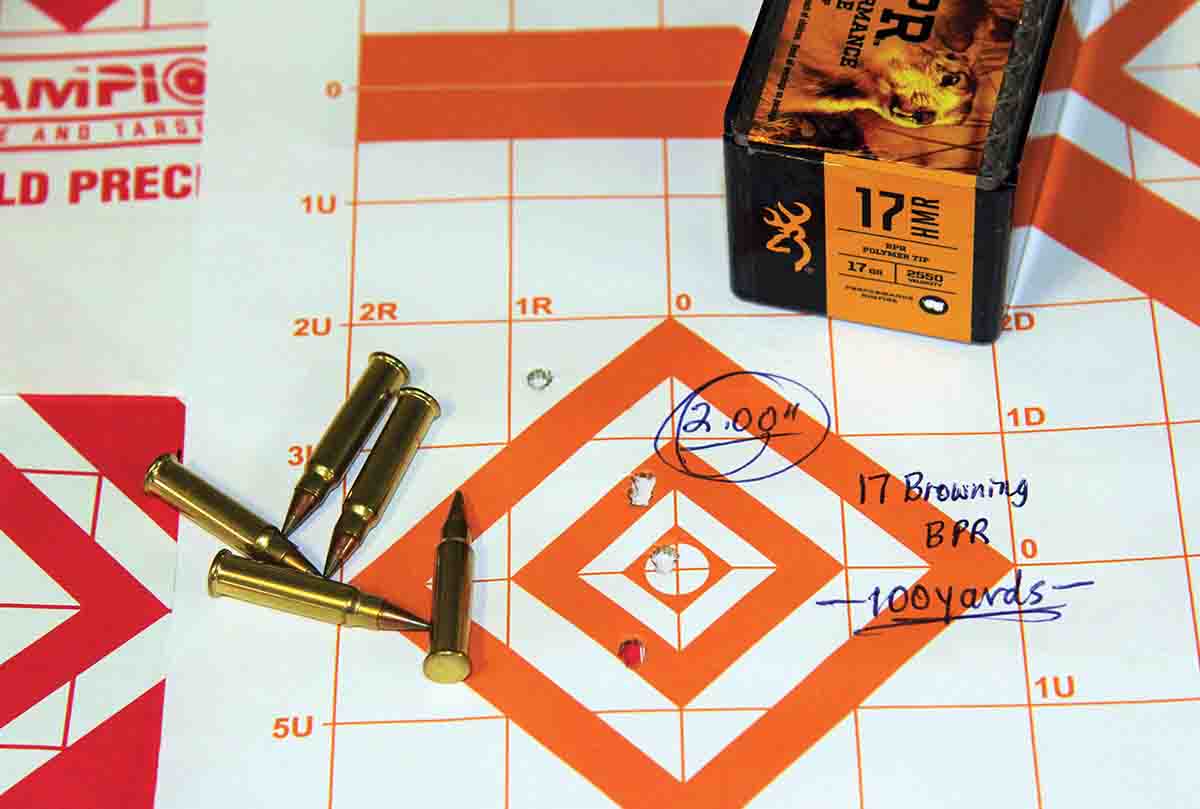
Browning’s BPR Polymer Tip assembled to worst group of the 17-grain 17 HMR ammunitions, measuring an even 2 inches across and sent at 2,671 fps.
With the standard 17-grain loads results varied considerably, and again did not corelate to some of the exceptional groups assembled with the same ammunitions at 50 and 75 yards. Almost without exception, the final group size was created by a flier or two, not so unusual with mass-produced rimfire ammunition. Browning did the worst at 100 yards – 2 inches – after turning in some great 50- and 75-yard groups. Everything else was pretty much on par for what I would expect at 100 yards with a rifle of this quality. Hornady’s V-MAX printed five shots into .97 inch, CCI Polymer Tip Varmint 1.17 inches, Remington Premier AccuTip-V BT .71 inch, and CCI VNT Polymer Tip 1.18 inches. Different lots of ammunition would no doubt provide different results.
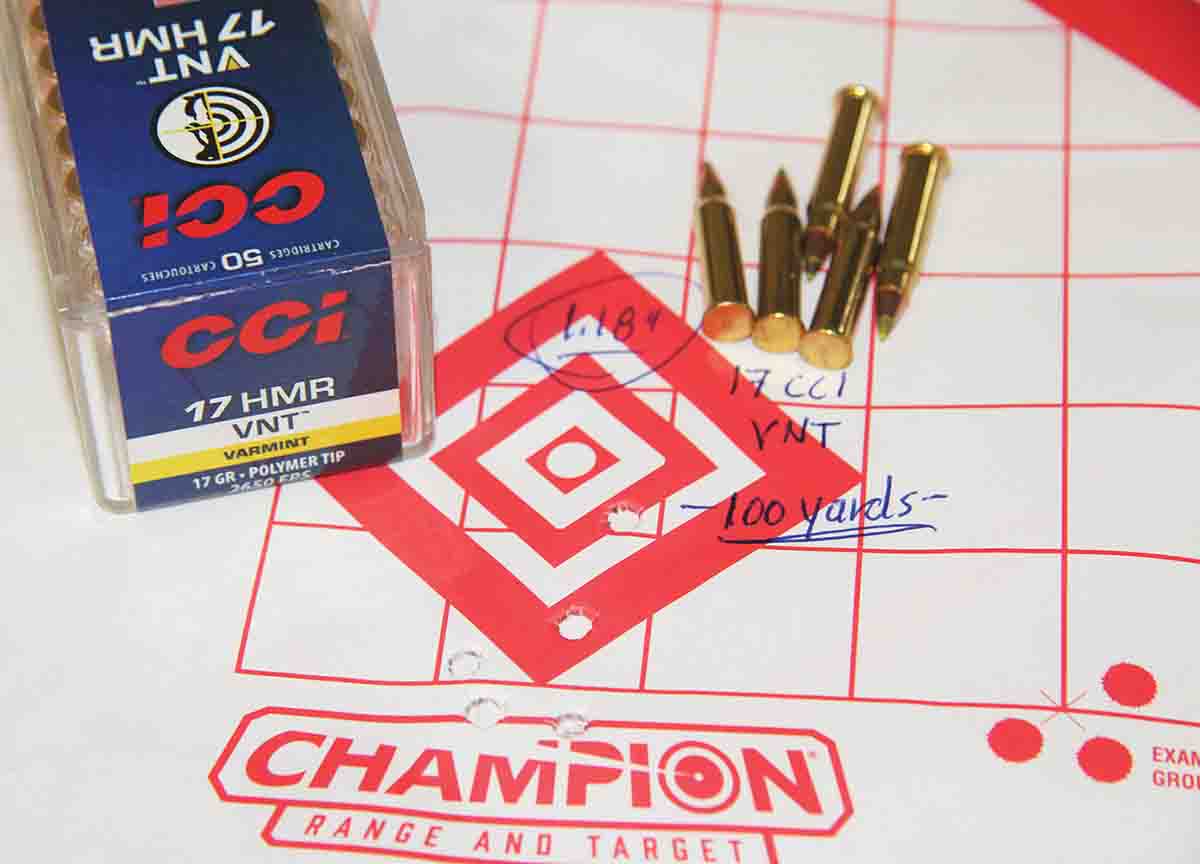
CCI’s fast 17-grain VNT Polymer Tip ammunition created this 1.18-inch group at 2,711 fps with five shots at 100 yards.
The VT2 Takedown ships fully assembled with an aluminum thread protector and a protective hard case. This is a well-built and fun rifle capable of remarkable accuracy – especially inside 75 yards. The auto-loading system cycled all ammunition flawlessly, not a single stoppage was experienced. The rifle handles well and points naturally, making it field ready, whether sniping burrowing rodents or addressing called-in predators. And, of course, the toolless take-down system makes it unique and in a class of its own. I would expect nothing less from Volquartsen.


.jpg)