


25 Krag Imrpoved
An Early Varmint Cartridge
feature By: David A. Webb | April, 15

Essentially the 25 Krag would be considered a “high-performance” cartridge based on the case capacity compared to the bore diameter. Early small arms ballistics pioneers worked extensively with the Krag case. A.O. Niedner apparently built the first 25 Krag rifle in 1907 for Dr. F.W. Mann. H.A. Donaldson ordered his 25 Krag-Niedner in 1909 after reading Dr. Mann’s book Bullet’s Flight. Both Ned Roberts and Col. Townsend Whelen took delivery of their rifles in 1910 and 1911, respectively. These early 25 Krag rifles were built on single-shot actions such as the Winchester High Wall. The primary use for the 25 Krag was as a long-distance, flat-shooting cartridge for taking the eastern woodchuck.
Along with those early twentieth-century experimenters, Charles Newton of Newton cartridges and rifle fame had a one-time passing interest in the 25 Krag. Newton attempted to convince Savage Arms to adopt a shortened version of the 25 Krag for its Model 99 rifle. The designers at Savage, however, opted for the 250-3000 Savage, a rimless case based on the 30-06 case rather than Newton’s proposal of the shortened 30-40 Krag case necked to .25 caliber.
Development of the wildcat 25 Krag has gone through several stages. Niedner used the standard length 30-40 Krag case (2.30 inches) to make his 25 Krag. There was no change in body taper or shoulder angle. F.C. Ness reported in his book Practical Dope on Big Bores another variation known as the 25 Krag H.P. (High Power). This might have been Newton’s version of the Krag wildcat.
In the 1940s the late P.O. Ackley initiated work on a series of cartridges with minimum body taper for the case and rather sharp shoulder angles. This experimentation also was done with the 30-40 case necked to .25 caliber. There were two different designs – the 25 Short Krag and the more common standard case length known as the 25 Krag Improved. Each of Ackley’s “improved” design versions of the 25 Krag had minimum body taper and a 40-degree shoulder angle. It was concluded that the improved version reduced case stretching and erosion in the barrel throat area.
In the 1963 Gun Digest, Hal Stephens wrote about a Winchester High Wall single-shot action and a Douglas barrel with a 14-inch twist. The barrel and action were fitted and chambered for the standard length 25 Krag Improved. All the metalwork was done in Ackley’s Utah shop. Stephens reported excellent accuracy with Sierra 87-grain bullets with 43 grains of IMR-4064; muzzle velocity was 3,115 fps. Loads were increased with IMR-4064 to 50 grains for 3,561 fps.
The heaviest bullet weight tested by Stephens was the 100-grain Sierra; that weight was the upper limit for a 14-inch twist, .25-caliber barrel. The 100-grain bullet was not stabilized as compared to the 87-grain bullet when tested for accuracy.
In 1980 James C. Gates published in Rifle No. 67 his findings on the 25 Krag Improved. The rifle was built using a Ruger No. 3 action and a Douglas premium grade barrel with a 10-inch twist. Gates stated that long 117- and 120-grain bullets were accurate and stabilized in the faster rifling twist. The 117-grain Sierra spitzer boat-tail backed with 52.5 grains of H-4831 with a muzzle velocity of 3,100 fps gave excellent performance.
In the 11th edition of Handloader’s Digest, I reported load data for the 25 Krag Improved rifle built by Lenard Brownell on the Siamese Mauser action. The Douglas barrel had a one-in-12-inch twist. That twist rate fits in between those reported by Stephens and Gates, 14 and 10 inches, respectively.
It was somewhat expected that the 125-grain Barnes bullet would not be stabilized. That was found to be true, while 120-grain bullets gave conflicting results. Both Nosler Solid Base spitzer and Partition 120-grain bullets and the Sierra hollowpoint boat-tail 120-grain bullet would not stabilize in the 12-inch twist.
The only other weight bullet reported upon in the Handloader’s Digest piece were those that weighed 100 grains. Three different manufacturers were tested – Hornady, Nosler and Speer. Load data in the table is for .25-caliber bullets weighing less than 100 grains. These loads for varmint-type bullets along with the previously cited 100- and 120-grain loads illustrated the versatility of the 12-inch twist of the 25 Krag Improved.
A practical way to convert 30-40 Krag brass into the Improved case is to use RCBS forming and file-trim dies followed by full-length sizing in the 25 Krag Improved die. Cases then need to be fireformed, and this can be accomplished using 9.0 grains of Bullseye powder, a piece of Dacron fiber filler placed over the powder, cornmeal filled to the shoulder and another wad of Dacron fiber to close off the case. After fireforming, resizing and trimming again, the Improved 25 Krag cases are ready to use in load development.
Fifty new Winchester 30-40 Krag cases were prepared for the load development work with the varmint-type bullets, which were limited to those that would perform afield against varmints. There are others, but those selected were the 75-grain Hornady and Sierra, 85-grain Nosler Ballistic Tip and a few limited loads with Berger 82-, 85- and 87-grain bullets. Several different powders were used focusing on the moderate burning rate selections because of the lighter weight bullets.
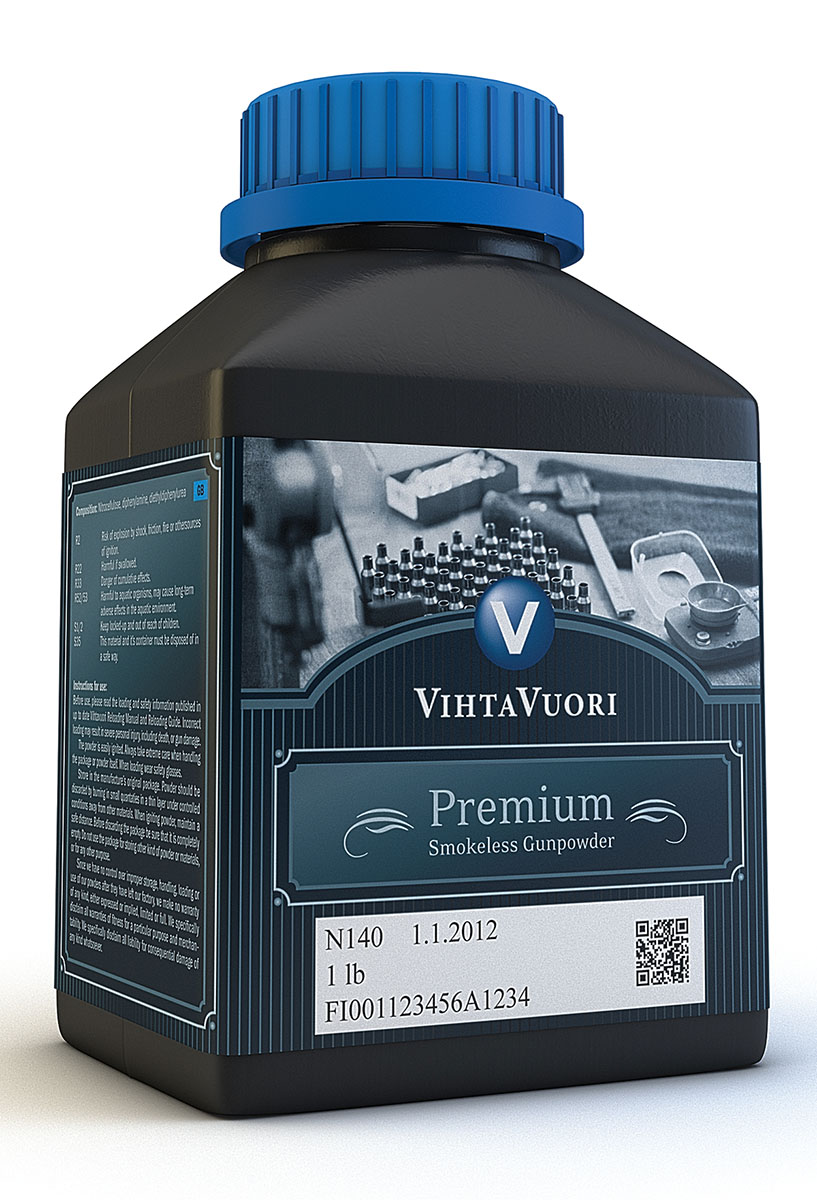
The same Winchester cases were used throughout load development. Winchester primers also were the only brand used; however, when slower-burning powders such as IMR-4350, Reloder 19 or H-4831 were being tested, the Winchester Large Rifle Magnum primers were used. In addition a significant number of loads were developed for Vihtavuori N135, N140, N150 and N160 powders.
The table lists the results of the loads developed using the different combinations of bullets and powder components. All loads were fired in the Brownell-built Siamese Mauser with a Leupold 4x scope mounted in a set of Brownell “lever mounts” and scope rings.
Velocity data was recorded using an Oehler Model 33 chronograph and Skyscreen System III that was placed 15 feet from the muzzle. All data were converted back to muzzle velocity. A minimum of two separate tests were conducted for each load using five-shot groups for each bullet/powder combination.
There are a total of 47 loads given in the table that represent those developed for the Siamese bolt rifle and should therefore be used with caution. Maximum powder charges should be reduced 10 percent to determine performance. Incremental powder increases then can proceed to achieve optimum accuracy and velocity in another rifle chambered for the 25 Krag. Again it needs to be stressed that caution and discretion are important when developing handloads for a wildcat.
In particular there has appeared from time to time a reference or question concerning the various 25 Krag wildcat cartridges for chambering in the old standard Krag action. That would be an absolute no-no! It is unfortunate that some Krag actions were so chambered.
Dr. F.W. Mann reported chamber pressures on average in excess of 50,000 psi, significantly above the maximum allowable pressure of 40,000 psi or 43,200 CUP for the Krag action. The wildcat 25 Krag cartridge and especially the high-performance Improved design should never be chambered for use with the Krag action.
To summarize results of the loads tested, one could conclude that a twist of one in 12 inches provides flexibility for the cartridge concerning the different bullet weights. The 120-grain Speer flatbase bullet ahead of 48.0 grains of IMR-4831 would be an excellent flat-shooting load for open-range hunting in quest of pronghorn or mule deer. The 75-grain Hornady varmint bullet with 48.0 grains of Vihtavuori N140 gave a velocity of 3,637 fps. In addition the 85-grain Berger bullet in combination with 48.0 grains of IMR-4064 proved to be quite effective on prairie dogs. Accuracy was excellent with groups being less than one inch at 100 yards.
In the U.S. the 25 Krag Improved was one of the very first smokeless powder wildcat cartridges. The Krag case is built with strong, durable brass, ideal for wildcat purposes. One could possibly state that the 30-40 Krag case and the subsequent forming to the 25 Krag by A.O. Niedner is the “original” wildcat cartridge for the modern era with smokeless propellants.
(Article was previously published in Handloader No. 194 (Aug.-Sept. 1998).