Login


Wolfe Publishing Group
    Menu

    Oregunsmithing's 24 York

    An Ultra-Efficient Varmint Options

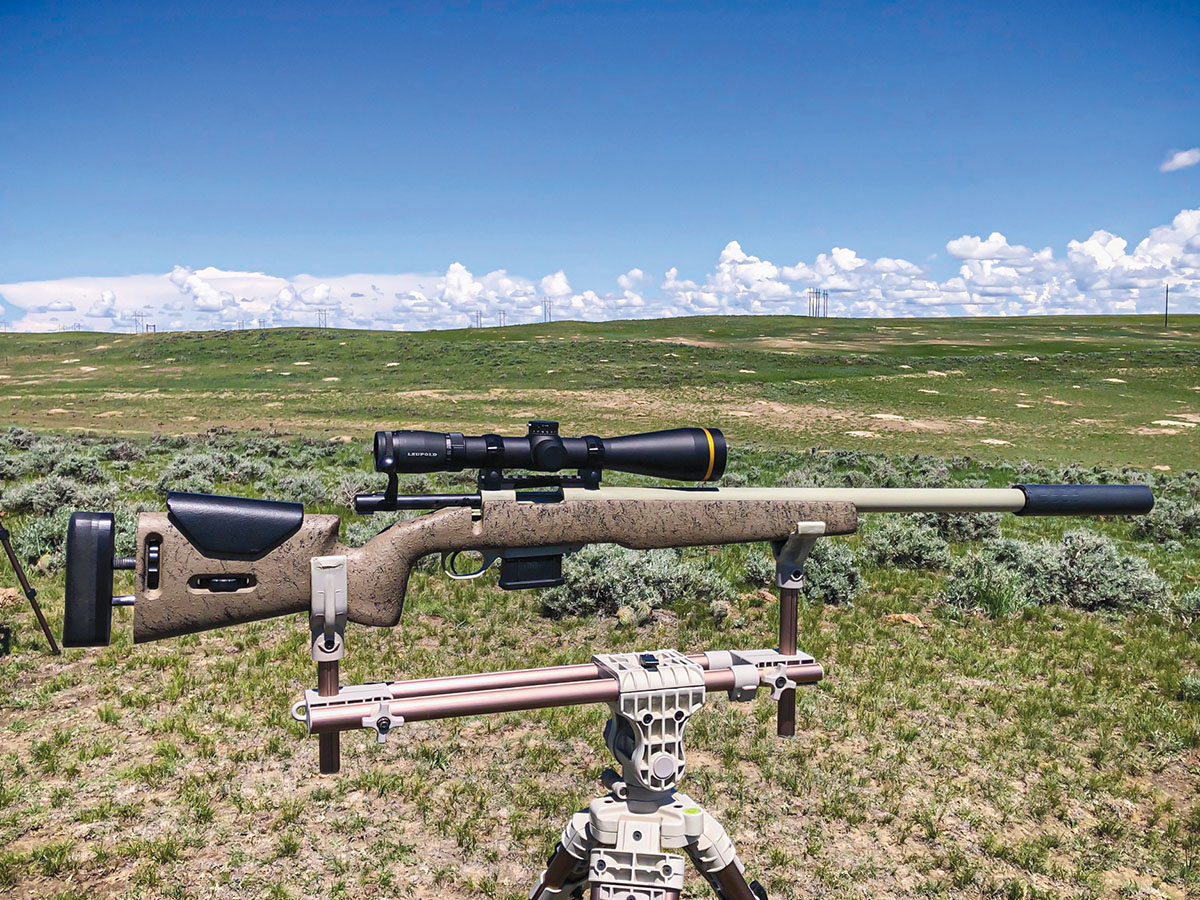
    Wayne York, owner of Oregunsmithing and Pendleton Composite Stocks in Pendleton, Oregon, built this tack-driving rifle for himself, chambered in his own 24 York cartridge, to use while shooting Wyoming prairie dogs.
    Wayne York, owner of Oregunsmithing and Pendleton Composite Stocks in Pendleton, Oregon, built this tack-driving rifle for himself, chambered in his own 24 York cartridge, to use while shooting Wyoming prairie dogs.
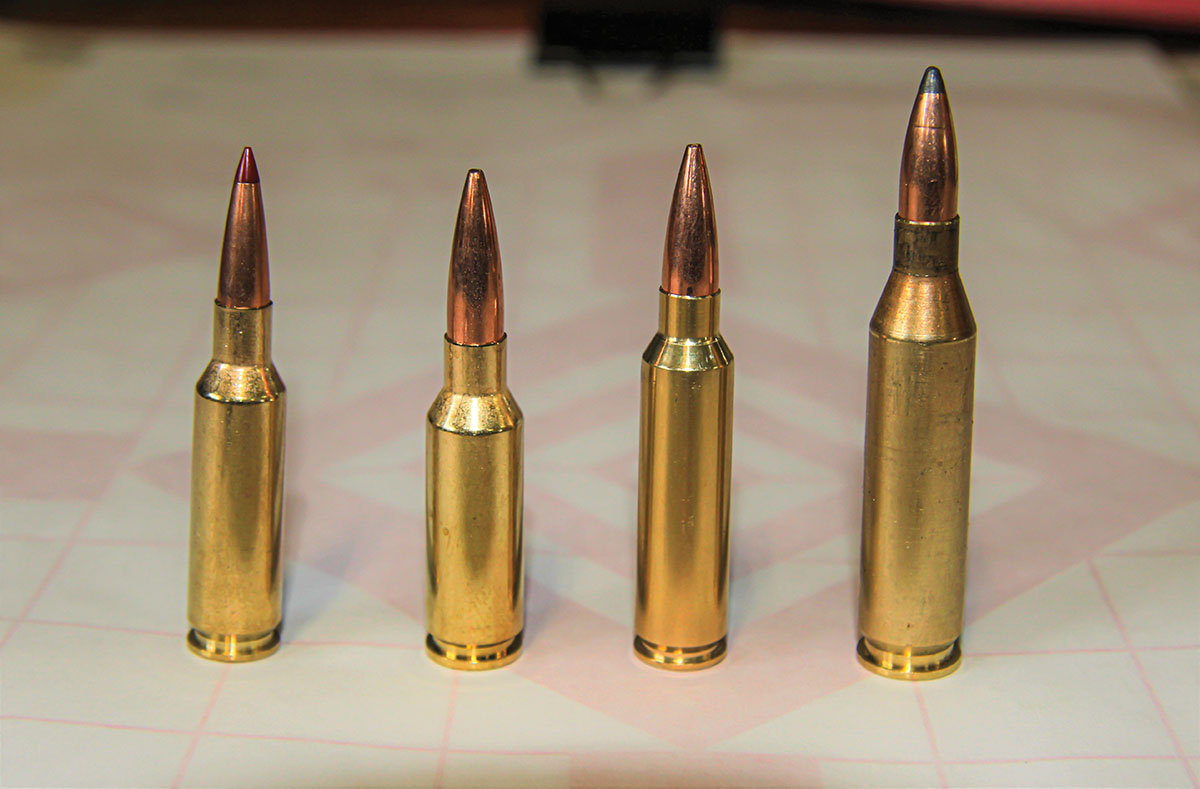
    Shown for comparison (left to right): the 224 Valkyrie, 6mm ARC, 24 York under discussion here and the venerable 243 Winchester.
    Shown for comparison (left to right): the 224 Valkyrie, 6mm ARC, 24 York under discussion here and the venerable 243 Winchester.
    Wayne York, owner of Oregunsmithing and Pendleton Composite Stocks in Pendleton, Oregon, created his 24 and 25 York cartridges in 2011. York was seeking a high-performance round in 243 and 257 calibers that would fit into a smaller action but also prove powerful enough to cleanly take big game such as deer and pronghorn. He did so by “improving” the 6.8 Remington SPC case,
    Left to right: The 224 Valkyrie and the 24 York are both cartridges derived from the 6.8 Remington SPC.
    Left to right: The 224 Valkyrie and the 24 York are both cartridges derived from the 6.8 Remington SPC.
    moving the shoulder forward and necking them down to the desired calibers, essentially creating a miniaturized version of the 308 Winchester. York also developed a 22 York by the same means, but pushed it to the back burner after Nosler introduced the 22 Nosler, which is essentially the same cartridge but with the change of a rebated rim to allow operation with standard AR-15 bolt faces. The 24 and 25 York cartridges are a pair of ultra-efficient rounds that send varmint or big-game bullets at respectable speeds while also burning modest measures of powder.

    Visiting Wayne in Pendleton recently, dropping off a couple rifles to be threaded to accept suppressors, he asked if I had any interest in shooting a 24 York rifle he had recently built for varmint shooting – specifically to take on his annual prairie dog forays to Wyoming. I am always glad to shoot one of York’s Oregunsmithing creations and this project would also help expand choices of viable loads for his varmint-shooting passions.
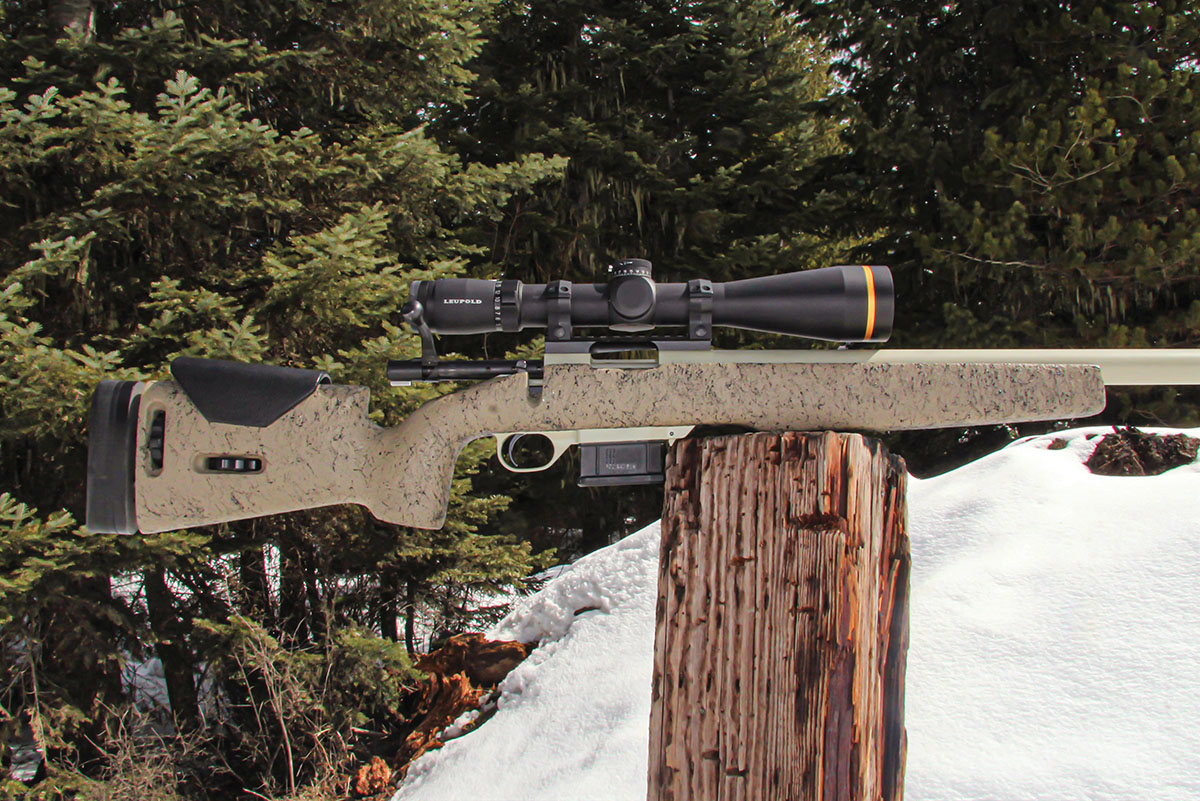
    Wayne York’s personal prairie dog rifle, chambered in his own 24 York round, was built on a Howa 1500 Mini Action, and holds a heavy Benchmark barrel, Timney Trigger and Pendleton Composite Stocks’ T11 handle.
    Wayne York’s personal prairie dog rifle, chambered in his own 24 York round, was built on a Howa 1500 Mini Action, and holds a heavy Benchmark barrel, Timney Trigger and Pendleton Composite Stocks’ T11 handle.
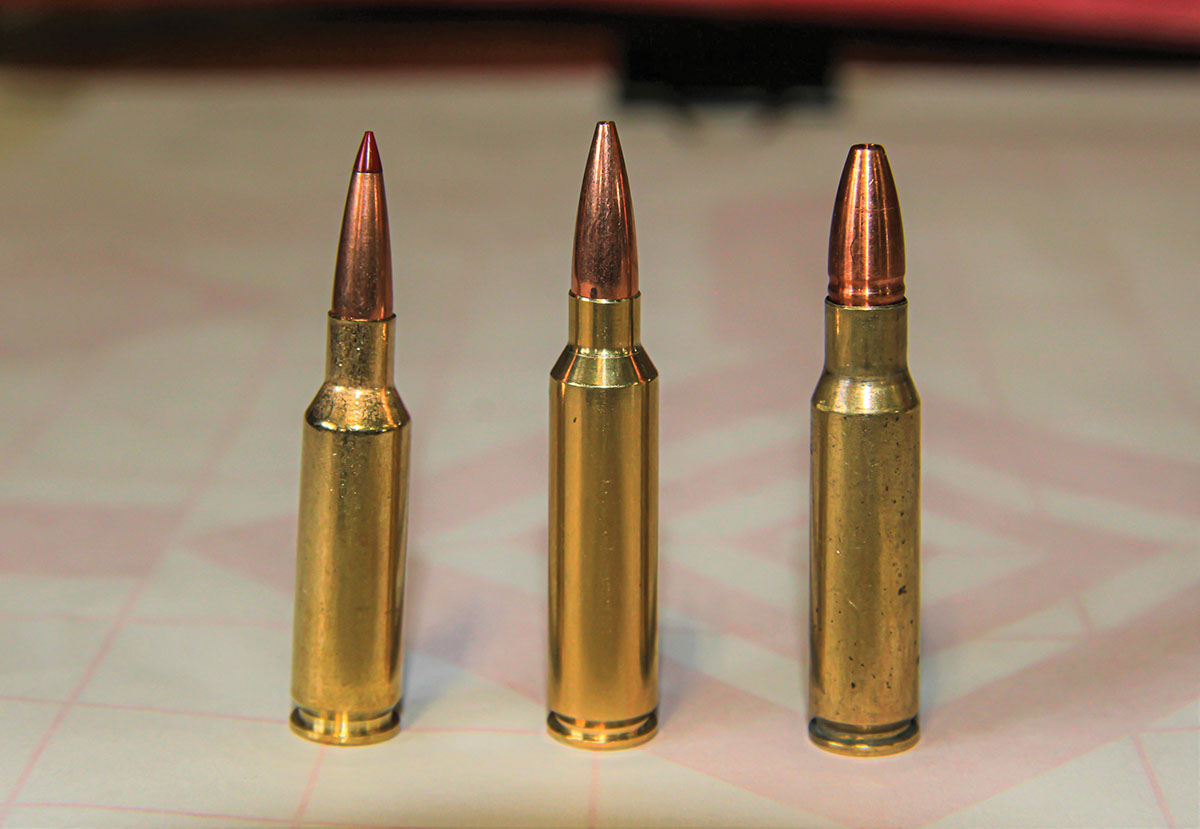
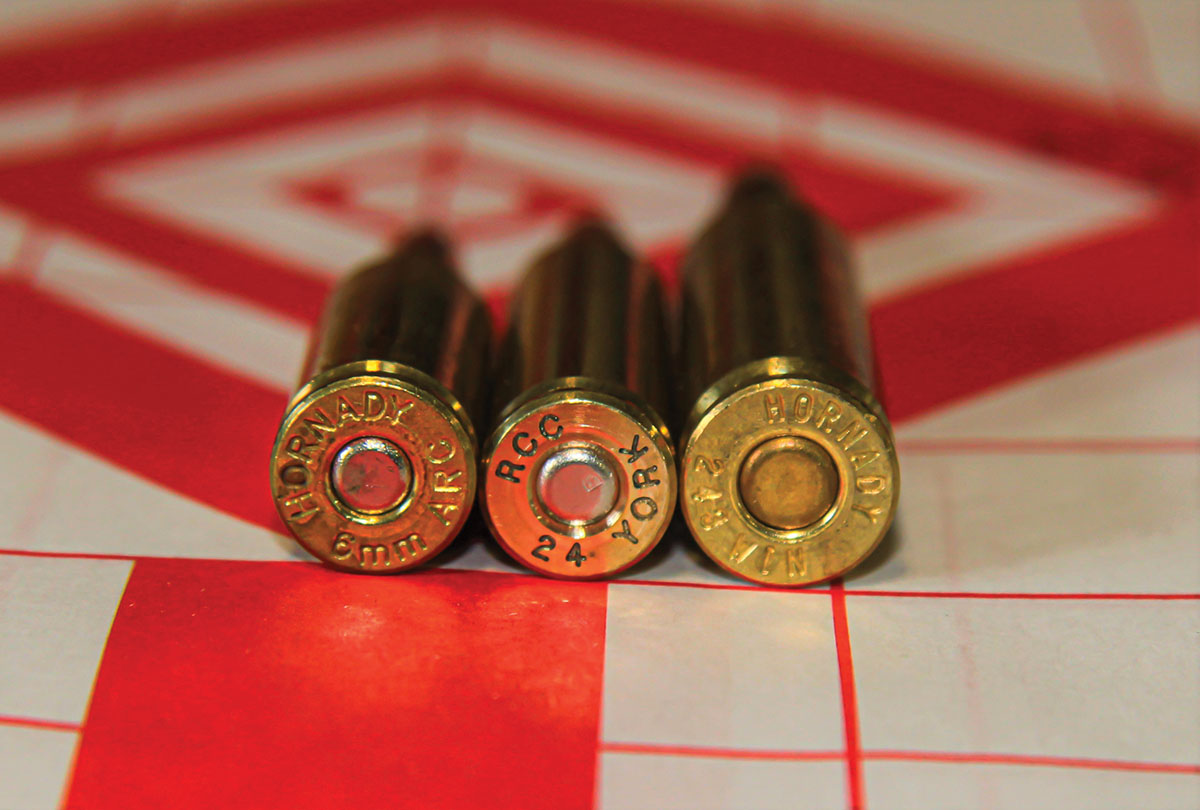
    The 24 York, middle, was loaded in RCC brass manufactured on special order for Oregunsmithing. The 6mm ARC, at left and 243 Winchester at right, are shown for comparison.
    The 24 York, middle, was loaded in RCC brass manufactured on special order for Oregunsmithing. The 6mm ARC, at left and 243 Winchester at right, are shown for comparison.
    This rifle was created to be steady over a rest and to provide extreme accuracy. He started with a Howa 1500 Mini Action, which Wayne has a great deal of respect for. He finds them to be well-made, precise and smooth running – typically requiring no truing before work begins. To this, he added a heavy stainless steel barrel (1.14-inch diameter just behind the muzzle threads) made by Benchmark and included a slow 1:10 twist made of 5R rifling to best accommodate lighter varmint bullets. The barrel was finished at 22 inches and included 5⁄8x24 threads to hold a suppressor. The trigger is a Timney, a Vanguard model York modifies to operate in the Howa action. The trigger broke at a crispy 1.75 pounds without overtravel.
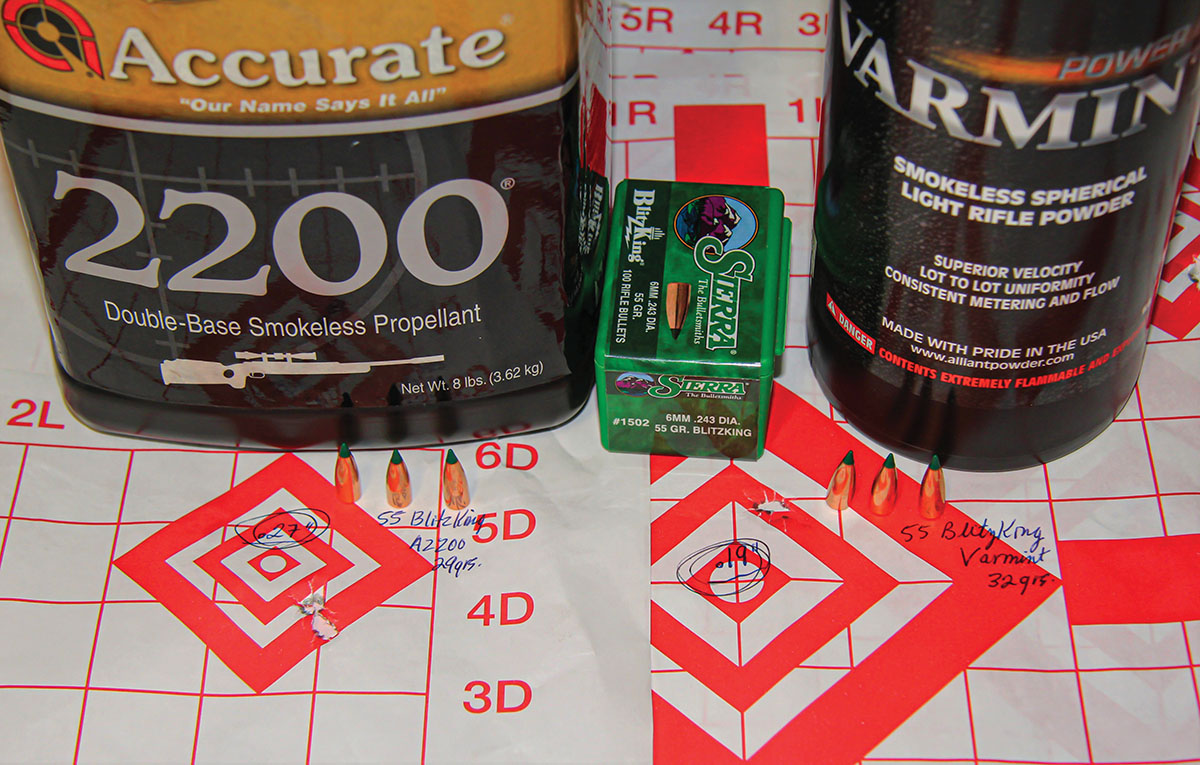
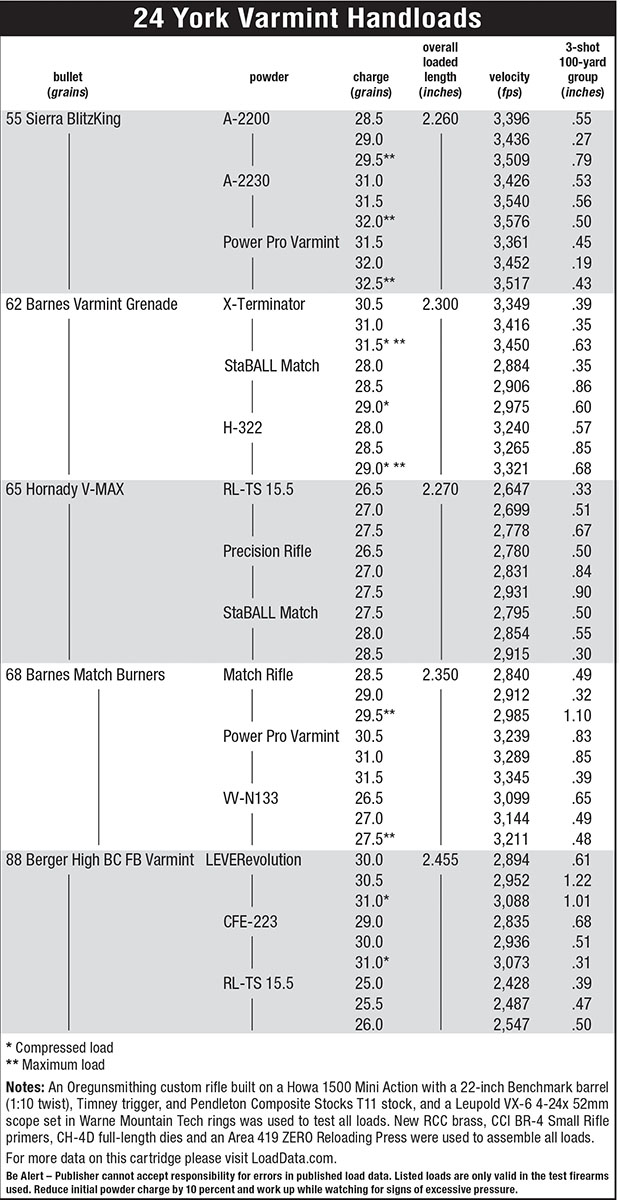
    The two best groups shot with the Sierra 55-grain BlitzKing included .27 inch at 3,436 fps with 29 grains of Accurate 2200; and .19 inch at 3,452 fps with 32 grains of Alliant Power Pro Varmint.
    The two best groups shot with the Sierra 55-grain BlitzKing included .27 inch at 3,436 fps with 29 grains of Accurate 2200; and .19 inch at 3,452 fps with 32 grains of Alliant Power Pro Varmint.

    The barreled action was dropped into one of York’s hand-laid Pendleton Composite Stocks (PCS) T11 models, a beefy tactical-style handle including a carbon makeup, vertical grip, and holding an adjustable comb and buttpad to adapt length of pull to specific shooters. A Coyote finish with black and tan spider webbing completed the stock’s finish. Wayne added some lead to the forend during the build to make it more stable on a rest. Howa’s polymer trigger guard/magazine-well assembly was retained with the rifle feeding from a detachable Howa polymer magazine. The action, barrel and bottom metal were given a Coyote Tan CERAKOTE finish.
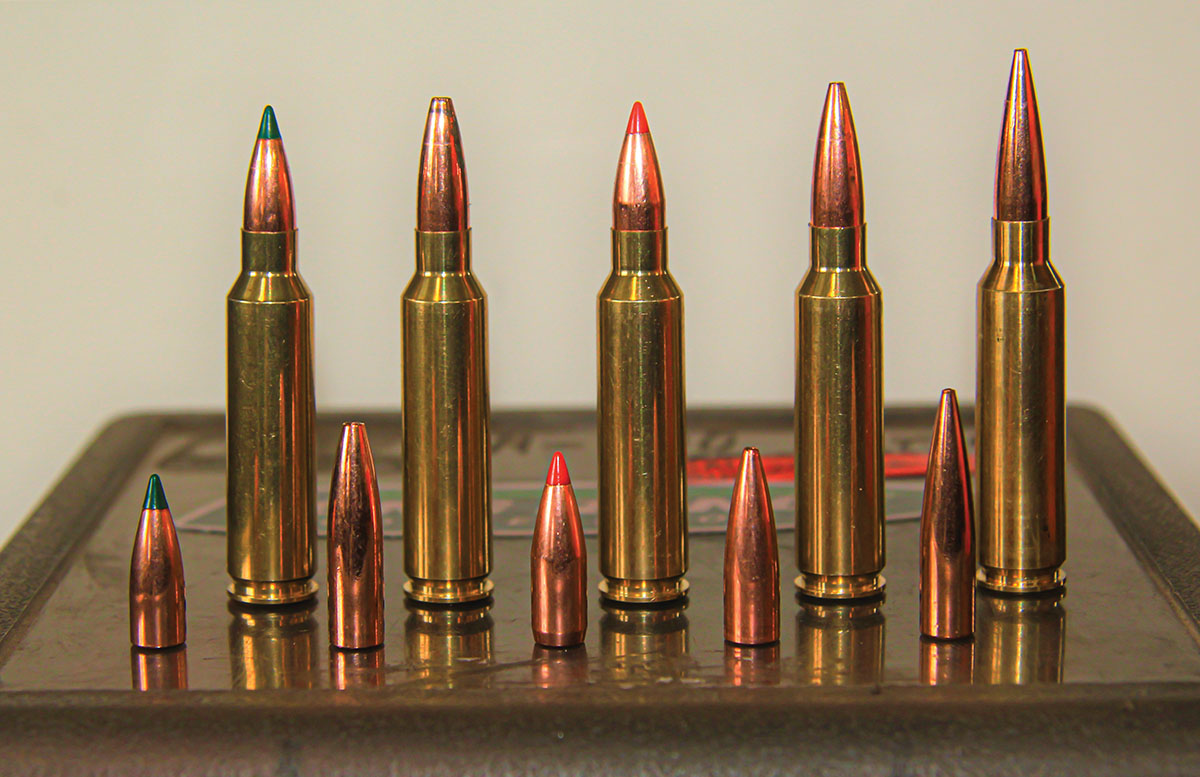
    Bullets used to test the 24 York included (left to right): Sierra 55-grain BlitzKing, Barnes 62-grain Varmint Grenade, Hornady 65-grain V-MAX, Barnes 68-grain Match Burners and Berger 88-grain High BC FB Varmint.
    Bullets used to test the 24 York included (left to right): Sierra 55-grain BlitzKing, Barnes 62-grain Varmint Grenade, Hornady 65-grain V-MAX, Barnes 68-grain Match Burners and Berger 88-grain High BC FB Varmint.
    Sitting atop the rifle was Leupold’s VX-6 4-24x 52mm scope. This riflescope includes Leupold’s clear “Professional-Grade Optical System” with Guard-Ion lens coating for high-definition performance, and CDS-ZL2 elevation dial with elevation turret lock and zero stop. The optic is 100 percent fog, shock and waterproof, the 24x magnification is sideal for long-range varmint shooting. A Warne Mountain Tech Picatinny rail and Mountain Tech four-screw rings provided a sleek mating. Finished weight with the Leupold in place was 15.63 pounds.

    The 24 York case includes an overall length of 1.70 inches, base to shoulder length of 1.398 inches, and the neck is .259 inch. It included a 30-degree shoulder, case taper taken from .420 inch at the base to .399 inch at the shoulders. By comparison, the parent 6.8 Remington SPC case included an overall length of 1.686 inches, base-to-shoulder length of 1.301 inches, and the neck is .272-inch long. The SPC shoulder is set at 23 degrees and the body included more taper for smooth AR-15 feeding. The 224 Valkyrie makes another apt comparison, which also uses the SPC as a parent case. It included an overall length of 1.600 inches, base-to-shoulder length of 1.203 inches, a .269-inch neck length, and 30-degree shoulder. The new RCC brass used for loading the 24 York included small rifle primer pockets. The round would also make an excellent fast-twist option, shooting long-for-caliber bullets in the 105-grain class, providing a mild-mannered, pleasant-shooting long-range target combination.
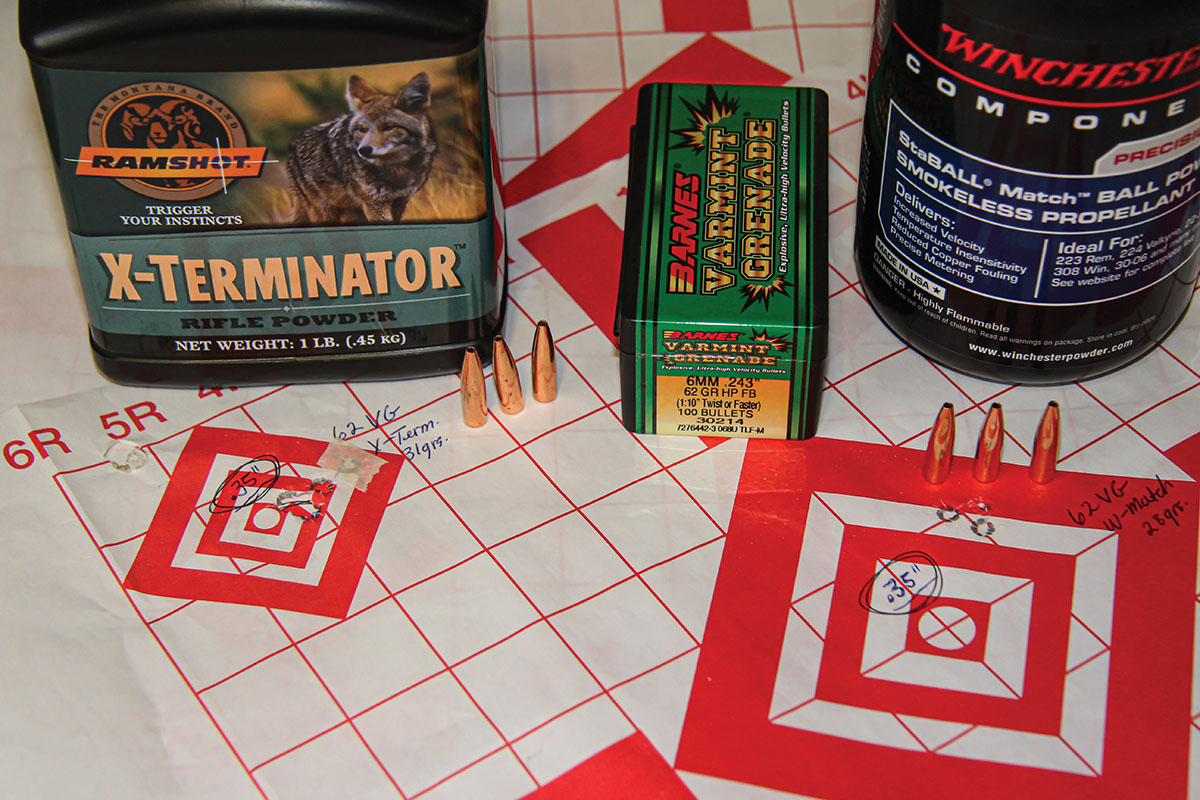
    Shown here are the best 62-grain Varmint Grenade groups of .35 inch at 3,416 fps using 31 grains of Ramshot X-Terminator and .35 inch at 2,884 fps using 28 grains of Winchester StaBALL Match.
    Shown here are the best 62-grain Varmint Grenade groups of .35 inch at 3,416 fps using 31 grains of Ramshot X-Terminator and .35 inch at 2,884 fps using 28 grains of Winchester StaBALL Match.

    As it is a proprietary cartridge, one of the stumbling blocks to owning and shooting a 24 York was once creating brass, and securing proper dies. To help boost interest in his York cartridges, Wayne partnered with Robertson Cartridge Company, aka RCC (recently purchased by Custom Cartridge & Projectile in Fort Meyers, Florida) to supply ready-made cases, and CH-4D to produce full-length die sets. RCC cases include high-strength C272 brass alloy, hammer-forged into a tight molecular grain structure with high tensile strength and 15 percent elasticity. Cases are then machined on CNC lathes and mills to tighten weight and volume tolerances and include .001-inch concentricity. York is also talking to Pendleton Ammunition, hoping to strike a deal to provide loaded factory rounds.

    Cases for the 24 (and 25) York can also be made by running readily available 6.8 SPC brass through a Redding bushing die to neck down to the desired caliber, charging with a moderate load, and then fireforming in a York-chambered rifle. The trim-to length is 1.40 inches, though York said fireformed brass usually emerges from the chamber at the proper length. Another stumbling block to shooting the 24 York is lack of load data. This was made easier with the introduction of the 6mm ARC, as it includes identical case capacity as the 24 York. Ten once-fired Hornady 6mm ARC cases with spent primer in place held an average of 32 grains of water when filled to the brim, while 24 York cases held 31.9 grains of water. The 224 Valkyrie (Federal case) holds 30.3 grains of water, and the 6mm PPC 34.1 grains. Data for the ARC works well for the 24 York, though it should be approached conservatively until you gain a better feel, as the two rounds include different chamber dynamics. Data for some of the newest powders (Winchester StaBALL Match and Alliant Reloder TS 15.5) included in this test was carefully extrapolated from printed 224 Valkyrie recipes.
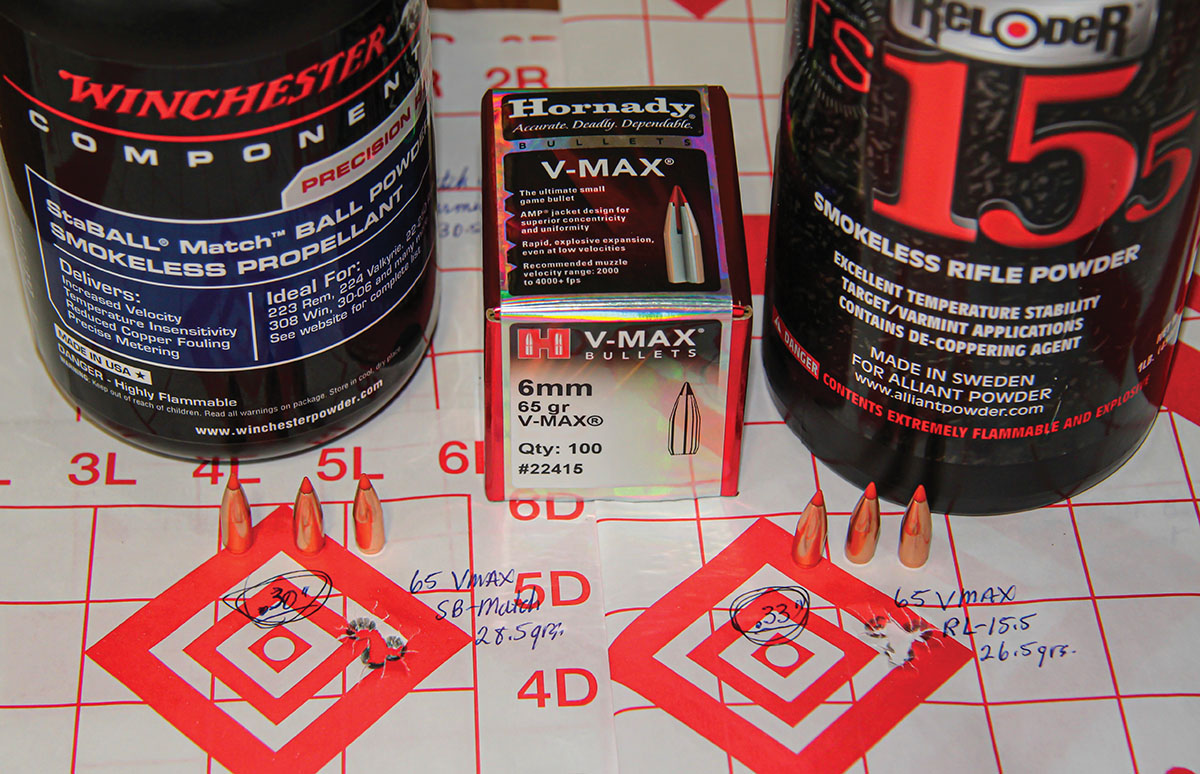
    Hornady’s 65-grain V-MAX assembled two excellent groups, including .30 inch at 2,915 fps with 28.5 grains of Winchester StaBALL Match; and .33 inch at 2,647 fps using 26.5 grains of Alliant Reloder TS 15.5.
    Hornady’s 65-grain V-MAX assembled two excellent groups, including .30 inch at 2,915 fps with 28.5 grains of Winchester StaBALL Match; and .33 inch at 2,647 fps using 26.5 grains of Alliant Reloder TS 15.5.
    Compatible powders included Accurate A-2200, Hodgdon H-322, and Vihtavuori N133 on the fast end (best for lighter bullets), and CFE 223 on the slower end (for heavier bullets). In the middle sit Accurate A-2230, Ramshot TAC, and Alliant Power Pro Varmint, which seem to represent an ideal balance with all bullet weights for this cartridge. TAC is Wayne’s powder of choice, so it was not included here, as I was exploring additional possibilities and didn’t feel I needed to cover ground already covered.

    All bullets tested were varmint numbers selected to serve Wayne’s intended goals. On the light end was Sierra’s 55-grain BlitzKing, a polymer-tipped, boat-tail design giving up a .225 G1 ballistic coefficient (BC) and providing explosive terminal performance. Barnes’ 62-grain Varmint Grenade was up next, a flatbase, nontoxic bullet designed for explosive impacts on small varmints. This one included a .199 G1 BC. Hornady’s 65-grain V-MAX is the consummate varmint bullet, a red polymer tip and boat-tail provided a .280 G1 BC and providing dismantling impacts. Barnes’ 68-grain Match Burners is a flatbase target bullet, but included a thin jacket and hollowpoint that expand aggressively, while providing a .267 G1 BC. Finally, Berger’s 88-grain High BC FB (Flat Base) Varmint provided both a high .380 G1 BC and excellent expansion on smaller targets. All turned in excellent groups.

    I was afraid the Sierra 55-grain might prove too squatty for top accuracy from this rifle, but I was proven wrong when shooting began. In fact, the bullet turned in the two smallest groups of any bullet tested, while also producing stellar velocity. Accurate A-2200 and A-2230, plus Alliant Power Pro Varmint, were paired with the BlitzKing, and all hit top velocities in excess of 3,500 fps. A-2230 proved most consistent across the board, all groups hovering around a half-inch at velocities from 3,426 to 3,576 fps using 31, 31.5 and 32 grains of powder. That was also the fastest velocity with this bullet. A-2200 produced a .27-inch group at 3,436 fps using 29 grains of powder, while Power Pro Varmint produced a .19-inch group at 3,452 fps using 32 grains of powder. The other two groups also broke a half-inch.
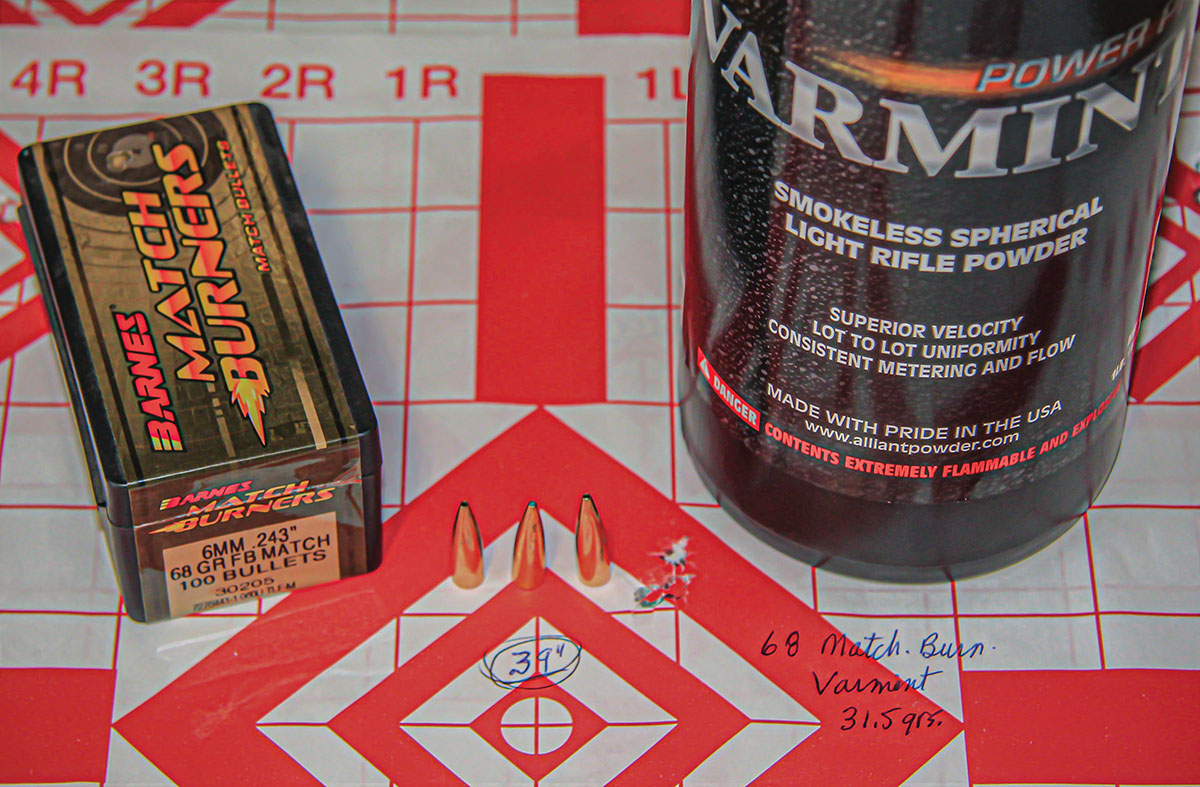
    Barnes 68-grain Match Burners and 31.5 grains of Alliant Power Pro Varmint proved to be a winning combination, producing this .39-inch group at 3,345 fps.
    Barnes 68-grain Match Burners and 31.5 grains of Alliant Power Pro Varmint proved to be a winning combination, producing this .39-inch group at 3,345 fps.
    I have owned rifles that hated Barnes Varmint Grenades and rifles that have loved them. This 24 York was one of the latter. New Winchester StaBALL Match produced one of the best groups with this bullet – .35 inch at 2,884 fps with 28 grains of powder – though velocity was somewhat unimpressive. You might wring a bit more velocity out of this powder by adding another half grain to the 29-grain “maximum” load, though it would become heavily compressed and accuracy was unimpressive with the heavier loads. Hodgdon H-322 managed to hit 3,321 fps with a compressed and true maximum load of 29 grains, but again accuracy was ho-hum. Ramshot X-Terminator proved the clear winner, the two best groups .39- and .35-inch at 3,349 fps and 3,416 fps, respectively, with 30.5 and 31 grains of powder.

    The Hornady 65-grain served as the true guinea pig, stoked with new Alliant Reloder TS 15.5 and newer Winchester StaBALL Match, plus Shooters World Precision Rifle. All provided somewhat lackluster velocity, telling me these powders were perhaps a touch slow burning for this cartridge, though accuracy was certainly exceptional. Reloder TS 15.5 turned in .33- and .51-inch groups at just 2,647 and 2,699 fps, using 26.5 and 27 grains of powder. Group size increased with 29 grains of powder, about as much as you can get in the case without severely compressing each load. Precision Rifle also shot its best group with the lightest load, printing .50 inch at a faster 2,780 fps. This powder could be pushed a bit beyond the 27.5-grain “maximum” used. StaBALL Match proved remarkably consistent, 27.5-, 28- and 28.5-grain charges produced .50-, .55- and .30-inch groups at 2,795 to 2,915 fps. That .30-inch group was the tightest shot with this bullet.
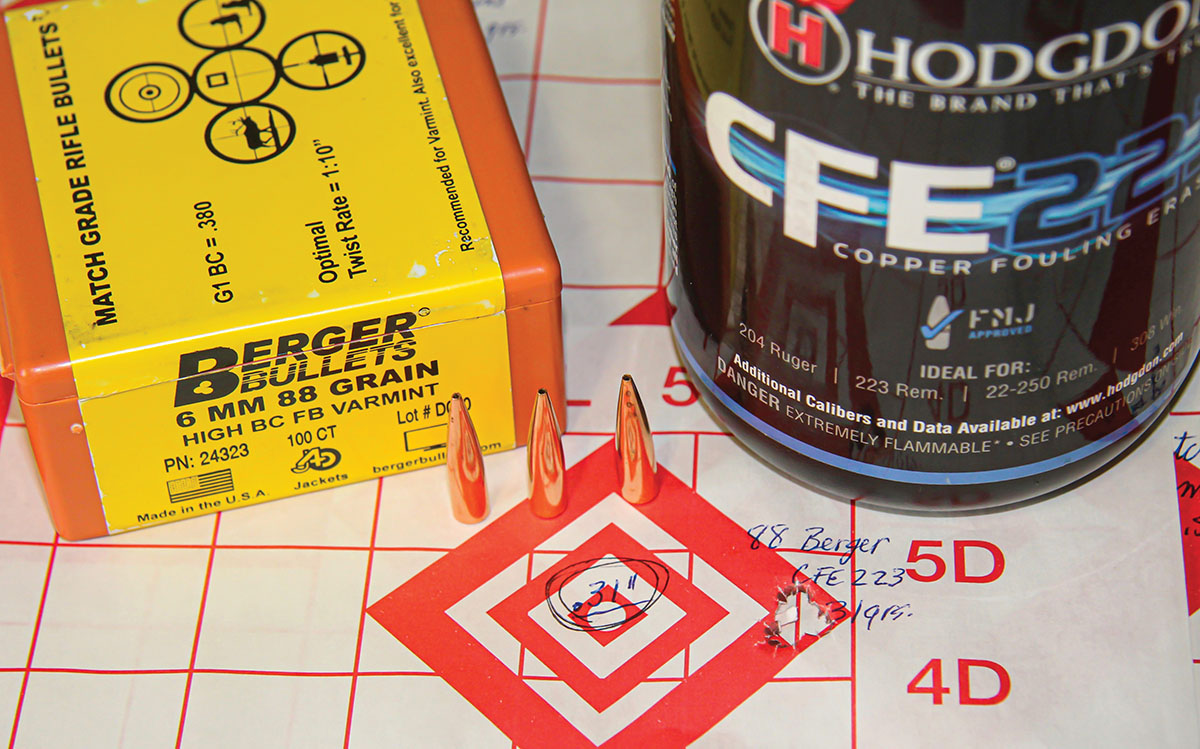
    Thirty-one grains of Hodgdon CFE 223 beneath Berger’s 88-grain High BC FB Varmint bullet assembled this .31-inch group at 3,073 fps.
    Thirty-one grains of Hodgdon CFE 223 beneath Berger’s 88-grain High BC FB Varmint bullet assembled this .31-inch group at 3,073 fps.
    The 68-grain Barnes Match Burners produced good groups with every powder tried. Shooters World Match Rifle produced .49- and .32-inch groups with 28.5 and 29 grains of powder and velocities of 2,840 and 2,912 fps. The .32-inch group was the smallest assembled with this powder, though a maximum load of 29.5 grains produced this test’s first group measuring more than an inch – 1.10 inches. Vihtavuori N133 picked up the pace, the best groups .49 and .48 inch at a reputable 3,144 and 3,211 fps, respectively. The second-best group with this bullet also resulted from the fastest velocities, using Alliant Power Pro Varmint. That .39-inch group resulted from a true maximum load of 27.5 grains of powder sent at 3,345 fps. This demonstrated that Alliant Power Pro Varmint is an excellent all-around choice for the 24 York cartridge.

    LEVERevolution, which is a top-three choice in the 6mm ARC, proved dismal from the 24 York while shooting the Berger 88-grain bullet. None of the groups broke half an inch, with the test’s 1.22-inch worst included. Luckily, CFE 223 and Reloder TS 15.5 improved things immediately.

    Reloder TS 15.5 lacked the pace again, with velocities from 2,428 to 2,547 fps all it managed with this bullet using 25 to 26 grains of powder, but with impressive .39-, .47- and .50-inch groups. No pressure signs resulted from listed loads, so they could be carefully pushed a little faster. CFE 223 proved the star with the heavier bullet, .51- and .31-inch groups (the best from this bullet) emerged from 30 and a compressed load of 31 grains of powder. Velocities were 2,936 fps with 30 grains, and 3,073 fps with 31 grains of powder.

    York has obviously assembled a winner with both his 24 York cartridge and this rifle. The heavy rifle will make an ideal choice for the bench-based prairie dog hunting it was built for, the 6mm bullets providing both the zap and wind-bucking abilities needed on the invariably breezy conditions found on the plains of Wyoming.


    Wolfe Publishing Group