
Login


Wolfe Publishing Group
    Menu

    AR-10 in 6.5 Creedmoor

    Marital Bliss

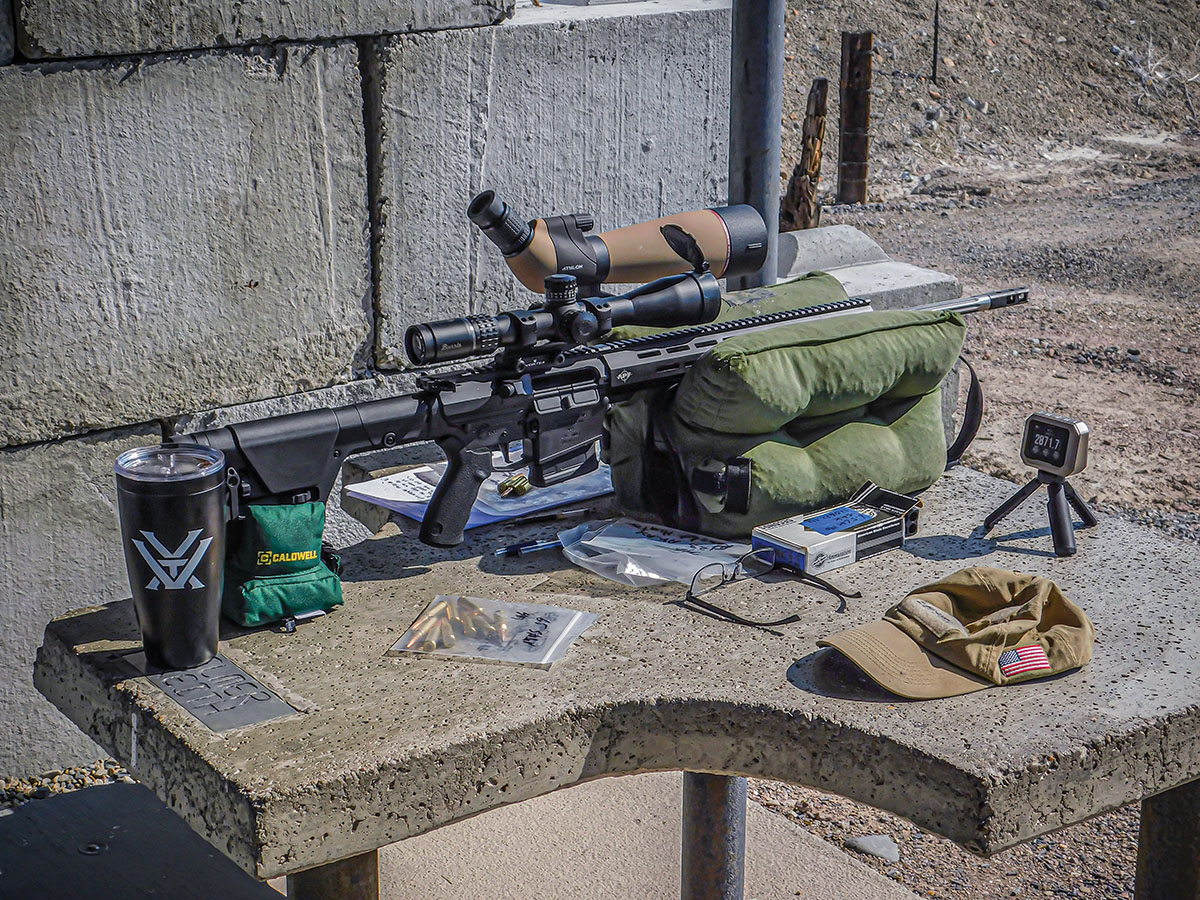
    With temperatures approaching 100 degrees Fahrenheit by early afternoon, Rob spent three early mornings at the range. Unfortunately, the morning sun at that time of year is directly over the target butts, creating bright, glaring conditions.
    With temperatures approaching 100 degrees Fahrenheit by early afternoon, Rob spent three early mornings at the range. Unfortunately, the morning sun at that time of year is directly over the target butts, creating bright, glaring conditions.
    I’m so old that answering the phone used to be a dicey endeavor. Sometimes, I got to speak to someone I liked, and sometimes, I wished I had dodged the call. When my phone rang a few months ago, Siri’s melodic voice announced that the caller was Cole Bender. That’s a call I want to take.

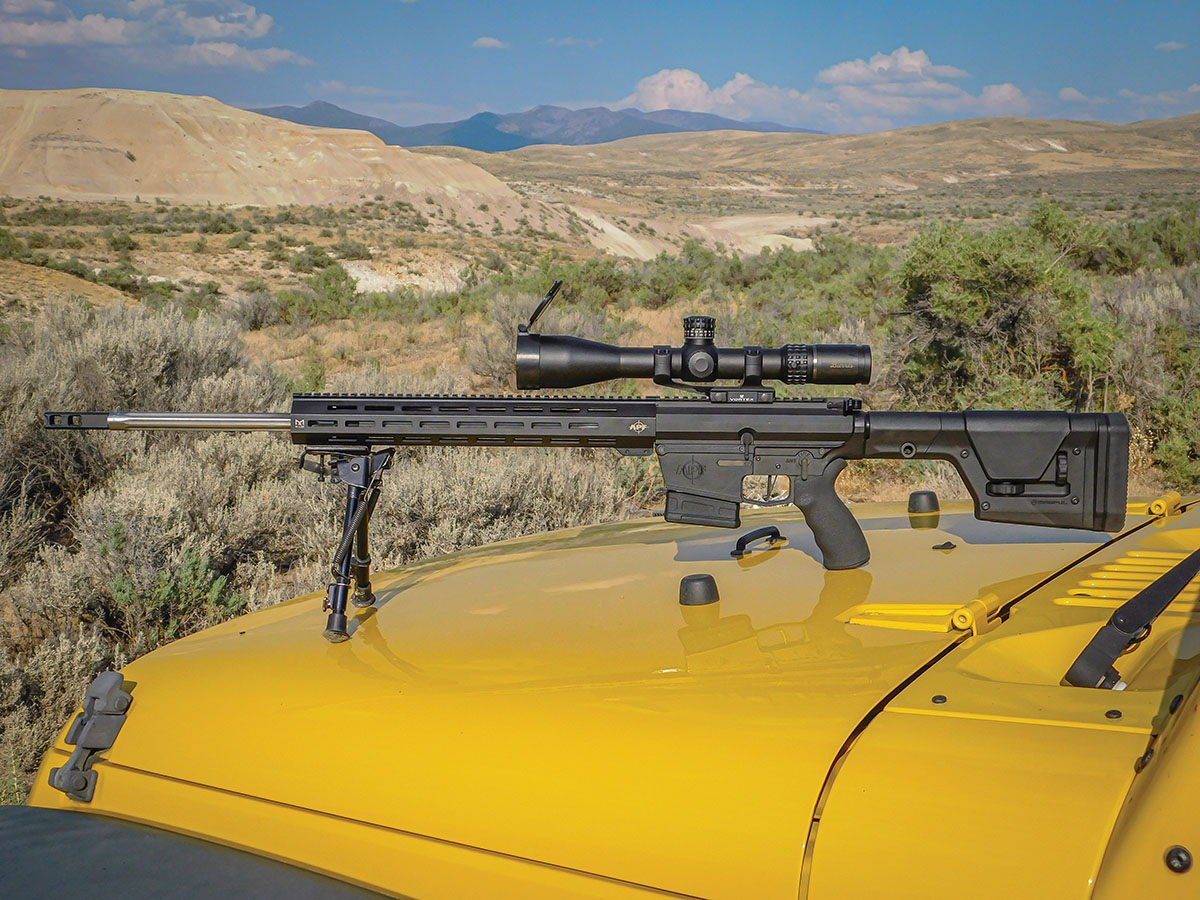
    The Alex Pro Firearms AR-10 Target in 6.5 Creedmoor is a big, heavy rifle. It  is also spectacularly accurate and will be a menace to coyotes this winter.
    The Alex Pro Firearms AR-10 Target in 6.5 Creedmoor is a big, heavy rifle. It is also spectacularly accurate and will be a menace to coyotes this winter.
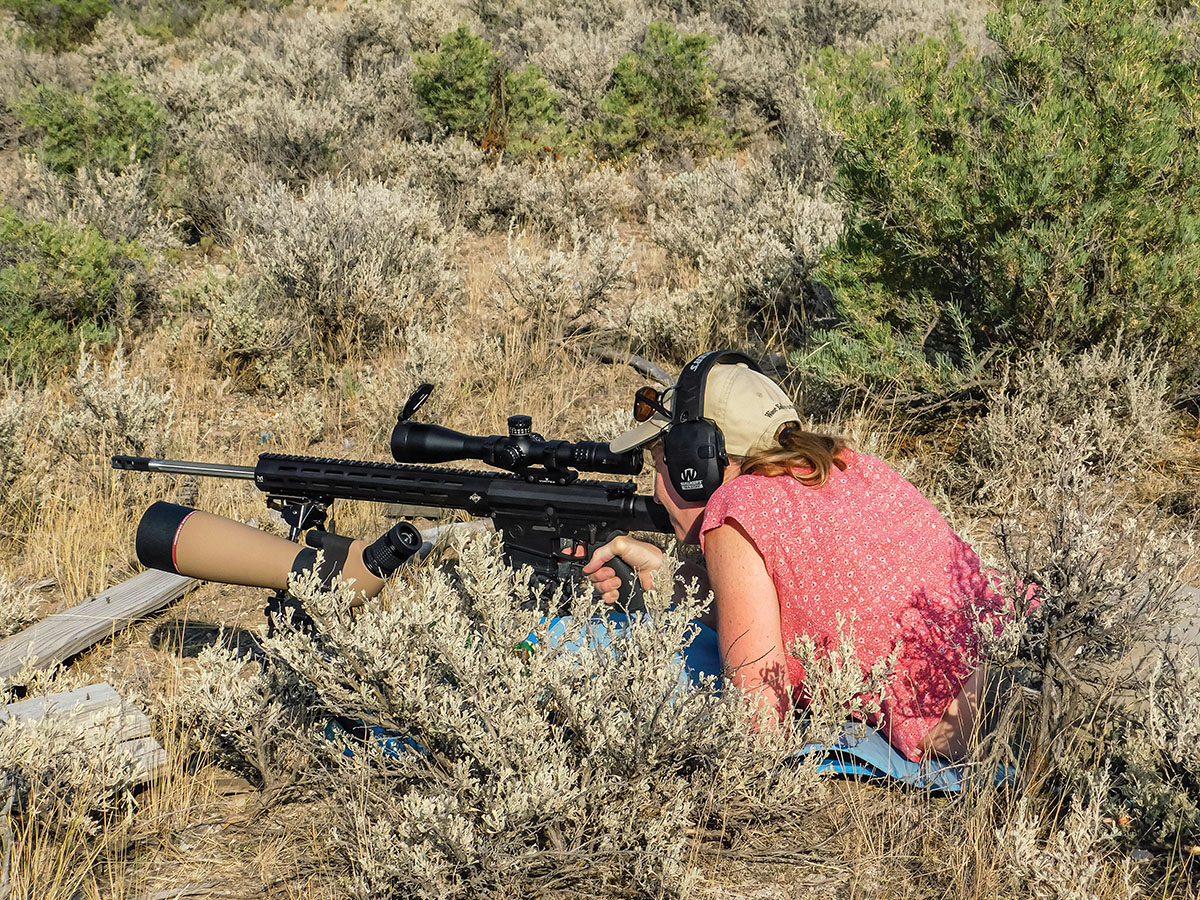
    Rob’s wife, Camille, settles into a shot at a boulder on a cliff face almost 400 yards away. Her successful shot and subsequent decision to keep Rob’s rifle caused marital disharmony.
    Rob’s wife, Camille, settles into a shot at a boulder on a cliff face almost 400 yards away. Her successful shot and subsequent decision to keep Rob’s rifle caused marital disharmony.
    Cole and I met when we were both working for Proof Research. That smart guy is still there while I’m prone to looking for spare change in my couch. Such are the choices I made in life. However, my fiancé and I liked him so much that he performed our wedding ceremony. Montana is like that. Machinists are allowed to perform weddings under the right circumstances. Who knew? The only problem with accepting Cole’s call is that it often costs me money.

    “Say, I have a rifle that you might like, but it’s a weird one,” he told me. “A woman I know wanted to shoot in precision rifle matches but decided it wasn’t for her after the first competition. Do you want a gas-gun precision rifle? It’s an AR-10.”

    I thought about that for a moment. I envisioned how happy my life would be with a new rifle. I thought about how peerless I would be among peers if I had a treasure like that. I thought about divorce and how much I would miss my wife. I considered it carefully.

    “Yeah, I think I need that. How much?”

    “A grand.”

    I again considered how much I love and depend upon my wife.

    “Deal. Bring it down next time I see you.” I knew then that my only chance was to get it into the safe before she saw it.
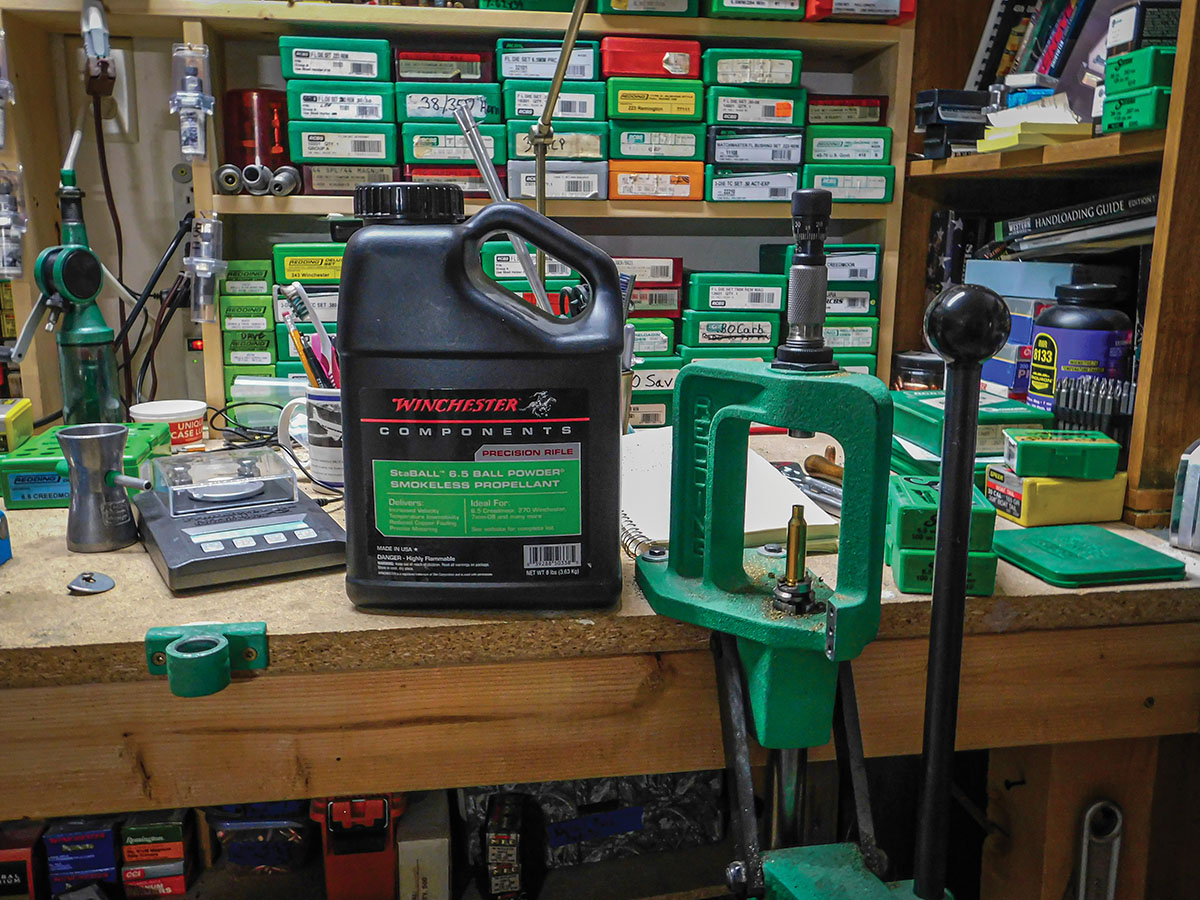
    After testing it years ago, StaBall 6.5 was Rob’s first choice in the Alex Pro gas gun. From cold weather hunting to scorching hot prairie dog towns, its consistency is remarkable.
    After testing it years ago, StaBall 6.5 was Rob’s first choice in the Alex Pro gas gun. From cold weather hunting to scorching hot prairie dog towns, its consistency is remarkable.

    You may have noticed that a number of things went unasked in that conversation. The most obvious one, looking back with perfect hindsight, was that I never asked what cartridge it was chambered in. I just assumed it was a 308 Winchester. When my new 6.5 Creedmoor arrived, I was pleasantly surprised.
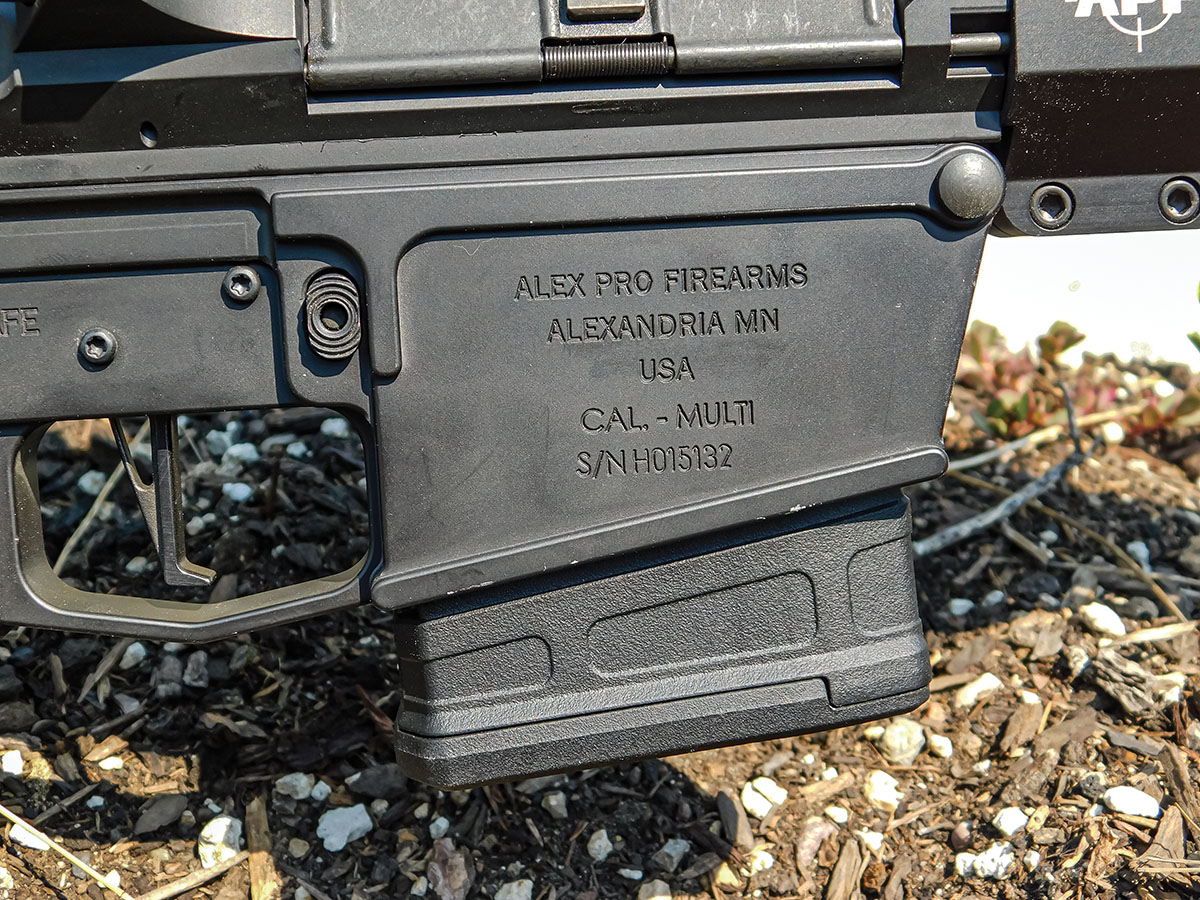
    The flat target trigger was everything Alex Pro Firearms promised it would be. The single-stage trigger broke cleanly at 3.5 pounds.
    The flat target trigger was everything Alex Pro Firearms promised it would be. The single-stage trigger broke cleanly at 3.5 pounds.
    Seeing my new Alex Pro Firearms AR-10 Target rifle for the first time left me overawed. First of all, it’s huge. Measured from the butt of the Magpul PRS buttstock to the tip of its Butcher muzzle brake, the rifle is 46.5 inches long. With my Burris XTR II mounted, the rifle weighs 14.2 pounds empty. The flat trigger broke right at 3.5 pounds on my gauge, just like the advertising promised. Everything about this rifle is like that, it’s everything that Alex Pro says it is and perhaps a bit more. When Camille caught me red-handed with my unsanctioned rifle, I was too giddy to make up a good lie. With a noticeable eye roll, she asked me what this one was for and I told her it was a varmint rifle. To be honest, I wasn’t sure that was true.

    With its relatively modest muzzle velocities, even with lighter bullets, the 6.5 Creedmoor initially seems at a disadvantage to the speed demon varmint rifle cartridges using .224- and .243-caliber bullets. At shorter ranges, say out to 500 yards, traditional varmint calibers have it beat.
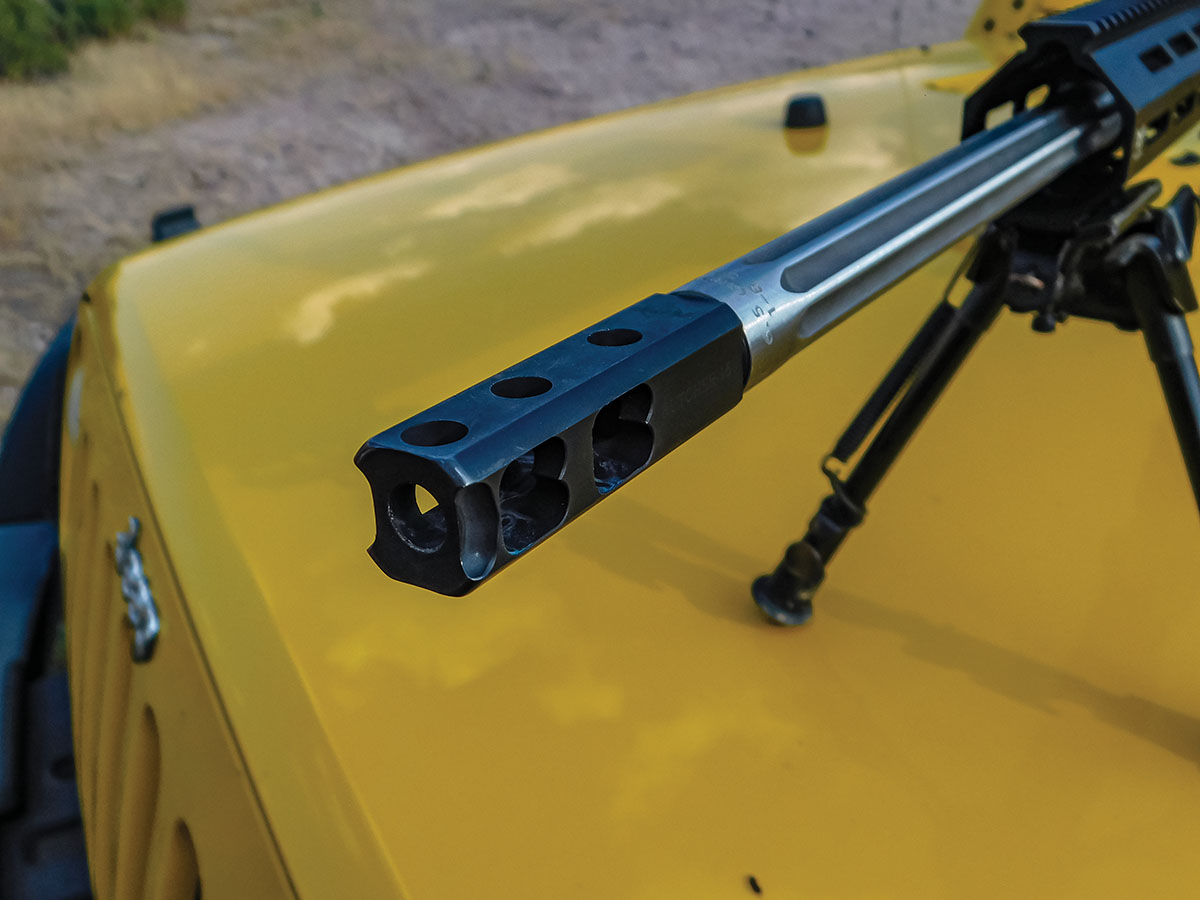
    The Alex Pro AR-10 Target came equipped with a .30-caliber Butcher-16 muzzle brake. Originally designed for 3-gun competition, it, along with the rifle’s heavy weight made it easy to see the bullet’s impact. It will be of real use to those who choose to hunt coyotes at extended ranges.
    The Alex Pro AR-10 Target came equipped with a .30-caliber Butcher-16 muzzle brake. Originally designed for 3-gun competition, it, along with the rifle’s heavy weight made it easy to see the bullet’s impact. It will be of real use to those who choose to hunt coyotes at extended ranges.

    If I’m going to hunt prairie dogs out on the hot, windy plains of eastern Montana, I would probably take a high performance .224-caliber rifle like a 22-250 Remington or my ridiculously heavy-barreled 243 Winchester shooting lighter bullets. As the ranges stretch and the varmints get bigger, I think the 6.5 Creedmoor can play a useful role. Let’s take a look at the ballistics.
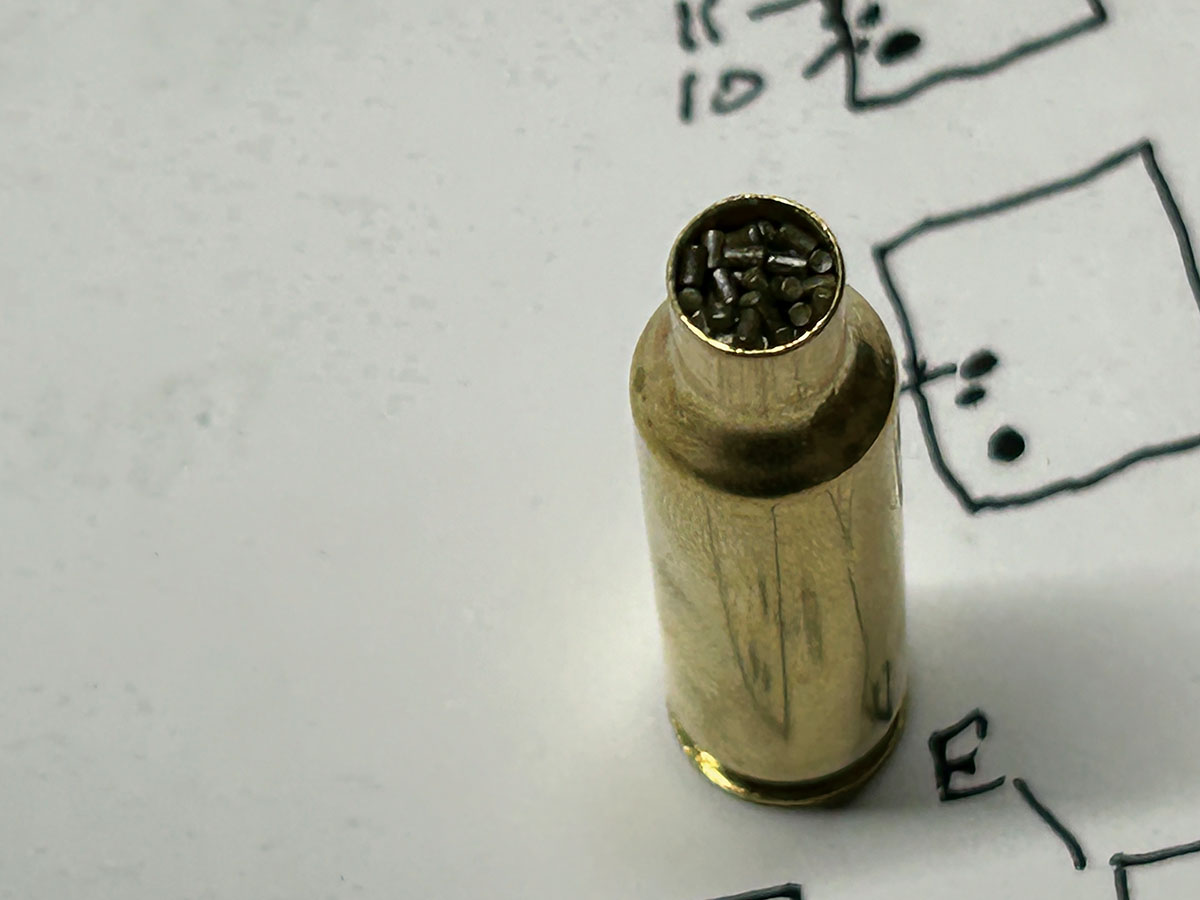
    This case is filled to top with H-4350, an excellent performer in the 6.5 Creedmoor. When capped with a Varminter 85-grain bullet it was able to exceed 3,200 fps and produced very good accuracy.
    This case is filled to top with H-4350, an excellent performer in the 6.5 Creedmoor. When capped with a Varminter 85-grain bullet it was able to exceed 3,200 fps and produced very good accuracy.
    For many shooters, 4,000 feet per second (fps) is a magical number.

    In this instance, let’s look at a .224-caliber, Sierra 40-grain BlitzKing bullet that leaves the muzzle at exactly 4,000 fps. With a ballistic coefficient (BC) of .196, it is still good for more than 3,400 fps at 100 yards. By the time it reaches 500 yards, the little Sierra is still supersonic at about 1,650 fps and has dropped 39 inches. At 1,000 yards, the bullet’s velocity has decayed to about 840 fps and has dropped 477 inches.

    My goal going into testing this new rifle was to develop a handload that could operate at 3,000 fps with the heaviest bullet that had a BC of at least .400. Let me compare those numbers.

    At 500 yards, the arbitrary point where I imagined I would choose the Alex Pro over one of my
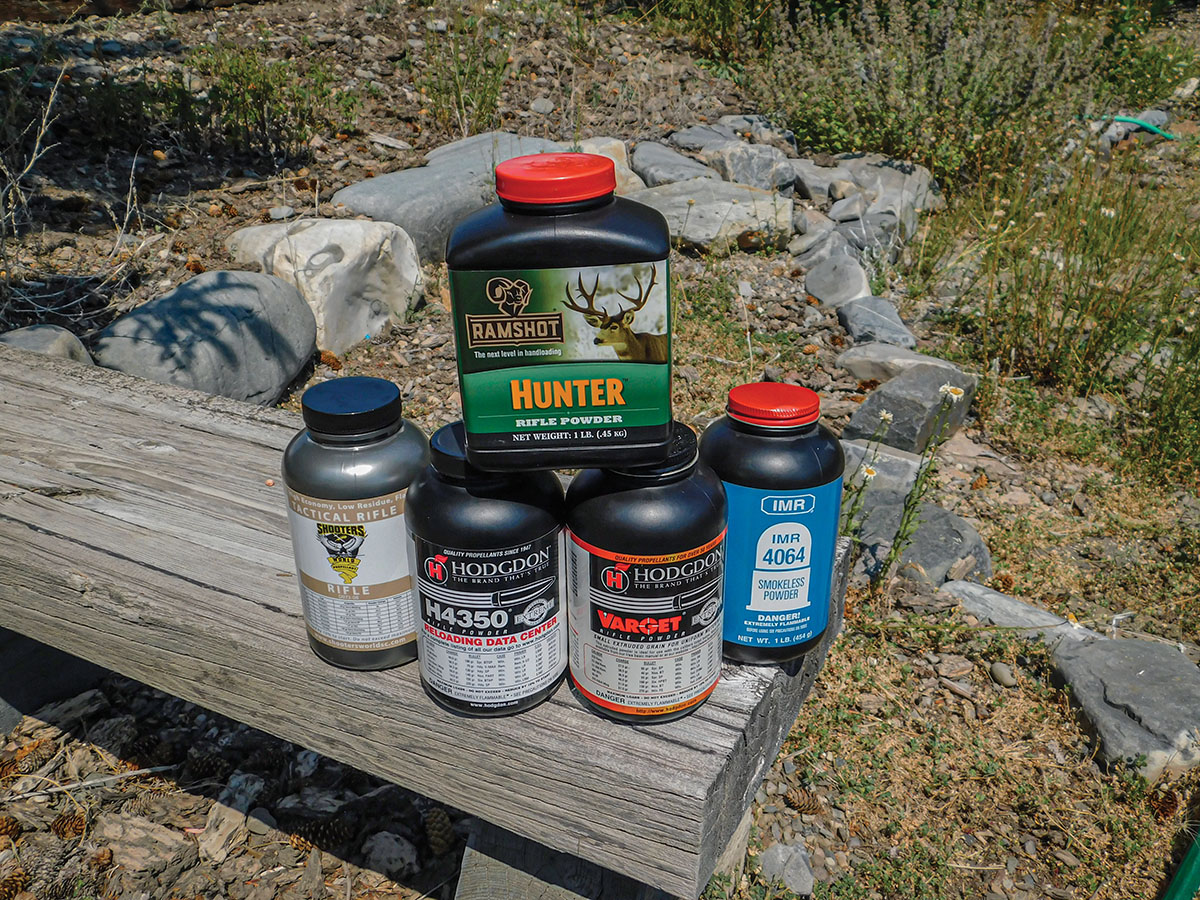
    The 6.5 Creedmoor is well-balanced and not terrible finicky about propellants. Any of these powders were capable of producing very good velocity and  excellent accuracy in Rob’s AR-10 Target rifle.
    The 6.5 Creedmoor is well-balanced and not terrible finicky about propellants. Any of these powders were capable of producing very good velocity and excellent accuracy in Rob’s AR-10 Target rifle.
    beat-up Cooper single-shot rifles, the numbers were less impressive than I’d hoped. Launched at 3,000 fps, my hypothetical load at 500 yards was traveling about 1,932 fps and it had dropped 10 inches more than the BlitzKing. The only advantage it showed on paper was substantially more energy, which was to be expected. At a thousand yards, the 120-grain bullet was approaching transonic levels of less than 1,200 fps. It had dropped 351 inches. The Creedmoor caught up to the BlitzKing in terms of velocity at about 400 yards but failed to show a better trajectory until 700 yards into its flight. So, is it a varmint cartridge? No, probably not in the traditional sense but it takes more than velocity to make a varmint rifle. I’ll take a slow hit over a fast miss every time. Ultimately, the varminting game is won with accuracy.

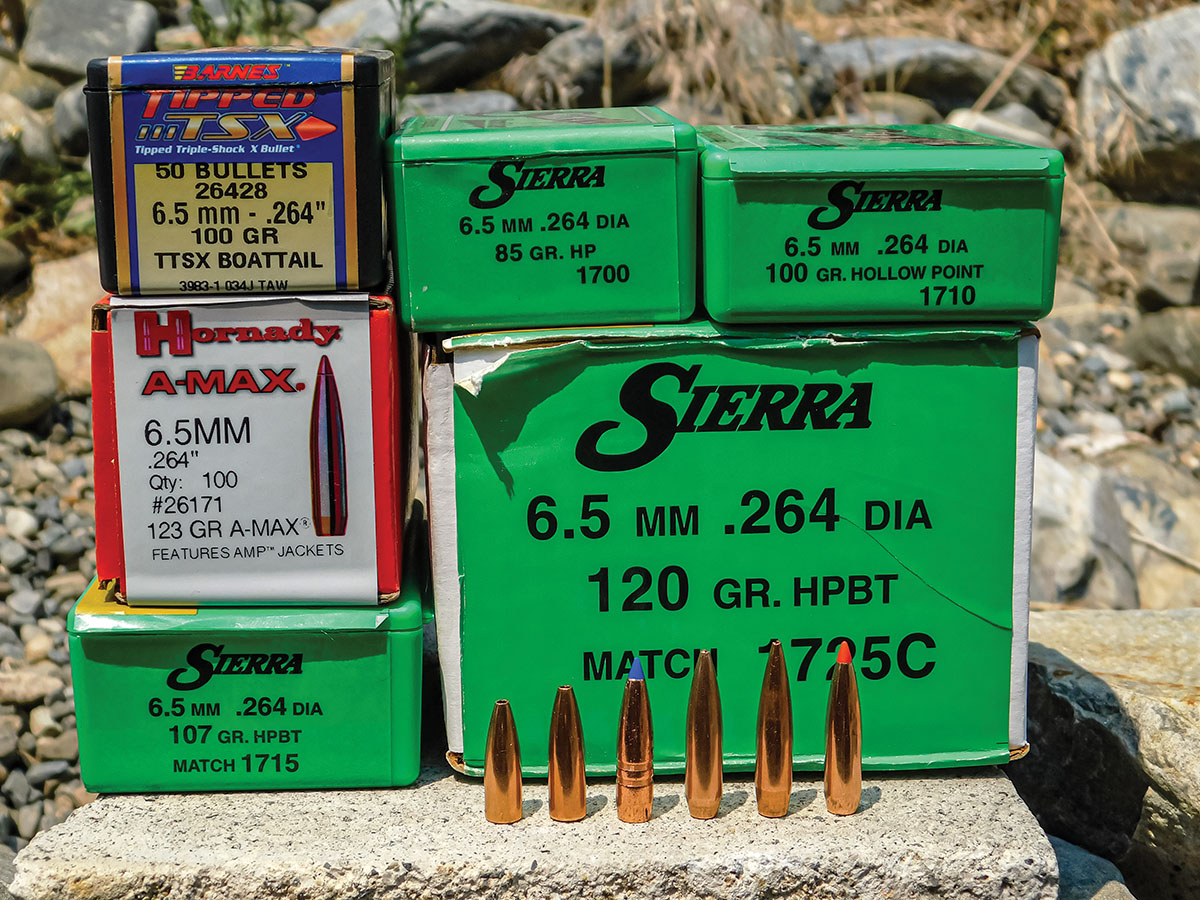
    Only the Barnes 100-grain TTSX boat-tail bullets failed to produce reasonable groups in Rob’s initial testing. All of the others showed potential to be developed for some very impressive groups. If Rob hadn’t decided to pursue the Sierra 120-grain MatchKings, the 123 A-MAX would have been his next choice.
    Only the Barnes 100-grain TTSX boat-tail bullets failed to produce reasonable groups in Rob’s initial testing. All of the others showed potential to be developed for some very impressive groups. If Rob hadn’t decided to pursue the Sierra 120-grain MatchKings, the 123 A-MAX would have been his next choice.
    Our local farm and ranch store had four different brands of 6.5 Creedmoor ammunition that weighed less than 140 grains. I bought all four.

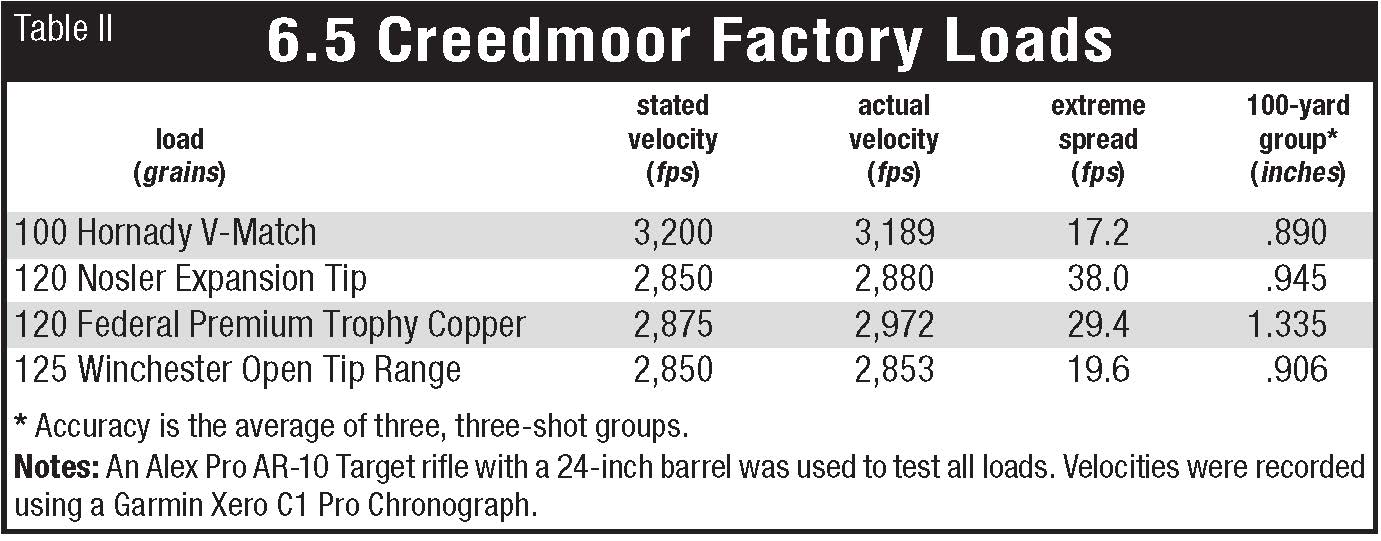
    One of them, Hornady’s new V-Match loaded with 100-grain ELD-VT bullets, more than fulfilled my specifications for a varmint round. With a stated muzzle velocity of 3,200 fps and a G1 BC of .448, Hornady has answered the question I had asked myself. They certainly see the 6.5 Creedmoor as a potent varmint rifle cartridge.

    The Hornady loads proved to be the most accurate of the factory rounds I tested. It produced the best factory group, measuring .530 inch center-to-center. After firing three groups in steadily decreasing range conditions, the V-Match average group was .890 inch at an average velocity of 3,189 fps from the Alex Pro’s 24-inch barrel. I had high expectations for the Hornady cartridges and my faith proved well-placed.
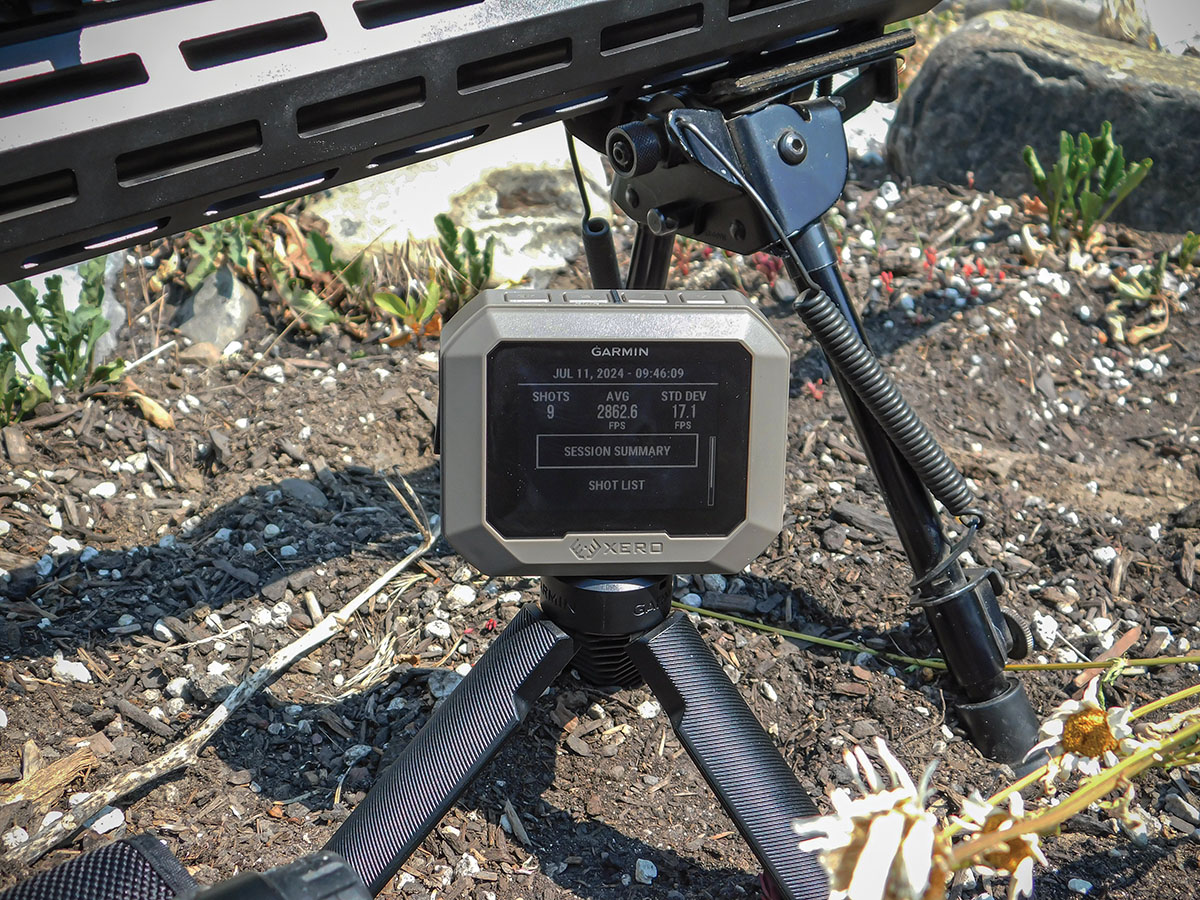
    The Garmin Xero C1 chronograph is a relatively new staple on Rob’s shooting bench. Accurate, intuitive and easy to set up, it has proven a game changer in the world of chronographs.
    The Garmin Xero C1 chronograph is a relatively new staple on Rob’s shooting bench. Accurate, intuitive and easy to set up, it has proven a game changer in the world of chronographs.

    The biggest surprise was the red and white box of bulk Winchester 125-grain, open-tip range ammunition. By far the least expensive of the ammunition I purchased for testing, it provided the second smallest average group measuring .906 inch center-to-center. In fact, the overall average of all groups fired on that first day came to .993 inch when Federal’s 120-grain Trophy Copper loads were excluded. Including those loads, the overall average rose to a still respectable 1.164 inches.

    That evening, I rooted around my reloading bench looking for lighter 6.5 bullets. I found six that fit the bill, running from Sierra’s 85 grain up to the Hornady A-Max 123 grain. I played a mix-and-match game of powders for testing, matching bullets to powders that had a good reputation in the 6.5 Creedmoor. Many powders fill that bill. It is a very well-balanced cartridge.

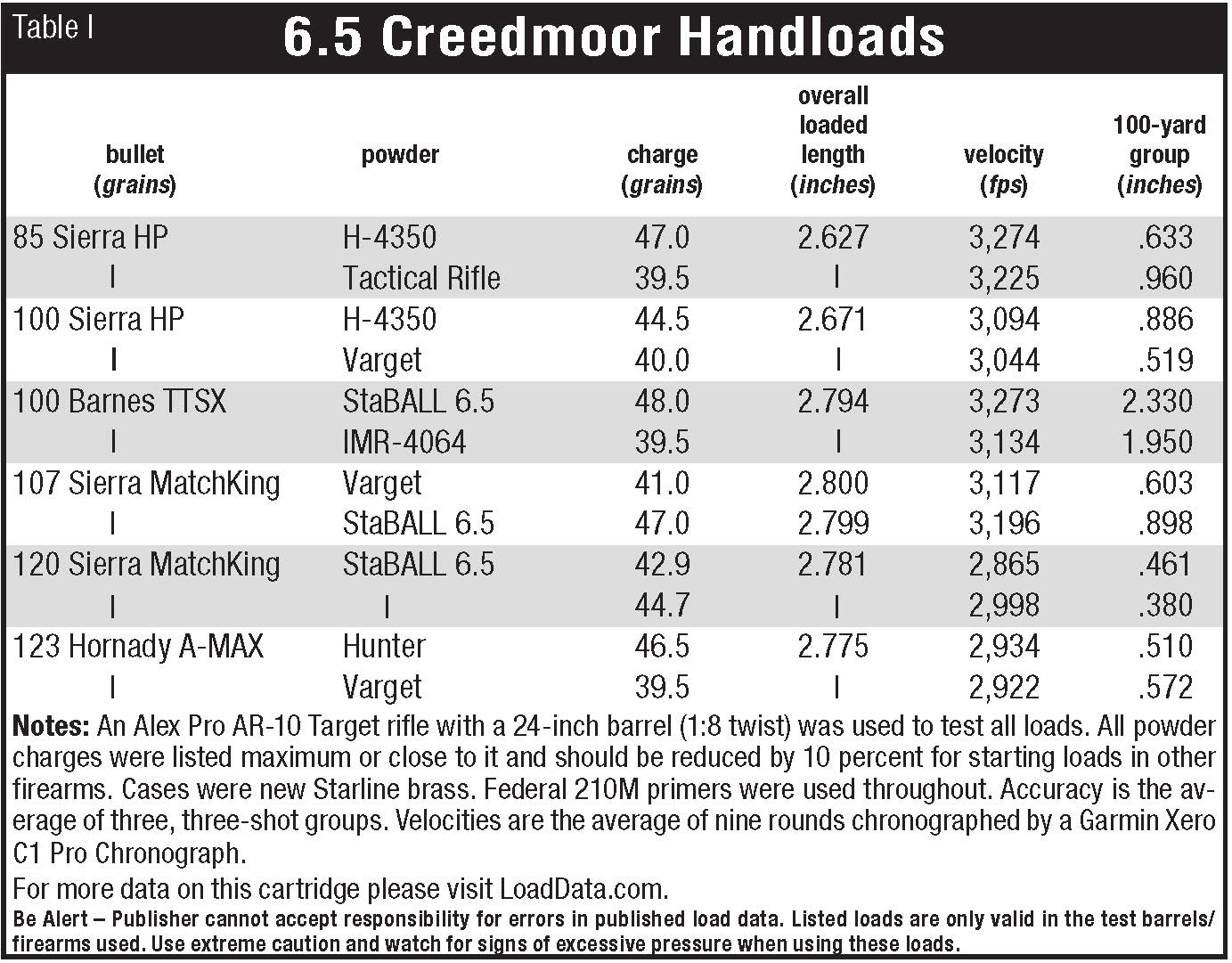
    Among the combinations I tested, the results were uniformly promising. Most ran solidly between a minute-of-angle to a little above half that size. The only exceptions were the Barnes 100-grain TTSX bullets that showed no promise at all. I think that any of the other combinations could have been developed into very accurate loads. I had other plans.

    The best find I made looking for bullets was a box of 500 Sierra 120-grain MatchKings I had purchased for my Grendel and never used. They were languishing unloved on a dusty shelf in my storage room. I also have an 8-pound jug of StaBall 6.5 that cost me more than my first car. I really wanted this combination to work. It’s hard to find components and when I do, they are expensive. Having a lot of StaBall 6.5 and 500 MatchKings is a blessing that shouldn’t be ignored. I really wanted this combination to work.
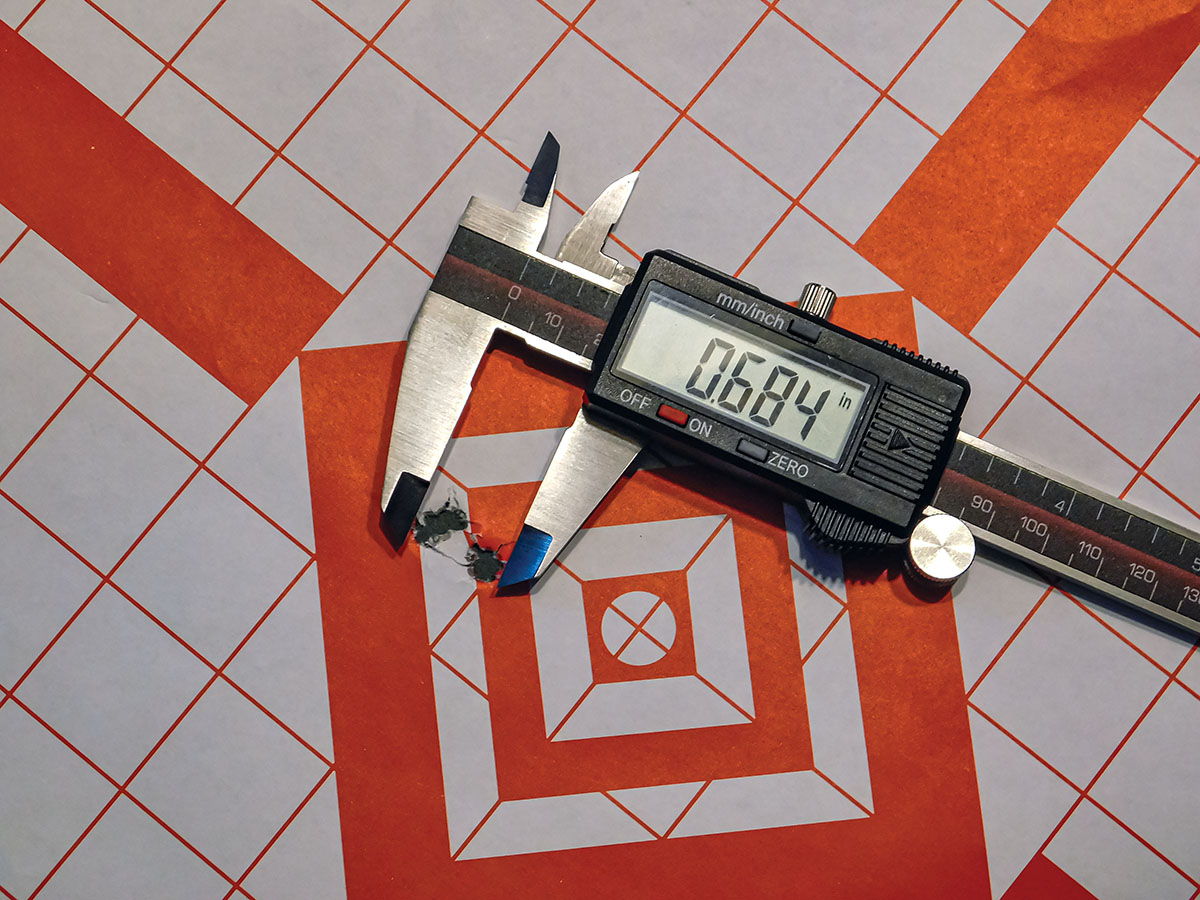
    This group was typical of the accuracy found at the Alex Pro’s lower velocity node. The union of Sierra 120-grain MatchKings and StaBall 6.5 proved to be  a useful combination.
    This group was typical of the accuracy found at the Alex Pro’s lower velocity node. The union of Sierra 120-grain MatchKings and StaBall 6.5 proved to be a useful combination.
    If you haven’t tried StaBall 6.5, it is well worth the investment. It is simply amazing that a double-base propellant can be this temperature stable. When I tested it for my “Propellant Profiles” column in Handloader magazine, I put a handful of 6.5 Creedmoor cartridges into a small Yeti cooler and then froze the whole thing overnight in a chest freezer. The thermometer inside my freezer indicated that it was, if I remember correctly, 22 degrees below zero Fahrenheit. I also heated a handful of cartridges to 100 degrees Fahrenheit. A velocity comparison between the cold and warm cartridges produced an astonishing 4 fps
    This was the smallest group Rob shot while testing the higher velocity node of 44.7 grains of StaBall 6.5 and a Sierra 120-grain MatchKing bullet. At almost 3,000 fps, the rifle was able to average sub-half minute-of-angle groups.
    This was the smallest group Rob shot while testing the higher velocity node of 44.7 grains of StaBall 6.5 and a Sierra 120-grain MatchKing bullet. At almost 3,000 fps, the rifle was able to average sub-half minute-of-angle groups.
    velocity shift. Chances are that I am going to be using this rifle to hunt coyotes in winter and for long-range rockchucks in the summer. That type of stability in these two extremes made StaBall 6.5 an easy choice.

    Hodgdon’s handloading site provided data for a similar weight bullet that began at 41.7 grains and ran to a maximum of 45.3 grains. Starting off with an arbitrary 2.750-inch cartridge overall length, I produced a load ladder in .3-grain increments. The last load tested was 45.6 grains, .3 grains higher than Hodgdon’s maximum.

    The rifle hit a dead spot in its harmonics very quickly, at about 42.9 grains. A higher velocity node developed somewhere between 44.7 and 45 grains. The next day, I tested both nodes and it was like I’d brought a new rifle to the range. The lower node developed an average velocity of 2,863 fps with ana sectional density of 17.1. The extreme spread was 52 fps. Despite these ugly velocity shifts, the average group size was .461 inch measured center-to-center, marking the first time that the big Alex Pro was able to break a half-minute-of-angle.
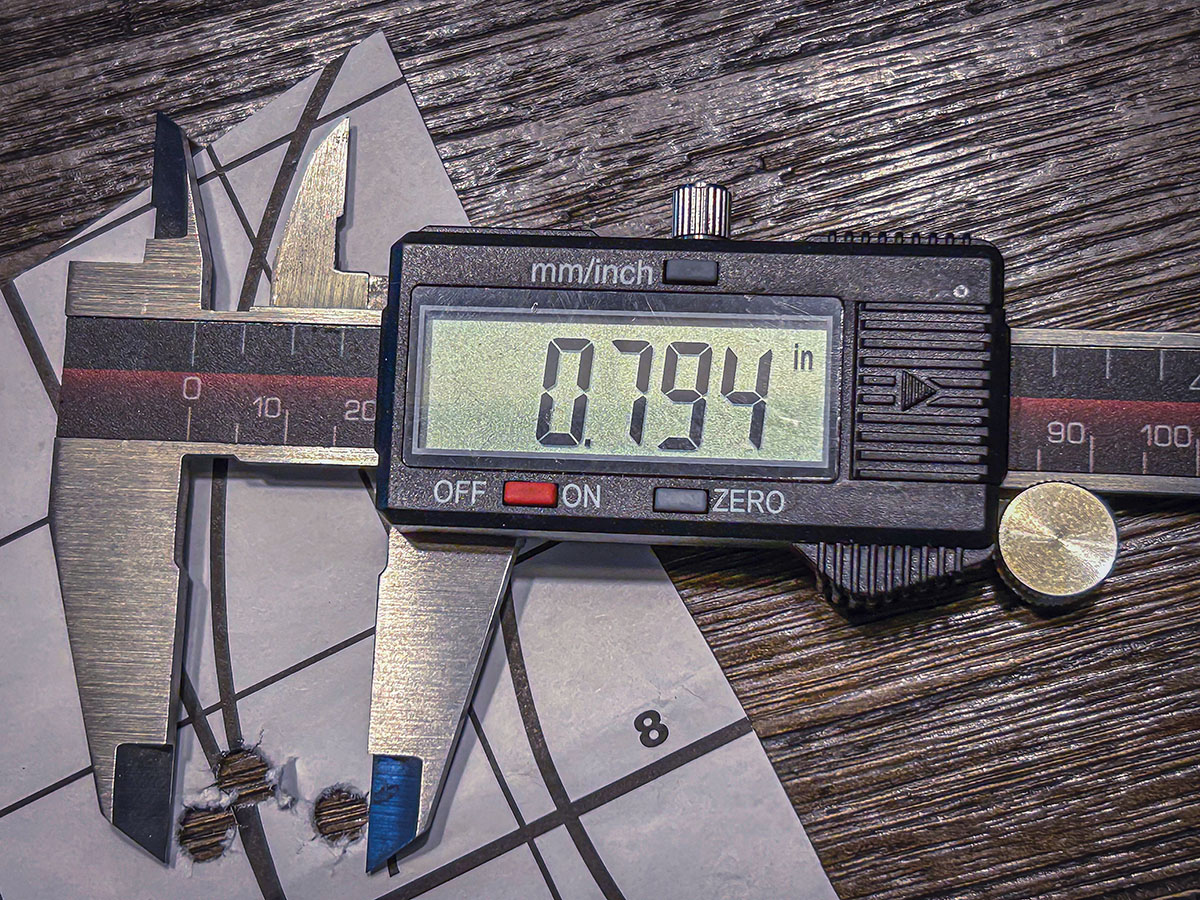
    The best factory groups, shot on the first day of testing, were produced by Hornady’s new V-Match ammunition and very sleek 100-grain ELD-VT bullets.
    The best factory groups, shot on the first day of testing, were produced by Hornady’s new V-Match ammunition and very sleek 100-grain ELD-VT bullets.
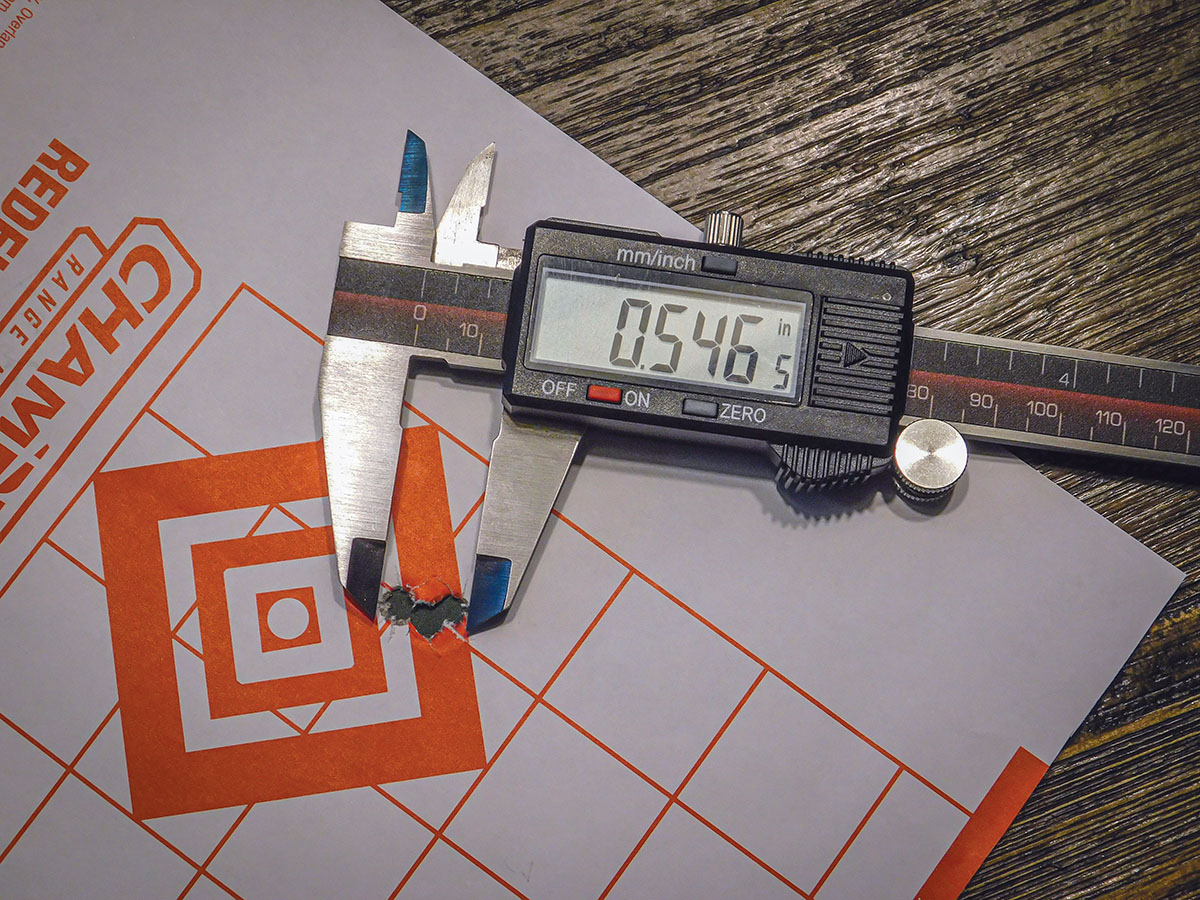
    The higher node was nothing short of impressive. At 2,998 fps, the load was slightly slower than I’d hoped, but it was very close. The first group surprised me enough that I walked out to look at the target firsthand. It measured .546 inch from the outside edges making it a .282-inch group. The next two groups brought the average group size up to .380 inch. With a bullet that has a BC of .409, being fired from an accurate semiauto rifle, this load is going to be the end of a lot of coyotes.

    On that first day of shooting, I had convinced myself that I was probably going to have to be satisfied with groups that ran around a minute-of-angle. I reminded myself that it was a gas gun and not a custom bolt-action rifle. What a difference a few days on the range can make. This thing shoots well. I sent a couple of group photos to Cole, to show how his find had progressed. His laconic answer sums it up, I think. “Shoots pretty well for a gasser, doesn’t it.”

    That was supposed to be the last line in the story, and I think it would have been a good one. It turns out that life had one more subtle cruelty waiting around the corner. My wife asked me if I wanted to go shooting a couple of evenings ago. She has a new 6.5 PRC she is breaking in and a much desired Idaho controlled hunt bull elk tag in her pocket. We need her to score this November, or our family will probably face starvation again this winter.

    I took the Alex Pro along for her to try and to start doping the rifle at longer ranges. Her first shot hit a good-sized rock at a range of 384 yards. I saw it hit. Moreover, she saw it hit too. The combination of weight and the efficient Butcher brake reduces recoil to the point that the shooter can watch the bullet into the target. This is a tremendous advantage when hunting varmints, especially when the hunter is alone.

    “It didn’t kick at all” she told me, looking at her new 6.5 PRC rifle with a jaundiced eye. “I’m going to use this one next time we go back to Montana for prairie dogs. You’ll have to shoot something else.”

    I should have left it hidden in the safe.

    Wolfe Publishing Group