I grew up on a farm and like most men of the soil in our small part of the world, my father was not on good terms with crows. Corn was an important crop and immediately after a field had been planted, a mob of the highly-intelligent birds would descend and become quite efficient at scratching up and devouring the seeds. Dad put me in charge of predator control at the age of 11, and when the crows were feeding in a field bordered by trees and brush, I occasionally managed to stalk close enough to ventilate one with my Marlin 39A lever-action rifle. I was quite proud of it and the Marlin Micro-Vue scope of 4x magnification with a 3⁄4-inch tube it wore. A solid hit with a high-velocity 37-grain hollowpoint never failed to send one of those black bandits to that big rookery in the sky. But they wised up fast and avoided feeding within range of the 22 Long Rifle cartridge. Soon after informing my father that a rifle with more reach was badly needed, he rounded up a slightly used Savage Model 219 break-action single shot in 22 Hornet with a Weaver K6 scope along with a generous supply of Remington ammunition.
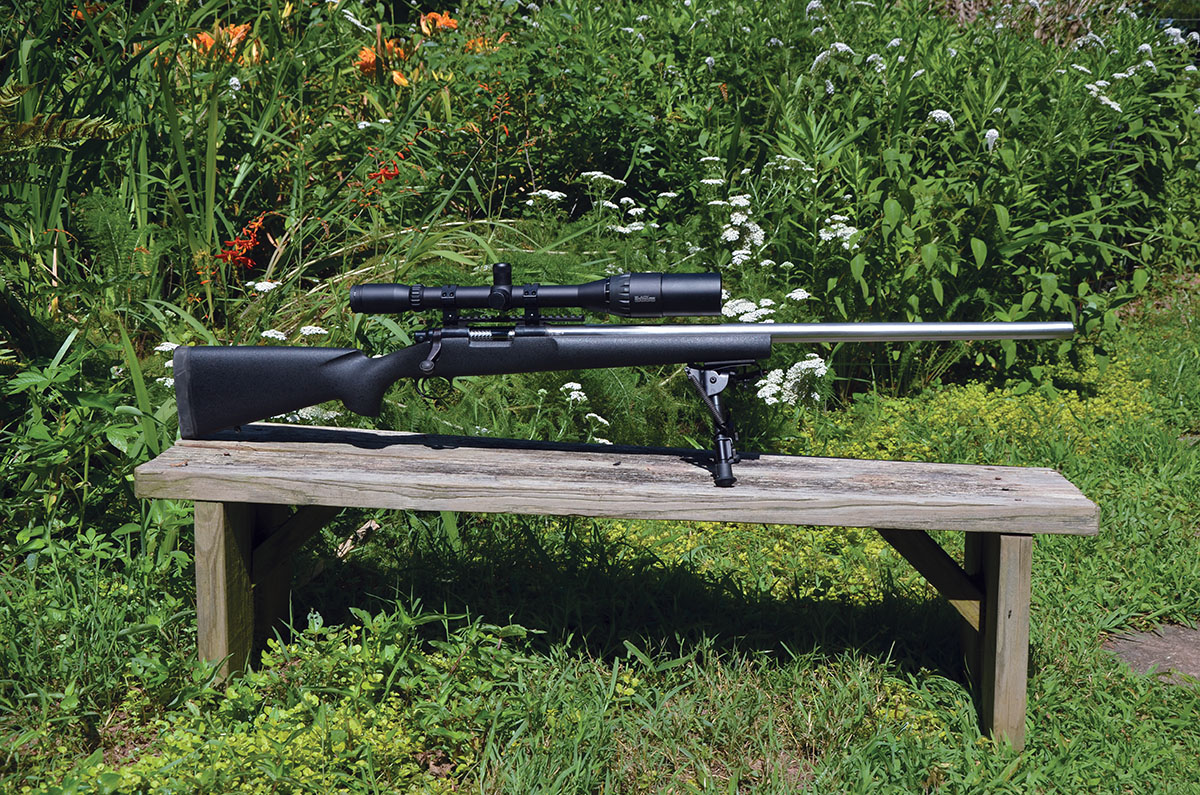
This 40X-KS in 220 Swift was built for Layne by craftsmen in Remington’s Custom Shop when the factory was located in Ilion, New York. He still has the rifle, and with its favorite handload, it still shoots five Nosler 55-grain Ballistic Tip bullets inside a half-inch at 100 yards.
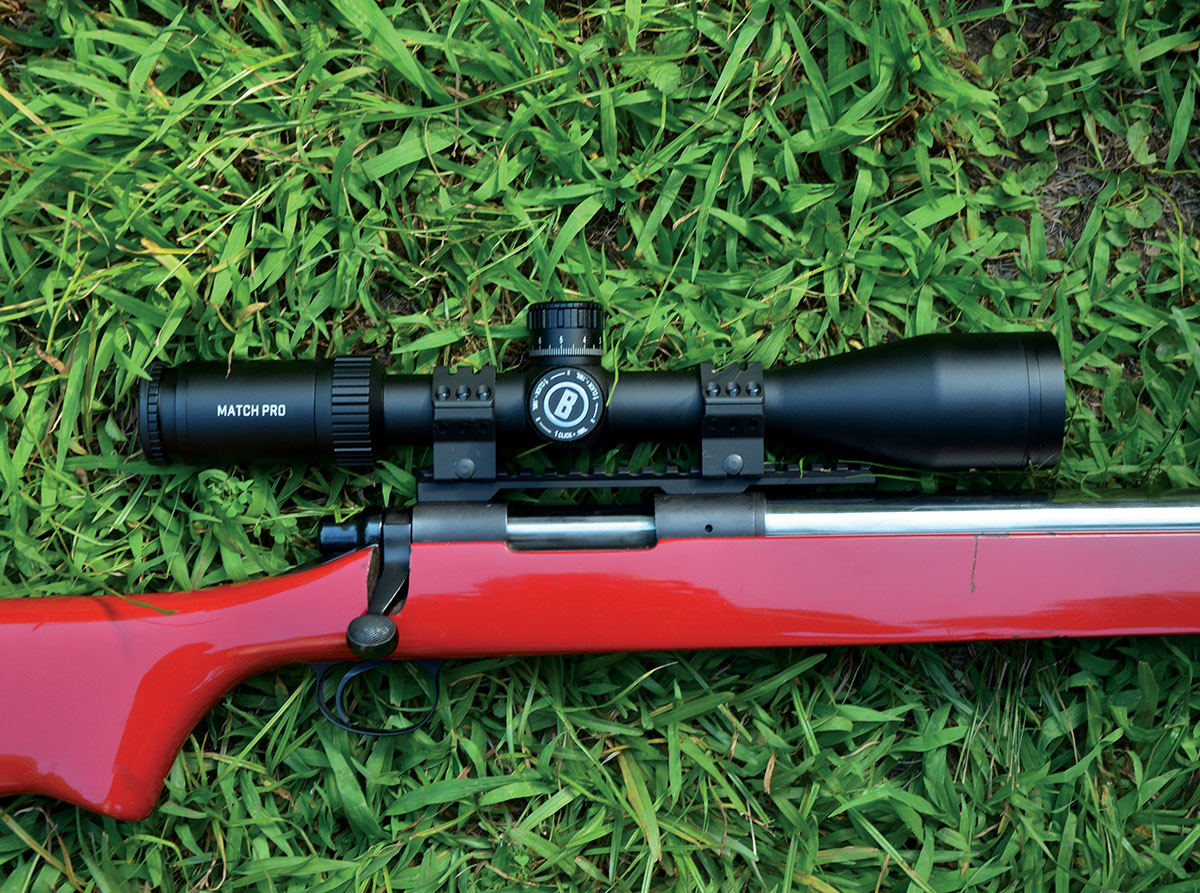
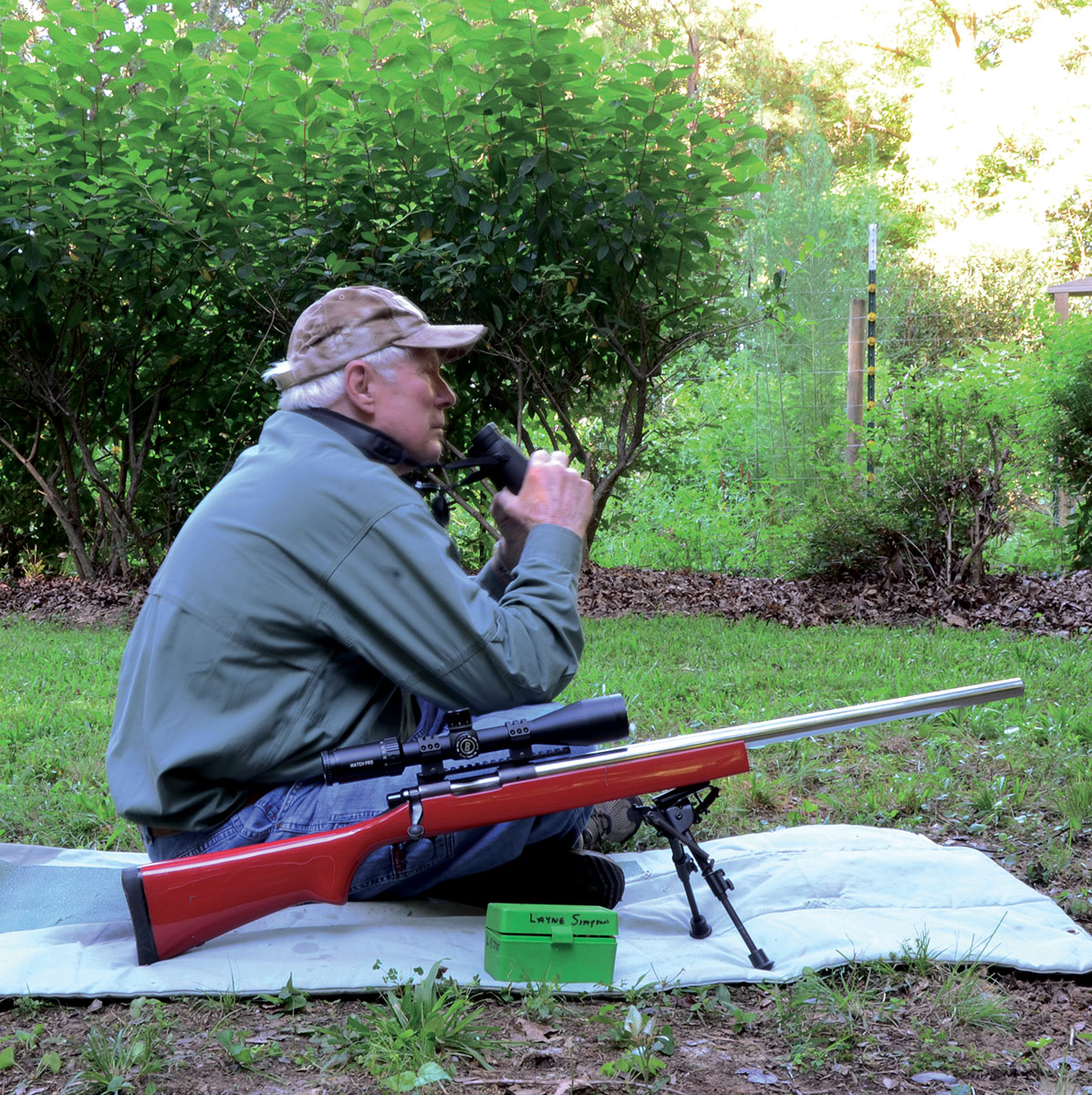
The Bushnell Match Pro 6-24x scope has all the bells and whistles many varmint shooters love with reliability, preciseness of adjustment and optical quality equal to those of many higher-priced scopes. Like all Bushnell optical products, it comes with a lifetime guarantee.
On a windless day, a crow digging up dinner within 150 long paces of the Savage was in grave danger and 200-yard kills happened often enough to make me keep trying. I simply could not imagine a better varmint rifle. That changed when Dad informed me that one of his friends, who was also an avid crow shooter, was coming for a visit and I would be his guide. In those days, cruising dirt roads and taking shots of opportunity at ground-feeding crows in safe directions was not only popular among varmint shooters, but it was also welcomed by farmers.
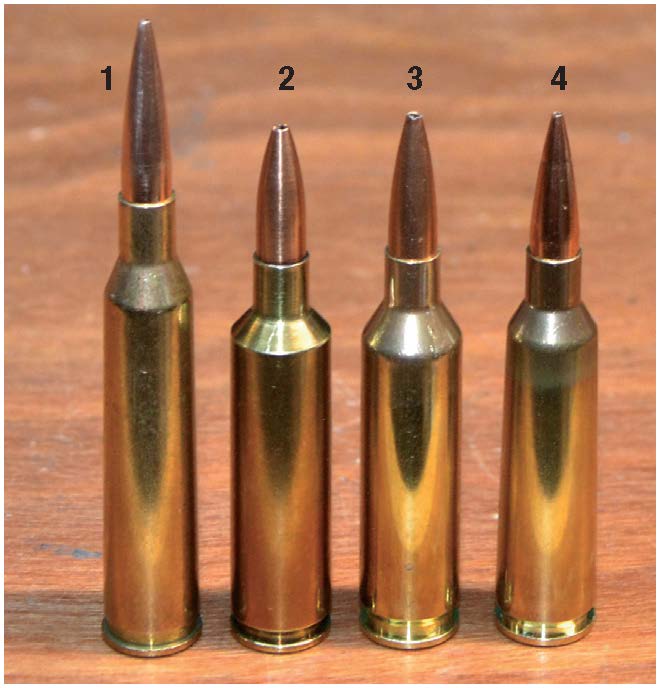
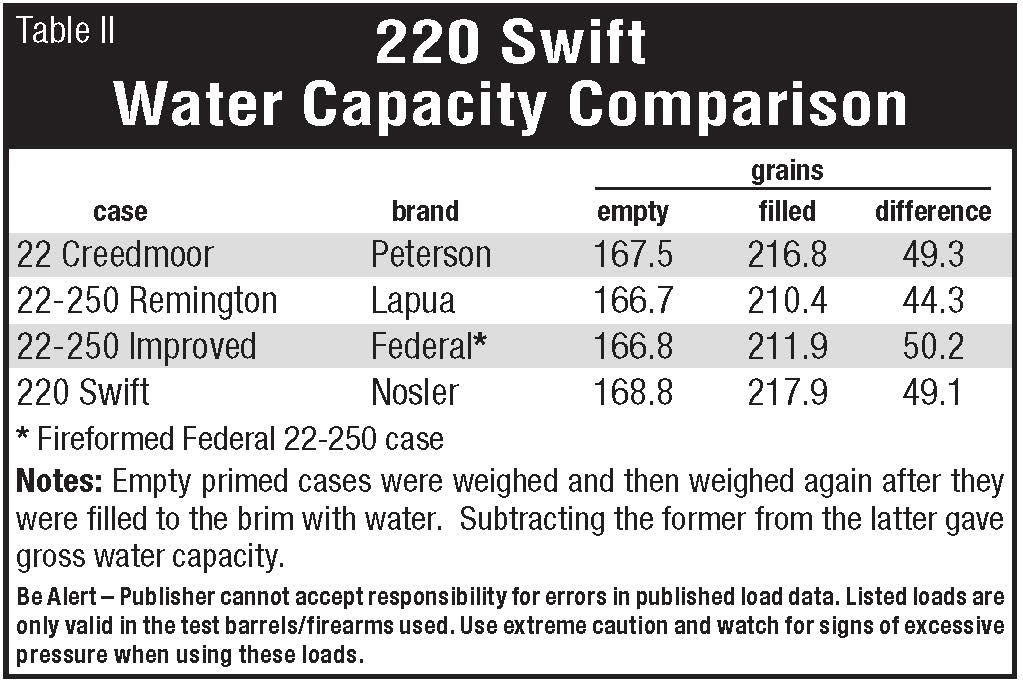
The gross water capacity of the 220 Swift and 22 Creedmoor are virtually the same with both being a bit less capacious than the 22-250 Improved and a bit more than the 22-250. Shown are: (1) 220 Swift, (2) 22-250 Improved, (3) 22 Creedmoor and (4) 22-250.
We had not gotten far when my new friend stopped his pickup truck, calmly placed a couple of sandbags on its hood, pulled his rifle from its case and chambered a round. I could see what he had spotted but they were so far away, I simply could not imagine why he would waste ammunition. Moments after he yelled “ears,” the rifle fired and seemingly quicker than instantly, a very distant crow simply exploded in a cloud of feathers. His rifle, wearing a Lyman Super Targetspot 15x scope, was a Winchester Model 70 National Match with a heavy 26-inch barrel in 220 Swift. At the time, that particular model was available from Winchester only in 30-06 and it had been rebarreled by the famous stockmaker, Lenard Brownell, who would later work for a fellow by the name of Bill Ruger. Then and there, I vowed to someday have a 220 Swift of my own.
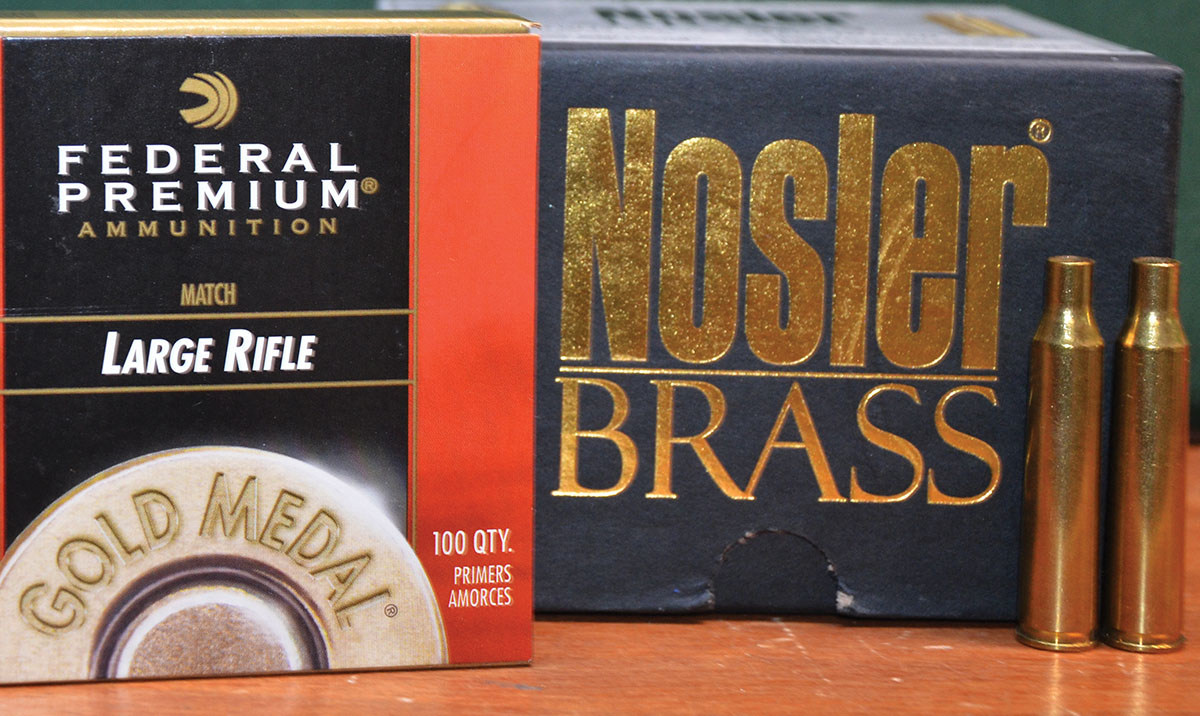
Nosler 220 Swift cases and Federal Gold Medal 210M primers are a great combination for developing precision handloads for an extremely accurate rifle.
That day eventually arrived when a local firefighter decided to thin out his small collection of varmint rifles. The one I purchased was (you guessed it) a Winchester Model 70 with a 26-inch Douglas barrel in 220 Swift. The huge Bausch & Lomb Balvar 6-24x scope it held sold for more than two Remington Model 700 ADL rifles but I managed to buy the rifle for a song. Included were 200 rounds of his favorite load with Winchester cases, CCI primers and 38 grains of IMR-4064 behind the Sisk 50-grain bullet. At the time, I was not into reloading ammunition, but eventually I bought a Herter’s Model 3 press, RCBS dies from Fred Huntington, a Lyman powder scale and I was off and running.
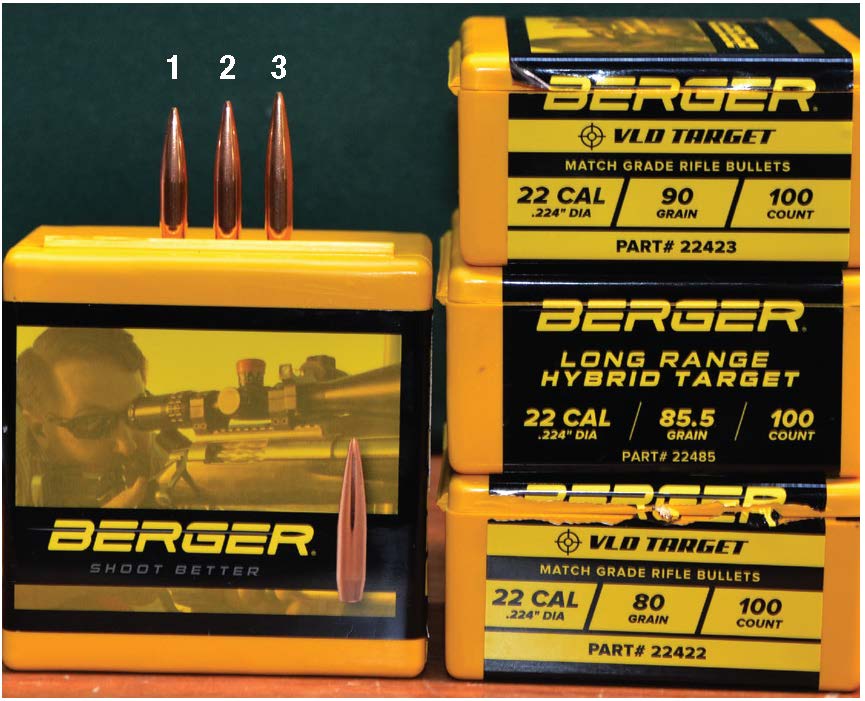
During the 1990s, Berger introduced heavy .224-inch bullets in support of across-the-course High Power competitors who were beginning the transition from M1A rifles to AR-15s with quick-twist barrels. All are accurate in the 1:7 twist of Layne’s custom switch-barrel rifle in 220 Swift. Berger bullets from left to right: (1) 80-grain VLD Target, (2) 85.5-grain Long Rifle Hybrid Target and (3) 90-grain VLD Target.
I never managed to coax the rifle inside half-MOA, but it got close enough to make me very happy. Soon after buying it, my wife, Phyllis, and I moved to Kentucky long before the coyote invasion there and hordes of groundhogs were busy munching their way through hundreds of acres of young soybean plants. That, along with the fact that our new friends, Dorris Rideout and his wife, Barbara, both of whom were born and grew up in the friendly little rural community of Little Dixie, seemed to know the location of every den in the county. An abundance of whistle pigs and permission to shoot on many farms made for the most enjoyable varmint shooting of my life. Dorris used a Ruger Model 77 in 243 Winchester and seldom did he waste a 75-grain bullet.
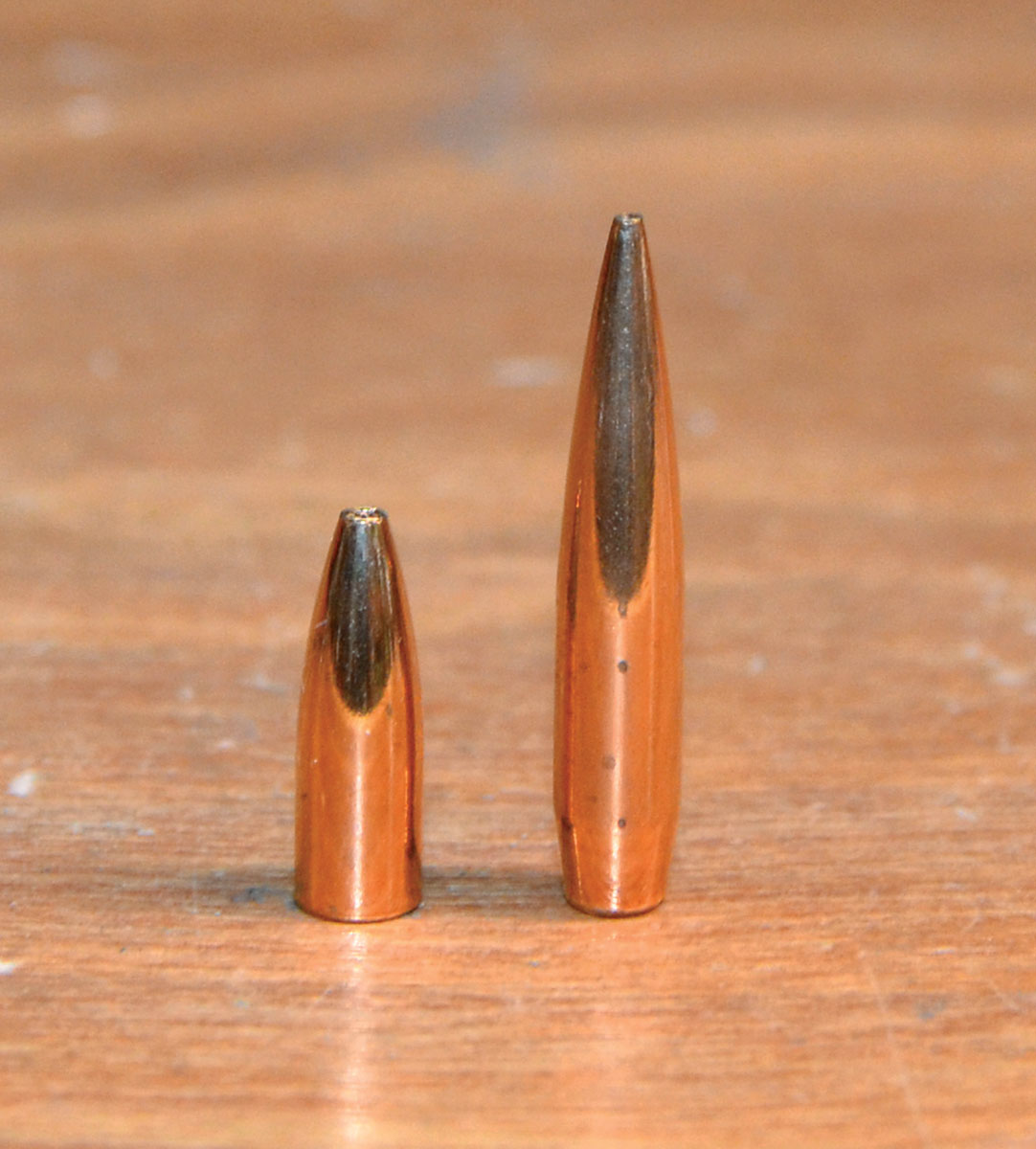
Because a short bullet such as the Berger 50-grain FB Varmint shown at left has to free-travel quite a long distance prior to engaging the rifling in a chamber throated for a long bullet such as the Berger 90-grain VLD Target at right, it may or may not deliver excellent accuracy.
When Phyllis and I relocated to Tennessee, a groundhog seemed to be lurking behind every bush and rock pile there as well. Remington’s Custom Shop had only recently gotten serious about NBRSA and IBS benchrest competition by introducing single-shot 40XBR rifles in Light Varmint and Heavy Varmint configurations. Overcome with new varmint rifle fever, I bought one in 222 Remington and had Nashville Gunsmith, Harry Creighton, who was known by varmint shooters far and wide as “Mr. 220 Swift,” opened up its bolt face and rechambered its barrel for my favorite long-distance cartridge. Its very first five-shot group at 100 yards measured .444 inch, still easy to recall because at the time, my favorite deer rifle was a Marlin lever action in 444 Marlin. While that 220 Swift was bad news for distant varmints, the forearm of its walnut stock was about as wide as a beaver’s tail, so I eventually replaced it with a 40XB KS (Kevlar Stock), also from the Remington Custom Shop. Its first group was not as small as the one shot by the rifle it replaced but its fourth group measured .343 inch, with additional load development taking it close to quarter-MOA. There are no plans to replace it.
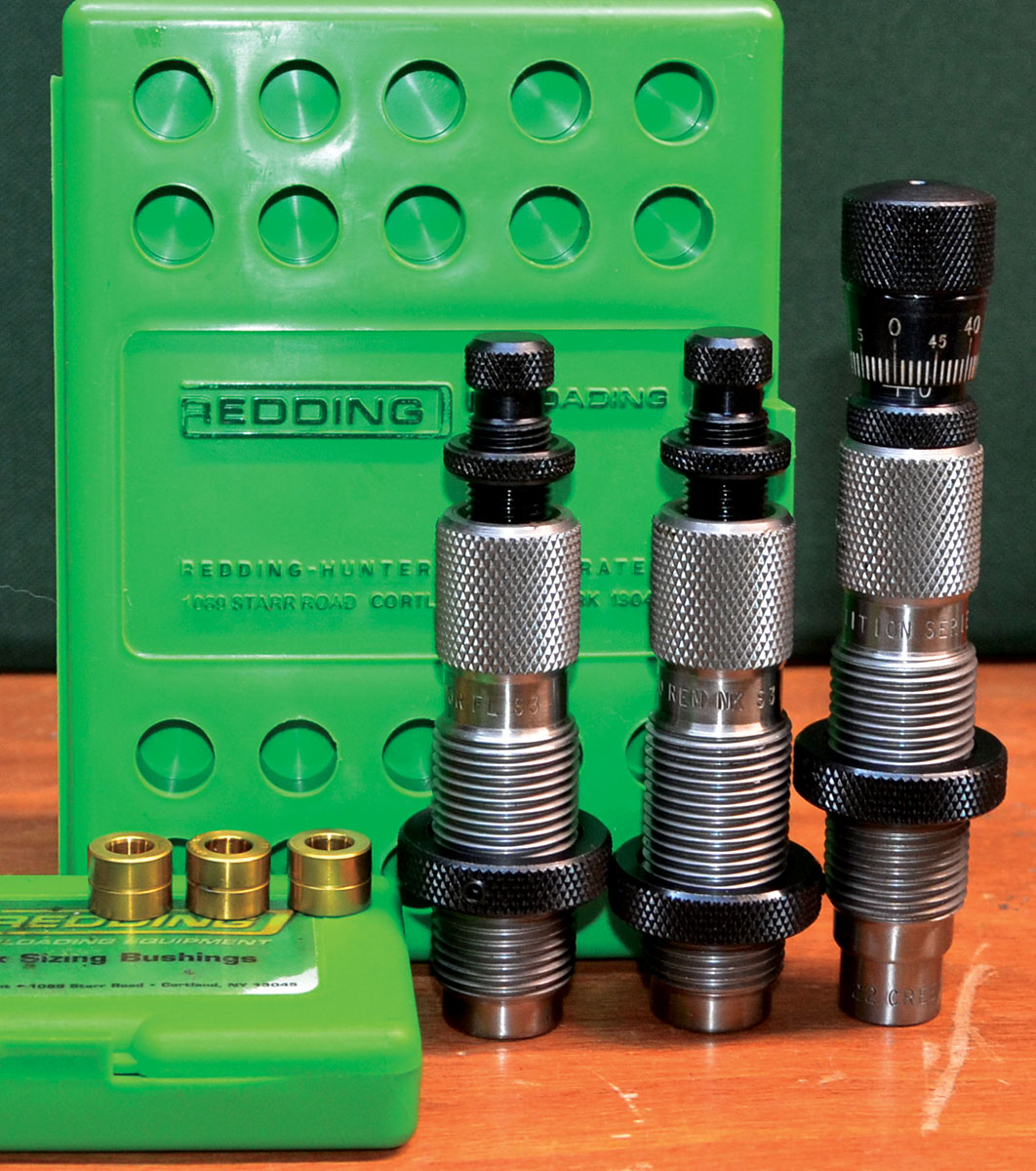
Layne uses Redding dies when loading ammunition for his quick-twist rifle in 220 Swift. After Nosler virgin 220 Swift cases are full-length resized, necks are outside-turned to a diameter of .254 inch with bullet seated. From that point on, cases are neck-sized only with a Redding bushing die with a .252-inch bushing installed. After several firings, cases became a bit difficult to chamber, the neck-sizing die, along with the No. 1 shellholder from Redding’s Competition Shellholder Set, are used to bump shoulders back .005 inch. Bullets are seated with a Redding Competition seating die.
Not long after adding the 40XB KS to my battery, I settled on the Nosler 55-grain Ballistic Tip pushed to 3,750 feet per second (fps) by a maximum charge of old faithful IMR-4064. Some five-shot groups bordered on .250 inch and when zeroed 2 inches high at 100 yards, the sleek bullet landed about 5 inches below point of aim at 400 yards. Holding the crosshairs on the north end of a standing whistle pig and squeezing the trigger seldom failed to get the job done. If Berger had not introduced .224-inch bullets weighing up to 90 grains with off-the-chart ballistic coefficients during the late 1990s, that rifle would most definitely have been my last 220 Swift. Berger did so in support of across-the-course High-Power competitors who were transitioning from 30-caliber M1A rifles to softer-recoiling AR-15s with quick-twist barrels. Palma shooters were also experimenting with various .22-caliber cartridges loaded with heavy bullets. At that same time, Redding added icing to the cake by introducing its bushing-style, neck-sizing dies for various cartridges, including the 220 Swift.
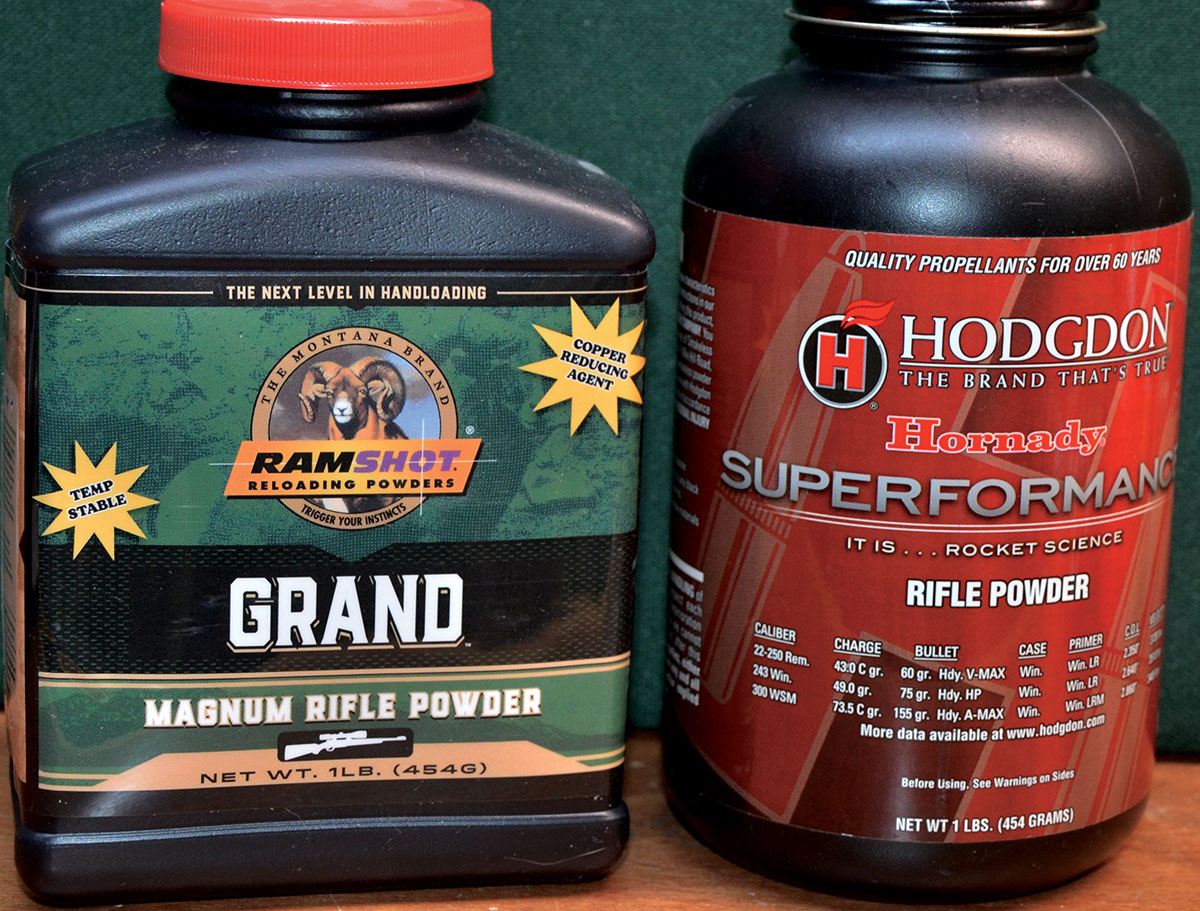
Two excellent powder choices for developing heavy bullet loads for the 220 Swift as well as for the 22 Creedmoor, 22-250 and 22-250 Improved.
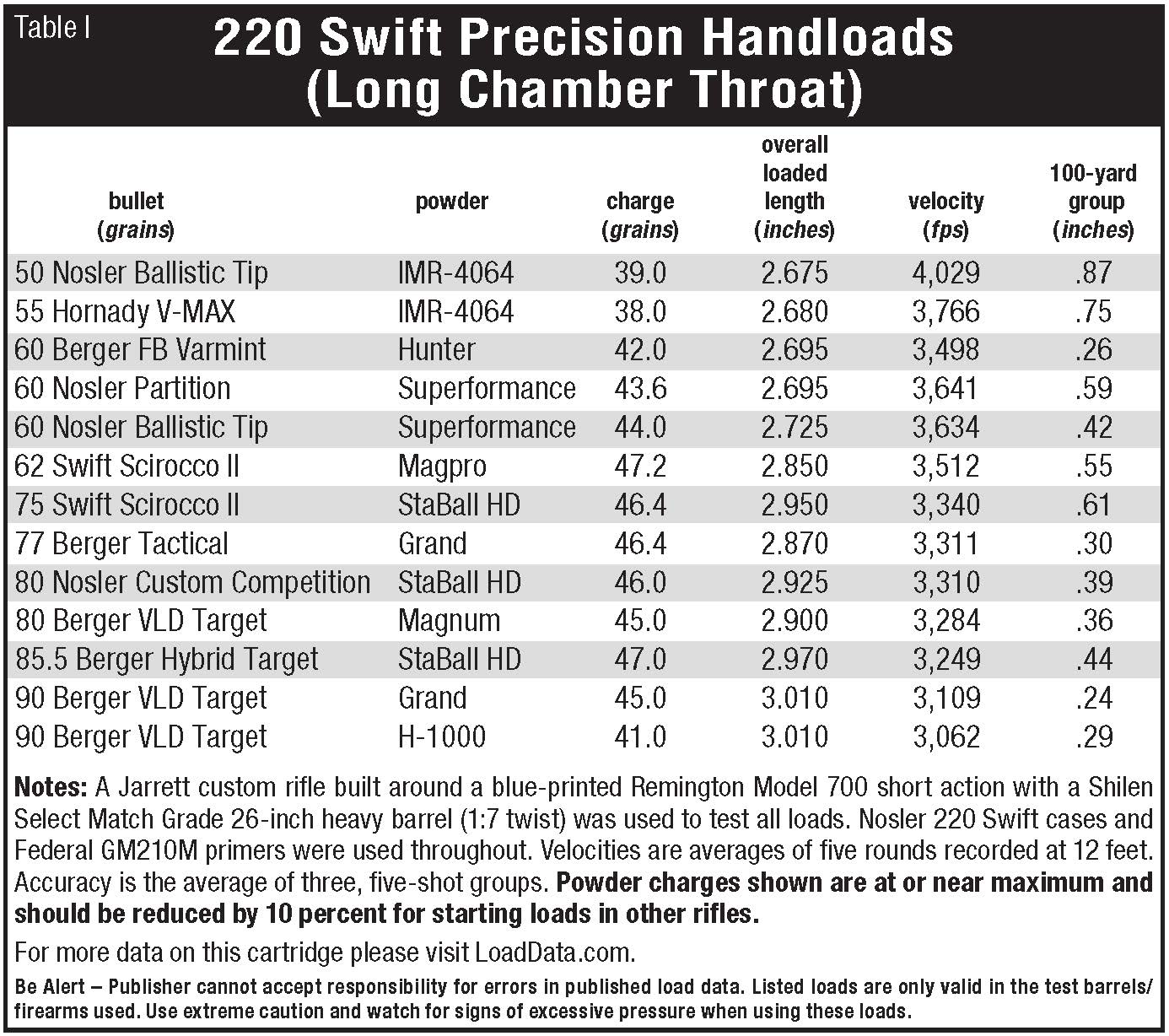
Through the years, I accumulated several custom switch-barrel rifles built around various turn-bolt actions. One is on a blueprinted Remington Model 700 short action with its barreled action that had been pillar-bedded in a McMillan Hunter stock. When it comes to rifles, I have always been quite conservative and when choosing a color for the stock, I went with fire engine red. When discussing the addition of a quick-twist barrel in 22-250 Improved with a gunsmith friend, he suggested that I try the 220 Swift instead and mentioned two reasons for doing so. He had long been aware of my fondness for the cartridge and he already had a reamer for it that cut a chamber throat long enough to handle the heavy Berger bullets. The barrel is Shilen’s Select Match grade, which means chamber to muzzle bore and groove diameters air-gauge with no more than .0001 inch of variation. That’s only slightly larger than not at all. The barrel is 26 inches long with a muzzle diameter of .910 inch and a 1:7 rifling twist rate.
The reamer cut a chamber neck diameter of .258 inch and to serve as a warning to someone who might own the rifle in the future, the barrel was engraved “220 Swift .258 Neck.” The undersized chamber neck was perfect because with a bullet seated, my batch of virgin Winchester cases also measured .258 inch and that allowed me to uniform case necks by outside-turning to .254 inch. I later switched to 220 Swift cases made by Nosler due to their better uniformity and I use a Redding Type S neck-sizing die with a .252-inch bushing. The rifle has held several different scopes but with the very impressive Bushnell Match Pro 6-24x 50mm it now holds, the ready to go weight is just shy of 15 pounds. Weaver six-screw rings and a Picatinny rail made by Talley hold the scope in place.
My deer and feral hog load for that first Model 70 consisted of the Nosler 60-grain Partition seated atop a case full of military surplus H-4831 sold by Hodgdon in those days in 30-pound kegs for $18. A friend and I split a keg and loaded it in a number of different cartridges, including the 25-06, which was still a wildcat at the time. I did not have a chronograph but the velocity of the 220 Swift load was probably in the neighborhood of 3,500 fps. At reasonable distances, the Swift 62-grain and 75-grain Scirocco II bullets are also extremely effective on deer and both shoot a bit flatter than the Nosler bullet as well. One of my best pronghorns was felled by the 75-grain bullet at 312 yards. Many great 220 Swift powders are available today, choosing just one for loading behind the heavyweights is not easy but I could get along quite nicely if only Grand and Superformance were sitting on my shelf.
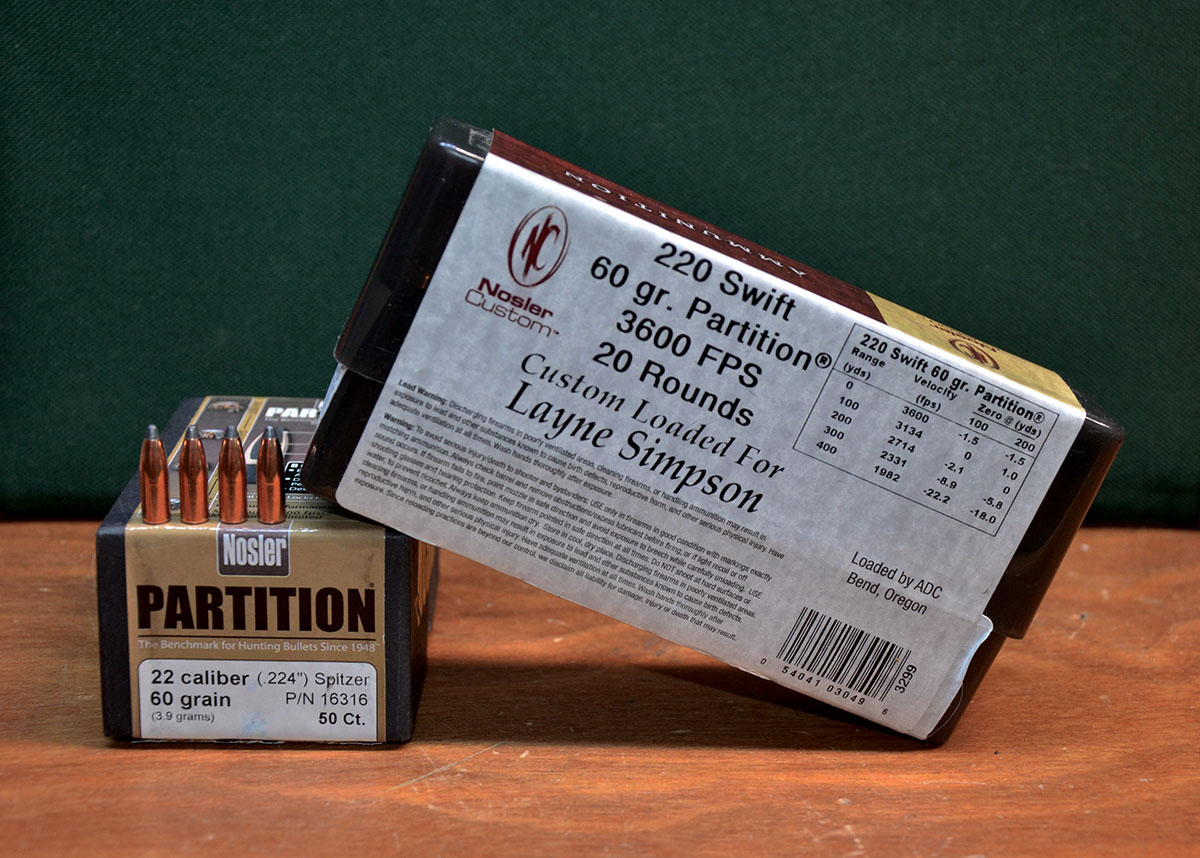
Despite being 89 years young and lacking what some shooters consider to be a modern shape, the 220 Swift is still popular enough for Nosler, Federal, Hornady, HSM and Remington to continue loading with a variety of bullet weights and styles. Shown here is a load used by Layne over the years to take a few deer.
So how does the old-timer stack up against its competition? As can be seen in a capacity comparison table included in this report, Nosler 220 Swift and Peterson 22 Creedmoor cases hold the same amount of water. Both have a bit less capacity than the 22-250 Improved and a bit more than the standard 22-250 case. With all loaded to the same pressures, the 220 Swift case can require trimming more often, although neck-sizing only for as many firings as possible puts it on equal footing in that department with the others.
At the ripe young age of 89, the 220 Swift may have a few creaky joints and a less than sexy shape but it is quite capable of running with the best of them. The health of a cartridge is easily determined by the number of companies offering one or more loadings and you can thank Nosler, Hornady, Federal, Remington and HSM for keeping the grand old number alive.