Varmint Loads for the 6mm Dasher
Long-Range Varmint Shooting
feature By: Patrick Meitin | October, 24
The 6mm Dasher has made its mark as a 600- and 1,000-yard benchrest juggernaut, establishing numerous world records in the relatively short time it has been in circulation (including Jim Richards’ 2.6872-inch/1,000-yard/Light Gun Class world record set in 2014). Gunsmith Dan Dowling, the “Da” in Dasher, and his friend, Al Ashton, the “ash” in Dasher, created the round in 1999 by fireforming 6mm Benchrest (BR) brass to produce a 10 percent increase in powder capacity with a 40-degree shoulder and .260-inch neck.
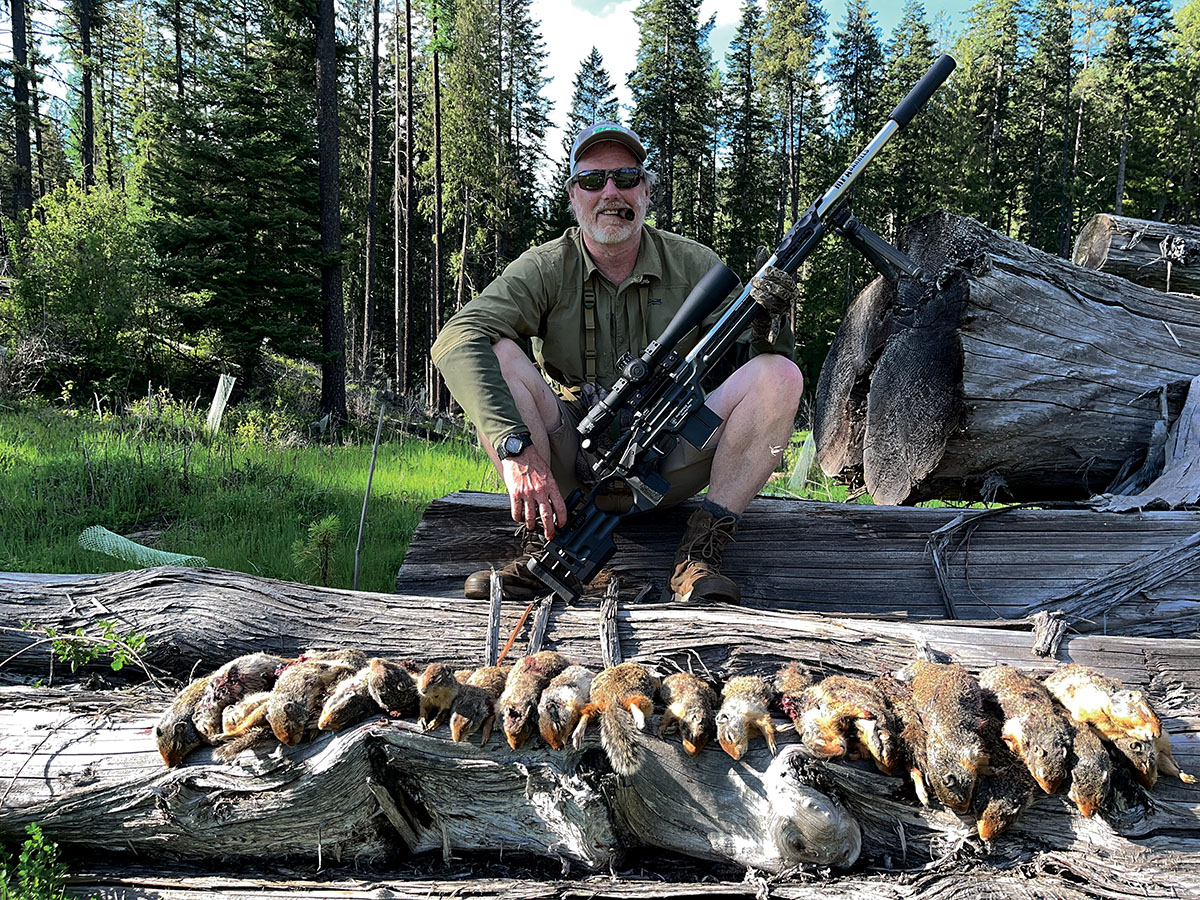
The result was a cartridge that launches high-ballistic coefficient (BC), low-drag bullets at 2,900 to 3,000 feet per second (fps) while producing conspicuously less recoil and bullet drop than rounds such as the 6.5 Creedmoor. These talents, combined with a 2,500- to 3,000-round competitive barrel life (much longer for casual varmint shooting), have also made it wildly popular with many professional Precision Rifle Series (PRS) shooters.
The resulting cartridge, which holds about 41 grains of water, provided a 100 to 130 fps velocity advantage over the 6mm BR Norma while firing 105-grain bullets. The 6mm Dasher outperforms the highly efficient 6mm ARC with same-weight bullets, but gives up 100 to 150 fps to the larger 6mm Creedmoor and 243 Winchester with same-weight bullets. With its long-range benchrest pedigree, the 6mm Dasher offers – dare I say – “inherent accuracy.”
Though technically a wildcat cartridge, the 6mm Dasher is a pretty domesticated one. Properly headstamped brass is available from Norma, Alpha Munitions and Peterson Cartridge with Alliant Reloder 15 and Hodgdon Varget powder being favorites with competitive shooters. Ready-made brass makes getting started easy. Forming cases once entailed necking 6mm BR cases up to 6.5mm and then partially renecking them back down to 6mm to help hold the case head firmly against the bolt face during fireforming, neck turning and trimming.
The top-grade Peterson Cartridge cases used for testing here included small rifle primer pockets with .060-inch flash holes requiring a slim decapping pin, and including .0013-inch neck-wall thickness and the 1.53-inch overall length gleaned from Sierra, Berger and Lyman handloading manuals. There are currently no Sporting Arms and Ammunition Manufacturers’ Institute (SAAMI) standards for the 6mm Dasher.
Dies are offered by the usual suspects, with a Redding Series D Deluxe Die Set used in this load series. This set includes full-length, neck-sizing and seating dies. In the interests of utmost precision, the standard issue expander ball was replaced with a 6mm Free Floating Carbide Button Kit and the seating stem with a Redding Micrometer. Only the neck-sizing die was employed during testing in combination with once-shot, fireformed Peterson Cartridge brass. I had previously used Remington No. 7½ Small Rifle Bench Rest and Federal Premium GM205M Small Rifle Match primers with good results in this cartridge, but for this round of testing, I tried CCI No. 450 Magnum Small Rifle primers based on superior results while developing 224 Grendel/22ARC loads.
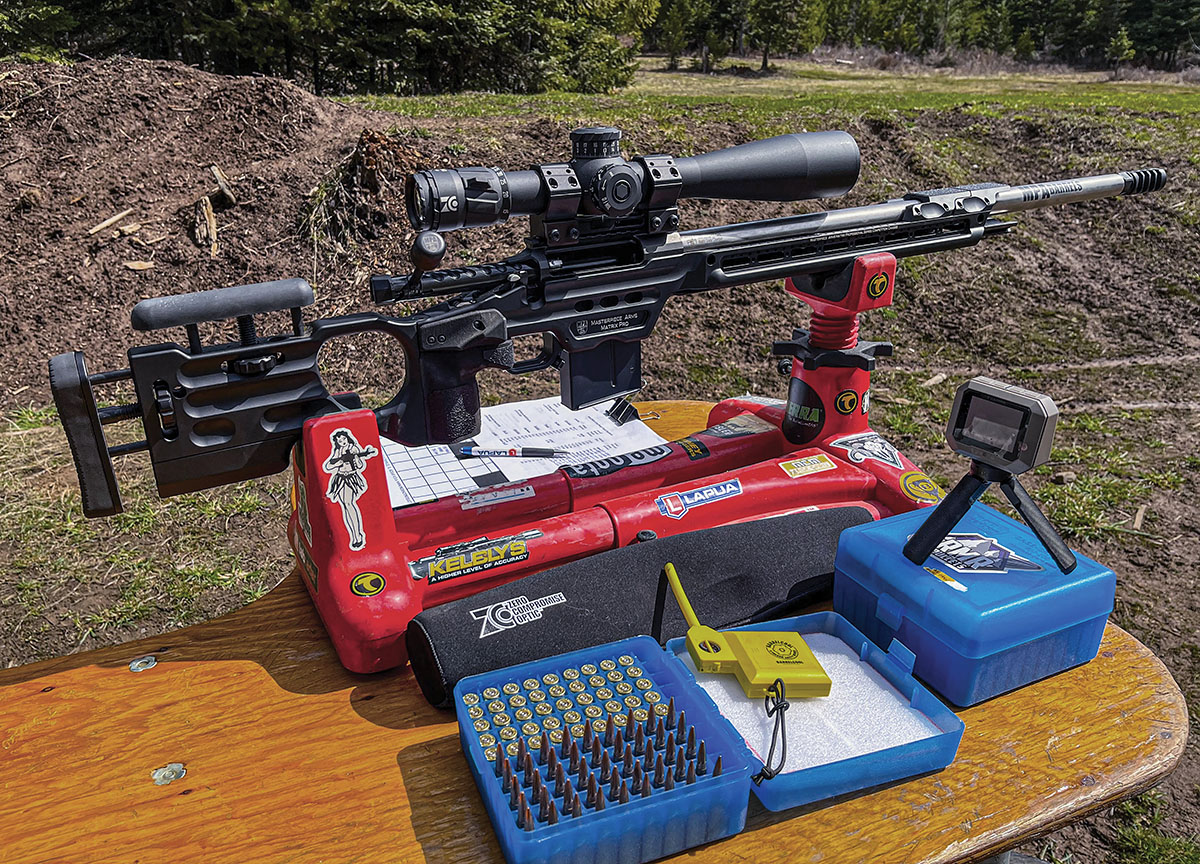
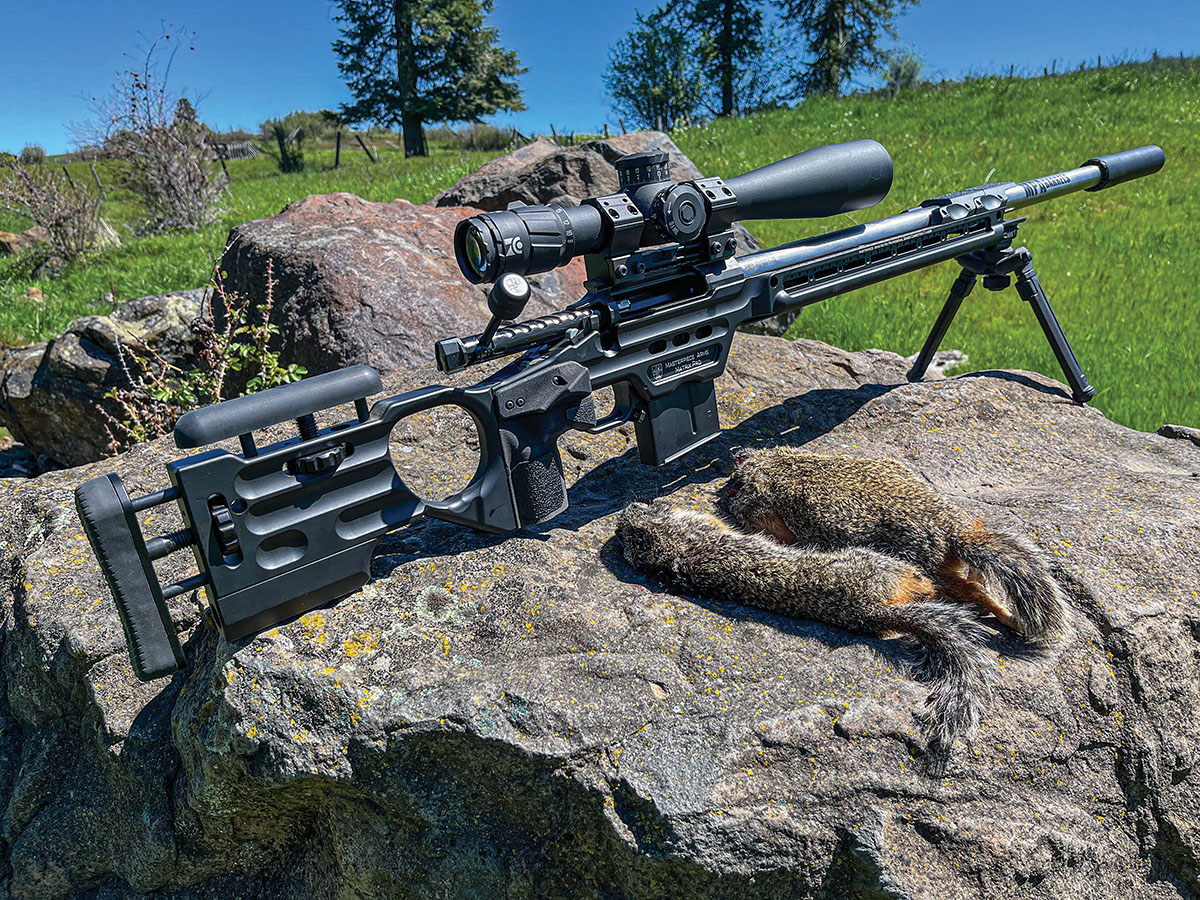
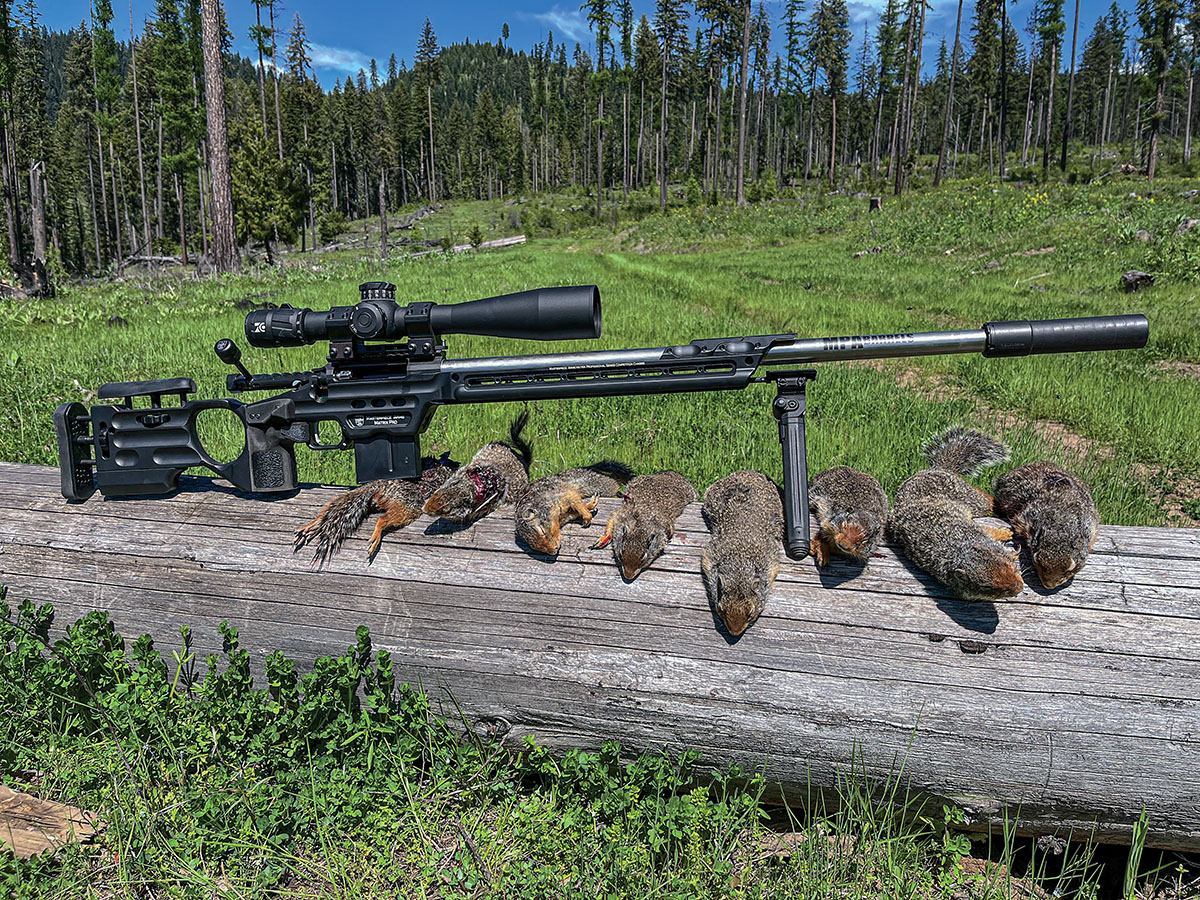
The test rifle was a heavy competition chassis made by Masterpiece Arms (MPA) and meeting the Production Class requirements for 2023 Precision Rifle Series (PRS) guidelines. The MPA Matrix Pro PMR Rifle was based on the company’s refined Matrix Pro II chassis and a barreled action borrowed from PMR Series rifles. The 26-inch Match Contour barrel was an MPA/Spencer barrel milled from 416RQ stainless steel, stress relieved and hand lapped. Each of these barrels is video borescoped and Sheffield air gauge inspected to within .0001 inch, and the chamber indicated within .0001 inch or less to the rifle bore. The chamber was reamed specifically for Peterson brass, the honed pull button rifling provided a twist
rate of 1:7. The barrel held an MPA DNS brake on 5⁄8x24 muzzle threads. The American Rifle Company action, with integral recoil lug and 20-MOA Picatinny rail, cycled slickly and included a three-piece, three-lug bolt with spiral fluting, a mechanical extractor and a quick-release firing pin assembly removal system for quick, tool-free cleaning. All surfaces received a black nitride treatment for longer life.
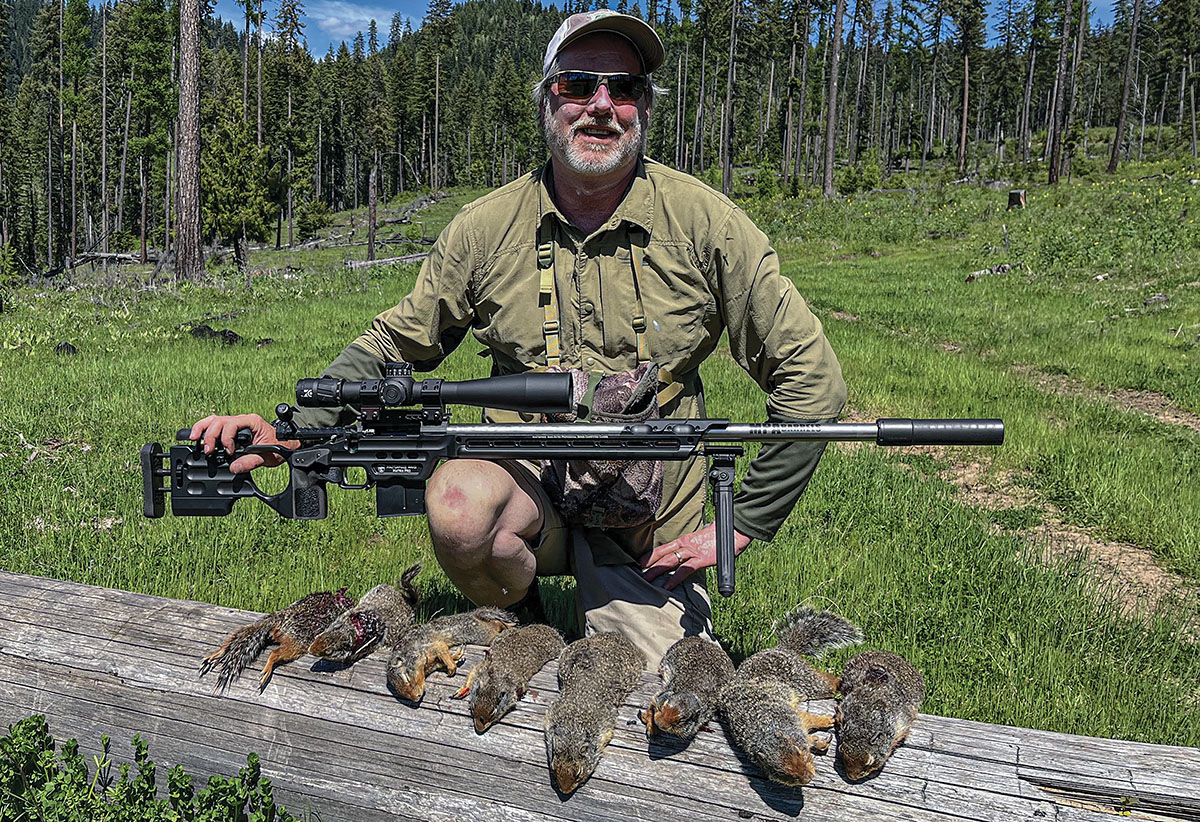
The 6061 chassis included a V-bedding system with additional clearance for glass bedding the action and straight section of the barrel. The comb height and length of pull (LOP) were fully adjustable to create comfortable scope alignment and LOPs between 12.75 and 14 inches. The stock included a bag rider bottom with butt hook, night vision bridge, Picatinny rail/ARCA Swiss/spigot mount, built-in inclinometer, Matrix EVG vertical grip and thumb ledge. The MPA Bix N Andy Tac Sport Pro Custom trigger broke at a couple of ounces over 1 pound. Rounds were fed from a 10-round, detachable Accurate Mag, and a Plano hard case was provided. MPA guarantees 1⁄2-MOA with premium ammunition.
I mounted a Zero Compromise Optic ZC 840 8-40x 56mm in a Zero Compromise Block Mount holding a swing-out level. This scope was designed specifically for long-range precision by the man who helped get Nightforce off the ground (Jeff Huber), including locking/pop-up turrets and illuminated MPCT 2X reticle. This is unequivocally the finest riflescope I have ever worked with; the Austrian glass was clear even at the 40-power magnification and all controls are precise and intuitive. All glass and parts are manufactured in Austria and assembled in Orofino, Idaho. Adding the powerful optic brought the finished rifle weight to 20.86 pounds from a 16-pound starting weight.
This is an incredibly accurate package. My introduction to this cartridge involved target bullets weighing from the Lapua 90-grain Scenar-L to 115 grains with the Nosler RDF and out of 54 loads, four printed in the .1s, nine in the .2s, eight in the .3s, and 12 in the .4s – meaning more than 59 percent shot less than ½-MOA. This naturally started me thinking about varmint potential. In this series, I tested a selection of varmint-ready bullets, all chosen for long-range efficiency and/or explosive terminal performance. I have conducted enough shooting with the Dasher at this point to understand what powders are most compatible. Some of those were selected here, but I also asked the question, what else might work? Of note, extreme velocity spreads with the light bullets were conspicuously wider than those witnessed with the typical 105-110-grain target bullets used in this cartridge and group averages were on average larger, though certainly varmint ready.
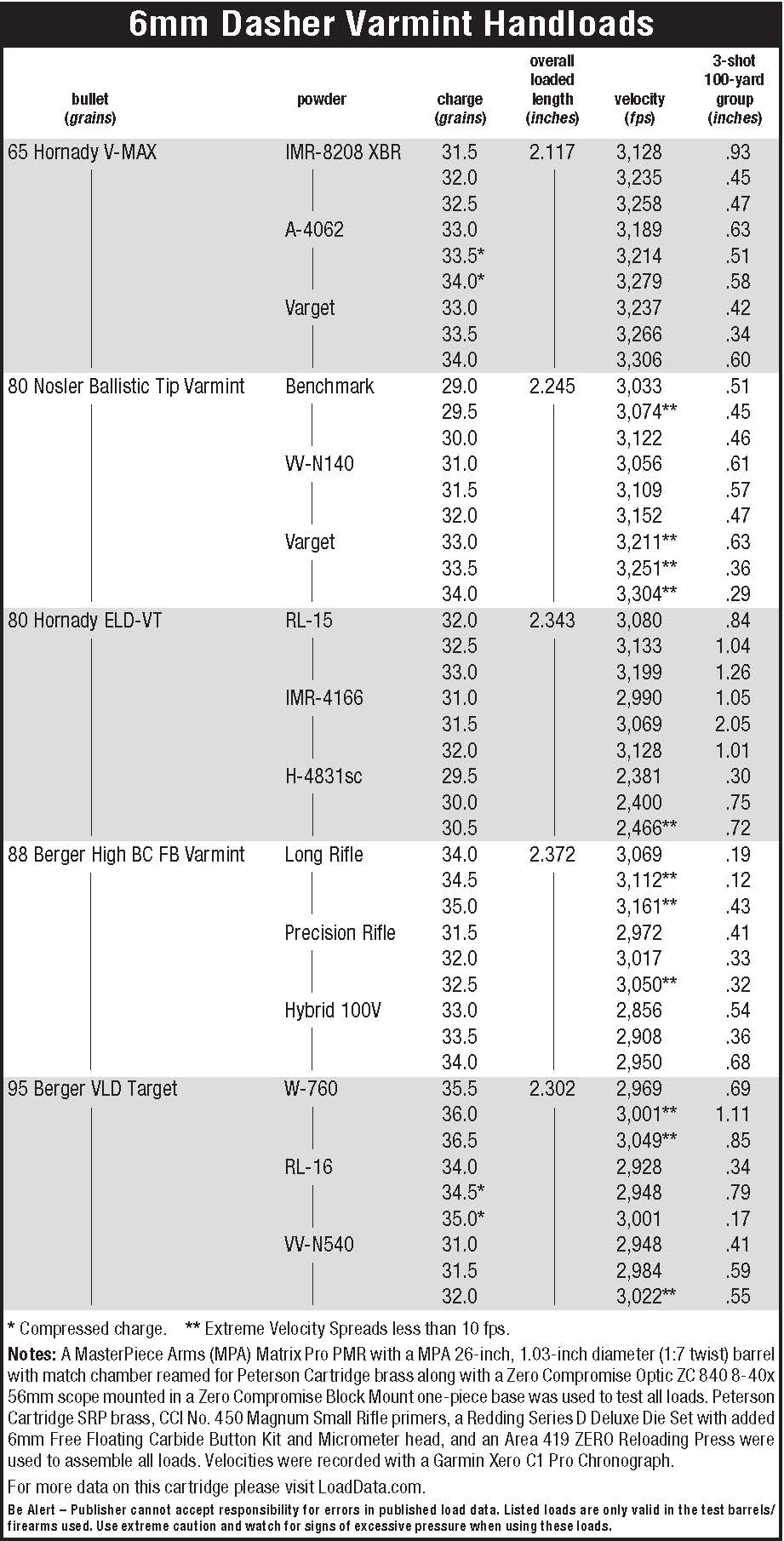
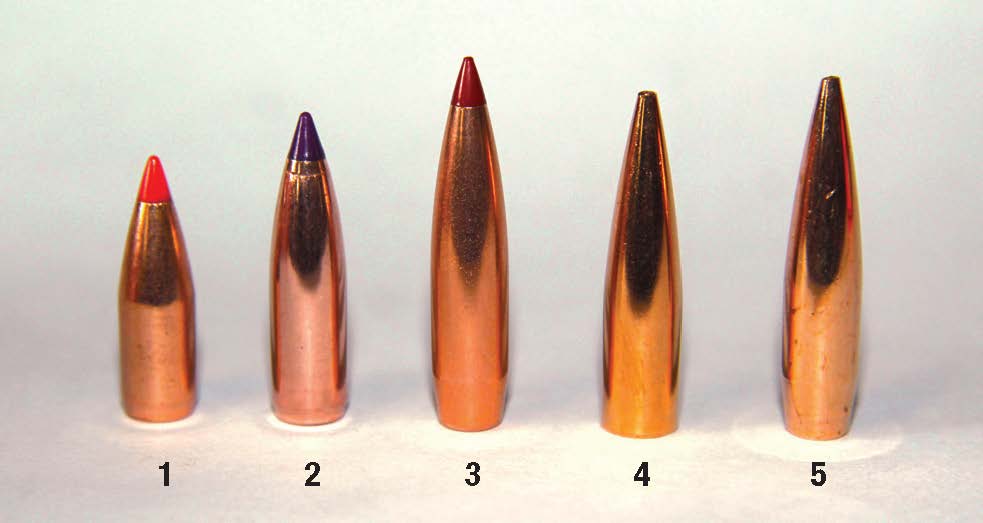
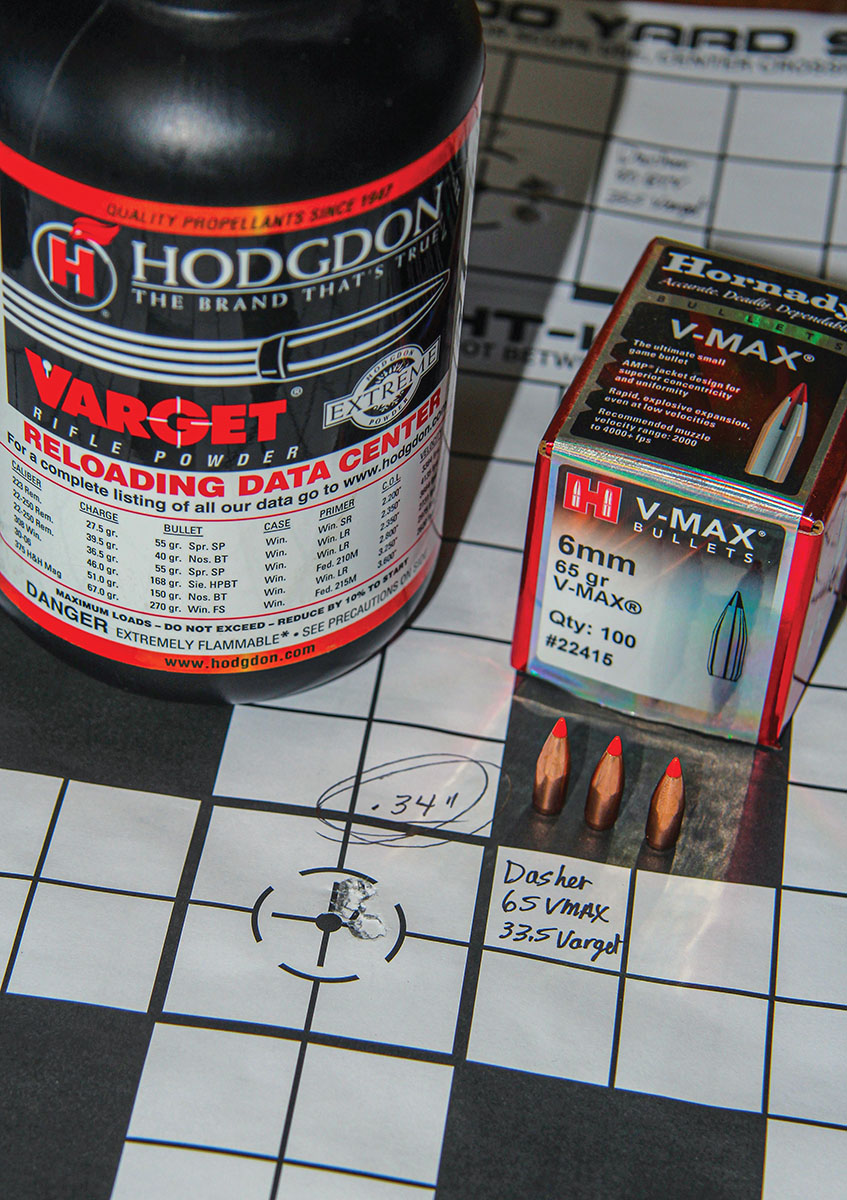
At the light end sat Hornady’s 65-grain V-MAX, the consummate varmint bullet with a proven track record. This bullet includes a .280 G1 BC created by the boat-tail and red polymer-tip profile, and velocities of up to 3,250-3,300 fps are possible using IMR-8208 XBR, Accurate 4064 and Hodgdon Varget. Honestly, I had planned to audition the 75-grain V-MAX instead, but found my stocks lacking and replacements unavailable prior to testing. I didn’t expect much from this lightweight bullet in conjunction with the fast twist, but it surprised me in the end, producing a .55-inch overall group average. A-4064 produced the largest groups, though .51- and .58-inch groups don’t exactly constitute a Greek tragedy. That .51-inch showing resulted from 33.5 grains of powder sent at 3,214 fps. IMR-8208 XBR produced .45- and .47-inch groups with 32 and 32.5 grains of powder and velocities of 3,235 and 3,258 fps, respectively. Predictably, Varget produced the smallest groups of .42 inch at 3,237 fps with 33 grains of powder and .34 inch at 3,266 fps with 33.5 grains of powder, making it the clear choice with this bullet.
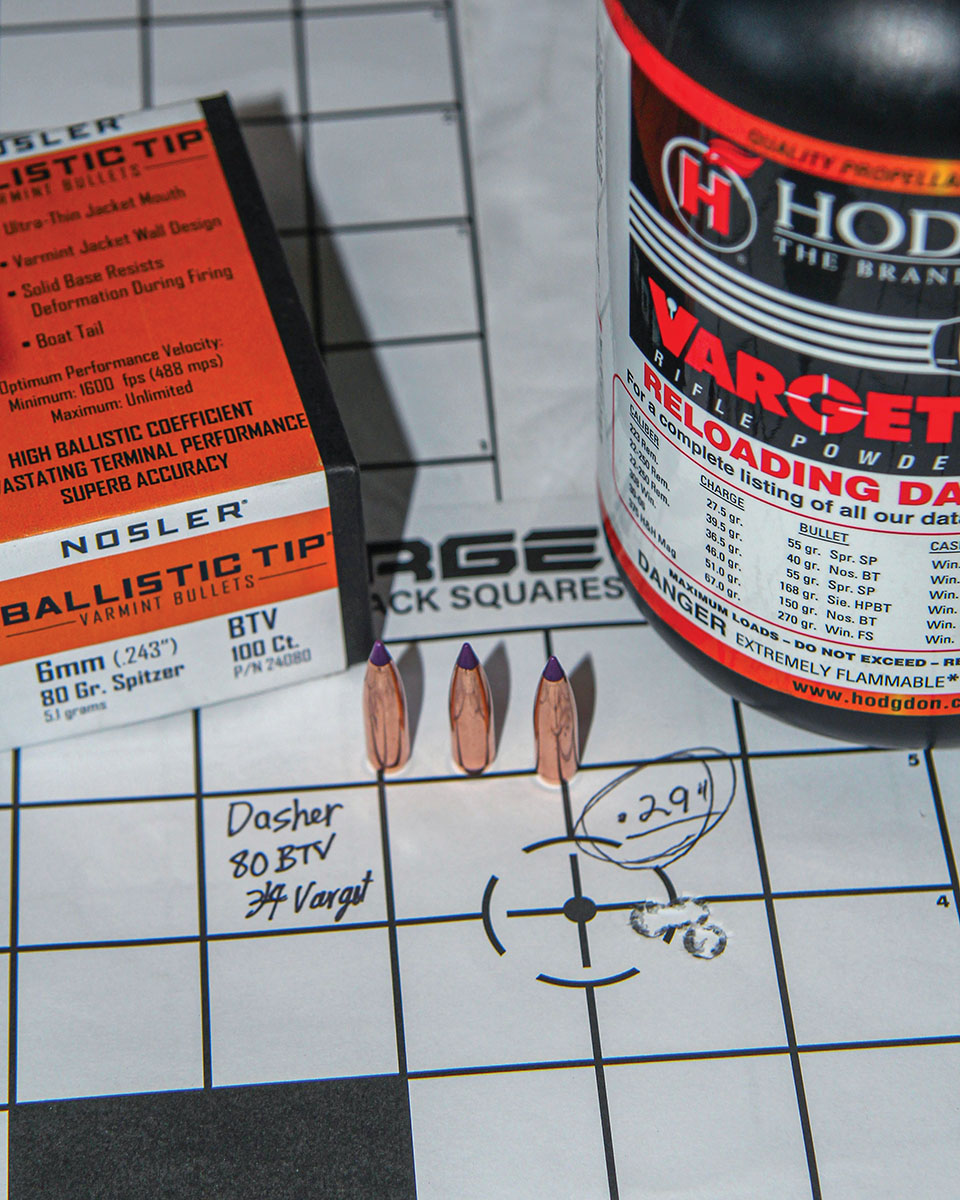
Nosler’s 80-grain Ballistic Tip Varmint made another easy choice. This is another boat-tail, polymer-tipped bullet providing vaporizing impacts. It carries a .329 G1 BC and a reputation for consistent accuracy. Hodgdon Varget is a Dasher standard, Hodgdon Benchmark promising sizzling velocities and Vihtavuori N140 proved accurate. The overall group average was .48 inch – the second best of this test. N140 produced the largest group average by a slim margin, the best showing was a .47-inch group sent at 3,152 fps. Benchmark showed remarkable consistency across the board, producing groups measuring from .51 to .45 inch and velocities from 3,033 to 3,122 fps. Nothing to complain about here. Varget again produced the smallest group, .29 inch at 3,304 fps using 34 grains of powder and with a single-digit extreme velocity spread. This bullet’s largest group was .63 inch at 3,211 fps.
I was pretty excited to include Hornady’s 80-grain ELD-VT in his test, a brand-new offering from the Grand Island, Nebraska, company that provided the long-range talents of the ELD-X and ELD Match bullets in a more explosive varmint-splattering option. Alliant Reloder 15 served as the benchmark, IMR-4166 added for its temperature-stable and clean-burning characteristics, and Hodgdon 4831sc out of purest curiosity. This one proved a surprising disappointment, this rifle either just did not care for this bullet or the seating depth chosen. The overall group average was an even inch, including one group that broke 2 inches – the largest I have shot with this rifle by a wide margin. IMR-4166 was an utter failure, the best group was just 1.01 inches. Reloder 15
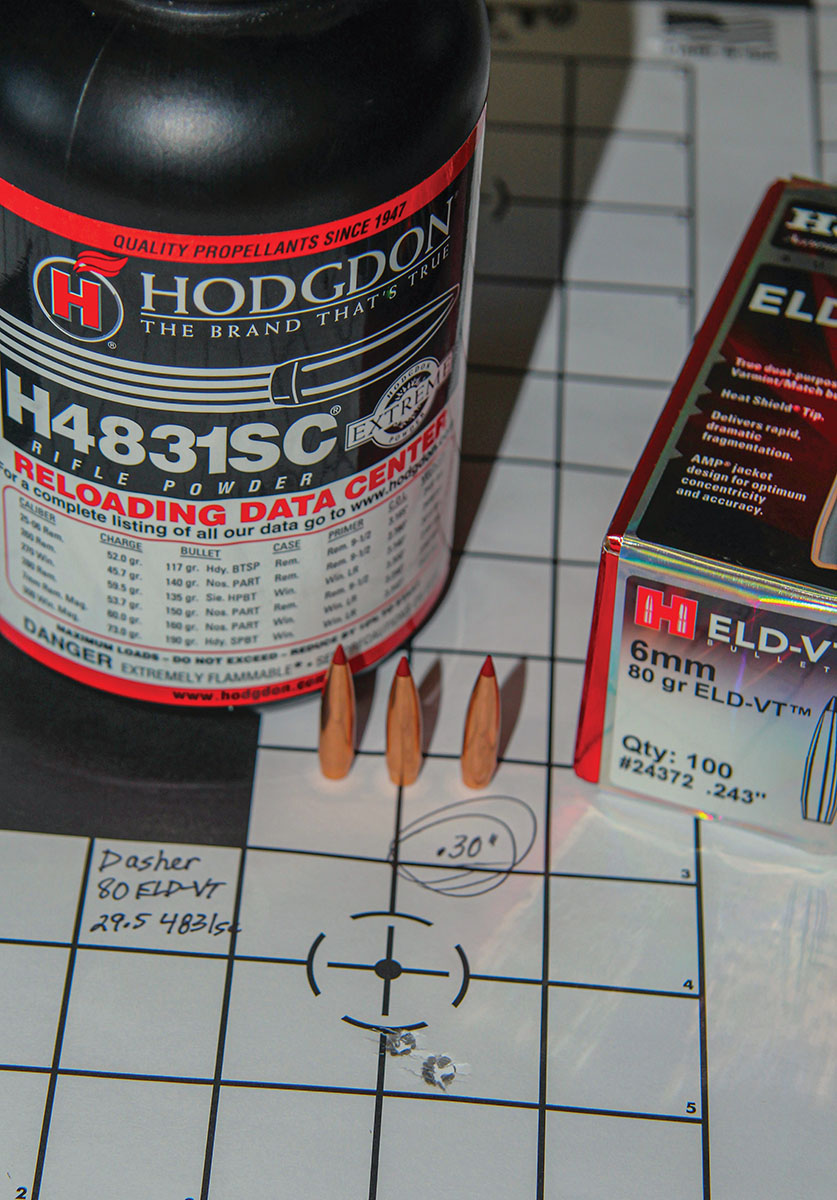
only managed a .84-inch group. So that left H-4831sc, which did produce a .30-inch group using 29.5 grains of powder, but at such lackluster velocity as to be easily dismissed. When drawing up my initial load chart, I questioned this powder choice when it turned up in Sierra Edition VI data (where max-load velocity was listed as 3,000 fps), instinctively believing the H-4831sc burn rate to be too slow. My gut feeling seems to have been validated, though it is interesting to note that the best groups resulted from the lowest velocities. I’ll have to try this one in my 6mm Creedmoor for additional input, as it may simply be seating-depth fussy.
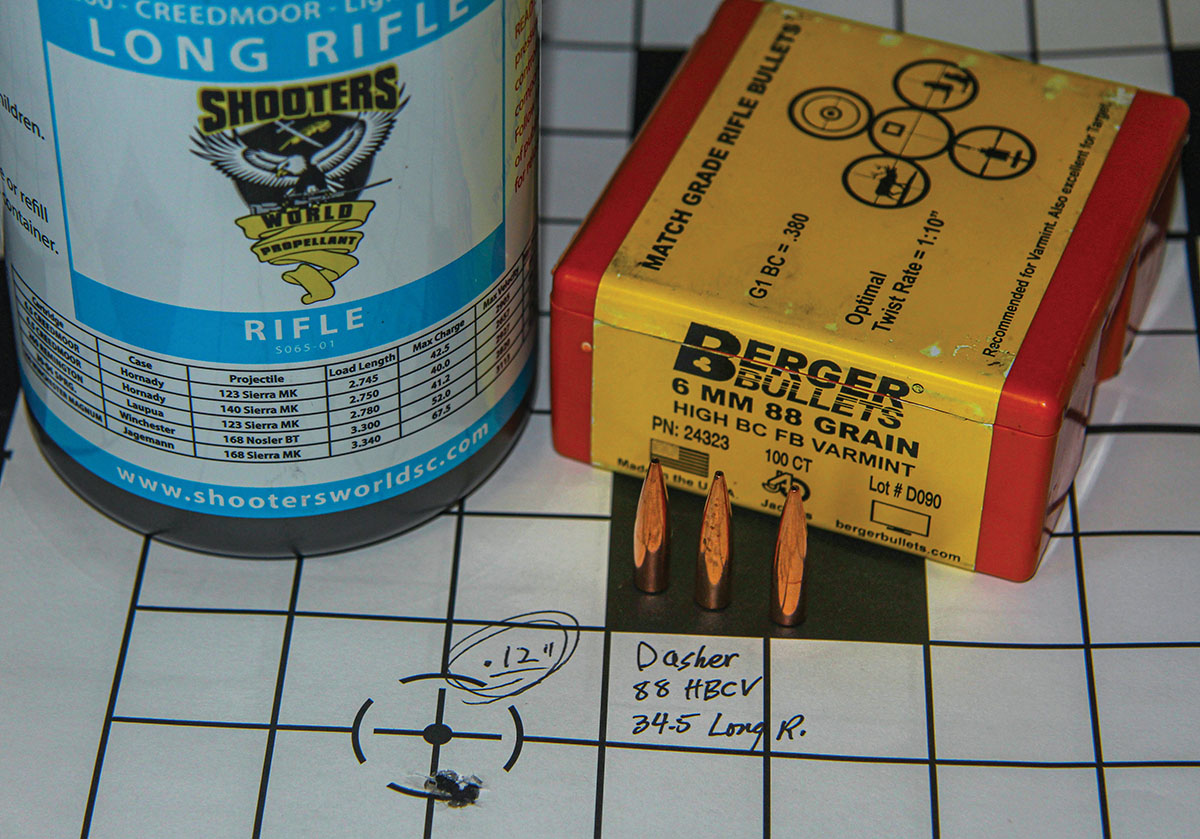
Berger’s 88-grain High BC FB (flatbase) Varmint has proven reliably accurate in past load tests, and did not disappoint from the Dasher. It produced a .38-inch overall group average – the best of this series. The flatbase makes them less fussy than some boat-tail designs, while a sharp ogive produced a G1 BC of .380. Shooters World’s Long Rifle and Precision Rifle, and Hodgdon Hybrid 100V were paired with this bullet. Hybrid 100V provided the worst average but did produce a .54-inch group at 2,856 fps using 33 grains of powder and a .36-inch group at 2,908 fps using 33.5 grains, so it shouldn’t be dismissed. Precision Rifle lived up to its name, resulting in .41-, .33- and .32-inch groups. The latter resulting from a maximum load of 32.5 grains of powder, leaving the muzzle at 3,050 fps and producing a single-digit extreme velocity spread. But it was Long Rifle that stole the show. Thirty-four grains of powder produced a .19-inch group at 3,069 fps, and 34.5 grains a .12-inch bug-hole at 3,112 fps and with a single-digit extreme velocity spread.
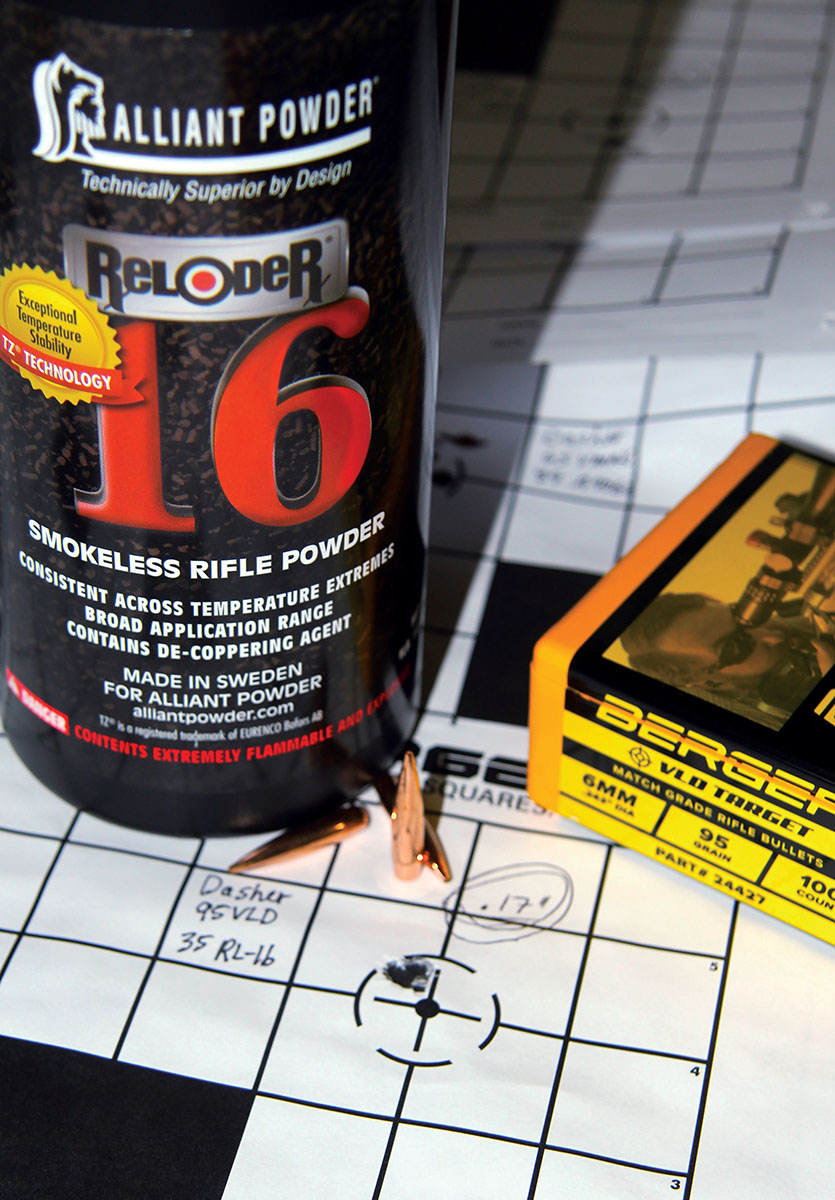
Berger’s 95-grain VLD Target surpasses the .450 G1 BC threshold that I consider a true long-range bullet. The sleek boat-tail/spear-point profile produced a .467 G1 BC; Berger bullets are world-renowned for consistency and experience has shown the company’s target bullets open aggressively on burrowing rodents. I had shot this bullet previously from the Dasher, so I tried different powders this go-round. Winchester 760 was included because it is more easily obtained today, Alliant Reloder 16 based on good results with several cartridges in this class and Vihtavuori N540 out of pure curiosity. The experimental powder choices resulted in some disappointments and a .61-inch overall group average, but also some excellent groups. I’d call Winchester 760 a failure, the best showing was just .69 inch with good velocity. N540 was fairly consistent, producing groups from .59 to .41 inch – that .41-inch group sent at 2,948 fps in front of 31 grains of powder. Reloder 16 made the choice easy with 34 grains producing a .34-inch group at 2,928 fps, and the maximum/compressed load of 35 grains produced a .17-inch group while breaking 3,000 fps.
In general, and with obvious exceptions, the lighter varmint bullets did not perform as consistent as the heavier target bullets this cartridge was designed for and that I have tested previously. That said, there was certainly plenty of accuracy provided to serve as solid starting points for further fine-tuning. The Dasher would make a fine choice for long-range rockchucks or to uncase when a Wyoming prairie dog shoot turns breezy.