

Colt Rimfire New Frontiers
My Lifelong Love of Single Actions
feature By: Dick Williams | October, 22

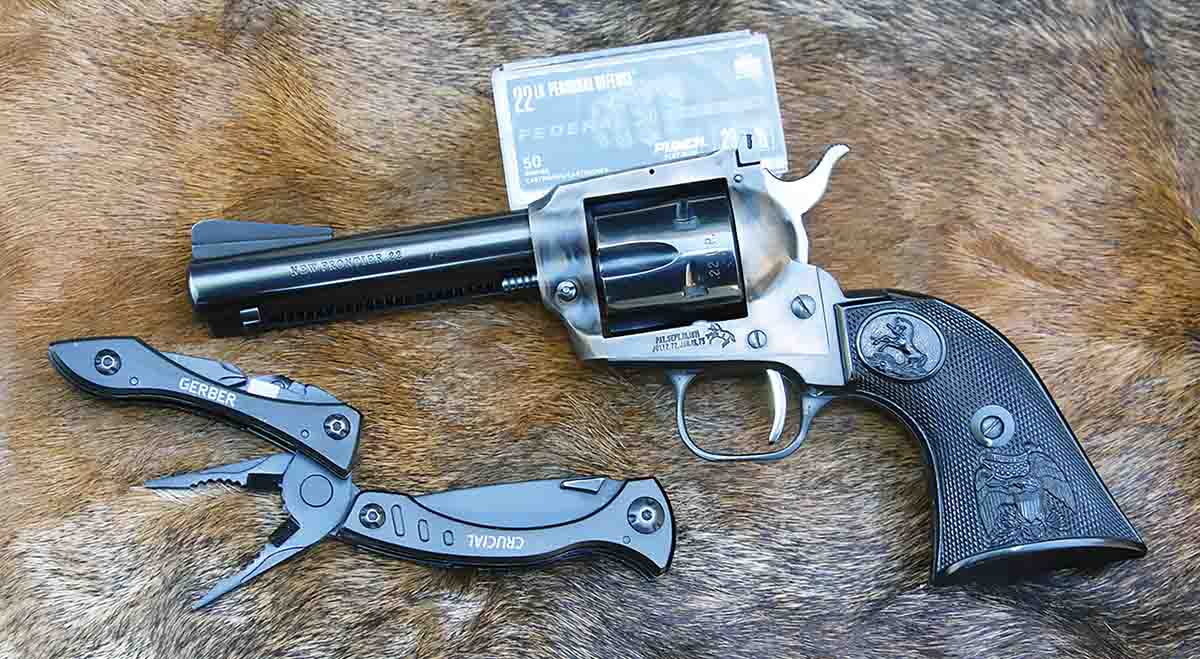
My lifelong love of single actions began at the age of 16 with my first Ruger Single Six 22 LR. Over the next several decades my interests (and my bank account) expanded to include single-action revolvers of all calibers from almost every manufacturer, but it wasn’t until the new millennium that a quick stop at a gas station in Laramie, Wyoming, exposed me to a Colt New Frontier 22 LR with a 7 1⁄2-inch barrel that was for sale inside the station’s small gun store. Since I was on my way to SPUR Outfitters for a few days of varmint shooting, the outcome was inevitable. Out from my wallet came the credit card and into my range bag went the Colt.
A couple of years later when attending the Shootists Holiday at the Whittington Center in Raton, New Mexico, I made the mandatory visit to a local gun store and discovered a 4 1⁄4-inch barreled .22 caliber Colt New Frontier with dual cylinders. As Yogi Berra once said, “It was deja vu all over again!”
To prove that I had not recovered from my new addiction to Colt revolvers, a couple of years ago, I was shooting at the classy indoor range at North County Shooting Center in San Marcos, California, and spied a 6-inch barreled 22 LR New Frontier in the display case. At that time, we were well into the “Great California Gun Shortage” era when just about anything that went “bang” sold within minutes of becoming available. By now, you know the drill.
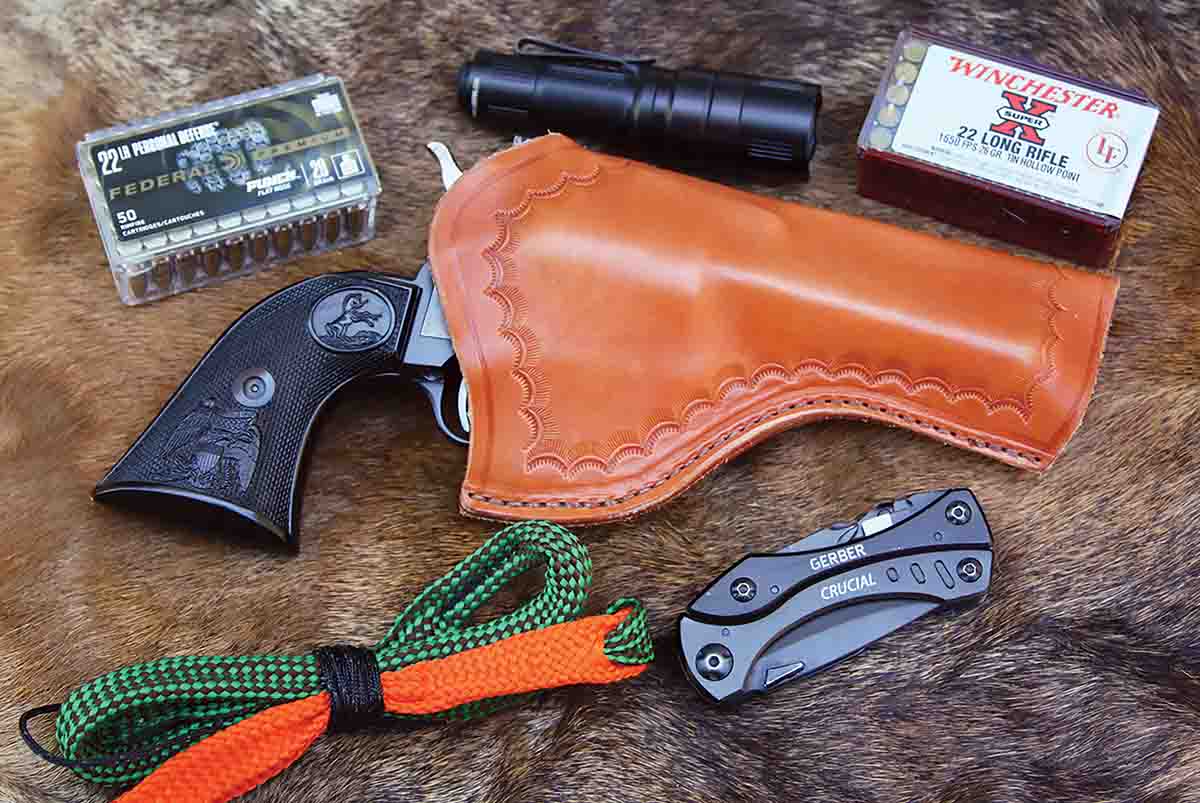
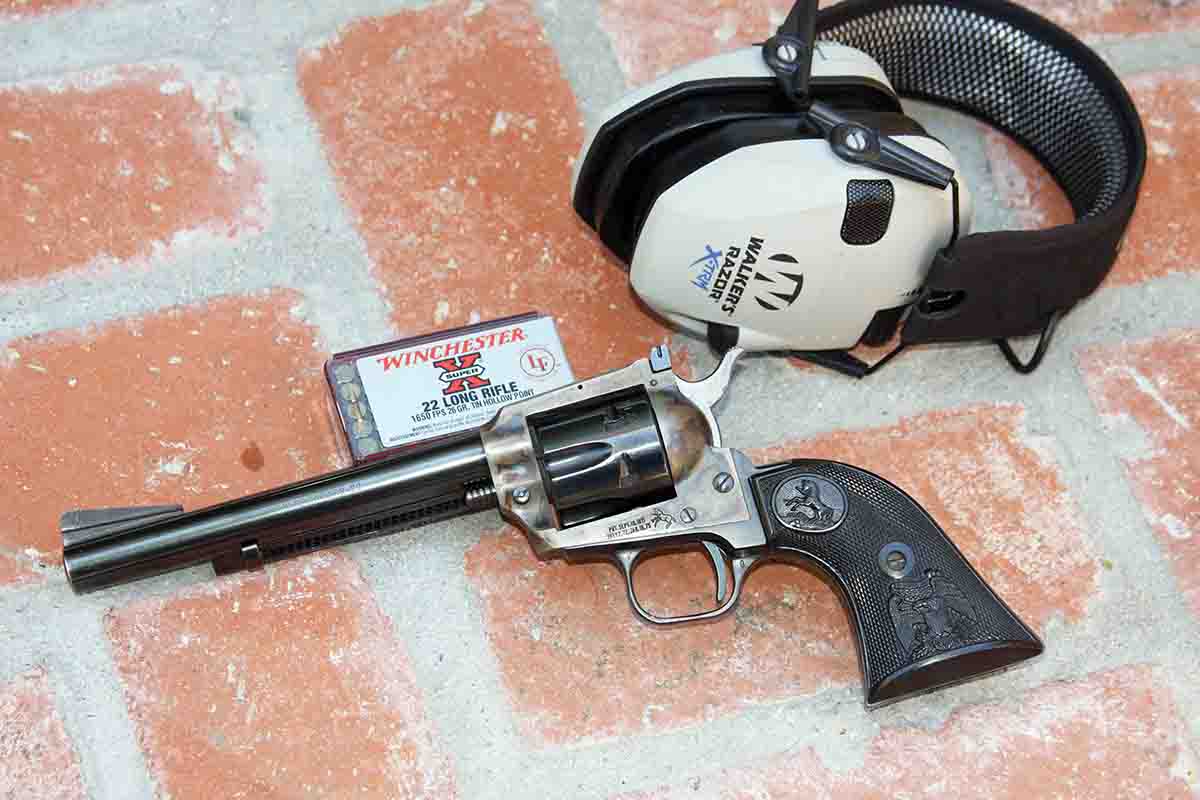
As already mentioned, barrel lengths were 7 1⁄2 inches, 6 inches and 4 1⁄4 inches. The Wyoming Colt (7 1⁄2 inches) had “New Frontier Buntline .22” engraved on the left side of the barrel. I’d always thought of Buntline revolvers sporting longer barrels, like 10 inches or so, but since the New Frontiers have smaller frames than original single-action Colts, perhaps the 7 1⁄2-inch barrel deserves to be called a Buntline. Sporting the smaller frame, the downsized gun generates the emotional response of a Buntline. The other difference is the laminated wood grip panels on the Buntline. The fit of panels to grip the frame wasn’t perfect, but the overall appearance was pleasing and the gun seemed to fit me perfectly. Since the gun would be hunting on the prairie in less than 24 hours, it was obviously being purchased as a shooter rather than a collector’s investment, so I didn’t care whether or not the panels were original. The blueing on the barrel, cylinder and grip frame appeared original and was in excellent condition.
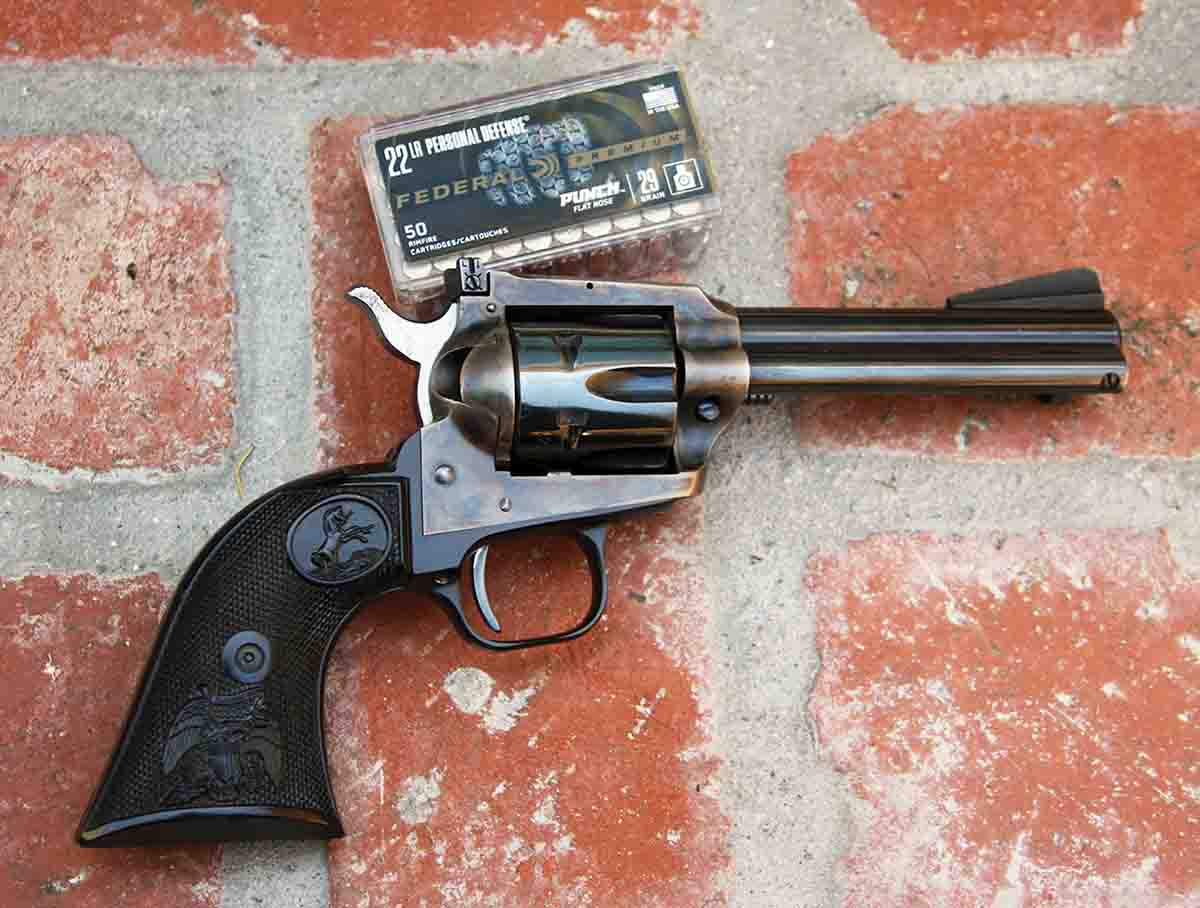
Colt was almost as pristine as the Buntline while the hammer and frame on the 6-inch California gun showed some hard service. Worse, it looked as though someone had used a pair of pliers on the sides of the ramped front-sight blade. The dings and gouges were irritating, but didn’t disturb or distort my sight picture when the gun was at arms’ length. That said, the gun will receive an evaluation at Fink’s Gunsmithing on my next visit to Gunsite to see if something can be done to erase the obvious abuse.
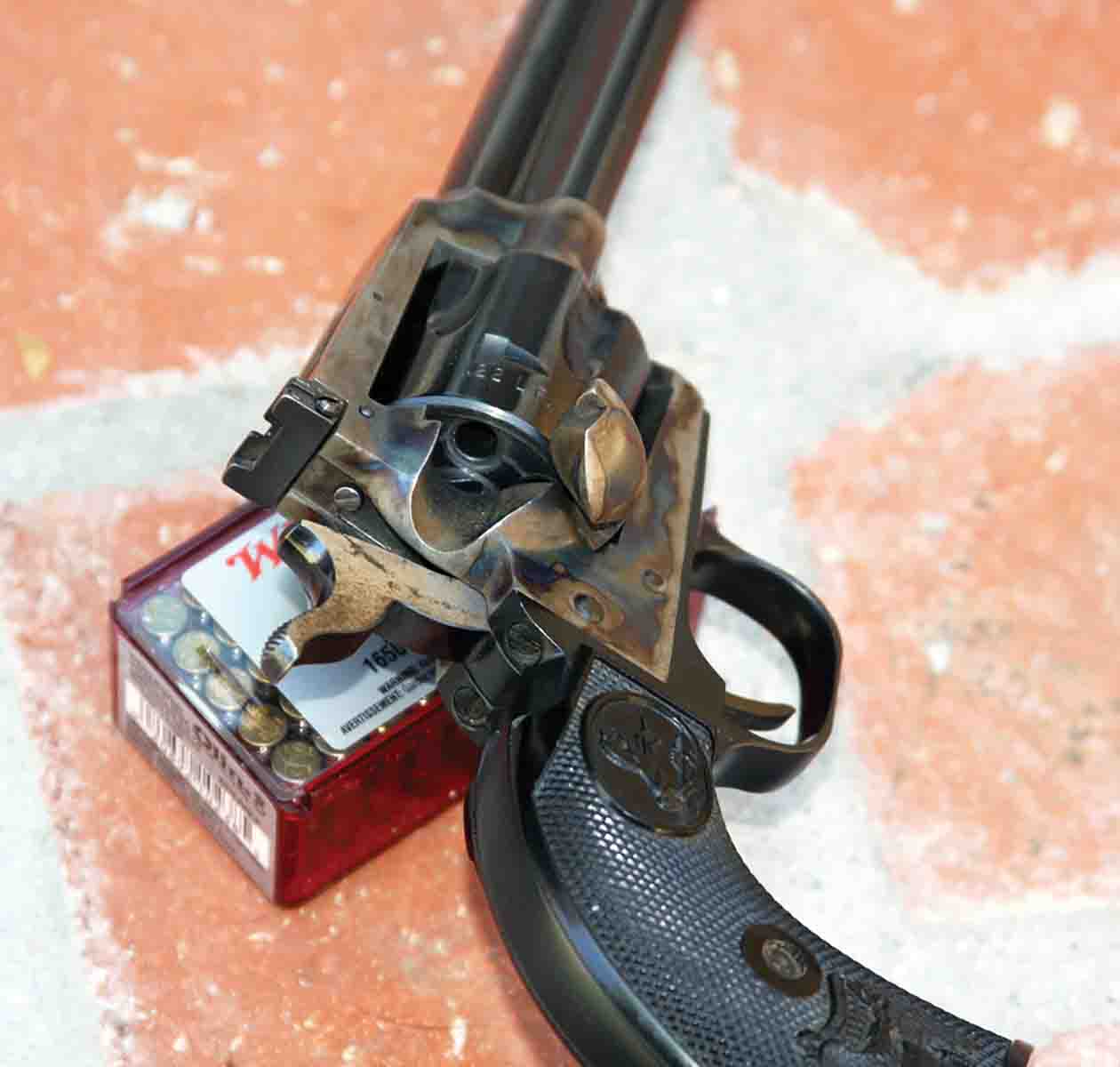
The cylinders on all three of my guns are imprinted with “.22LR.” Magnum cylinders fitted to New Frontiers are marked “.22MAG.” Cylinder faces are recessed on all three guns with the shortest and longest barreled guns showing no dings or scratches. The 6-inch model showed a bit more use, but the cylinder rotated freely and spent cases eject easily and smoothly from all chambers.
Trigger pull weights varied, but all are within my tolerance range for field use on a close range varmint mis-sion. Using Lyman’s trigger gauge, the Buntline’s trigger measured right around 3.5 pounds while the 6-inch Colt from California required 3 pounds of effort to launch. The short-barreled gun from New Mexico is the winner with a 2.5 pound let-off. Measured trigger weights can vary depending on where the gauge contacts the trigger and the direction in which it’s pulled. When I actually fired the guns using my trigger finger, pull weights felt a bit heavier. The Buntline will also get evaluated at Fink’s Gunsmithing for some possible weight loss therapy on the trigger, but after all these years, it’s not that big a deal.
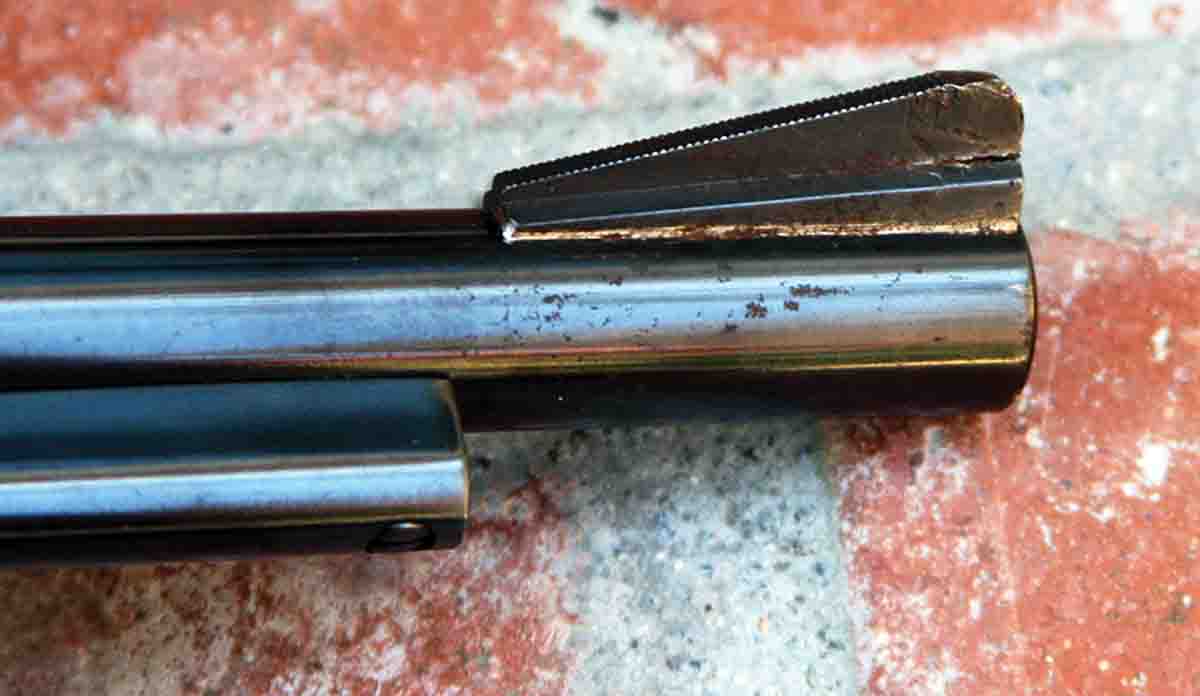
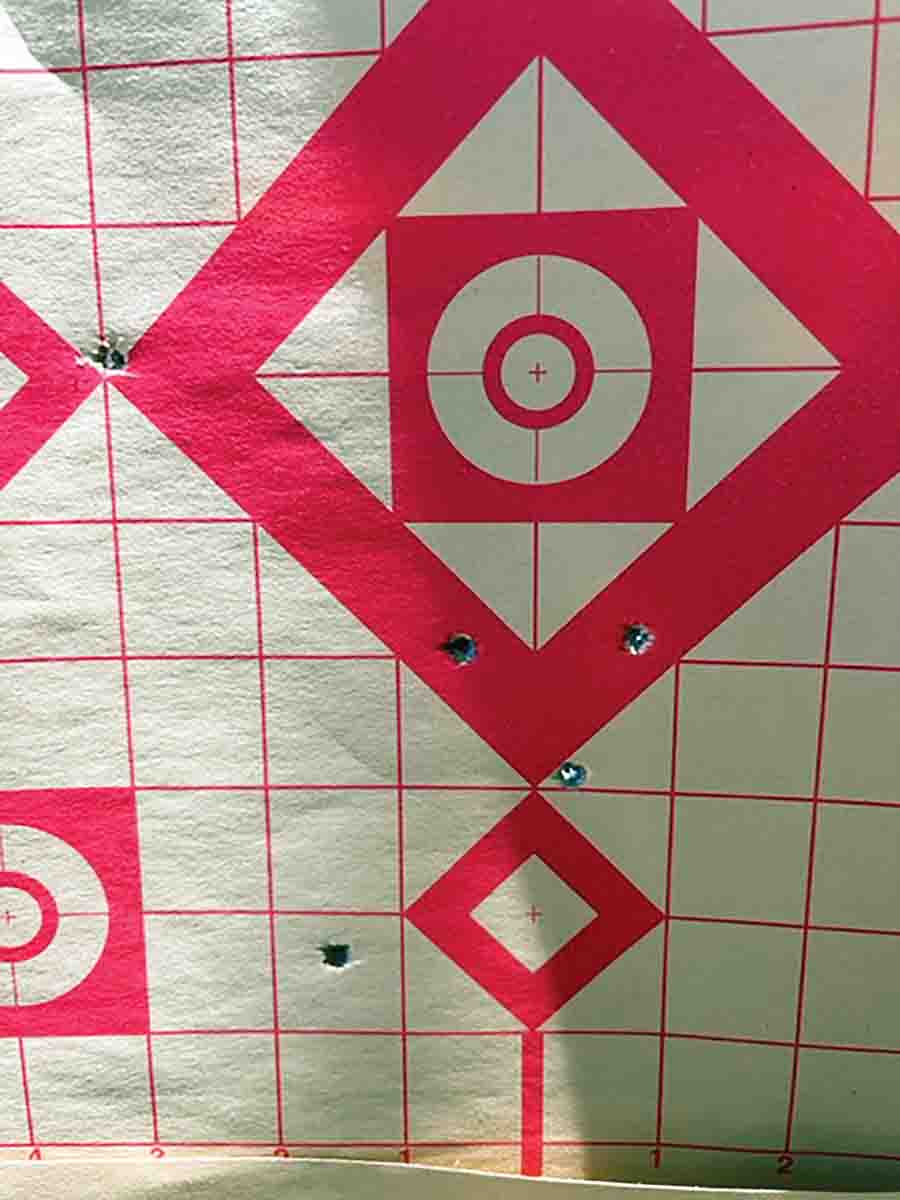
Iron sights don’t usually get much attention on a “plinking” 22 LR handgun simply because the gun’s mission is to have fun and practice your shooting skills and safe-gun handling. Like playing horseshoes, close counts. In varmint hunting, there’s a much greater need for precision because just being close can result in a wounded animal, and that’s not acceptable regardless of what animal you’re hunting. The 22 LR is an adequate cartridge for prairie dogs and ground squirrels if solid hits are made, but it lacks the explosive effect of a high-velocity centerfire rifle cartridge. I much prefer, but don’t insist on, adjustable sights that I can dial in for a variety of bullet weight. What I insist on are front and rear sights

The Colt New Frontier is a downsized gun, so it’s not just a smaller frame. Everything that requires manipulation in order to operate the weapon has shrunk. Likewise the ammunition it shoots is rather tiny, so remember the old adage. “Fat fingers manipulating small objects in confined spaces does not a good match make!” This was brought home to me initially on the range, and even more so trying to load and unload the little Colts out in the open prairie or strolling along a trail. There was enough clearance between the frame and the loading gate for my thumb to rotate the gate, but only if I wasn’t wearing gloves. The ejector-rod tab felt smaller than on larger caliber single actions, and occasionally, my finger slipped off it when trying to eject. The good news is the ejector rod did push the empty cases clear of the cylinder. Point the muzzle skyward to let gravity help and push the tab briskly to gain momentum. It’s when you start loading fresh ammunition into the individually exposed cylinder chambers between the frame and open loading gate that the “fat fingers” warning becomes relevant. Enjoy!
The New Frontier is an old-school design, meaning it must be put on half cock for the cylinder to rotate and must be carried with an empty chamber under the hammer due to the absence of a transfer bar. With recessed chambers, it’s difficult to see which chambers are loaded when you’re done. A good way to ensure that there’s no round under the hammer is to use the old technique of “Load one chamber, skip the next chamber, load the next 4, pull the hammer all the way back and lower it over the empty chamber.”
.jpg)
I’m not sure there’s any point in making recommendations about what model Colt New Frontier you should buy since they’re no longer in production. If you want one, you’ll have to buy whatever you can find. If it’s in pretty good shape, jump on it. Any problems can probably be fixed by a good gunsmith, and it’s not like your investing in a 1st generation single-action army or an original Python. I’m not suggesting that serious, precision long-range shooters should sell your rifles with the 20X scopes. But if you’re taking a late spring/early summer varmint hunt when the younger critters aren’t as educated as they will be late in the summer and you want some extra fun, toss a 22 LR handgun in with your gear. If you want to add a sense of history, pick up a used Colt New Frontier. That is if you can find one.