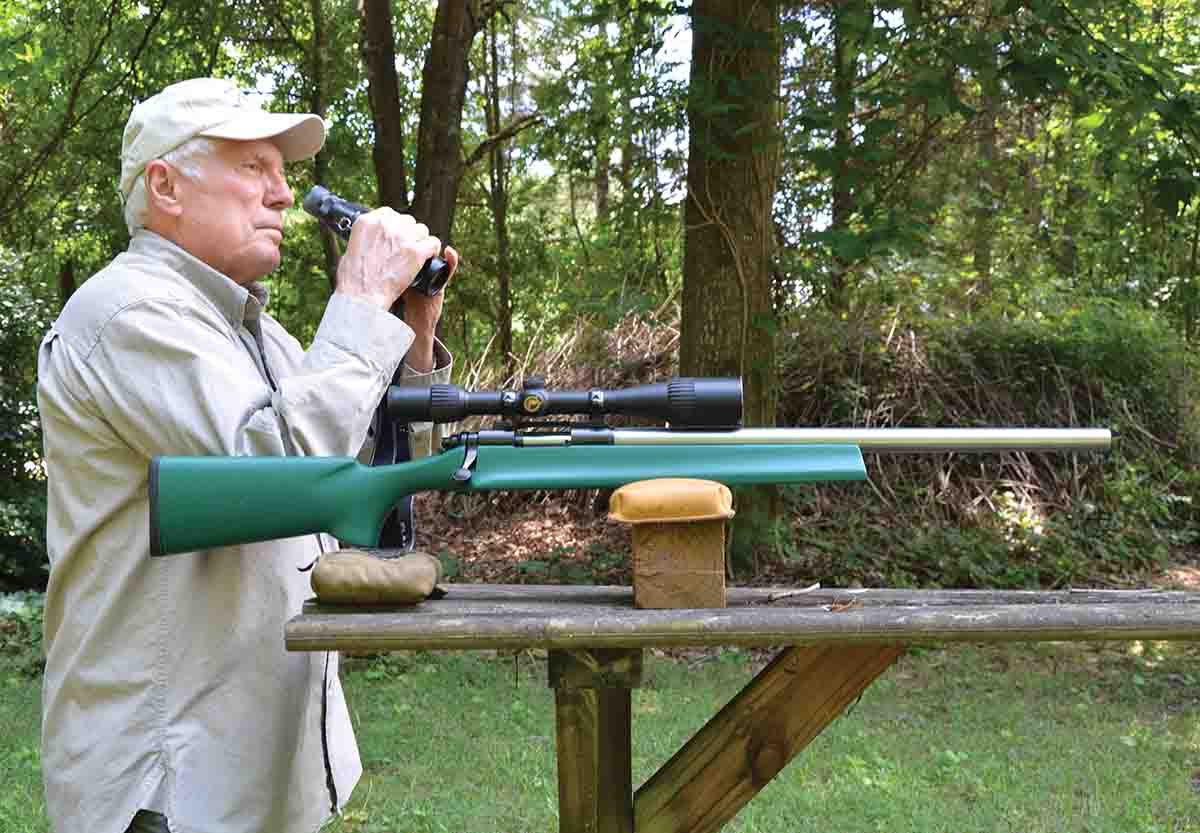
Thinning out chipmunks with the 40-XR BR in 22 Long Rifle.
For about four decades, the 40-XB and the earlier 40X, built by talented craftsmen in Remington’s Custom Shop, was the most accurate factory-built centerfire rifle in America. Like delicious icing on an irresistible cake baked by a master at his craft, it was available in a number of super-accurate cartridges suitable for bumping off varmints of various sizes at great distances. In order to escape the factory, a rifle had to deliver a certain level of accuracy for five-shot groups on a 100-yard indoor range. Accuracy was verified to the customer by including test targets with each rifle shipped. For many years, the accuracy delivered by each rifle was recorded and a tally was kept on the average accuracy of all rifles built in each caliber. The last time I checked, the overall average for several hundred rifles in 222 Remington was .373 inch.
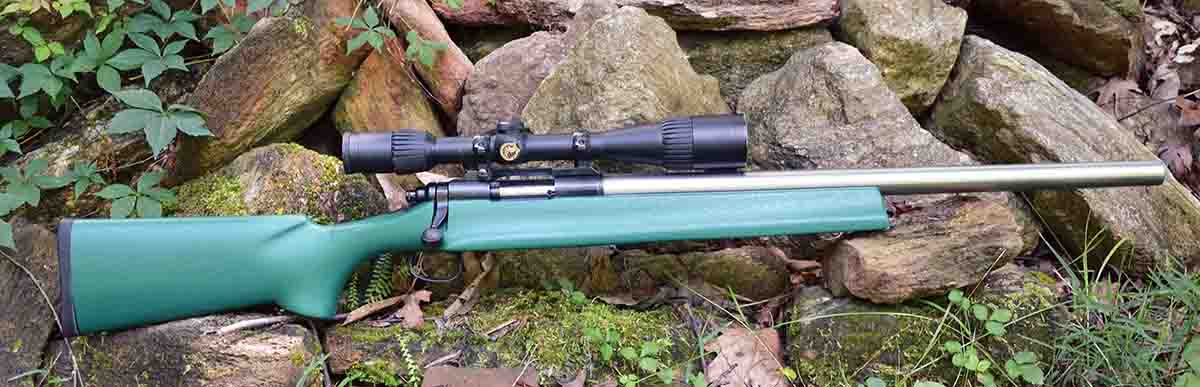
In response to requests from BR-50 benchrest competitors who use super-accurate rifles in 22 Long Rifle, Remington’s Custom Shop introduced the 40-XR BR in 1994. As the bolt pushes a cartridge into its match-dimension chamber, the bullet engages the rifling. This aligns the axes of the bullet and the bore as perfectly as possible.
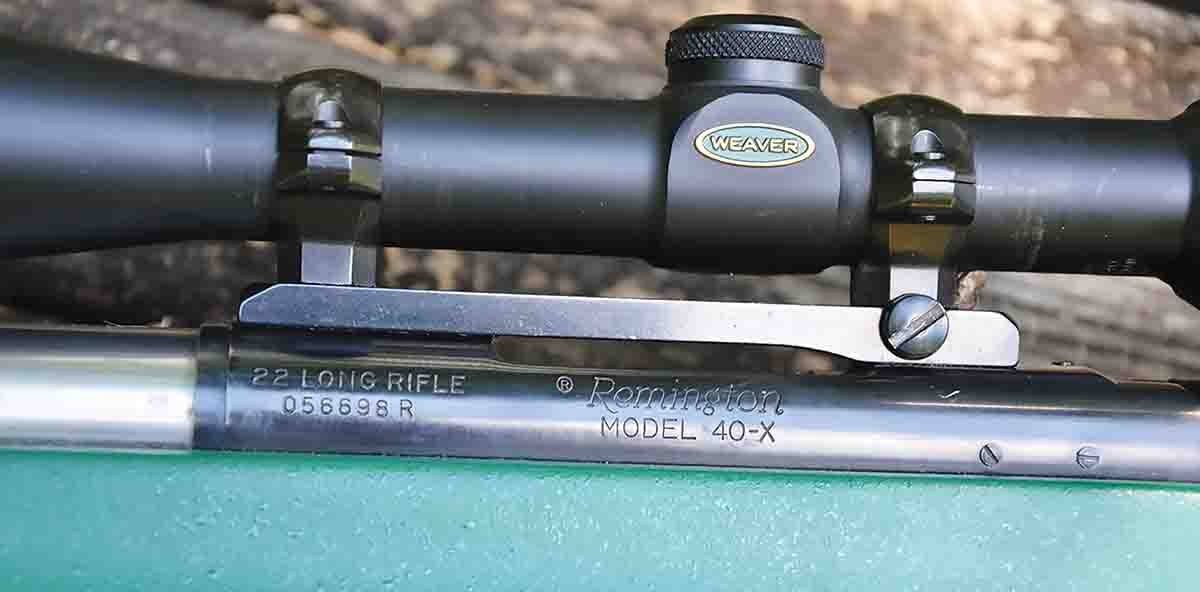
Receiver markings on most 40-XB BR centerfire rifles were applied by etching, but as illustrated here, it was roll-marked on this particular 40-XR BR in 22 Long Rifle.
In this article, I have included a table compiled by Remington on the average accuracy of 17 different cartridges, and while not all are entirely suitable for varmint shooting, the information is interesting just the same. While impressive, those test results were misleading because the exact same handload was used to accuracy-test all rifles of a particular caliber. For many years, the 222 Remington recipe consisted of the Remington 6½ primer, Remington case and a custom, 52-grain bullet seated atop 20.3 grains of IMR-4198. Developing a precision handload specifically for a particular rifle almost always resulted in considerably smaller groups than those shot by Custom Shop personnel.
The story actually began around 1950. Among a number of interesting things, Mike Walker was in charge of designing the Remington Model 721 (long action) and the Remington Model 722 (short action) centerfire rifles, both introduced in 1948. A successful benchrest competitor, he won a number of matches with heavy-barrel, single-shot rifles in 222 Remington and 6x47mm on Model 722 actions. Eliminating the magazine box cutout in the receiver increased rigidity for an improvement in accuracy. Another of his experimental rifles on the Model 722 action was chambered for the .22 Long Rifle.
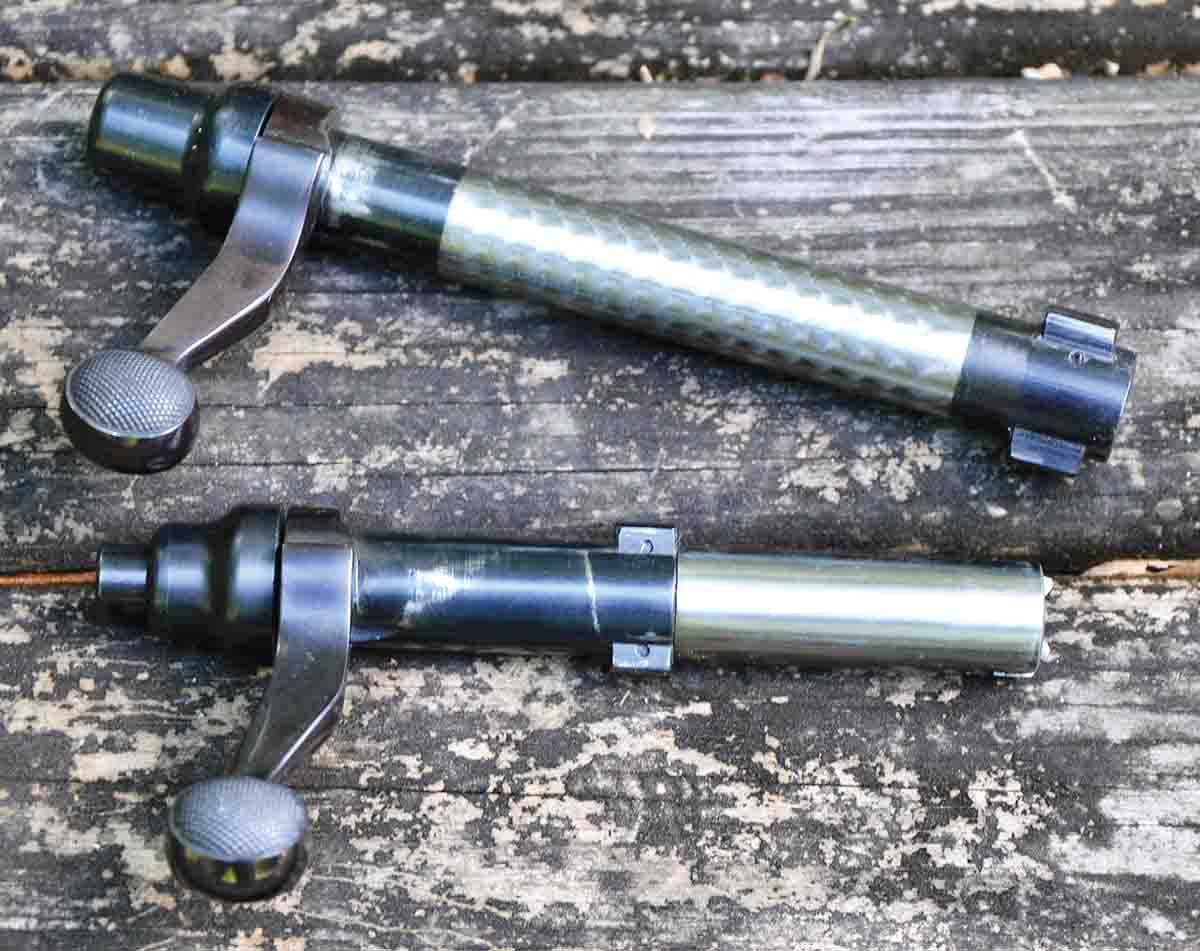
The 40-XB bolt (top) is basically a hand-selected Model 700 bolt with dual- opposed locking lugs at the front. Rifles in 22 Long Rifle have a two-piece bolt with the non-rotating front section containing a pair of extractors while the rotating rear section has opposed locking lugs.
In 1955, Remington introduced Walker’s favorite squirrel rifle as the 12.75 pound 40X Rangemaster. It was followed in 1959 by a centerfire version in 7.62mm NATO with the 222 Remington, 222 Remington Magnum, .30-06 and 300 H&H Magnum added during the following year. To avoid confusion, I will mention that all rifles built on the Model 721/722-style action were designated as “40X” and it was hyphenated to “40-XB” with the introduction of the Remington Model 700 rifle in 1962. Both single-shot and repeating versions of both were offered. If not for Mike Walker, Remington’s Custom Shop where all 40X and 40-XB rifles were built, would likely have not existed. Every craftsman who worked there was handpicked for various talents.
The 40-XB action is basically a Model 700 action that finished at the head of its class. After being hand-selected for its concentricity, the action headed to the Custom Shop for “blueprinting” long before other gunsmiths added the word to their vocabularies. The locking lugs of the bolt were hand-lapped for close to 100 percent surface area contact with their seats in the receiver and the face of the receiver ring was squared with its axis.
In other words, an action that was already quite concentric was made even more so. I must mention that sometime after Mike Walker retired from Remington, a number of changes were made to 40-XB rifles and not all were good. Action blueprinting was discontinued, although I was told that the selection of Model 700 bolts and receivers for concentricity continued. Barrel quality remained satisfactory, although it did not seem as good as when Mike Walker was in charge of production.
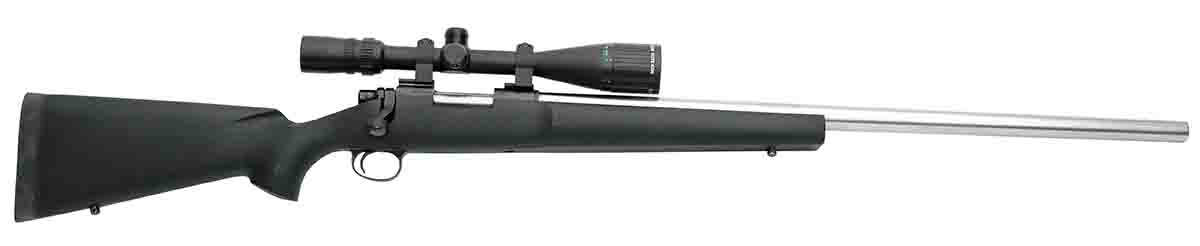
Layne received the first 40-XB KS Varmint Special in 220 Swift built by the Remington Custom Shop in 1987. It has a flat-bottom Kevlar stock, a heavy, match-grade 27.25-inch stainless-steel barrel and weighs 10.5 pounds without a scope. The rifle was eventually offered in a number of other calibers.
The standard 40-XB trigger was often described as a match-grade version of the Model 700 trigger. It had a pull weight adjustment range of 1.5 to 3.5 pounds. For many years, it was the best trigger offered by an American rifle manufacturer. Each one I tried broke crisply with absolutely no creep or overtravel and could be safely adjusted down to 30 ounces or so. A 2-ounce trigger was available on all rifles with the single-shot action. A 40-XB BR in 6mm BR Remington I shot for several years had one, and in addition to being quite remarkable, it proved to be totally reliable during thousands of firings. Of three-lever design, it differs considerably from the standard trigger and it does not have a safety. The trigger is much too light for all but highly experienced competitors.
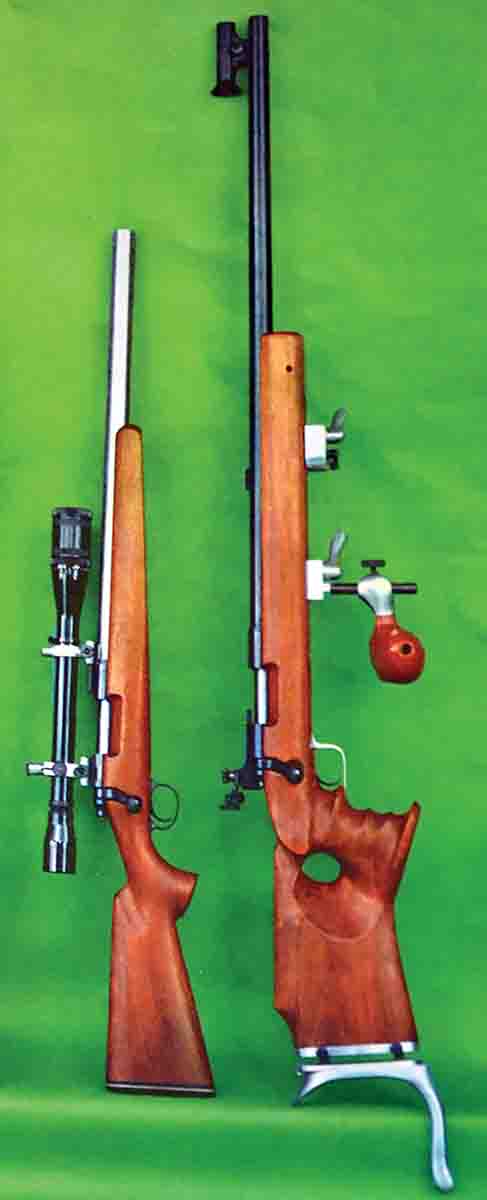
A page from the 1969 Remington catalog shows two variations of the 40-XB: left, a Model 40-XB BR (Bench Rest) 222 Remington, with a Remington 20X scope; and right, a Model 40-XB International Free Rifle 222 Remington with Redfield Olympic Sights.
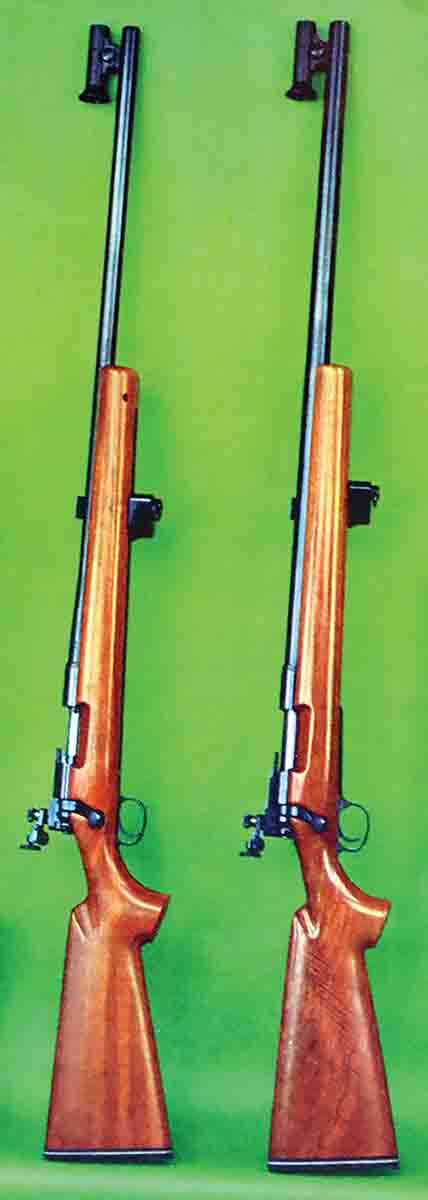
In addition to various centerfire cartridges, the 40-XB Target was available in a .22 Long Rifle (left). Except for a different bolt and receiver, it was identical to the 40-XB Target in 7.62mm NATO (right). Both have Redfield Olympic sights.
While Mike Walker was equipping the Custom Shop, he installed barrel-making equipment designed to produce quality rather than quantity. One of his proudest and most successful inventions was the button method of rifling barrels. All barrels were made of the best steels available with chamber-to-muzzle bore and groove diameter uniformity varying by no more than .0003 inch. Chambers were usually reamed on the minimum side of the Sporting Arms and Ammunition Manufacturers’ Institute (SAAMI) tolerance range. As was expected by serious benchrest shooters, chamber necks for the .22 BR Remington and 6mm BR Remington were actually smaller than the SAAMI minimum, requiring outside neck-turning of those cases. The first 40X barrels were chrome-moly with a blued finish with stainless steel added during the mid-1960s.
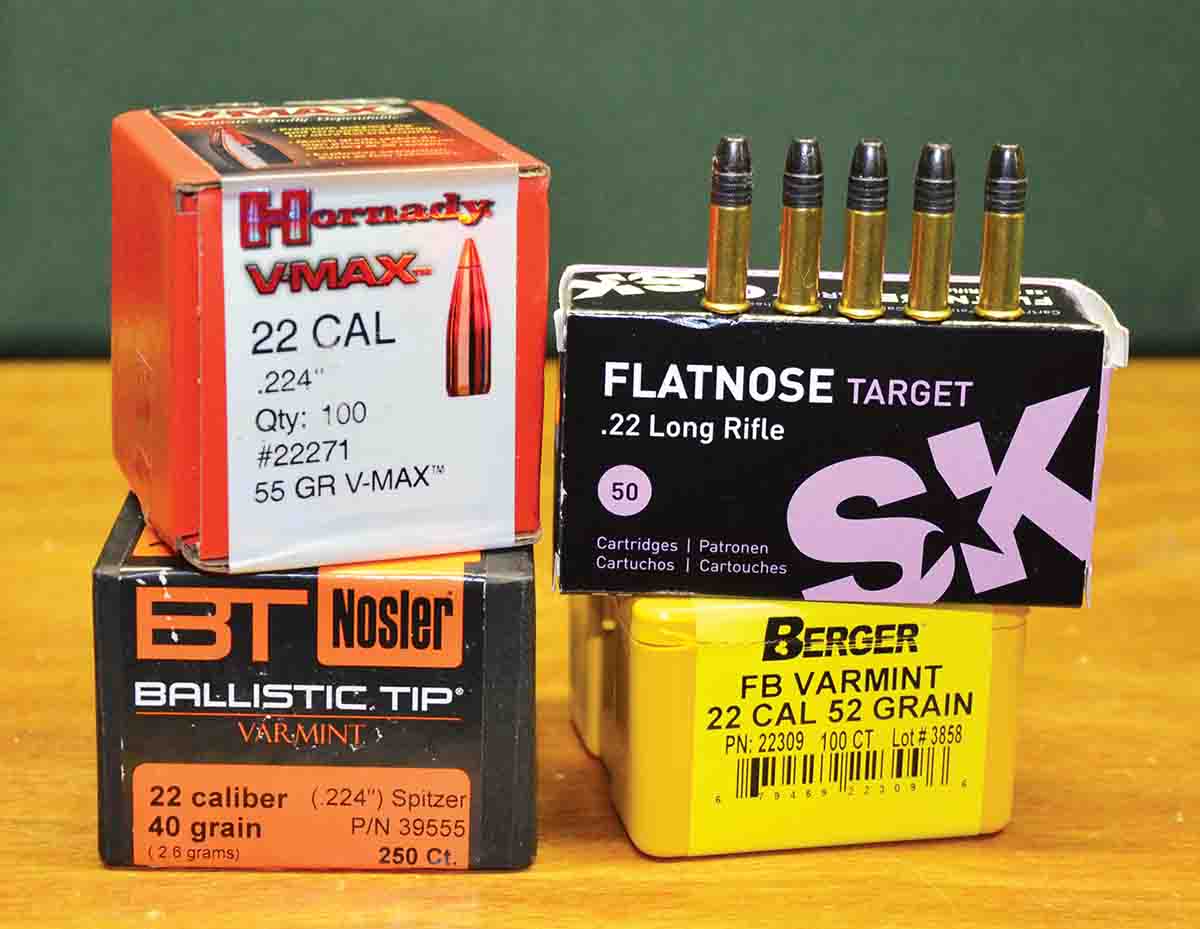
Excellent varmint bullets.
Numerous variations of the 40-XB were eventually offered. The International Free Rifle introduced in 1959 may have been the most interesting, but I will stick with those I have used most to bump off varmints. In 1969, Remington introduced the company’s first benchrest rifle called the 40-XB BR in 222 Remington. The 222 Remington Magnum, 223 Remington, 6mm International, 6x47mm, 22 BR Remington and 6mm BR Remington were eventually added. Two versions were built to meet the National Benchrest Shooters Association 10.5 pound and 13.5 pound weight (with scope) restrictions for two classes of competition. The Light Varmint rifle had a 20-inch barrel while the barrel of the Heavy Varmint rifle was 26-inches long. There is an easy way to identify the 40-XB BR action. Receiver markings of all the others are rolled on with a die but they are etched on the BR action. That detail goes back to the days of Mike Walker who insisted that receivers used in building those rifles were to be etched to eliminate the possibility of warping them.
The Heavy Varmint rifle I bought in 1974 was in 222 Remington and it weighed a few ounces less than 13.5 pounds with its Remington 20X BR scope. According to my records, the prices were $299.95 for the rifle and $169.95 for the scope (I still have the scope). At the time, Phyllis and I were living in Nashville, Tennessee, and farm lands in the area were infested with groundhogs. Needing more reach than the 222 Remington offered, I decided to have the rifle converted to 220 Swift. Harry Creighton, a local gunsmith who had built many super-accurate rifles chambered for that cartridge through the years was known far and wide as “Mr. 220 Swift.” I had Harry open up the bolt face of my rifle and rechamber it to .220 Swift. The first group I fired after the conversion measured .444 inch, easy to remember since I also owned a Marlin Model 444 in 444 Marlin. Further load development improved accuracy to a hair over .250 inch, with occasional individual groups in the “ones.”
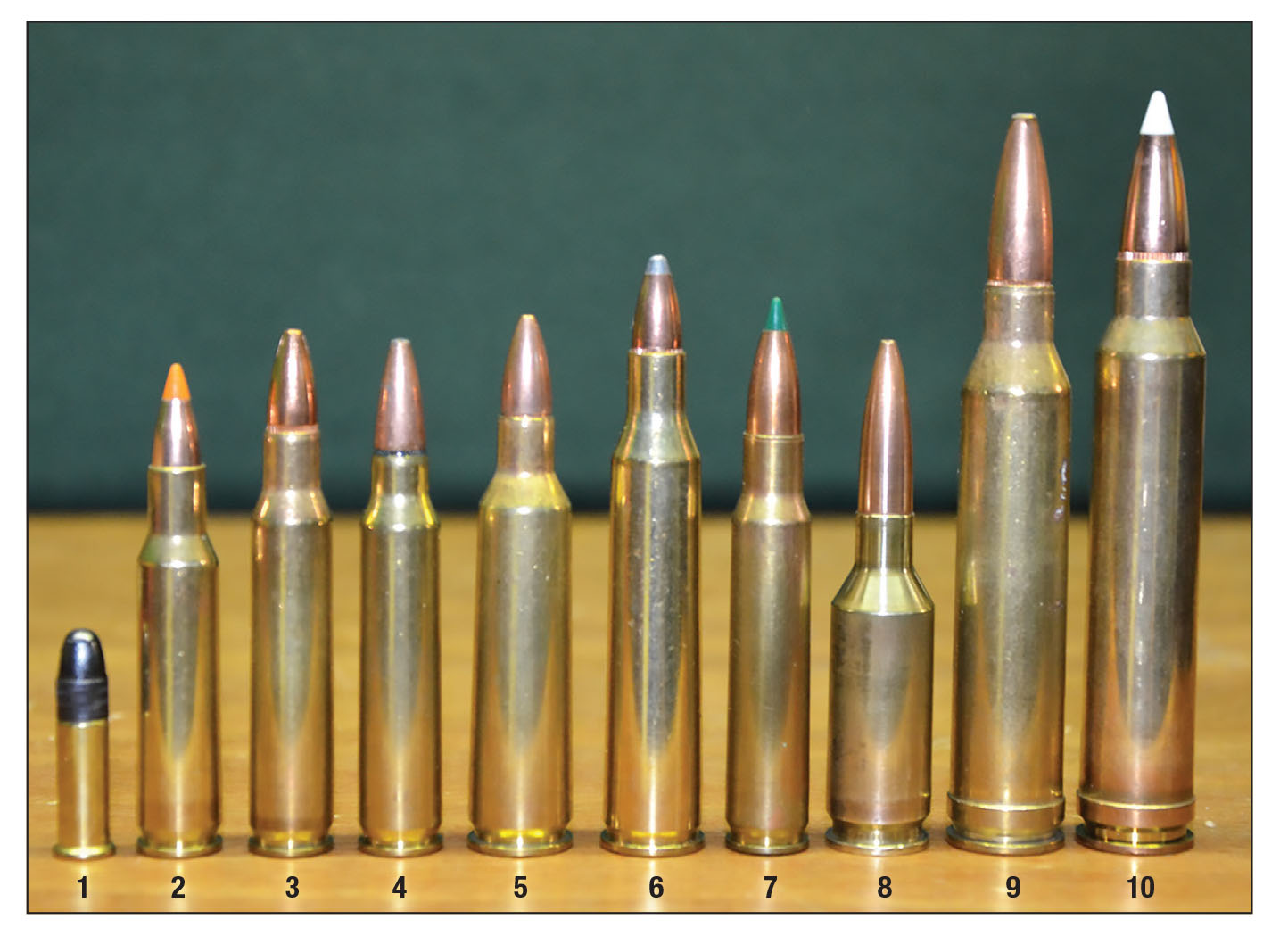
A few of the many cartridges the Remington 40X was chambered for throughout the years: (1) .22 Long Rifle, (2) 222 Remington, (3) 222 Remington Magnum, (4) .223 Remington, (5) .22-250, (6) .220 Swift, (7) 6x47mm, (8) 6mm BR Remington, (9) 7mm Remington Magnum and (10) .300 Winchester Magnum.
Mentions of that rifle and its accuracy in several of my articles caused what a Remington official described as a small flood of reader requests and as a result, the 40-XB KS Varmint Special with a heavy, 27.25-inch stainless steel barrel in .220 Swift was introduced in 1987. It was the very first rifle the company had chambered for that cartridge. Other calibers were eventually offered. A flat-bottom forearm on the black, Kevlar-reinforced stock is just the ticket for shooting over sandbags. As a token of his appreciation, a friend at Remington sent the first one built to me and on the day of its arrival, I gave my rechambered 40-XB BR to a varmint-shooting pal who had long admired it. My 40-XB KS is a single shot with a solid-bottom receiver, but a repeater was available in certain calibers. Its weight without a scope is 10.5 pounds. A 28 ounce caress breaks its trigger like an icicle in December with not a trace of creep or overtravel. If a better long-distance varmint rifle has ever been built, I have yet to discover it.
.jpg)
.jpg)
In those days, Remington took opinions and suggestions from customers (and potential customers) quite seriously. In response to requests from BR-50 benchrest competitors who used super-accurate rifles in 22 Long Rifle, Remington introduced the 40-XR BR with a heavy, 22-inch stainless steel barrel in 1994. Due to the match dimensions of its chamber, the bullet engages the rifling as a .22 Long Rifle round is chambered. Bore and groove diameter variation from chamber to muzzle was held to a maximum of .0001 inch. Respective bore and groove diameters of .2165 and .2215 inch were a bit tighter than standard for the 22 Long Rifle cartridge.
The green Kevlar-reinforced synthetic stock is shaped the same as the stock of the 40-XB BR chambered for various centerfire cartridges. Whereas the bolt body of the centerfire rifle is one-piece with dual-opposed locking lugs at the front, the 40-XR BR bolt is two-piece with a non-rotating section containing dual extractors at the front and a rotating section with dual-opposed locking lugs at the rear. An extremely strong design, Ruger pretty much copied the bolt when designing the Model 77/44 rifle in 44 Remington Magnum. While my 40-XR BR was designed for competitive shooting, it has ventilated far more chipmunks and flickertails than paper targets. In addition to being quite accurate, SK Flatnose Target consistently anchors the little varmints in their tracks.
When Remington shut down its Custom Shop in 2015, production of 40-XB rifles was moved to Dakota Arms, in Sturgis, South Dakota. Dakota closed its doors along with the Remington bankruptcy and now under new ownership, is known as Parkwest Arms. Let us hope that what was once America’s most accurate factory-built rifle will soon rise up from its ashes and be as good or perhaps even better than it once was. In the meantime, I will hang onto those I am fortunate to have.


.jpg)