Heavy Bullets in the 223 Remington
Loading Long-for-Caliber Projectiles
feature By: Patrick Meitin | April, 21
Years later I acquired a Remington Model 700 VTR-SS – used for testing here. The distinctive 22-inch triangular barrel with integral muzzle-brake slots and a 1:9 twist cooled quickly given any amount of wind, and provided commendable accuracy. The VTR shot my standard 40-grain 223 Remington loads quite well, but there came the day when I experienced a particularly breezy day during a rockchuck shoot in southern Idaho. The wind initiated some pretty serious drift frustrations while shooting standard weight varmint bullets.
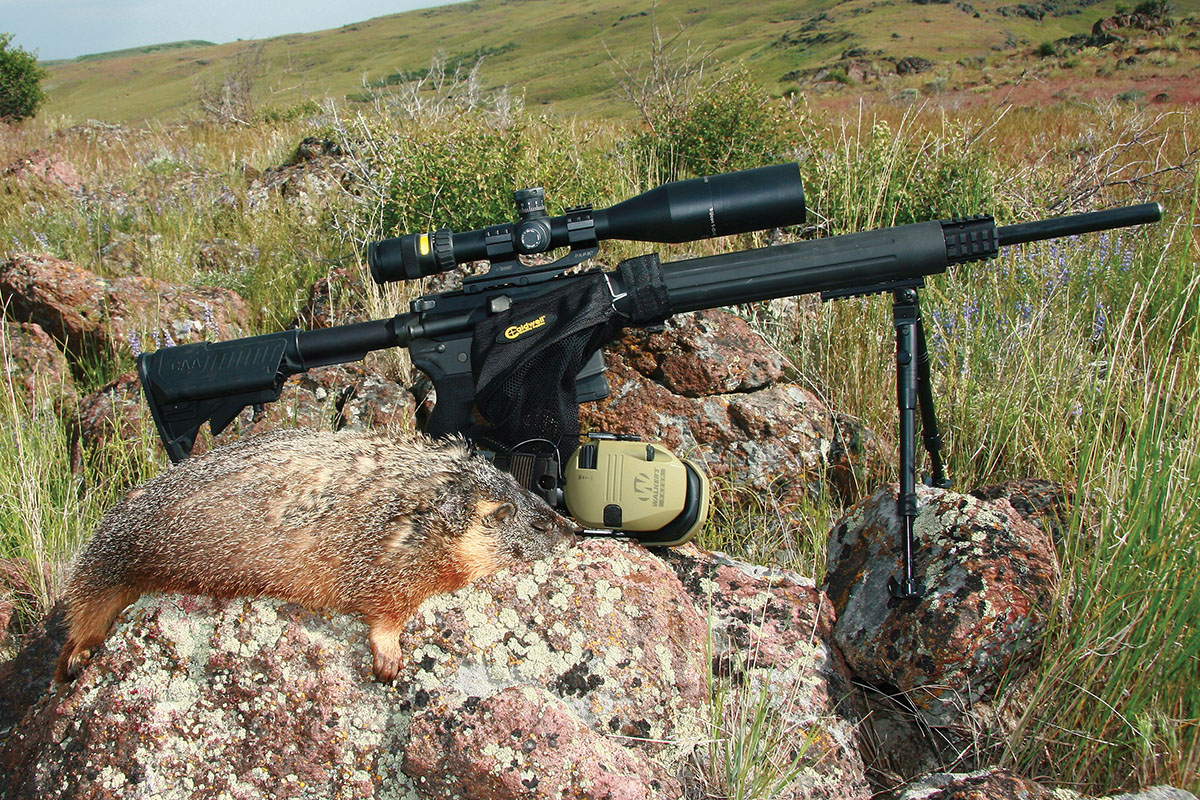
Rockchucks, more properly known as yellow-bellied marmots, are a consummate long-range varmint target. Idaho ’chucks live in scattered rock piles and lava outcrops in relatively open terrain. The best vantage for discovering the sunning critters are opposing canyon faces, where it is easier to peer directly into their rocky grottoes. Those canyons span 350 to 600 yards across, and in Idaho’s dry southern reaches, desert winds are more standard than rare. My interest in long-for-caliber bullets with exceptional ballistic coefficients (BC) blossomed. I quickly adopted some of the more high BC 6mm rounds for these pursuits, but also developed VTR/223 Remington loads targeted to those conditions, as half the fun of varmint shooting is experimenting with a wide variety of rifles and cartridges.
I found the Remington VTR-SS and its 1:9 rifling twist reliably stabilized bullets to around 77 grains, at least at the 3,500-foot altitudes where I shot most. (Every 5,000-foot gain in elevation above sea level corelates to an inch of rifling twist). I was also surprised to recently discover most of the newest crop of 223 Remington bolt rifles are now rifled with 1:9 to 1:8 (even 1:7) twists. Hopefully, those rifles are equipped with enough freebore to allow properly seating long-for-caliber bullets. A persistent source of annoyance with my VTR is that Remington gave the rifle a fast twist but remained stingy with chamber freebore, requiring seating relatively-blunted bullets (like the Nos-ler 62-grain Varmageddon used here) to fit AR-15 magazines. (Spear-pointed bullets allow longer overall loaded lengths.) Even my standard 40-grain/poly-tipped Savage 110 loads require deeper seating to allow closing the bolt without jamming bullets into the lands.
I had also owned a “parts-build” AR-15 for several years (20-inch “heavy-match” barrel with a 1:7 twist). Texas road trips involving wild hogs and thermal-imaging optics inspired experiments with bullets much heavier. Texas hog forays had demonstrated my 1:7-twist AR easily handled bullets to 90 grains, including especially long numbers like those made by Berger. Though, the 90s, loaded as deeply as practical to avoid crowding the ogive, could only be loaded two or three at a time (backed by Speer 75-grain Gold Dots) before binding in the AR magazine. Seating to 2.26 inches also intrudes into powder space. Other long-for-caliber .224 bullets, like the Cutting Edge 78-grain MTH Max used here, won’t allow seating to clear even the mag well. The .223’s short neck loses its grip on the bullet, allowing it to fall into the case. Instead of fighting this reality, I seated the heaviest test bullets so they would chamber in my AR without binding in the lands upon extraction, ignoring magazine restrictions completely. These rounds were single fed – a common approach even while varmint shooting with bolt rifles. These loads will no doubt function well in appropriately-rifled actions.
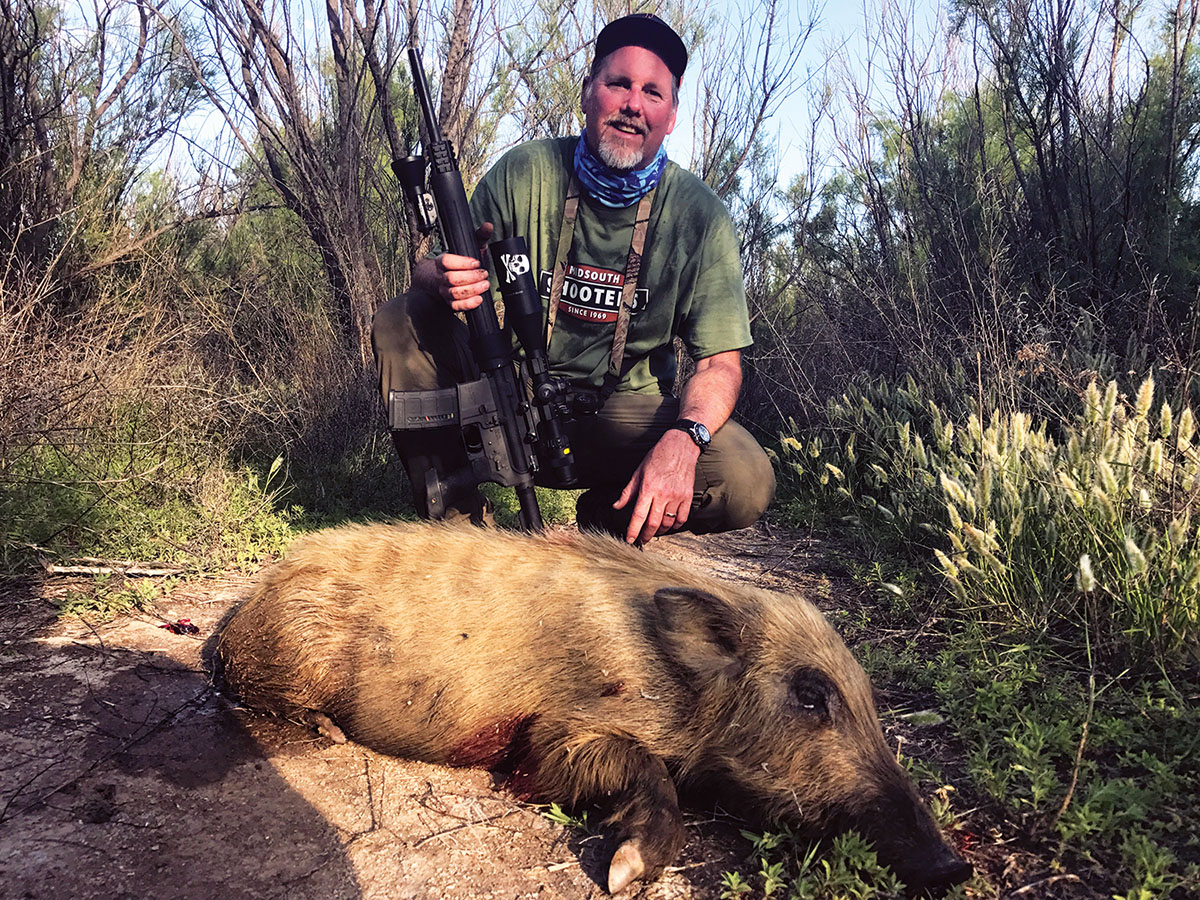
Where things become trickier is wind drift, which is definitely not straightforward when ranges stretch, as wind seldom remains static in any varmint shooting scenario. Subjected to a 10-mph crosswind, the 55-grain bullet drifts 34.5 inches, the 69 grain 26.3 inches and the 90 grain only 20 inches at 500 yards with the same loads used above. That 14.5-inch margin translates into a miss on even a 10-pound rockchuck, with the heavier bullets narrowing the margin for error should wind velocity vary only slightly while bullets are in route. Regarding large “varmints,” like feral hogs, heavier bullets obviously deliver substantially more energy.
This series gave me the opportunity to thoroughly test some Shooters World powders, like Tactical Rifle (characteristics similar to Hodgdon H-335), Match Rifle (similar to Alliant Reloder 15) and Precision Rifle (similar to Hodgdon Varget) with published data instead of cautiously extrapolating from data garnered from cartridges with similar dynamics. I also added Vihtavuori N140 and N540, Western Powders Accurate LT-32, A-2520 and Ramshot TAC and X-Terminator, Hodgdon Varget, CFE-223 and Alliant Power Pro 2000-MR, Power Pro Varmint and Reloder 15. This is not to imply staple 223 Remington powders such as Hodgdon H-322, H-335, BL-C(2), Benchmark and Winchester 748, as quick examples, aren’t viable. I just wanted to try some newer options.
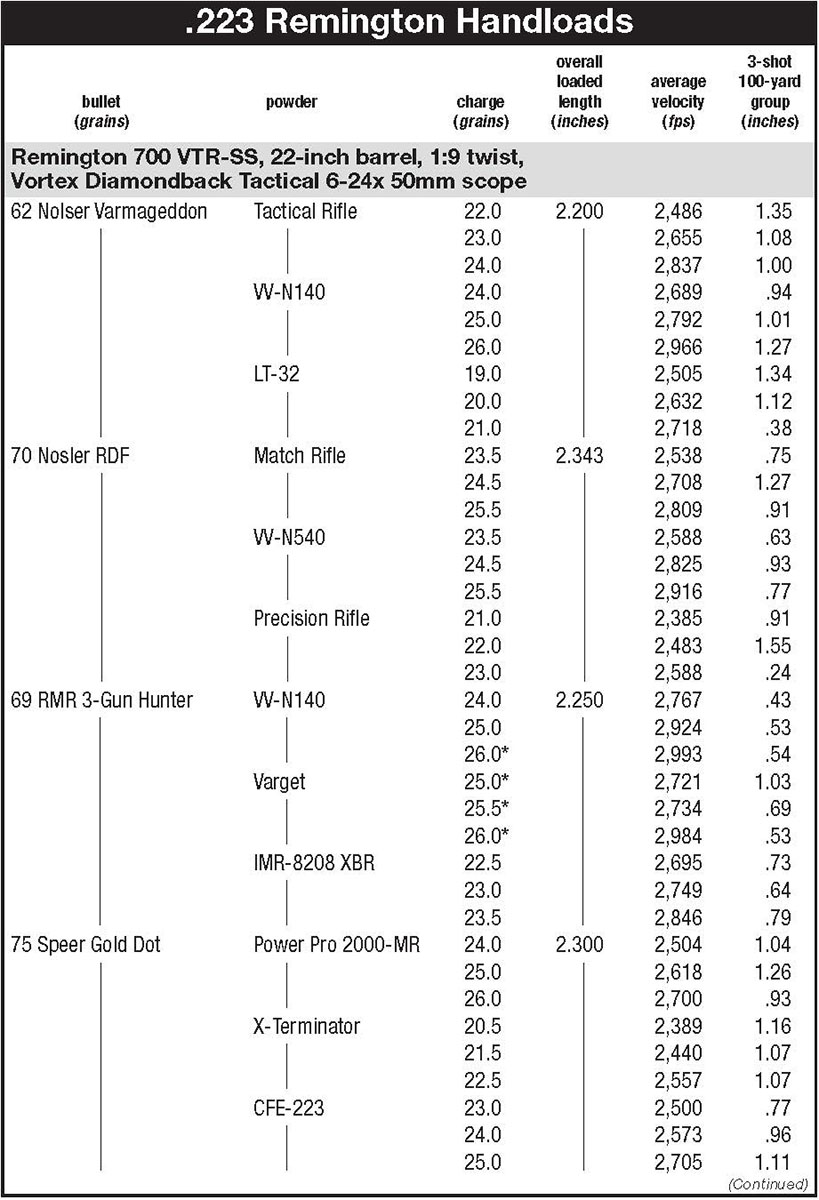
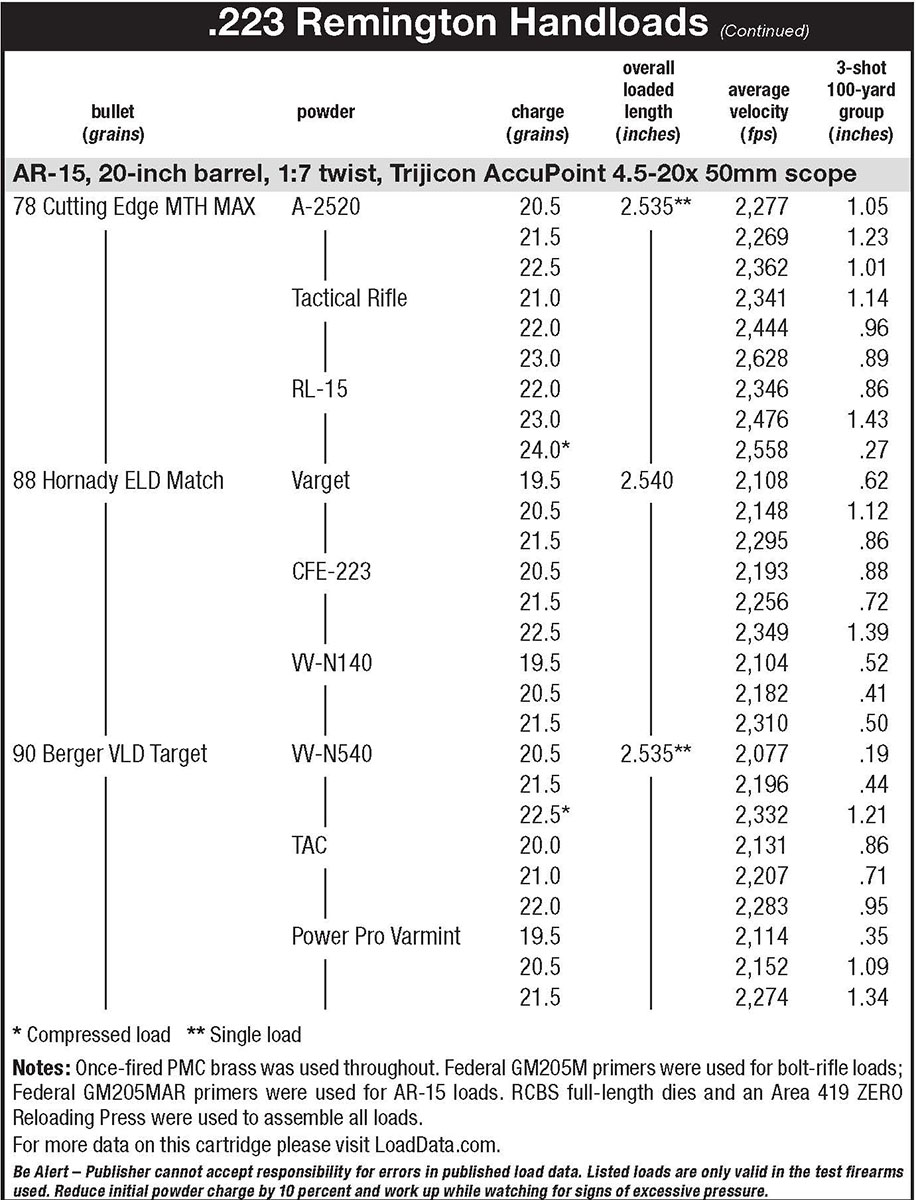
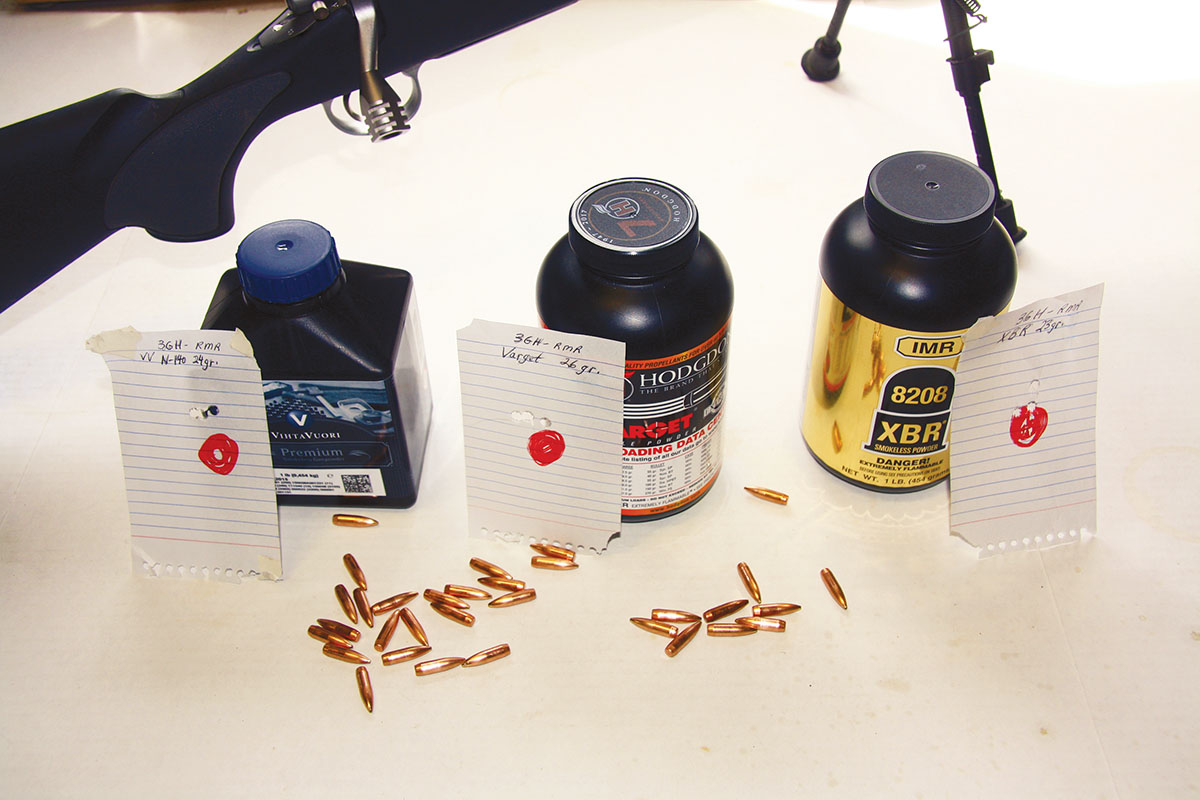
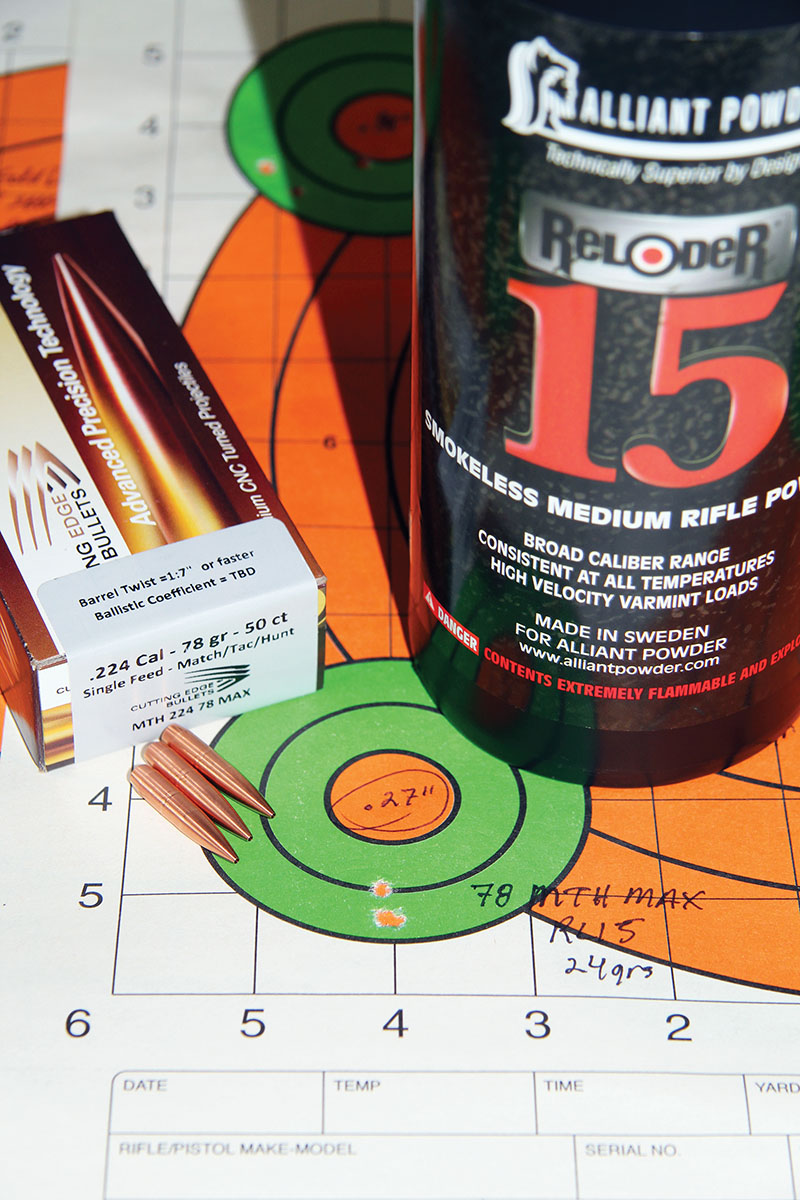
For the Remington VTR-SS, I chose Nosler 62-grain Varmageddon, Nosler 70-grain RDF and Speer 75-grain Gold Dot bullets. The 69-grain Rocky Mountain Reloading (RMR) 3-Gun Hunter (3GH) loads were added from notes taken during previous load development, and also shot from this rifle. For the AR, Cutting Edge Bullet’s 78-grain Single Feed MTH Max, Hornady 88-grain ELD Match and Berger 90-grain VLD Target bullets were selected. Due to continued panic hoarding and a quickly dwindling supply of irreplaceable small rifle primers, three-shot, 100-yard groups were fired instead of more revealing five-shot clusters.
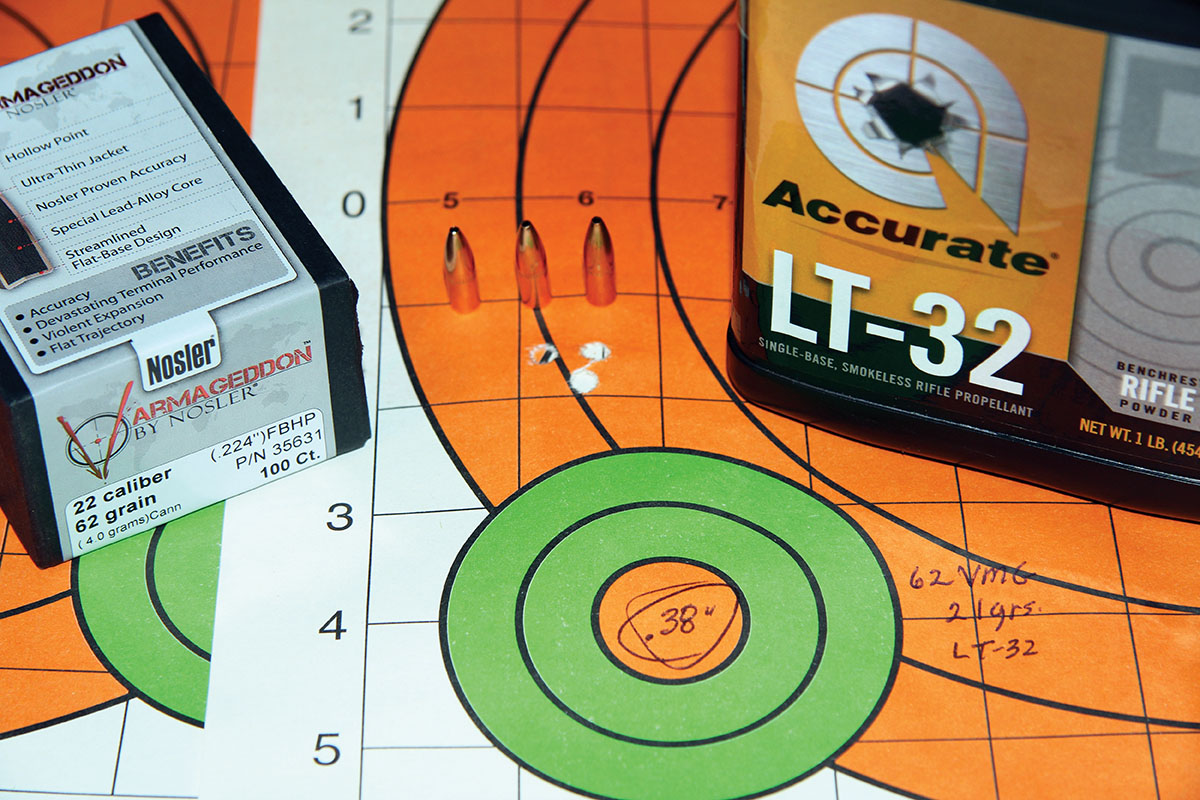
The Nosler 62-grain Varmageddon is an affordable, flat-base hollowpoint varmint bullet with .251 G1 BC. Paired powders included Shooters World Tactical Rifle, Vihtavuori N140 and Accurate LT-32. I was a little disappointed by the results with this one, the VTR proving particularly finicky with this bullet. Tactical Rifle resulted in three-shot groups averaging 1.14 inches, (the best an even inch with 24 grains of powder at 2,837 fps). VV-N140 groups averaged 1.07 inches, with the best group, .94 inch, resulting from 24 grains of powder at 2,689 fps. This isn’t terrible, but not up to this rifle’s usual performance. Then there was LT-32. The first two groups averaged an uninspiring 1.23 inches, the final shot string finally printed what I was looking for, a .38-inch group at 2,718 fps.
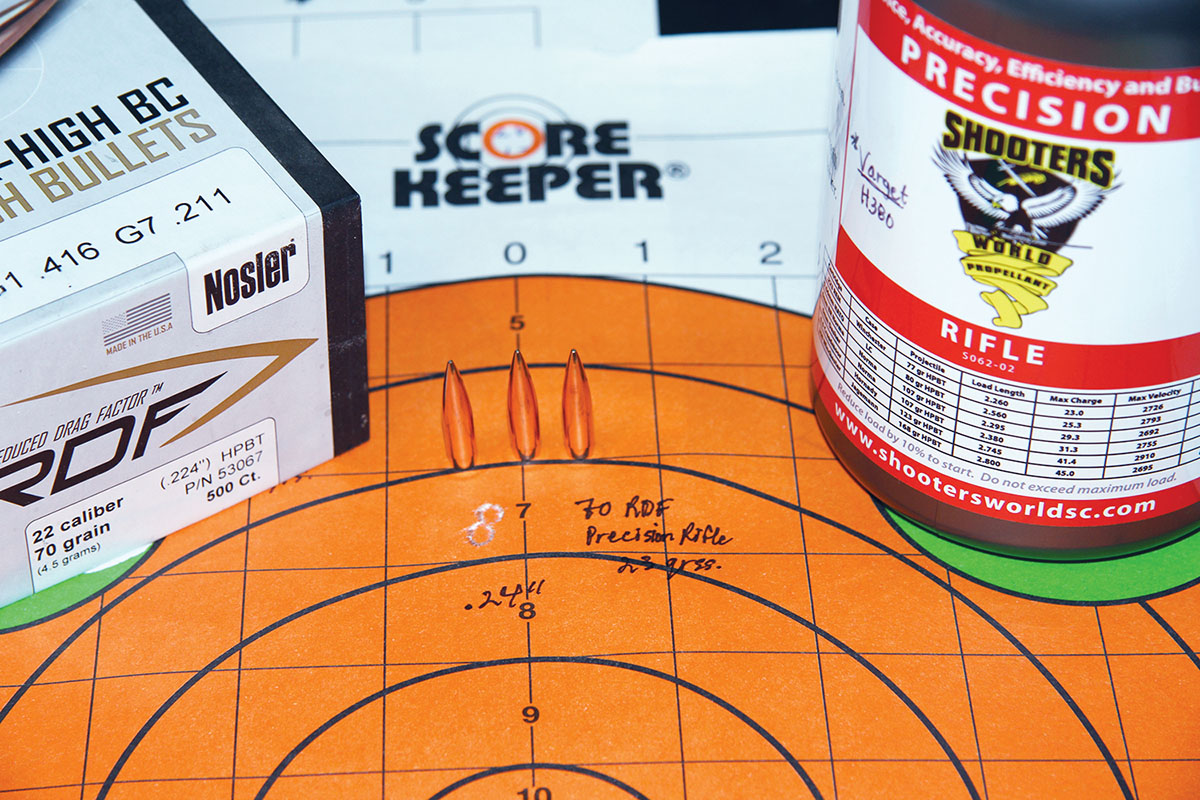
Nosler’s 70-grain RDF (Reduced Drag Factor) is a sleek boat-tail hollowpoint target bullet with an impressive .416 G1 BC. They are unlikely to expand violently on small varmints, but add some rock (thinking in terms of rockchucks) and they turn into grenades. Shooters World Match Rifle and Precision Rifle and Vihtavuori N540 provided the fuel. Match Rifle turned in .75- and .91-inch groups with 23.5 grains at 2,538 fps and 25.5 grains at 2,809 fps. All VV-N540 groups clustered into less than an inch, the best group into .63 inch at 2,588 fps and 25.5 grains producing a .77-inch group at 2,916 fps. I’d again have to wait until the very last shot string to assemble a small group. Twenty-three grains of Precision Rifle produced a .24-inch group at 2,588 fps – the best group with this rifle.
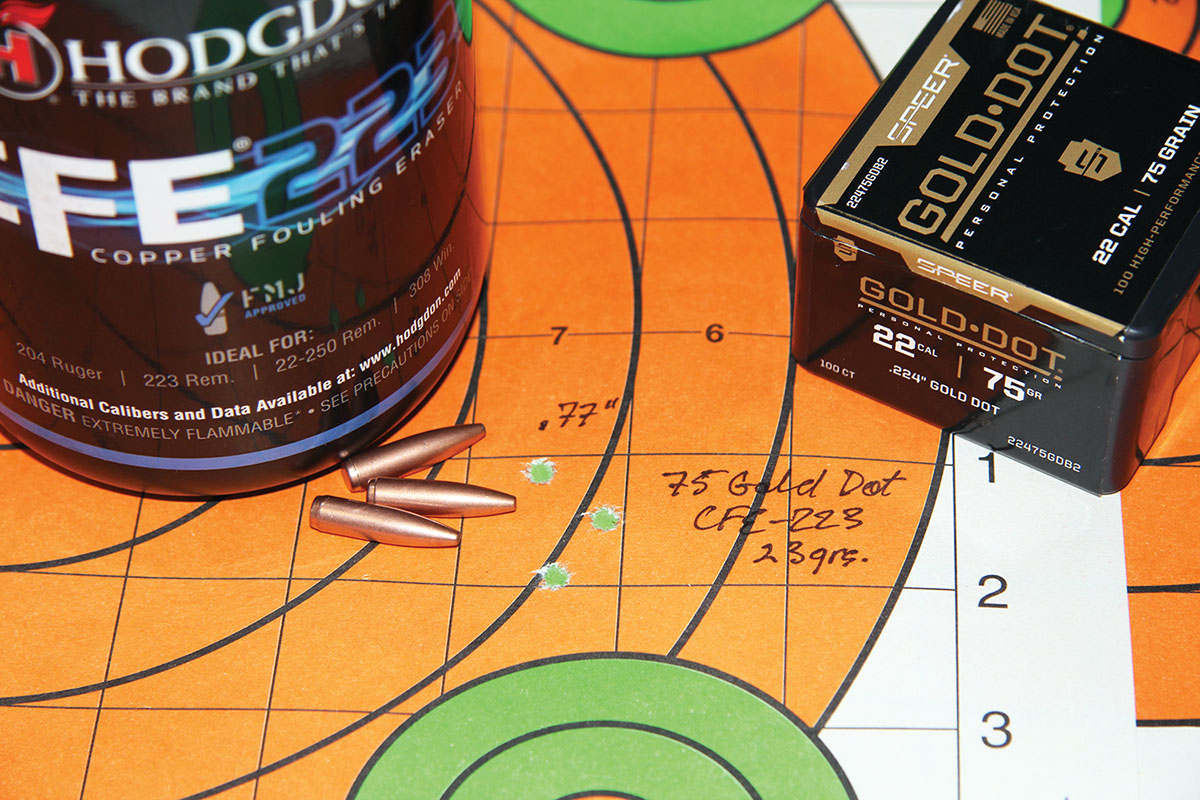
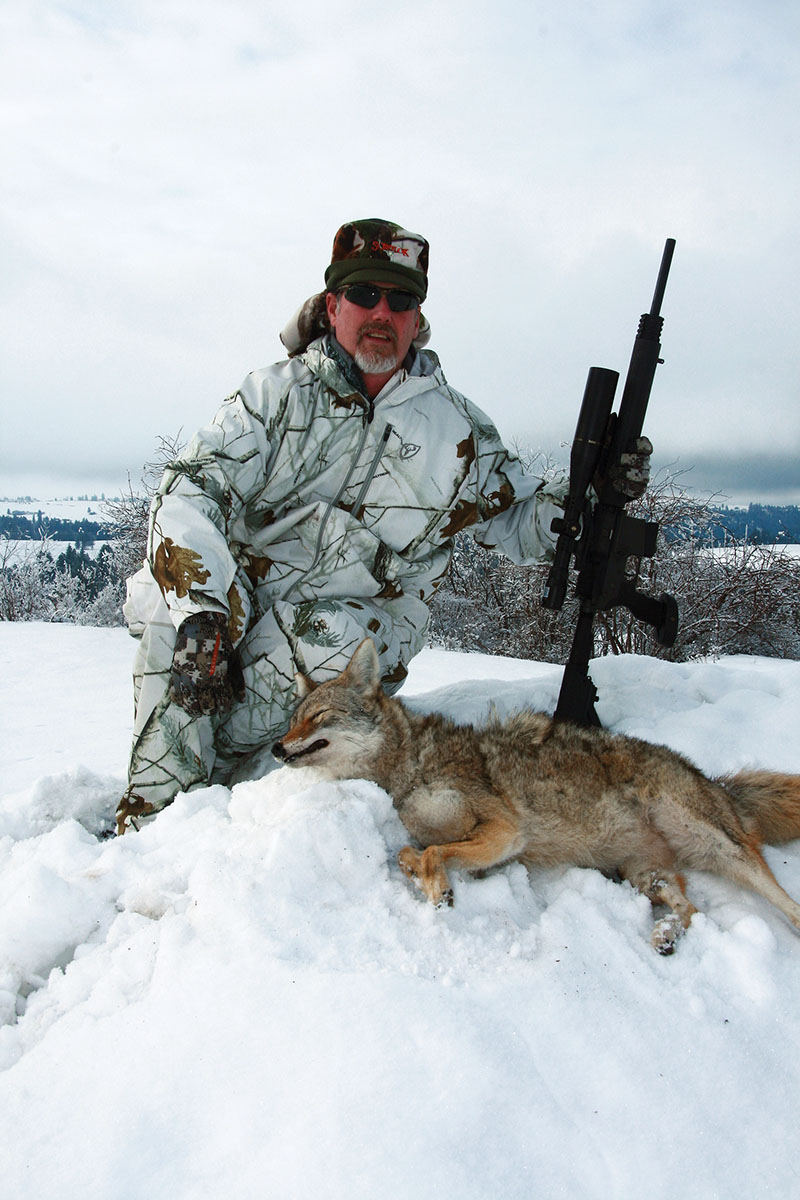
Speer’s 75-grain Gold Dot with a .411 G1 BC is my go-to bullet when calling predators such as coyotes, foxes and bobcats, as an electromagnetically-bonded jacket results in anchoring expansion without inflicting undue pelt damage. The boat-tail softpoints have also proved up to the task of dispatching decent-sized wild hogs with proper shot placement. Alliant Power Pro 2000-MR, Ramshot X-Terminator and Hodgdon CFE-223 were chosen for this bullet. Power Pro 2000-MR produced a sub-MOA group with a maximum load of 26 grains at 2,700 fps, with X-Terminator groups all hovering around an inch but with slower velocities than the other two powders. CFE-223 provided a good balance of accuracy and velocity, with 23 grains producing a .77-inch group at 2,500 fps, 24 grains a .96-inch group at 2,573 fps.
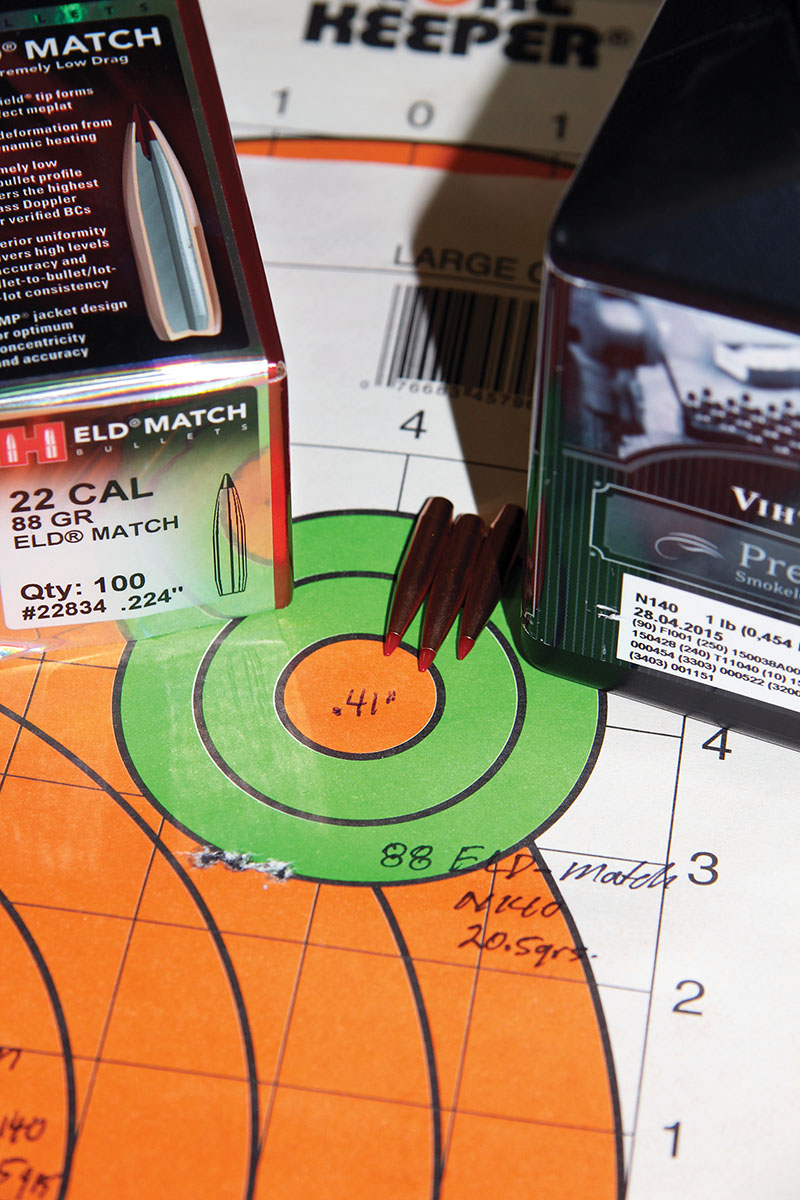
Hornady’s 88-grain ELD Match offers an excellent long-range BC of .545. I’ve tested these bullets on water-filled aluminum cans and noted good expansion, though at higher velocities. This bullet was paired with Hodgdon Varget, CFE-223 and Vihtavuori N140. Varget produced two sub-MOA groups, the best measuring .62 inch at 2,108 fps. CFE-223 produced two sub-MOA groups, the best measuring .72 inch at 2,256 fps. Reliable VV-N140 proved .52-, .41- and .50-inch groups at 2,104, 2,182 and 2,310 fps, respectively.
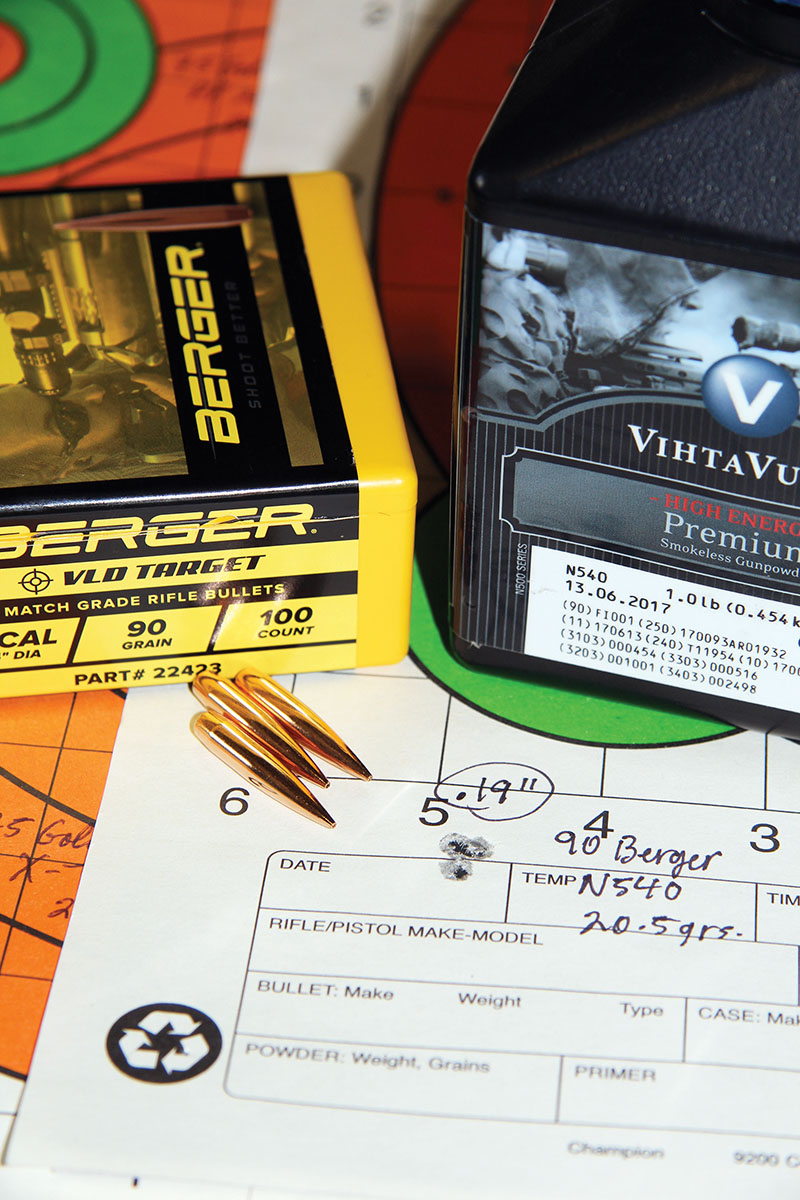
The 90-grain Berger VLD Target, with its .527 G1 BC, generated by a spear-like hollowpoint tip and long boat-tail profile, is a bullet I’ve used successfully on Texas coyotes, bobcats and wild boar from the AR test rifle, usually seated over 21 grains of Ramshot TAC. Vihtavuori N540, Ramshot TAC and Alliant Power Pro Varmint served this bullet. VV-N540 proved itself right out of the gate, punching a tiny .19-inch group at 2,077 fps with 20.5 grains of powder, and 21.5 grains produced a .44-inch group at 2,196 fps. TAC resulted in three sub-MOA groups, the best measuring .71-inch at 2,207 fps. Power Pro Varmint started with a bang, producing a .35-inch group with 19.5 grains of powder at 2,114 fps, then groups opened as more powder was added.