

Varmint 2017
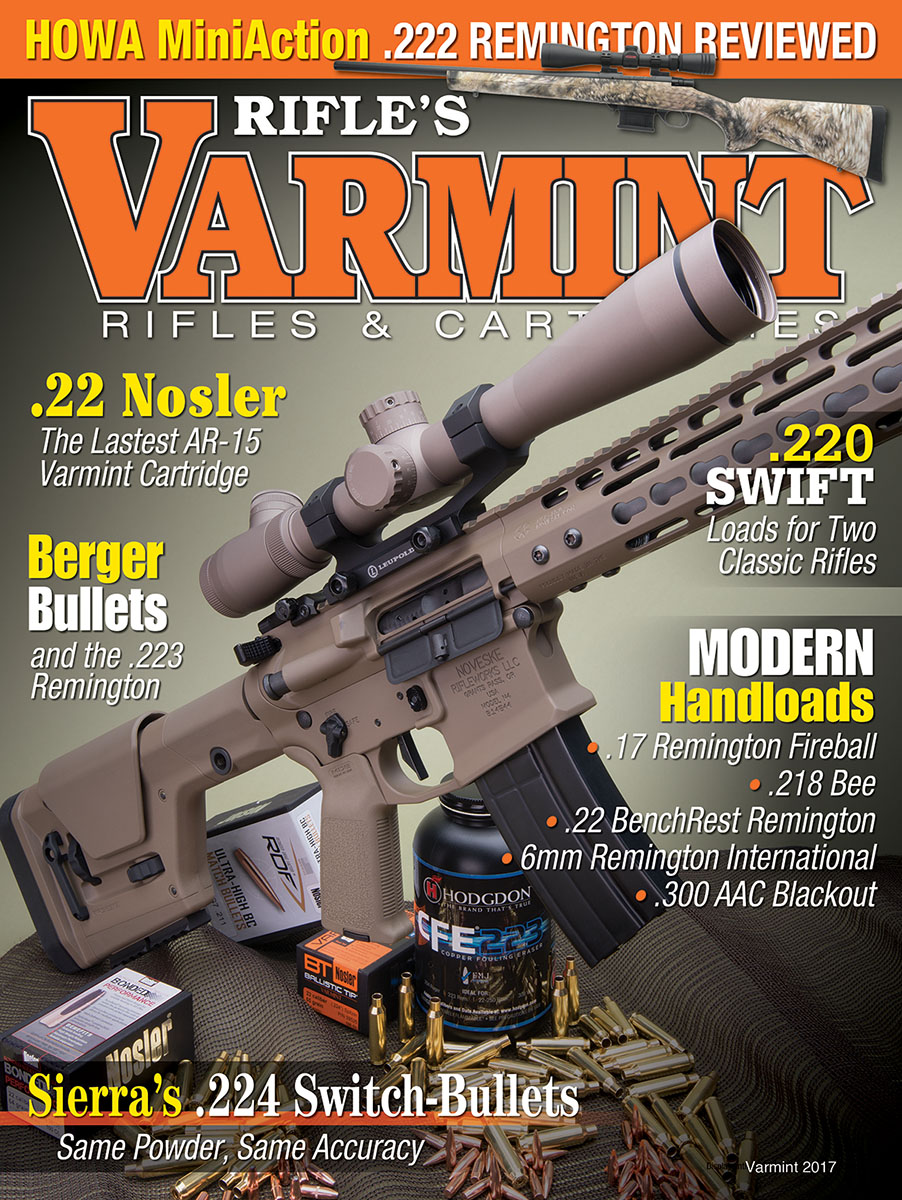
On the Cover: Noveske Rifleworks Nosler Varmageddon N4 22 Nosler with a Leupold Mark 4 3.5-10x 40mm scope. Photos by Chris Downs.
Volume 6, Number 1 | ISSN:
Article Bites
22 Nosler
Exclusive Loads for the Newest AR Cartridge
feature by: John Haviland
The problem with AR-15-style rifles is they limit cartridge length to about 2.26 inches, yet a constant campaign continues to introduce cartridges within that length that improve on the performance of the 223 Remington. In the neighborhood of 10 cartridges that meet that limitation have been introduced in recent years to either increase bullet velocity or bullet weight. The 22 Nosler is the newest cartridge to increase velocity over the 223. Converting a standard AR-15 223 Remington to the Nosler cartridge is as easy as swapping to an upper assembly for the 22 Nosler and switching to a 6.8 Remington SPC magazine. ...Read More >
17 Remington Fireball
Loading 20- and 25-Grain Bullets
feature by: Stan Trzoniec
The 17 Remington Fireball could be called a copycat. Essentially, this cartridge is a close twin to the 17 Mach IV wildcat from the 1960s and uses the 221 Fireball case necked down to handle a .172-inch bullet without all the fuss of case forming, then fireforming, to get everything right. Remington has done all the hard work, including new factory brass, bullets and rifles. At last count, it appears that Remington offers the 17 Remington Fireball (RFB) in both the Model 700 in various models, as well as the Model Seven. ...Read More >
222 Remington
Shooting Howa's MiniAction Bolt Rifle
feature by: Lee J. Hoots
In favor of the 223 Remington, given its popularity as a varmint cartridge, and in a broader sense its use in today’s popular AR rifles that largely have brought the 223 into the realm of the “commodity” cartridge, its predecessor 222 Remington goes largely ignored. For a time, however, it was a highly favored varmint cartridge. Like the fabled Sako L461 and Remington Model 788 rifles brought to market in the two decades following the 222 Remington’s introduction in 1950, the cartridge is considered an also-ran by shooters who look only at velocity. From a commercial perspective, plainly and simply, the 223 and 22-250 Remingtons have taken over the field and for decades have kept the 222 buried in a prairie dog’s lair, so to speak. ...Read More >
Sierra 22-Caliber Switch-Bullets
The Blitz and standard spitzer give near-identical accuracy.
feature by: Mike Thomas
Except for specialized projects, I have used the Sierra .224-inch, 50-grain Blitz bullet in bolt-action centerfire 22 rifles (from the 222 Remington through the 220 Swift) for at least the last 10 years. Usually, and with minimal load development, the 50-grain Blitz is accurate. Most such rifles have barrels designed for use with target and varmint bullets weighing from about 40 grains up to 55 or 60 grains and have the conventional one-in-14- or one-in-12-inch twist ratios. A very thin, frangible jacket on the 50-grain Blitz enhances its “effect” on varmints, an important factor when used in a cartridge of modest velocity potential, such as the 222 Remington. They are designed for total breakup upon impact. ...Read More >
223 Remington
Berger Bullets for a Classic Varmint Cartridge
feature by: John Haviland
Berger offers a line of .22-caliber bullets devoted to varmint shooting. The Match Grade Varmint bullets are made with a J4 Precision Jacket comprised of a thin nose with a tangent ogive and a flat base. I’ve shot these 40- to 64-grain bullets from various 223 Remington rifles for years with great success, working up loads on targets and hunting game from ground squirrels to coyotes in the mountains and across prairies. ...Read More >
220 Swift
Handloads for a Versatile Varminter
feature by: Jim Matthews
The 220 Swift may be the most versatile varmint cartridge on the market today. At the time of its arrival, there was no factory-loaded round that was faster and flatter across a prairie dog town, but peruse the latest ammunition catalogs, and a varmint hunter would swear the 220 Swift was ballistically inferior to the 22-250 Remington. ...Read More >
6mm Remington International
Varmint Loads - and Then Some - for a Storied Cartridge
feature by: R.H. VanDenburg, Jr.
Perhaps no other cartridge has had the storied history of the 6mm Remington International. The story begins in 1915 with Charles Newton, who developed a .25-caliber cartridge for the Savage Model 99 rotary-magazine, lever-action rifle. The cartridge was introduced with an 87-grain bullet propelled to the then-amazing velocity of 3,000 fps. The company named the cartridge the 250-3000 Savage, and today it’s simply the 250 Savage, factory-loaded with a 100-grain bullet at 2,800 fps. ...Read More >
The 22 BenchRest Remington
Loads for Modern Varmint Bullets
feature by: Charles E. Petty
In the early 1960s, there was some thinking that “short-fat” cases with small primer pockets might be interesting. The benchrest world jumped to attention with the notice of the 22 and 6mm PPC (Pindell-Palmisano Cartridges). The PPCs were derived from the 220 Russian (5.56x39) with the shoulder angle set at 30 degrees. One disadvantage in the U.S. was the rim diameter of .445 inch instead of .473 inch, which was the rim diameter of the 30-06, the foundation of many American centerfire cartridges. ...Read More >
300 AAC Blackout
Varmint Bullets for ARs and Bolt Rifles
feature by: Richard Mann
J.D. Jones of SSK Industries developed the 300 Whisper cartridge based on the 221 Remington Fireball, a very capable varmint cartridge. Jones necked the .221 case up to .30 caliber and loaded it with long, heavy bullets with high ballistic coefficients at subsonic velocities. Though the Whisper has appeal, it offers ideal subsonic properties due to the case’s low powder capacity. It even has tactical and more traditional hunting use when loaded to supersonic velocities. ...Read More >
218 Bee
Loads for a Classic Cartridge and Rifles
feature by: Layne Simpson
When the 218 Bee was introduced by Winchester in the Model 65 lever-action rifle in 1939, many serious varmint shooters had already graduated to bolt-action rifles that had been introduced earlier. Soon after Winchester 22 Hornet ammunition became available in 1930, Griffin & Howe and other shops began offering rifles chambered for the cartridge using 1922 Springfield actions. Winchester began offering the 22 Hornet in its Model 54 bolt gun in 1933, and not long after the Model 70 was introduced in 1937, it became available in 220 Swift. All varmint shooting bases were adequately covered by those rifles and their cartridges. ...Read More >