Sierra 22-Caliber Switch-Bullets
The Blitz and standard spitzer give near-identical accuracy.
feature By: Mike Thomas | April, 17
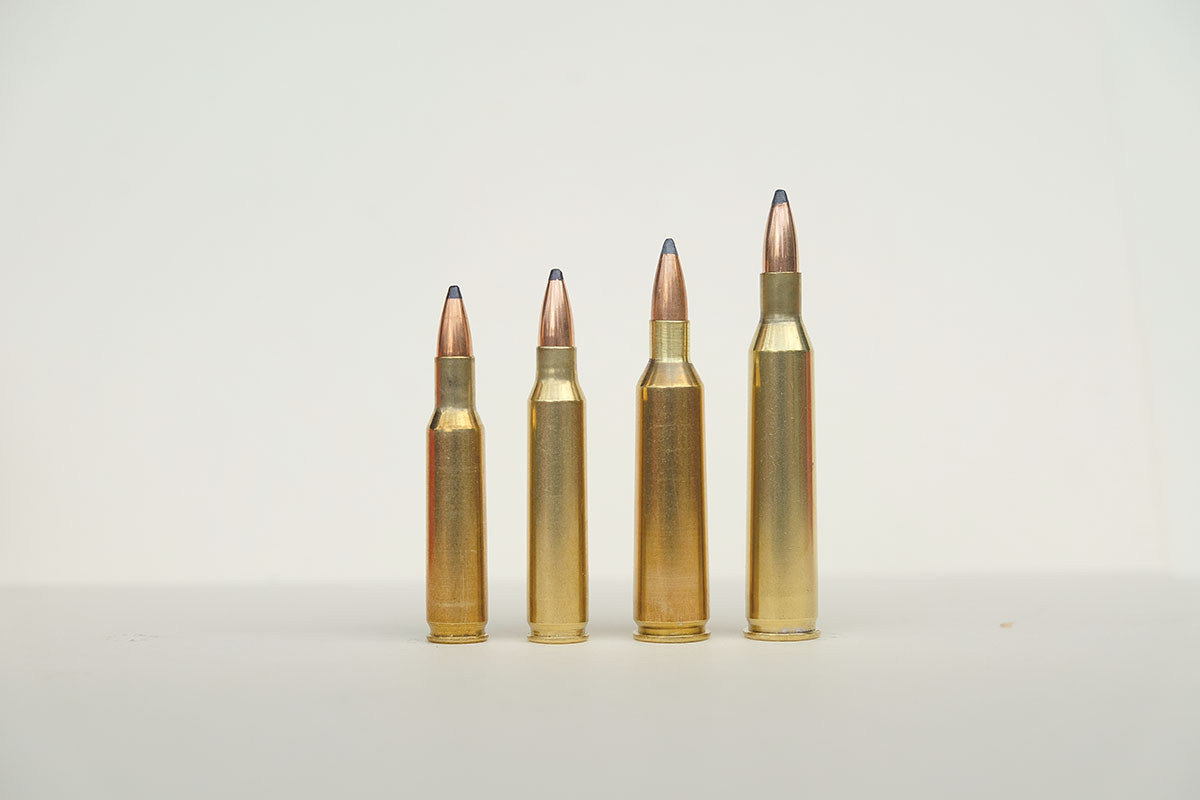
Because of the thin jacket, Sierra recommends muzzle velocities of no more than 3,600 feet per second (fps) for the Blitz design. Sierra has had reports from some shooters using these bullets at much higher velocities with no problems. The company stands by its recommendation, because some bores, due to roughness or other factors, won’t give satisfactory results with the Blitz at higher velocities. Additionally, the bullet maker cautions against shooting any Blitz in fast-twist barrels (1:7, 1:9, etc.) like those found on many AR-15s. The spitzer version has no such limitations.
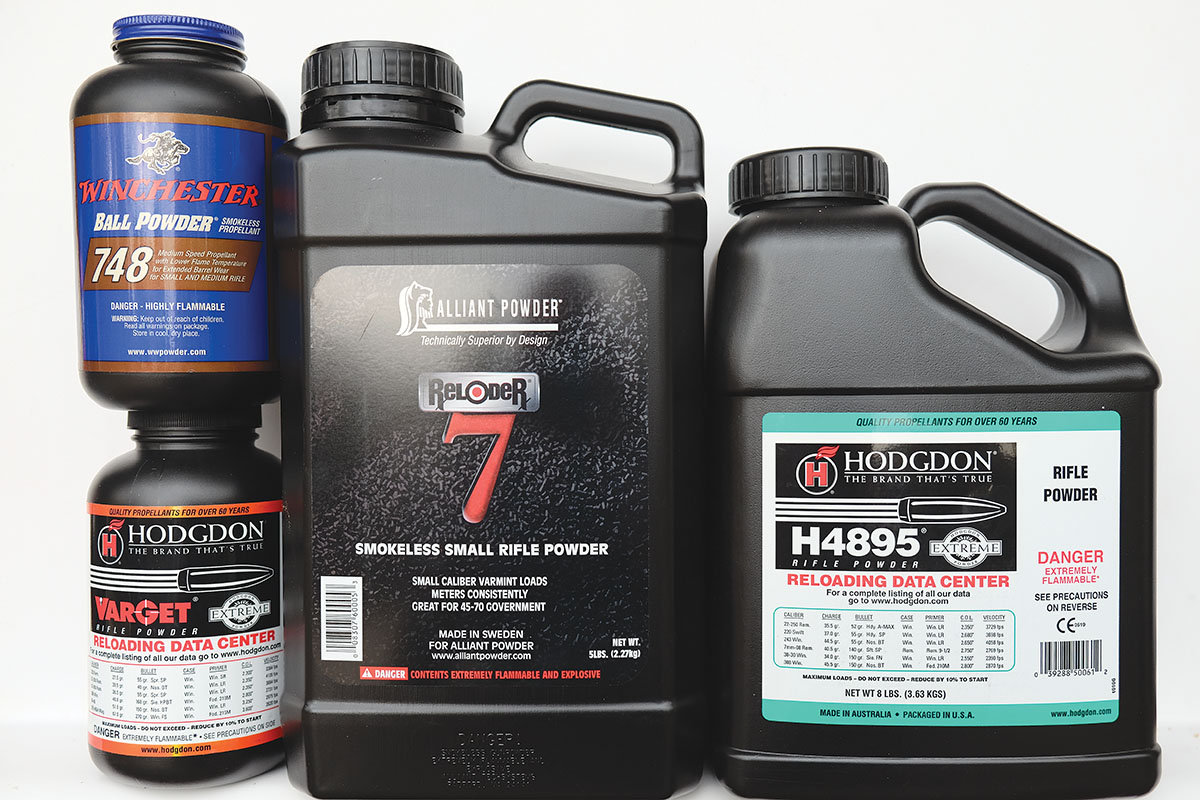
For decades, Sierra has offered a huge variety of 22 varmint bullets. Not only are the 50-grain spitzer and 50-grain Blitz among these, but also there are the 55-grain spitzer and 55-grain Blitz. Long-time Sierra employee Carroll Pilant confirmed that jacket thickness is the only major difference between the Blitz and spitzer versions. All are flatbase bullets of conventional design without sharp-pointed, plastic noses – just good, accurate varmint bullets that frequently shoot like target bullets. While I’m not adverse to the use of boat-tail bullets, many handloaders find them unnecessary for most needs. Despite the current BC (ballistic coefficient) fad, a flatbase bullet will often display slightly better accuracy than a boat-tail until distances become very long. As an example, with both bullets started at a muzzle velocity of 3,600 fps, a Sierra 55-grain boat-tail shoots a little less than an inch flatter at 400 yards than a Sierra 55-grain flatbase. As for 10-mph wind drift at the same distance, the boat-tail bullet beats the flatbase with less drift – just over an inch less drift. For shooters who wish to call that a “real” difference, please do so.
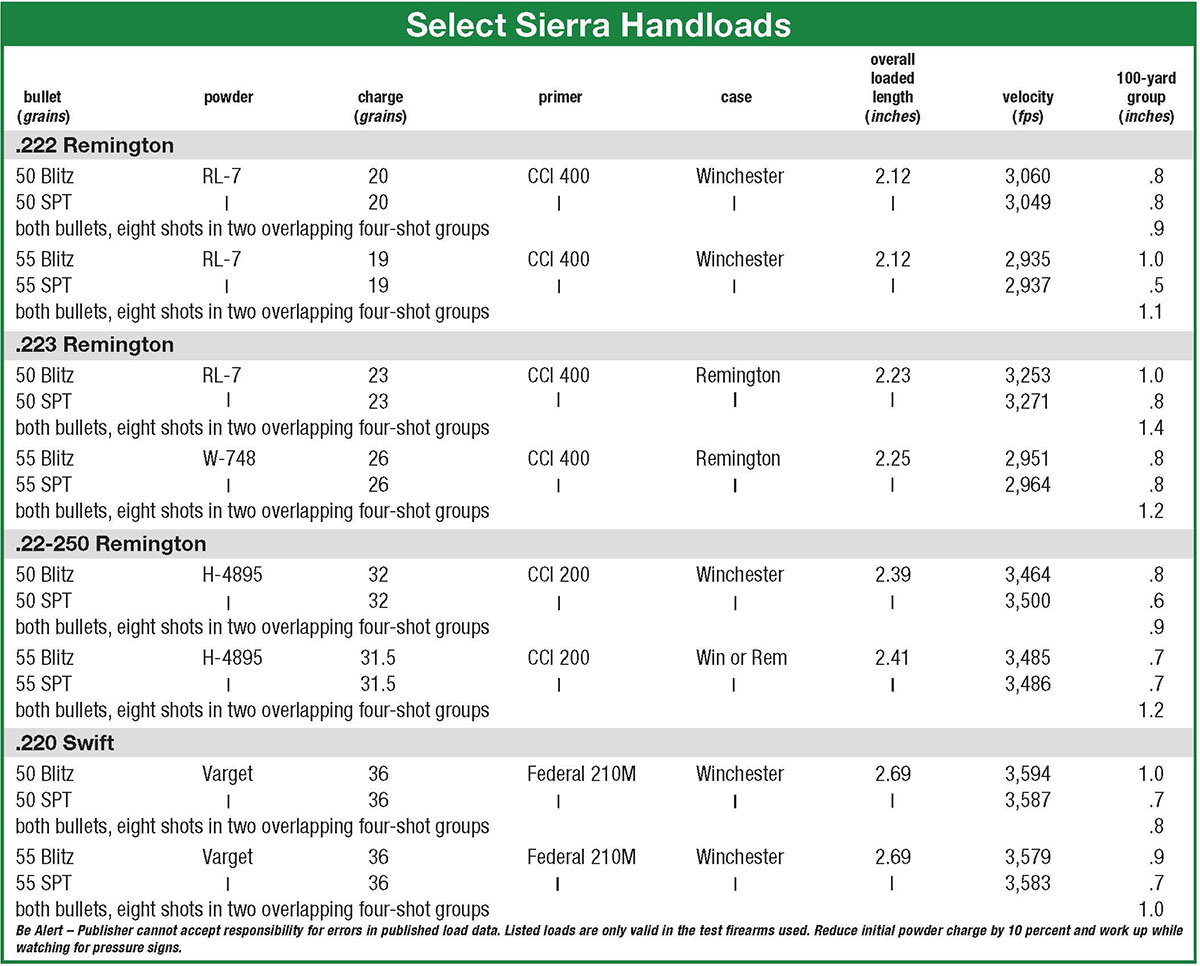
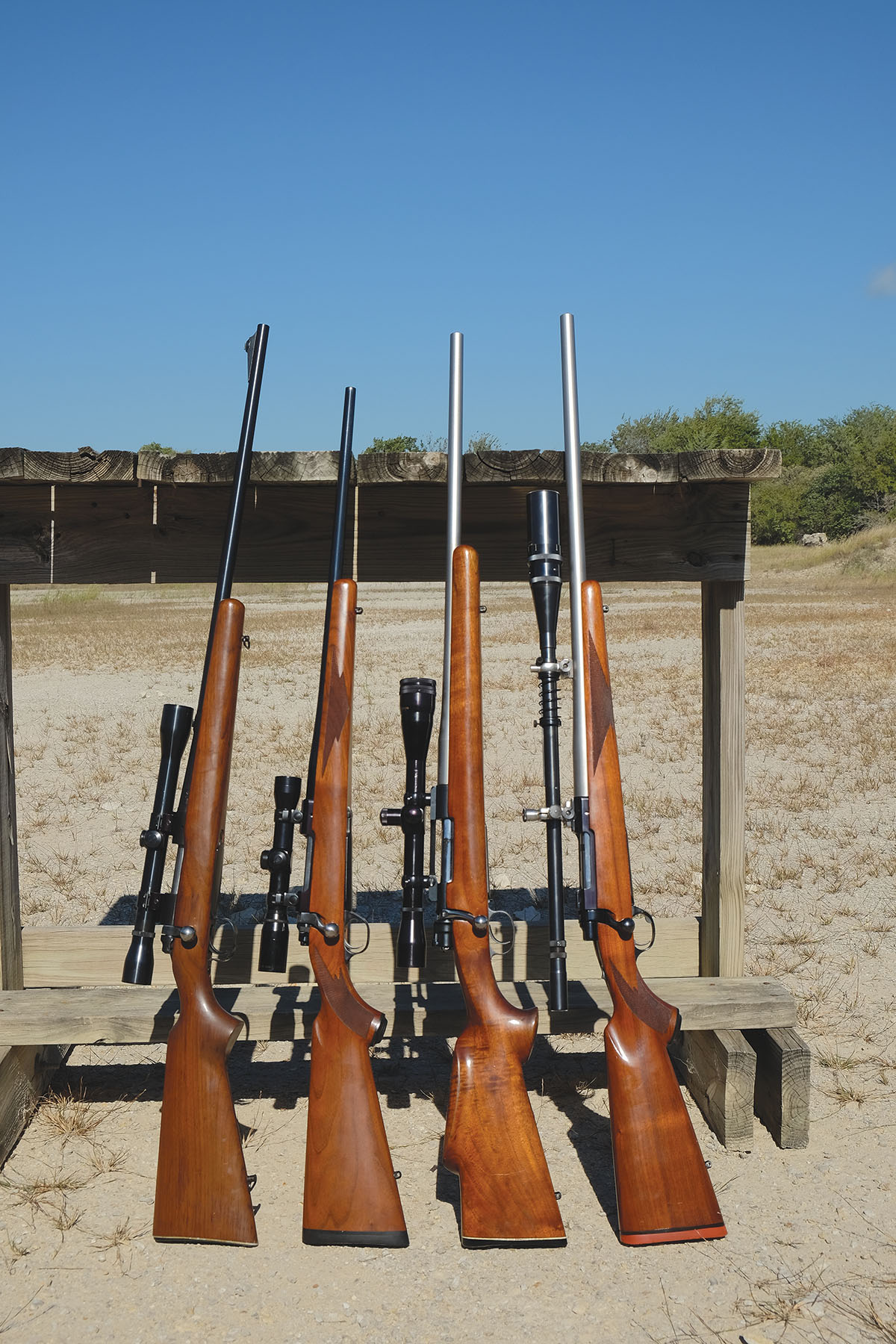
While having used various manufacturers’ bullets since the mid-1960s, I don’t recall trying the Sierra .224-inch, 50-grain spitzer until recently. According to published Sierra load data, it was apparent that the spitzer could be substituted for the Blitz. Powder charges, muzzle velocities and overall cartridge length showed to be identical for the two bullets. A main concern was how they compared in accuracy and trajectory in my rifles. The only 22 centerfire cartridges I shoot these days are the 222, 223 and 22-250 Remingtons and the 220 Swift. Rifles so chambered and used here include, respectively, a Remington 722, a Ruger M77 MKII, an FN Mauser and a Ruger 77V. I’ve owned all of them for years, and they’ve been fired extensively. The latter two are on their second barrels.
As many handloaders are aware, it is difficult, if not impossible, to determine overall cartridge length to an exact and uniform degree if using the tip of the bullet as a measuring point. There is simply too much variation in the nose/point, particularly with softpoint bullets, as the lead is often slightly deformed in handling, shipping, etc. Some retain a point or partial point while others may be slightly, or greatly, flattened. Different bullet lot numbers can also contribute to a variance.
For a long time, I have used a Sinclair hexagonal bullet comparator “nut” that measures off the bullet ogive for a consistent and accurate method of determining overall cartridge length. Other, newer tools may have some advantages over the basic Sinclair, but I doubt any provide a better end result. The 50-grain Blitz and 50-grain spitzer profiles were virtually identical according to the Sinclair tool, and my seating die could be left at the same setting for these bullets.
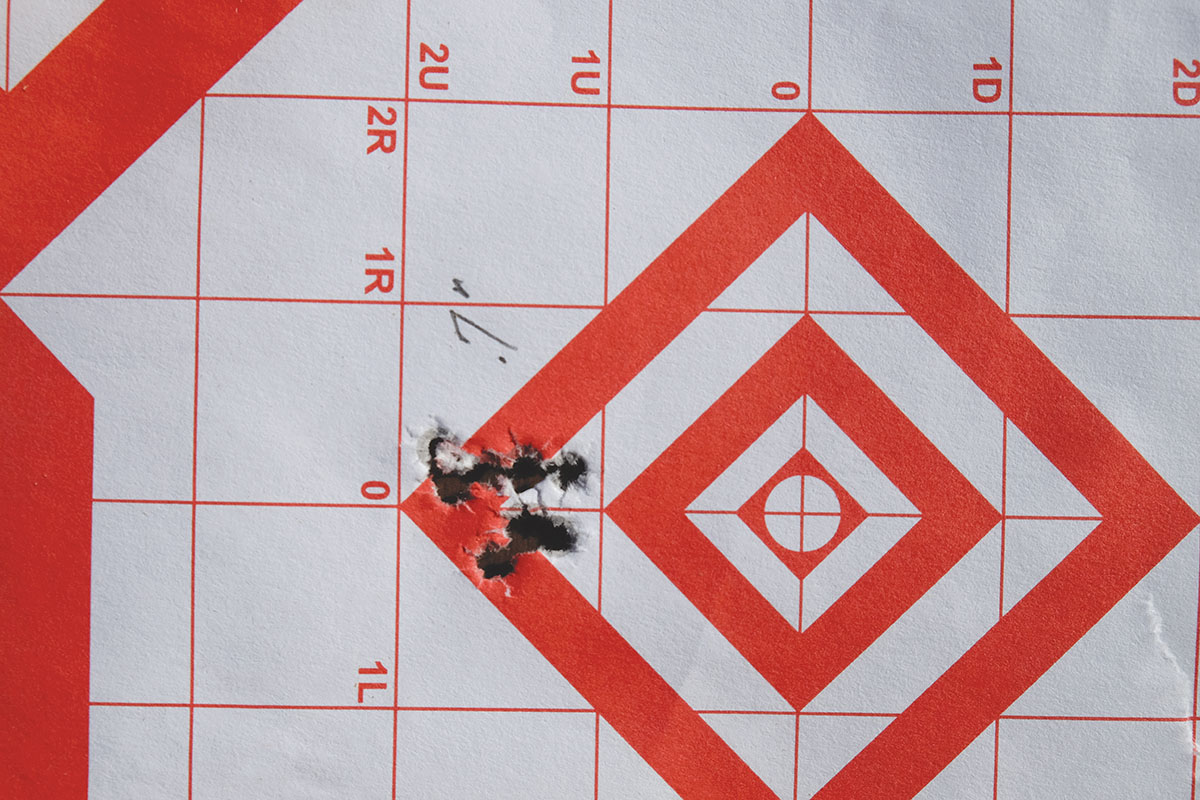
Well into this endeavor, I began a similar comparison using the 55-grain Blitz and 55-grain spitzer. While having previously used 55-grain bullets from Sierra and other makers, I had not tried any in quite a while. The profile on these heavier Sierras appeared to have a slightly different ogive. After checking both with the comparator, such a conclusion was confirmed. I initially compensated for the difference by changing the seating die adjustment. After firing groups using bullets seated to slightly different depths for the same overall length, and then doing the same with the seating adjustment at identical depths for both bullets, additional groups were shot. Accuracy and point of impact were the same – no difference whatsoever. At first, I considered the additional experimentation a wasted effort, but since I learned something in the process and had more data, I suppose there was a benefit.
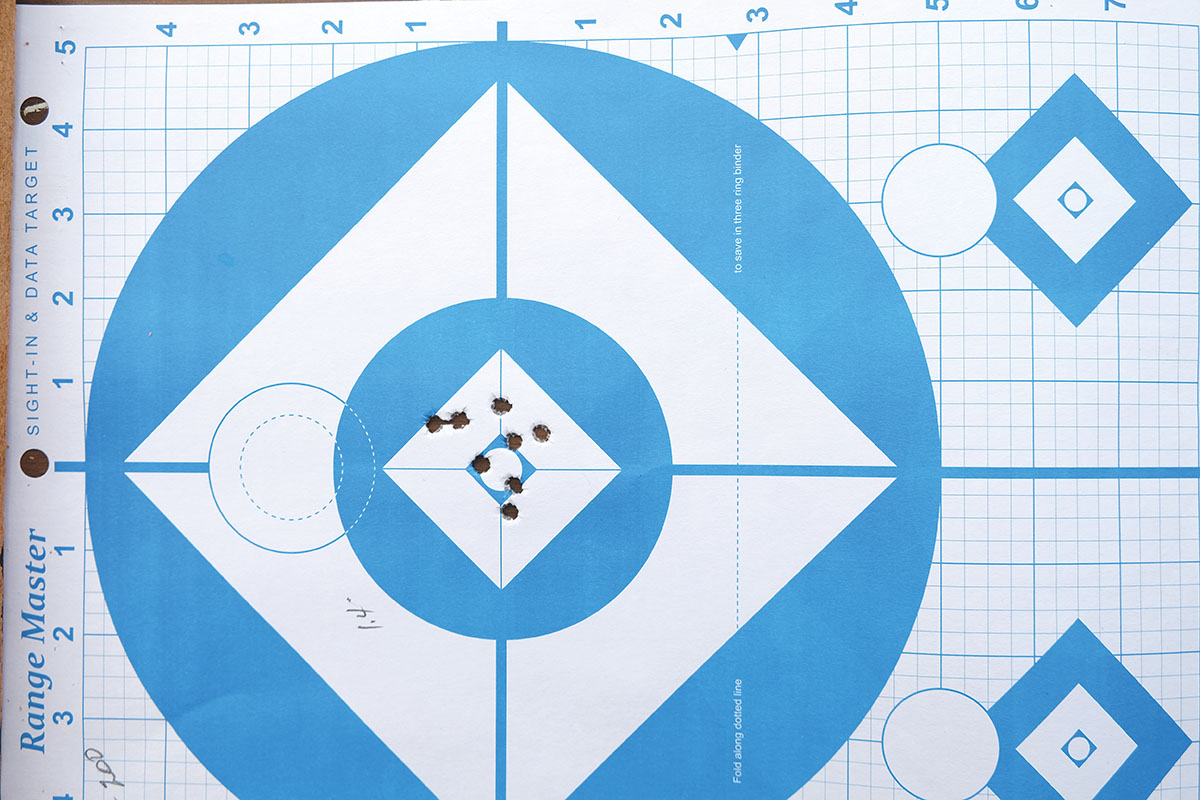
As these types of projects develop, they often expand in nature, which usually means more shooting than planned. With regard to this one, different powders and primers were tried in a few instances for added verification. The main goal was to fire groups at 100 yards from all the rifles using all four bullets: Sierra’s 50-grain Blitz and spitzer and the 55-grain Blitz and spitzer. Subsequently, I
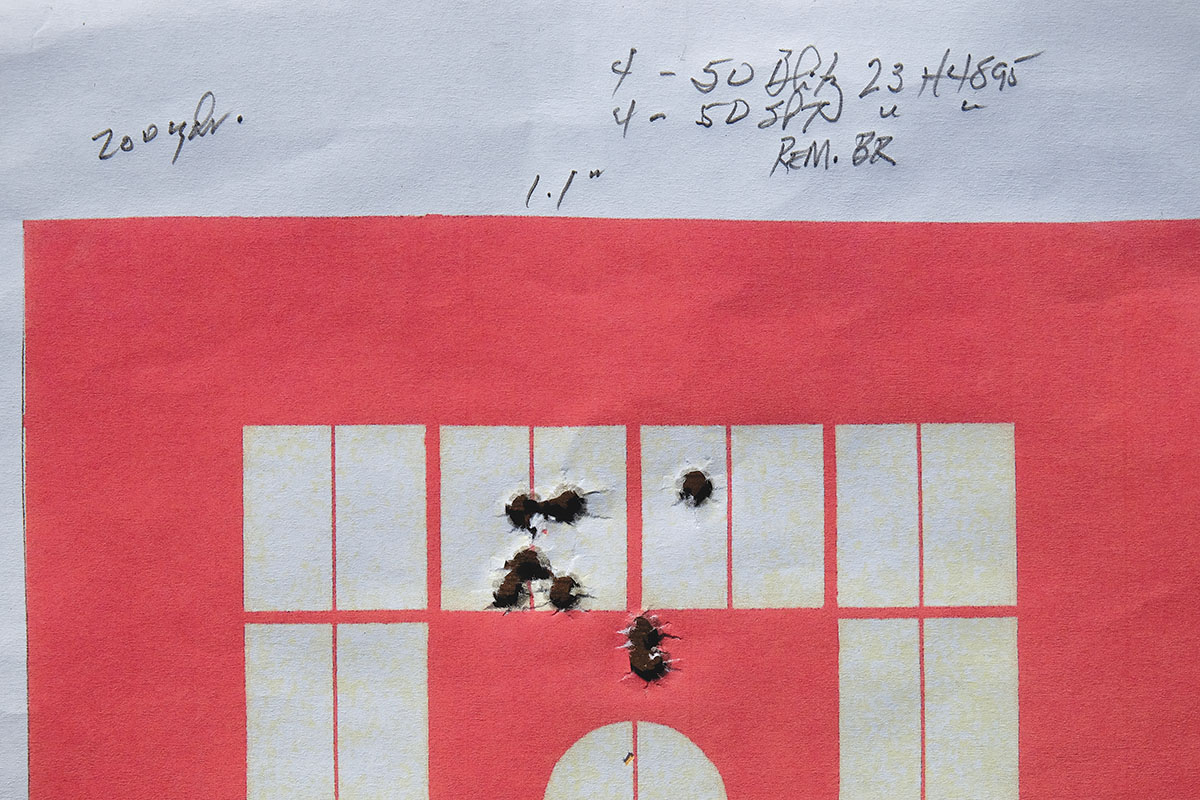
Both four-shot and five-shot groups were tried at various points. Four-shot groups were settled on for final evaluation. This was not done in an effort to provide smaller “gloating” groups. Rather, it was done to slightly stave off barrel overheating when it came to shooting two overlapping four-shot groups (effectively one eight-shot group) back-to-back on the same target.
This was an exception to my usual practice of firing no more than one three-, four- or five-shot group from any centerfire rifle without allowing the barrel to cool.
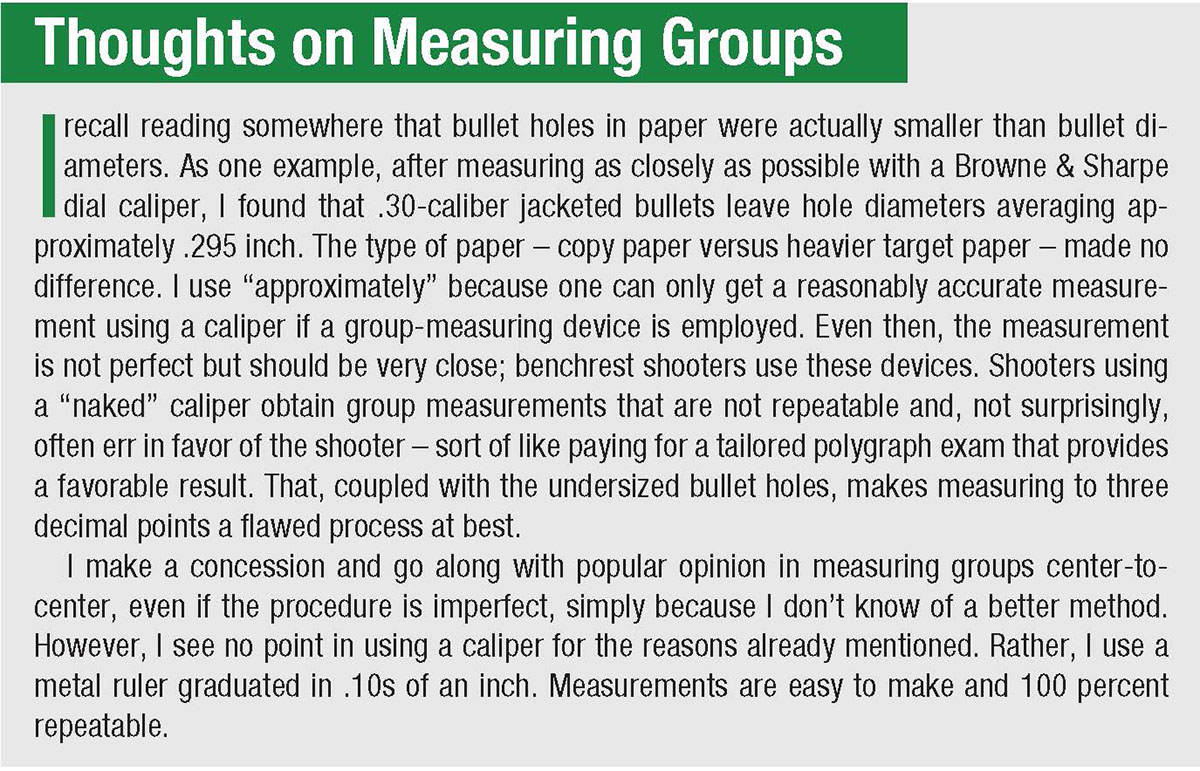
Doing a bit more random experimentation, I tried the 222 Remington load with both 50-grain bullets at 200 yards. The eight-shot group (two overlapping four-shot groups) measured 1.4 inches. Switching the powder to H-4895 and using 23 grains and Remington No. 7½ Bench Rest primers, group size was reduced to 1.1 inches. The same was done with the Ruger 220 Swift, first using both 55-grain bullets and the table’s listed powder charge; 200-yard group size was 1.9 inches. The test was repeated using 39 grains of H-414, another popular Swift powder. Group size was 1.7 inches. A slight breeze may have contributed to both these groups being a bit larger than anticipated, but the fact that all shots were in the same basic group was the main concern.