

Varmint Fall 2025
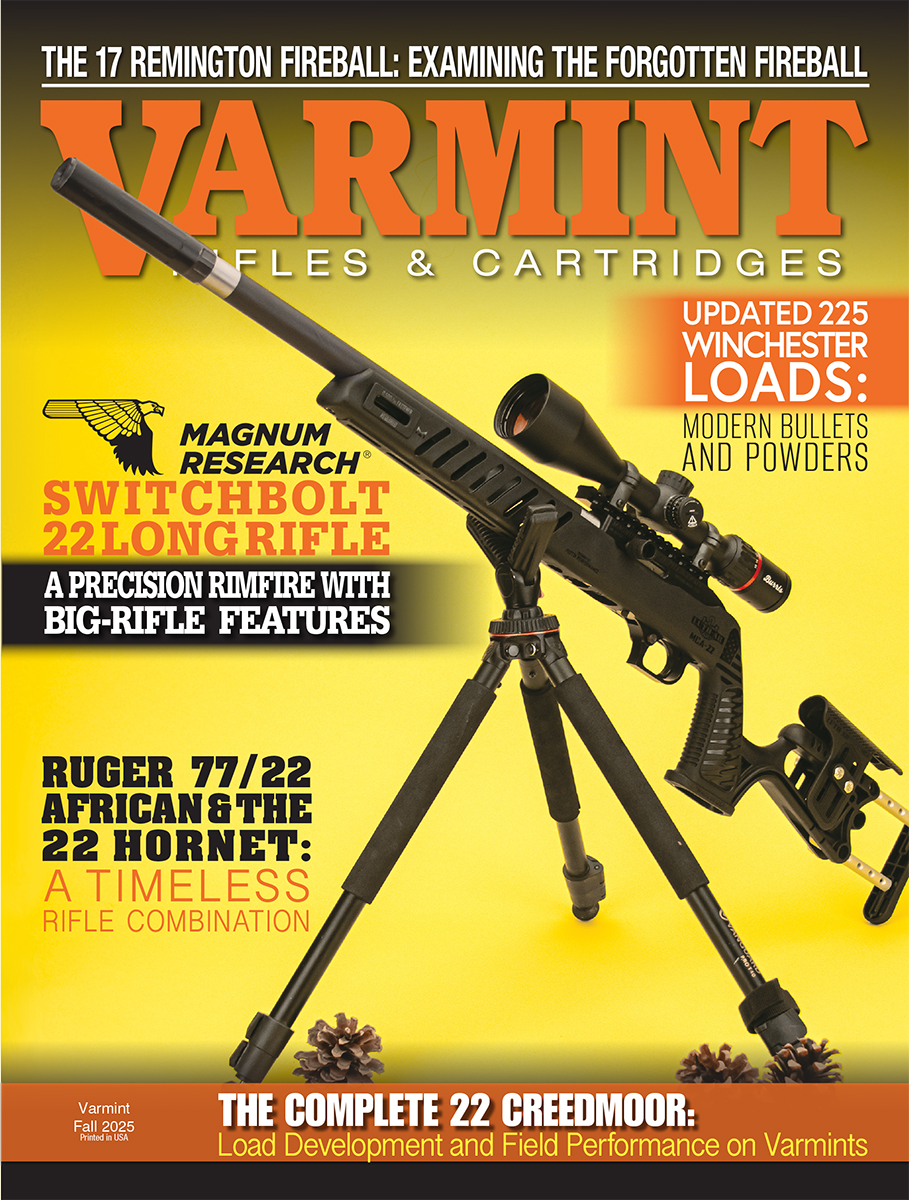
On the Cover: A Magnum Research SwitchBolt 22 Long Rifle with a Burris 4-16x 50mm optic mounted in Burris Zee rings with a Dead Air Mask suppressor. The Luth AR stock features plenty of adjustability while saving weight. The tripod is a Vanguard Pro T40 and a favorite on coyote stands.
Volume 2, Number 22 | ISSN:
Article Bites
Magnum Research SwitchBolt 22 Long Rifle
A Lightweight Customizable Rifle
feature by: Jeremiah Polacek
When it comes to rimfires, 22 LR in particular, I think just about everyone is familiar with the cartridge. Most of us probably grew up shooting it as a kid, or have fond memories of our first rifle, likely a small rimfire. I distinctly remember my first rifle, a Henry Mini Bolt Youth G2 chambered in 22LR. It was a fine rifle for a kid starting out at four years old - with strict supervision from my Dad. However, I quickly outgrew it and wanted something more; my sights were set on a Marlin 15 YS, which I had read had a micro-groove barrel and a self-cocking action and had the same fiber optic sights I liked on the Henry. It might be hard to believe that a 7-year-old kid understood such things, but I grew up in a family where guns and hunting were a staple. Many dinner table conversations revolved around what new rifles were acquired by family members and what tags were drawn that year. I was also a voracious reader, and one of my favorite pastimes was browsing gun catalogs and magazines that my dad would bring home. That Marlin was carried for many years, and I have many good memories of the rifle. As I sit behind my desk and type this article, many of those memories are coming back to me as the rifle quietly refreshes distant times of adventure. ...Read More >
Bushmaster Firearms: the Varminter
A Trade I never Regretted
feature by: Rob Behr
When I was asked if I had anything that might fit the bill for an article on varmint rifles, I had to admit I was stuck for a minute. I only have three. Considering I worked for Cooper Firearms of Montana for most of a decade back when Dan Cooper still ran the show, that doesn’t seem like very many. One is a Cooper Model 21 in 223 Remington that I cobbled together from spare parts for a writer’s shoot in Eastern Montana. This accurate, single-shot bolt action is the rifle I take when I want to seem sophisticated. My exceedingly heavy barrel 243 Winchester can be found in a previous edition of this magazine, and it’s the rifle that I take when I feel strong enough to lug that monster into the field. Chances are, though, if you find me out varminting anything from gophers to coyotes, I will have my Bushmaster Varminter. ...Read More >
Updated 225 Winchester Loads
An Old Classic Thrives with Modern Bullets and Powders
feature by: Patrick Meitin
Winchester introduced the 220 Swift in 1935, which remains a factory-cartridge speed king to this day. So, when the company introduced the 225 Winchester in 1964, many understandably questioned why it was necessary at all. Ken Waters, preeminent handloading authority and Wolfe Publishing’s “Pet Loads” author for decades, wasn’t among those detractors, once writing that the 225 Winchester was “the finest varmint cartridge ever developed.” Remington then released the 22-250 in 1965, introducing performance that edged the 225 Winchester out ever so slightly and ultimately sealed its fate. Today, you must flip back to the “rifle legacy reloading data” to find 225 Winchester load recipes. The round is completely absent from many other handloading manuals. Loaddata.com has the most extensive reloading data on the 225 Winchester. ...Read More >
Lipsey's Exclusive Ruger 77/22 African and the 22 Hornet
A Hunter's Classic Varmint Rifle Combination
feature by: Shane Jahn
The word “Wyoming” is derived from a Native American term meaning “land of vast plains,” and some of the parts I’ve seen surely fit that description. Detouring from the mundane pavement and bustle of I-25 and taking in a beautiful piece of rolling Colorado countryside was a welcome change before crossing the state line below Laramie. One can’t think of Wyoming without remembering the great gun scribe, Bob Milek, who often showcased his state’s hunting and picturesque outdoors in his excellent magazine articles. After Laramie, the terrain widened into a vast rolling prairie that resembles the Big Bend country of western Texas, where you can easily see over 30 miles from my front porch on a clear day. The wide-open country wasn’t awe-inspiring to me, but I can see how it could be to folks from areas of less expanse. I liked it and felt right at home. As a matter of historical fact, a small square in the southeastern corner of Wyoming was the Republic of Texas at one time. No wonder it feels like home! ...Read More >
The 17 Remington Fireball
The Forgotten Fireball
feature by: Zak May
One of my favorite parts of testing cartridges and writing reviews about them is finding awesome cartridges like the 17 Remington Fireball. When looking for a ground squirrel getter that’s handloadable, this one is fun, inexpensive on components and offers little to no recoil. Before diving in too far, let’s take a look at its beginnings. ...Read More >
The Complete 22 Creedmoor
Load Development for Varmints
feature by: Layne Simpson
Soon after the 6.5 Creedmoor was introduced by Hornady in 2008, riflemen across the country necked down the case for .224-inch bullets and started bumping off varmints of various sizes at long distances. Among them was Texan Derrick Ratliff, founder of Horizon Arms and builder of extremely accurate rifles. Horizon and Hornady co-sponsored the cartridge sometime during 2023, and it gained approval by the Sporting Arms and Ammunition Manufacturer’s Institute (SAAMI) in January of 2024. Whether or not the 22 Creedmoor will catch on in a big way among major rifle builders is anybody’s guess. Still, due to the way it is being promoted, it may never give the 95-year-old 22-250 a run for its money among the majority of varmint shooters. As an example of this, load data published by Hornady is only for bullets ranging in weight from 62 to 88 grains. Data developed by Hodgdon is for bullets weighing from 62 to 90 grains. I have lost count of the number of varmint shooters who have told me they would not have a rifle in 22 Creedmoor because they could only shoot heavy bullets in it. Not true. ...Read More >
Customizing Ruger's Iconic 10/22
Transforming the 22 Long Rifle into Something Special
feature by: Patrick Meitin
There are things in life that reach so deeply and successfully into first principles that your trust in them becomes absolute. For me, these include Sancho Panza cigars, Sitka Gear Grinder pants, Area 419’s ZERO Reloading Press, Puma knives, Bell’s Two-Hearted IPA, Toyota Hilux trucks, Gransfors Bruk axes, Led Zeppelin and Ruger 10/22 rifles. ...Read More >
Memories with an Ol' 788
A four-decade adventure with a Remington 788 and a color-phased coyote.
feature by: Jason Stanley
This journey began in the 1980s, stalking red fox in Northwest Iowa. Bill Sebern from Emmetsburg introduced me to this addiction when I was twelve years old. His son, my best friend Joel, and I would ride along while he glassed snow-covered fence rows, often spotting the Vulpes over a mile away. ...Read More >
The 221 Fireball
A Hot Little Cartridge
feature by: Layne Simpson
During the 1950s, a fellow by the name of Jim Harvey, who specialized in designing firearms, cartridges and fishing lures, decided to convert the Smith & Wesson K22 revolver. He converted it to handle the slightly shortened 22 Hornet case. Jim thought it would be great fun to play with and sell a few guns as well. Velocity was a bit lower than expected, so Harvey fire-formed the shortened Hornet case for an increase in powder capacity and called it the 224 Kay-Chuck. It could also be accurately described as a shorter version of Ackley’s 22 Hornet Improved. The fairly large number of Smith & Wesson revolvers converted by Jim Harvey and converted for him by Bennett Gun Works of Delmar, New York, is an indicator of the popularity of his 224 Kay-Chuck. ...Read More >