


Memories with an Ol' 788
A four-decade adventure with a Remington 788 and a color-phased coyote.
feature By: Jason Stanley | October, 25
This journey began in the 1980s, stalking red fox in Northwest Iowa. Bill Sebern from Emmetsburg introduced me to this addiction when I was twelve years old. His son, my best friend Joel, and I would ride along while he glassed snow-covered fence rows, often spotting the Vulpes over a mile away.
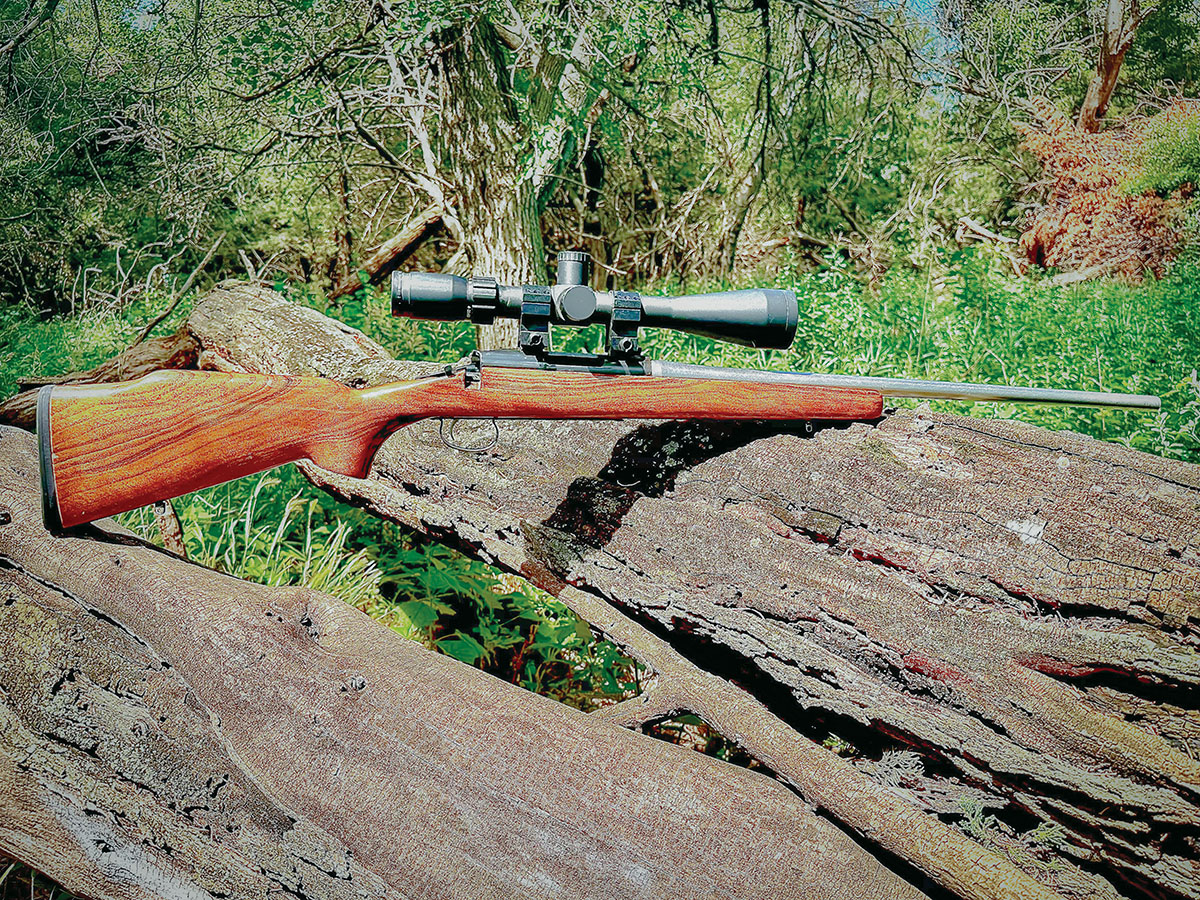
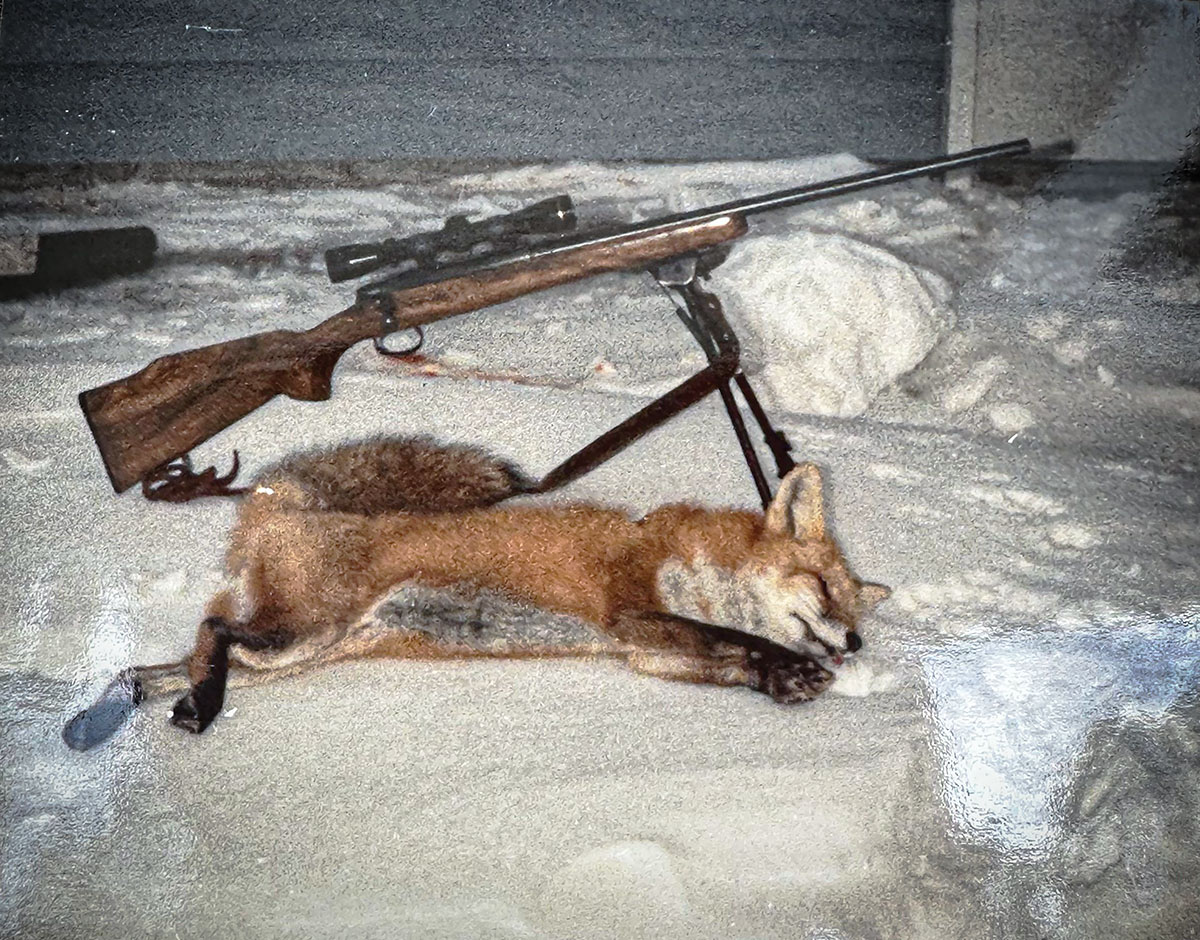
Bill, a physically imposing six-foot, five-inches, would be covered head to toe in white camouflage. Religiously using the wind to his advantage, he would walk, then crawl for the opportunity to place the Leupold’s crosshairs on the varmint. Our job, using a Bushnell Discoverer spotting scope, was to observe and then position the vehicle in a location that allowed the shortest walk back to the country road. Often, we would watch Bill powering through the knee-deep snow, dragging a fox in one hand and carrying his trusted 788 in the other.
The Remington 788 action was designed by Wayne Leek in 1967, and roughly 560,000 were produced. The 788 was offered in nine different calibers, two of which were also left-hand options. Accurate as records indicate, Bill’s rifle was made around 1974 and chambered for the popular .22-250 cartridge.
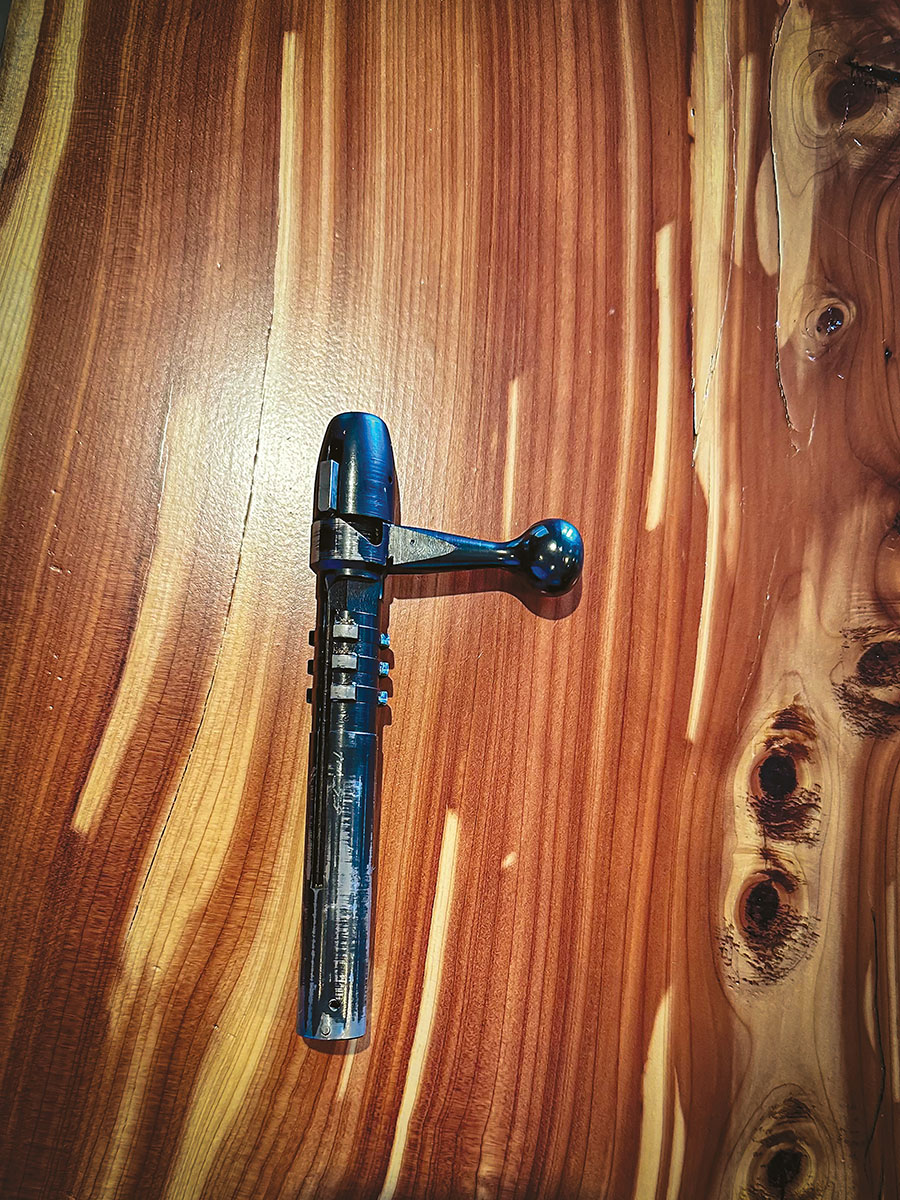
A distinguishing characteristic of the 788s is the three rows of three lugs located at the rear of the bolt. This engineering allows the bolt to function with only a 60-degree lift, significantly less than most two-lug bolts, which require 90 degrees.
Rumors abound about the demise of the 788 in 1983. On the dramatic side, the 788 outshot
the iconic, and more expensive, Remington 700. Obviously, not a good business situation for the majestic company.
For years, I admired that .22-250. Sneaking a peek as it rested on the rifle rack, tagging along on any zeroing sessions, dissecting Bill’s cleaning regime, anything that involved the 788. One night, while sitting at the Sebern dinner table, Bill inquired about my savings account balance. “$115” was the proud answer, a decent amount for a fourteen-year-old at the time. Bill then said something unforgettable: “I’ll sell you the 250 for $100.” The next day, I proudly carried home my first centerfire rifle, twenty or so loaded rounds, dies, and enough brass, bullets, powder and primers to get me hooked…err… I mean, started.
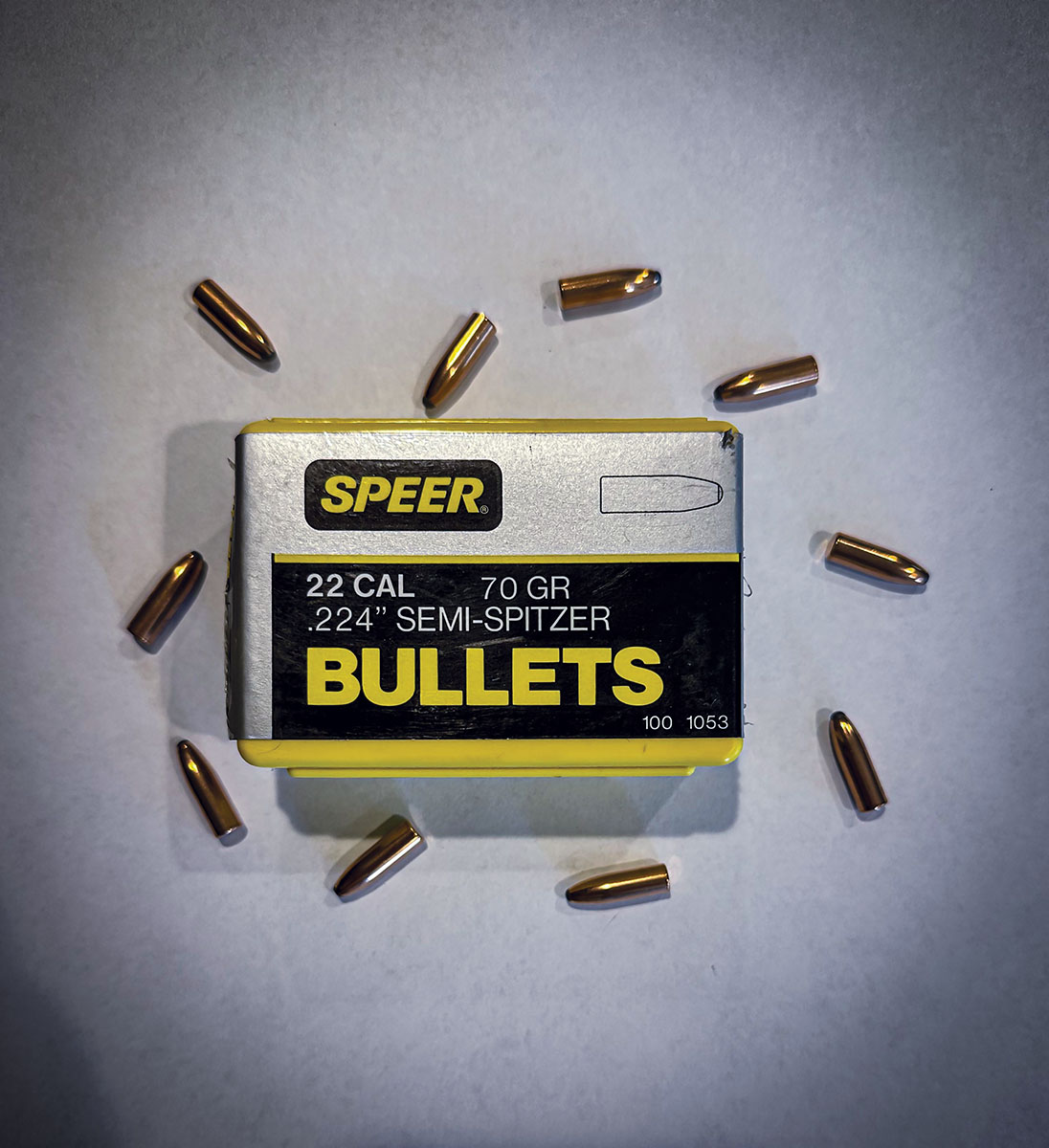
Mowing and painting for some generous neighbors earned me enough money to buy a RCBS Rock Chucker and a 505 balance scale. Being a young teenager with zero reloading knowledge, load development was not even an option. Bill helped me set the dies and his recipe, never changed throughout my high school years. Countless Speer 70-grain semi-spitzer bullets were fired with a modest load of H-380 ignited by CCI primers.
Fast forward two decades, my good friend Steve Grosvenor from Beresford, South Dakota, asked me to shoot in a Postal Match. Competitors were mailed, hence the name, targets that were to be shot at one hundred yards, then returned for scoring and ranking before the preset deadline.
Growing up shooting varmints instilled a skewed perception of precision and accuracy. The harsh reality of competition humbly introduced this predator hunter to new levels of both. Every shot would have been in the vitals, but in terms of the required 1/16-inch X count, the 788 and I finished toward the bottom of the Postal match list. Nonetheless, the “behind the woodshed beating” was a gateway to precision shooting.
The path rapidly led to competitive short-range benchrest shooting starting in 2009. By necessity, the learning curve was steep. Schooling at the range and in the reloading room, promptly transferred over to the field, and my favorite 788.
Load development and record keeping had now become an integral part of the precision puzzle. While checking seating depth using a Hornady Lock-N-Load Seating Depth Gauge, the bullet fell out of the case instead of contacting the rifling. The Grand Canyon jump, however, did not seem to matter. The ol’ 788 was routinely drilling coyotes over two hundred yards in the new hunting ranges of Southeast Nebraska.
Realizing the 788 needed a makeover, in 2015 the action was bedded, and a new Krieger 1:14 twist barrel was chambered for the original .22-250 cartridge. A Timney trigger, set at a crisp one and a half pounds, replaced the creep-infested, five-pound, factory trigger. To finish the tune-up, a Sightron S-Tac 4-18X was mounted in lapped and bedded Burris Signature rings.
Tuning was textbook, as almost every combination shot well in the “new” rifle, a common trait of the popular .22-250 cartridge. Two powders rose to the top with the BIB 52 grain flat-based projectile, Hodgdon H-380 and Alliant’s Reloader 15. H-380 provided slightly higher precision; however, the temperature stability of R-15 provided a wider tune window, desirable in the extreme Nebraska weather changes.
During the Fall of 2021, Moultrie Trail Cameras confirmed a mature 150-to-160-inch 5x5 whitetail on our forty-acre section of hunting land. Although the pictures were all nocturnal, his age and size catapulted him to the top of the hit list.
The nine-day November whitetail firearm season was in full swing with no daylight signs of the big ten-point. However, shortly after sunup on day eight, an equally impressive trophy appeared. An orange and white colored-phased coyote. Not just kind of orange, but “Lassie” orange. The word tempted is a gross understatement. Sights were steady, the safety was off, and my finger was caressing the trigger, yet this beautiful coyote received a hall pass due to the possibility of the ten-point being nearby. Despite Mr. Big not showing himself, disappointment was short-lived thanks to the orange and white newcomer.
My job as a high school science teacher kept me from hunting the color-phased coyote until the following weekend. A Lucky Duck Roughneck E-caller was placed forty yards from the same enclosed stand occupied during deer season. Lucky Pecker started the hunt at a non-startling volume of ten, trailed by two minutes of silence. Silly Rabbit followed at a volume of fifteen. After another rest period, the same distress call was used at an increased volume of twenty.
Out of nowhere, as predators regularly do, the identifiable target appeared. No time was wasted analyzing the situation. The one-hundred-yard full frontal shot looked and felt good. Multiplying the confidence, an audible “whap” was heard. Yet, to my bewilderment, the coyote ran into a nearby section of dense cedar trees seemingly unharmed. Had ‘buck fever’ reared its ugly head?
Ten long minutes passed before walking to the location of the impact. No visible sign of blood. No apparent patches of fur. Nothing. Knowing the canine went into the cedars, I walked to the entrance point. A worn passage provided a clue through the thick evergreens. Dropping to my hands and knees for a better view, the female prize was quickly located in the thicket.
Later that day, I called a friend and taxidermist, Don Goracke at Wild Country Taxidermy in Burr, Nebraska. After listening to the story, he asked me to bring the coyote over for an in-person inspection. Dropping the tailgate, Don’s first words were “Whoa…that’s a pretty one.” Although justified, the $900 full-body mount price was a little steep for my budget, so we agreed on a rug. After supplying the paperwork needed and writing a deposit for the tannery, the coyote was left with Don.
On Wednesday, I received a text message to give Don a call. Listening to the taxidermist revealed that he pulled the coyote out on Monday for the skinning. Couldn’t do it. Retried on Tuesday. Again, he couldn’t do it. I jokingly interrupted, “Couldn’t do it because she smelled so bad, or what?” Don replied, “No. You don’t understand. This is the prettiest coyote I have ever seen. Are you sure you want to turn it into a rug?” When a taxidermist with fifty years of experience tells you it is the prettiest coyote he has ever seen, you do not turn it into a rug.
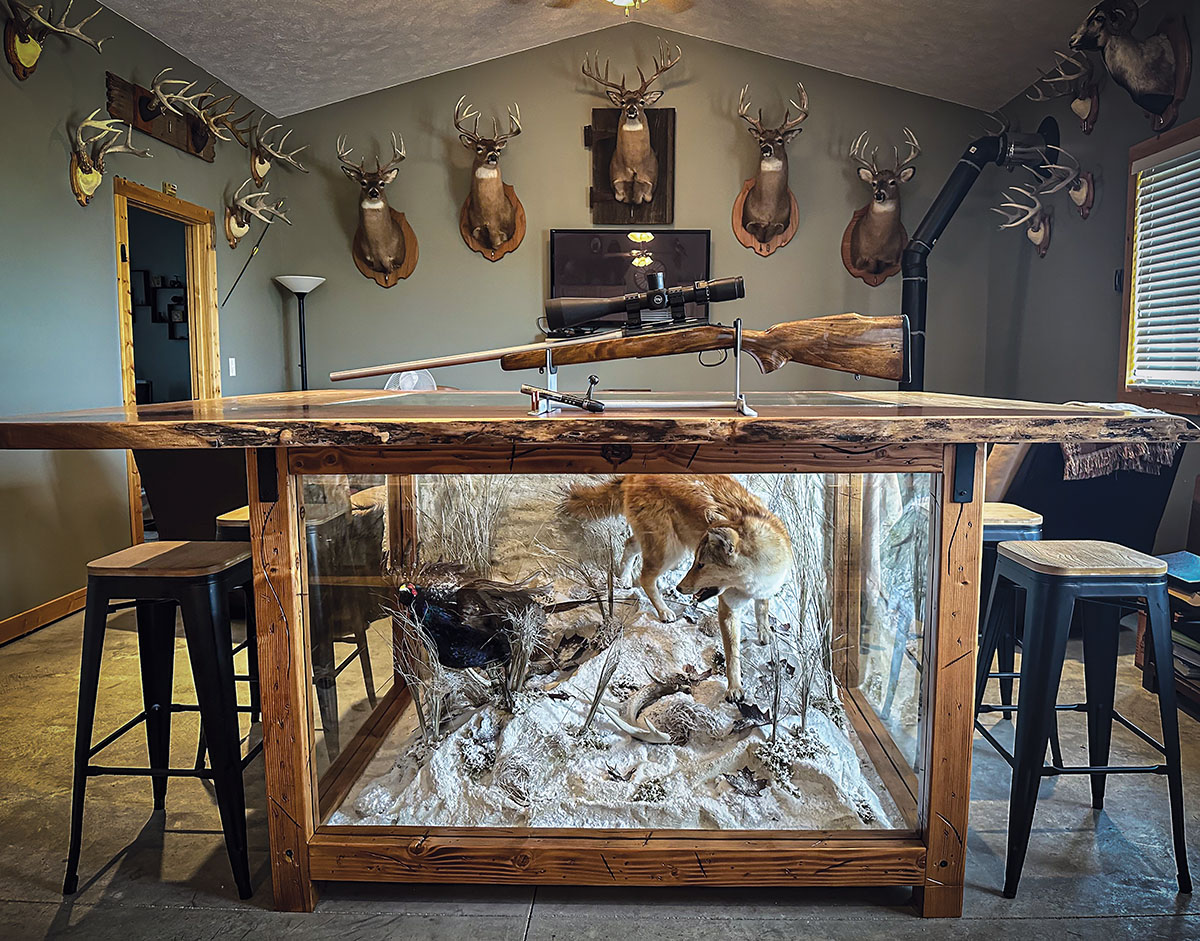
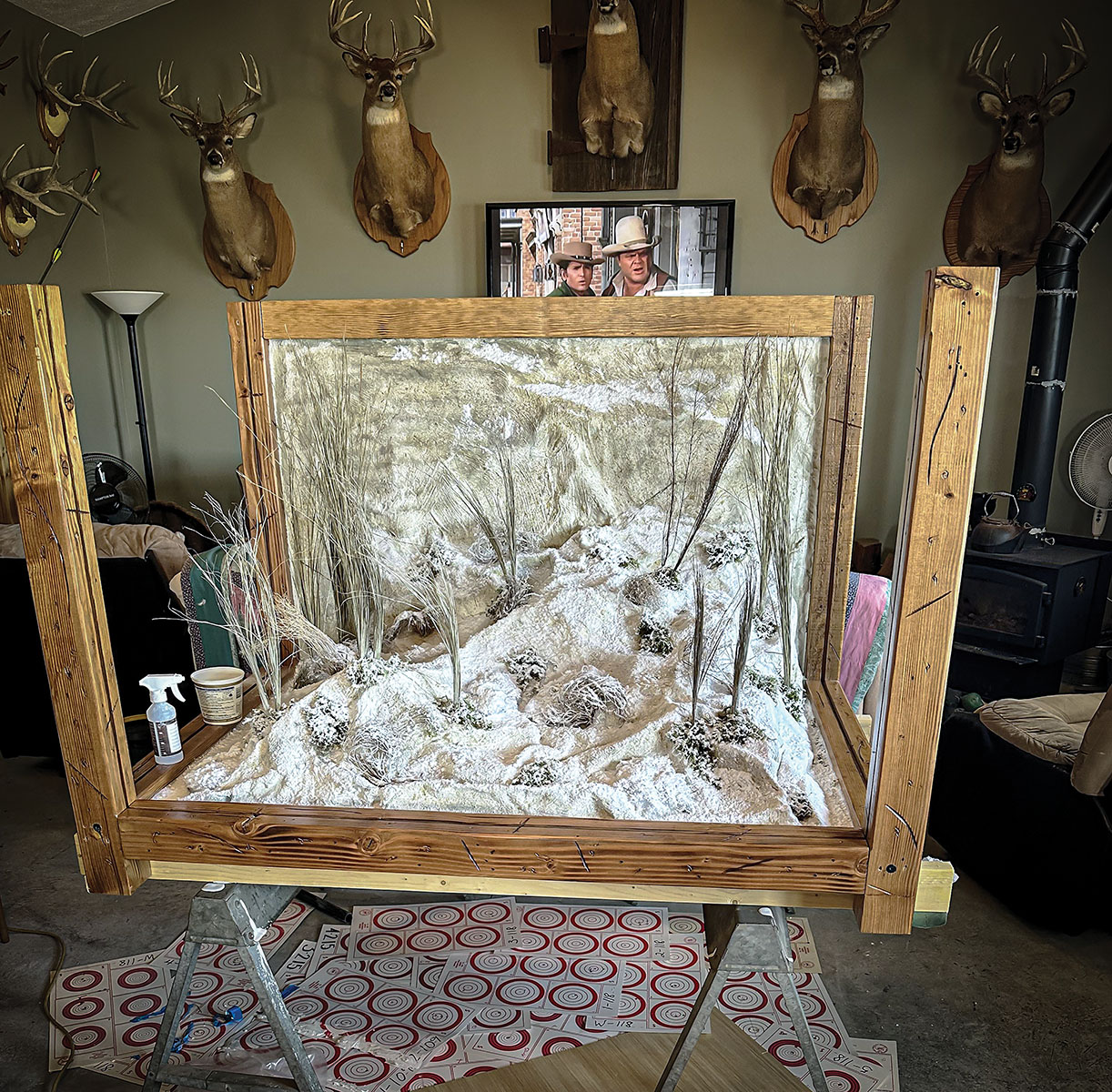
Providing there was no rush for completion, Don was kind enough to set up an extended payment plan with the only interest being a “couple cold ones.” A few months later, while enjoying some “frosties,” we hashed out the initial idea. Don suggested the orange of the coyote would be emphasized by a snow scene. Albeit the snow scene would need to be enclosed to protect it from dust. By the time the glasses were empty, we agreed that Don would do all the taxidermy and scene work while I would construct the enclosure that would preserve the white color.
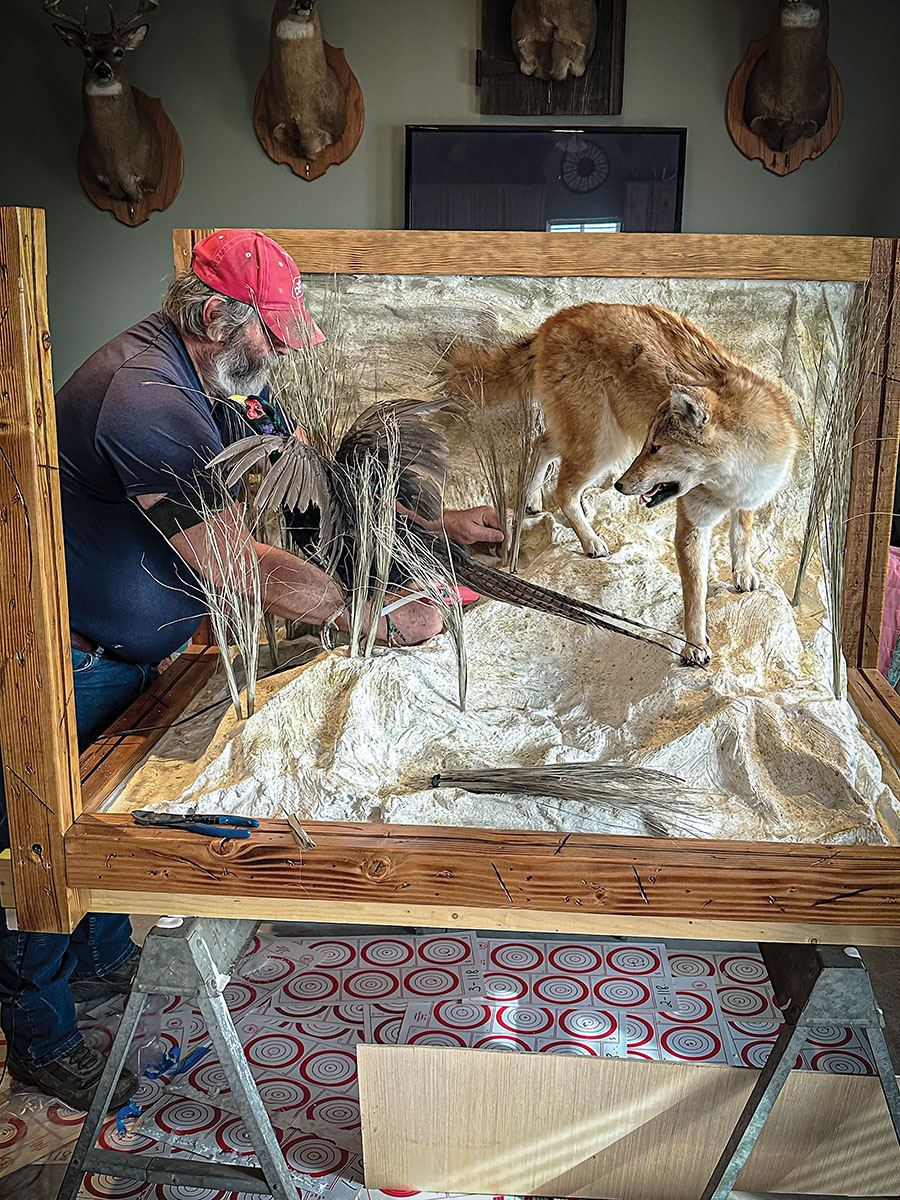
The puzzle was starting to come together, now for the pose of the coyote. I enjoy upland bird hunting with my two black labs, thus the coyote chasing a pheasant was a logical choice. However, this is no ordinary coyote; therefore, no ordinary pheasant would do. A phone call to Matt Beede at Beede Outdoors provided the solution.
Occasionally, Matt will receive a request to release different game birds at his hunting preserve located just outside of Syracuse, Nebraska. Having a Dog Training Membership to Beede Outdoors allowed me to hunt any “scratch” birds left over after the main hunting party is finished. I asked Matt to keep me in mind if anything unusual was released.
In late February of 2022, Matt called and said he released some melanistic pheasants, and the hunting parties did not harvest them all. A date and time were scheduled to see if the labs could find one.
There was a singleness of purpose that afternoon at Beede’s; one black rooster. Chukar after chukar, pheasant after pheasant burst from the CRP grass. To increase my chances of seeing a melanistic rooster, no shots were taken on the flushing birds. In terms of birds and dog work, it was one of the best days I have ever experienced. Yet, focus was so pinholed on the melanistic rooster that I failed to notice the labs’ building aggression each time a bird was flushed with no retrieve.
After an hour of hunting, and at least a dozen birds within range of the Benelli, a dark rooster erupted from the grass. The Fiocchi six-shot quickly found the mark, resulting in a lifeless bird cartwheeled to the ground. This was when the aggression was released. The lab’s overflowing desire to fetch was taken out on the lifeless bird, finishing the carnage with a tug-of-war retrieve. When I sheepishly handed Don the mangled pheasant and bag of feathers, he despairingly said, “Oh buddy, I got some work to do.”
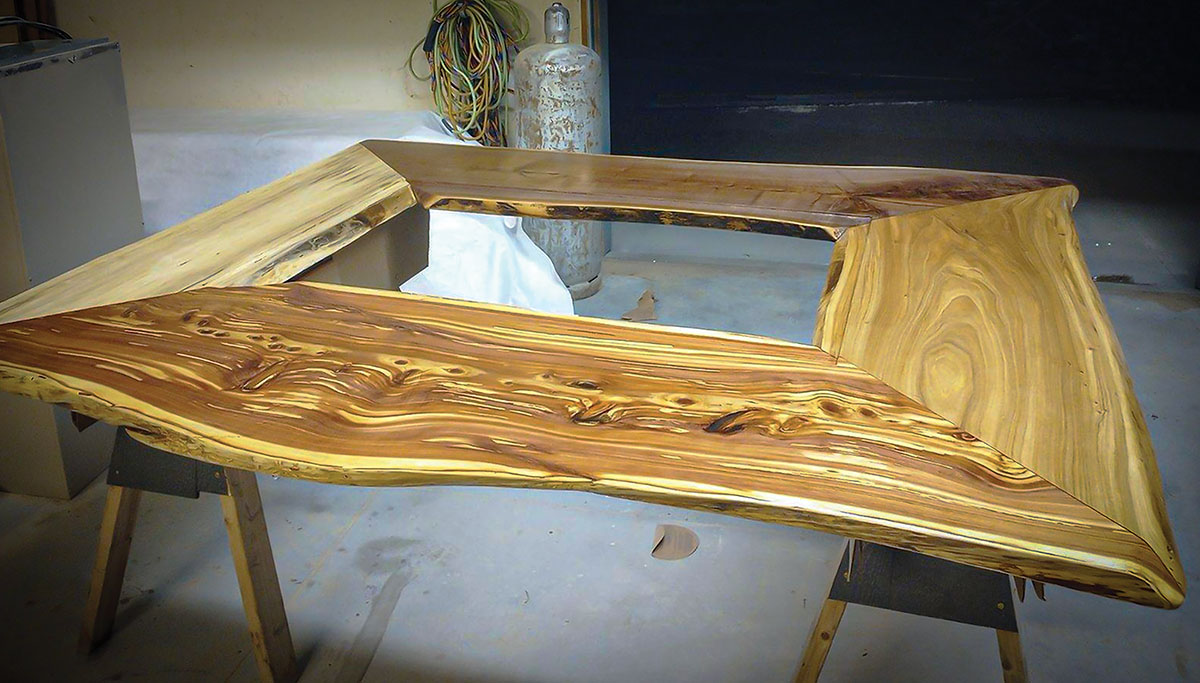
A little over a year later, the coyote and pheasant were nearing completion. Enough that Don could give me measurements to start designing the enclosure. The vision was a sixty-inch-long, forty-three-inch-wide, and forty-two-inch-high bar with a glass front and sides. Outkicking my construction ability coverage, the top would be four live-edge wood slabs with a glass center for a top view of the scene.
The uniforming of the four-by-four-inch Douglas Fir legs and cross supports was straightforward. Yet, as with many construction jobs, nothing is ever as easy as it first seems. Cutting the groove for the glass proved a challenge. Good friend and expert woodworker, Tom Block of Unadilla, Nebraska, used a combination of dado blades to give 1⁄16-inch clearance for the quarter-inch glass being used. Tom’s experience and guidance were greatly appreciated, overcoming many measuring and alignment obstacles.
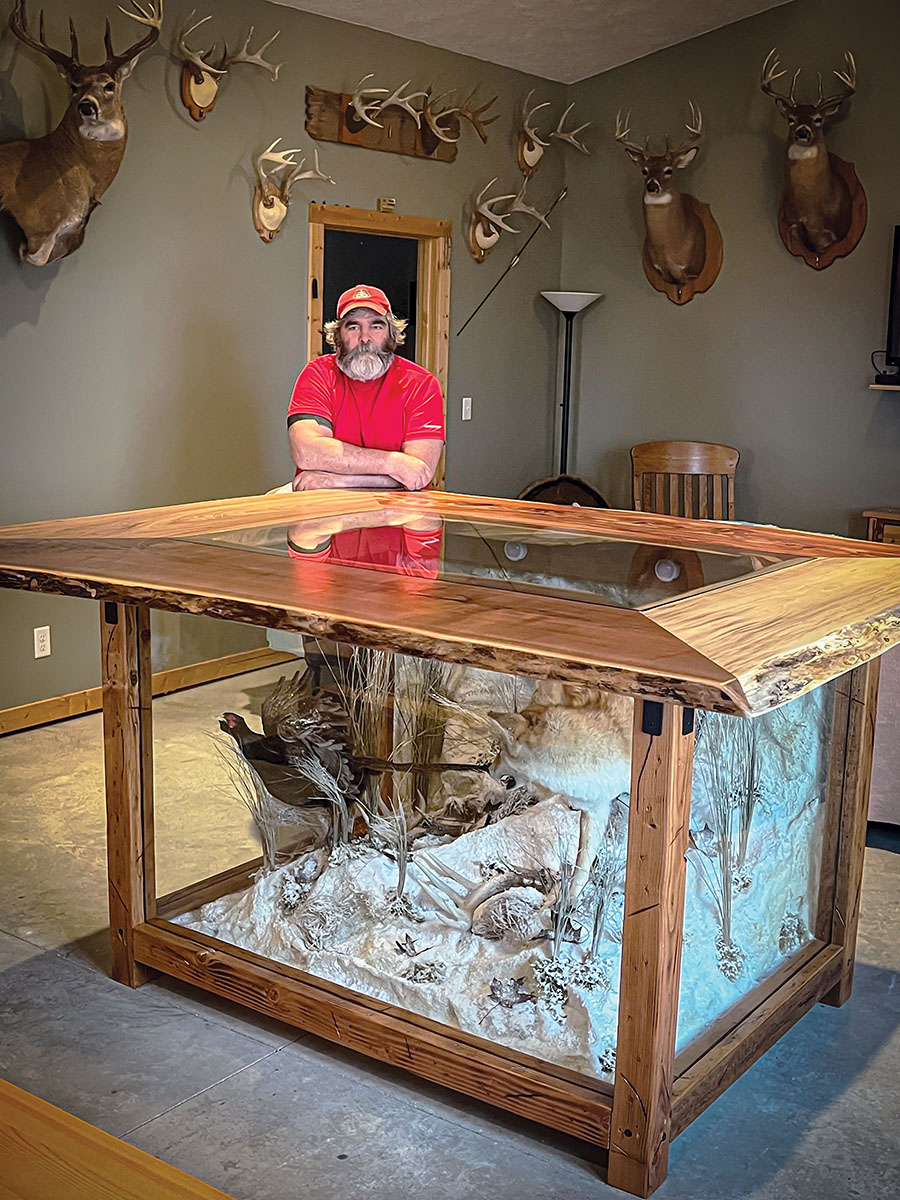
To make the new posts look weathered, chain links were pounded into the wood, a nail punch was used to make artificial wormholes, and an angle grinder provided some wear marks. The posts were then burned, sanded, stained, and sealed.
The bar base was temporarily assembled in my garage to get accurate measurements for the three pieces of glass. An informative call to Brown Glass in Nebraska City, Nebraska, resulted in an order for tempered glass.
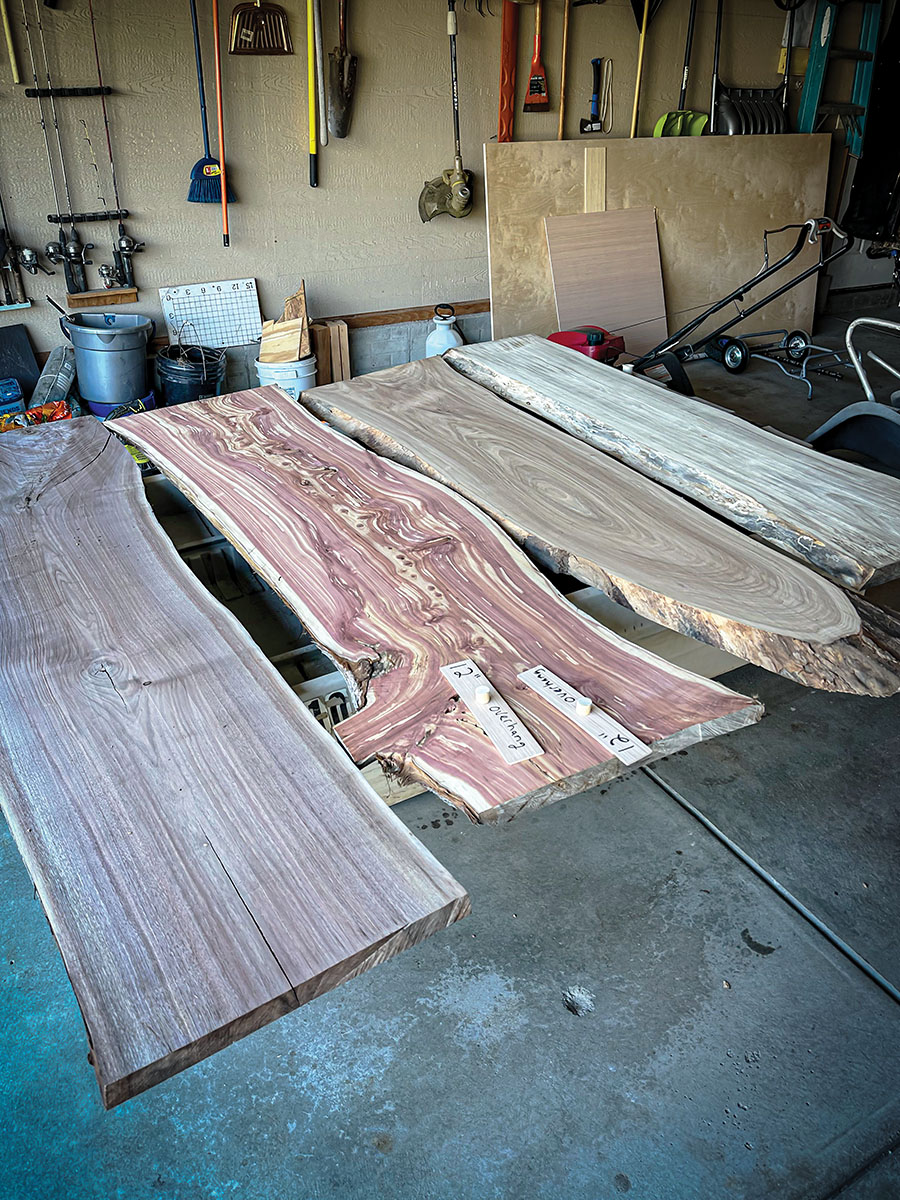
The top of the display was designed to be constructed out of live-edge Walnut. This meant a trip to Big Red Sawmill, located just outside of Palmyra, Nebraska, whose specialty is live-edge wood in a variety of species. While taking a stroll through their stockroom, I was awestruck at the beauty of the live-edge slabs. For good reason, Walnut is always a fan favorite. However, during the tour, Hackberry immediately caught my eye. The white wood with dark grains was alluringly contradictory. Close by was Red Cedar, which I have always admired for its red and white contrast. Walking to another stack of wood, Travis from Big Red noticed my attraction. “You’re never going to guess…That is elm.” What many consider a scrap tree, barely good enough for campfirewood, was absolutely beautiful.
Everything about the display is unique; why not make the top just as unique? Walnut, Hackberry, Cedar and Elm were the chosen favorites to be planed to a uniform thickness of two inches. To up the “cool factor,” the four species can be found on the land where the coyote was harvested.
I had done construction as a summer job for many years: framing, deck building and various similar projects. However, furniture making is on a completely different level of precision, eerily like the learning curve experienced when I started shooting competitively.
Since live edge wood has few straight boundaries, a linear line was scribed, accounting for a twelve-inch overhang on all four pieces. These would be the reference marks around which the whole project would revolve.
Using geometry and numerous careful measurements, a forty-five-degree angle was traced on the ends of the live-edge wood. I did not have access to a radial arm saw large enough, so a Milwaukee Skill Saw was cautiously used to cut the thirty-inch angles on the expensive wood. The “pucker factor” was high, but the cuts were true, and all angles aligned when the heavy slabs were joined with glue and biscuits.
Now that the top had the basic structure, the same quarter-inch tempered glass was ordered to sit flush with the top. Once received, a matching template was made from 1⁄8 inch plywood. This template was outlined at the top and used as a guide for the especially challenging router job.
After several weeks of sanding and epoxy work, the wood was ready to be sealed. Shawn Grudman of rural Syracuse sprayed several coats of Sher-Wood Hi-Bild Precat Lacquer. The one-of-a-kind top was secured to a homemade platform on a trailer for delivery.
The destination for the display was our family cabin, on the same land where the coyote was harvested. For two days, Don Goracke worked his magic assembling the piece. It was fascinating watching the “behind the scenes” of an artist at work.
It has been said that good things come to those who wait. From the initial spotting of the coyote to when the last screw was inserted was just under four years. However, the memories the display represents span far greater. They all started four decades ago with an ol’ 788.