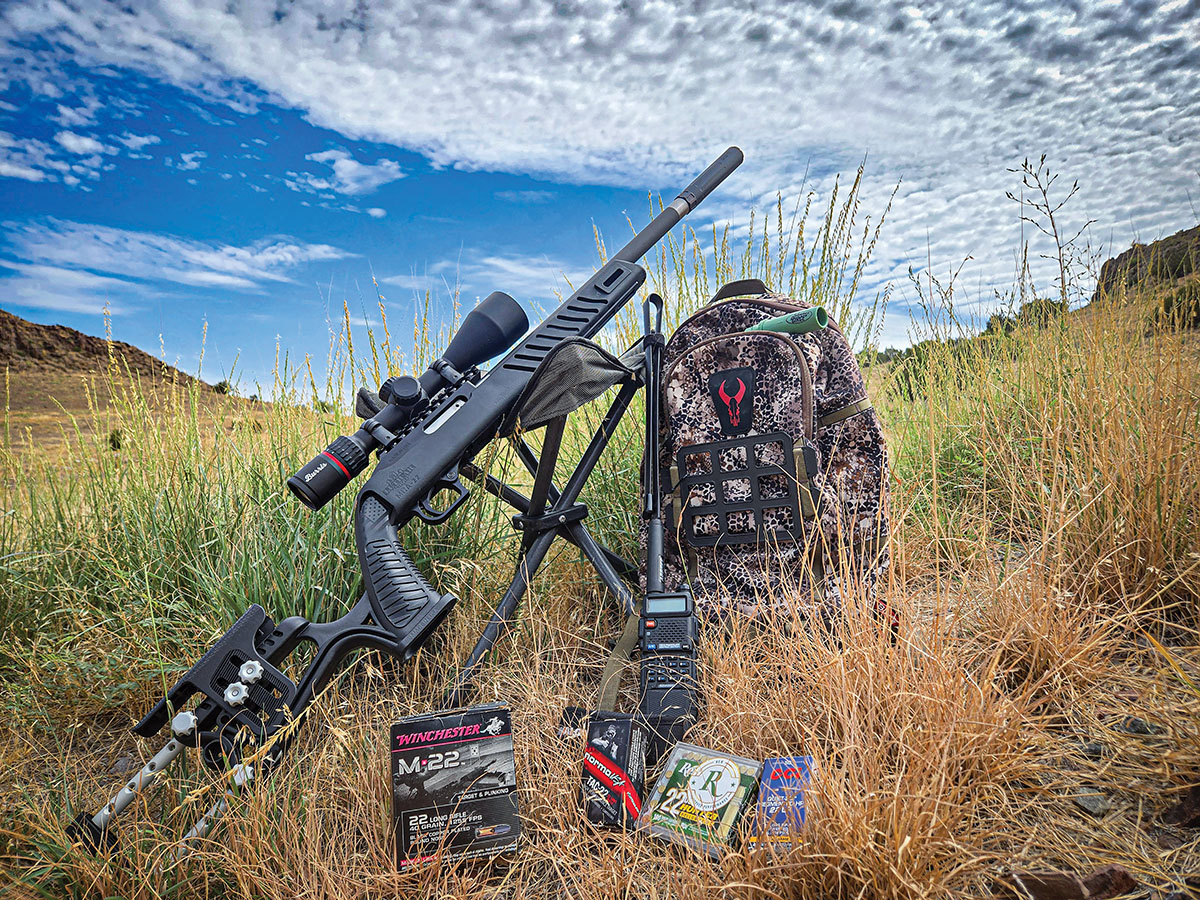
Some time was spent calling foxes and coyotes with the Magnum Research SwitchBolt rifle on the stand. The 22 LR is certainly not my first choice for such situations, but with the right shot placement and proper ammunition, it can be done with minimal damage to the pelt.
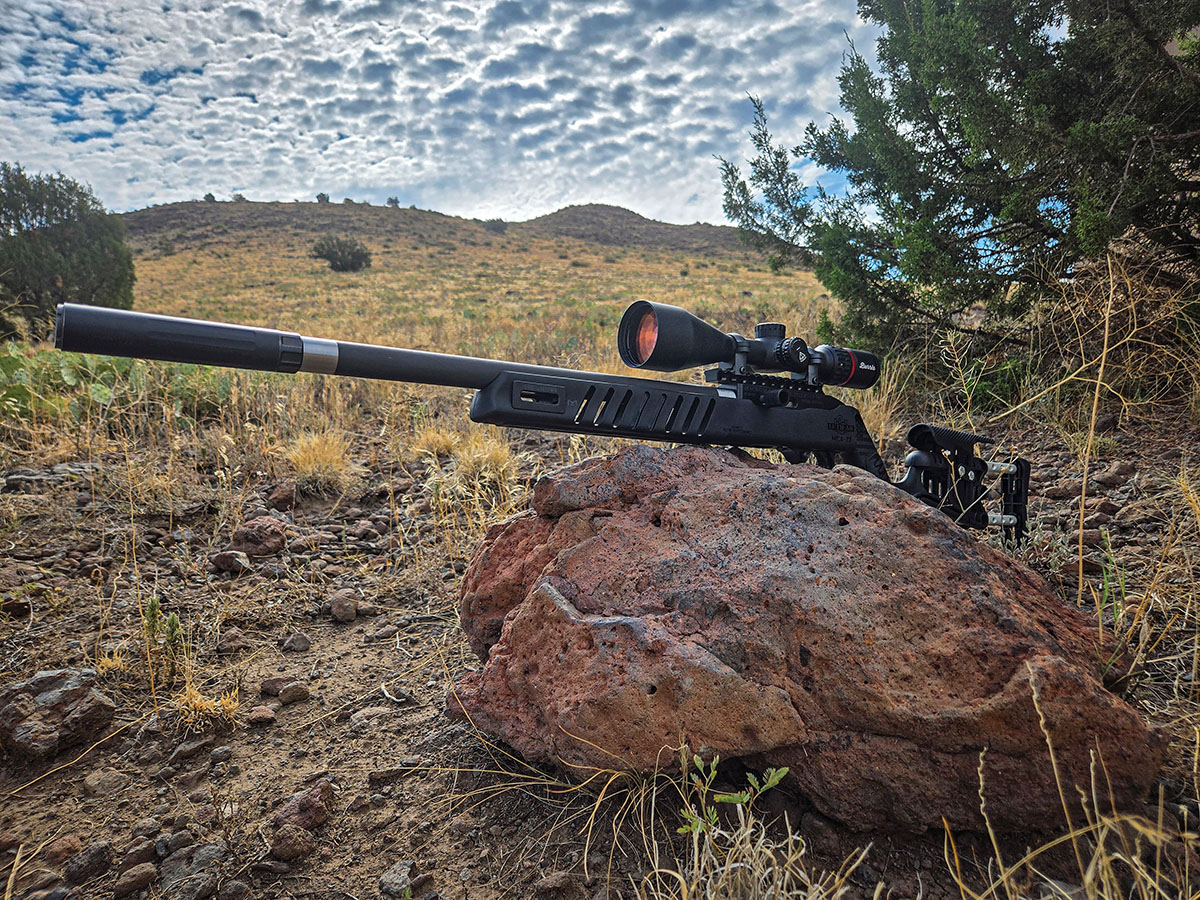
The SwitchBolt is a highly customizable platform compatible with many 10/22 stocks, magazines and trigger groups. It has a good reputation in competition circles as well as those looking for a high-end rifle for varmint hunting.
When it comes to rimfires, 22 LR in particular, I think just about everyone is familiar with the
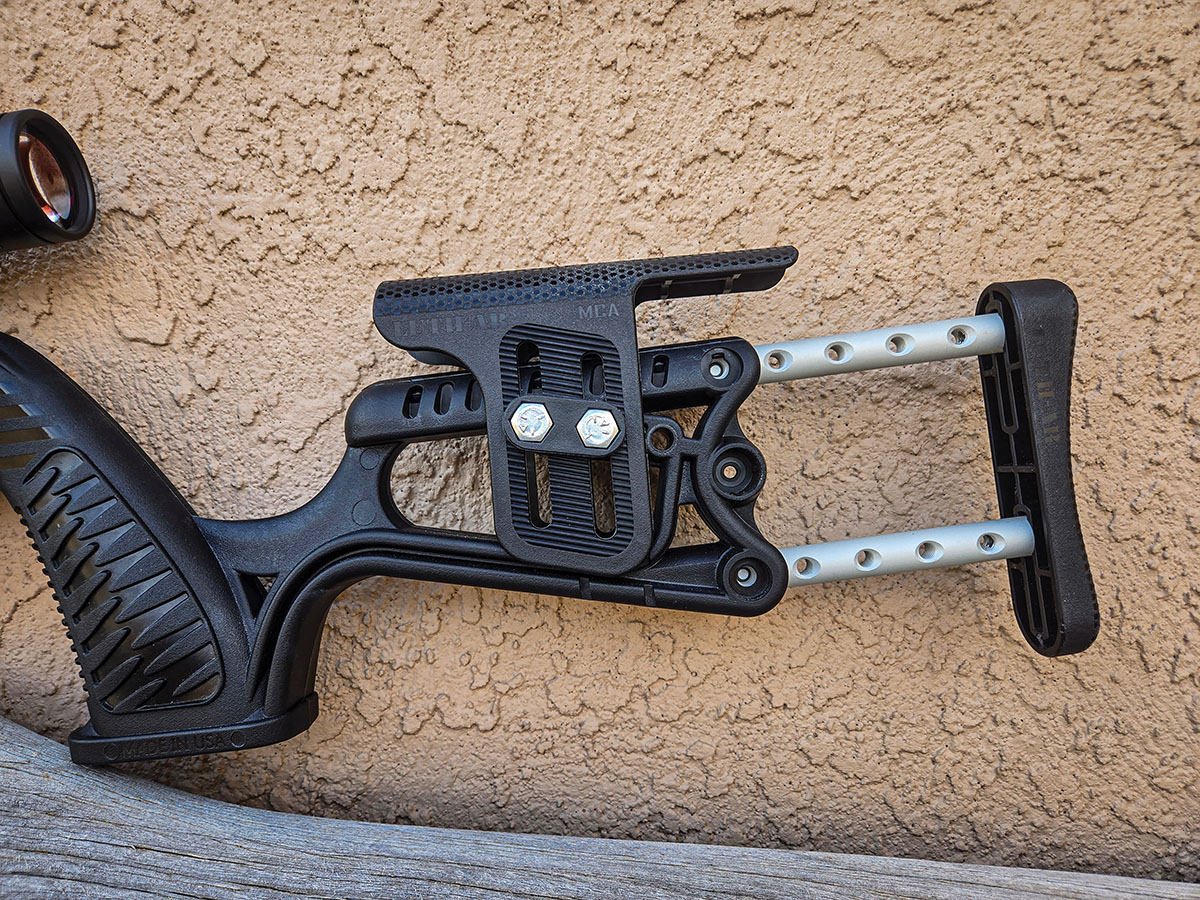
The Luth AR MCA-22 Modular Chassis Assembly is an excellent stock option for the SwitchBolt and is also compatible with the Ruger 10/22. It has adjustability for the length of pull as well as an adjustable cheek riser to ensure a good, consistent cheek weld.
cartridge. Most of us probably grew up shooting it as a kid, or have fond memories of our first rifle, likely a small rimfire. I distinctly remember my first rifle, a Henry Mini Bolt Youth G2 chambered in 22LR. It was a fine rifle for a kid starting out at four years old - with strict supervision from my Dad. However, I quickly outgrew it and wanted something more; my sights were set on a Marlin 15 YS, which I had read had a micro-groove barrel and a self-cocking action and had the same fiber optic sights I liked on the Henry. It might be hard to believe that a 7-year-old kid understood such things, but I grew up in a family where guns and hunting were a staple. Many dinner table conversations revolved around what new rifles were acquired by family members and what tags were drawn that year. I was also a voracious reader, and one of my favorite pastimes was browsing gun catalogs and magazines that my dad would bring home. That Marlin was carried for many years, and I have many good memories of the rifle. As I sit behind my desk and type this article, many of those memories are coming back to me as the rifle quietly refreshes distant times of adventure.
There comes a point where you move on to bigger and better things in life, and
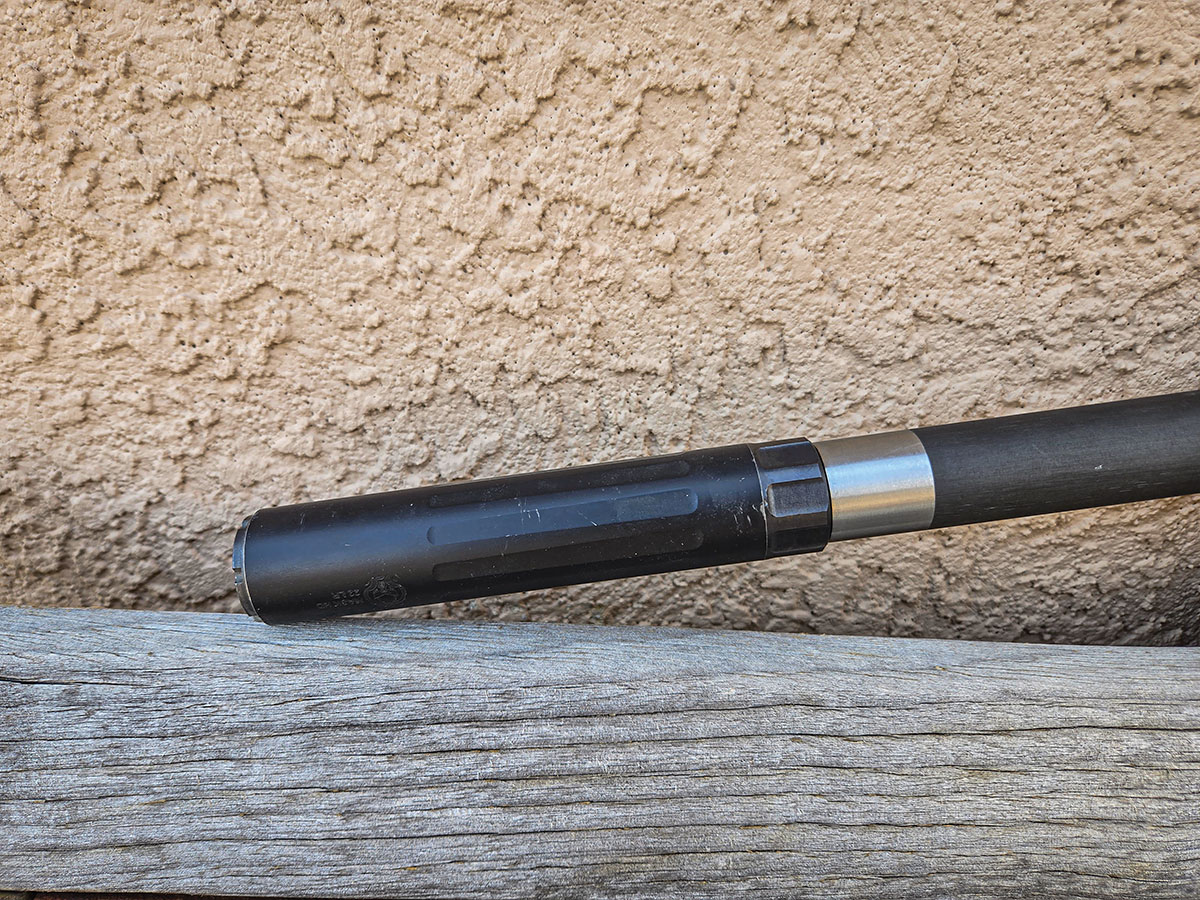
The Dead Air Mask was used quite a bit throughout testing and hunting with this rifle, making the overall experience much more pleasant. When dispatching critters around livestock, it comes in extremely handy.
for me, it was centerfire rifles and handloading, which have become two passions (or obsessions)
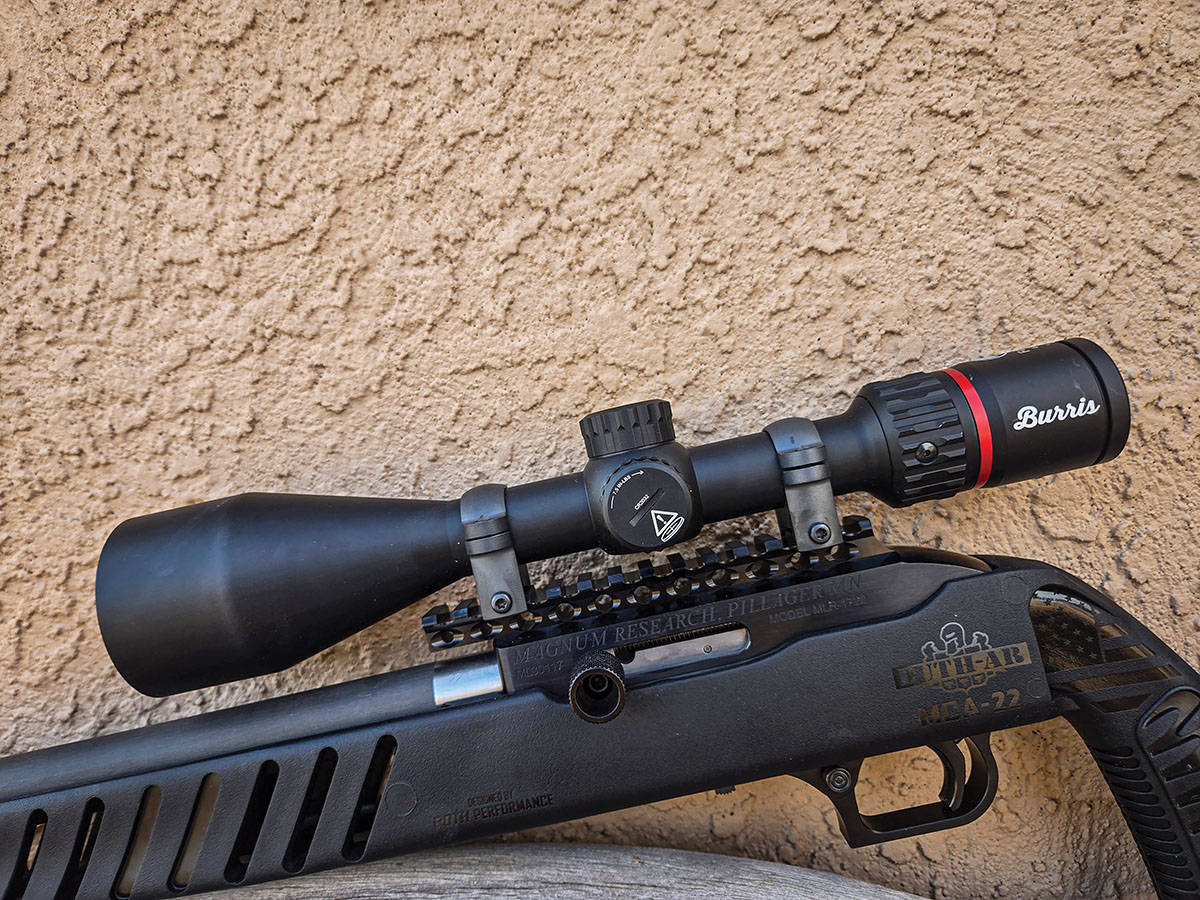
The bolt handle is oversized and easily operated with the support hand while keeping the rifle shouldered. The SwitchBolt also has a bolt hold-open button. The only gripe with this rifle is the magazine release can be a little challenging to operate, but with practice, smooth reloads can be conducted.
of mine, depending on who you ask. For many years, the rimfires all but sat in the safe, untouched during my teenage years. I am still a huge fan of centerfire rifles, but over the last few years, I have become a fan of rimfires again. They fill a unique role in the hunting and shooting world that no other cartridge has been able to fill effectively at such a low cost. I didn’t fully appreciate the role they played until the last few years, and had all but forgotten it until my nephews were old enough to truly enjoy firearms. Over the years, watching them grow proficient with their rifles has been a joy to see. There are a few cartridges and rifles that fill the niche of introducing new shooters to firearms better than that of the little 22 LR.
It is due to all this that I decided it was time to refill that void with a new rimfire rifle - the subject of this article. I wanted something chambered in 22 LR, as that seemed like a fitting place to pick back up with rimfire shooting. The rifle I got is made by Magnum Research, they are well known for the Desert Eagle Handgun. However, they make excellent rimfire rifles as well. I settled on a custom SwitchBolt Rifle. One nice thing about Magnum Research is the fact that they have a custom rifle builder on their website, and customizing your SwitchBolt to your specs is quick and easy. I settled on the Luth AR Stock, which has adjustments for
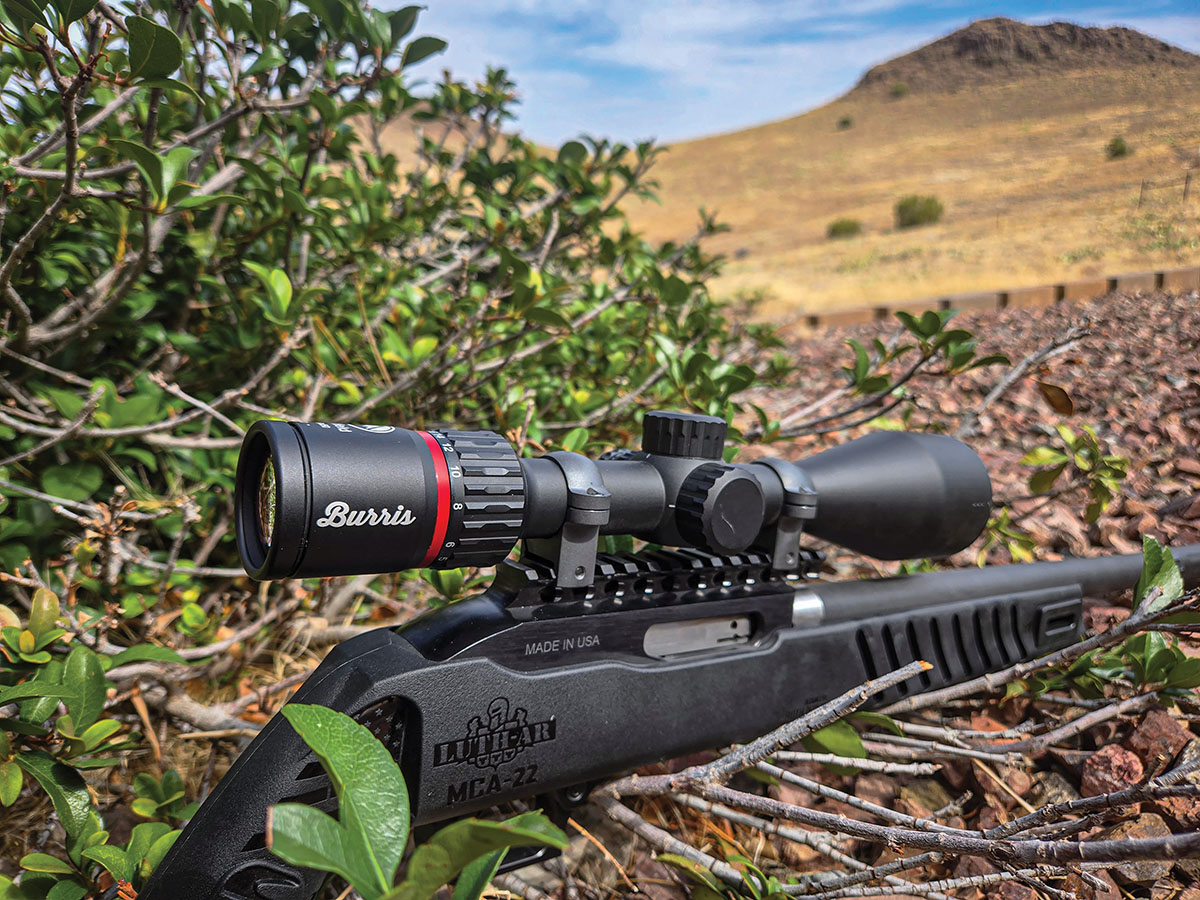
The Burris Fullfield 4-16x 50mm Optic proved rugged and reliable, and with parallax adjustments from 25 to infinity, it made a perfect match for the SwitchBolt. I’ve been using and hunting with these optics for three different scope generations, and all have served me well.
length of pull as well as an adjustable cheek riser. This seemed like a natural fit, since most of my shooting would be at ground squirrels and prairie dogs off a bench. For the barrel, I went with their straight black carbon fiber option as well as the standard bolt and trigger
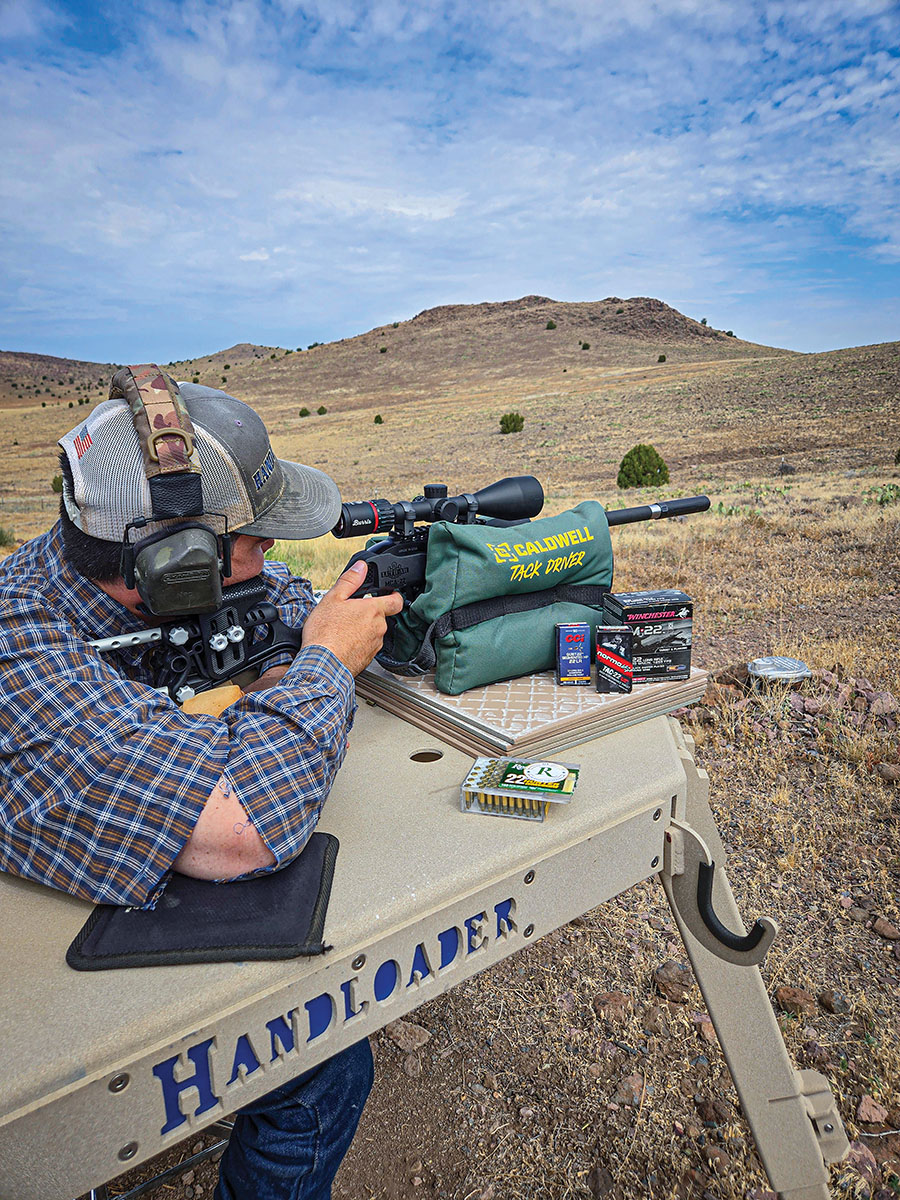
Much time was devoted to bench testing accuracy and various types of ammunition to get an idea of how accurate and reliable this rifle would be.
group. One nice thing about these rifles is that they are compatible with many Ruger 10/22 aftermarket parts, including some stocks, trigger groups and magazines. Once you have a customized rifle built on the website, all you have to do is make a payment and wait for them to finish building the rifle. Estimated build times are listed on their website. In this issue of Varmint Rifles & Cartridges, Patrick Meitin has an article on 10/22 upgrades, with many of those upgrades being compatible with this rifle.
When taking a closer look at the SwitchBolt 22, we can see that it is not simply another Ruger 10/22 clone. There are some notable departures from the 10/22 design; the most notable is likely the fact that the Switchbolt is a gas-assisted, blowback-operated semiautomatic, as compared to the Ruger 10/22, which is a simple blowback design using the weight of the bolt and recoil spring to keep the bolt closed during firing. The Switchbolt actually has a “gas discharge device” or a gas block. This unique design makes the rifle much more reliable, and in my experience, shooting suppressed aided in preventing gas from blowing back into my face when compared to certain other simple blowback semiautomatic 22 LR rifles. This is most welcome, as most of the varmint shooting I do these days involves a suppressor.
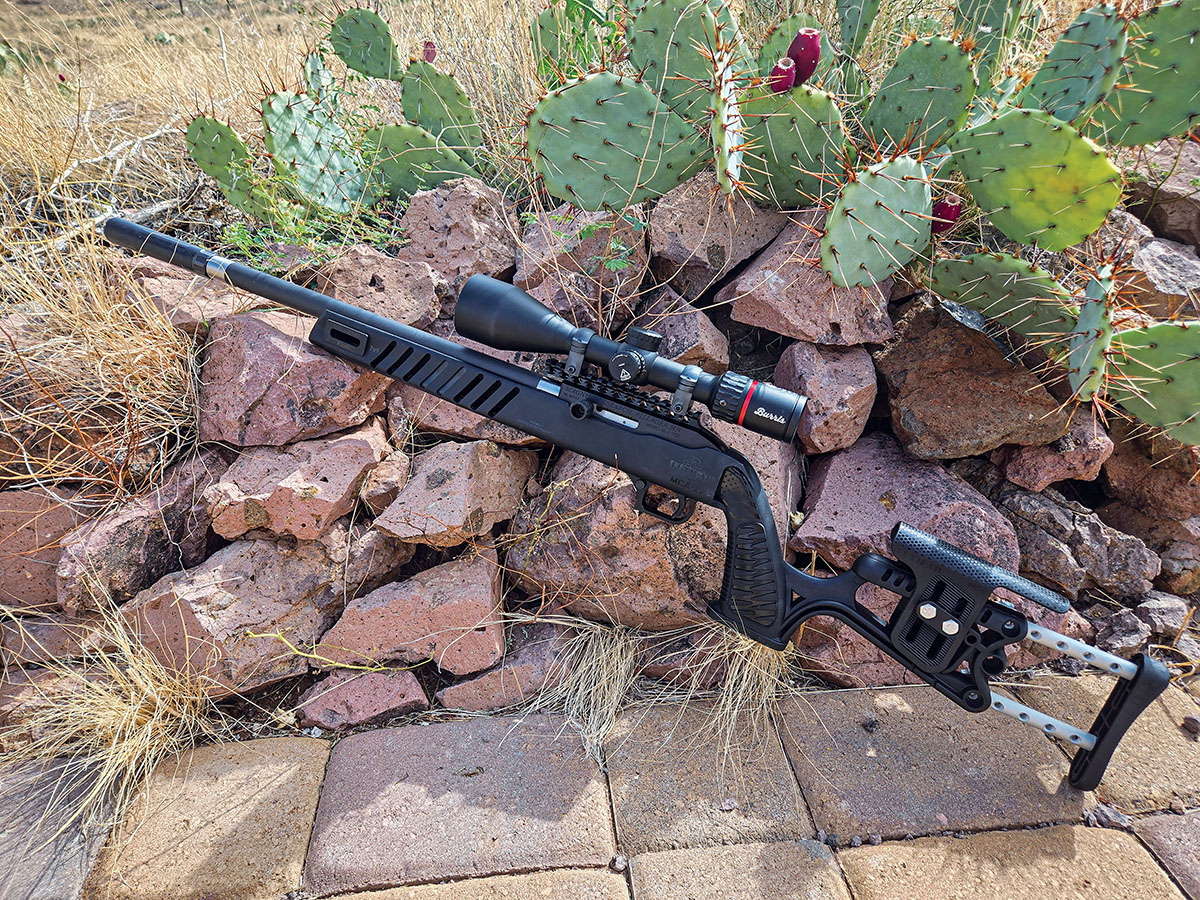
The rifle weighed in at 5.9 pounds with rings, optic and suppressor, which made it nicely balanced and pleasant to carry in the field all day.
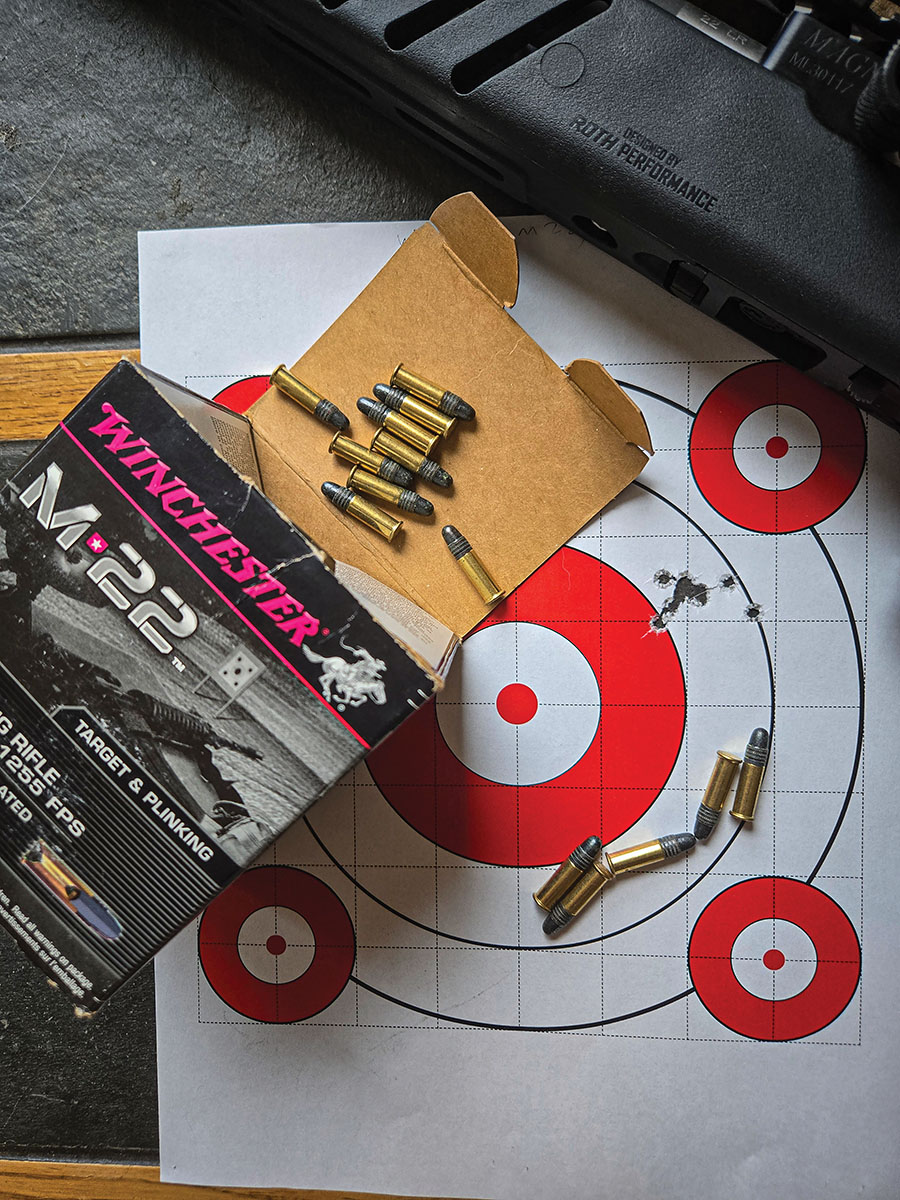
Winchester M-22 is generally considered “budget” or “plinking” ammunition, but this rifle proved to be more than accurate with this ammunition. The reliability did leave something to be desired, but for an afternoon practicing or plinking, it was more than acceptable.
Once the rifle was received, the first order of business was to select and mount an optic; thankfully, I had the perfect solution already on hand. The optic I selected was a Burris Fullfield 4-16x 50mm rifle scope with the Ballistic E3 reticle. There are many reasons this optic was selected. The parallax is adjustable from 25 yards to infinity, which I consider mandatory for a rimfire optic. The ballistic E3 reticle is calibrated about perfectly when zeroed at 50 yards. I have holds at 63 yards, 83 yards and 101 yards, which is about as far as I plan on shooting ground squirrels with a .22 LR. Burris has an excellent set of ballistic tools on their website, so you can check and see exactly where this reticle will true out with your exact ammunition.
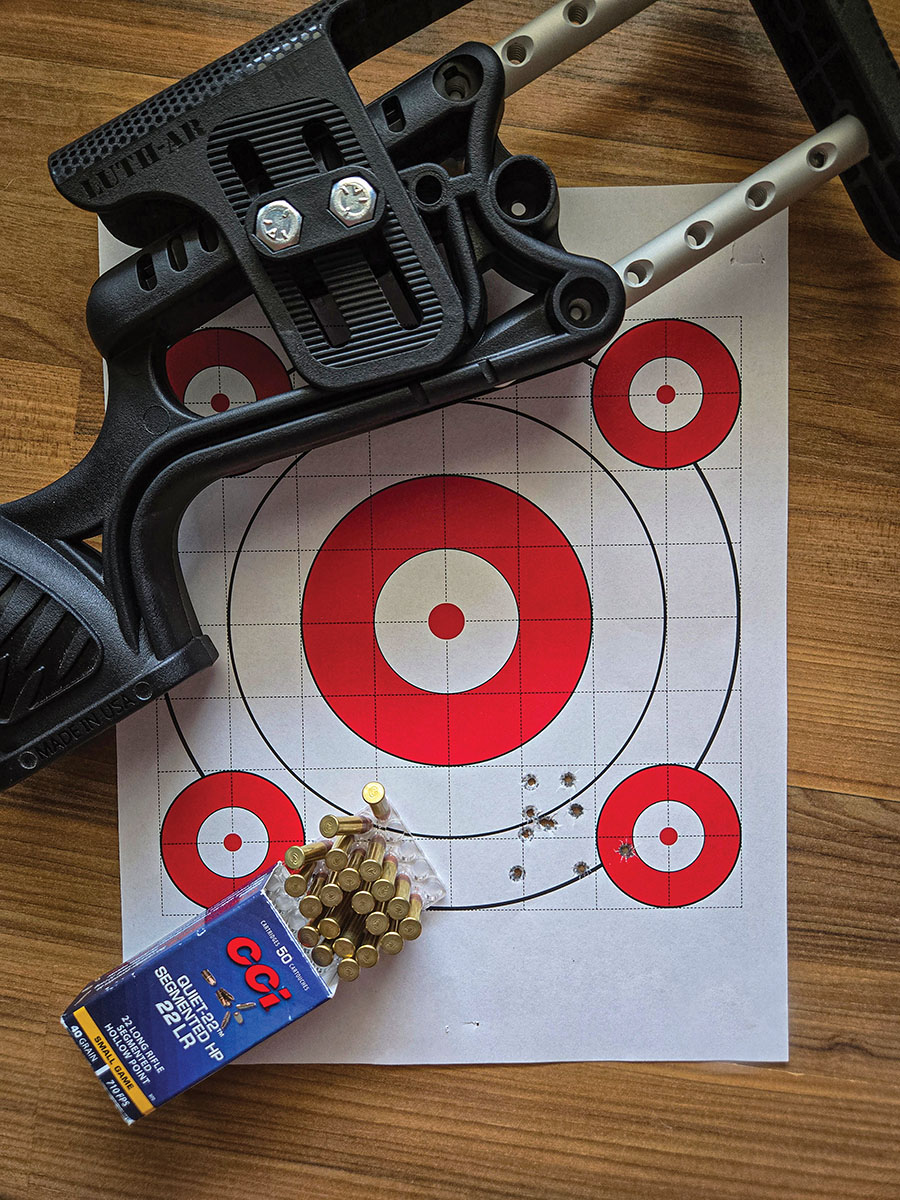
The 40-grain Segmented HP CCI Quiet-22 proved accurate and effective at dispatching small critters up close with minimal noise pollution. It failed to cycle the action, but it was neither expected to, nor designed to, function in semiautomatic firearms. CCI manufactures various Quiet-22 models for semiautomatic firearms, which minimizes sound by not cycling the action – appearing slightly quieter than the faster options.
After the optic was mounted, it was time to begin testing. I started out by shooting about 300 rounds of Winchester M22 ammunition at steel, paper and various targets to get a feel for the rifle and foul up the barrel a bit. After that, the barrel and bolt were cleaned with a light coat of Lucas Extreme Duty Gun Oil applied to the appropriate lube points. During this process, there were a few malfunctions; however, every one of them could be attributed to the ammunition and not the rifle itself. With the gun now broken in and running very smoothly, it was time to conduct some accuracy testing.
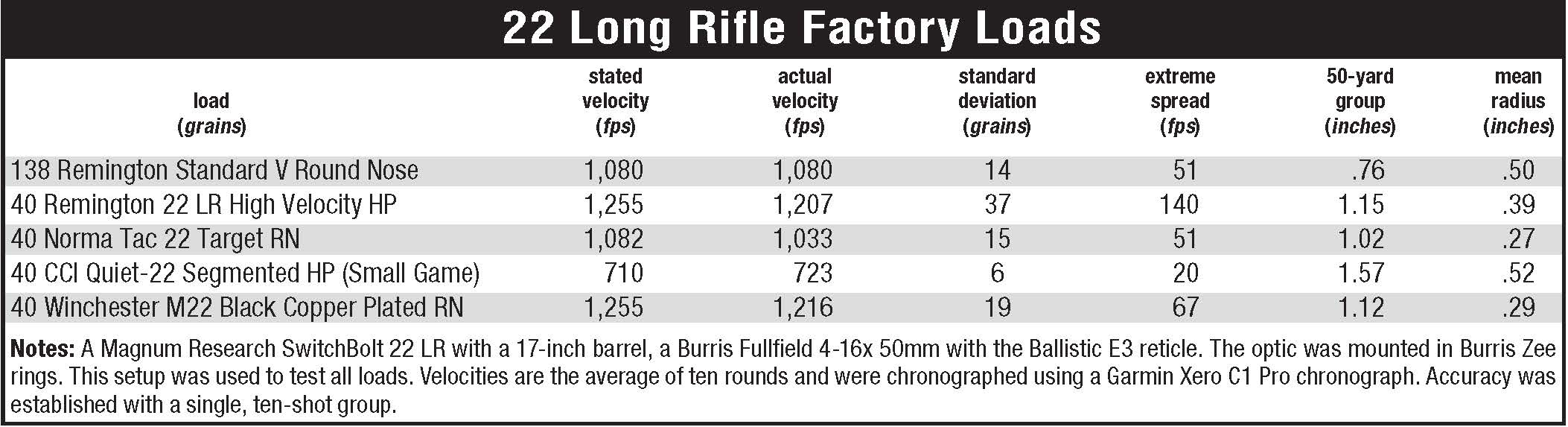
I selected five different types of ammunition to try using 10-round groups as my standard for the test, with the target placed at 50 yards. I wanted to see how the rifle would perform with both match-grade ammunition as well as more inexpensive and less reliable plinking ammunition. I also threw in some CCI Quiet-22 40-grain segmented hollow-point ammunition. This ammunition will not cycle the action, nor was it intended to. I prefer to use this when dispatching pack rats, skunks, or other unwanted critters around the house and or horses, and simply wanted to see how it would perform from this rifle with its match-grade barrel.
As you can see from the table, all ammunition performed rather well without any malfunctions during the accuracy testing. The CCI Quiet-22 did not cycle the action, but it also did not jam up the gun after each shot. The bolt essentially just remained closed, which turned my semiautomatic into a straight pull bolt action rifle. Which is exactly what I was hoping it would do for my purposes of removing unwanted house pests. All testing was conducted with a Dead Air Mask Rimfire suppressor, which made the CCI Quiet-22 about as loud as an airgun or pellet gun.
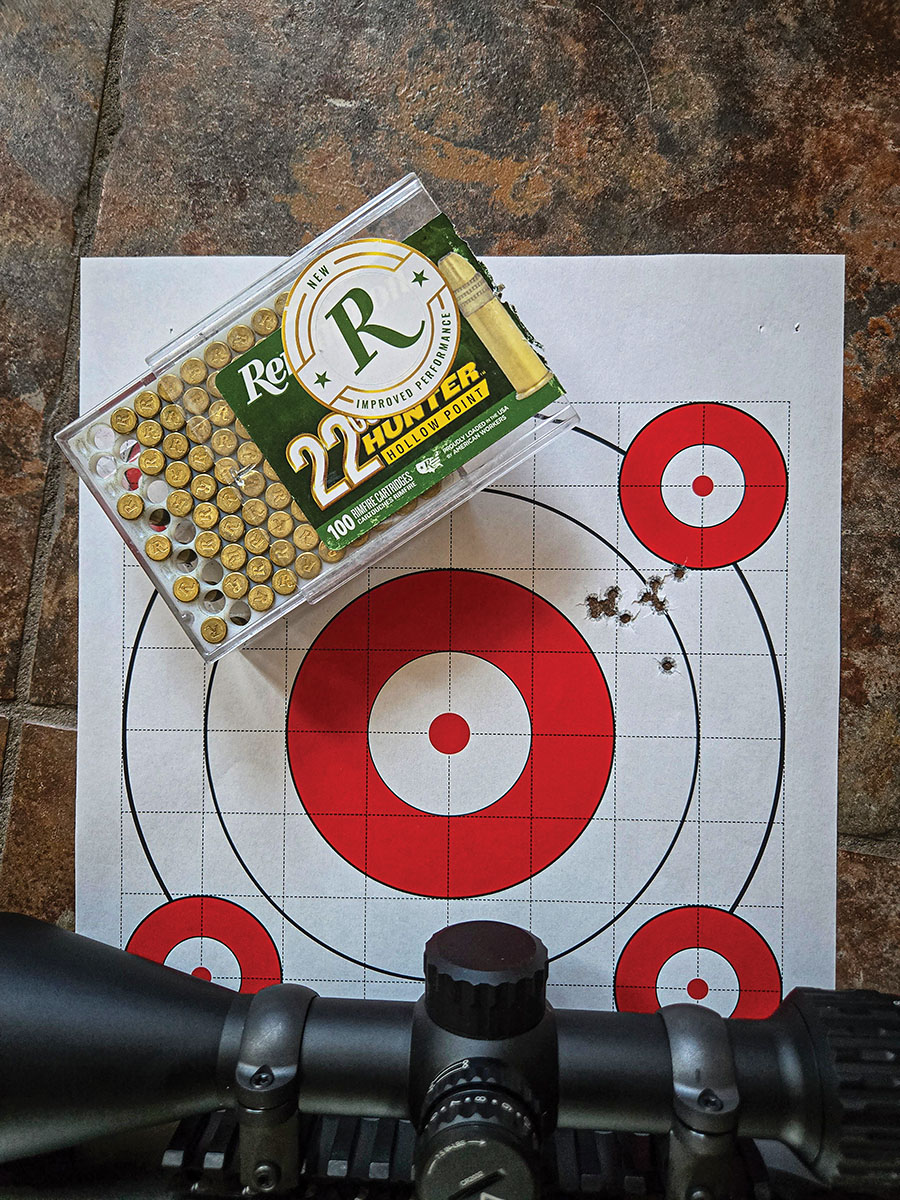
The 40-grain Remington Golden Hunter HP proved reliable as well as accurate, and would make for an excellent option for varmint hunting.
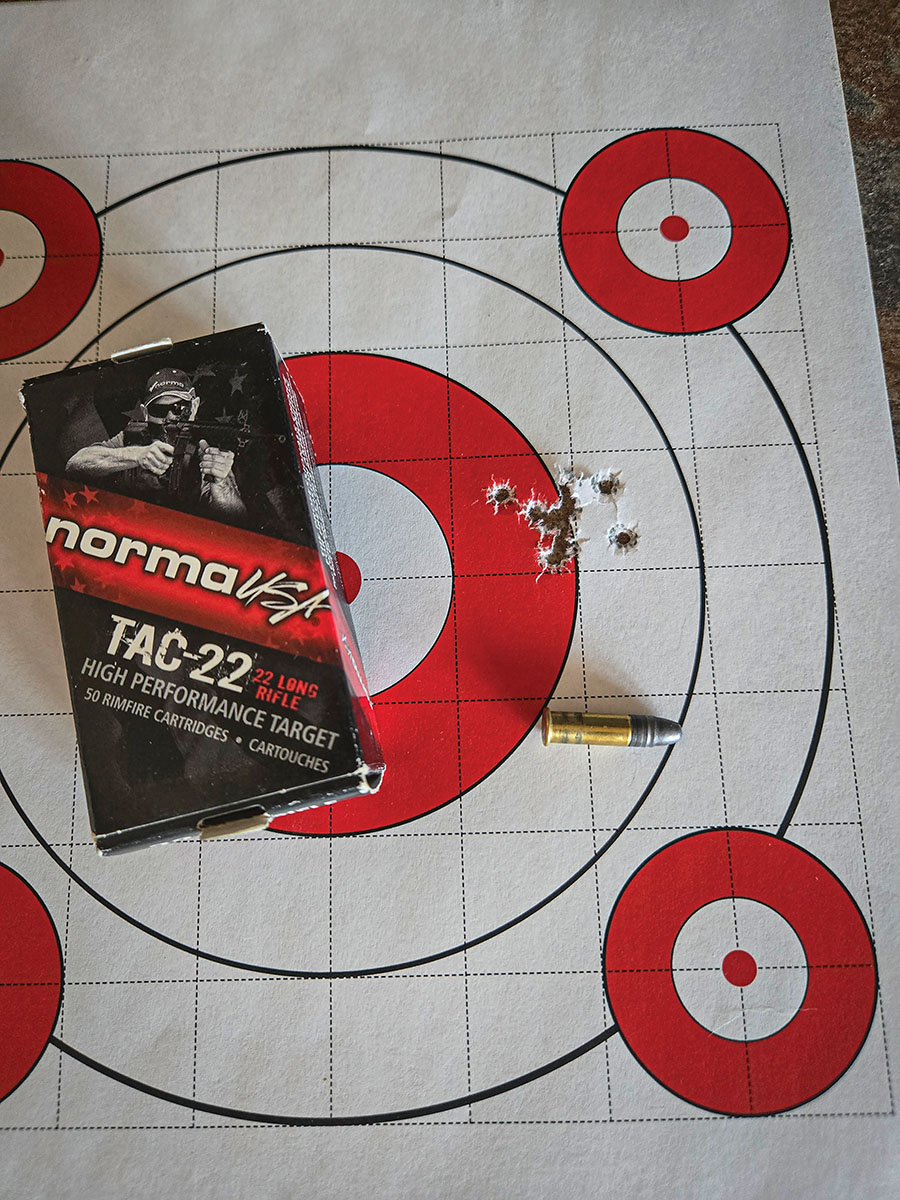
The 40-grain Norma Tac-22 proved to be the most accurate and reliable ammunition type tested of the 250 rounds put through this rifle. There was not a single malfunction.
As a whole, I was personally impressed with the accuracy of the rifle, and at the same time, it quickly became apparent that the primary limiting factor for accuracy was not the rifle but the ammunition itself. Most bulk packaged plinking ammunition is simply not accurate enough for varmint hunting purposes. In one string firing 25 rounds at paper with the chronograph running, extreme spreads in excess of 200 feet per second were recorded. Also, many of the round-nose bullets fail to expand on game and exhibit poor terminal performance. It is for this reason that I highly recommend a high-quality hollowpoint bullet if any serious varmint shooting is to be done.
Once the accuracy testing was completed, the rifle had another 300 rounds of Remington Standard Velocity run through it, mostly on steel, as a final reliability check. Then it was time to start using this rifle in the field and begin hunting with it. This came faster than expected, as one night, while my wife and I were walking over to feed the horses, the dogs took off after a black and white object moving between patches of tall grass. I quickly recalled the dogs, hoping it wasn’t too late, and they weren’t already blessed by the now-still skunk. My wife quickly ran back to the house to retrieve the nearest rifle, which happened to be the SwitchBolt 22, since it was still resting on the table from the previously conducted accuracy testing. She quickly returned and dispatched the unwanted critter. Saving the dogs and ourselves from any unwanted lingering smells. However, it did prevent me from taking trophy photos of the first animal taken with this rifle.
As a whole, the rifle is handy, lightweight, and proven not only to be accurate but also reliable. With the optic, the rifle weighs a mere 5 pounds, 15.9 ounces. The trigger is just the standard option from Magnum Research, which is still quite good, breaking at 3 pounds, 9 ounces on an average of five pulls on a Wheeler Professional Digital Trigger Pull Gauge. This rifle has received a lot of praise in competition circles, and many of its features/benefits make this rifle an excellent choice for the varmint shooter as well. The bolt’s hold-open feature is extremely nice, and the magazine release can be operated with gloves as well, which is very nice.
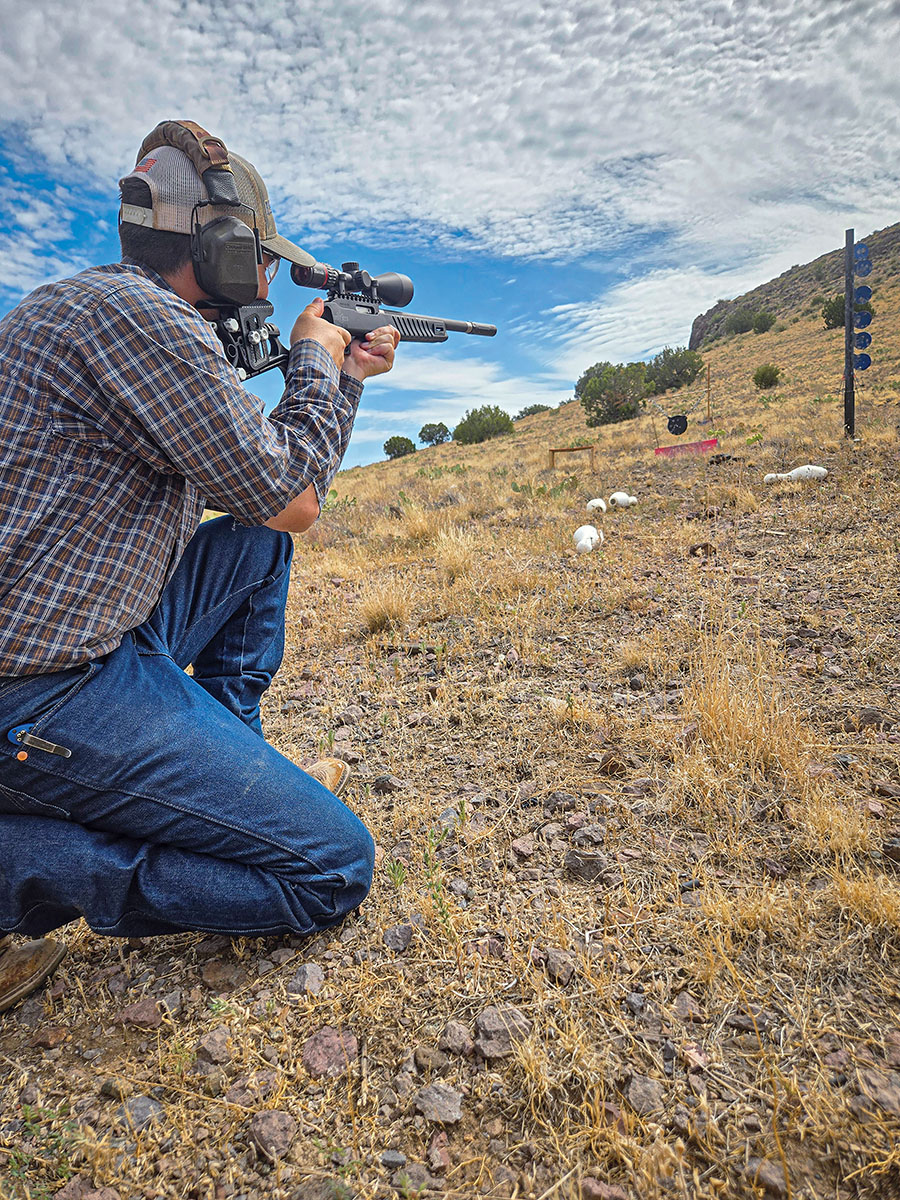
Shooting/plinking steel was a while lot of fun and proved that the rifle balanced well and transitions from target to target were quick and effortless. It would be easy for this rifle to serve double duty as both a ground squirrel rifle and a competition rig.
While the 22 LR is not optimal for coyote and larger critters – and I would not recommend it for taking such game in a pinch when it is all you have – it does work quite well. Sometimes, when you are in the field and all you have is the old ranch 22 LR, you have to do what you have to do. Thankfully, this rifle is much more accurate than your typical 22LR found on a ranch and is another reason it is a constant companion in the truck. I much prefer CCI Mini Mags segmented HP or CCI Stinger HP ammunition for larger critters. These are also great options for those who trap varmints and need a clean and quiet way to dispatch them.
For smaller game and varmints, this rifle has proven to be a favorite and has quickly earned a good reputation among those who have tried it. With the addition of the Dead Air Mask suppressor, there could be a full-on social gathering and conversations taking place, all while picking off ground squirrels on an alfalfa field. This is a huge benefit to using the 22 LR in the field. Another significant advantage of rimfires, particularly the 22 LR, is that the cost is about as low as it can be. As a result, more 22LR ammunition is sold over any other type of ammunition on the market.
With all these modern advancements in ammunition, the versatility of the 22 LR has been greatly increased, and its ballistics have been improved upon since its introduction - well over 100 years ago. Even to this day, the 22 LR is still a whole lot of fun to shoot and hunt with. Thanks to modern engineering and machining, the rifles we have are better than ever, and the Magnum Research SwitchBolt is no exception to this.
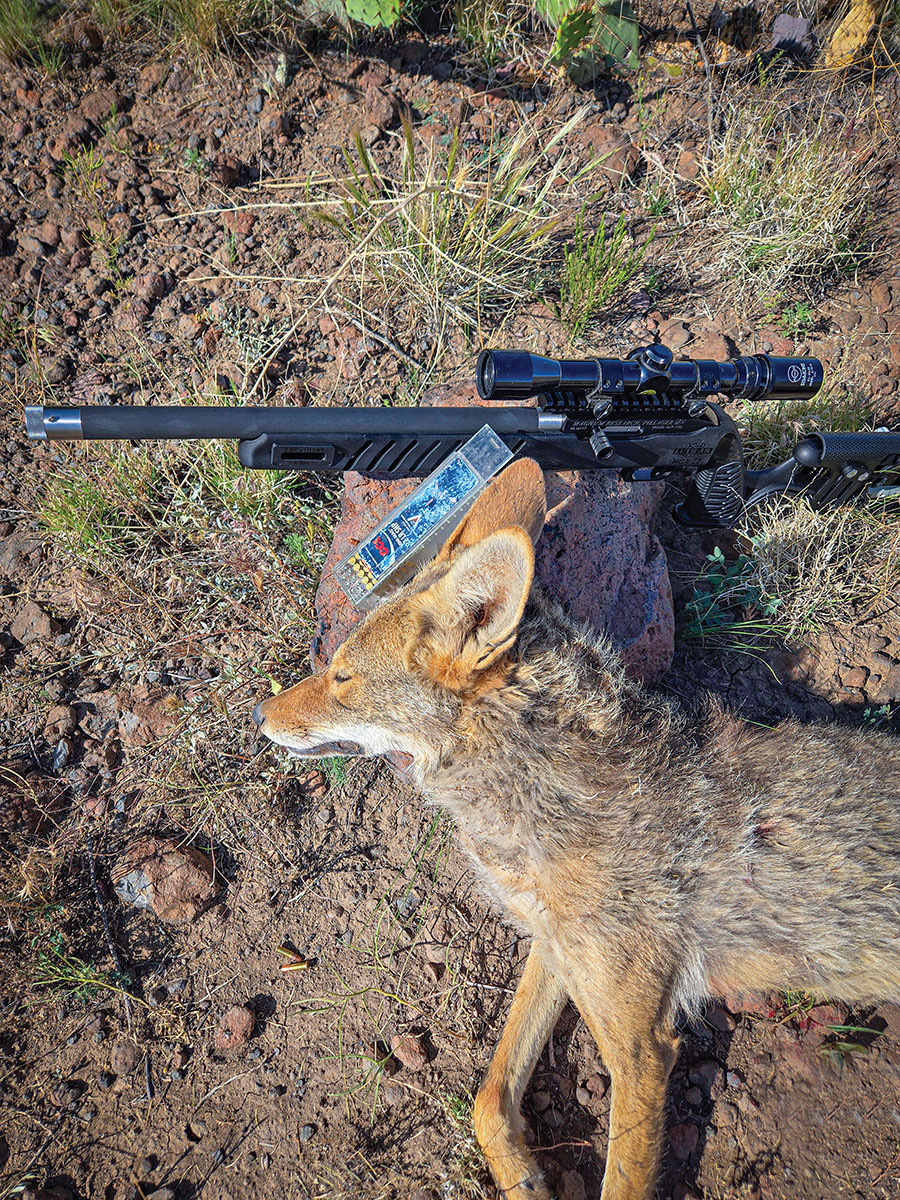
This Coyote was taken with minimal pelt damage with the Magnum Research SwitchBolt in 22 LR using CCI Mini Mag ammunition. With the proper shot placement, distance and ammunition, the 22 LR can be effective on coyotes – especially for those looking to harvest the pelts.