All Twisted Up
Heavy Bullets and the 220 Swift
feature By: Patrick Meitin | October, 19
Our fastest mainstream varmint cartridge is nearly 85 years old. Sure, there are a couple of .22-caliber cartridges that match or slightly edge its performance, but they never really grabbed American shooters’ imaginations like the Swift. Winchester chose the semi-rimmed 6mm Lee Navy as the parent case, and like anything well ahead of its time, the outdoor press summarily piled on. Furthermore, as is standard practice in the shooting community, decades-old assertions are passed down through the years – usually by people who have never actually shot the cartridge under discussion.
Modern barrels are quantifiably superior to those manufactured in the 1930s. But the standard line remains that Swifts quickly burn out barrels. Some early-model Swifts even included .223-inch grooves, holdovers from original 22 Hornets of the day. It is still occasionally related that Swifts develop dangerous pressure spikes. As a result, 220 Swift factory ammunition is generally anemic, often loaded below 22-250 Remington velocities in diffidence to older rifles. Handloading for modern firearms unleashes the Swift’s full potential.
The Swift’s overbore nature suffered from the limited powders available upon its introduction. The “barrel-burning” issue has largely been addressed by modern steels (combined with common sense, like not shooting your Swift until it gets so hot it’ll brand), improved cleaning techniques (a bore snake every 50 shots goes a long way toward extending barrel life) and up-to-date propellants.
Yet one glaring issue persists from those early days: The 220 Swift is hobbled by 1:14 to 1:12 rifling twist rates that stabilize only light bullets carrying low ballistic coefficients. Some traditions die hard. The 48-grain bullets Winchester loaded in introductory ammunition maximized velocity and grabbed headlines. Four-thousand-plus fps was certainly newsworthy in 1935, adding 1,000 fps to the pace set by the 1915 250 Savage.
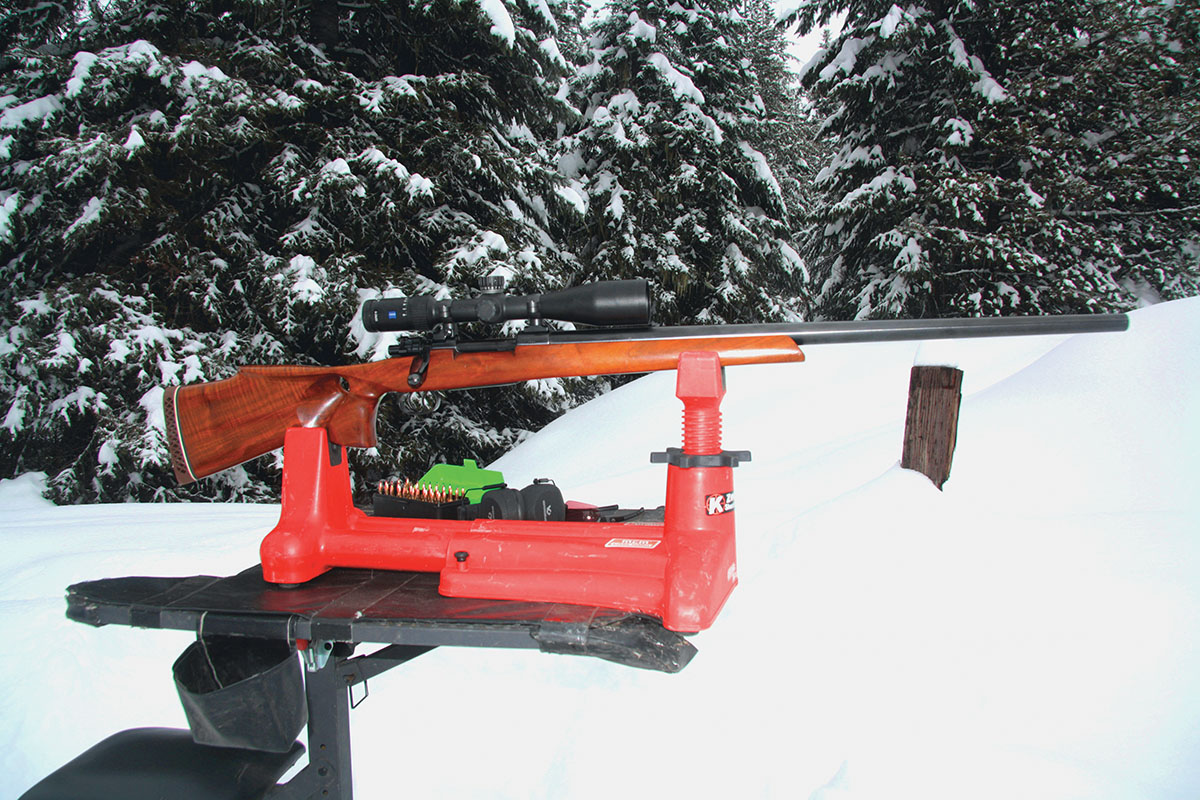
My father and I frequently discussed this travesty during varmint-shooting discussions. If any .22-caliber varmint cartridge could effortlessly accommodate heavier bullets, it was the 220 Swift. Dad finally did something about it, refitting a customized FN Mauser 98 with a heavy-contour (.870-inch just behind muzzle crown), 1:9 twist E.R. Shaw barrel. The rifle is glass bedded into a gorgeous thumbhole-stock of walnut and weighs 16 pounds with a scope added.
Load development posed initial challenges, as most 220 Swift load data dead-ends with 60-grain bullets in step with standard-issue rifling twists. Berger Bullets and Sierra loading manuals provided welcomed heavy-bullet starting points. The question then became how far bullet weight/length could be pushed in relation to the 1:9 twist. So I started where most others stop; 60 grains, working toward 75- to 80-grain bullets with BCs of .467 and .485, respectively. The goal was to create accurate 400-plus-yard loads for wind-cursed Western hunts for ground squirrels, prairie dogs, rockchucks and coyotes.
Bullets from Cutting Edge (60-grain ER Raptor), Nosler’s 60-grain Ballistic Tip and 70-grain RDF, Swift’s 62- and 75-grain Scirocco II, Sierra’s 65-grain GameKing SBT and 69-grain Tipped MatchKing, Barnes’ 69-grain Match Burners, Rocky Mountain Reloading’s (RMR) 69-grain 3-Gun Hunter (3GH), the Hornady 73-, 75- and 80-grain ELD Match bullets and Berger’s 77-grain BT Target were tested.
Of these, the Berger, heavier Nosler (and likely the heaviest Horn-ady ELD Match) bullets include 1:8 rifling twist recommendations. Pursuing higher BCs, particularly with the heaviest bullets, also meant many were not bona fide varmint designs, instead they were match or “big-game” numbers that might provide questionable expansion on burrowing rodents at longer ranges. This is typical of long-for-caliber bullets and especially consequential with tiny ground squirrels, most reaching their “expiration date” underground.
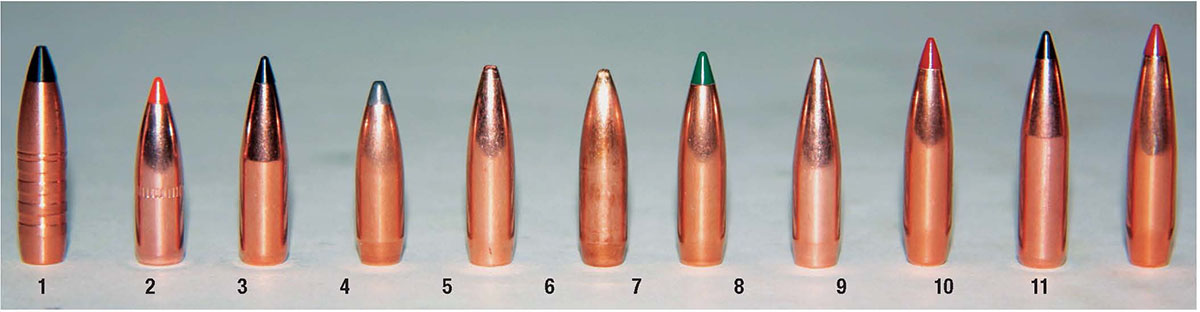
This is less problematic with rock-chucks; bullets typically zipping through, encountering rock and turning into “grenades.” For the predator caller collecting pelts for the raw fur market, less expansion could be considered ideal. Exceptions include the obvious Nosler Ballistic Tip, Cutting Edge ER Raptor and RMR’s 69-grain 3GH.
Powders were selected largely from stock on hand to load my 6mm and 25-06 Remingtons. These included Vihtavuori N-140; Winchester 760; Hodgdon Varget, H-4350 and Superformance; IMR-4451 Enduron, IMR-4350 and IMR-4831; Western Powder’s Ramshot Hunter, Accurate 2700 and 4350 and Alliant Reloder 19 and 22.
Other powders I had little experience with were added, including Hodgdon H-414, H-4831sc, H-1000 and H-4831; IMR Hybrid 100V and IMR-4166 Enduron; Ramshot Big Game; Alliant RL-16 and Power Pro 2000-MR. Also included was Hodgdon H-380, which I hadn’t loaded since a teen when shooting 60-grain hollowpoints from my 243 Winchester.
The Swift thrives on a huge variety of propellants, from IMR-4166 and Varget at the fast end to H-4831sc and H-1000 at the slower.
A word of caution: Listed loads are maximum for my rifle and all were tested in temperatures from the teens to the mid-30s. Some of the older powders are sure to become “hotter” with spring/summer temperatures. Reduce charges by at least 5 percent for starting charges. This is a solid argument for temperature-insensitive propellants in Hodgdon’s Extreme line, IMR’s Enduron powders, Alliant’s TZ Technology and the like. So why the focus on sheer velocity? Minimized flight time equals less wind drift, translating into more dead varmints at longer ranges.
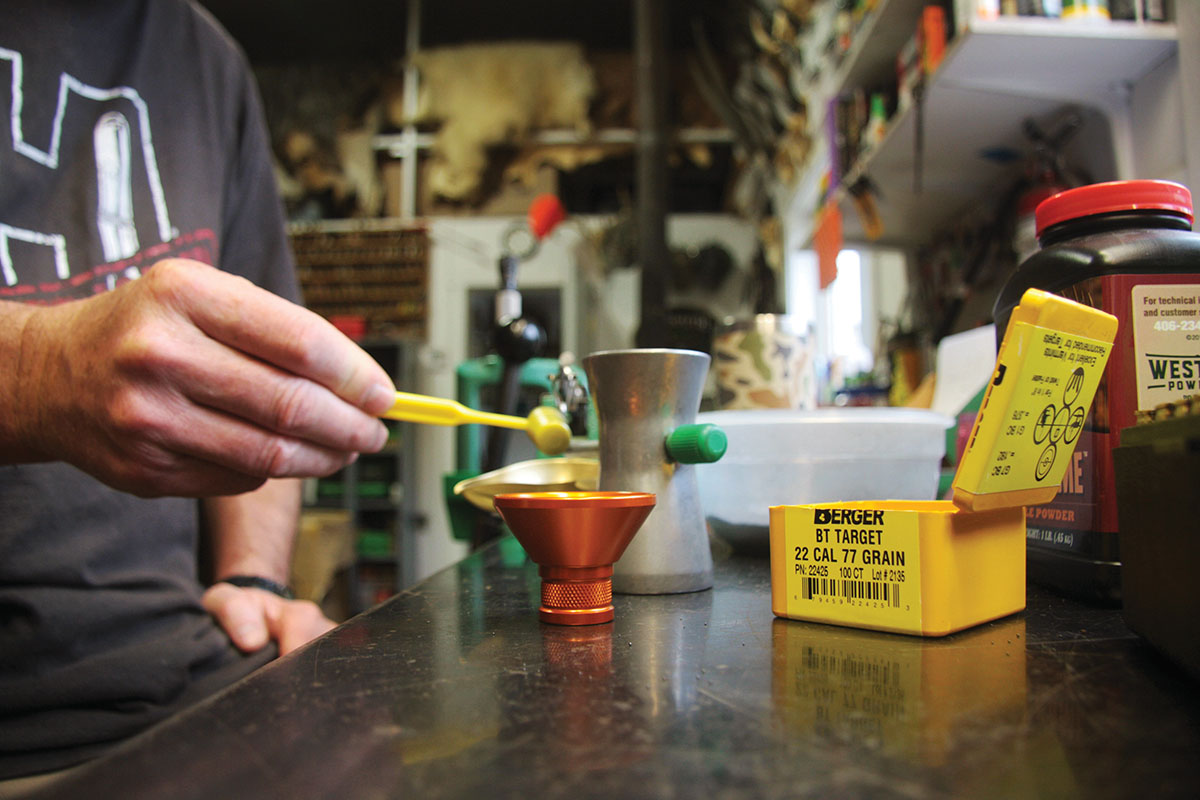
All powder charges were hand-trickled onto a RCBS beam scale and dumped into Norma brass fitted with CCI BR2 primers. The brand-new Norma brass held an average of 48 grains of water with a spent primer in place and filled to the brim. This is in contrast to Hornady brass (46.2 grains), Winchester (47.6) and Remington (47.9).
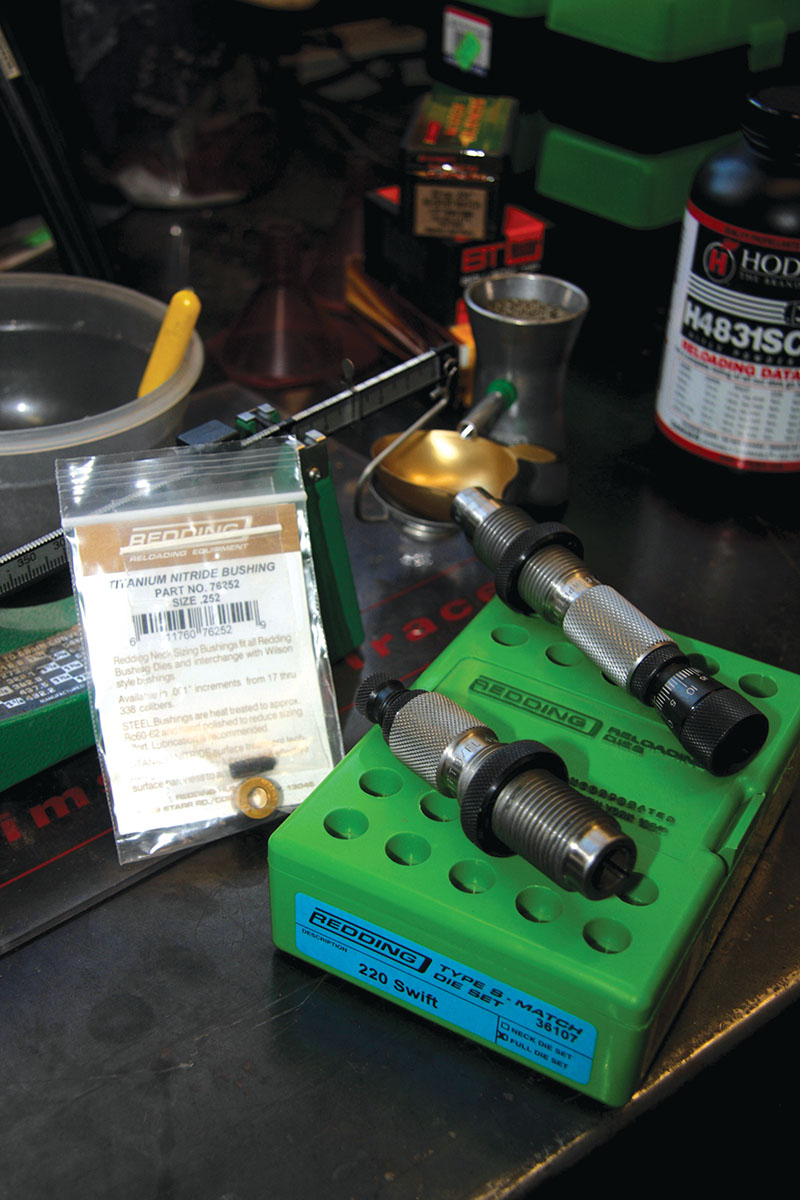
Another new experience was Redding’s Type S Match full-length die set with a .253-inch Titanium Nitride Bushing to give the best chamber fit. Interchangeable bushings are offered in .001-inch increments, allowing precise neck sizing based on specific brass thickness and desired chamber fit. Redding’s Robin Sharpless says sizing necks only as much as necessary, and the bushing’s self-centering nature, improves concentricity. The Titanium Nitride bushings minimize neck stress for longer brass life. Redding’s Competition Bullet Seating Die also provides ultra-tight internal tolerances plus instantly-repeatable and consistent bullet-seating depths measured to .001 inch.
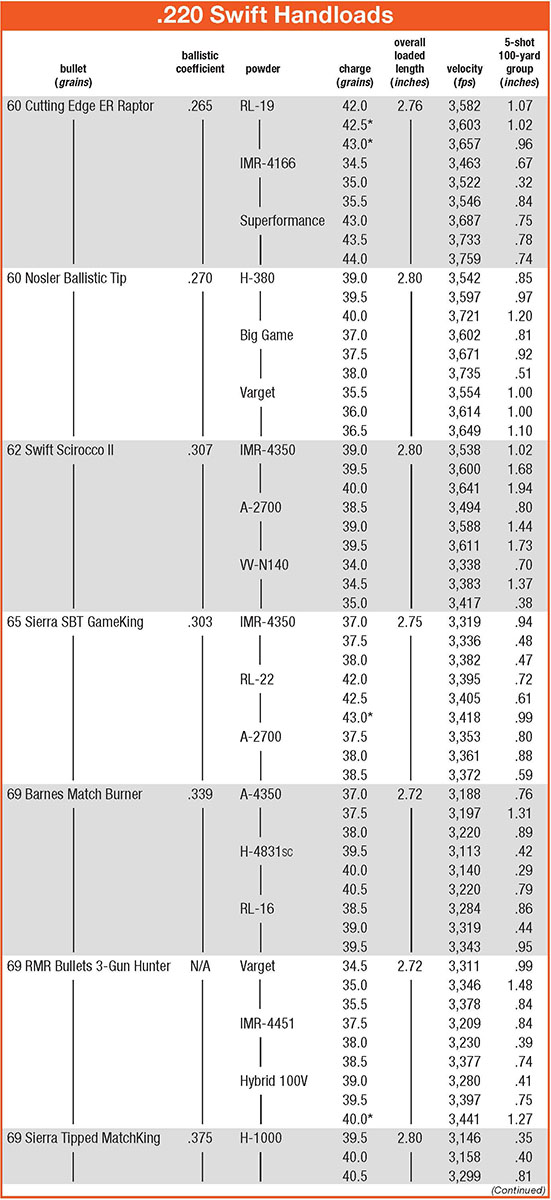
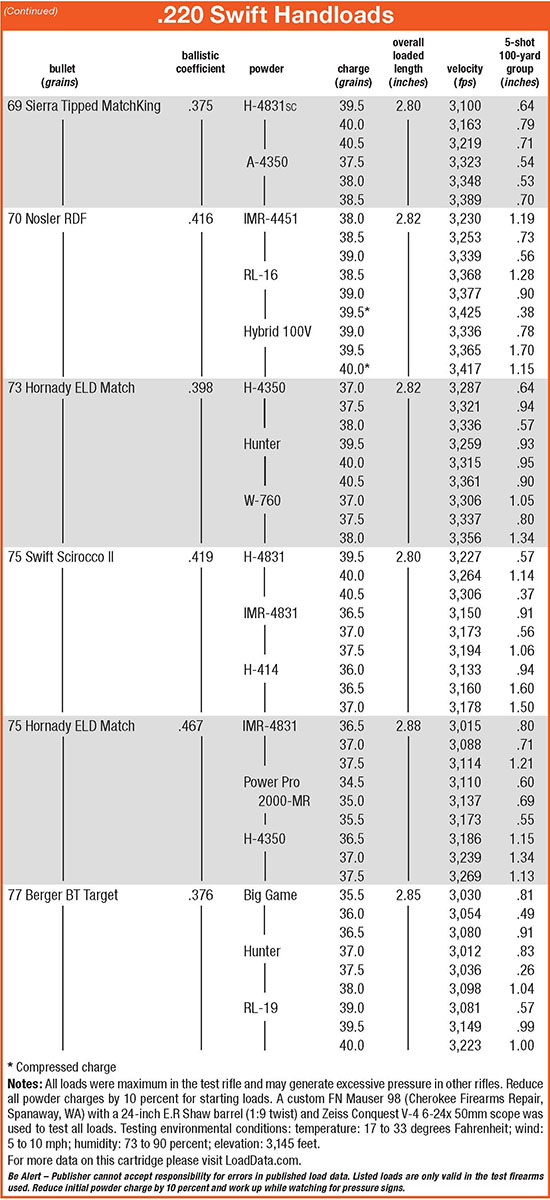
Overall this Swift and its 1:9 rifling twist proved fairly finicky, with loads on either side of ideal generally shooting poorly. Cutting Edge’s 60-grain ER Raptor got off to a bad start with Reloder 19 but redeemed itself with IMR-4166 and Hodgdon’s Superformance, producing one group smaller than .50-inch and three less than .75 inch. The best of these measured .32 inch with 39.5 grains of IMR-4166. All Superformance groups printed around .75 inch, so more work is warranted there. With Nosler’s 60-grain Ballistic Tip, the worst groups hovered right at an inch, the best a .51-inch group with 38 grains of Ramshot Big Game – all other groups measuring just less than an inch.
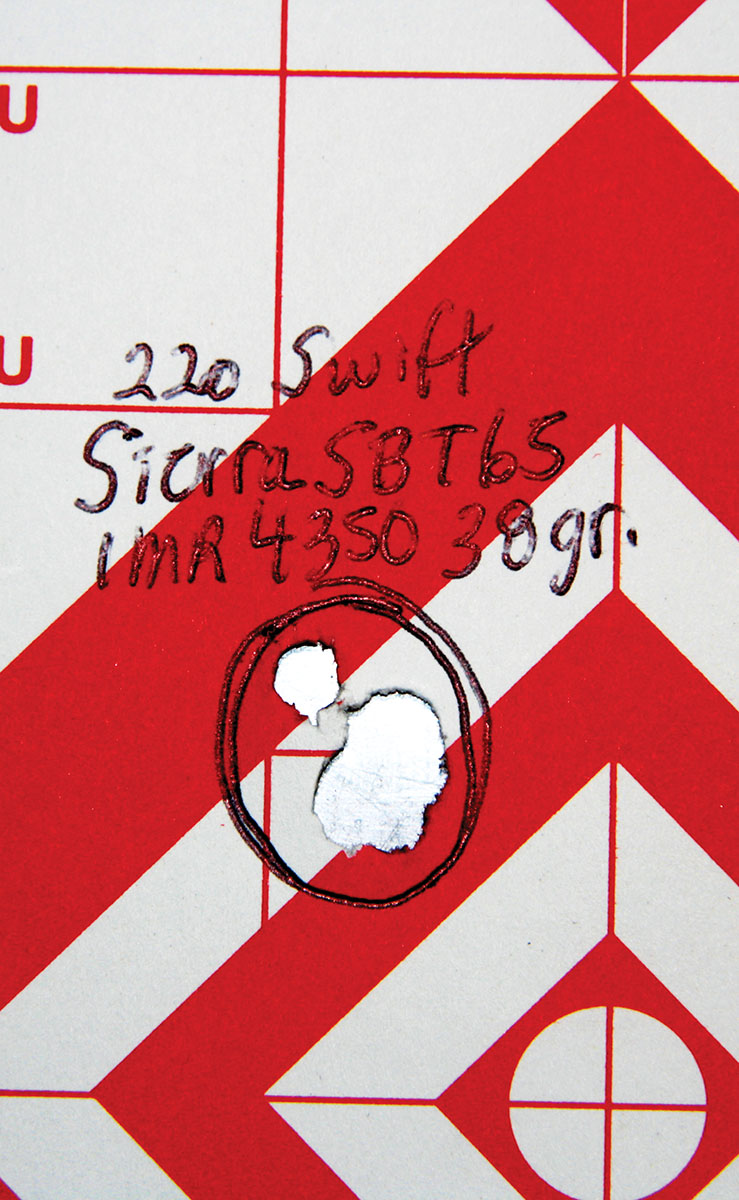
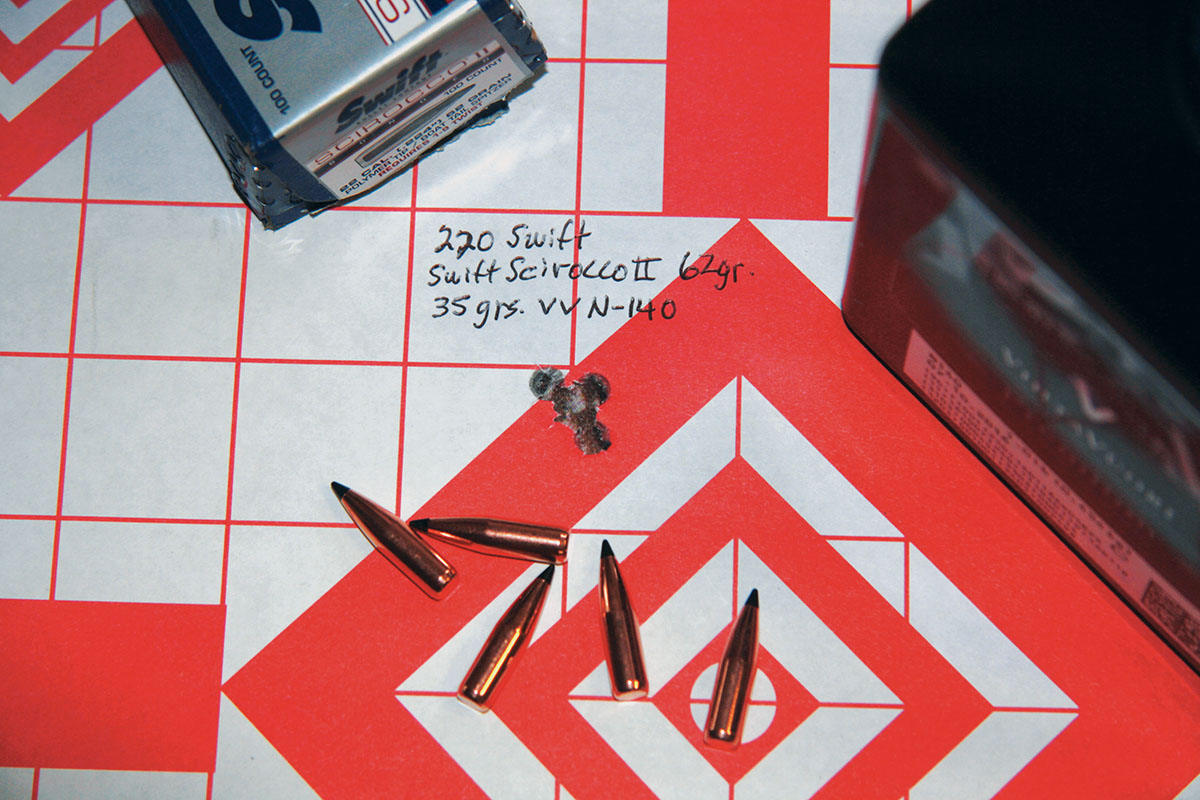
IMR-4350 proved surprisingly lackluster, with Swift Bullet’s 62-grain Scirocco II barely breaking an inch with the lightest load, the other loads approaching 2 inches. Accurate 2700 didn’t do much better. It took Vihtavuori’s reliable N-140 to wring some accuracy out of this bullet; 35 grains of powder produced one ragged hole measuring .38-inch – exactly what I was expecting from this rifle. Sierra’s 65-grain SBT GameKing, unsurprisingly, impressed with all loads printing less than an inch, three less than .75 inch and two sub-.50-inch groups. The best of these were .48- and .47-inch groups with 37.5 and 38 grains of IMR-4350. Reloder 22 and Accurate 2700 also provided respectable clusters. The Scirocco II and GameKing aren’t exactly small-varmint bullets but are exceptional pelt-shooting (or wild hog) options that won’t shred valuable hides or break up on bone.
This rifle had a sweet spot with 69- to 70-grain bullets, which produced nine groups measuring less than .50 inch. Eighteen loads bettered. .75 inch and only seven loads measured more than an inch.
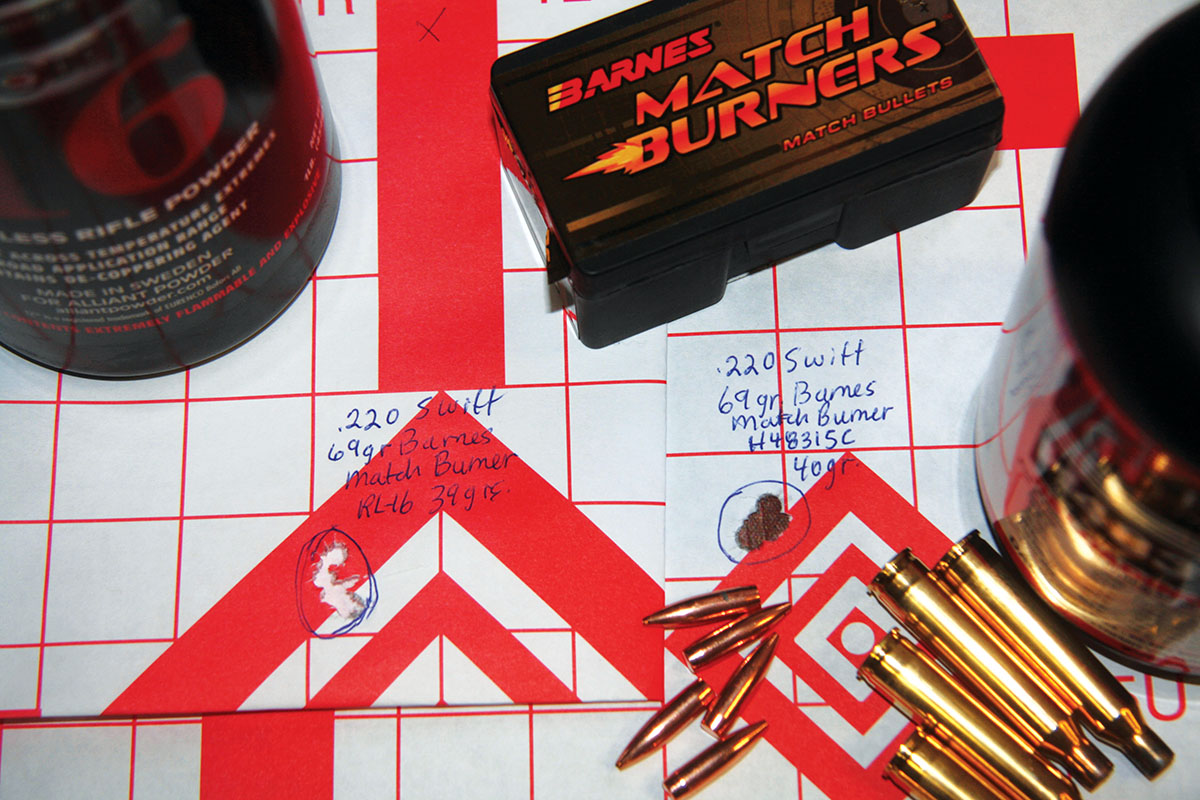
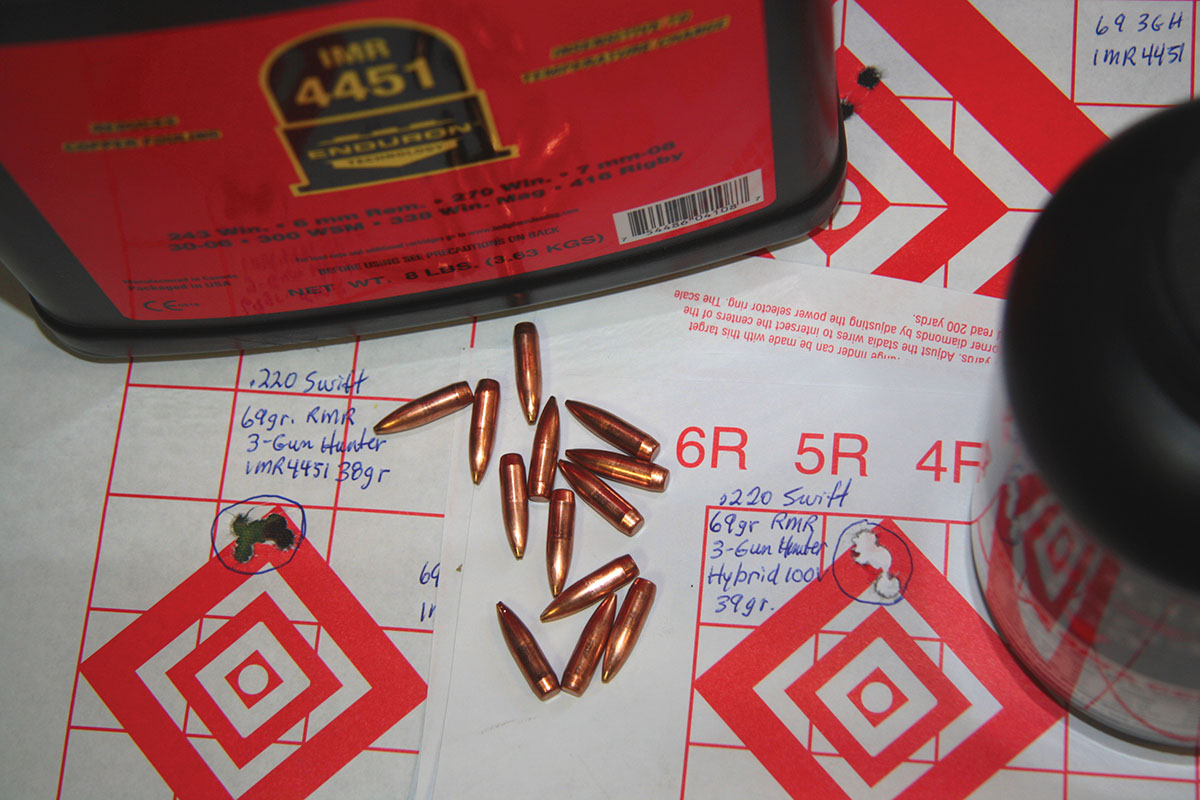
Barnes’ 69-grain Match Burners accounted for three sub-.50-inch groups; .42 inch with 39.5 grains and .28 inch with 40 grains of H-4831sc and .44 inch with 39 grains of Reloder 16. RMR’s 69-grain 3GH produced two sub-half-inch groups, including .39 inch with 38 grains of IMR-4451 and .41 inch with 39 grains of Hybrid 100 V. Hodgdon’s H-1000 paired well with Sierra’s Tipped MatchKing (TMK), producing .35- and .40-inch groups with 39.5 and 40 grains, respectively. Nosler’s 70-grain RDF printed an impressive .38-inch group with 39.5 grains of Reloder 16. Overall, H-4831sc, IMR-4451, Hybrid 100V and Reloder 16 proved most consistent in this bullet class. Hornady’s 73-grain ELD-Match did its best work with 38 grains of H-4350.
There were also the usual tight groups ruined by a single frustrating flier. The Sierra 69-grain TMK with 39.5 or 40 grains of H-1000 and 73-grain Hornady ELD Match with 38 grains of H-4350 and 40 grains of Ramshot Hunter deserve further exploration. Of note were Winchester 760 loads, which produced impressive single-digit extreme velocity spreads (five shots) but conspic-uously unimpressive groups. This only reaffirms my conviction that extreme velocity spread is worthless information to accuracy-conscious handloaders.
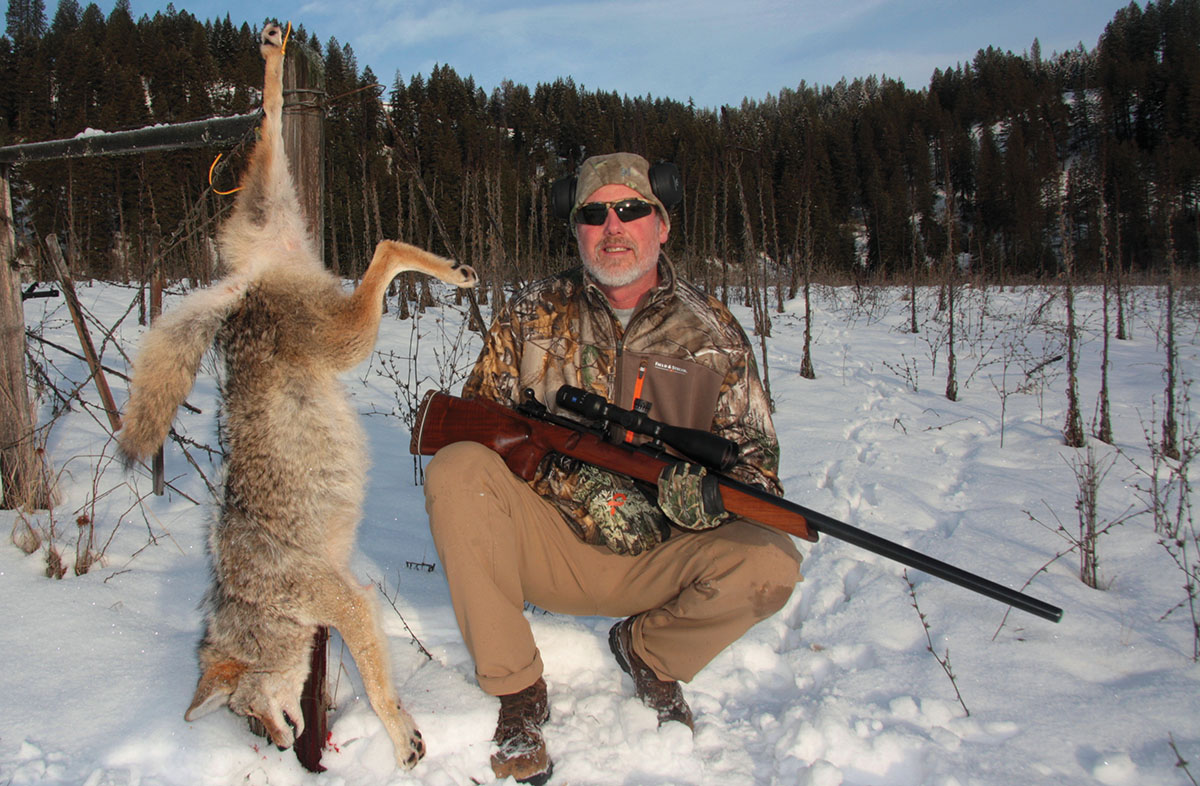
Some quick asides: I shot a hefty mountain coyote with a Barnes’ Match Burner while testing this rifle. The bullet expanded aggressively – not good for pelt hunters but great news for small-varmint shooters. I’ve shot jackrabbits and ground squirrels with RMR’s 3GH, which have expanded at 223 Remington velocities. I have also shot small varmints with 95-grain 6mm Sierra Tipped MatchKings from my 6mm Remington with pleasing results, so the 69-grain TMK at 220 Swift velocities should prove satisfactory.
On the heavy-bullet end, the Shaw barrel’s 1:9 twist obviously didn’t provide enough stability for Hornady’s 80-grain ELD Match bullet. The smallest group touched 3 inches, most others measuring 5 to 6-plus inches. This bullet obviously needs at least a 1:8 twist, so I removed them from the load list.
Knocking off just 3 to 5 grains, Swift’s 75-grain Scirocco II, Hornady’s 75-grain ELD Match and Berger’s 77-grain BT Target provided better results. In fact they produced excellent accuracy, at least when combined with the right powder and charge. The best 75-grain Scirocco II group (.37 inch) resulted from 40.5 grains of H-4831, with other noteworthy groups including .56-inch with 37 grains of IMR-4831 and .57-inch with 39.5 grains of H-4831. Hornady’s 75-grain ELD Match pushed by 34.5, 35 and 35.5 grains of Alliant Power Pro 2000-MR printed .60-, .69- and .55-inch groups, respectively; 36.5 grains of IMR-4831 provided a promising .71-inch group that included a flier. Only two 77-grain Berger groups broke an inch, with the top three-shot clusters including a .57-inch group with 39 grains of Reloder 19, .49 inch with 36 grains of Ramshot Big Game and .26 inch from 37.5 grains of Ramshot Hunter. Berger’s on-the-box promise that these bullets are “excellent for varmints” is also encouraging.
It was exciting to see a subject of frequent musings become reality, and even more thrilling was realizing such promising results. This 220 Swift is a shooter! As an added benefit, sacrificing a bit of velocity by shooting heavier, higher-BC bullets should mitigate worries of premature barrel wear while also providing substantially less drop and wind drift on those long pokes that inspired this rifle’s conception.