Login


Wolfe Publishing Group
    Menu

    Rifle Talk

    CZ 457 American 22 Magnum

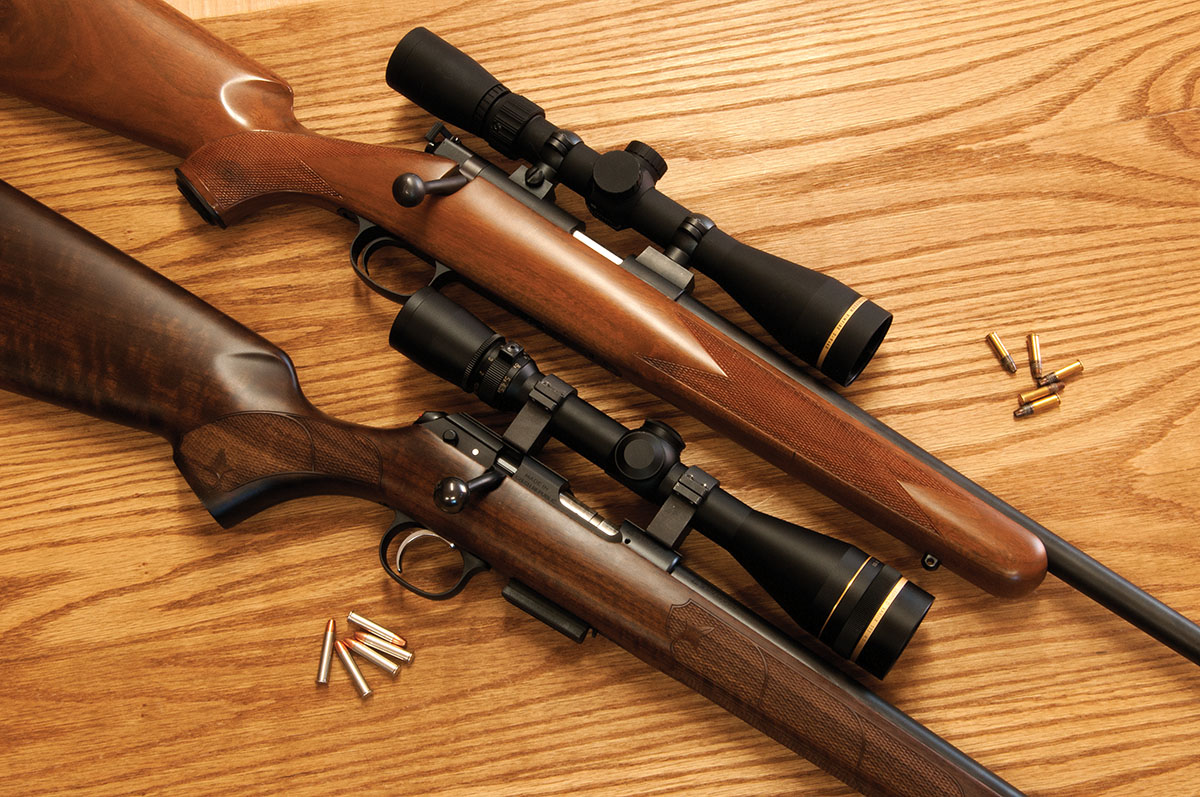
    The dark, Turkish-walnut stocked CZ 457 American .22 Winchester Magnum has a lean profile that is nearly as trim as the long-discontinued Kimber 22 .22 Long Rifle. Both are representative of the classic style.
    The dark, Turkish-walnut stocked CZ 457 American 22 Winchester Magnum has a lean profile that is nearly as trim as the long-discontinued Kimber 22 22 Long Rifle. Both are representative of the classic style.
    A few utilitarian rifles and shotguns were stored in a shallow bedroom closet. With occasional permission, Dad allowed the removal and sometimes disassembly of each one. Then, one at a time I wiped them down with WD-40 (!), helped put them back together and awaited another opportunity. Their engineering was too complicated to understand at the time, but the cold, blued barrels, firing and ejection systems became more interesting over time. This sounds silly today given my career path, but most fascinating of all were the stocks. The look and feel of the ordinary walnut was pleasant even to a boy.

    Note the straight lines of the 22 Magnum 457 varmint/plinking rifle. For testing purposes, it was topped off with an older Leupold 4.5-14x Vari-X III with an adjustable objective.
    Note the straight lines of the 22 Magnum 457 varmint/plinking rifle. For testing purposes, it was topped off with an older Leupold 4.5-14x Vari-X III with an adjustable objective.
    A new 22 Long Rifle was added, a Ruger 10/22, when I was about 10 years old. As with many older Ruger rifles, it had a stock of dark walnut with nearly black, thin and narrow lines running full length, butt to forend. The stock’s grain structure truly captured the attention of an impressionable mind. In spite of the fact it wouldn’t cycle hollowpoint loads reliably, shooting that 22 Long Rifle at a tender age while providing it with a share of dings and scratches while chasing jackrabbits, meant many things; one being a life-long preference for walnut and blued steel. That 10/22 is still in fine condition to this day.

    This may be old-school ideology, but today as increasing numbers of rifles lack the lines, look and feel of “tradition” and so-called “modern” versions prove over and again that they can be accurate and sometimes less expensive, plastic stock or otherwise, it’s nice to know a few manufacturers mindfully continue to provide classically-styled long-guns made of walnut and blued (or coated) steel. If this sounds like harping, please accept all apologies. Yet if correspondence sent to the office from readers of Rifle, Handloader and Varmint Rifles & Cartridges (first published as a special edition in 2012) are a reliable “barometer,” the majority of enthusiastic rimfire shooters who read these magazines prefer walnut over injection-molded stocks.
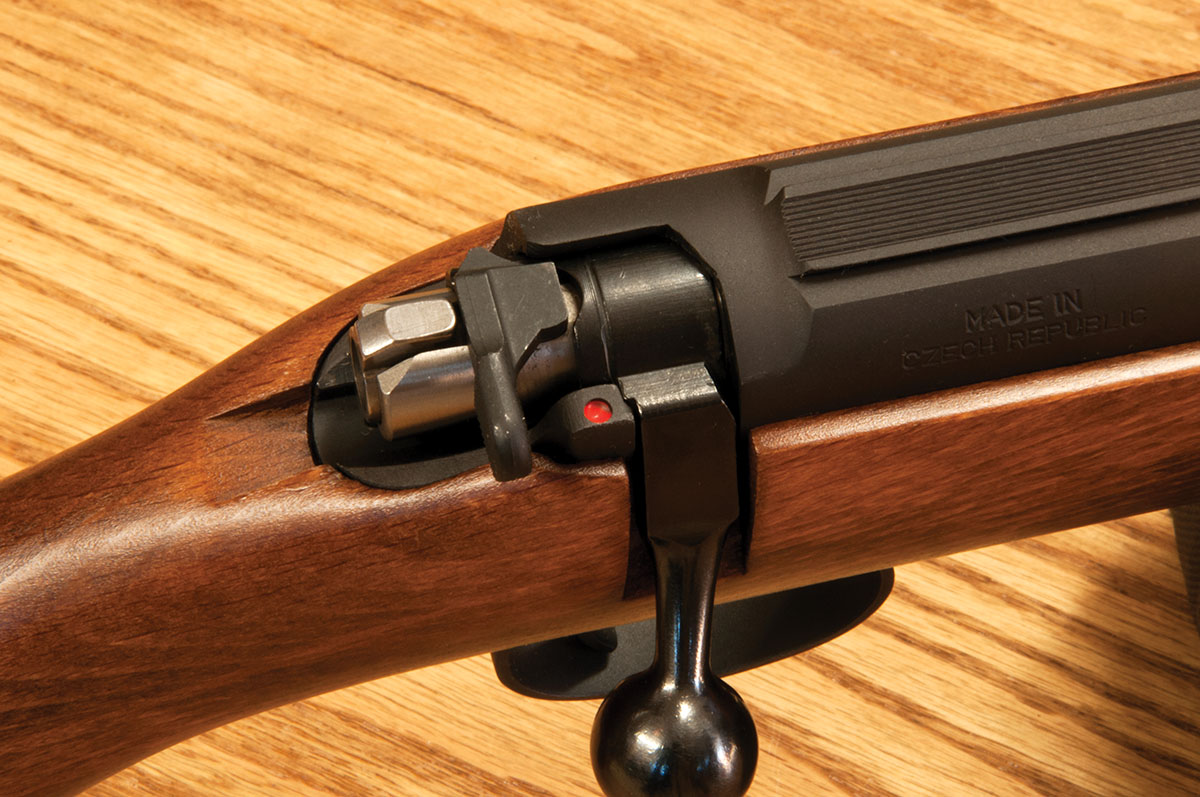
    Older CZ rifles like this Model 452 Scout 22 Long Rifle featured a safety lever located on the bolt, which required a shooter to pull the lever back to fire. Newer Models feature a traditional two-position sliding safety on the receiver’s side.
    Older CZ rifles like this Model 452 Scout 22 Long Rifle featured a safety lever located on the bolt, which required a shooter to pull the lever back to fire. Newer Models feature a traditional two-position sliding safety on the receiver’s side.

    They long for new rifles that don’t fit the current “mold.” In this regard, CZ USA is one stand-out with two or more handfuls of rimfire offerings, one of which is the subject here: The 457 American 22 WMR bolt rifle that features a fairly thin and trim stock that in many ways is similar to the most accurate 22 Long Rifle I own, a Kimber 22, which has been out of production for years. The 457 American is not quite as accurate, but 22 Magnums don’t often shoot quite as well as the best 22 LRs, including others made by CZ.

    Nonetheless, the American is a nice plinking/varmint rifle that weighs roughly 7.5 pounds with a Leupold Vari-X III 4.5-14x with an adjustable objective attached in CZ rings. The fact that 11mm rings don’t come with the rifle proved a bit frustrating, but a call to High Country Guns in Prescott proved there was at least one set in town. Then it was discovered that a neighbor had a set of rings I could use. Though a little on the bulky side for an all-purpose hunting rig, this old Leupold is often used to evaluate accuracy potential of rimfire rifles and/or ammunition.
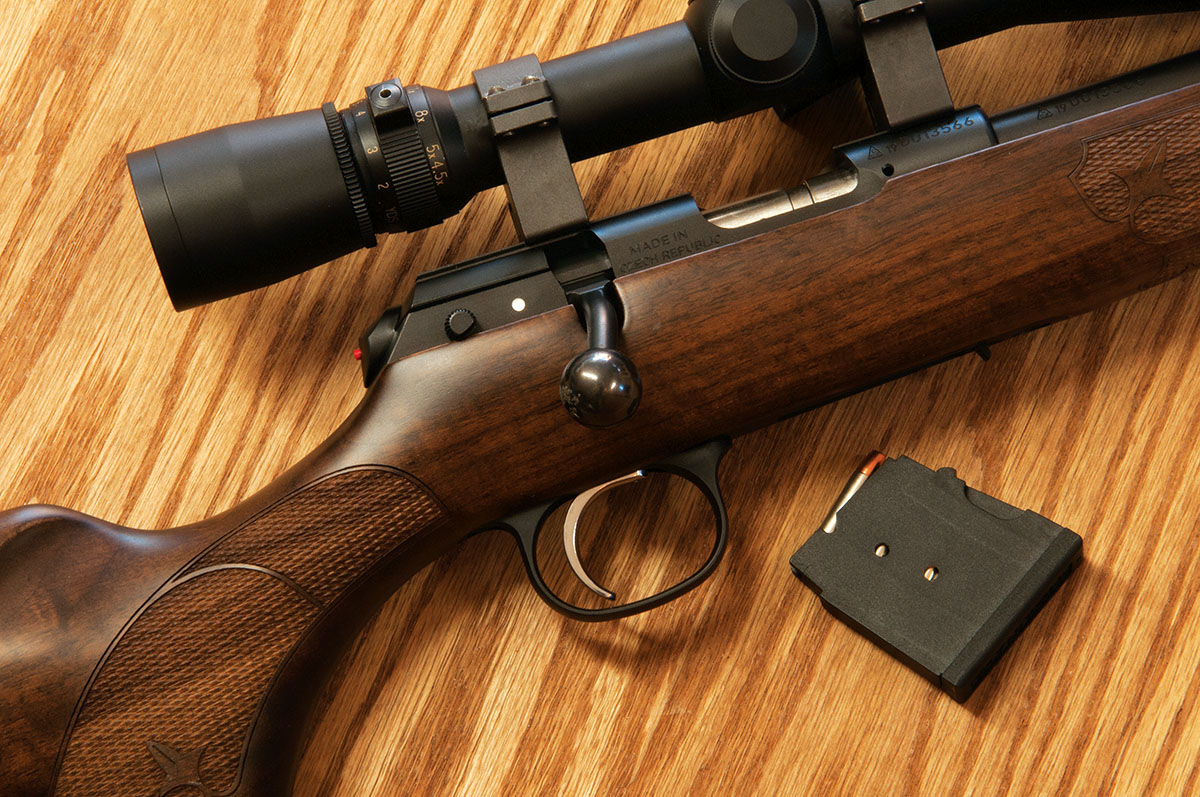
    Magazine capacity is five rounds of .22 Magnum. Note the traditional 11mm dovetail scope rail atop the receiver and two-position safety.
    Magazine capacity is five rounds of 22 Magnum. Note the traditional 11mm dovetail scope rail atop the receiver and two-position safety.
    Above and beyond other bolt-action makers, CZ has for some years provided a broad selection of wood-stocked rifles for the rimfire crowd. The American 22 Magnum features a cold hammer-forged barrel measuring 24.8 inches long and .560 inch at the muzzle; twist rate is 1:16. For some years the company was criticized by purists for the use of stamped bottom metal, but the 457’s setup consists of two opposing pieces of machined steel with a Torx-head screw at each end that mates with the receiver.

    Loosening the two screws reveals that the front half of the bottom metal dovetails into the trigger guard proper. The rear screw also passes through a sort of steel pillar arrangement that appears to be pressed into the stock. Aft of this – in its own mortise – sits a small piece of steel about 5⁄8 inch wide by 1⁄8 inch thick that serves as a recoil lug. Trigger pull is adjustable, but there appeared to be no good reason to fiddle with the test rifle simply because its trigger released at 3 pounds as measured with a Lyman digital trigger pull scale.

    Along with updating the bottom metal, the 457 has a two-position safety that is a departure from many older CZ rimfires that used a lever on top of the receiver that worked “backward.” To fire the rifle, the safety lever was pulled back instead of pushed forward. The 457’s safety is located on the side of the receiver: The rear position is “safe” and the forward position is “fire.” A latch to remove the bolt is located on a flat on the left side of the receiver.

    As suggested, the Turkish walnut stock is quite attractive, dark in color with extensive figuring. Ample checkering wraps around the forend while the pistol grip features a panel on each side. As is common with machine or laser checkering, the panels aren’t nearly as dark as the rest of the stock, which is a dark chocolate color with attractive grain.
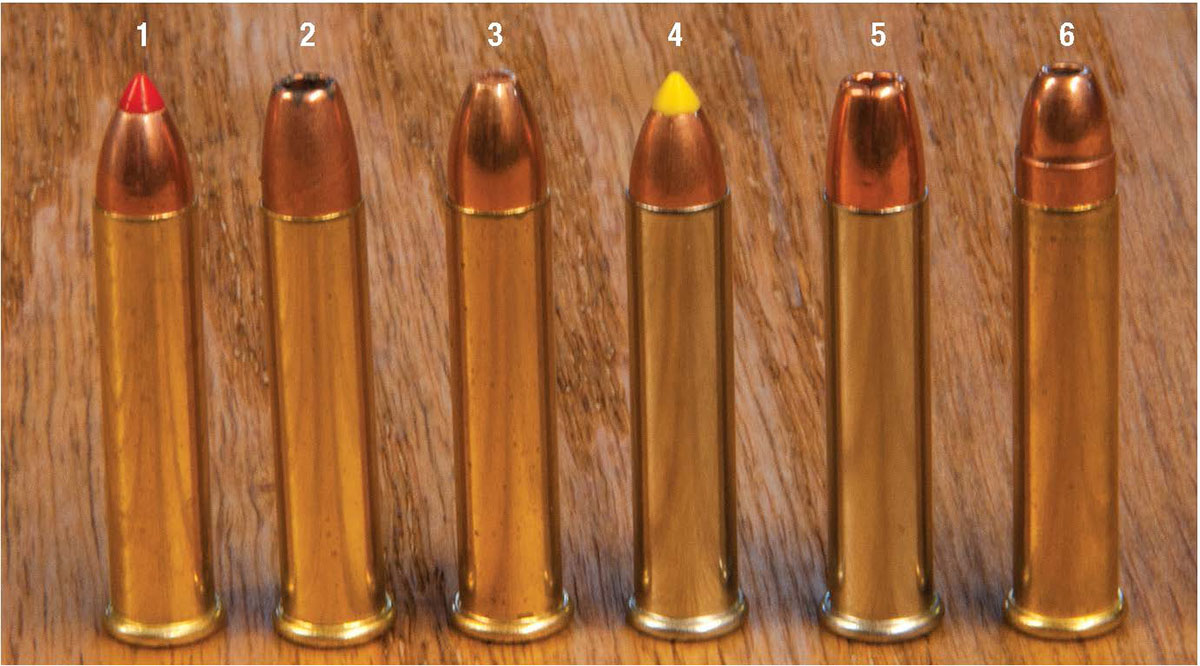
    Bullets tested included the (1) Hornady 30-grain V-MAX, (2) Speer 30-grain TNT, (3) Speer 30-grain TNT Green HP, (4) CCI 30-grain VNT, (5) Speer 40-grain Gold Dot HP and a (6) Federal 50-grain jacketed HP.
    Bullets tested included the (1) Hornady 30-grain V-MAX, (2) Speer 30-grain TNT, (3) Speer 30-grain TNT Green HP, (4) CCI 30-grain VNT, (5) Speer 40-grain Gold Dot HP and a (6) Federal 50-grain jacketed HP.
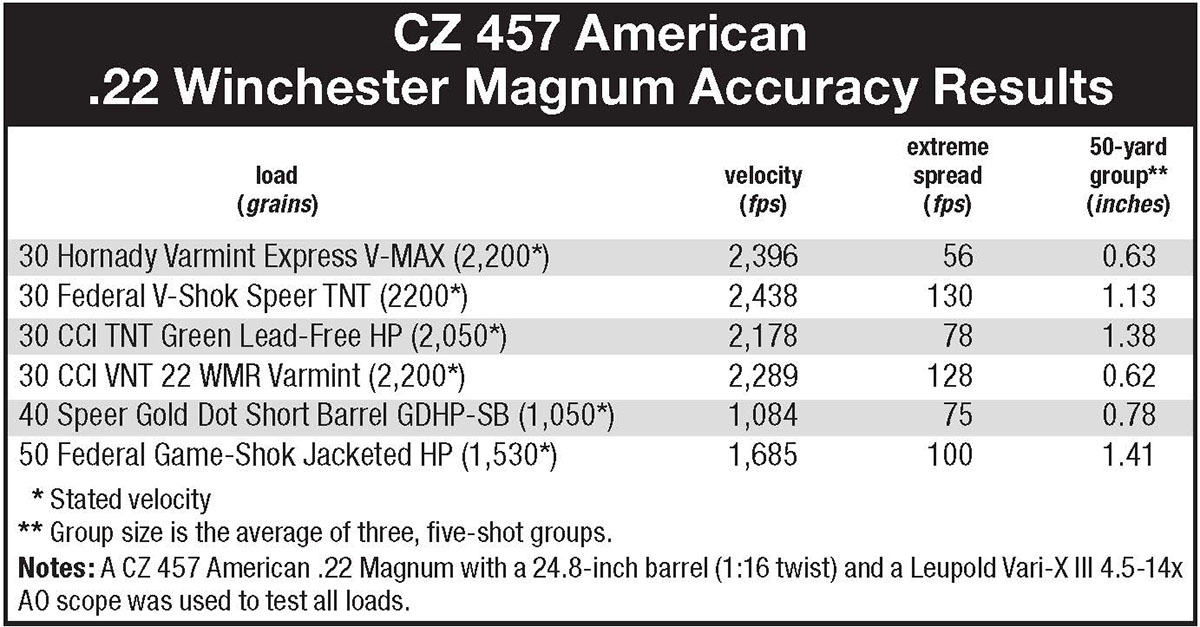
    Three five-shot groups at 50 yards were deemed sufficient enough to provide a realistic accuracy comparison.  Six very different options were used to test the CZ 457 American: Hornady Varmint Express Rimfire 30-grain V-MAX; Federal V-Shok 30-grain Speer TNT; CCI TNT Green 30-grain Lead-Free Hollow Point;  CCI VNT  22 WMR 30-grain Varmint; Federal Game-Shok 50-grain Jacketed Hollow Point and Speer Gold Dot Short Barrel Personal Protection 40-grain GDHP-SB. Most loads provided representative accuracy, including the tipped Hornady load with an average group of .631 inch and CCI’s VNT load (.628 inch average). Other loads produced average groups around an inch (see table).

    Winchester introduced the 22 Winchester Magnum Rimfire cartridge in the late 1950s, but it took a year or so before the company had a rifle in which it could be used, the Model 61 pump. During that short window, the 22 Magnum was issued in the Marlin Levermatic. Over time, nearly every manufacturer that could (can) accommodate the 22 Magnum’s long case has provided firearms of various types, including single shots, revolvers, combination guns and gas- or manually-operated repeating rifles. The cartridge has survived (even thrived) the “Great Rimfire Recession,” as evidenced by a mind-boggling number of ammunition options.

    In my estimation, CZ USA’s 457 American rifle is far more than just another 22 Winchester Magnum. With an eye-popping walnut stock, traditional lines and known accuracy, it represents a return to the classic rimfire sporting rifles of my youth. Furthermore, in comparison to prices for used Ruger 77/22 22 Magnums the American costs roughly $300 less.

    Wolfe Publishing Group