

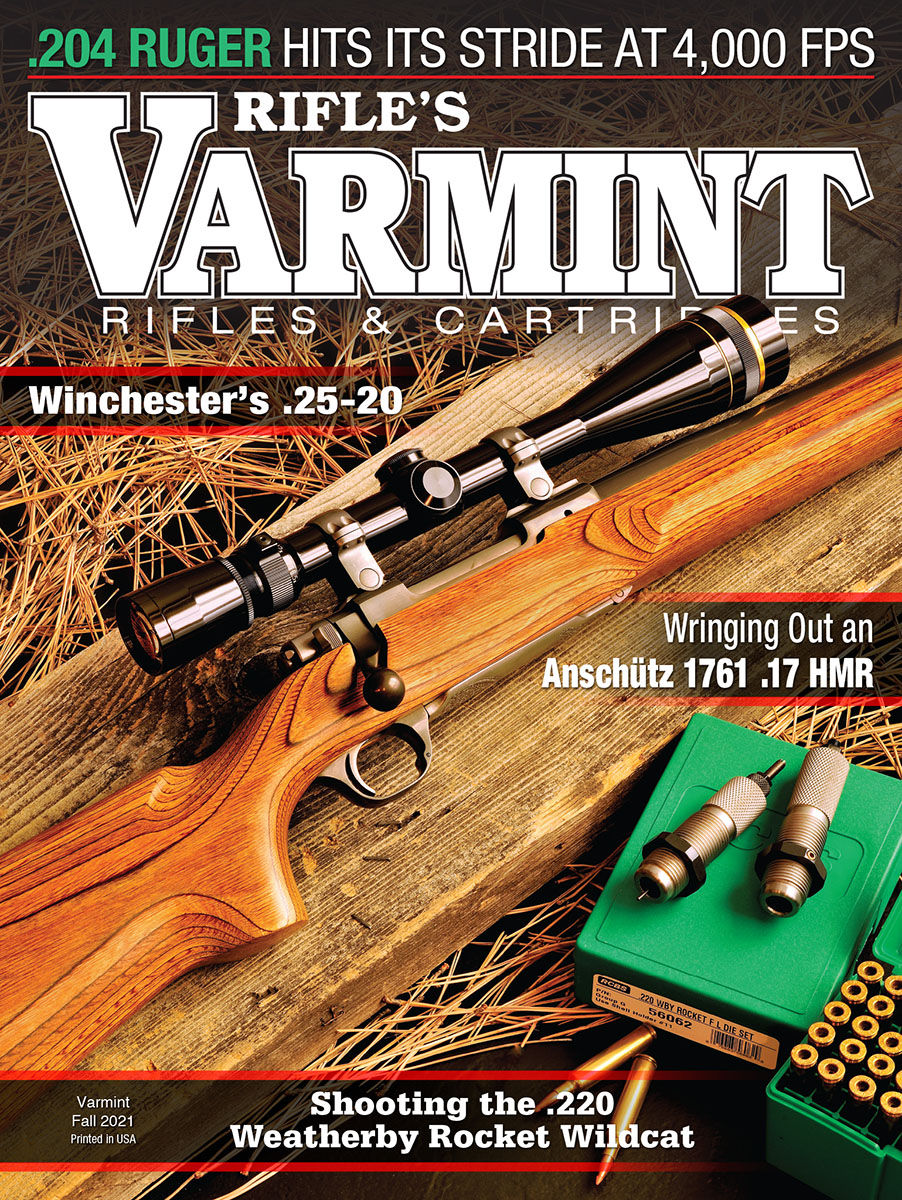
Varmint Fall 2021
On the Cover: A Ruger MK II Target converted to the Weatherby 220 Rocket with a Leupold 6.5-20x scope. Photo by Stan Trzoniec.
Volume 14, Number 2 | ISSN:
Article Bites
Rifle Talk
Remington Scoremaster 511
column by: Lee J. Hoots
It’s not quite so easy to pin down what could be considered the beginning of the “heyday” of classic bolt-action rimfire rifles, but it surely lasted at least through the 1960s and into the late 1970s. Rifles like the Marlin-Glenfield, Winchester Model 64 and Savage Model 4 were considered “boy’s rifles” and were made as such. Those like the Winchester Model 52 ruled match shooting, which demanded great accuracy from the shooter and rifle both. ...Read More >
220 Weatherby Rocket
Loads That Bring Out the Best in This Wildcat
feature by: Stan Trzoniec
When it came to rifle cartridges, Roy Weatherby was an innovator. He had to be. Without a staff of engineers, ballisticians or a direct source for brass, over the years he turned out some very distinct cartridges in a wide variety of calibers. From small-game .22s to the bone-crushing .460 Magnums, if a shooter wanted something special along with a very elegant rifle, Weatherby was the man. ...Read More >
Winchester's 25-20
Does it Still Have a Place in Varminting? Yes.
feature by: Art Merrill
If any object intended for lethality could be called “cute,” the 25-20 Winchester is a candidate. Looking pretty much like a “mini-me” version of the British military 577/450 Martini-Henry cartridge of 1871, the long bottleneck profile of the 25-20 Winchester harkens to roughly the same black-powder metallic cartridge era, having been introduced by Winchester in 1893. ...Read More >
Ruger Model 77 Varmint 220 Swift
Testing Loads - and Two Scopes
feature by: Randy Bimson
As a gunmaker, design engineer and recently retired director of technical affairs and advisor of the Sporting Arms and Ammunition Manufacturers’ Institute (SAAMI), I must admit that the why and how of the design of a particular firearm, a cartridge, or other piece of kit from reloading tools to optics, has always been of interest to me. This article centers around a rifle, the Ruger Model 77 Varmint. The cartridge the rifle is chambered for is the 220 Swift; and one of two telescopic sights used with the rifle, the Bausch and Lomb BALvar 24. ...Read More >
The 17 (Hornady) Hornet
Small, but it Still Stings
feature by: Phil Massaro
My first experience with the little .17 Hornet was a trial by fire. I was sitting over a hot prairie dog town in the middle of the Rosebud Reservation of South Dakota, loading and shooting as fast as I could. The speedy, little cartridge would create the famous “red mist” at distances out to 200 yards, killing cleanly out to 350 yards and proved to be wonderfully accurate. Recoil and report were both significantly diminished in comparison to the 223 Remington and the 22-250 Remington, and the additional velocity of the Hornet gave it an advantage over both the 17 HMR and 17 WSM rimfire cartridges. Though the 17 Remington is an absolute speed demon, the Hornet is undoubtedly easier on throats and barrels. ...Read More >
223 Remington
Loading Lead-Free Bullets
feature by: Patrick Meitin
Politicians have an insidious habit of disguising larger schemes under the mantel of “the greater good.” The Golden State’s (California) wholesale ban on lead bullets, serves as an illustrative point. “Trust The Science!” has become dubious. ...Read More >
A Need for Speed
The 204 Ruger Hits Its Stride at 4,000 fps - and Beyond
feature by: Art Merrill
Ruger and Hornady designed and purpose-built the 204 Ruger varmint cartridge from the get-go specifically to launch 32-grain bullets at 4,000 feet per second (fps). As a successful production cartridge, the 204 Ruger has the .20-caliber niche all to itself. ...Read More >
Ruger 10/22 Rifles
A Survey of Custom Varmint Rifles
feature by: Layne Simpson
I love all types of varmint shooting, with high-volume days in prairie dog and Richardson’s ground squirrel towns at the top of my fun list. Flat-shooting, centerfire rifles take center stage, but when I grow weary of muzzle blast through double ear protection, I reach for a rifle chambered for a rimfire cartridge and enjoy the challenge of stalking closer prior to pulling the trigger. For that, my super-accurate custom Ruger 10/22s are just the ticket, and here are brief looks at them. ...Read More >
Winchester's Model 94 Rimfire
Loading Three Rifles
feature by: Dick Williams
As a kid, I firmly believed there was only one rifle worth having: a Winchester lever action. At the time, I had no clue as to how many different lever-action rifles Winchester made, nor did I care. It just had to be a lever action because that’s what all the cowboy heroes carried in movies and television shows. Being one of those lucky kids that had access to some open land for small-game hunting, my only stipulation was that it had to be chambered in 22 Long Rifle. Alas, Winchester didn’t make such a gun, and while I settled for other .22 rifles over the next half century, including Marlin’s excellent Model 39, I was never quite satisfied. ...Read More >
Wringing Out an Anschütz 1761 Rifle
An All-New 17 HMR
feature by: Patrick Meitin
Ulm, Germany-based J. G. Anschütz & Company developed an enviable reputation among precision-minded rimfire shooters after its Match 54 rifle won several Olympic gold medals in 1960. The company’s history dates back to 1856, when Julius Gottfried Anschütz founded J.G. Anschütz in Mehlis, Thuringia, Germany. Forty years later, the company moved from that small workshop to its first factory building, and within 10 years it grew from 76 to 550 employees. After the Russians dismantled the factory following World War II, Anschütz moved to Ulm, West Germany. Since those first Olympic wins, Anschütz has become a fixture on competitive firing lines, with U.S. distribution funneled through Anschütz North America. ...Read More >