A Need for Speed
The 204 Ruger Hits Its Stride at 4,000 fps - and Beyond
feature By: Art Merrill | October, 21
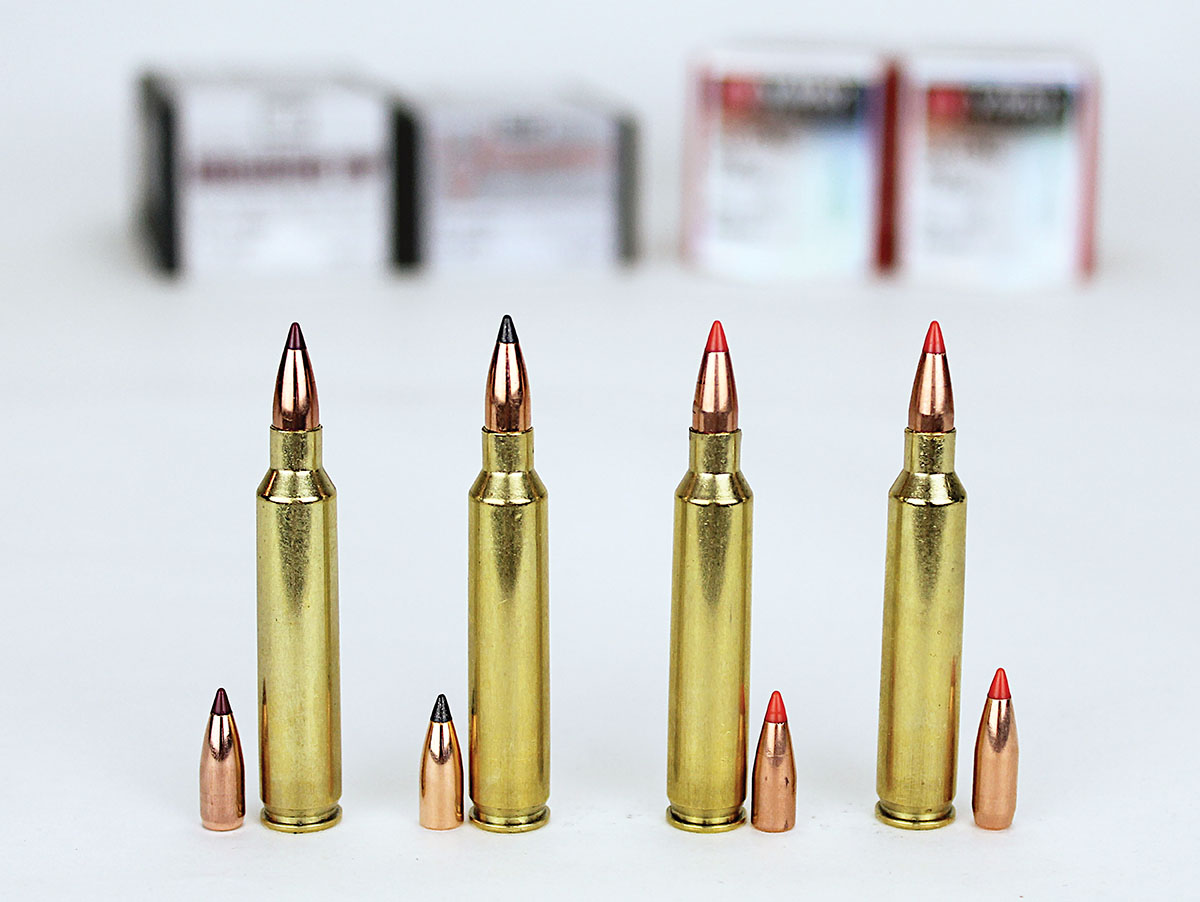
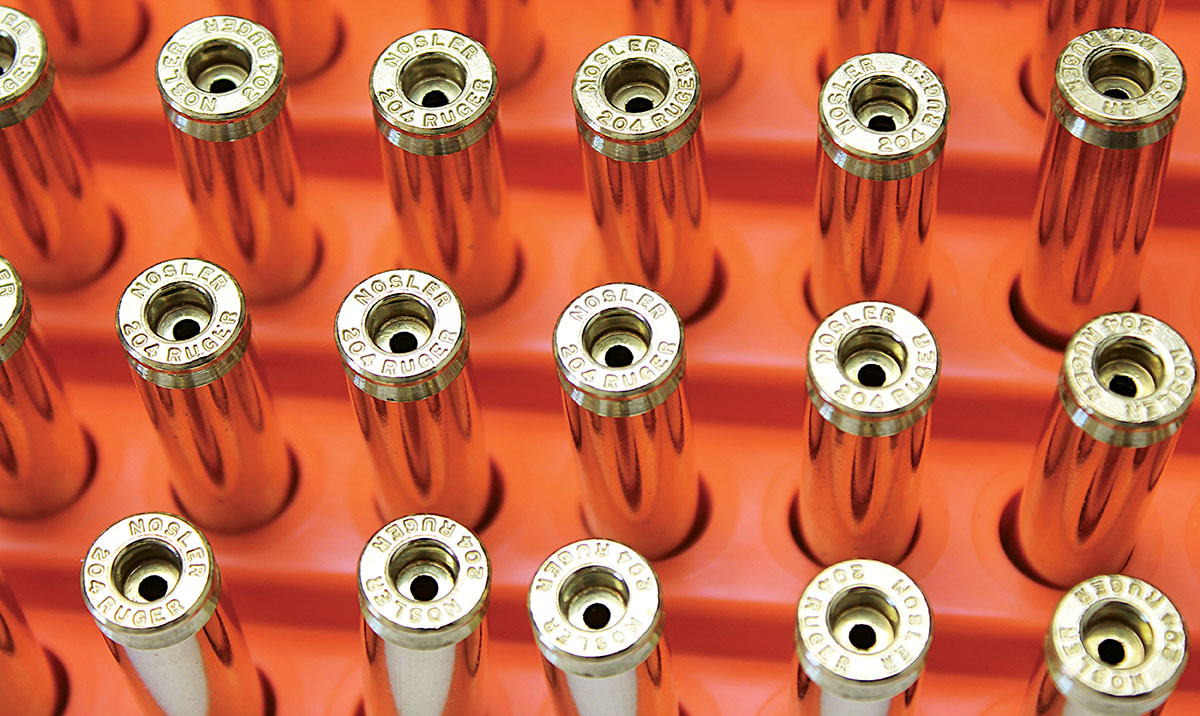
What advantages are in the .204 Ruger niche? It can match the varmint .17 calibers in speed while throwing heavier bullets for (theoretically) better downrange performance. The .17s have a reputation for needing cleaning in the prairie dog fields during extended shooting sessions, which the .204 Ruger does not suffer. Compared to the popular .22 and 6mm varmint cartridges, it has far less recoil than the .220 Swift, which produces about 4.5 foot-pounds (ft-lbs) of recoil energy in an 8-pound rifle launching a 36-grain bullet at 4,350 feet per second (fps), compared to the .204 Ruger’s 2.5 ft-lbs of recoil firing a 34-grain bullet at 4,225 fps. That lesser recoil also applies to the .22-250, 6x45, 6mm Remington, and most of the longtime standard .22 and 6mm varmint cartridges.
If stepping on the accelerator is your thing, the .204 Ruger stays in the 3,600/4,000 fps neighborhood with 40- and 32-grain bullets, and factory 24-grain loads reach 4,400 fps. Another positive is that the .204 Ruger works through the popular AR-15, utilizing the rifle’s standard bolt and magazine.
Ruger/Hornady introduced the new cartridge in 2004, utilizing the nearly dead .222 Remington Magnum case for its .204 Ruger by necking it down. Certainly, the company considered the staggeringly popular .223 Remington case, but the .222 Remington Magnum has about five percent more case capacity for a little more oomph. Of course, if you’re a firearms manufacturer introducing a new cartridge, you’ve also got your own rifle chambered for it.
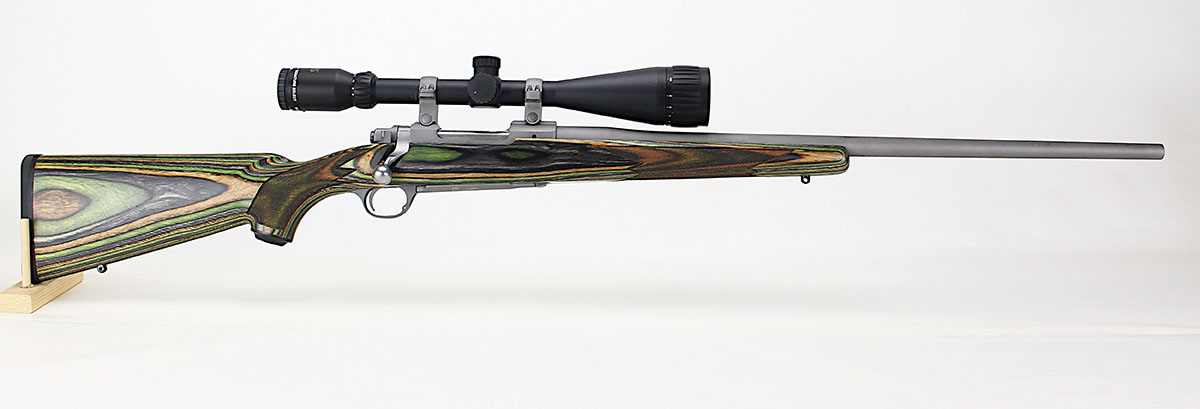
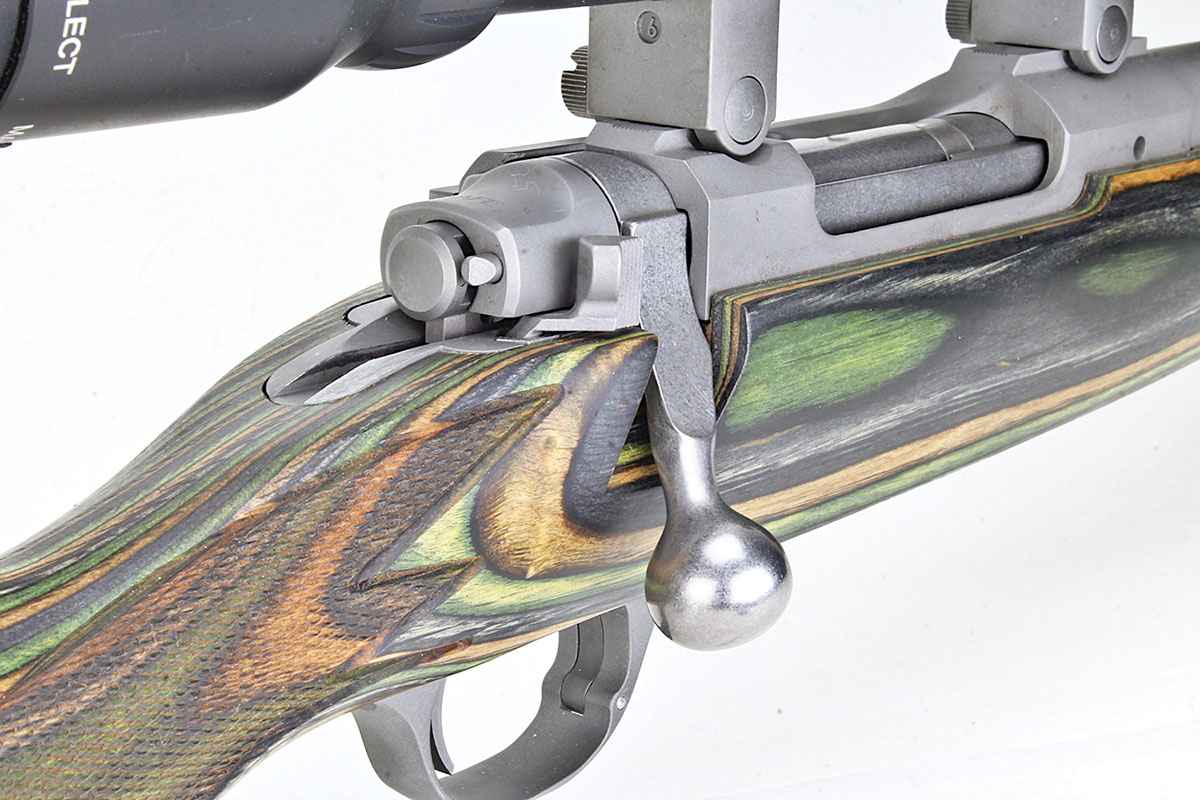
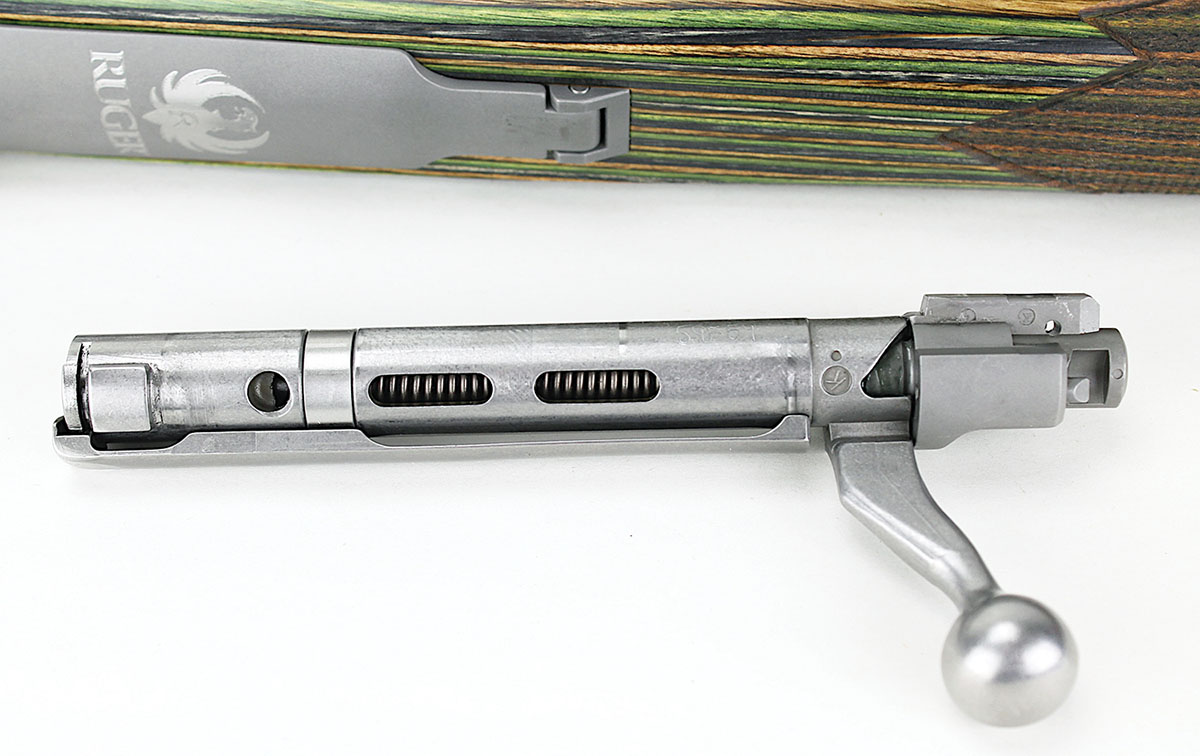
Ruger introduced the Model 77 rifle in 1968, an improved M77 Mark II version in 1991 and the M77 Hawkeye in 2006. A Hawkeye is the launching platform for evaluation here. At 9.8 pounds with a Burris scope, the Ruger Hawkeye is as hefty as an M1 Garand, if perhaps better-looking with its laminated stock of alternating green and blonde bands and matte stainless steel barrel, receiver and trigger/floorplate assembly. It’s a full-size rifle with a 24-inch, 1:12 twist barrel, 13.75 inch length of pull and 44 inches of overall length. The factory LC6 two-stage trigger, an improvement over the Mark II trigger, breaks cleanly at 1.75 pounds with a minimum of overtravel, befitting a precision hunting rifle intended for small targets. The barrel is not free-floated, but the front action screw is angled, pulling the action rearward as well as downward, which can improve accuracy.
The Hawkeye leaves the Ruger factory with a No. 4 Ruger front scope ring and a No. 5 Ruger ring on the rear, matte-finished to match the receiver metal. To clear the barrel, the objective lens of the Burris Signature Select 6x-24x 44mm scope required higher rings, so I moved the No. 5 ring to the front and installed a No. 6 on the rear. With the scope adjustments set at exactly center, zeroing the scope with a collimator required only a few clicks of elevation and windage, a testament to Ruger’s precise machining of the receiver mounts and rings, and fitting of the barrel.
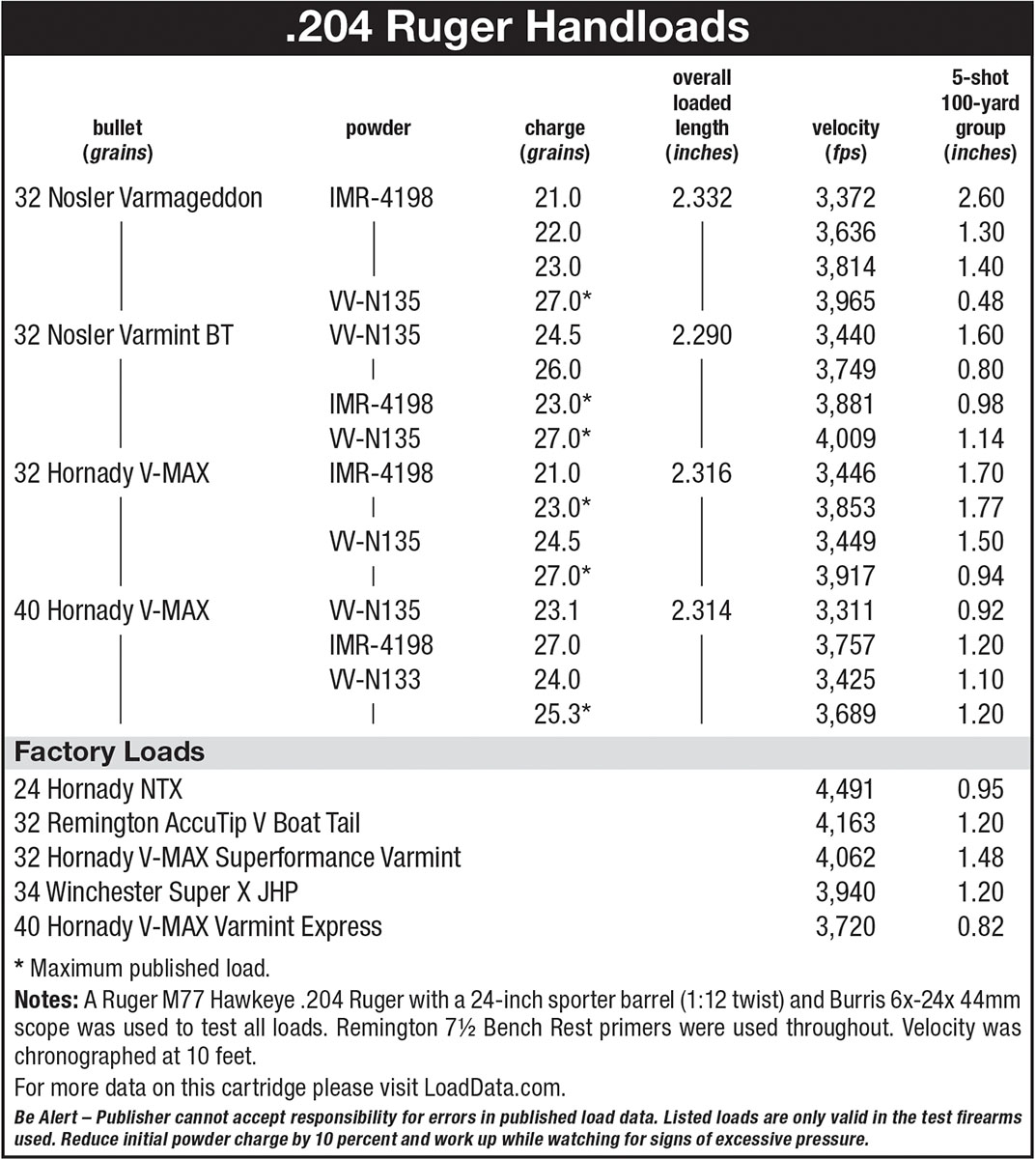
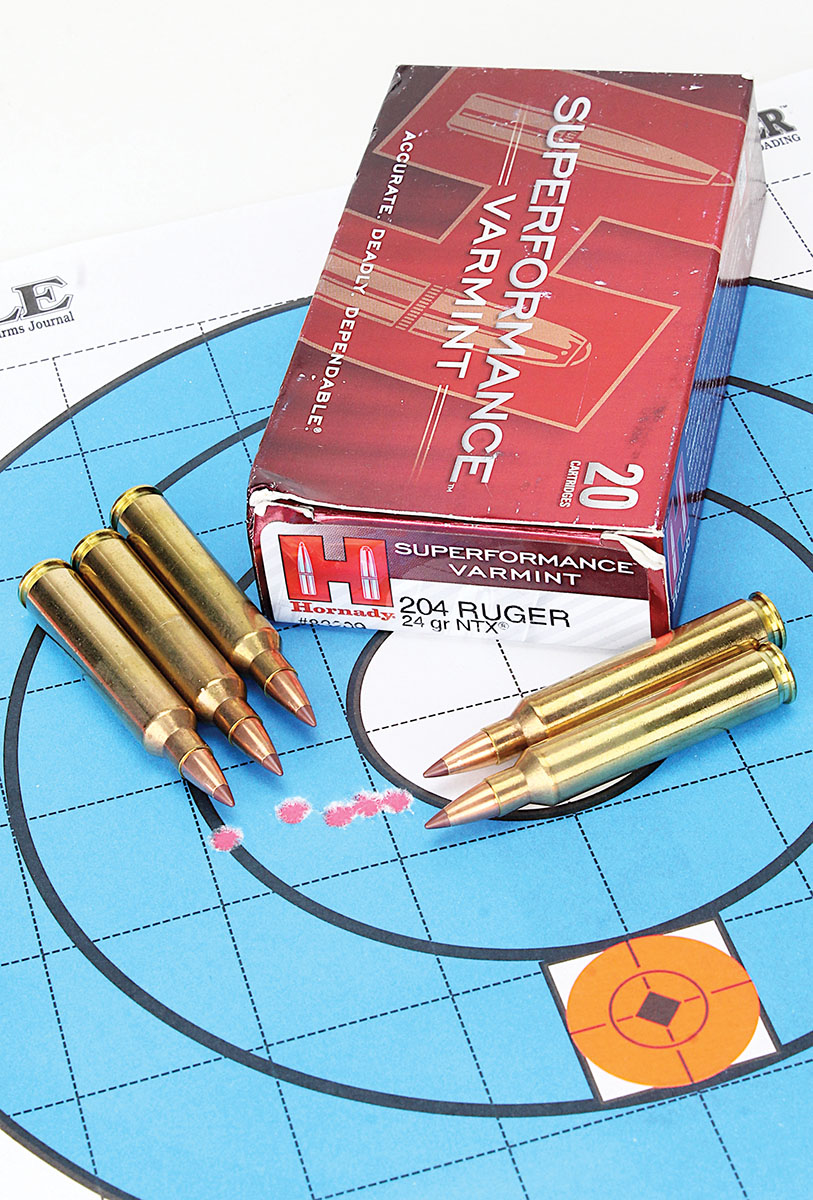
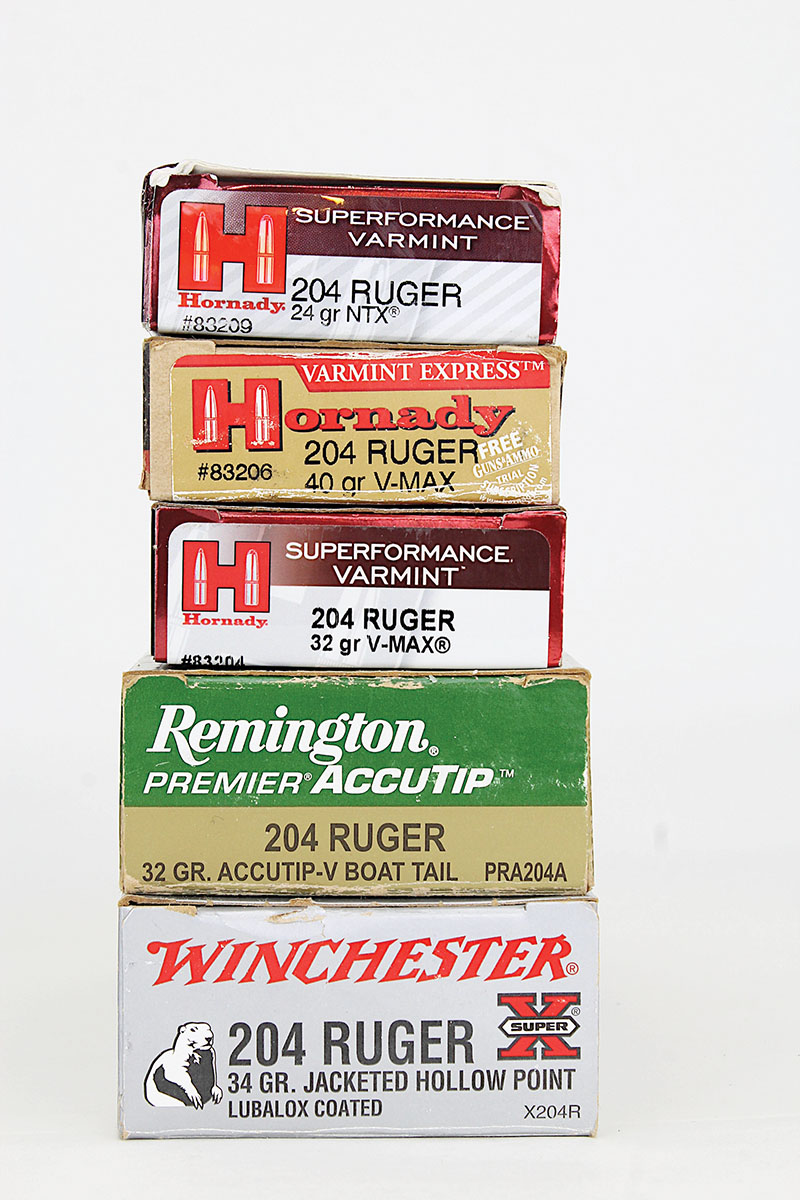
Accuracy testing the Hawkeye included both factory loads and handloads. Hornady offers a 24-grain NTX (Non-Toxic eXpanding) lead-free bullet, which the company also loads in its Superformance Varmint factory ammunition. With the featherweight NTX bullet factory load, shooters get a kind of nitrous oxide boost of speed; Hornady claims a 4,400 fps muzzle velocity for the .204 Ruger Superformance ammunition, and it exceeded that in the Hawkeye, with several rounds clocking in excess of 4,500 fps and none falling below 4,400 fps. Other factory ammunition tested here included Hornady Superformance Varmint with the 32-grain V-MAX bullet, Remington 32-grain AccuTip-V BoatTail, Winchester Super X 34-grain JHP and Hornady Varmint Express 40-grain V-MAX.
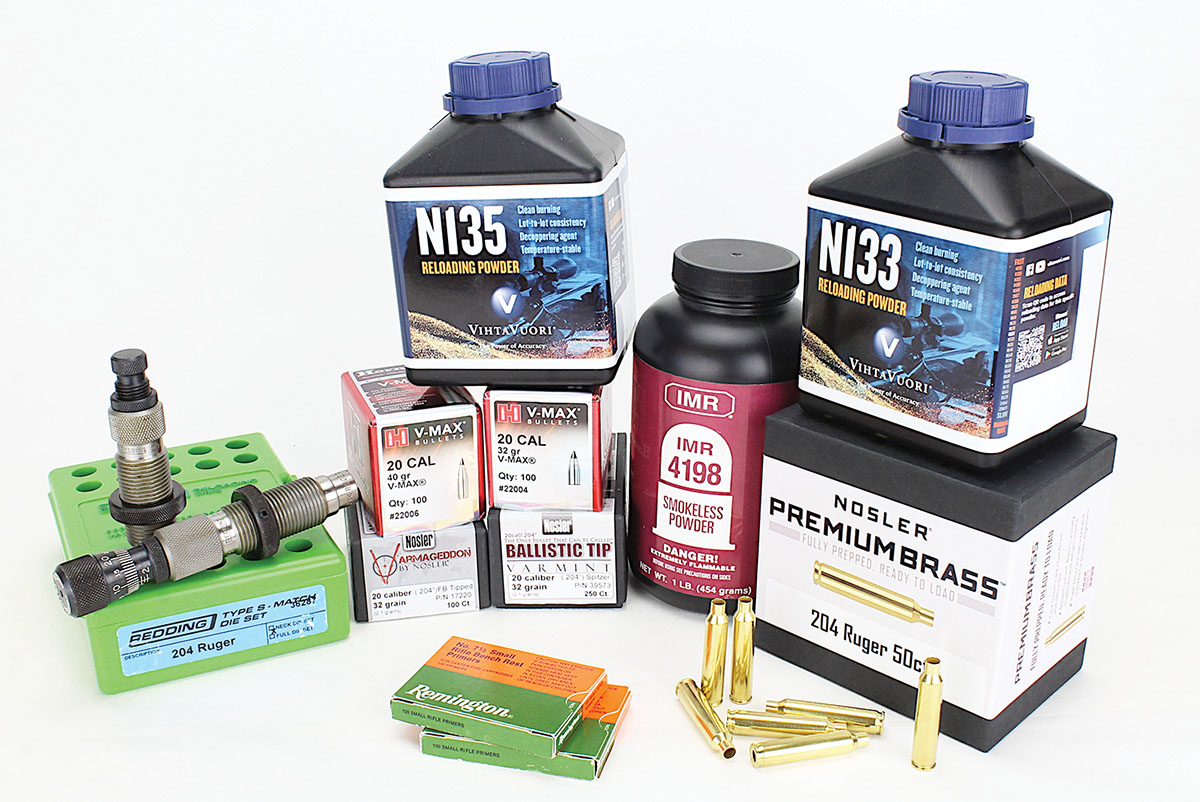
In this time of shortages of everything firearms related, bullet selection for handloading was necessarily limited to 32- and 40-grain Nosler and Hornady bullets. Cases were new Nosler Premium Brass, full-length resized and trimmed to 1.835 inches between reloadings. Though recommended trim length is 1.840/1.843 inches, the Nosler brass was too short to make that cutoff. Cases stretched .003 to .006 inch after firing and resizing, but to keep all cases uniform, the 1.835-inch trim was necessary. An RCBS die with a .192-inch expander ball performed resizing duties, while Redding’s superb Type S Match Die with micrometer bullet seater made changing between bullets precise and easy.
Though load data manuals assign the .204 Ruger a loaded cartridge overall length (OAL) of 2.260 inches, in search of best accuracy, I instead utilized a Hornady Lock-N-Load Overall Length Gauge to start bullet ogives at .010 inch short of the lands. The result, as with most factory rifles, is that OAL was too long to permit rounds to feed through the magazine. Decision time: give up some potential accuracy to feed rounds through the magazine, or limit myself to single-loading rounds for best accuracy? As prairie dog shooting doesn’t typically require laying down suppressive fire, I went for single-loading accuracy.
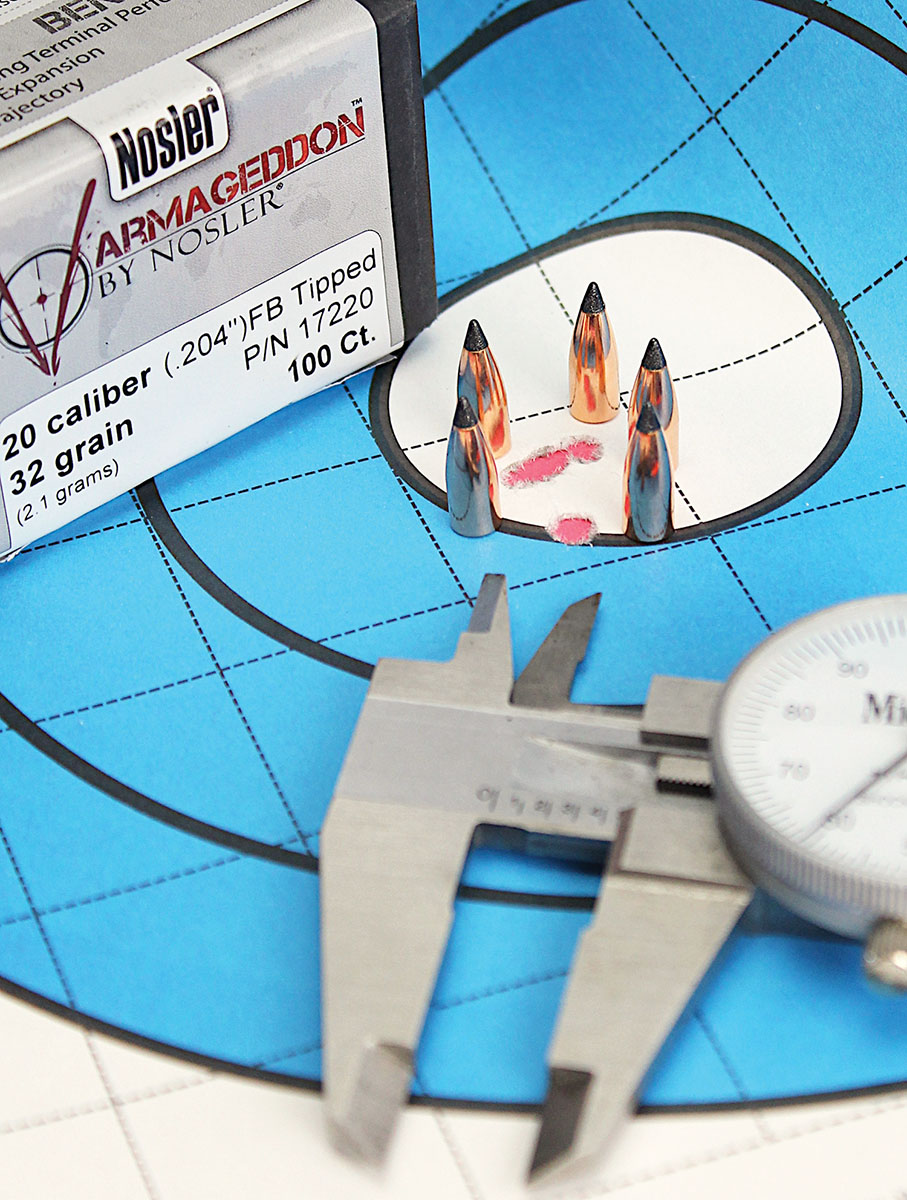
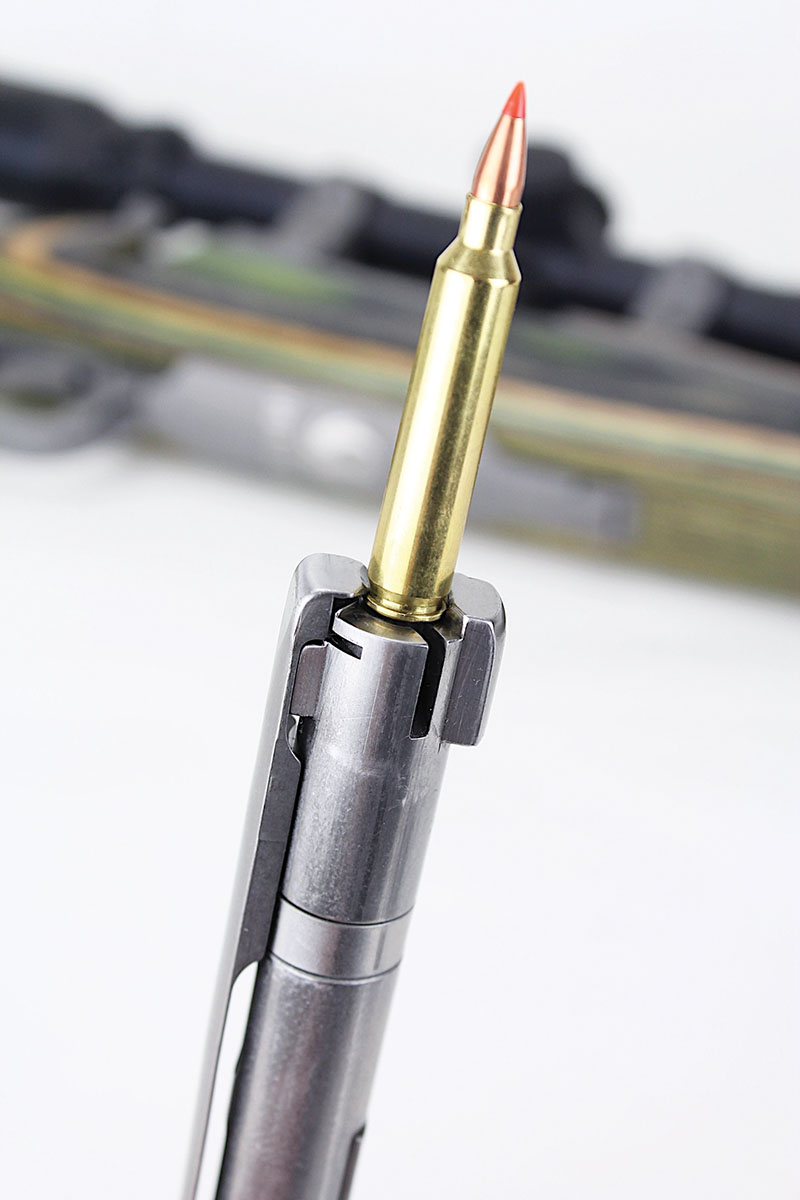
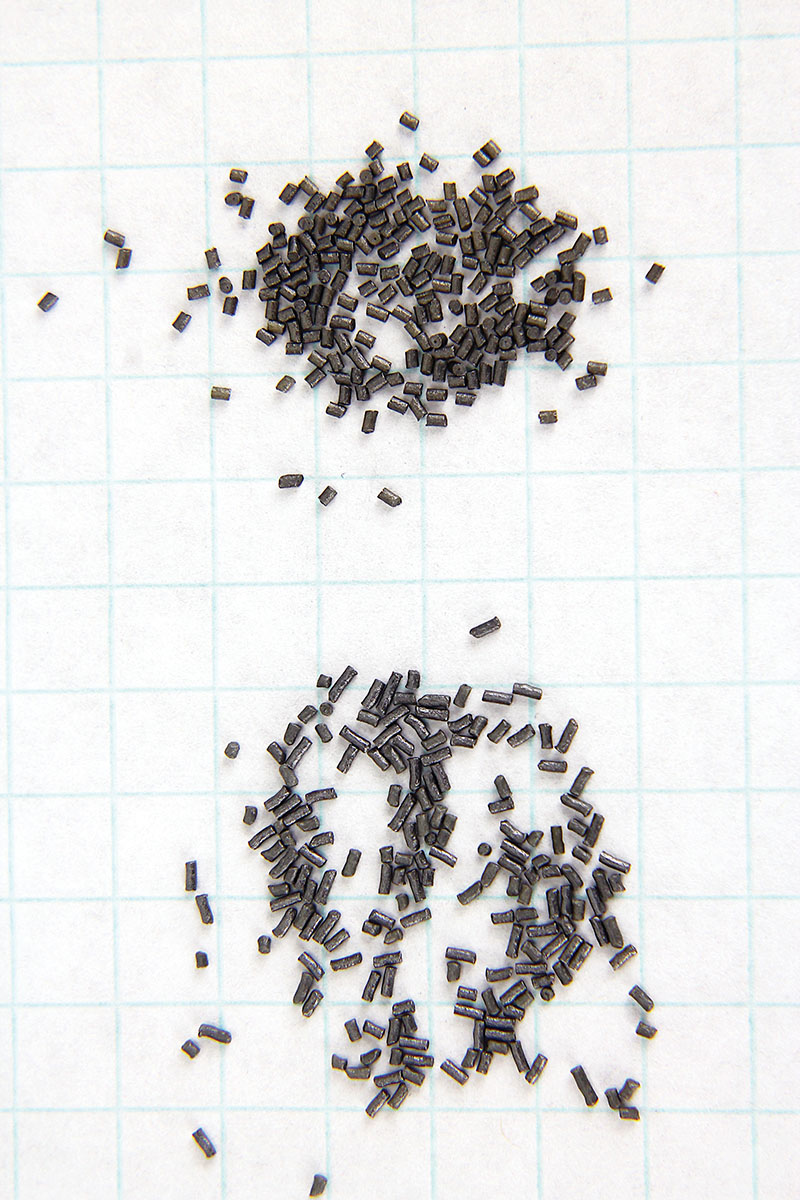
For powders, I picked IMR-4198 because the Nosler reloading manual named it “most accurate powder tested” with its 32-grain bullets. Given the comparatively small capacity of the .204 Ruger case, I also chose two Vihtavuori powders, N133 and N135, for their shortcut kernels, which deliver greater load uniformity for improved shot-to-shot consistency, and which meter smoothly through the electronic powder scale. Remington 7½ Bench Rest Small Rifle primers got the nod for all loads.
Minimum published starting loads with the Vihtavuori powders were too minimum with the .32 grain bullets; the brass cases failed to expand properly to seal the chamber, resulting in soot coating the brass and bolt face. The problem occurred only with starting loads with the Finnish powders, disappearing when charge weights increased beyond minimums. As it turned out, Vihtavuori N135 turned in the smallest groups at the highest velocities. Chronographed bullet velocities consistently fell 200/300 fps below those published in the Nosler Reloading Guide 6. Vihtavuori load data velocity estimates also fell short until shooting maximum charges, when they were pretty much spot-on.
Winds are rarely idle a mile high up here in the Arizona mountains, and winds swirling between the berms at the local shooting range may have had some slight impact on shot groups, which I fired from a heavy rest on a concrete bench. However, the barrel’s slim sporter contour is not really conducive to extended firing sessions, one reason for limiting groups to five shots; free-floating a heavier barrel would likely shrink groups, though it would undoubtedly send rifle weight beyond the 10-pound mark. The Hawkeye produced several one-hole groups if I discount single flyers. One called flyer opened a .70-inch group to .98 inch, and a single “mystery” flyer tripled another group from .40 inch to 1.35 inches.
Though I most often find best accuracy somewhat below maximum velocity for any rifle/cartridge combination, this M77 Hawkeye has a definite need for speed with the .204 Ruger, as the smallest groups appeared at the maximum published loads. That’s perhaps unsurprising, given the cartridge’s original mission of hustling downrange with utmost alacrity.
But the trade-off for screeching muzzle velocity is reach: the .204 Ruger’s short, lightweight bullets begin to lose out to the wind, compared to the larger .22s and 6mms, much beyond 300 yards. That 32-grain bullet started at 4,000 fps in a 10 mph crosswind drifts only 3.3 inches at 300 yards, but doubles that at 400 yards and is off target by 15 inches at 600 yards. Larger caliber, heavier bullets, all other factors being equal, theoretically perform better over distance. Of course, handloaders can improve .204 Ruger performance well beyond 300 yards by going to 40-grain and heavier bullets, but only at a sacrifice of 300 fps to 1,000 fps velocity, which is .223 Remington territory. That takes us out of the .204 Ruger’s niche so, practically, if you want more reach, you might as well stick with the .223 Remingtons we already shoot and not bother with buying another rifle and tooling (and one-cartridge-only bullets) to load the .204 Ruger.
Every rifle is an individual, and while it’s entertaining and educational to experiment with rifles and cartridges, shooters finally reach the point where they recognize the optimum limits of their respective performance. The .204 Ruger is about velocity, and hitting a small target is about precision, and the .204 Ruger combines the two right at the 4,000-fps mark, which it was designed to do with 32-grain bullets, and does so out to a reasonable 300 yards for a reasonable marksman. That’s a pretty good niche.