223 Remington
Loading Lead-Free Bullets
feature By: Patrick Meitin | October, 21
To demonstrate just how silly this lead ban truly is, monolithic brass bullets, like polymer-tipped ESP Raptors from Cutting Edge Bullets, are not legal in California because brass contains an insanely minute trace of lead.

Those outside California might shrug, believing it’s a problem well outside their own concerns. But make no mistake; California laws have a way of creeping into the national conscious. Other states are considering or have discussed lead-bullet bans as this is written. In the current political climate, it doesn’t require too much of an imagination to envision the U.S. purged of lead ammunition and component bullets in the not-too-distant future.
It could be argued that manufacturers responded to the significant marketplace that is California, or that they simply saw the writing on the wall, but nontoxic, or lead-free component bullets have become increasingly commonplace. These consist of mono-copper designs or gilding metal jackets packed with powdered tin/copper concoctions, or in the case of Sinterfire, such matrixes molded into projectiles and subjected to extreme heat treatment to create a solid slug. Sophisticated internal designs make many monolithic bullets fairly “explosive,” providing the aggressive terminal performance preferred while targeting burrowing rodents or tenacious predators. Cutting Edge Bullets or Hammer Bullets’ Dead Blow offer perfect examples. Compressed powder mixes also provide dramatic expansion, including examples from Hornady (NTX), Nosler (Ballistic Tip Lead-Free Varmint) Barnes (Varmint Grenade), Speer (TNT Green) or Sinterfire.
Though, one fly in the ointment is that long-for-caliber bullets of equal weight generally require faster rifling twists to impart equal gyroscopic stabilization and consistent groups. Lead-free bullets weighing much more than, say, 45 grains (depending on design) are apt to require more contemporary 1:9 to 1:7 twist rates. My custom .22-250 Remington, for example, assembles sub-half-inch, five-shot 100-yard groups with lead-core 50-grain bullets, but keyholes at 50 yards with Barnes’ 50-grain Varmint Grenade, which shoot very tightly from my 1:7 twist AR-15. On this note, I was fascinated to discover, while perusing firearm manufacturer sites as I sought a possible test rifle for this project, that every .223 Remington rifle of recent manufacture I could locate included the faster twist rates already mentioned. This makes them compatible with 50-grain or heavier nontoxic options. That said, most serious varmint shooters already own an older .223 rifle with a classic 1:12 twist rate. That reality influenced the bullets selected here.

It is common to hear handloaders insist that lead-free bullets are inherently less accurate than traditional lead-based bullets, particularly the composite blends. This may be true to some degree, as premium lead-core projectiles have been perfected over a period of decades while lead-free designs are a relatively recent development. Still, I’ve tested a good number of lead-free bullets that relinquished sub-half-inch accuracy from a number of favorite varmint rifles, including zippy numbers such as my .204 Ruger and .22 Creedmoor, so this isn’t something I would say stands up as a general rule.
I had a decent selection of lighter .224-diameter nontoxic bullets on hand so a thorough test seemed indicated, and America’s most popular centerfire round, the .223 Remington, seemed the ideal rifle. It is worth mentioning that while .224-caliber mono-copper bullets like Hornady’s GMX and the Barnes X Series, just as examples, do not provide the aggressive expansion preferred for smaller burrowing rodents. They do make ideal pelt-shooting options that won’t shred hides destined for the raw-fur market. In this test, I selected bullets for use on smaller burrowing rodents, with the goal to create dismantling impacts that prevent wounding on marginal hits.
For the most part, I chose modern propellants promising stability under a hot spring or early summer sun, when I do most of my varmint shooting. The tendency is to push things toward maximum while seeking dramatic impacts and flattened trajectories at longer ranges, and I don’t want a maximum load becoming too “hot” under such conditions. Bullets consisted of nontoxic bullets accumulated during various projects, and weighing from 35 to 43 grains. Once-fired Norma brass salvaged from factory ammunition, Winchester Small Rifle primers, RCBS full-length dies and an Area 419 ZERO Reloading Press were utilized throughout.

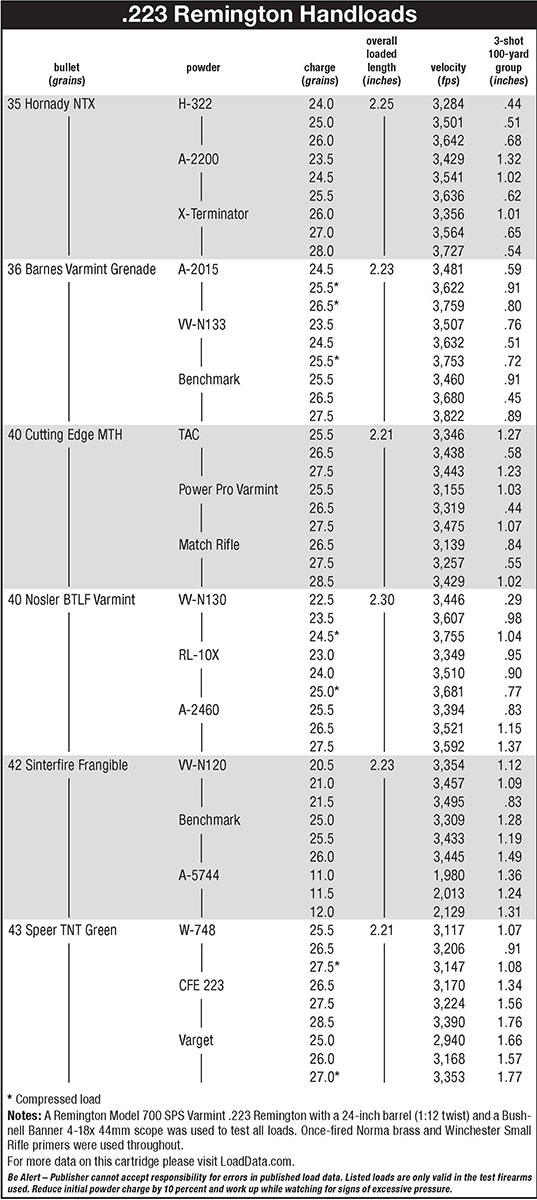
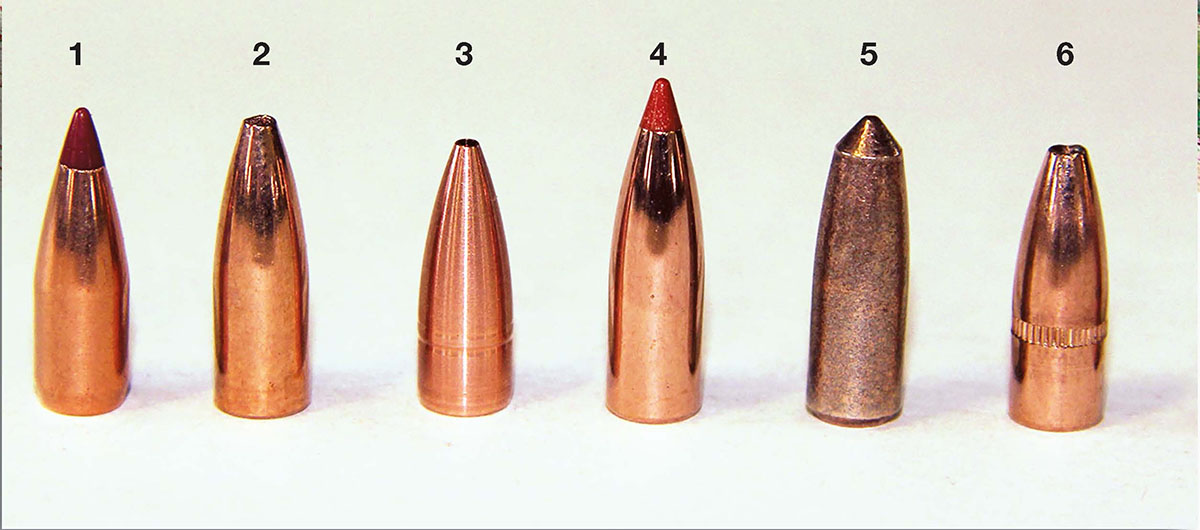
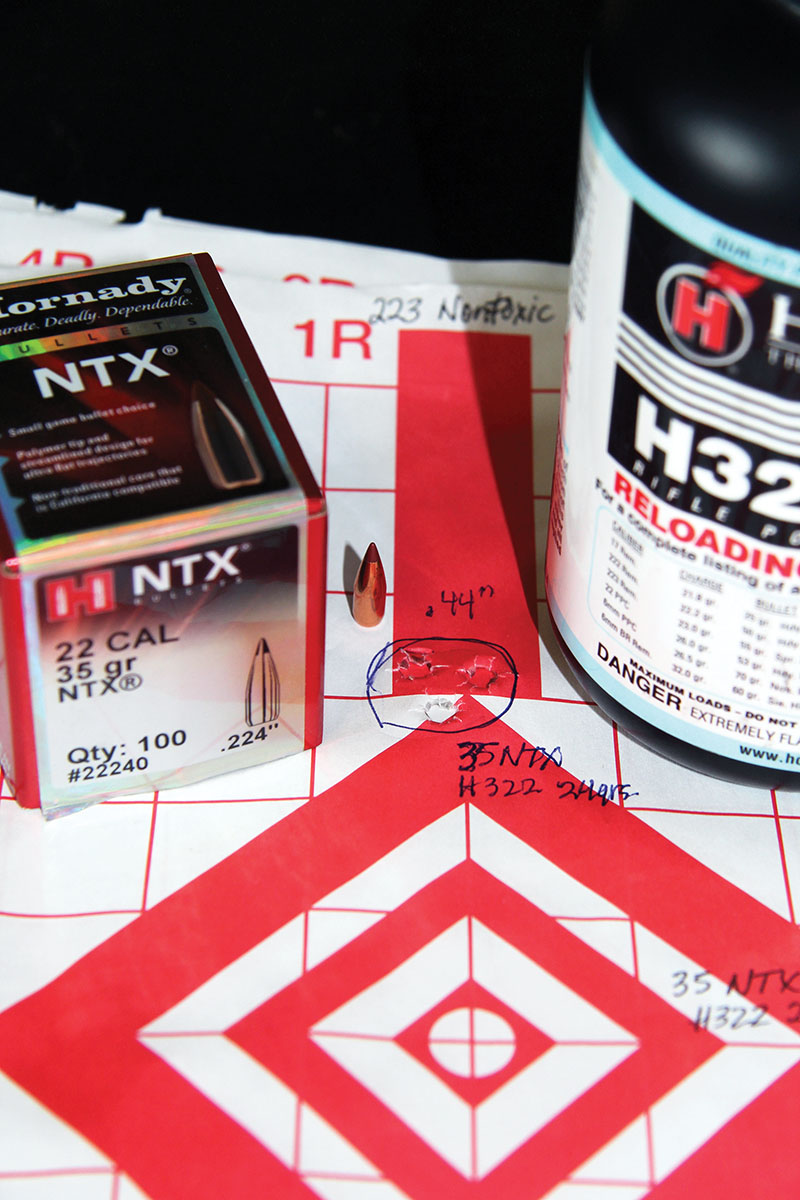
Hornady’s NTX (Non-Traditional eXpanding) is one of the more successful copper/tin projectiles on the market. They represent some of the lightest bullets in respective calibers – 15.5 grains in .17 caliber, 24 grains in .204 and 35 grains in the .224-caliber used here. I’ve enjoyed exceptional accuracy from these polymer-tipped, NTX bullets from several rifles. Think of it as a lighter, lead-free V-MAX design. This bullet averaged .75 inch overall when paired with Hodgdon H-322, Accurate 2200 and Ramshot X-Terminator. The best group measured .44 inch, resulting from 24 grains of H-322 at 3,284 feet per second (fps), with 25 grains producing a .51-inch group at 3,501 fps. I’d call the latter an acceptable trade of a minute amount of accuracy loss for a far greater gain in velocity. Accurate 2200 managed just .65 inch with 25.5 grains of powder and pushed to 3,636 fps, while Ramshot X-Terminator did best with 28 grains of powder, producing a .54-inch group at 3,727 fps. That kind of velocity and a perfectly acceptable group would make a great load when ranges stretch beyond 300 yards.
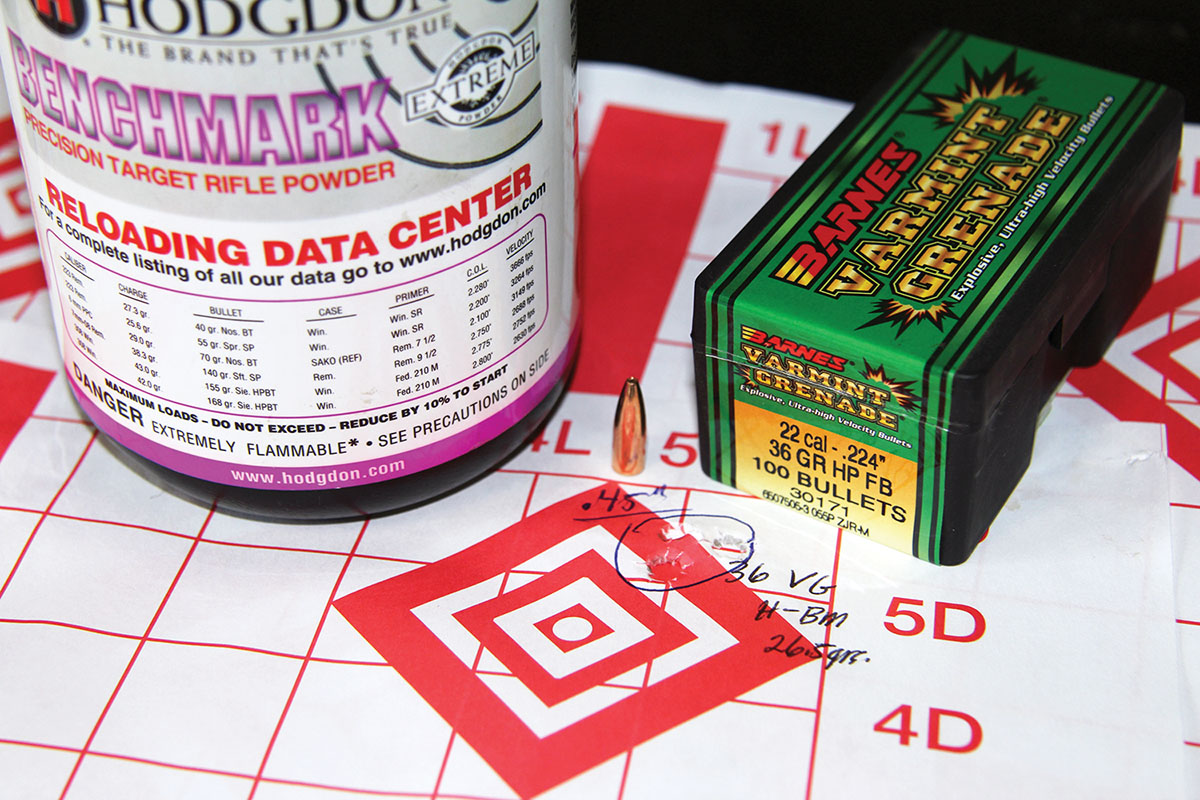
The best pairing proved 26.5 grains of Benchmark, producing a .45-inch group at a zippy 3,680 fps. Twenty-four and a half grains of VV-N133 produced a .51-inch group at 3,632 fps, providing another exceptional option. Finally, A-2015 managed a .59-inch group at a slower 3,481 fps.
Cutting Edge Bullet’s 40-grain MTH (Match/Tactical/Hunting) is a pure copper bullet milled on sophisticated CNC Swiss-style lathes that assure minimum weight deviation, .0001-inch concentricity and .00015-inch diameter variations. The Sealtite Band assures no blowby for improved accuracy, and pressure/fouling reducing grooves are included. A special hollowpoint design allows multiple cutting edges to spin away from the tip on impact, the solid base passing through. It provides a relatively high ballistic coefficient (BC) for weight. This bullet turned in several exceptional groups, but averaged .92 inch overall when paired with Ramshot TAC, Alliant Power Pro Varmint and Shooters World Match Rifle. The best group resulted from 26.5 grains of Power Pro Varmint, measuring .44 inch and sent at 3,475 fps. The next best load was 27.5 grains of Match Rifle at 3,257 fps (.55 inch), and then 26.5 grains of TAC at 3,443 fps (.58 inch). Cutting Edge bullets, in my experience, can prove a touch finicky, usually requiring some seating depth jockeying to find the sweet spot – just something to keep in mind.

The 40-grain Nosler Ballistic Tip Lead-Free Varmint includes Fragmenting Copper Core Technology engineered to expand at velocities down to 1,600 fps. The long-for-weight design has typically proven quite accurate from several of my varmint rifles. It follows the same basic construction principles as the Ballistic Tip Varmint, including a polymer tip, but replaces the traditional lead core with a copper/tin matrix. Despite producing this test’s smallest group, this bullet averaged .92 inch when matched with Vihtavuori N130, Alliant Reloder 10X and Accurate A-2460, showing a bit of a touchy nature. The .29-inch group resulted from 22.5 grains of VV-N130 sent at a respectable 3,446 fps. Reloder 10X, surprisingly, managed only .77 inch at 3,681 fps. I only say surprisingly because this powder usually produces better results in this cartridge. Accurate A-2460 managed a ho-hum, .83-inch group at 3,394 fps.
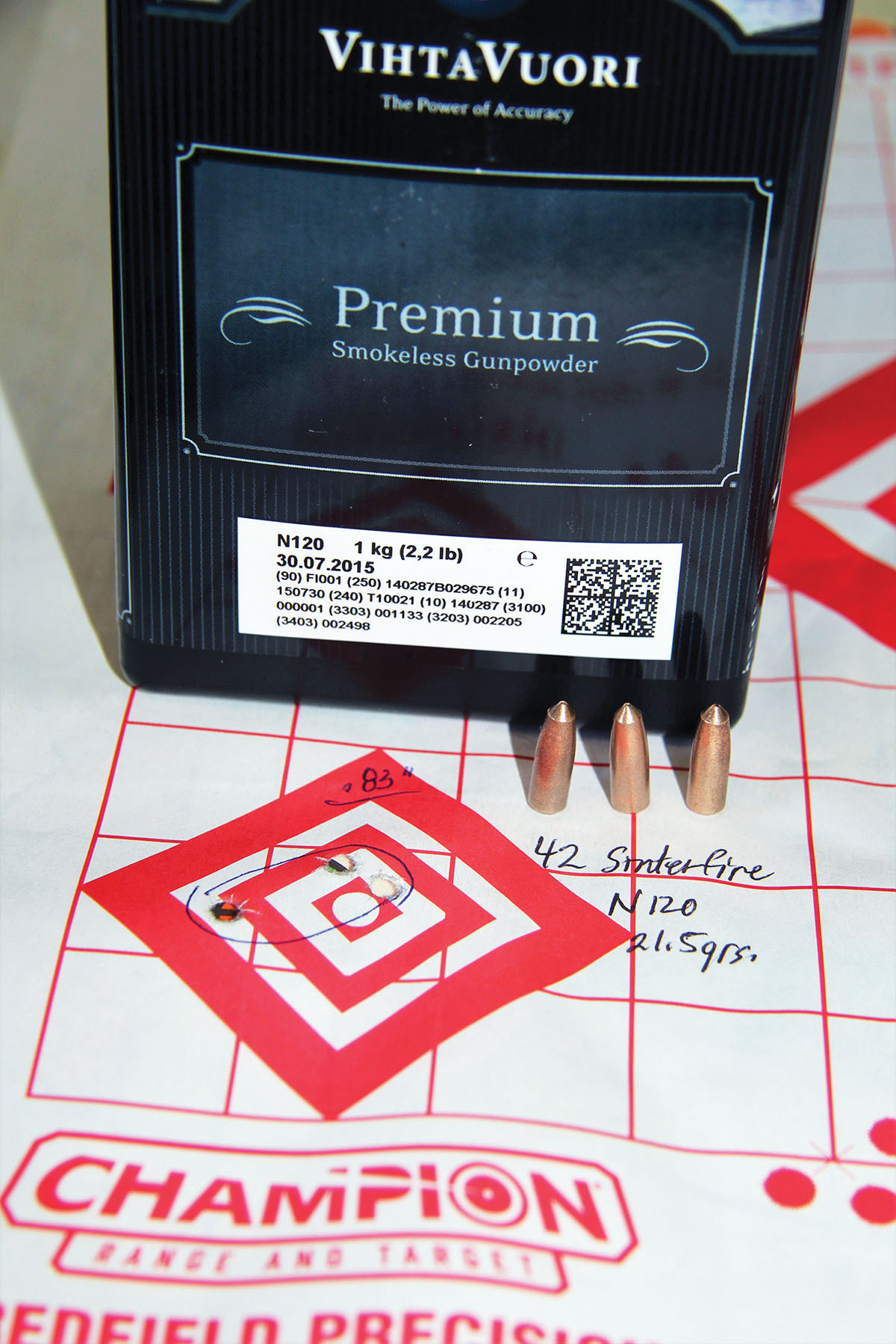
The 42-grain Sinterfire Frangible lead-free bullet is molded from a copper/tin mix and then subjected to a proprietary heat treatment process. It includes a flat-angled cone tip to initiate expansion. They were designed for close-range training on steel plates or in “tactical houses.” The bullets disintegrate into small particles on impact. One hundred-yard accuracy has proven a touch sub-par from a couple of my rifles, but this test provided slightly better results, averaging 1.21 inches when tested with Vihtavuori N120, Hodgdon Benchmark and Accurate A-5744. The best group, .83 inch, resulted from 21.5 grains of VV-N120 and was pushed to a respectable 3,495 fps.
Benchmark produced a 1.19-inch group at 3,433 fps with 25.5 grains of powder. Either of these loads would prove ideal for calling predators in wooded terrain where shots don’t run overly long. Accurate A-5744 was chosen to create reduced loads, as I had a theory that less velocity would result in better accuracy, as this bullet shoots well from my .223 Remington Thompson/Center Contender handgun with 14-inch barrel, though one naturally expects less from a handgun than a rifle. The best showing in this test was a 1.24-inch group at 2,013 fps using 11.5 grains of powder. So that theory seems suspect. All Accurate A-5744 loads dropped only a couple inches at 100 yards (100-yard zero) and were quite pleasant to shoot and produced zero recoil and only muffled pops.
Speer’s 43-grain TNT Green includes a thin jacket holding a compressed powder core, a flatbase hollowpoint and a cannelure. I have experienced good results with this bullet from two .221 Remington Fireball pistols – a Remington XP-100 and Thomson/Center Contender, with 10.75-inch and 10-inch barrels, respectively – but so far, I have not found a rifle that cares for these lead-free bullets. That was repeated again in this test. Winchester 748, Hodgdon CFE-223 and Varget averaged just 1.41 inches, and the best group measuring only .91 inch. That group resulted from 26.5 grains of Winchester 748 at 3,206 fps, and a 1.08-inch group was produced by 27.5 grains of W-748 at 3,447 fps. Winchester 748 is neither temperature stable nor clean burning. CFE-223 managed only a 1.34-inch group with its best effort using 26.5 grains of powder with a velocity of 3,170 fps. Varget further disappointed. Its best group was 1.57 inches at a slow 3,168 fps.
This test showed unequivocally that in most cases, accuracy on par with the lead-bullet standards shooters have long been using can be produced by lead-free bullets. A couple of the nontoxic designs obviously struggled, but there is no doubt that this class of projectile will continue to evolve and enjoy slow refinements, bringing accuracy around to that provided by the better nontoxic designs. Lead-free bullets certainly cost a bit more than more common lead-core designs, but when shooting in an area where they are required, that added cost shouldn’t be enough to keep a handloader from enjoying their annual varmint shooting campaigns.