

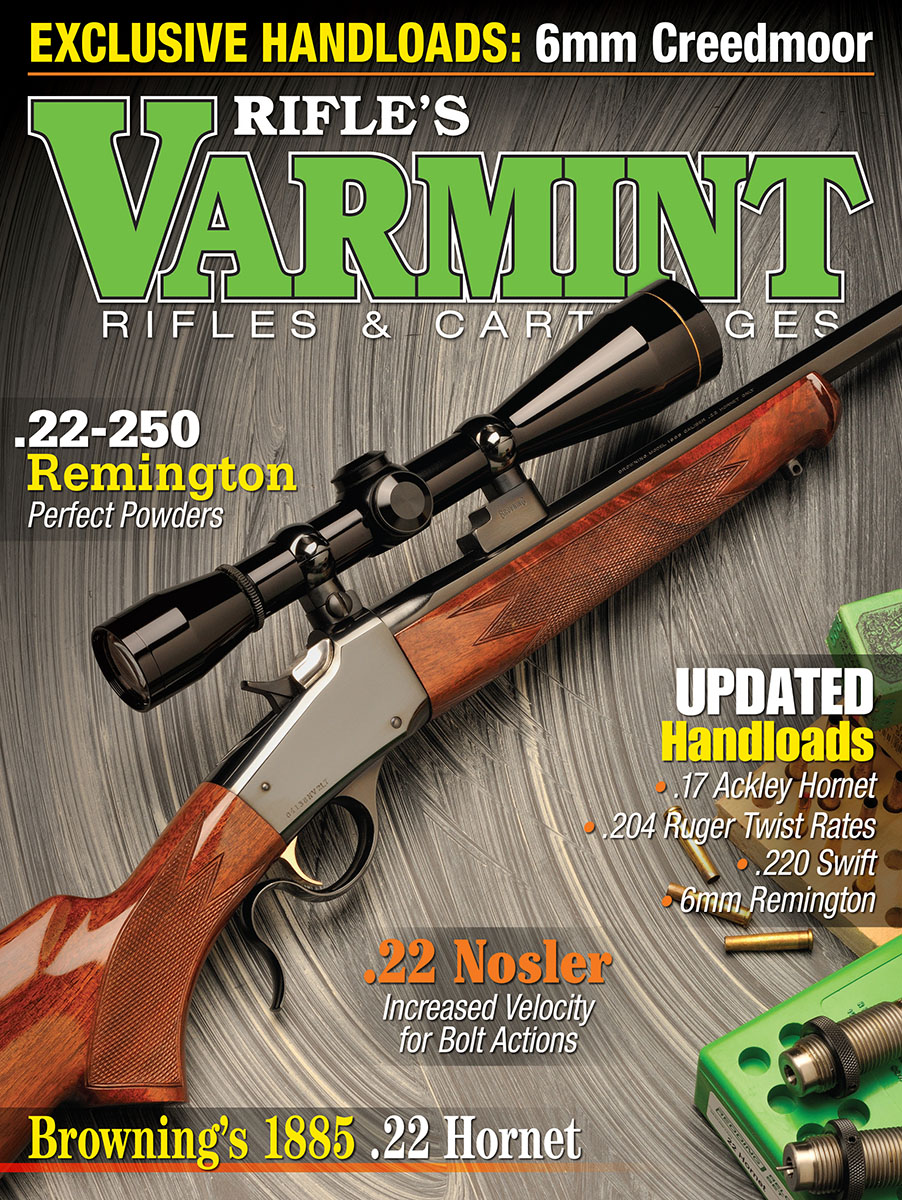
Varmint Spring 2018
On the Cover: A Browning Model 1885 Low Wall rifle with a 24-inch barrel and a Leupold M8 6x 42mm scope. Photo by Stan Trzoniec.
Volume 7, Number 1 | ISSN:
Article Bites
Rifle Talk
Rifle Basix RU-R Ruger Triggers
column by: Lee J. Hoots
As it goes with triggers, there are plenty of truths, misconceptions and outright fibs floating around – some of them perhaps dating back to the early 1900s. One of particular interest is the preposterous idea that a trigger should be set to the lightest pull weight possible to obtain the finest accuracy, even though we do not know what the “finest” accuracy is. As far as I’m aware, no rifleman has used a shoulder-fired rifle to shoot a mythical .0000-inch group. Even worse, it does not take into account the whims of a given barrel with a given load and/or bullet. ...Read More >
22 Hornet
Even today it has plenty of sting.
feature by: Stan Trzoniec
Few varmint cartridges can claim the history, accuracy or reloadability of the 22 Hornet. From the first time I encountered this little cartridge, to the years that followed with various rifles, woodchuck forays, uncountable bullets and grains of powder, it has yet to let me down. It seems that small-game enthusiasts have felt the same way, as the availability of rifles (old and new) has been steady over the past 20 years, including single shots and bolt actions – even revolvers. ...Read More >
6mm Creedmoor
Lightweight Bullets in the Newest ".243"
feature by: Jim Matthews
The 6mm Creedmoor was designed for long-range target shooting with long and skinny, heavy-for-caliber bullets that slip through the air with the greatest of ease. Wind affects these bullets little; they just fly right through it, almost unaffected. ...Read More >
22 Nosler
Handloads for a Bolt-Action Rifle
feature by: R.H. VanDenburg, Jr.
Having been aware of the 22 Nosler cartridge and realizing that it was designed to function in an AR rifle, my first question was whether or not the cartridge would be made available in the Nosler Model 48 series of bolt actions. Getting “Yes” for an answer, I ordered a wood-stocked Heritage variant for this handloading project. ...Read More >
Perfect 22-250 Remington Powders
Alliant, IMR, Hodgdon and Western Powders Propellants
feature by: John Haviland
The 22-250 Remington has been in hunting fields and on target ranges seemingly forever. After nearly nine decades of existence in one form or another, the cartridge should be wheezing its last gasp, but that is far from the case. The reason for the 22-250’s continuing popularity is the introduction of new powders that have continually improved the cartridge from when it was a wildcat during the 1930s to Remington applying its name to it in 1965, and especially up to today. ...Read More >
6mm Remington
Long Range Rockchuck Loads
feature by: Patrick Meitin
A 6mm was part of my initiation as a dedicated small-varmint shooter; it was a 243 Winchester to be more precise. I used one rifle to handle everything from small varmints/furbearers to big game, and that plain Remington 700 ADL filled the bill nicely. One drought-stricken summer, I even used it to burn 150 rounds per week thinning superfluous jackrabbits with Sierra’s 60-grain Varminter hollowpoint while feeding starving cattle. I shot those jackrabbits with the venality of day traders – unwelcomed competition for the wiry grass – though I greedily relished the shooting as children do candy. While that 243 served on everything from prairie dogs to elk, I distinctly recall coveting a 6mm Remington as a youngster because, you know, its outwardly larger case promised higher velocities. ...Read More >
220 Swift
Loads for a T/C Encore Handgun
feature by: Aaron Carter
Few cartridges have the polarized love/hate relationship of the 220 Swift. Debuting in the Winchester Model 54 bolt-action rifle in 1935, the Swift’s ability to dramatically dispatch varmints at distance garnered it much fanfare. On the other hand, hunters who used those same fragile varmint bullets on big-game animals acquired disdain for the cartridge due to lackluster bullet performance; the cartridge was hardly to blame. ...Read More >
Twists & Turns
Exploring Barrel Twist Rates for .224-Inch Bullets
feature by: Mike Thomas
For some time, I had been curious as to the maximum weight and length of bullets that would shoot well in older centerfire .22s with bore twist rates of 1:12 and 1:14. Like many shooters, I never gave this subject any thought until the fast twist rate .22 barrels became popular during the past decade or so. ...Read More >
17 Ackley Improved
Loads for a Classic Wildcat
feature by: Layne Simpson
Parker Otto Ackley’s name is synonymous with wildcat cartridges, and the 17 Ackley Hornet has long been one of the more popular. It is formed by necking down the 22 Hornet case and fireforming with a reduced powder charge. Doing so reduces body taper, moves the shoulder forward and increases shoulder angle for a slight increase in powder capacity. In his Handbook for Shooters & Reloaders, Vol. I, Ackley shows a velocity of 3,585 fps with a 25-grain bullet. ...Read More >
204 Ruger
A Realistic Look at Trajectory and Wind Deflection
feature by: Roy Welch
The 204 Ruger cartridge, developed by Sturm, Ruger and Company and Hornady Manufacturing, Inc., made its appearance in 2004, quickly establishing a reputation as a top-tier, high-velocity varmint cartridge. The 204 Ruger was initially designed to propel a 32-grain bullet at a velocity in excess of 4,200 fps from a rifle with a one-in-12-inch twist barrel – rivaling the muzzle velocity of the 220 Swift. Additional .204 Ruger factory loads were to follow, including those with a 40-grain bullet at a muzzle velocity of 3,900 fps and a 45-grain bullet at 3,625 fps. More recently, Hornady has offered a factory load with a 24-grain NTX bullet at a muzzle velocity of 4,400 fps. ...Read More >