22 Nosler
Handloads for a Bolt-Action Rifle
feature By: R.H. VanDenburg, Jr. | April, 18
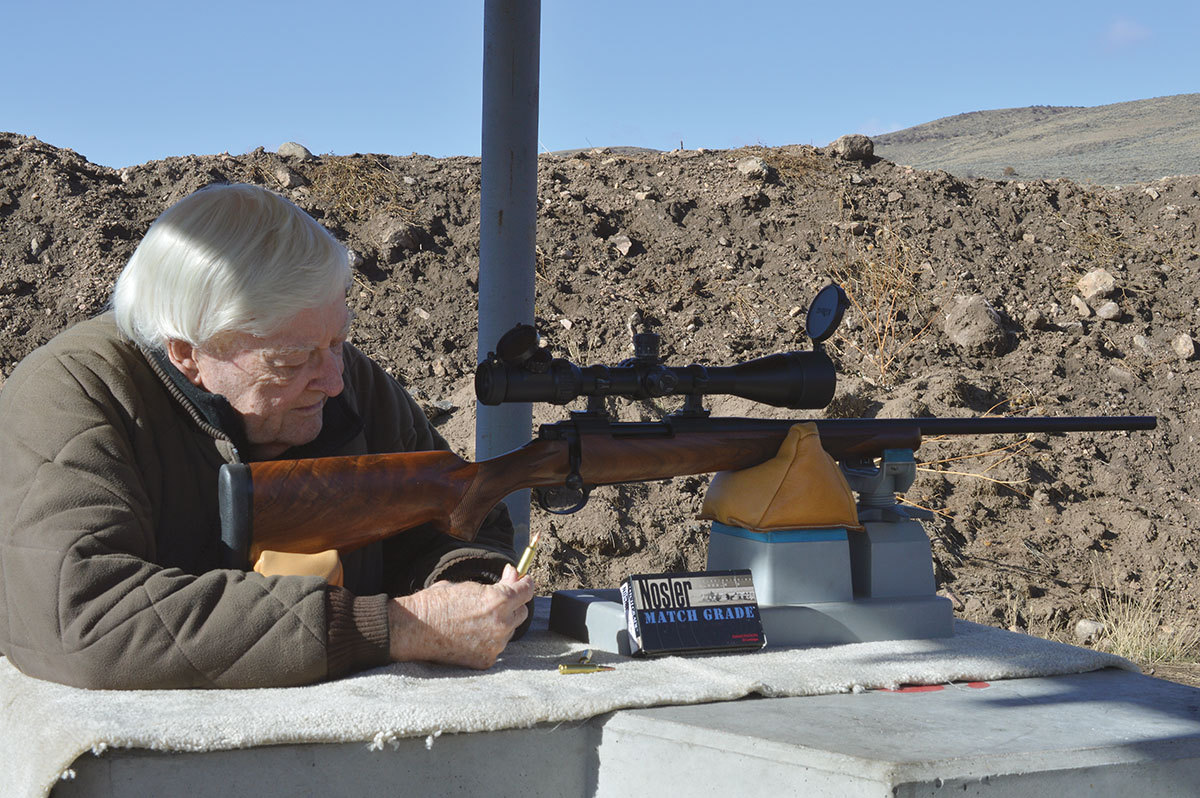
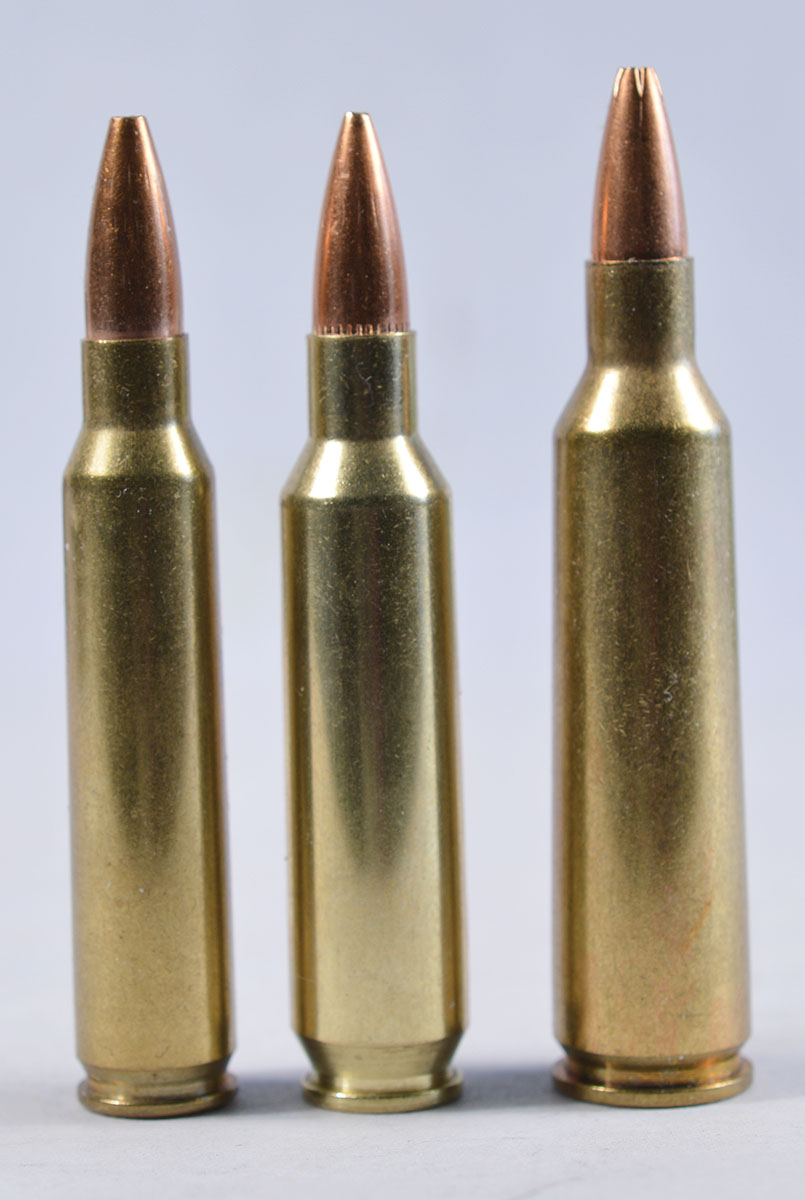
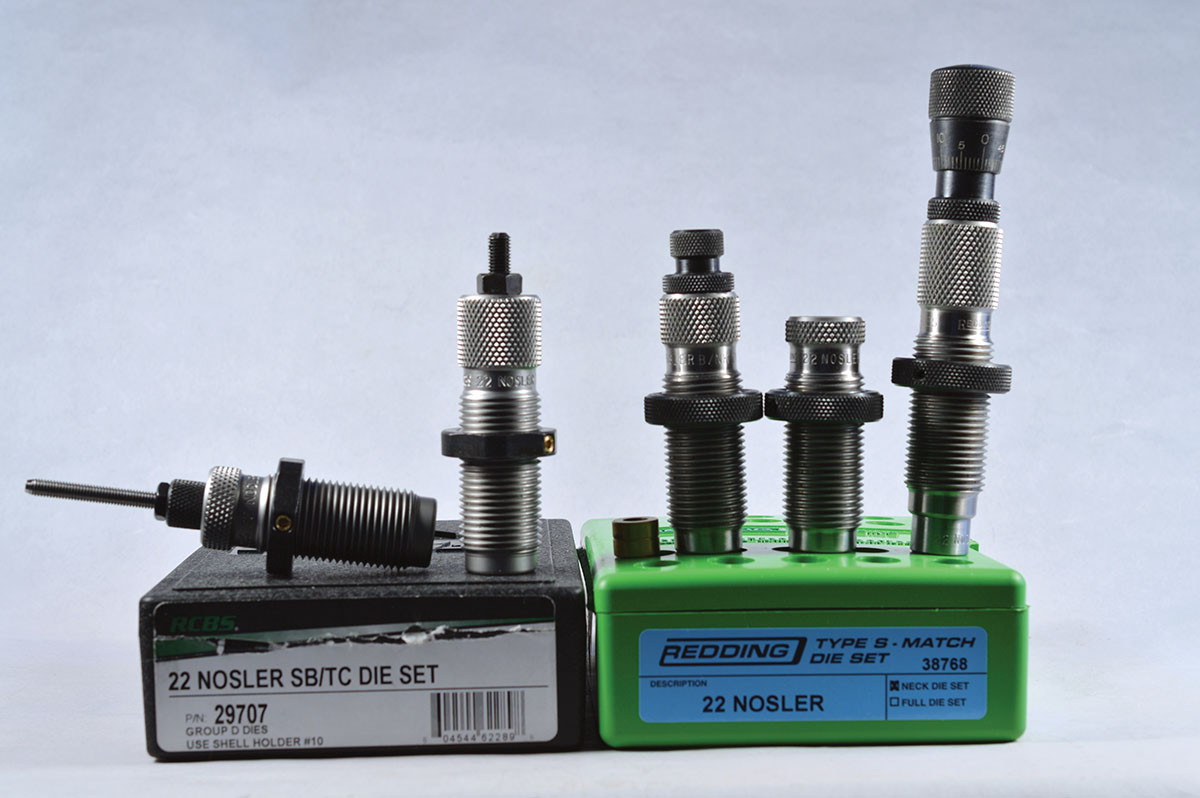
Before the rifle arrived, Nosler proved once again that it is really on its toes by forwarding a box with 55- and 77-grain factory ammunition, 100 new 22 Nosler cases, 55-, 64- and 77-grain Nosler bullets for reloading and a set of 22 Nosler reloading dies from RCBS. As the RCBS dies were of the company’s SB (small base) series designed to improve feeding and chambering in autoloading rifles, I also obtained a set of Redding Type-S match dies that included a body die that does not touch the case neck, a bushing die with decapping stem that under normal circumstances does not touch any part of the case except the neck, and two bushings with inside diameters of .251 and .252 inch. A Competition seating die with micrometer adjustment capability was also ordered.
The Model 48 is a traditional bolt action, similar to most but differing at times. The receiver is 8 inches in length from the shoulder to the end of the tang with an integral recoil lug. The bottom is flat and the sides are straight. The upper quarter is beveled to provide a six-sided shape, and the top is contoured to accept Remington Model 700 scope bases.
The trigger is from Timney with a two-position safety, also like the Remington. It does not lock the bolt. Nosler sets the trigger to break between 3 and 4 pounds. The sample rifle’s trigger broke right at 3 pounds with a very crisp release.
At the left rear of the receiver is the bolt release, a clever, hinged arrangement that is quick and positive. On the left beveled flat is “Nosler M48 Bend, Oregon”; on the right flat is the serial number. The cartridge designation is stamped on the right side of the barrel in front of the receiver.
The bolt is 7 inches in length with two locking lugs. The right lug is slotted to accept a corresponding protrusion in the receiver, acting as an anti-bind device. The bolt face is recessed with a plunger ejector and a very positive AR-type extractor. There are six shallow flutes running the length of the bolt body and three holes, one round and two elongated, on the bolt bottom to deflect gases from a pierced primer or an unlikely case failure away from the shooter’s face. The bolt handle appears to be a single piece with a knurled ring. On the
The barrel is 24 inches long with a recessed target crown. Inside are six lands with a 1:8 right-hand twist. Barrel dimensions are that of Nosler’s magnum contour with a muzzle diameter of .650 inch. (Mine actually measured .655 inch.) The trigger guard and hinged floorplate assembly are aluminum, with the floorplate release in front of the trigger guard, similar to that used by Winchester. Magazine capacity is four rounds. All metal surfaces are coated with a matte-black, CERAKOTE finish.
The walnut stock is nicely figured and oil finished with a shadow-line cheekpiece. The 20-lines-per-inch checkering appears to be machined with a point pattern: two side panels on the grip and wrap-around coverage on the forend. There are no caps on the forend or pistol grip. A one-inch thick, Pachmayr Decelerator recoil pad is black with an accompanying spacer and has a smooth, leather-like surface. Length of pull is given as 13.5 inches; drop at comb, .625 inches; drop at heel, .978 inches. These are for the Heritage model; other variations of the M48 may differ slightly.
Inletting is precise with bedding material around the front and rear stock bolt holes and recoil shoulder. Bolt holes are pillar bedded. The barrel channel leaves the barrel free floating. A nice touch in the glass bedding area behind the recoil shoulder contact is a circular tag with the name of the inspector who approved the rifle. Two sling swivel bases wrap up the stock.
In its accompanying handbook, Nosler encourages a strict barrel break-in regimen that includes firing 10 shots, cleaning the barrel after each shot and then firing five, three-shot groups, cleaning after each group. After receiving the test rifle, I mounted scope bases, rings and a scope removed from a Remington 700, then followed Nosler’s break-in recommendations.
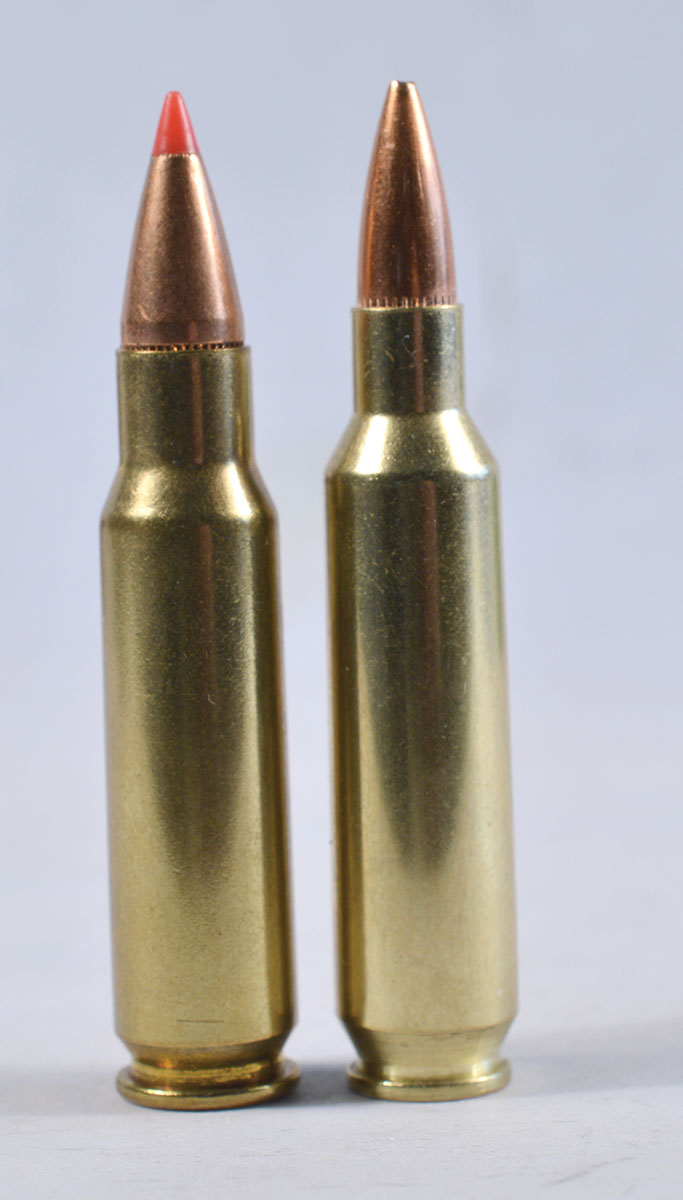
Designed to function in an AR, the traditional home of the 223 Remington and/or its military progenitor, the 5.56x45 NATO, the 22 Nosler shares the same case length of 1.760 inches and same cartridge overall length of 2.260 inches. It differs, however, in having a larger body diameter and a rebated rim that is the same as that of the 223. A 30-degree shoulder and a slightly shorter body length prevent a 223 from being fired in a 22 Nosler chamber. These dimensional differences also create a longer neck that is helpful when using heavy-for-caliber bullets. When chambered in an AR, a standard 6.8 Remington SPC magazine is used.
Comparisons, however odious at times, are inevitable. When comparing the 22 Nosler to the 223 Remington in an 18- or 20-inch barreled AR, the Nosler cartridge wins hands down, often producing velocities up to 300 fps greater than the smaller 223. In a bolt action, the comparison is often to the 22-250 Remington. Here things get a little more complicated. Most 22-250s have a rifling twist of 1:14; too slow to effectively handle bullets much heavier than 60 grains or so. On the other hand, some rifle manufacturers – Nosler among them – offer 22-250s with a 1:7 or 1:8-inch barrel twist. These are ideal for long, heavy bullets and smaller big-game hunting but are not noteworthy for handling lightweight varmint bullets.
Water capacities of the 223, 22 Nosler and 22-250 filled to the case mouth, are 31.0, 36.0 and 43.0 grains, respectively, which should clarify things a bit. These relationships remain essentially the same when the same bullets are seated to their respective cartridge overall lengths.
So, if you have a rifle chambered for the 223 Remington and want to increase potential range for varmints, or pursue deer-size game with a .22-caliber cartridge, consider the 22 Nosler or a fast-twist 22-250 Remington. Likewise, if you have a 1:14 twist 22-250 and want to hunt deer and pronghorn but with heavier bullets, rather than a second, fast-twist 22-250, consider the 22 Nosler.
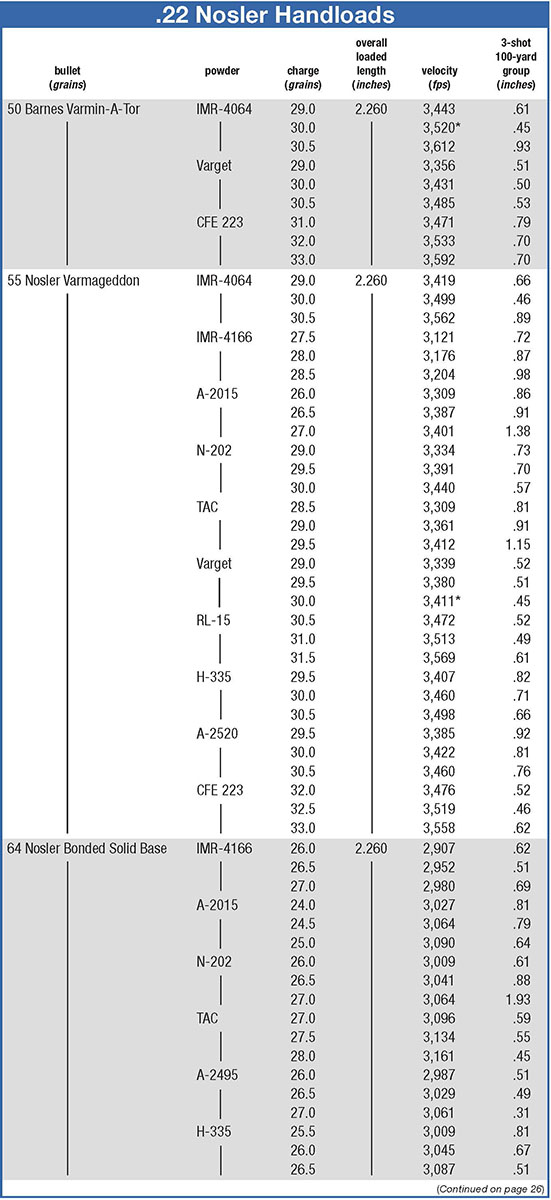
Now to the good part: handloading and shooting. I went through the barrel break-in regimen using factory ammunition. After that I chronographed the Nosler 55- and 77-grain factory loads. According to Nosler data, with a 24-inch barrel the 55-grain load averages 3,500 fps. My chronograph showed 3,652 10 feet from the muzzle. My first reaction was that Nosler had loaded the factory ammunition a bit on the warm side. Actually, throughout the testing, Nosler’s velocity projections for a given powder charge were frequently exceeded.
With respect to the two die sets, I used both in an attempt to discern any differences in performance. In a bolt action I didn’t need the small base reduction in case diameter provided by the RCBS dies. Actually, the smaller diameter provided by the RCBS SB die only amounted to about .001 to .0015 inch. The Redding dies provided a closer fit when simply neck sizing and even with the use of the body die followed by the neck sizing accuracy seemed to be better. Between the bushings I settled on the smaller .251-inch option. For all that, the differences were small and not always the same.
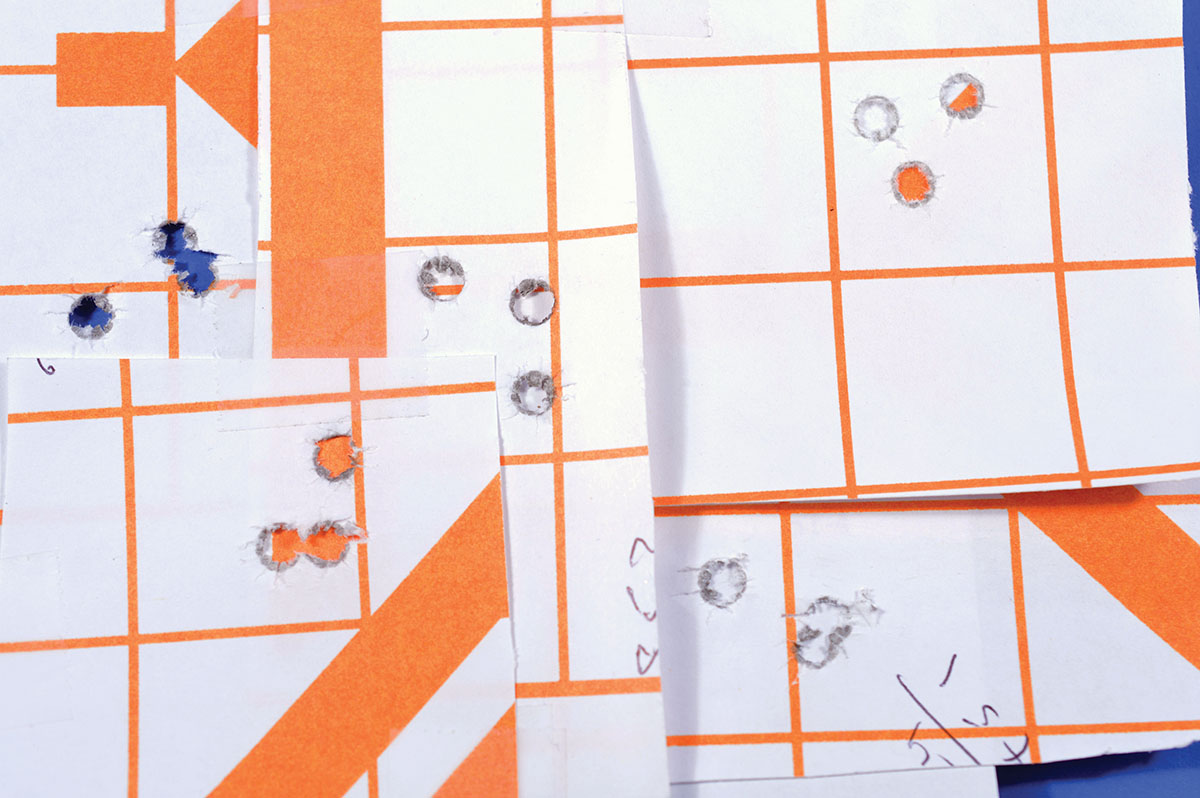
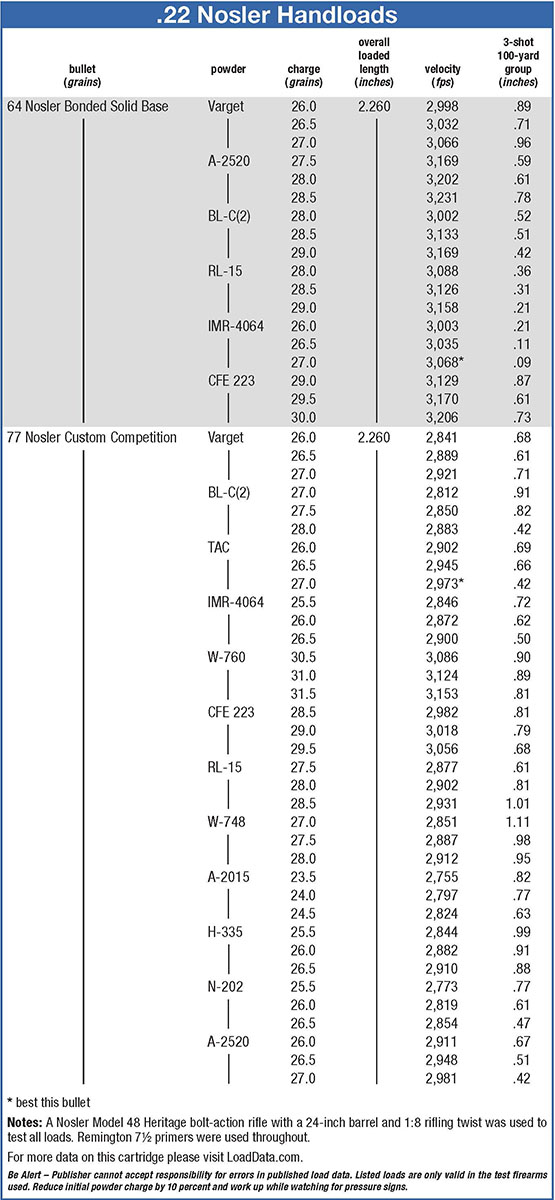
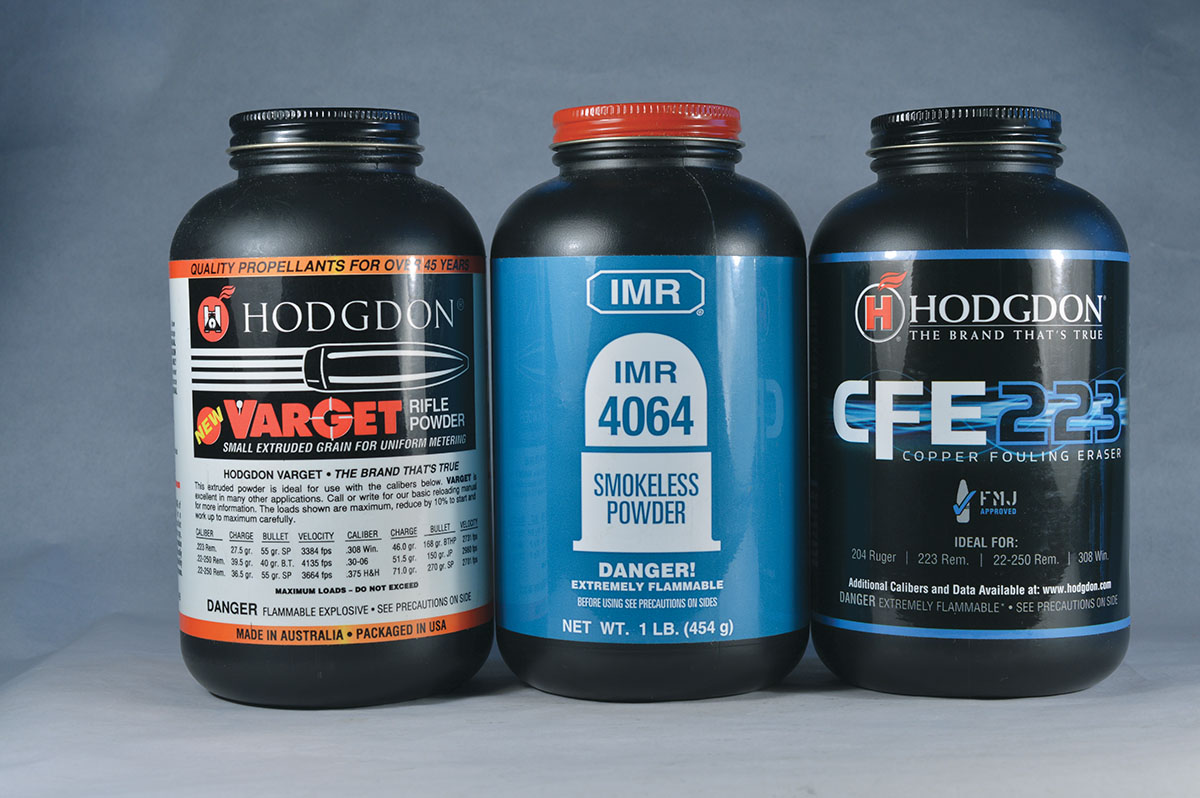
Using the Barnes 50-grain bullet, velocities reached 3,600 fps, but best accuracy came at slower speeds. In a 22-250 Remington the same bullet could be pushed over 3,900 fps, but again best accuracy always came at a reduced velocity. My best loads were with IMR-4064 and Varget, measuring under .5 inch for three-shot groups.
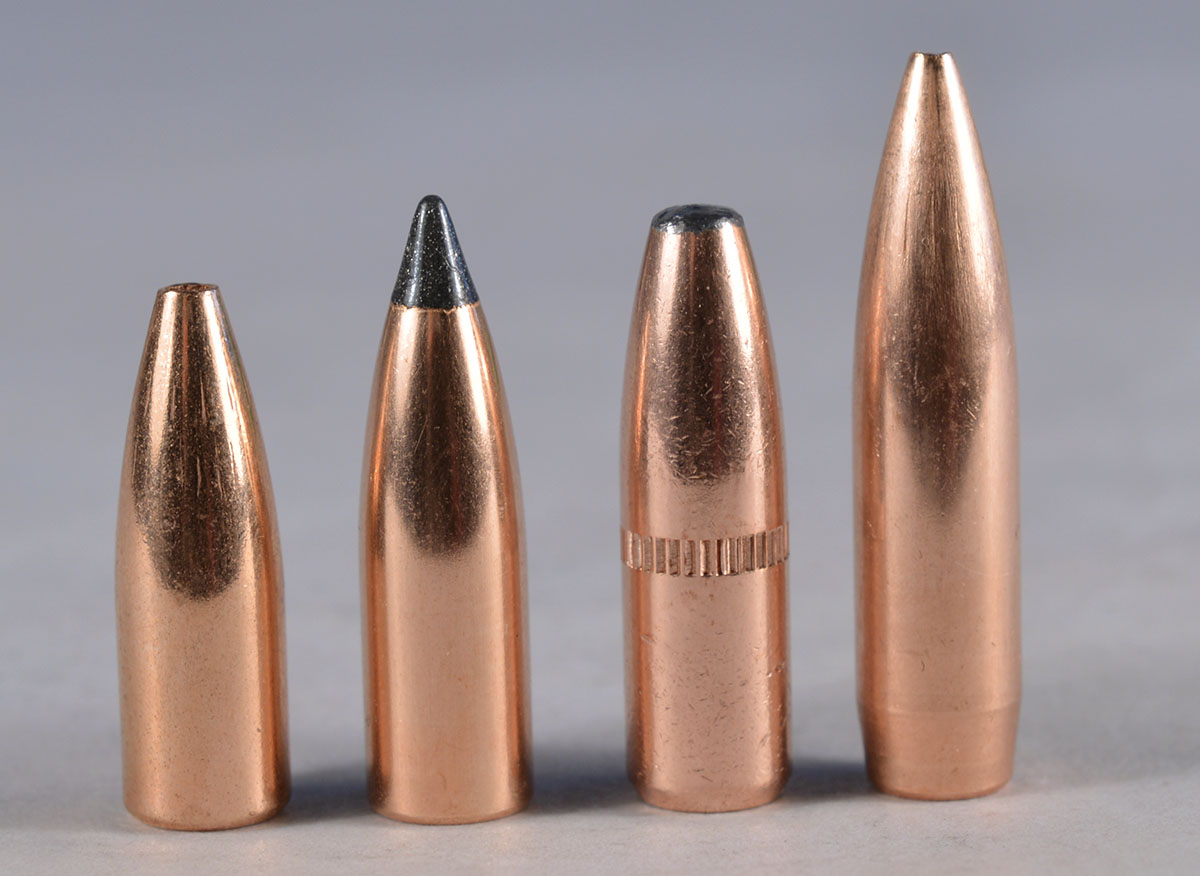
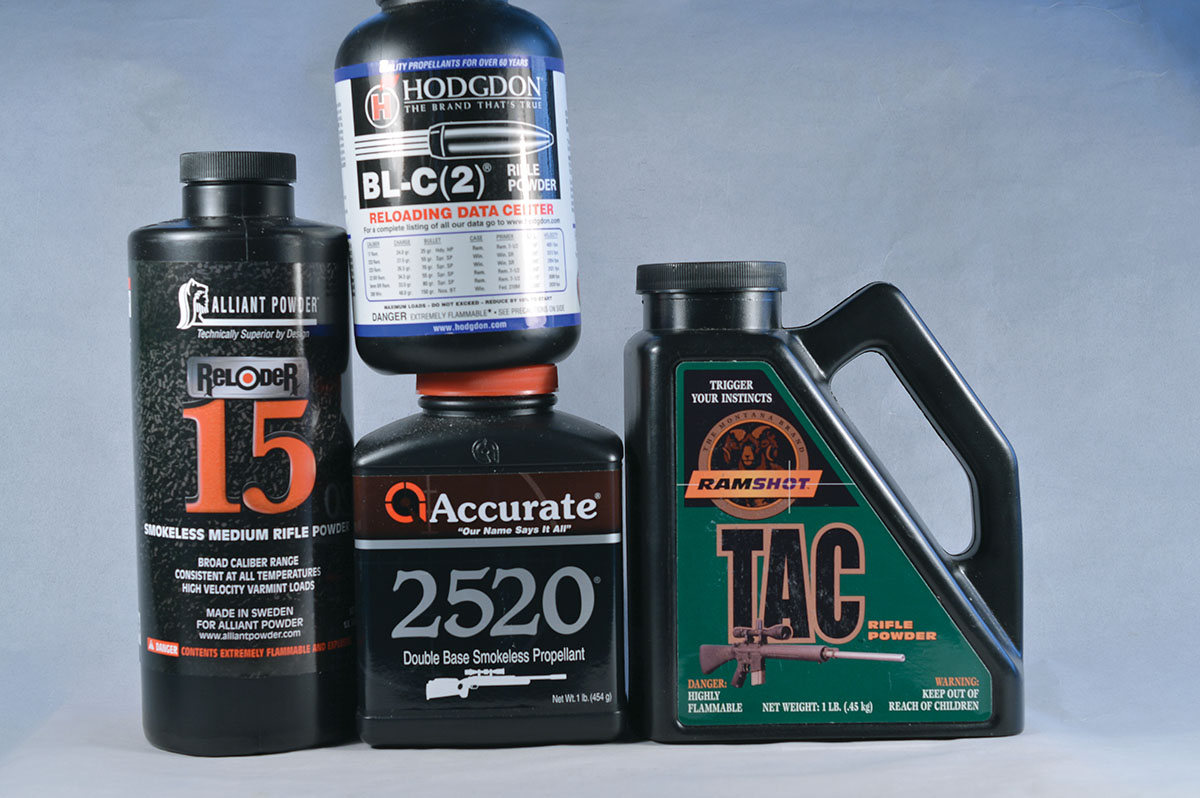
Fifty-five-grain bullets are probably the best weight for varmint loads with higher ballistic coefficients (BCs) that help to keep velocity up and minimize wind drift. Nosler’s 55-grain Varmageddon is a flatbase, polymer-tipped bullet designed for varmint hunting. An overall length of .795 inch aids in producing a BC of .255. Having said that, Nosler has introduced a 53-grain flatbase, polymer-tipped bullet in the Varmageddon series with an overall length of .830 inch and a BC of .303. (Unfortunately, I did not get to try these.) Sub .5-inch groups with the 55-grain bullets were obtained with IMR-4064, Varget, RL-15 and CFE 223.
The story repeated itself with Nosler’s 64-grain Bonded Solid Base bullets. These are true hunting bullets and accuracy was sometimes exceptional. Bullet overall length is .800 inch, and BC is .231. Several powders produced groups of less than .5 inch, but the best performers were IMR-4064 and RL-15.
Nosler’s 77-grain Custom Competition target bullet features a boat-tail and hollowpoint for long-range shooting. Its overall length is .980 inch; its BC is .340. Testing at 100 yards didn’t allow for the bullet to show its potential, but several powders turned in admirable performance including Ramshot’s TAC and Hodgdon’s BL-C(2).
Throughout my time with the test rifle and cartridge there were no glitches, with one exception. Every round fired – factory or handload – demonstrated a heavier-than-expected bolt lift owing to primer flow back into the firing pin hole in the bolt face. There were no pierced primers or other signs of excess pressure. It would appear the relationship between the firing pin hole and the firing pin diameter is not as close as it could be, or the firing pin spring is not as strong as it should be. Either might be the cause for the situation. I really don’t know. Another writer in another publication, when testing the cartridge in an AR, noted pressure problems in factory ammunition, which he attributed to soft brass. That was not the case here. On the other hand, in speaking with another shooter who had spent time with the cartridge in a similar M48 Heritage model, he did not have, or did not notice, the problem.
In the end, we have a fine new cartridge AR shooters will likely love and bolt-action shooters will likely come to appreciate, depending on their needs.