

Rifle Talk
Rifle Basix RU-R Ruger Triggers
column By: Lee J. Hoots | April, 18
For benchrest shooting, where customized rifles are made to be as physically heavy as possible within the parameters of their given class, there may be some recognizable worth to this idea, given that those who participate usually have long experience with pull weights measured in ounces. As a blanket statement for “all triggers,” which I take to include “all shooters,” it’s a bunch of malarkey.
Far more credible advice for some riflemen, but certainly not all, is the thought that a fellow should learn to shoot with a heavy trigger pull. This is reasonable enough, especially for rifles with triggers that cannot easily be swapped out (or rifles that only retain value with their original, unaltered parts), but it likewise insinuates “all shooters and all shooting,” and is consequently a point of view nearly as one-sided as a nonsensical, ultralight pull weight for everyone. Like most opinions, reason lies somewhere in the middle.
For personal big-game rifles, a trigger pull weight of 3 to 3.5 pounds is preferred, though I have taken big game and shot some reasonably small groups on paper with triggers that tripped somewhere around 6 pounds. For rifles that will be slung over the shoulder on cross-country walks in search of coyotes or jackrabbits, preferred pull weight stays the same – tiny clustered groups or otherwise. For true, heavy-barreled varmint rifles used only to shoot the smallest groups or rodents, sometimes out to 500 yards or farther, my preference lies in the neighborhood of 2.5 pounds. Exact pull weight for a given rifle is dependent on the perception of how smoothly the trigger works and how minimal its overtravel is.
Though it’s becoming more the rule than the exception, not all factory rifle triggers are adjustable, including Remington’s current trigger. Not to single out a struggling company with an otherwise sterling reputation, I have found during the last eight or so years that about one out of five X-Mark Pro triggers can actually be adjusted, and usually only by small margins. During a conversation with a friend and former Remington executive a few years back, I asked what would happen if the adjustment screw was removed completely, and was surprised by the lackadaisical, though bluntly honest, reply: “Then you’ll have a 5-pound trigger with no adjustment screw.” More recently, however, the trigger adjustment screw on a 35 Whelen was easily turned down to just over 3 pounds. This hit-and-miss trigger trouble long ago prompted me to put Timney’s excellent, easily adjusted triggers on nearly all 700s in the safe. One exception is a 25-06 Remington with a very good Shilen trigger that at first was a little gritty but quickly smoothed out after about 20 rounds.
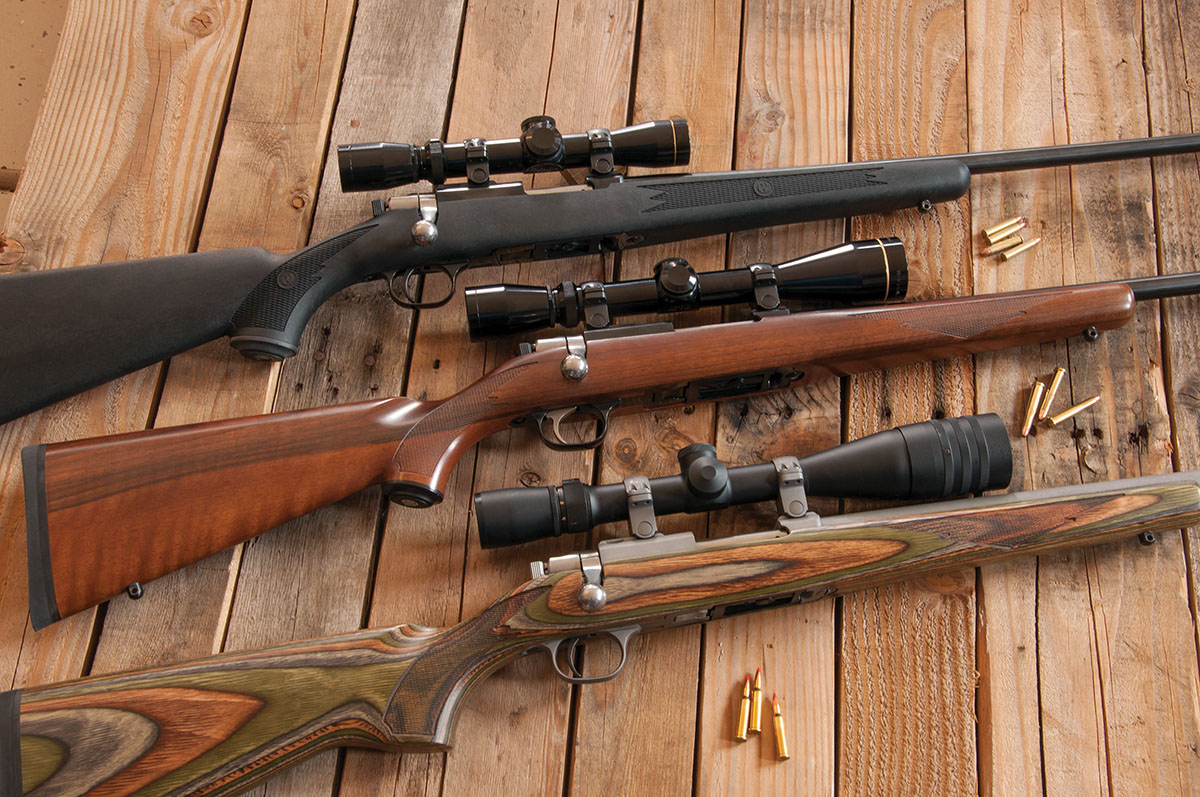
Some Ruger Hawkeye, 77/22 and 77/17 series rifles are quite nice due to classic stock lines, attractive walnut and generally good accuracy. Those shot in the last nine years include a 25-06 Remington, 6.5 Creedmoor, 300 Winchester Magnum, a semicustom 300 Ruger Compact Magnum with a 24-inch barrel, 22 Hornet, 17 Hornet, 22 Winchester Magnum Rimfire (WMR) and a 17 Winchester Super Magnum (WSM).
Of concern here are those chambered for the smaller-caliber rodent cartridges, and all of them were/are standard production rifles; the 17 Hornet is a stainless steel, heavy barrel variant with a laminated stock, and the 22 WMR has a plastic stock. With the exception of the 22 Hornet, those still on hand have a Rifle Basix RU-R trigger on them.
The 17 WSM with a Leupold VX-2 3-9x 33mm rimfire scope was the first rifle on which I tested a Rifle Basix trigger purchased from Brownells (brownells.com). According to notes, the rifle’s factory trigger pull weight was 6 pounds, 9 ounces (!) as measured on a Lyman digital scale, and groups shot with it ranged from 1.5 inches to slightly larger, and few of them were round. After installing the new trigger, 100-yard groups ranged from a mostly round, 1.186 inches with one load down to roughly .900 inch with another load. A third load provided groups as small as .765 inch.
Another example is the heavy-barreled 77/17 17 Hornet with a trusted, older Weaver 9-24x 42mm AO scope. The rifle, with its nonadjustable factory trigger pull of 4 pounds, 6.1 ounces, shot pretty well from the box, but a lighter trigger was desired, so I eventually planned to install a Rifle Basix trigger – then eventually got around to doing it.
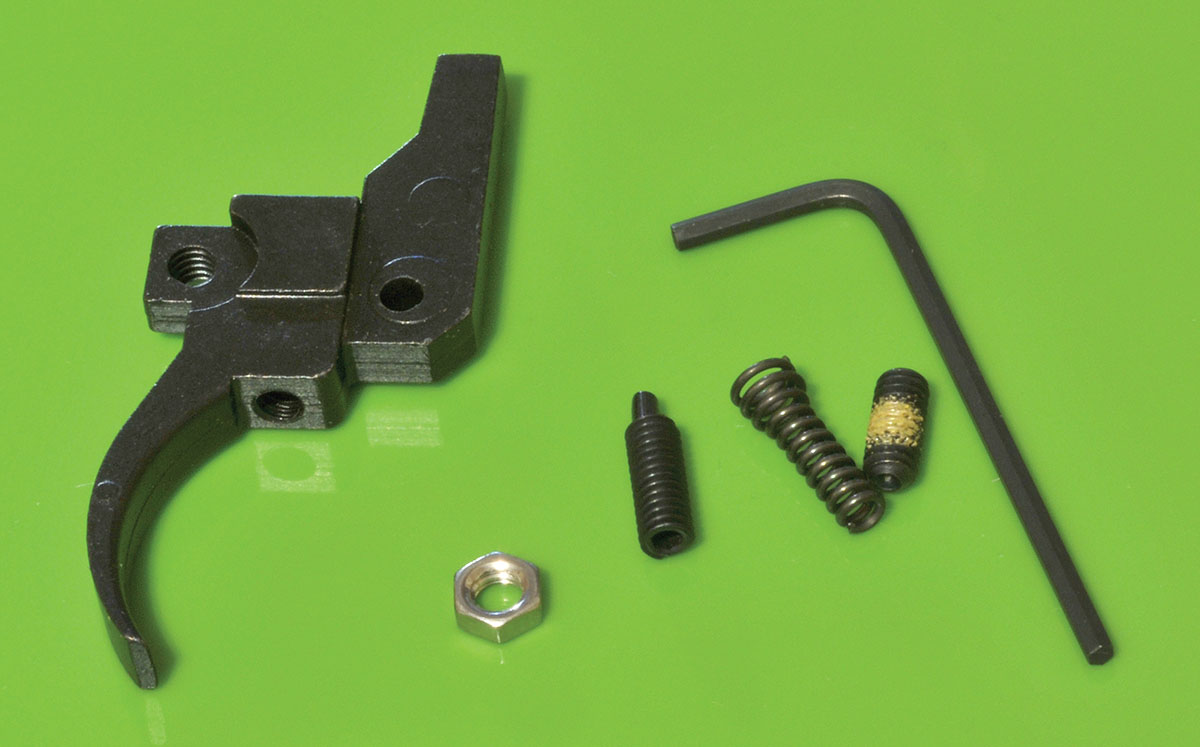
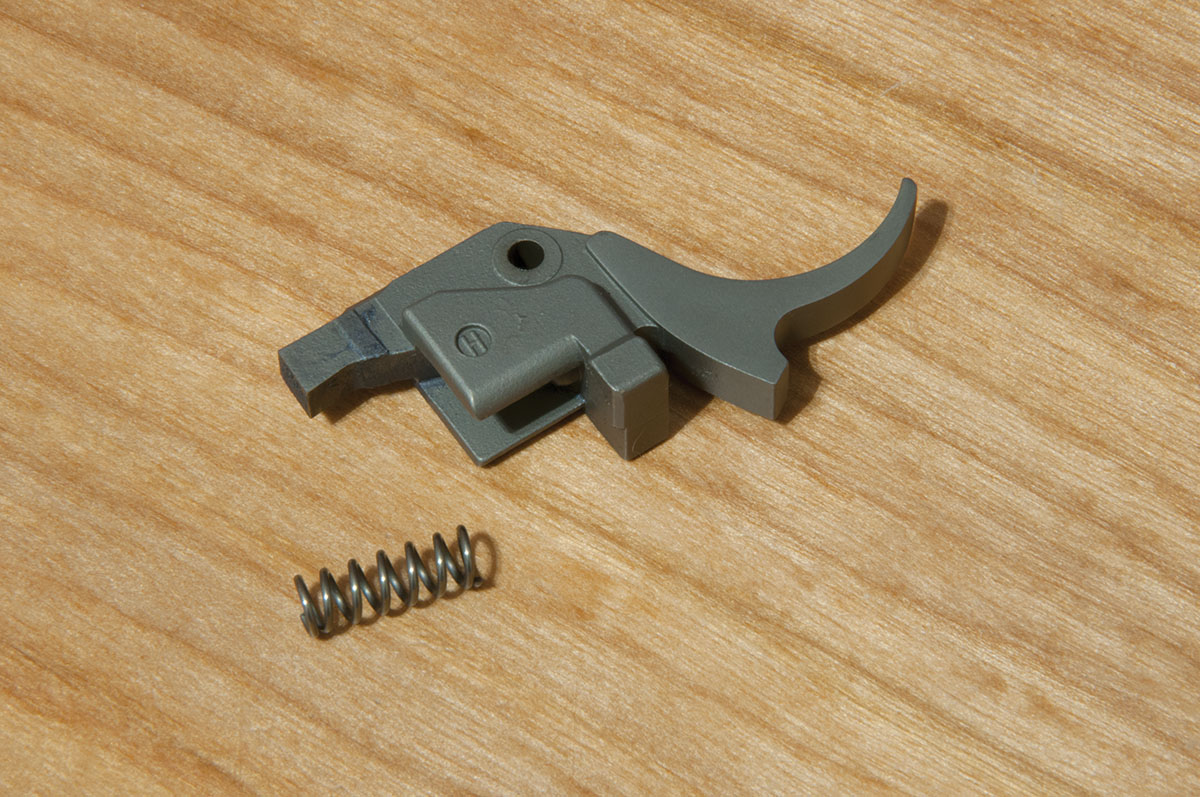
Ruger 77 trigger pull weights have been too often modified with the use of a lighter spring, or by adventurous souls cutting coils off the original trigger spring. The first modification should be left to aficionados with a great deal of experience; and clipping the original spring is a terrible idea that can lead to real safety concerns. The Rifle Basix trigger is a fairly inexpensive alternative, and installing one is nearly as intuitive as removing the original Ruger trigger.
When all was said and done, it probably took a half hour to replace the trigger, and much of that time was spent measuring pull weight, adjusting the weight of pull screw then weighing again with the digital scale to come up with something comfortable. The end result was a trigger that breaks crisply at 2 pounds, 11 ounces.
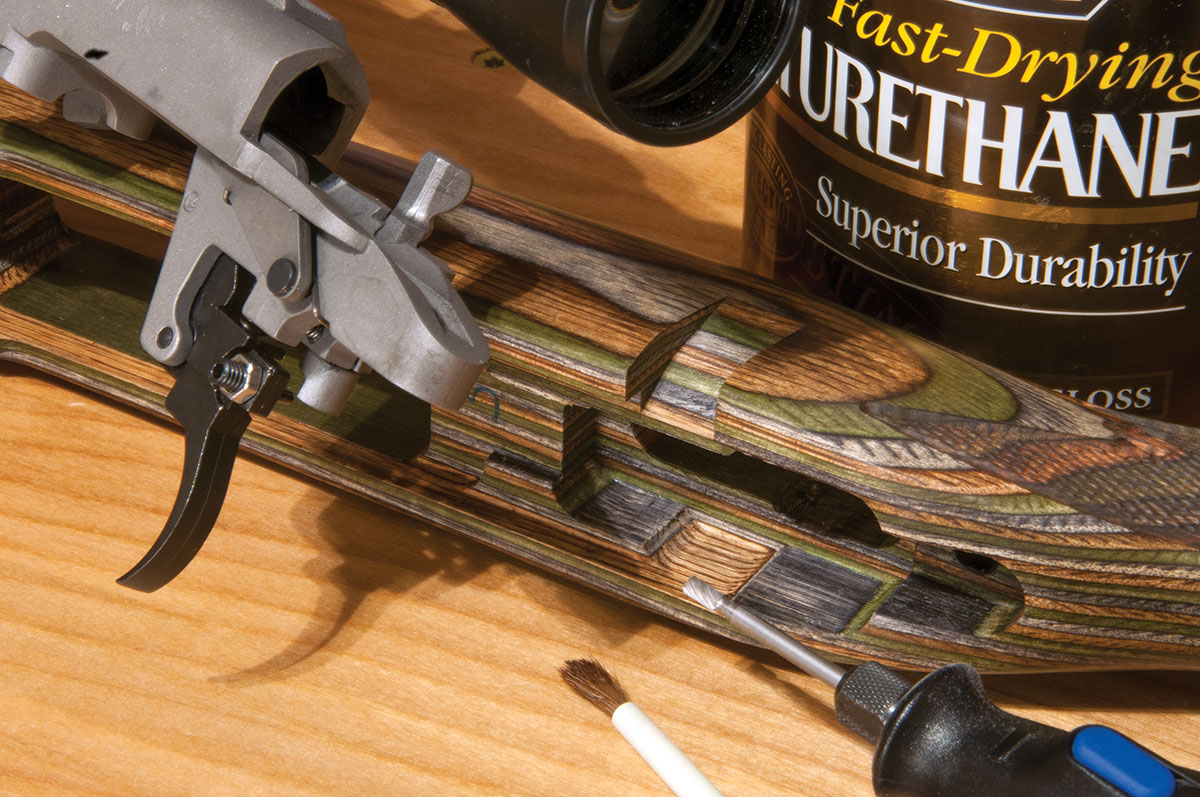
There is one caveat, and that is the fact that the safety adjustment screw protrudes from the right side of the trigger and may press against the wood stock inside the trigger mortise on Ruger 77/22 series rifles; this can be seen by placing the barreled action into the stock, then turning it over and shining a flashlight down beside the trigger. The injection-molded stock on the previously mentioned 77/22 22 WMR provides plenty of space, but the 17 Hornet (and the 17 WSM tested a couple years back) required a bit of wood removal.
With the rifle upside down, hold the flashlight and use a pencil or a fine-tipped Sharpie to inscribe a semicircle on the stock around the exposed half of the safety screw. The use of a Dremel tool or similar handheld grinding device will make quick work of removing wood where (and if) the safety adjustment screw touches the stock. Remove only enough wood to keep the screw from binding, checking fit several times during the process.
If a laminated stock is to be relieved, it’s possible that the ground portion may not require refinishing, as the resins used during the bonding of multiple plywood layers, which is done under great pressure, may very well have sealed the wood through and through. It makes far more sense, however, to seal the grinded-out depression with a trusted wood sealer, the application of which can be done with a small, disposable paint brush. Always seal a walnut stock.
On a final note, the pull weight adjustment screw on the Rifle Basix RU-R assembly is located at the bottom of the trigger so is easily accessible with or without the trigger guard assembly installed.