

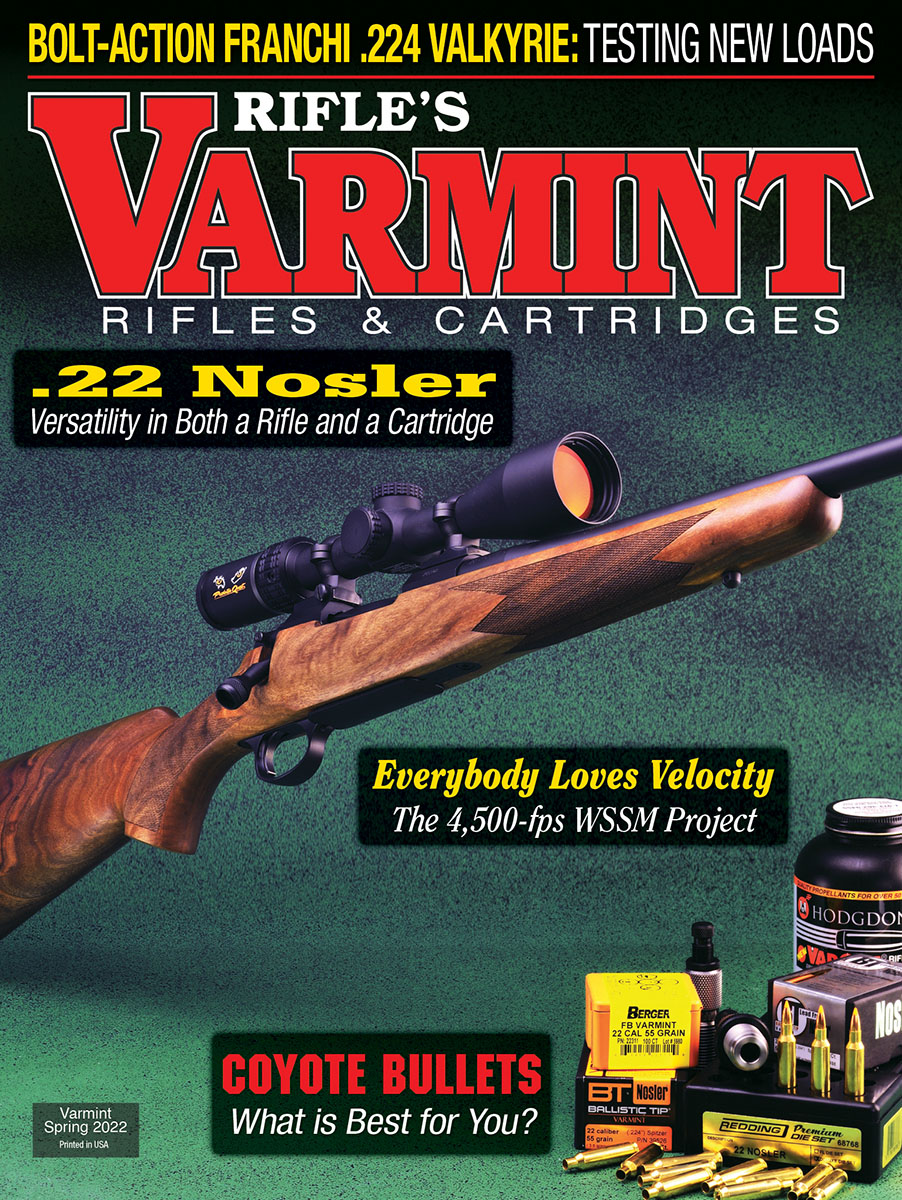
Varmint Spring 2022
On the Cover: A Nosler Model 48 .22 Nosler with a Burris 4-14x 42mm scope. Photo by Stan Trzoniec.
Volume 15, Number 1 | ISSN:
Article Bites
Rifle Talk
Remington's Model 722 and 222 Cartridge
column by: Lee J. Hoots
It’s easy enough to define what a varmint is, those pesky critters that tear up pastures, flower beds and all kinds of expensive crops people need for various reasons – most importantly, to make a living and/or something with which to feed themselves. On the other hand, defining what exactly constitutes a “varmint rifle” is not always so cut-and-dried. It could be anything from a BB gun used against a troublesome gopher to using a handy 270 Winchester when coyotes start stealing newly-born calves in the far pasture. Nonetheless, most riflemen still generally think of small caliber, high-velocity cartridges when discussing vermin rifles, even if they have a BB gun stashed near the back door. ...Read More >
22 Nosler
Versatility in Both a Rifle and a Cartridge
feature by: Stan Trzoniec
If I had to pick one caliber that I have followed through most of my life, it would be the .22. From the lonely rimfire to the high-end rifles of today, I’ve been involved with commercial ammunition as well as tuning my rifles with specific handloads while venturing into the world of wildcats. It seems it doesn’t end – and that’s good, in fact, one of the latest to grace my office is the 22 Nosler, and together with the Model M-48 rifle, has added another dimension to my work for this year. ...Read More >
A Bolt-Action Franchi 224 Valkyrie
Testing New Loads
feature by: Patrick Meitin
Federal Premium brought the 224 Valkyrie into the world by necking the 6.8 Remington SPC down to accept .224-caliber bullets and adding a 30-degree shoulder angle, which seems to have become a new-cartridge standard. Federal just happens to have 6.8 SPC ammunition contracts running into the billions of rounds with military organizations in Saudi Arabia, Jordan and maybe others, so I’m guessing some company ballistician looked at all that parent brass and thought, “You know, necking that down to .22-caliber would be interesting.” Those massive military contracts also keep the price of Valkyrie brass and ammunition reasonable – or at least more reasonable than other .224-caliber favorites like the 22-250 Remington and 220 Swift. ...Read More >
Remington's 5mm Rimfire Magnum
Shooting a Classic
feature by: Layne Simpson
The 5mm Rimfire Magnum was at the very top of the really big news list during the Remington writer’s seminar of 1968. A maximum average chamber pressure of 33,000 psi pushed a 38-grain Power-Lokt, hollowpoint bullet measuring .2045 inch in diameter to a muzzle velocity of 2,100 feet per second (fps). In comparison, Winchester’s 22 WMR, which had arrived on the scene 11 years earlier, was loaded with a 40-grain bullet at 22,000 psi for 2,000 fps. Residual energy at 100 yards was 217 foot-pounds for the 5mm Magnum and 170 foot-pounds for the 22 WMR. ...Read More >
Coyote Bullets
What is Best for You?
feature by: Phil Massaro
Sitting in one of my favorite deer spots – a small stone seat at the base of a huge oak in the middle of a nice hardwoods – I was looking to fill a doe tag, as I’d filled my buck tag three days prior. The gut pile had been barely touched, presumably by crows or ravens and was clearly visible down the logging road. The unmistakable sound of footsteps in the dry leaves caressed my ears, and soon, the big, blonde coyote stepped out onto that road, sniffing for the gut pile. A 180-grain Sierra bullet soon ended the possibility of a meal, and I quickly learned that a 300 Winchester Magnum and a softpoint best designed for big game might not be the ideal combination for furbearers. However, I have a motto: A good coyote is a dead coyote. ...Read More >
Loads for a 22 TCM
New Powders and Bullets
feature by: Patrick Meitin
The 22 TCM first appeared commercially in 2012, chambered in a Rock Island Armory 1911-style handgun. A pair of Rock Island TCM rifles followed – the 20-inch-barreled M22 TCM Tactical based on an adjustable synthetic stock and the 22.75-inch tubed M22 TCM BA bedded in wood. I’d attempted, unsuccessfully, to secure a loaner rifle for some time before coming across a used M22 TCM BA in the used-gun rack of Orofino, Idaho’s, Olive’s Auto Parts. I purchased the rifle, anxious to see what this cartridge was all about. ...Read More >
Everybody Loves Velocity
The 4,500-fps WSSM Project
feature by: Jim Matthews
There were six vehicles lined up along a dirt road on the edge of an irrigated pasture. About 15 of us were shooting at Columbian ground squirrels in the lush spring grass. The locals call this species of ground squirrel “gophers,” and they are little targets, especially the “young-of-the-year” juveniles, which probably have less than a one-inch vital area cross section. We started with semi-automatic .22 rimfires until we had eliminated or educated all the squirrels within 75 yards or so. Then we unlimbered the bigger centerfires in a wide variety of calibers. The game switched to a team sport where we alternated between being on the trigger and on a spotting scope or binoculars looking for likely targets. We almost universally agreed that it was more fun spotting than shooting because view of the target was usually lost at the moment of bullet impact for the shooter. ...Read More >
223 Remington from 30-30 Winchester?
Multitasking for Varmints
feature by: Art Merrill
Shooters old enough to remember Y2K may also remember Remington’s “Accelerator” round – a 30-30 Winchester, 308 Winchester or 30-06 cartridge that launched a 55-grain, .224-inch bullet via a .30-caliber plastic sabot. Remington introduced the Accelerator line in 1977, which had a run of about 30 years. Its purpose, of course, was to wring some viable varminting from a big-game rifle and cartridge. The Accelerator is discontinued, but handloaders can experiment with the concept with components still available today. ...Read More >
Winchester's New Wildcat
The Ultralight Rimfire Varmint Rifle
feature by: Randy Bimson
There is absolutely no doubt that Bill Ruger’s introduction of the 10/22 Carbine in 1964 has left its mark in the industry as the most popular, self-loading rimfire, small-game and informal target-shooting rifle with sales amounting to some 10 million rifles. ...Read More >
22 Winchester Magnum Rimfire
Shooting Revolvers
feature by: Dick Williams
It isn’t the diversity in hunting interests that has surprised me over the years. Rather, it’s the passions developed by the different groups of hunters for the hardware associated with their preferred trips afield. Bird hunters focus on and acquire some exotic models of shotguns. Big-game hunters engage in emotional discussions as to what’s the “best ever” bolt-action rifle. Although big-game handgun hunting is a more recent endeavor, the process is the same. ...Read More >