A Bolt-Action Franchi 224 Valkyrie
Testing New Loads
feature By: Patrick Meitin | April, 22
Being AR-15 inspired, the Valkyrie is generally held to a 2.26-inch overall cartridge length (OAL). This includes the detachable magazine of the test rifle under discussion here, Franchi’s new Momentum Elite Varmint Rifle, though, I am getting well ahead of myself.
The Valkyrie can certainly handle lighter varmint bullets down to around 55 grains, but it is with heavier bullets that the Valkyrie truly shines. With a 75-grain bullet (using the Speer Gold Dot), for instance, the Valkyrie delivers nearly 3,000 feet per second (fps) of velocity and 1,499 foot-pounds of kinetic energy at the muzzle and 703 foot-pounds at 500 yards. With a 90-grain bullet (Federal Fusion as an example) sent at 2,500 fps, it delivers 1,249 foot-pounds of energy at the muzzle and 565 at 500 yards. Ninety-grain bullets carrying higher ballistic coefficients (BC) remain supersonic out to around 1,300 yards, without the recoil and bluster of larger long-range cartridges. During a recent SHOT Show Industry Day at The Range, for instance, I shot three different Valkyrie rifles to 1,000 yards under breezy conditions. Hitting steel gongs based on Law Enforcement Silhouette B-27 targets proved pretty darned effortless.
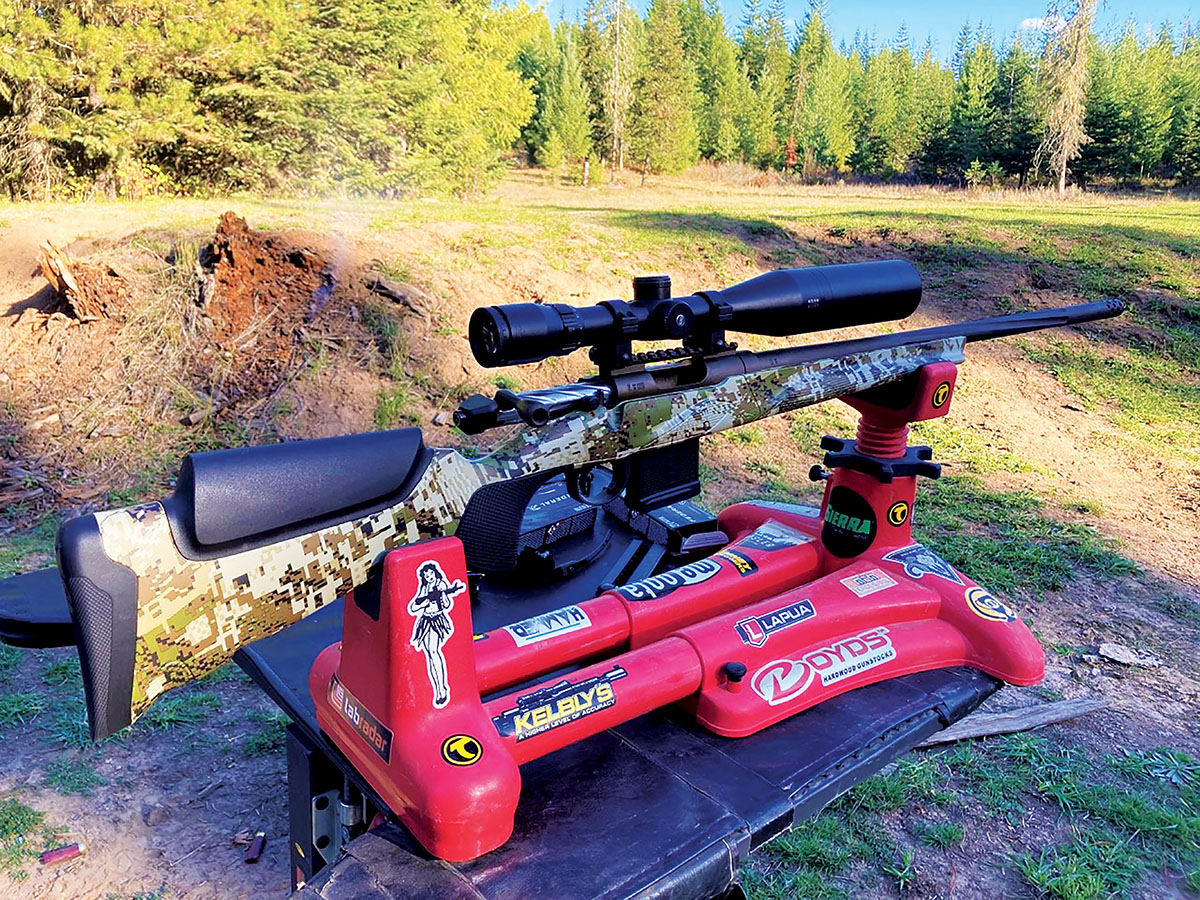
The Franchi test rifle is indicative of the evolution the Valkyrie cartridge has taken, now seemingly offered in more bolt rifles than AR-15s. The Franchi Momentum Elite Varmint (also chambered in 223 and 22-250 Remingtons) is a refined version of the company’s first venture into the bolt-action arena. The rifle includes an all-new EVOLVED EGONOM-X synthetic stock with a removable cheek rest, checkered-polymer grip, wide forearm and a TSA recoil pad that is said to reduce felt recoil by up to 50 percent. The stock design ensures the barrel is free-floated, it is finished with Gore OPTIFADE Subalpine camouflage and provides a 14-inch length of pull. The action holds a one-piece Picatinny rail for versatile optics mounting and the RELIA Bolt features three large lugs that allow a faster 60-degree lift and silky-smooth cycling. The heavy 24-inch, spiral-fluted barrel is covered in Midnight Bronze CERAKOTE and is threaded to hold a muzzle brake (included) or suppressor. It includes a 1:7 twist. The RELIA TRIGGER is adjustable from 2 to 4 pounds with a crisp break. The detachable seven-round polymer magazine clicks in and out with ease. The Italian rifle includes a U.S. street price of around $999.
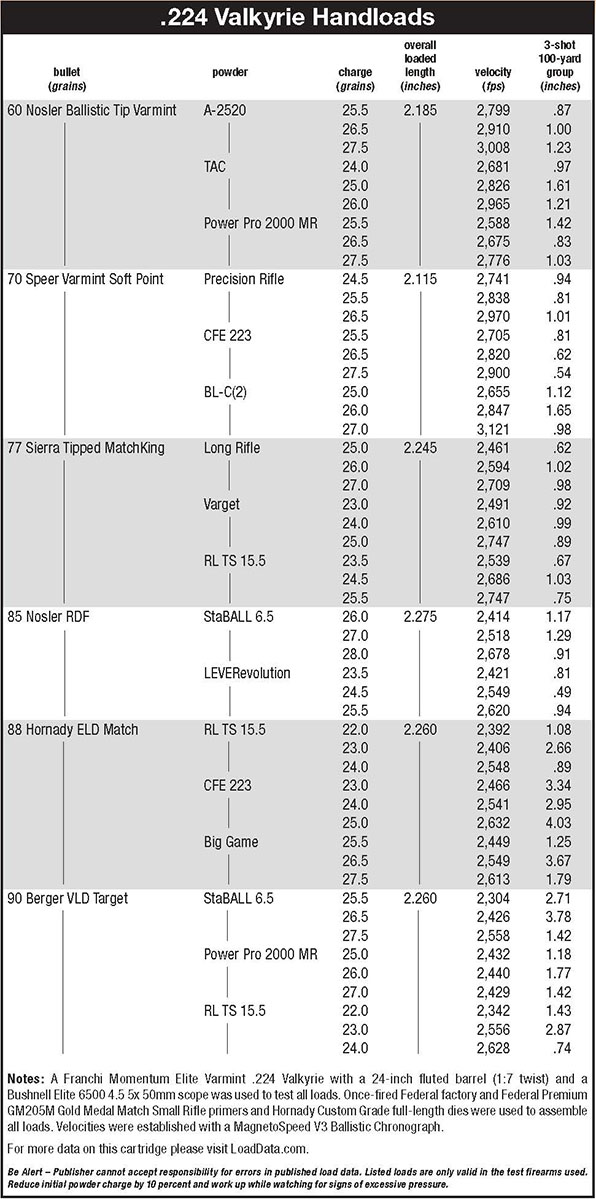
I used once-fired Federal Premium brass collected from factory ammunition to assemble handloads. These are small rifle primer cases, so they were paired with Federal Premium GM205M Gold Medal Match primers; one of my favorites when looking for precision. The Federal brass held an average of 31.7 grains of water, filled to the brim, compared to the 30.7 grains of water once-fired Starline brass held the last time I tested a Valkyrie in an AR-15. Federal nickel-plated brass on handheld 31.1 grains of water, just as a reference. Hornady Custom Grade full-length dies and an Area 419 ZERO Reloading Press were used throughout.
Powders mirrored those typically used for similar AR-15-compatible cartridges, like the 6mm ARC, 6.5 Grendel and 6.8 SPC. Western Powders’ Accurate 2520, Ramshot TAC and Ramshot Big Game; Alliant’s Power Pro 2000-MR and spanking-new Reloder 15.5; Shooters World’s Precision Rifle and Long Rifle; Winchester’s StaBALL 6.5 and Hodgdon’s CFE 223, BL-C(2), Varget and LEVERevolution were utilized for this test.
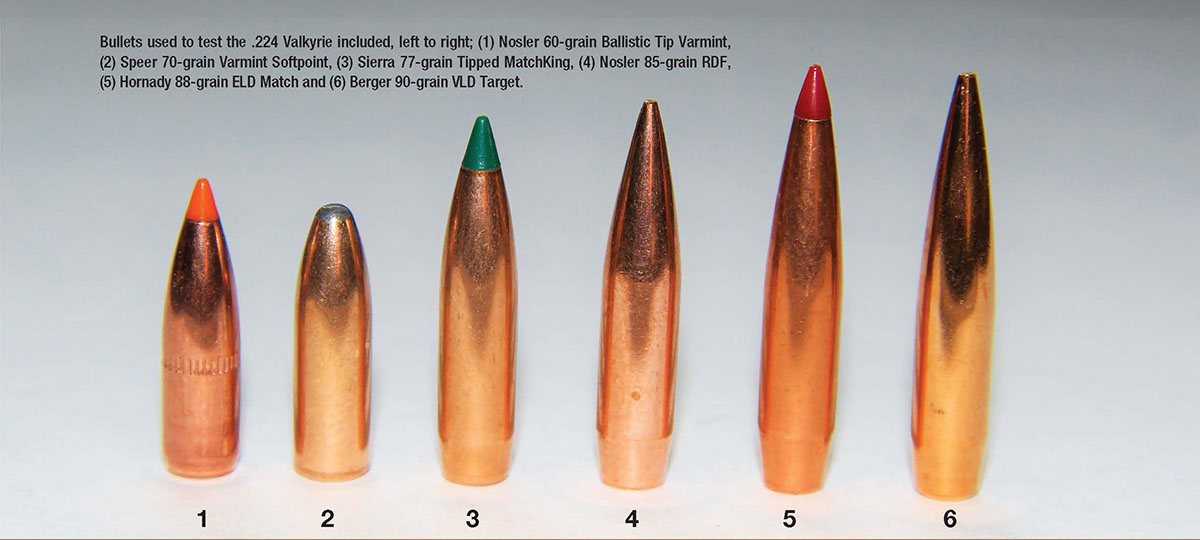
Bullets started with two mid-weight varmint options, Nolser’s 60-grain Ballistic Tip Varmint and Speer’s 70-grain Varmint SoftPoint. Sierra’s 77-grain tipped MatchKing was added as a reliable long-range varmint option. The rest were dedicated target bullets, including the sleek Nosler 85-grain RDF, Hornady 88-grain ELD Match and spear-like 90-grain Berger VLD Target. I can vouch that the latter pair will open on larger varmints such as groundhogs or marmots. The Ballistic Tip Varmint includes a .270 G1 BC created by a boat-tail and polymer tip, while also offering explosive terminal performance. The Speer 70-grain bullet is a highly-frangible, lead-core “semi-pointed” softpoint with a .214 G1 BC which is perfect for moderate to average ranges. The Sierra includes a boat-tail/polymer tip profile, resulting in a .420 G1 BC, the polymer tip initiating excellent expansion on small varmints more reliably than the classic hollowpoint MatchKing design. The Nosler RDF (Reduced Drag Factor) includes a .498 G1 BC, the ELD Match a .545 G1 BC and the Berger a .527 G1 BC, marking them all long-range ready.
As shooting began, a clear trend began to emerge; the first two shots shooting tightly, often touching, and the third drifting to open the group. This proved quite frustrating, as the potential was obviously there, but few truly impressive groups materialized throughout testing. If I were to purchase this rifle, I would immediately fill the flexible stock forearm with bedding compound to stiffen it, open the barrel channel slightly (a piece of printer paper inserted between barrel and forearm easily slid all the way to the action) and especially glass bed the works. I’m absolutely convinced these actions would quickly transform this rifle into a .25- to .50-inch tack driver.
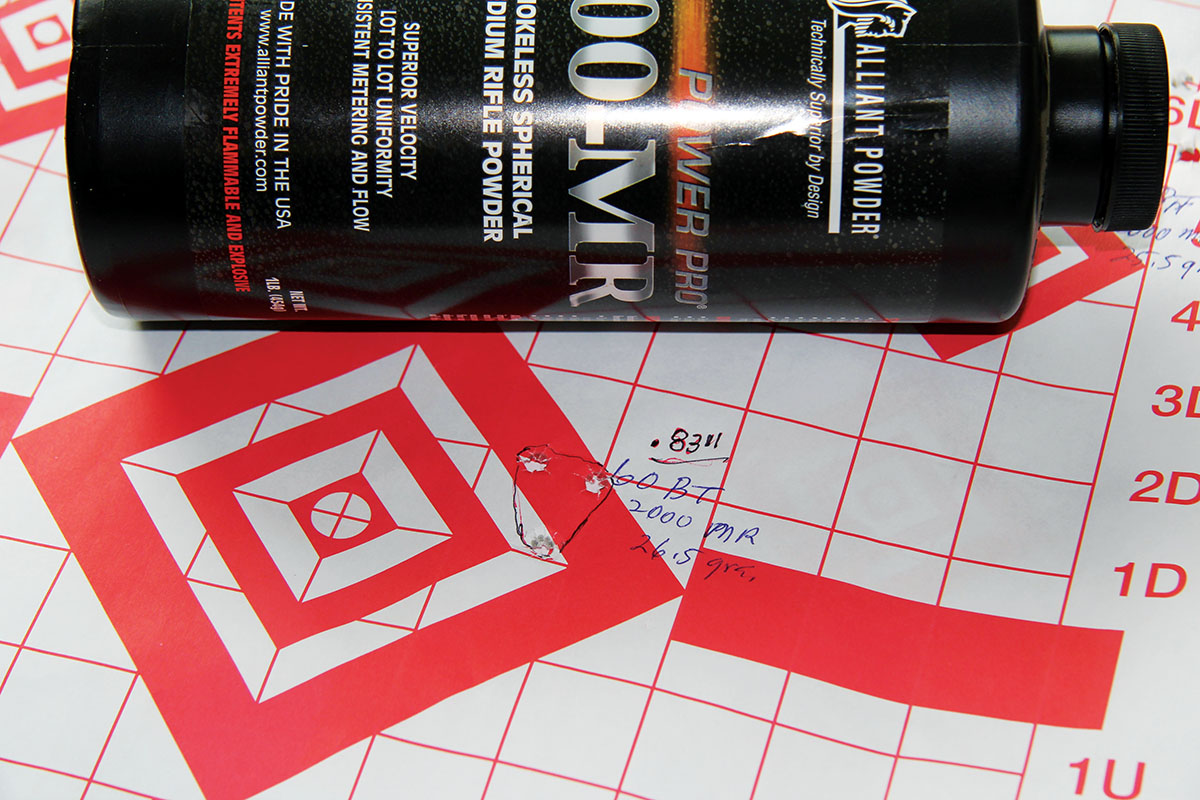
The Nosler 60-grain Ballistic Tip Varmint proved speedy and potentially accurate from the Valkyrie, hitting velocities of 2,900 to 3,000 fps with Accurate A-2520 and Ramshot TAC, and up to 2,776 fps with Alliant Power Pro 2000 MR. Most of the best groups – measuring in the .80s and .90s – resulted from listed start loads, the one exception being the 24.5-grain maximum load of Power Pro 2000 MR. Overall, all powders tested with this bullet showed potential, but I’d likely go with TAC for its temperature insensitivity and clean-burning properties.
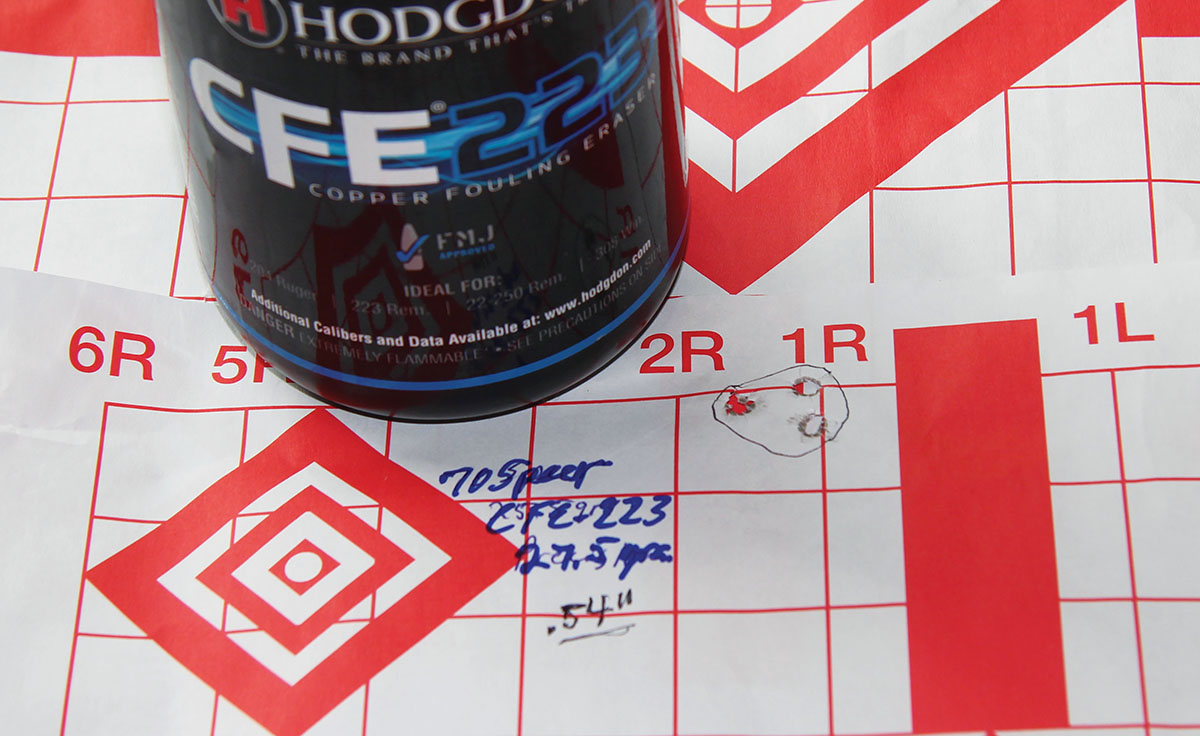
Speer’s 70-grain Varmint softpoint produced a decent overall group average relative to this rifle. Velocity hovered from top speeds of 2,975 to 3,100-ish with Shooters World Precision Rifle, Hodgdon CFE 223 and BL-C(2). BL-C(2) produced one and Precision Rifle two sub-1-MOA groups, while Hodgdon’s CFE 223 kept all three groups under an inch. BL-C(2)’s best group measured just .98 inch at 2,847 fps. Hodgdon CFE 223 was the clear winner, with this bullet printing .81- (2,705 fps), .62- (2,820 fps) and .54-inch groups using 25.5, 26.5 and 27.5 grains of powder, respectively. The .54-inch group – the second best shot in this test – left the muzzle at 2,900 fps and was the result of a nice, symmetric cluster. CFE 223’s Copper Fouling Eraser technology and exceptional temperature insensitivity makes that powder a great high-volume, varmint option.
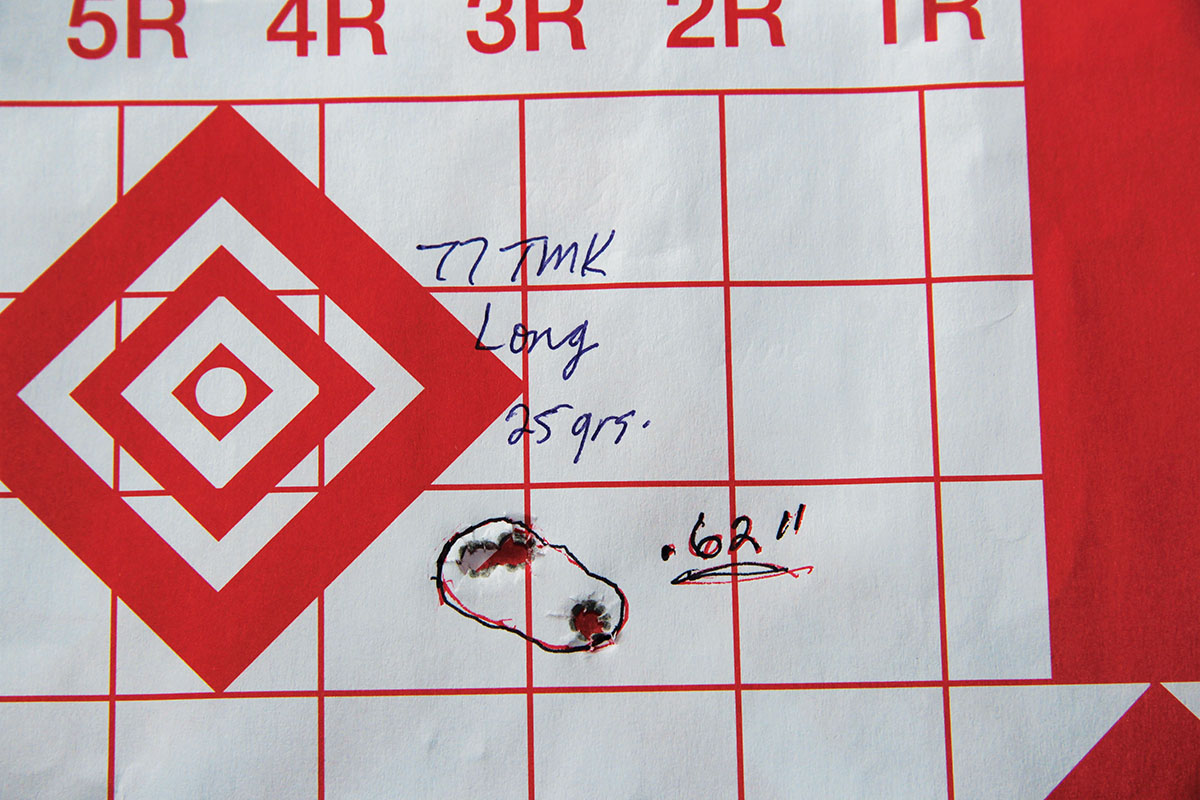
Sierra’s 77-grain Tipped MatchKing provided the most consistent results of the entire test, producing seven out of nine sub-1-inch groups. The best measured just .62 and .67 inch. Shooters World Long Rifle and Alliant’s Reloder TS 15.5 each accounted for two sub-1-inch groups apiece, while Hodgdon Varget produced three groups all just less than an inch. That .62-inch Long Rifle group, produced with 25 grains of powder, showed a 2,481-fps muzzle velocity, and the .67-inch Reloder TS 15.5 group 2,539 fps. Reloder TS 15.5 would be my first choice here, producing not only that .67-inch group, but a .75-inch group with a 25.5-grain maximum charge sent at 2,801 fps. TS (Temperature Stable) technology and a decoppering agent are also part of the bargain.
Nosler’s 85-grain RDF was paired with Winchester StaBALL 6.5 and Hodgdon LEVERevolution. Additional Hodgdon Superformance loads dropped when start loads began showing pressure signs. StaBALL 6.5’s best showing was .91 inch at 2,678 fps using a maximum charge of 28 grains. StaBALL 6.5 reduces copper fouling and is temperature insensitive, so it deserves more exploration. LEVERevolution proved to be the star with the Valkyrie, as it did when I tested an AR-15 chambered for the round in a past test. All groups clustered less than an inch and velocity proved exceptional. Twenty-four and a half grains beneath the 85-grain RDF produced the best group of the entire test – .49 inch at 2,549 fps.
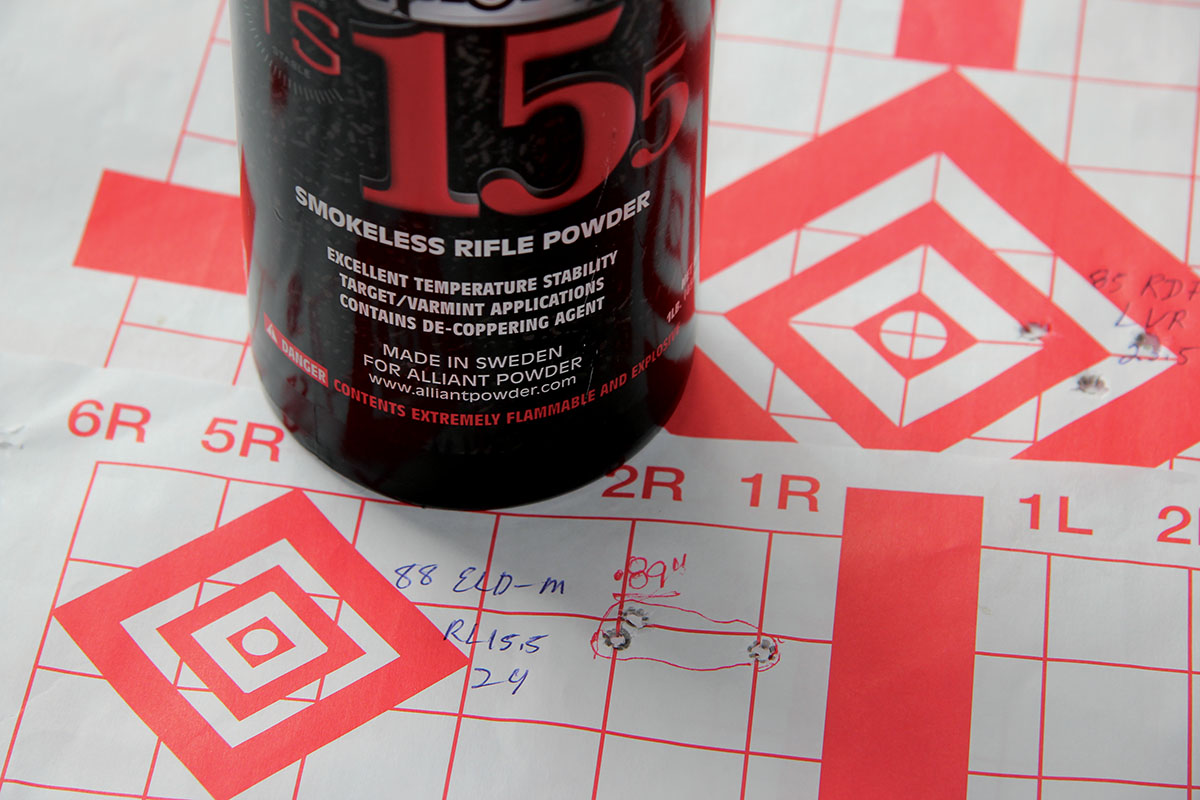
Things went quickly downhill with the introduction of the Hornady 88-grain ELD Match bullet. All loads were shot at near sea level and despite the 1:7 rifling twist, all signs indicate marginal bullet stabilization. This was further evidenced by the fact that accuracy generally improved with added velocity. I have no doubt results would have improved at the usual 3,500-plus feet above sea level where I conduct most of my shooting. Just one sub-1-inch group resulted, from a 24-grain maximum load of Reloder TS 15.5 sent at 2,548 fps.
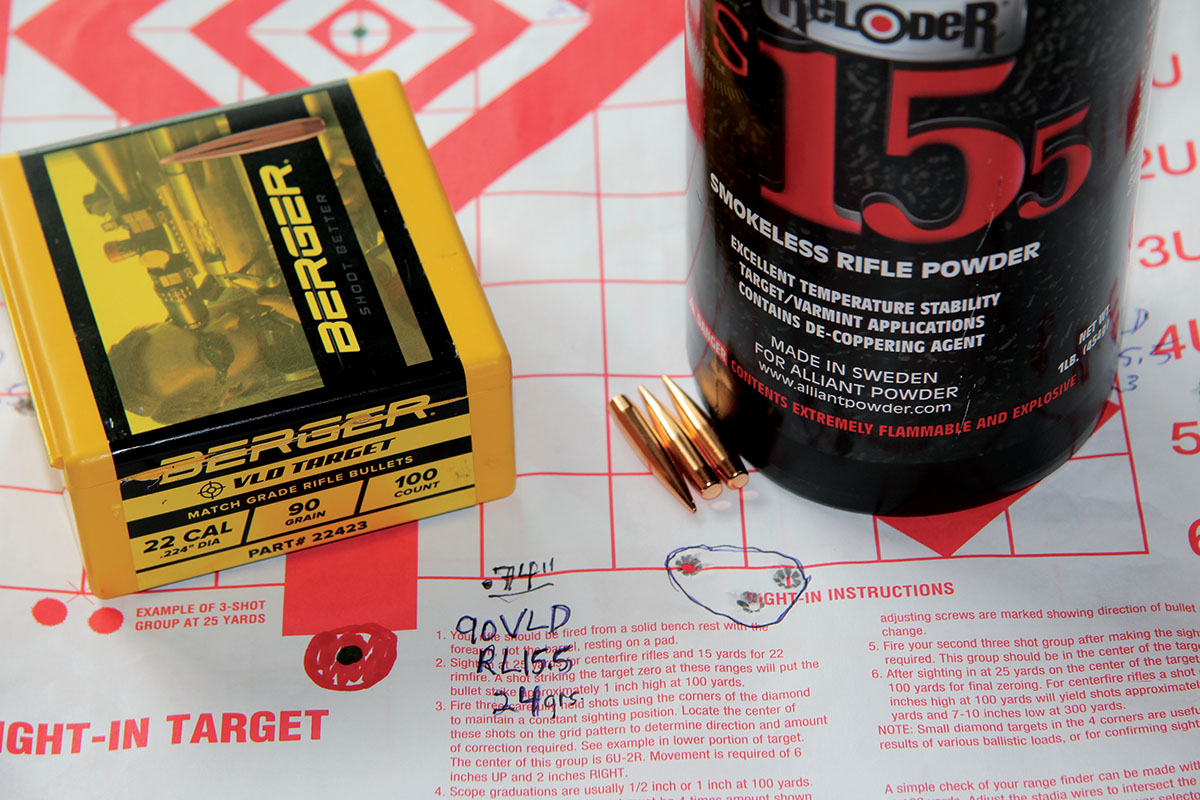
This trend continued with the Berger 90-grain VLD Target bullet, producing generally unimpressive groups until the very last string. The final Berger group, a nice round cluster, measured .74 inch at 2,628 fps. I’d wager that group – and all groups shot with the 88- and 90-grain bullets – would shrink by half at the 4,000 to 5,000 foot elevations where I shoot long-range rockchucks, for instance, as adding 5,000 feet of elevation is the equivalent to adding an inch of rifling twist.
I liked this rifle overall, as I see potential that could easily be realized with some simple stock work. A basic “glass bedding” job would no doubt help create more of the sub-0.5-inch groups I’m usually looking for in a varmint rifle, but I especially liked the Valkyrie cartridge. I see huge potential as a varmint round shooting 55- to 77-grain polymer-tipped varmint numbers to extend range, bucking a desert wind or anchor, tough mountain coyotes with authority. I also see it as a reliable wild boar round when loaded with more robust bullets such as Speer’s 75-grain Gold Dot or Federal’s 90-grain Fusion. I also see it – and have experienced it – as a pleasant, light-recoiling “steel banger” capable of scoring 1,000-yard hits. Add something like Hornady’s 88-grain ELD Match bullet or Berger’s 90-grain VLD Target bullet, and a little altitude, and making steel ring at extreme ranges is almost too easy. The 224 Valkyrie is a truly adaptable round and Franchi’s Momentum Elite Varmint rifle has the potential to make the most of that versitility. I may just be adding another rifle to my list.