Login


Wolfe Publishing Group
    Menu

    240 Weatherby

    Varmint Loads for a Magnum

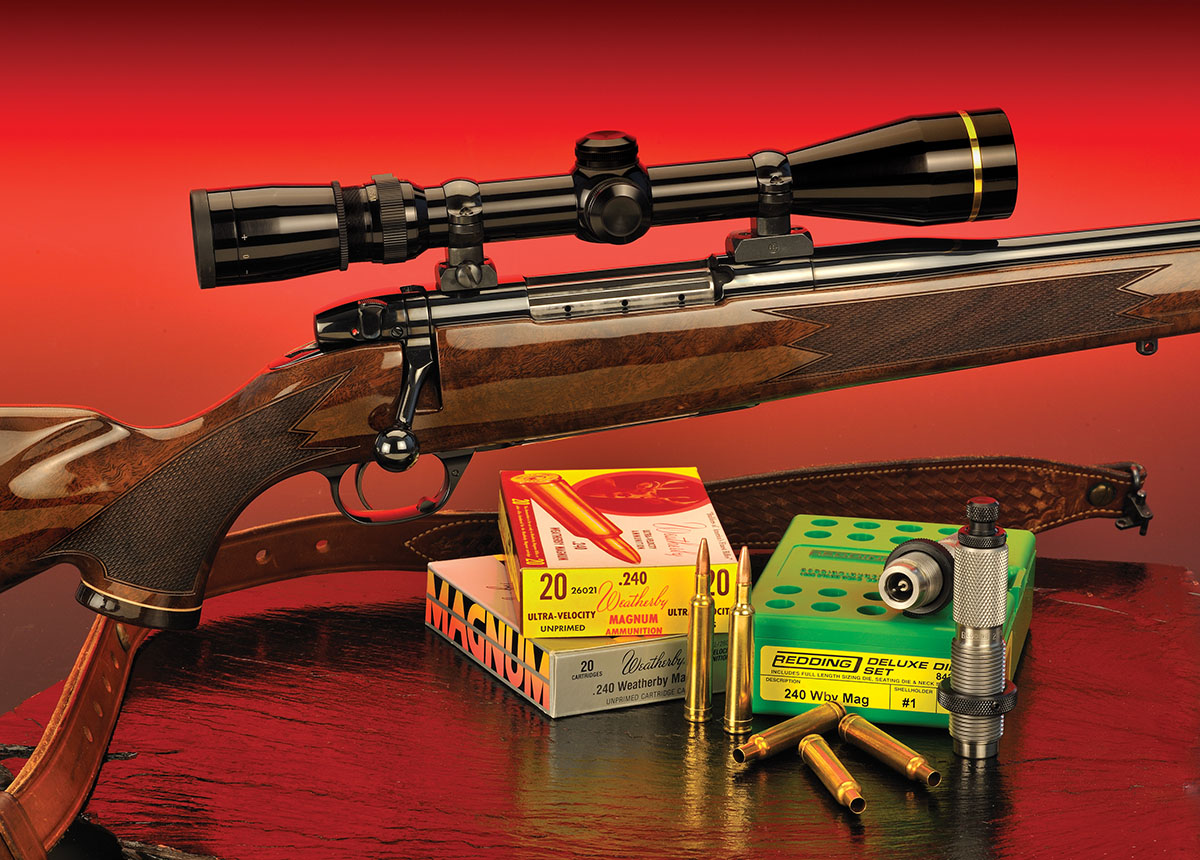
    This Weatherby Deluxe is chambered for the 240 Weatherby Magnum, and is fitted with a Leupold 2.5-10x scope mounted in the same company’s rings with Redfield two-piece bases.
    This Weatherby Deluxe is chambered for the 240 Weatherby Magnum, and is fitted with a Leupold 2.5-10x scope mounted in the same company’s rings with Redfield two-piece bases.
    There is an old saying that comes to mind... “You can’t teach an old dog new tricks!” The more I say it, the more I feel it relates to me. In all the years I’ve been chasing the elusive woodchuck, .22-caliber rifles have been the mainstay of my hunts. From rimfires to vintage wildcats to modern handloads and commercial entries, I don’t think I missed one. Now don’t get me wrong, I am not feeling like I’ve reached the end of the race, but it’s nice to try something different or to venture into uncharted territory.

    For making up any loads, it is a good idea to start out with fresh components like cases and recently made primers.
    For making up any loads, it is a good idea to start out with fresh components like cases and recently made primers.
    Moving up the scale, the 6mms came into focus as of late. The 6mm Remington in a Model 700 got plenty of use with lighter bullets. On a whim, I ordered a Savage Benchrest rifle in 6mm Norma BR. Looking deeper and being a Weatherby fan, its 240 Weatherby Magnum (WM) got more than a casual glance and is the subject of this article.

    But why the 240 WM, or any other 6mm for that matter? Most dedicated varmint hunters will say it kicks more and is not a good choice for all-day shooting. Well, yes and no, depending on how you look at it and the location of your hunt. Okay, for all-day shooting where prairie dogs are in abundance, any 6mm is not a good choice for many hunters, as it can get uncomfortable to shoot – no question there. However, in my neck of the woods in the northeast, since the coyotes are taking a toll on the marmots recently, the 6mm is a good choice considering you may only get three or four shots a day and most of them will be along the stonewalls, not in the open fields as in the past.
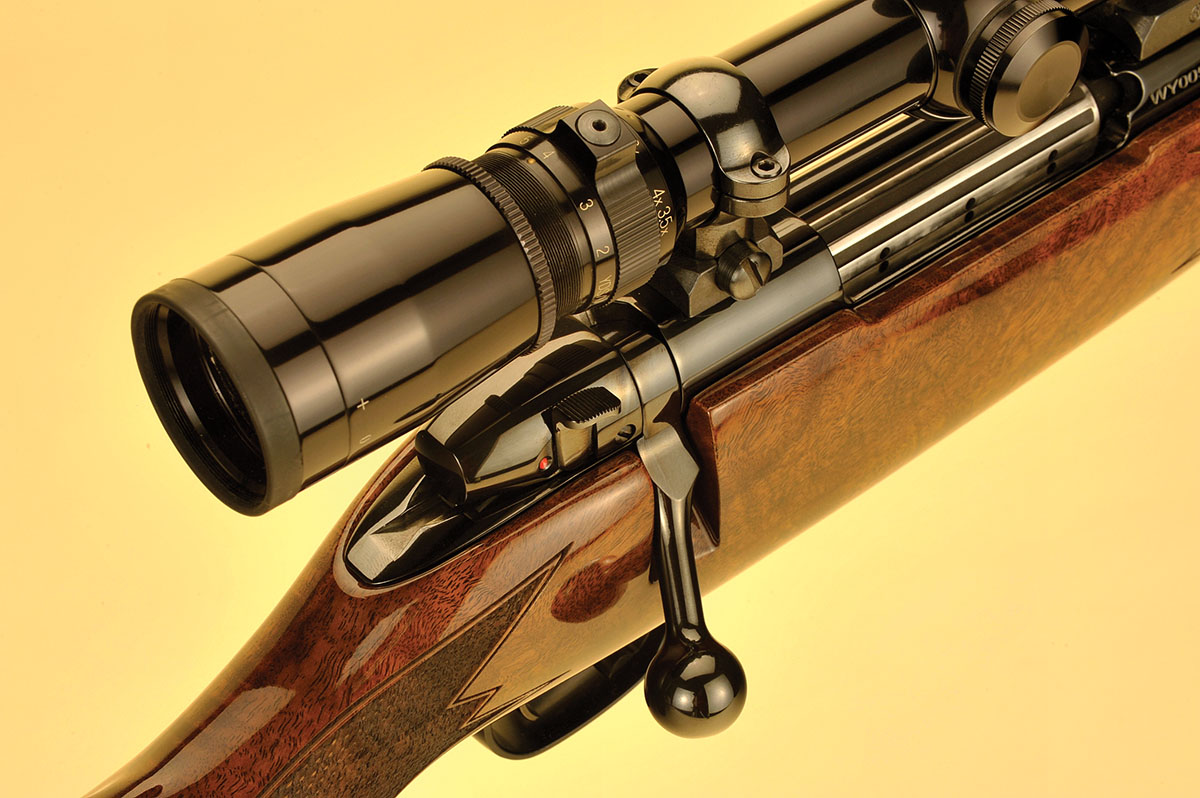
    This high angle shows the two-position safety lever located behind the bolt handle, fluted bolt body and smaller six-locking lug action. A fine line around the checking pattern is a new addition to the stock design.
    This high angle shows the two-position safety lever located behind the bolt handle, fluted bolt body and smaller six-locking lug action. A fine line around the checking pattern is a new addition to the stock design.

    With that established, the 240 WM needs a rifle to shoot it in, and since I did not want to invest in a custom rifle, the handsome Weatherby Deluxe was my choice. While there are other rifles in the line that chamber this high-stepping 6 millimeter, including those with synthetic stocks, this fancy, almost custom rifle was the one for me. A call to Weatherby had one on my doorstep in a short time.

    Like the past 224 VarmintMaster, this rifle has a smaller action made for the compact lines of the 240 WM and a six-lug locking arrangement rather than the larger nine-lug affair on the larger Mark V. Aside from that, the action is polished to a very high gloss and is made in the new plant in Wyoming. The stock is typical Weatherby with the Monte Carlo-type design, select wood, cut checkering and a Decelerator recoil pad. For my tests, a Leupold 2.5-10x scope mounted with the company’s two-piece bases and medium rings completed this rig. Just for the record, this rifle will not accept Mark V bases; you have to order the set made and marked for the smaller or VarmintMaster action.
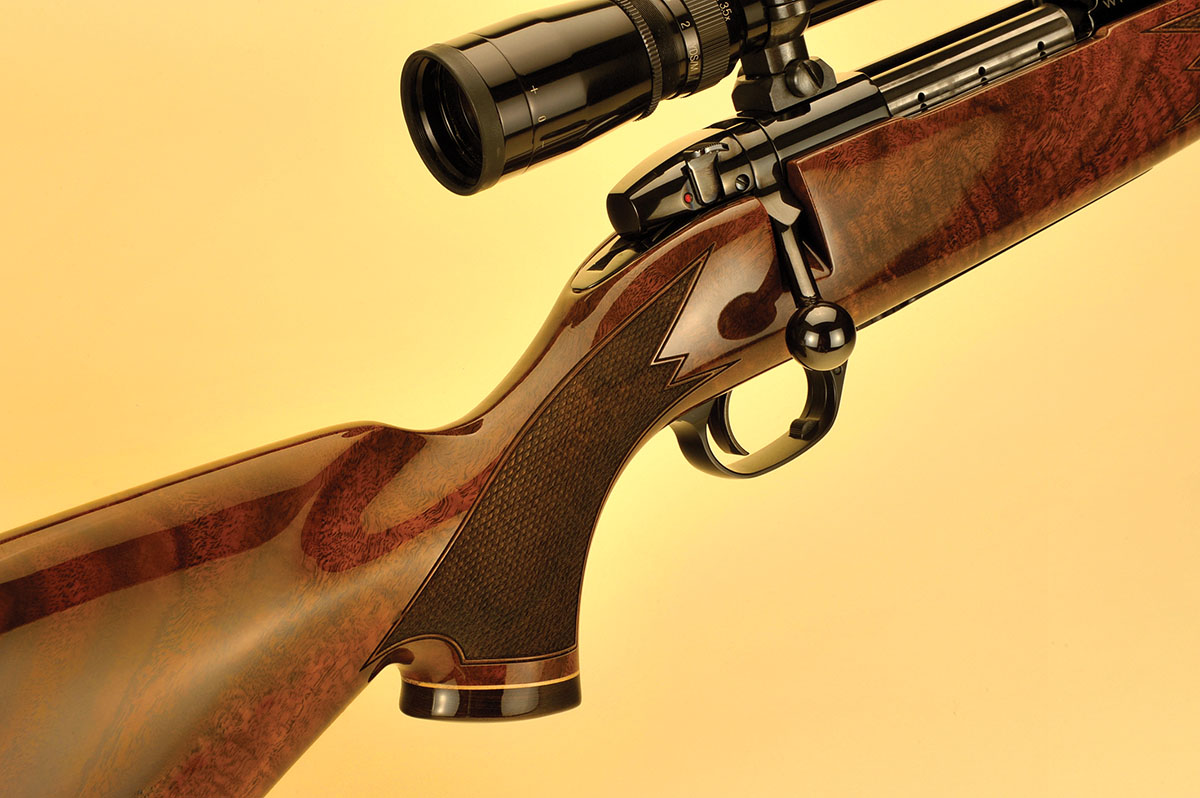
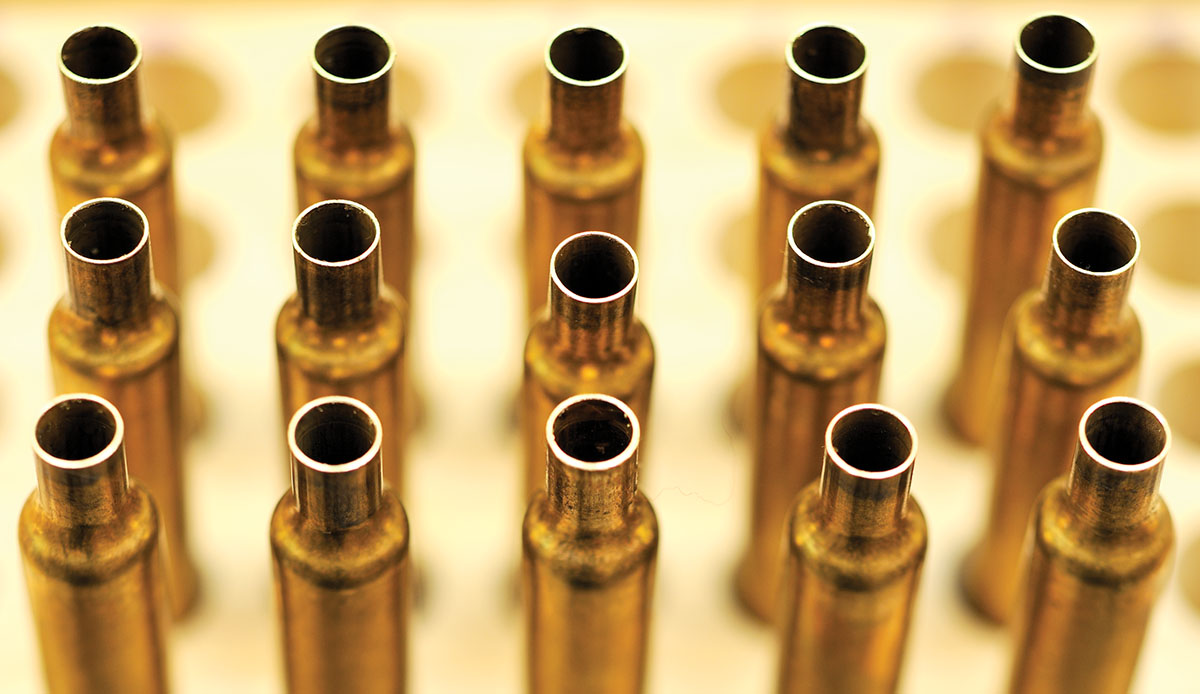
    Fit and finish rates a 10 from muzzle to recoil pad. Workmanship is paramount at Weatherby, as shown here with the clean checkering pattern, the familiar pistol grip cap and Maplewood spacers. Bolt lift is only 54 degrees.
    Fit and finish rates a 10 from muzzle to recoil pad. Workmanship is paramount at Weatherby, as shown here with the clean checkering pattern, the familiar pistol grip cap and Maplewood spacers. Bolt lift is only 54 degrees.
    Onto the cartridge: Introduced by Roy Weatherby in 1968, it was his original intent to overshadow every other 6mm on the market with his proprietary double radius case. While performance margins appeared to be higher back then, new powders and technology have seemed to bring the 243 Winchester and the 6mm Remington closer to the Weatherby product. According to factory offerings using a 100-grain bullet, the Weatherby provides 3,406 fps, and the 6mm Remington 3,100 fps – a 10 percent advantage to Weatherby. With an 80-grain bullet, the Weatherby musters 3,503 fps; the 243 Winchester 3,350 – only a five percent advantage to the Weatherby, but it is faster. Handloading will up the ante a bit, but not at the cost of overloading any case just to prove a point.
    When making up batches of ammunition for testing or shooting, do one step at a time. These cases have been neck sized, trimmed, chamfered and are now ready for priming and charging.
    When making up batches of ammunition for testing or shooting, do one step at a time. These cases have been neck sized, trimmed, chamfered and are now ready for priming and charging.

    When it comes to the 240 case, it holds 64 grains of water. Compared to the 6mm Remington with 58.4 and the 243 Winchester at 56.7, you can see a definite advantage. Dealing with the 240 as a varmint round, and using the 6mm Remington as an example, it would take a larger charge of IMR-4064 to reach 3,700 fps. With the 240 WM, handloaders are looking at 47.4 grains of the same powder to take it to 3,900 fps plus.

    Note the 240 WM is typical of the Weatherby stable of cartridges in that it is a belted case based on its own dimensions and smaller than the other Weatherbys from the 257 WM up, but larger than the 224 Weatherby. For varmint hunters who might want to rechamber a rifle for the 240 WM, the case length is a few thousands of an inch longer than the favored 30-06, but it has the same case head of .473 inch, so magazine length, bolt face or the host receiver should not be a problem.
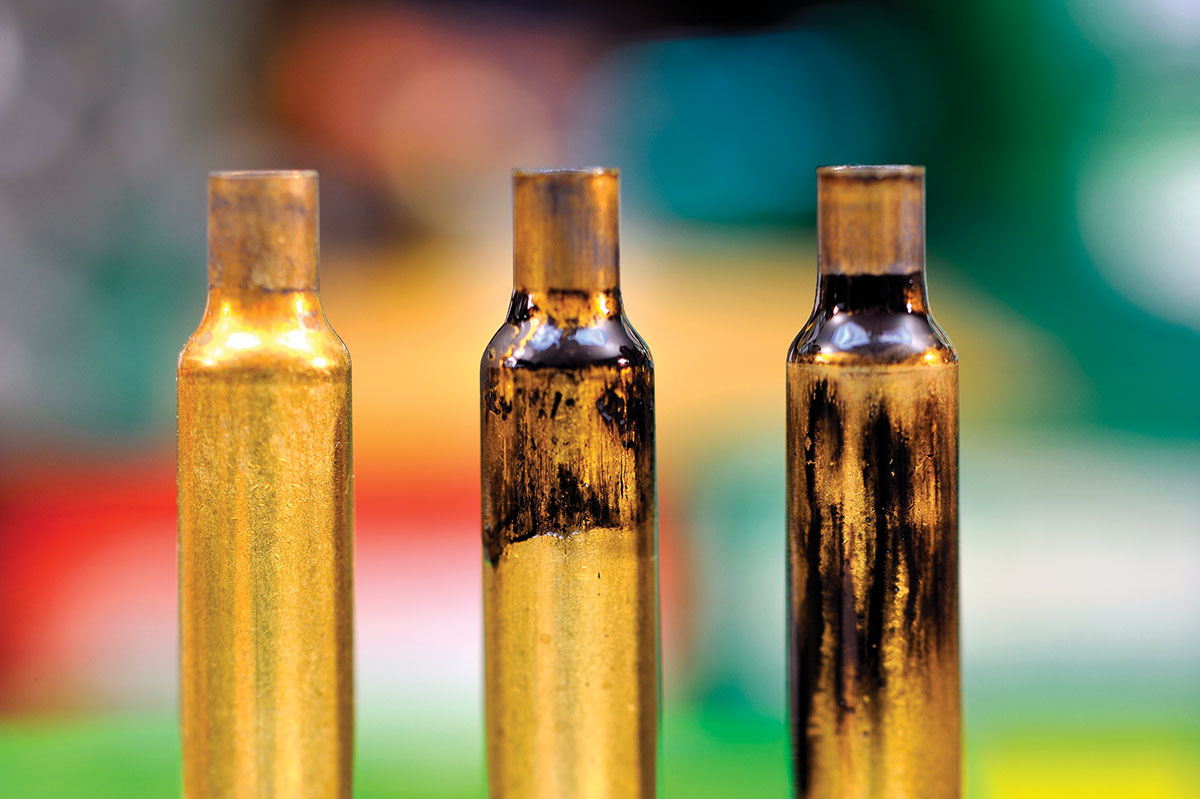
    Stan prefers to full-length size and neck size only. While neck sizing, the die does not make contact with the shoulder of the case as it does with the middle example. With the aid of the soot of a candle, this is a good way to check to see if both you and the die are doing everything right.
    Stan prefers to full-length size and neck size only. While neck sizing, the die does not make contact with the shoulder of the case as it does with the middle example. With the aid of the soot of a candle, this is a good way to check to see if both you and the die are doing everything right.
    Weatherby ammunition and brass is available and varies in price depending upon the vendor. I found new 240 brass running around $2.00 per case, while Weatherby’s Select ammunition ran $2.20 per round in 20-round boxes with a 100-grain bullet. If shooters move up to Select Plus ammunition, figure on almost $5.00 per round with either an 80- or 100-grain bullet.

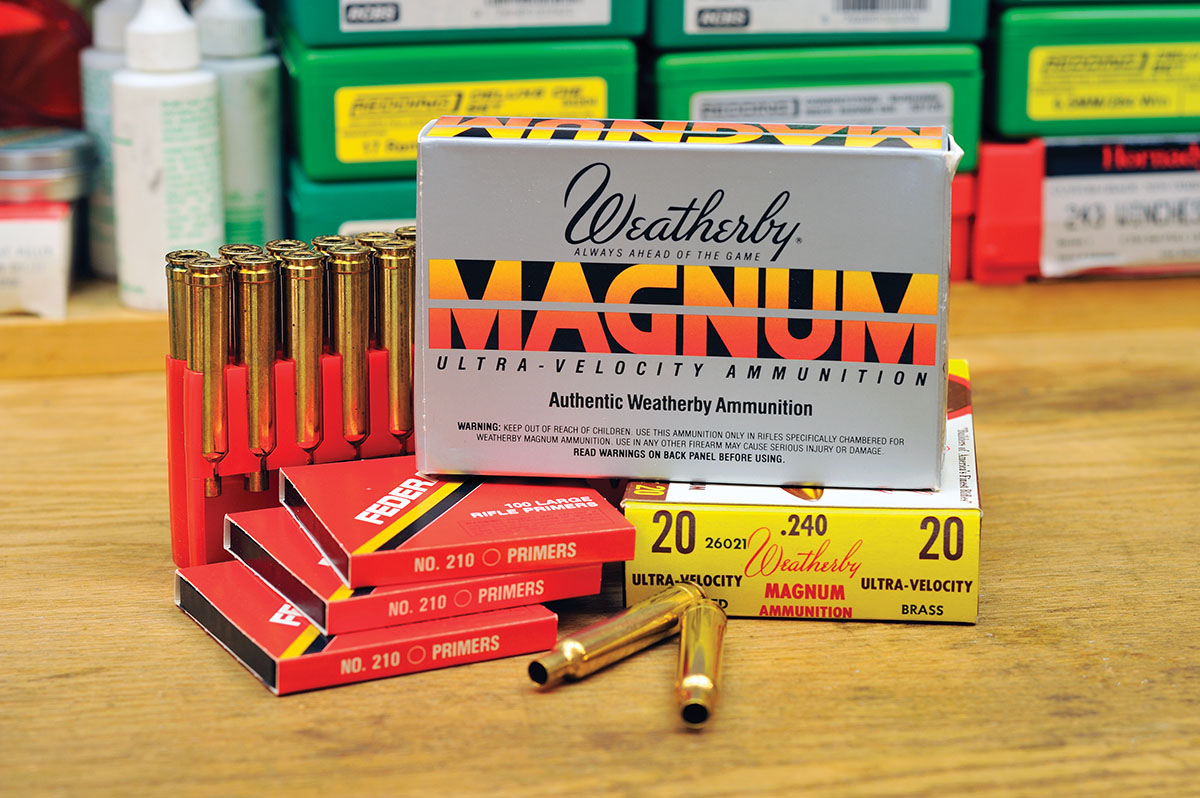
    Primers are always large rifle magnum, and for this testing Federal 210s filled the bill perfectly.
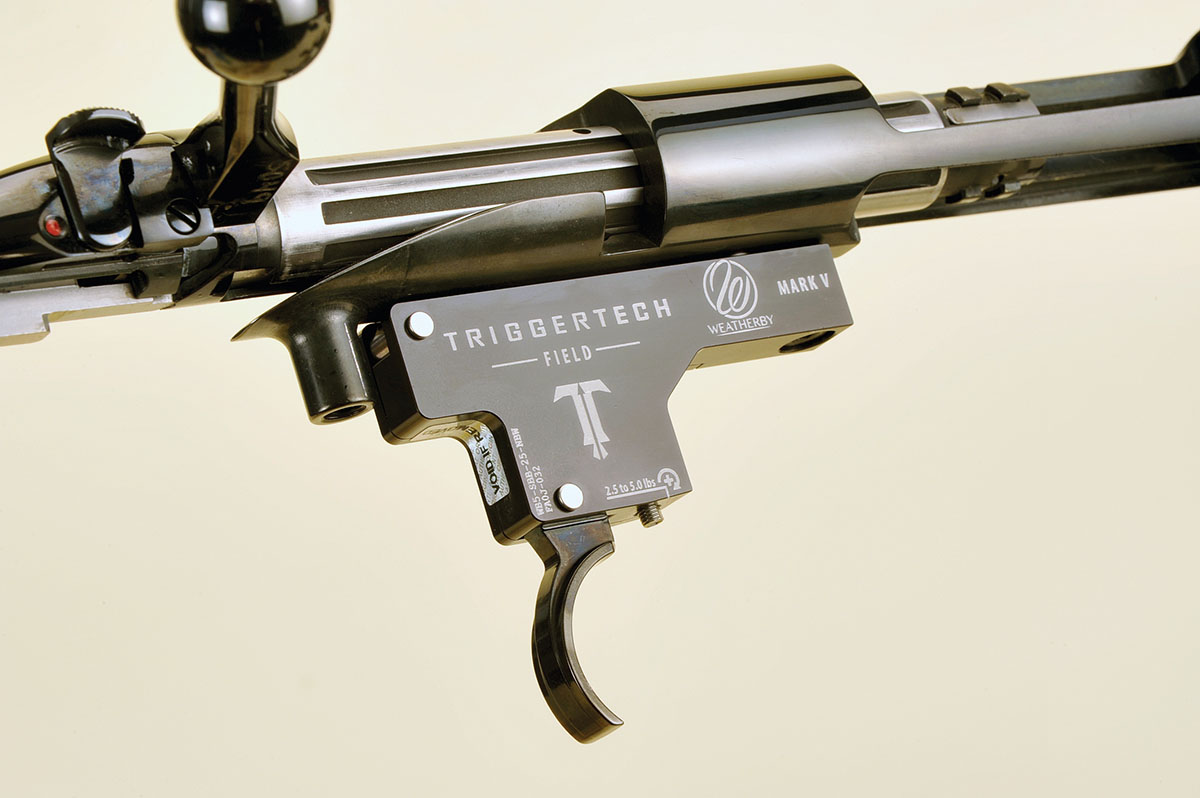
    Weatherby does not sit on its laurels when it comes to internal improvements on its rifles. Recently introduced was the LXX trigger that is fully adjustable to suit the needs of any hunter.
    Weatherby does not sit on its laurels when it comes to internal improvements on its rifles. Recently introduced was the LXX trigger that is fully adjustable to suit the needs of any hunter.
    Due to their construction, to me they are the best for high-volume cases like the 240 WM, as testing over the years with this and other cartridges prove they are very consistent in the velocity department, and since they are recommended by Weatherby, it just makes sense to use them. To this end, I think I can give credit to the Federal primers for the smaller groups over time. As a side note, some handloaders may want to use Federal’s 215 primer, but overall and over the years, I like the Federal 210 primers because they offer a better level of ignition.

    When it comes to a die set, get the best. I used a Redding Deluxe Set that includes a regular full-length sizer, a neck sizer and a seating die. With new cases out of the box, I run them through the full-length die first to square everything up. From there, and using once-fired cases for testing and hunting, the vote goes to neck sizing only, especially since I will be using them in one rifle…and one rifle only. In this case, my drill consists of smoking the neck and shoulder, trying a few, then locking the die down for the duration. Before I hit the bench, I trim all cases to 2.490 inches and then chamfer the neck before seating any bullets.

    Because the local range closed, I ventured up to New York and had friend Ed Hall help with the shooting. To me, he has the best setup for actually shooting out the back bedroom of his house, regardless of the weather.

    Since I’ve worked with the 240 WM before, I knew what to expect with handloading at home and shooting at the bench. For starters, and since I wanted the best in results, I weighed the once-fired cases to weed out any overly light or heavy brass. All deprimed and cleaned, they weighed from 189.5 to 191.4 grains – a difference of only 1.9 grains between all of them. Priming was next, then the hard part…choosing the right powder to do this cartridge justice. Since this rifle was to be used for varmints, lighter (read faster) bullets were in the offing, but I needed good powders to get them there. Weatherby cartridges thrive on slow-burning powders for maximum velocity, so the nod went to such well-known names as Alliant, Hodgdon, IMR and Winchester. Narrowed down, I used H-4895, IMR-4064, RL-15, IMR-4350, W-760 and IMR-4831.
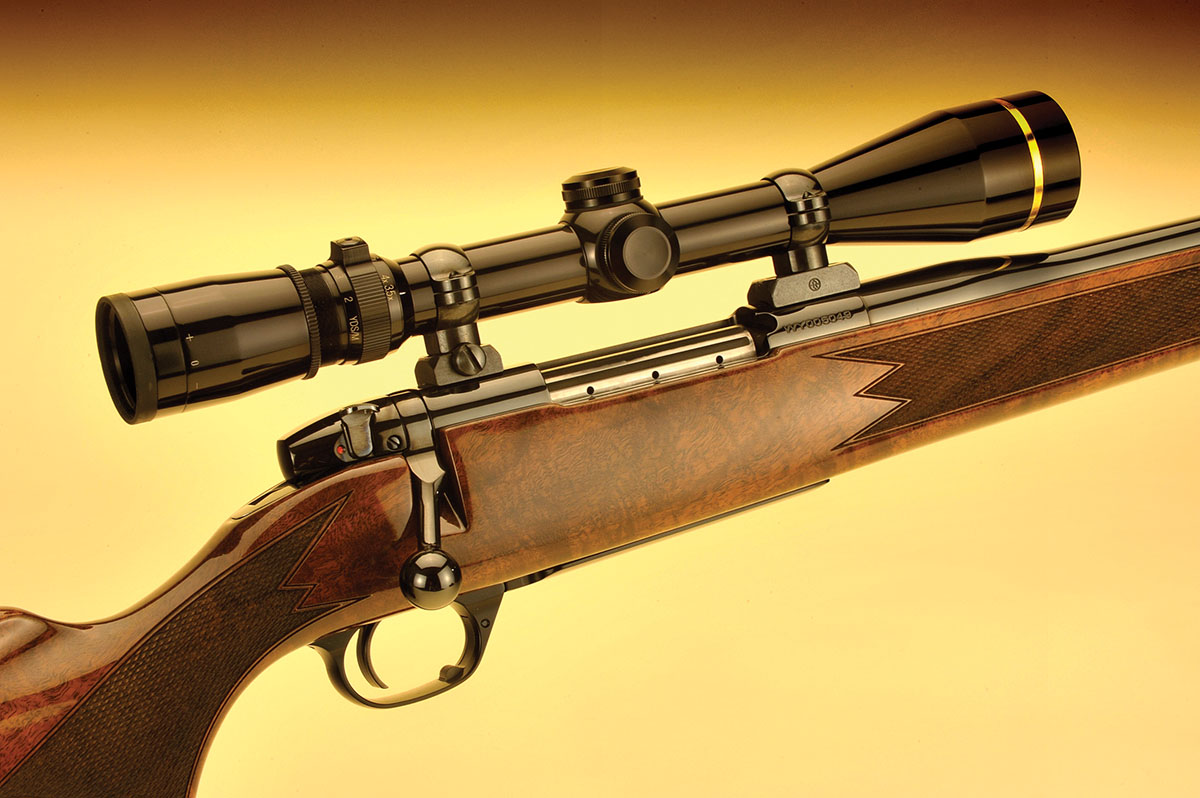
    Note the detailing that makes a Weatherby rifle a great choice for the discriminating hunter – fine wood, clean checkering, high polish and conservative lines.
    Note the detailing that makes a Weatherby rifle a great choice for the discriminating hunter – fine wood, clean checkering, high polish and conservative lines.
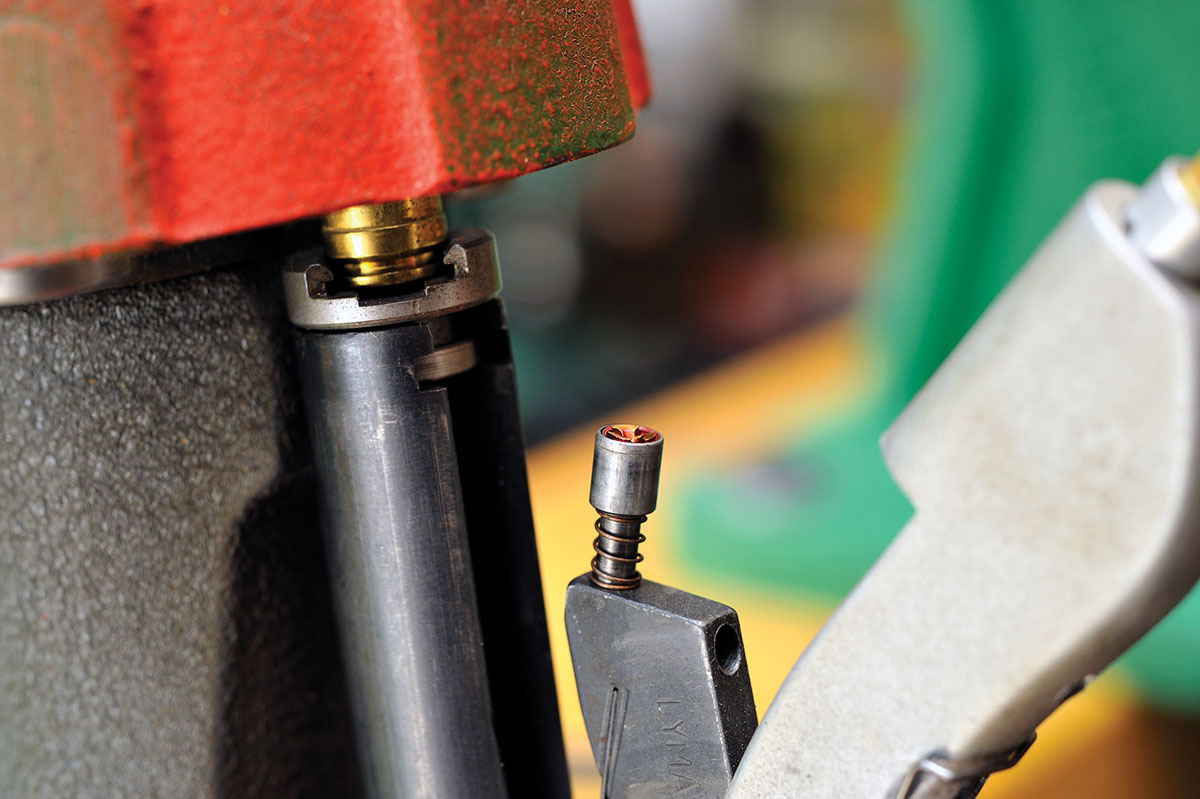
    Priming the cases is easy to do, but make sure the primer is always in the right direction prior to inserting it into the case. Occasionally, a primer will tip, allowing the insertion into the case the wrong way.
    Priming the cases is easy to do, but make sure the primer is always in the right direction prior to inserting it into the case. Occasionally, a primer will tip, allowing the insertion into the case the wrong way.
    For loading, any propellant worthy of shooting many cartridges in a day should be easy to meter and
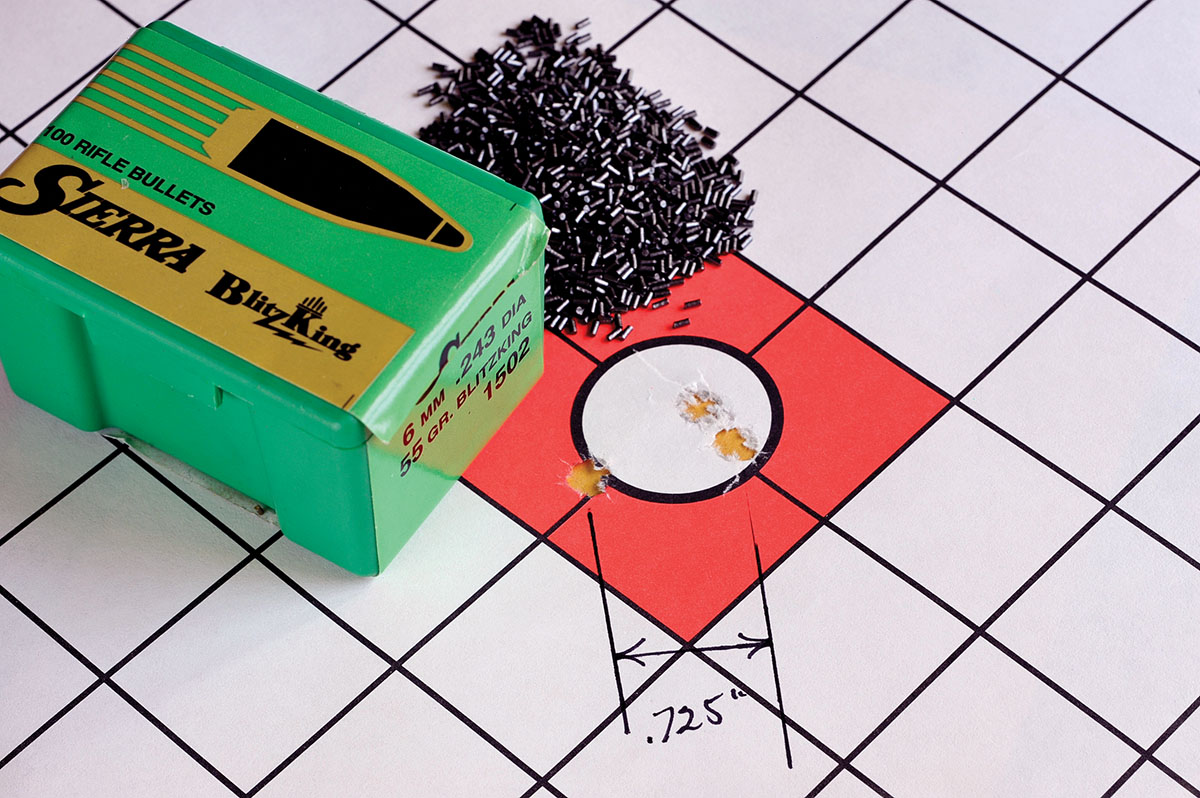
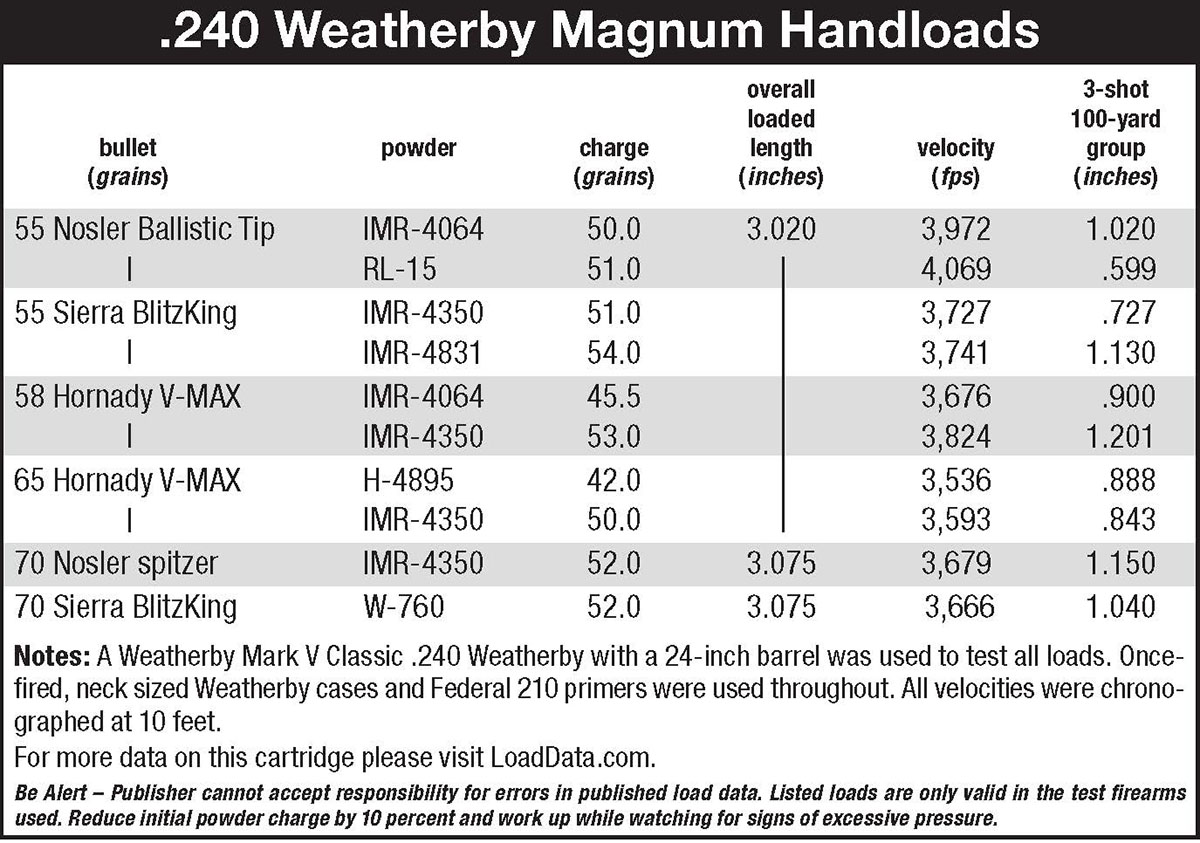
    The Sierra 55-grain BlitzKing bullets provided a group that measured .725 inch with 51 grains of IMR-4350 for 3,727 fps.
    The Sierra 55-grain BlitzKing bullets provided a group that measured .725 inch with 51 grains of IMR-4350 for 3,727 fps.
    weigh without too much time spent on trickling. When it came to IMR-4064, IMR-4350 and IMR-4831, they were bulky, in stick form, and I needed a trickler to get them up to the exact charge. Reloder 15 and W-760 worked well because I could count on exact charges while still checking every tenth charge just to make sure. Finally, H-4895 came in third for measuring. However, watch this powder as case volume was low by as much as 10 grains over the others, so the need to inspect charged cases for a possible double charge might be in the cards here.

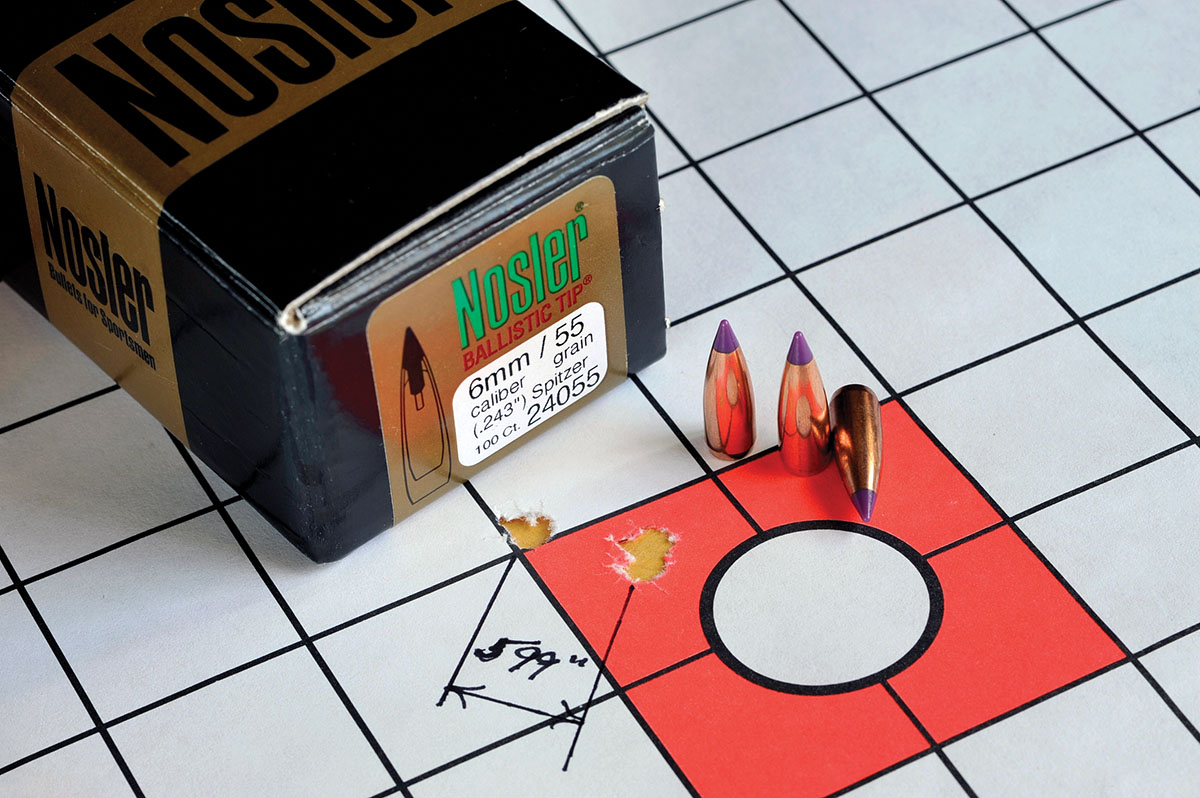
    When the “smoke” cleared, there was a surprise or two. First, the best group of the day with the highest velocity showed up with the Nosler 55-grain Nosler Ballistic Tip with Reloder 15 powder at 51 grains, with three shots almost touching at .599 inch. For a 6 millimeter cartridge, velocity reached out almost 4,069 fps. For shooters doubting this load, look in the Nosler reloading manual. Now at the top of my list and zeroed at 100 yards, drop at 200 yards would be about an inch; at 300 yards, which is about the maximum between hedgerows here in the East, you are looking at a drop of around 5.5 inches. I like Reloder 15 for the 6mms, as in the past it has delivered in the 6mm Remington with a 58-grain bullet at 3,600 fps with .380-inch groups.
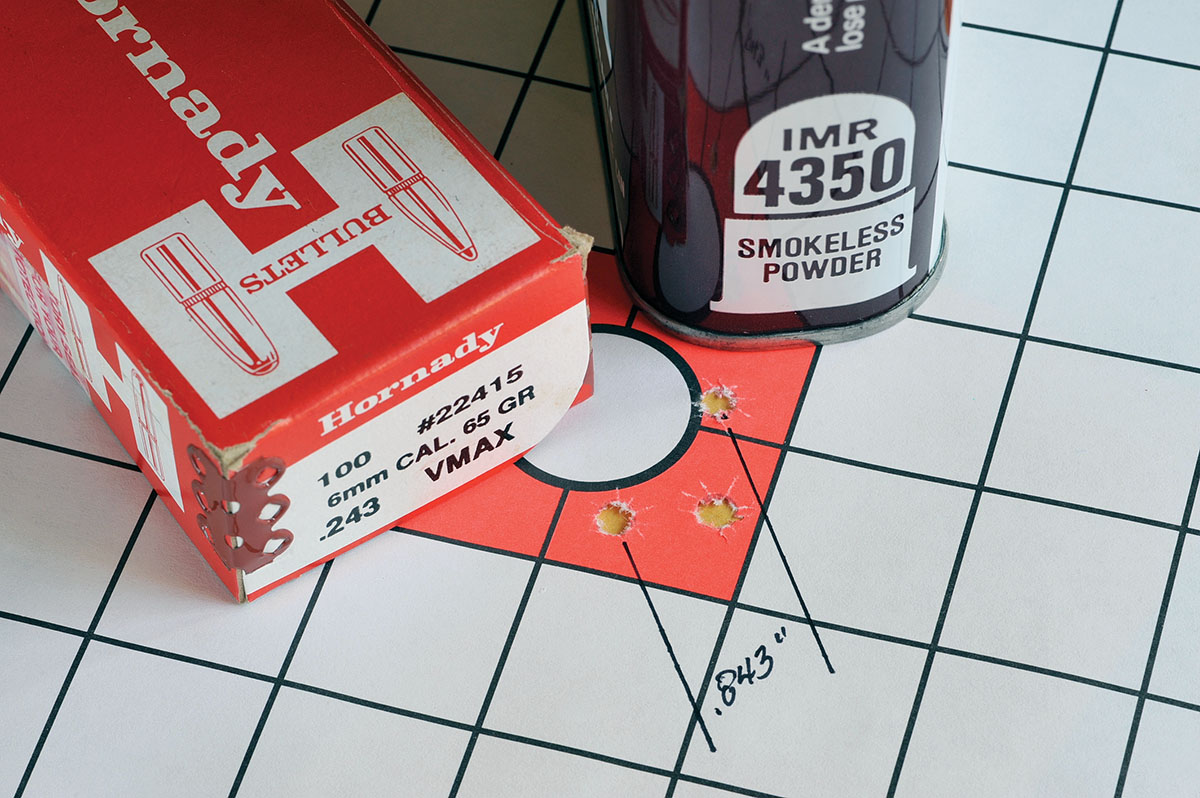
    Hornady 65-grain V-MAX bullets grouped into .843 inch.
    Hornady 65-grain V-MAX bullets grouped into .843 inch.
    Nosler also lists IMR-4064 as the “most accurate powder tested” in its manual. But the Nosler 55-grain Ballistic Tip was not so accurate in my rifle. The Hornady 58-grain V-MAX groups did average under an inch with only 3,676 fps over the chronograph screen. However, not to sell the powder short, with the lighter bullet, I did get almost 4,000 fps but with a little sacrifice in accuracy. The second most accurate load came in with a group hitting .727 inch with 51 grains of the popular IMR-4350 for 3,727 fps. In the number three place, IMR-4350 again hit under an inch at .843 for a velocity of 3,593 fps. Now and in the past, I’ve used IMR-4350 on more occasions than I can remember, and if I had to keep only one powder in my cabinet, this would be the one, especially with lighter bullets and heavy charges in cartridges like the 240 WM.
    The best group was shot with Nosler 55-grain Ballistic Tips. Three bullets went into a curt .599-inch group. Fifty-one grains of RL-15 was used to gain a velocity of 4,069 fps.
    The best group was shot with Nosler 55-grain Ballistic Tips. Three bullets went into a curt .599-inch group. Fifty-one grains of RL-15 was used to gain a velocity of 4,069 fps.

    Hodgdon’s H-4895 provided groups around .888 inch, but again case volume was low, so check your cases as you move along. This is not a bad reading at 3,536 fps, but it was the lowest of the entire group. I later tried W-760 for possible prairie dog marathons because of its easy metering, but it fell a little short in the accuracy department.

    Regarding factory loads, the lowest weight I had in stock was the 87-grain softpoint that made its mark in the past with 1-inch groups or less at the century mark with 3,448 fps.

    When out on the range, it’s a good idea to consider barrel weight and diameter when shooting for groups that you will use later in the field. On the day of testing, temperatures hovered around 70 degrees with a moderate dose of humidity. With this in mind, my shooting protocol called for waiting five minutes between groups with an additional one minute between shots. In that way, and in the shade of the range house, I could keep the barrel at more or less an even temperature with this so-called “pencil” type of barrel. All groups were shot over sandbags.

    In the end, do I like the 240 Weatherby Magnum? In a word, yes! From its modern, Roy Weatherby inspired stock to its shooting ability and accuracy, it remains one of my favorites. It is one of those cartridges that you can take varmint hunting in the morning with light bullets, then hunt larger game in late afternoon with heavier projectiles. The recoil is moderate, and with careful tuning it’s a great shooter. I really don’t need more than that.


    Wolfe Publishing Group