Login


Wolfe Publishing Group
    Menu

    256 Winchester Magnum

    Reviving a "Failed Varmint Cartridge"

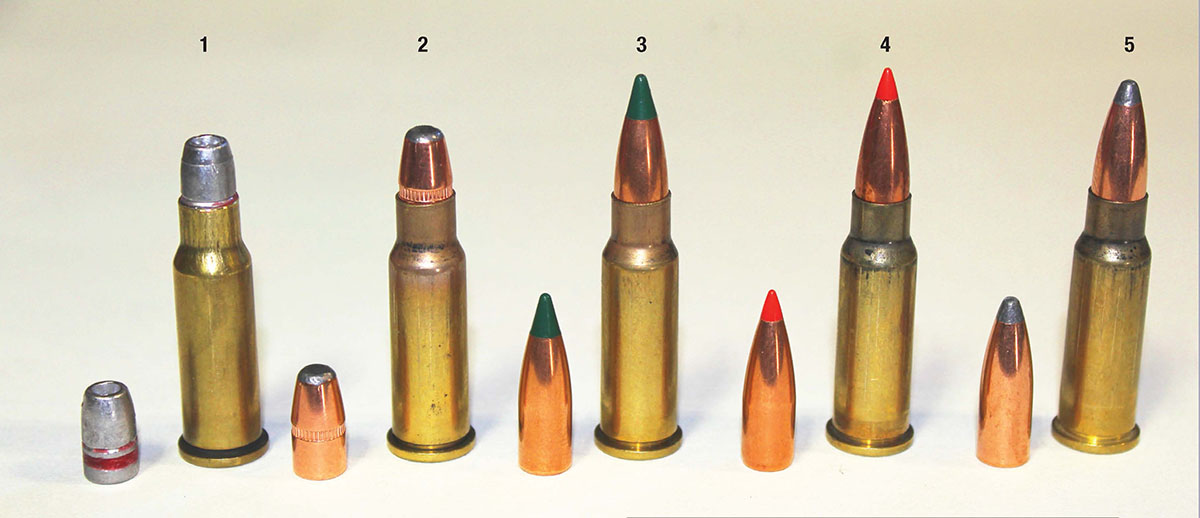
    Bullets tested from the .256 Winchester Magnum included the (1) GT 55-grain hard cast, (2) Hornady 60 FP, (3) Sierra 70 BlitzKing, (4) Hornady 75 V-MAX and the (5) Speer 87-grain SP.
    Bullets tested from the .256 Winchester Magnum included the (1) GT 55-grain hard cast, (2) Hornady 60 FP, (3) Sierra 70 BlitzKing, (4) Hornady 75 V-MAX and the (5) Speer 87-grain SP.
    The 256 Winchester Magnum is nothing more than the popular 357 Magnum necked down to accept .25-caliber bullets. It produces ballistics slightly bettering those found in the 22 Hornet and 218 Bee.
    The 256 Winchester Magnum is nothing more than the popular 357 Magnum necked down to accept .25-caliber bullets. It produces ballistics slightly bettering those found in the 22 Hornet and 218 Bee.
    The 256 Winchester Magnum was created by necking a .357 Magnum case to .25 caliber and was originally envisioned as a high-velocity, revolver-based varmint round. It was likely conceived in response to the 22 Remington Jet, but like Smith & Wesson’s ill-fated Model 53 revolver housing that cartridge, it soon became apparent chambering high-pressure bottleneck cartridges in revolvers posed serious issues, namely case setback locking the cylinder.

    The 256 Winchester Magnum generated 250 fps more velocity and double the energy of the 22 Jet, and 500 fps more velocity than 25-20 Winchester factory rounds. The 256 Winchester Magnum was introduced in 1960, but a year or two passed before any handguns chambered in the round appeared. Ruger’s Hawkeye – a swiveling-breach, single-shot pistol based on a revolver frame – proved the only mainstream handgun chambered for this interesting cartridge, but so few were manufactured they are now pricey collectors’ items.

    Marlin gave the round a whirl in its Model 62 Levermatic lever action and Universal Firearms the Model 1256 Ferret, an M1 Carbine auto-loading clone. These were the only commercial rifles chambered in 256 that I’m aware of. The Marlin’s tubular magazine required flat- or blunt-nosed bullets, but the longer barrel increased muzzle velocities about 600 fps and allowed heavier 75- to 87-grain bullets to be utilized.

    The rimmed cartridge should have been a shoo-in for single-shots like the Ruger No. 1, but apparently only Match Grade Machine, Bullberry and Thompson/Center produced single-shot rifles for this round. Thompson/Center also offered pistol barrels so chambered, but they never gained widespread appeal. Occasionally, 256 T/C Contender pistol barrels come up for sale and The Complete Reloading Manual for the Thompson/Centers Contender (1991, LoadBooks USA) includes load data.

    A single-shot rifle is what is under discussion here: a rebarreled Martini manufactured by Birmingham Small Arms & Metals Company (BSA) and refitted with a 24-inch bull barrel (1.065 inch at the muzzle). BSA was one of five English firms to produce Martini-Enfield rifles for the British Empire, a product of the colonial period and refinement of the American Peabody-Martini design. Original Martini-Henry Mk III rifles from the Zulu War were converted for use of the newly-adopted .303 British round (then fueled by black powder) and labeled the Martini-Metford. After the introduction of smokeless powders, these rifles were refitted with superior Enfield barrels, becoming the Martini-Enfield Mk I or newly-manufactured Martini-Enfield Mk IIs. The design remained in active service from 1885 through 1918, though served as reserve arms in former colonies such as India and New Zealand well into World War II. Martini rifles were universally well made and more than capable of safely firing modern .303 British factory ammunition – or high-velocity varmint cartridges when rebarreled by a competent gunsmith. I’m no Martini expert, but from what I can determine, the test rifle appears to have been a BSA No. 12 Cadet manufactured between 1911 and 1913, with about 80,000 produced.
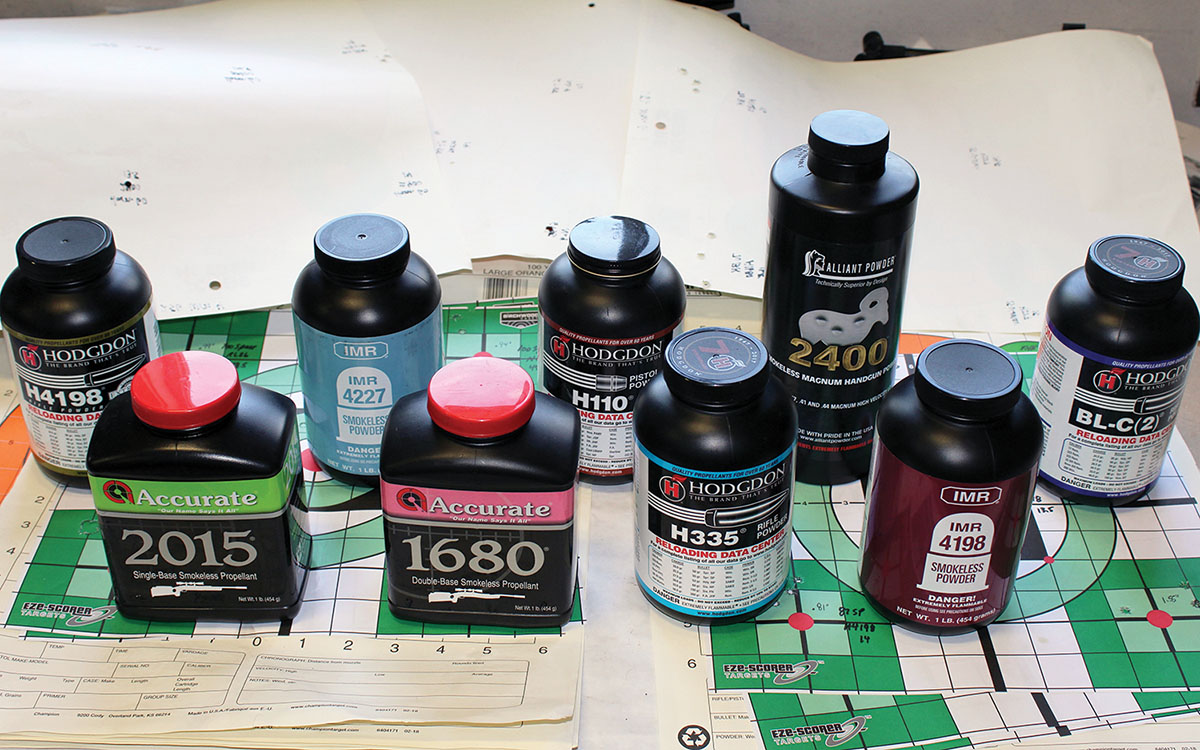
    Powders suitable to the .256 Winchester Magnum are fairly limited. They include H-4198, IMR-4227, H-110, Alliant 2400, Hodgdon BL-C(2), A-2015, A-1680, H-335 and IMR-4198.
    Powders suitable to the 256 Winchester Magnum are fairly limited. They include H-4198, IMR-4227, H-110, Alliant 2400, Hodgdon BL-C(2), A-2015, A-1680, H-335 and IMR-4198.
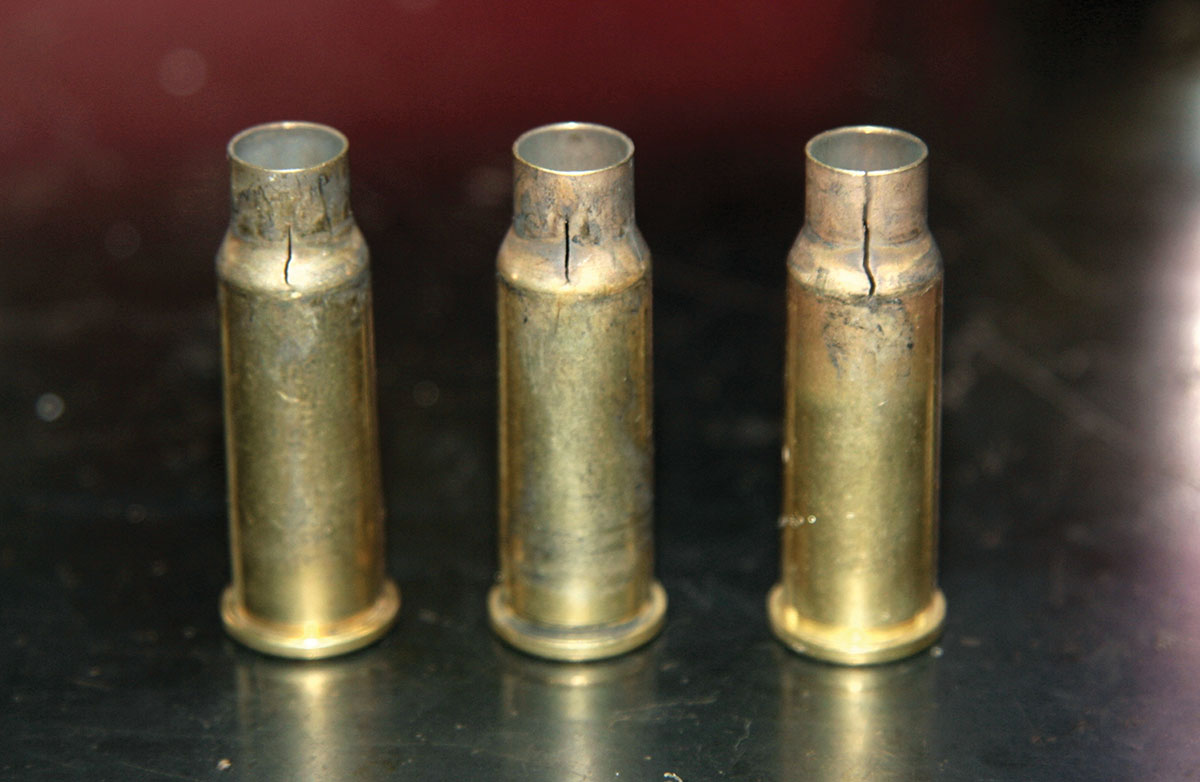
    Necking any straight-walled cartridge way down will result in some split necks. Using new or carefully-annealed brass should minimize this problem.
    Necking any straight-walled cartridge way down will result in some split necks. Using new or carefully-annealed brass should minimize this problem.
    The test rifle was drilled and tapped to hold a one-piece Weaver scope base, and a Simmons Boresighter 4-16x 40mm AO scope with cap-covered turrets set in Weaver rings was used during load testing. As shot, the rifle weighed 11.35 pounds. The single-shot action allowed loading pointed bullets with improved ballistic coefficients (BC) that would be off limits in levergun tubular magazines, creating a potent varmint and predator round. Of note, while Martinis are known for stout actions, extractors are notoriously weak, meaning maximum loads often result in extraction issues and should be approached with great care.
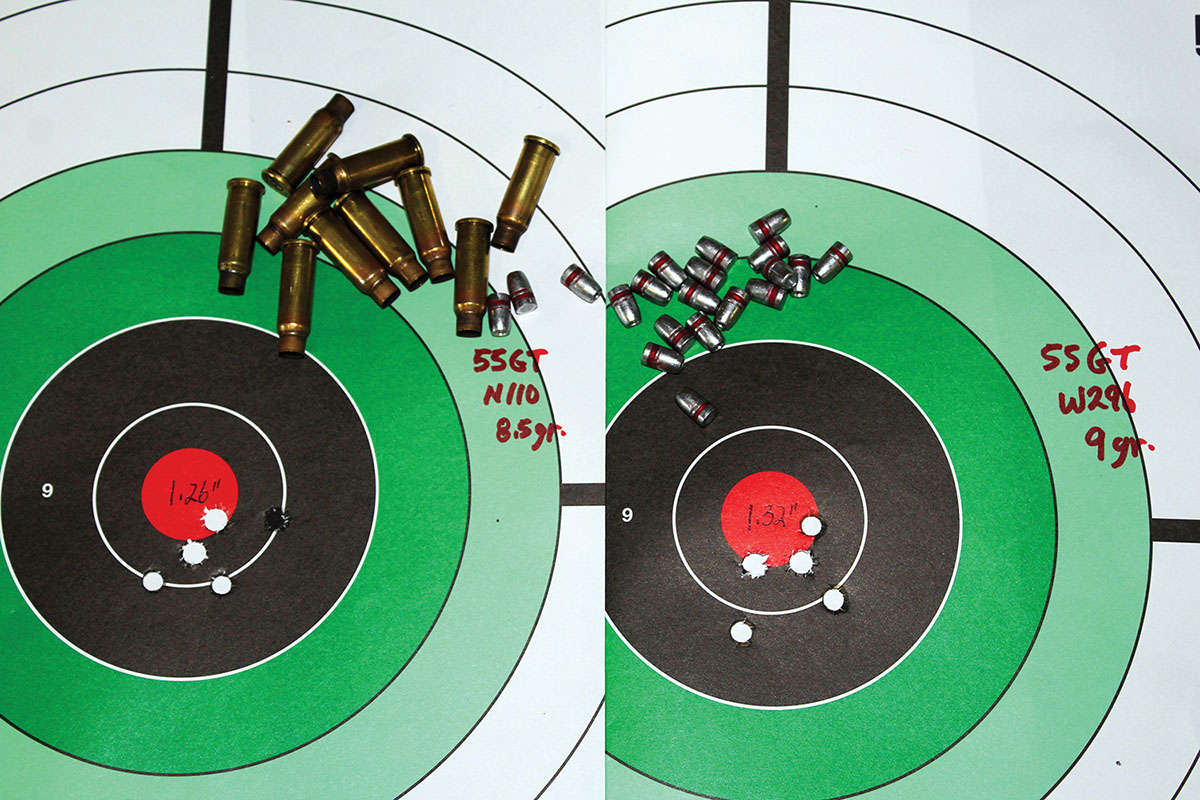
    GT Bullet’s cast 55-grain hollowpoint shot best from the .256 Winchester Magnum when loads were backed off to below 2,000 fps.
    GT Bullet’s cast 55-grain hollowpoint shot best from the 256 Winchester Magnum when loads were backed off to below 2,000 fps.

    Marlin’s Model 62 Levermatic didn’t last long, and no other notable rifles have been chambered in the 256 Winchester Magnum for more than 20 years. Winchester ceased production of factory ammunition in the early 1990s. This makes handloading mandatory for those lucky enough to own a rifle chambered in this pleasant little round. The cartridge delivers energy and ballistics slightly bettering those found in varmint cartridges such as the 22 Hornet or 218 Bee.

    Cases are easily formed from abundant .357 Magnum brass. Avoid nickel-plated versions, as they will flake and peel given this degree of resizing. New, unfired or carefully-annealed brass normally provides the most consistent results and fewer split necks. Brass for load testing was formed from Remington .357 Magnum cases. Weighing average water capacity between 256 brass formed from Winchester, Remington, Starline and Federal cases showed surprising uniformity, with all holding about 22.5 grains of water when filled – give or take a tenth of a grain or two. Trim-to spec is 1.271 inches.

    Older RCBS full-length reloading dies were used to assemble all loads, and Remington 7½ Small Rifle primers were used throughout. Interestingly, load data for this supposedly dead cartridge is relatively easy to find, some often including fairly modern powder options.
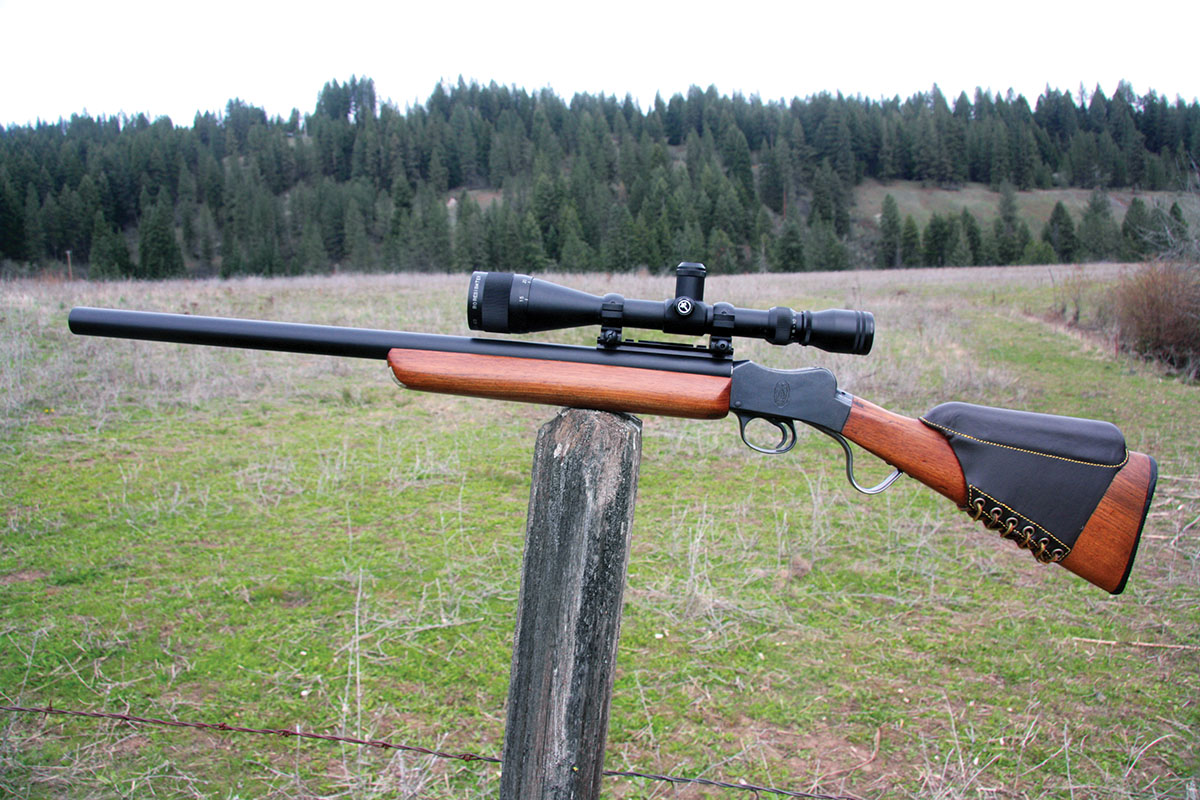
    Many old Martini rifles were converted into single-shot varmint rifles, as they are easily rebarreled and the actions are strong enough for many modern varmint cartridges.
    Many old Martini rifles were converted into single-shot varmint rifles, as they are easily rebarreled and the actions are strong enough for many modern varmint cartridges.
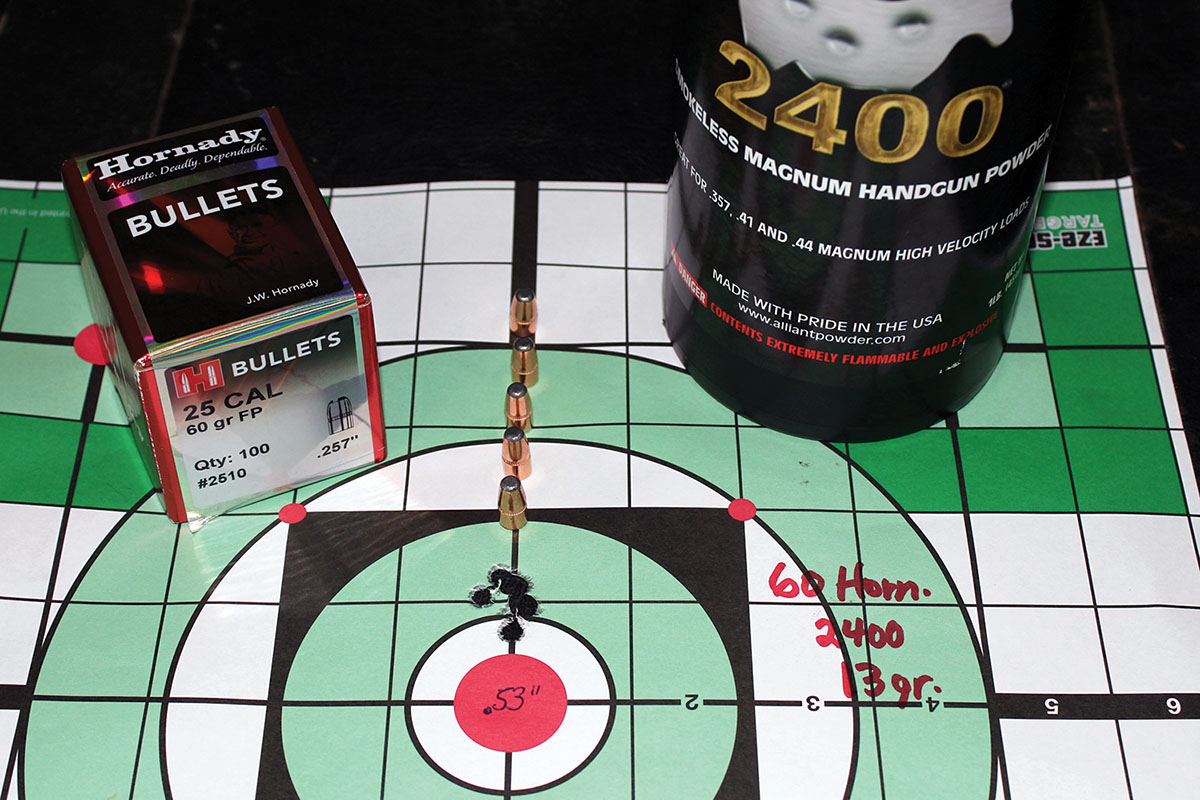
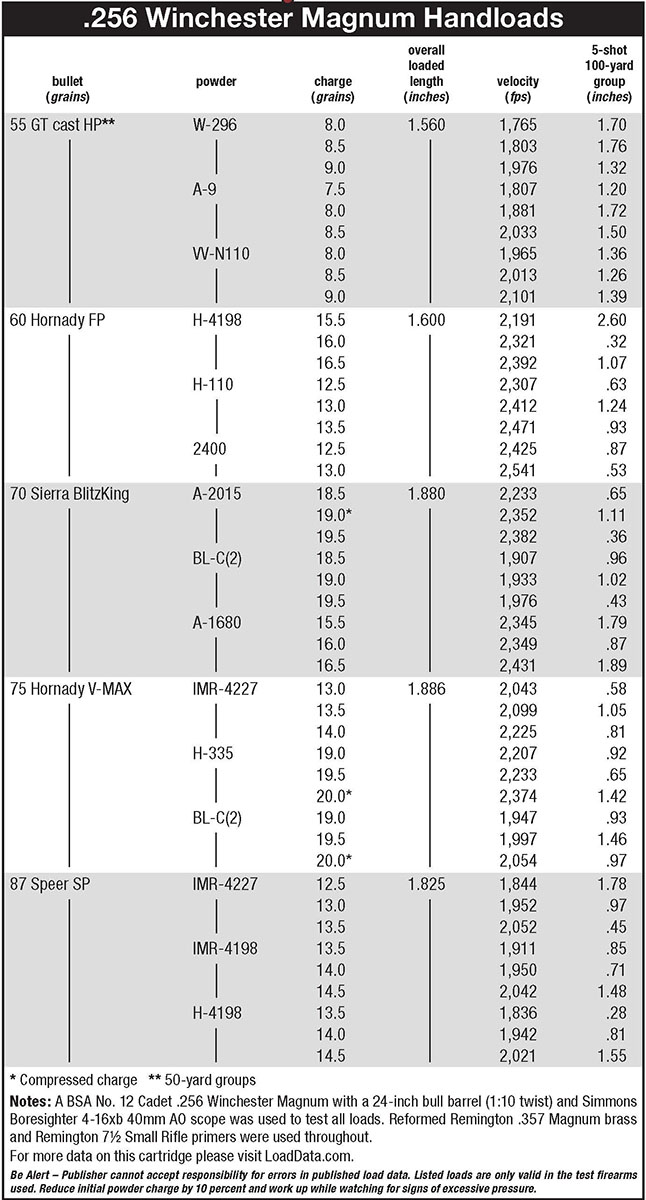
    Hornady’s 60-grain flatpoint is a .256 Winchester Magnum original. Thirteen grains of Alliant 2400 resulted in a .53-inch group at 2,541 fps.
    Hornady’s 60-grain flatpoint is a .256 Winchester Magnum original. Thirteen grains of Alliant 2400 resulted in a .53-inch group at 2,541 fps.
    Only the lightest/shortest .257-inch diameter bullets are compatible with the 256 Winchester Magnum and its standard 1:14 rifling twist. Bullets selected for testing included weights from 55 to 87 grains. Nosler’s 85-grain Ballistic Tip Varmint was initially included to fill the gap between 75 and 87 grains, but unfortunately, using a test load of 19.5 grains of Accurate A-2015 at around 2,400 fps, it failed to properly stabilize, punching round holes but producing patterns instead of groups. The polymer-tipped, boat-tail design and .329 BC were obviously too much bullet for the 256’s 1:14 twist at these velocities. All bullets, save the short 55- and 60-grain numbers, required seating bases below the shoulder/body junction to allow drop-in chambering. Suggested overall loaded length is 1.590 inches, though the single-shot action and sharp polymer-tipped bullets allowed overall loaded lengths of just less than 1.90 inches. Magnum pistol powders or propellants suitable for rounds such as the 22 Hornet or 218 Bee are well suited to the 256 Winchester Magnum.
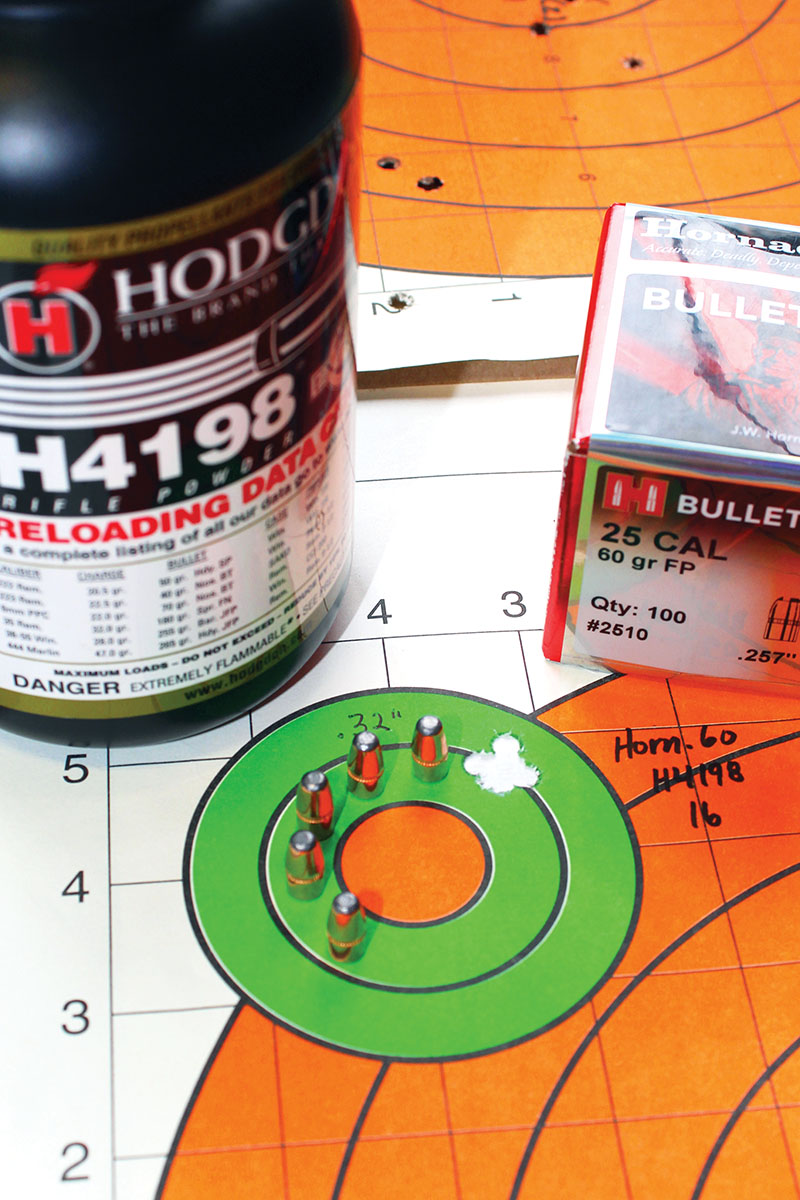
    One of the best groups coaxed out of the .256 Winchester Magnum test rifle included Hornady’s 60-grain FP over 16 grains of Hodgdon H-4198.One of the best groups coaxed out of the .256 Winchester Magnum test rifle included Hornady’s 60-grain FP over 16 grains of Hodgdon H-4198.One of the best groups coaxed out of the .256 Winchester Magnum test rifle included Hornady’s 60-grain FP over 16 grains of Hodgdon H-4198.
    One of the best groups coaxed out of the 256 Winchester Magnum test rifle included Hornady’s 60-grain FP over 16 grains of Hodgdon H-4198. One of the best groups coaxed out of the 256 Winchester Magnum test rifle included Hornady’s 60-grain FP over 16 grains of Hodgdon H-4198.One of the best groups coaxed out of the 256 Winchester Magnum test rifle included Hornady’s 60-grain FP over 16 grains of Hodgdon H-4198.

    GT Bullets’ (gtbullets.com) 55-grain hollowpoint was a Hail Mary experiment – an affordable hard-cast lead bullet with a flat tip and aggressive hollowpoint likely designed for near-useless 25 Auto pistols. It appeared viable for short range work from the 256 Winchester Magnum. Not having capabilities to bell case mouths, I chamfered them aggressively, experiencing no starting or shaving issues. The first set of loads pushing these bullets from just more than 2,100 to 2,350 fps were disastrous, providing shotgun patterns. I nearly scrapped this bullet and moved on, but then hit upon the idea of assembling lighter loads derived from 25-20 Winchester data. I also moved the target to 50 yards. This proved worthwhile. Light loads of Winchester 296, Accurate No. 9 and Vihtavuori N110 produced if not fantastic groups, at least groups that might allow you to hit a varmint at less than 75 yards. They also proved very quiet. The average of all groups was 1.47 inches, with the best resulting from 9.0 grains of Winchester 296 or Accurate No. 9, and 8.5 grains of VV-N110 – all were at less than 2,025 fps and clustered around 1.25 inches. These would make excellent jack-rabbit loads.
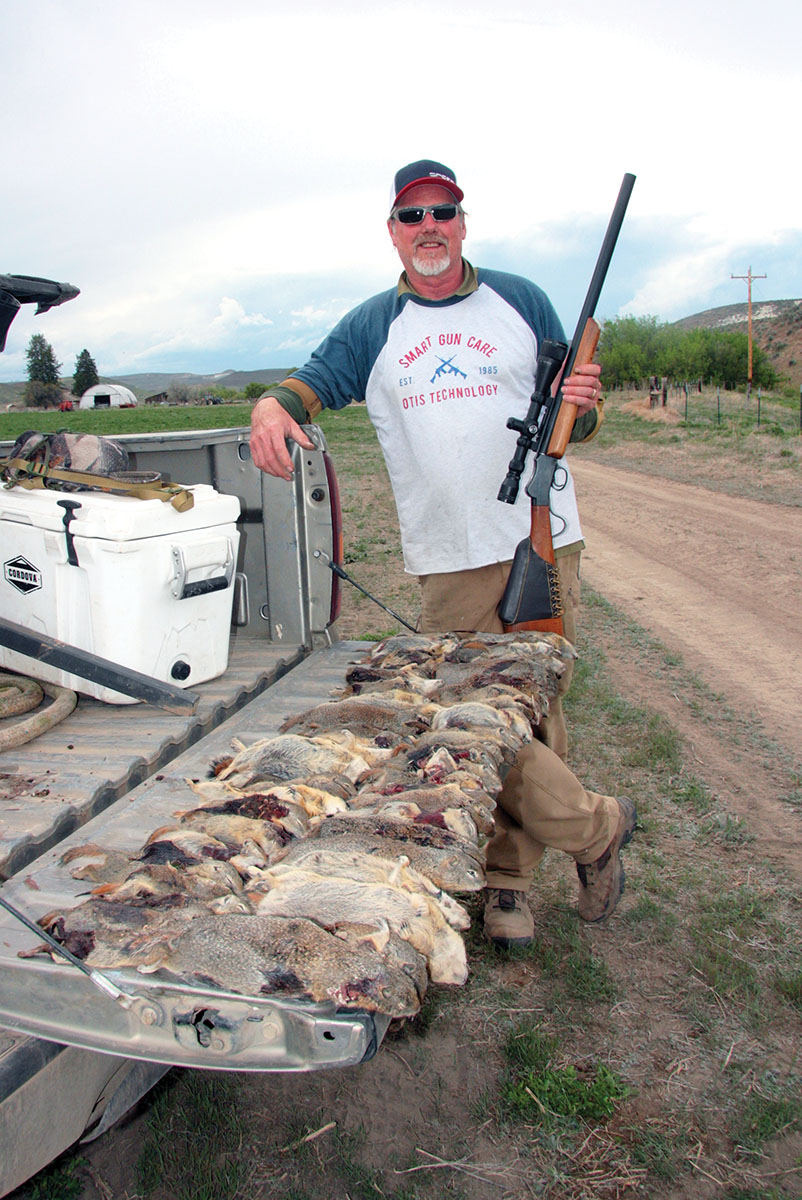
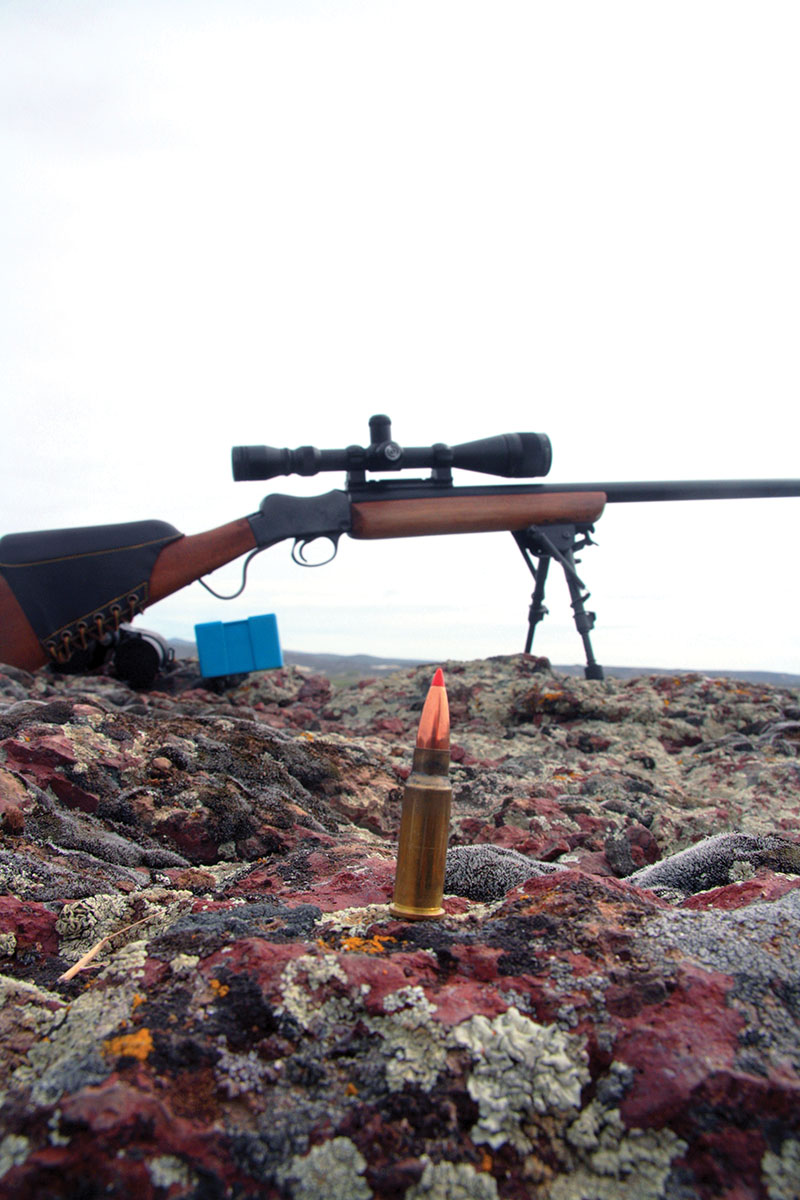
    Patrick put a Martini rebarreled to 256 Winchester Magnum to work on eastern Oregon Belding’s ground squirrels. The combination proved pleasant to shoot, and accurate enough out to 175 yards.
    Patrick put a Martini rebarreled to 256 Winchester Magnum to work on eastern Oregon Belding’s ground squirrels. The combination proved pleasant to shoot, and accurate enough out to 175 yards.
    Hornady’s 60-grain FB is the original 256 lever-rifle bullet; light for maximum muzzle velocities but including a poor .101 BC limiting shots to less than, perhaps, 150 yards. After my experiences with the short 55-grain bullet, I considered leaving the target at 50 yards, but decided this 256 needed to stand on its own merits at 100 yards. A 12.5-grain charge of Hodgdon H-110 at 2,307 fps – a full grain off maximum – printed a .63-inch group and showed this bullet was up for the task. But then 16 grains of Hodgdon H-4198 at 2,321 fps printed a .32-inch group, one of the better groups from this decidedly finicky rifle/cartridge combination. Better yet, it accomplished this with a load a half-grain off stated maximum, allowing easy extraction from the Martini action. Finally, Alliant 2400 produced a .53-inch group with 13 grains at 2,541 fps.

    Sierra’s 70-grain BlitzKing is the lightest modern-style varmint bullet offered in .25 caliber. It features a streamlined profile and green polymer tip to create a .242 BC (at actual 256 Winchester Magnum
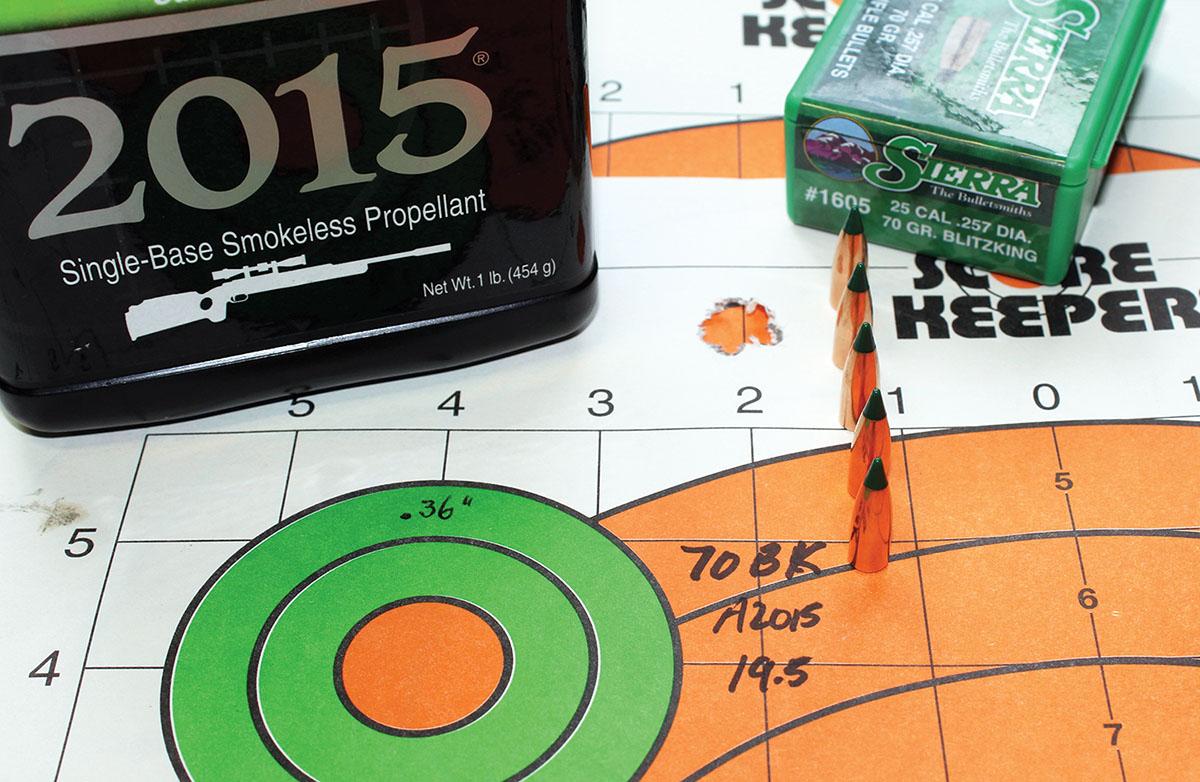
    Sierra’s 70-grain BlitzKing seated over 19.5 grains of Accurate 2015 powder produced a .36-inch, 100-yard/5-shot group at 2,382 fps.
    Sierra’s 70-grain BlitzKing seated over 19.5 grains of Accurate 2015 powder produced a .36-inch, 100-yard/5-shot group at 2,382 fps.
    velocities, BCs increasing with added velocity). In the course of load testing, which happened to occur during our spring varmint season, I found these bullets, seated over 19.5 grains of Accurate A-2015, mushroomed and anchored Columbia and smaller Belding’s ground squirrels fairly reliably, but didn’t produce the violent expansion I would’ve expected from a BlitzKing. That load also proved one of the most accurate from this rifle, with five shots grouping into .36 inch at 100 yards while also maximizing velocity from this cartridge at 2,382 fps. Hodgdon BL-C(2) proved accurate, and velocity was consistent with this bullet (and Hornady’s V-MAX). It provided a .43-inch group with a maximum load of 19.5 grains. The BL-C(2) downside, despite extremely-low extreme velocity spreads, is a lack of generated velocity. While A-2015 produced 2,233 to 2,382 fps, BL-C(2) produced only 1,907 to 1,976 fps with the same bullet. Considering the fact that this cartridge is already struggling to coax expansion from this bullet at 2,300 fps, these slower velocities do nothing to promote decisive rodent anchoring, or flattened trajectories on longer shots.

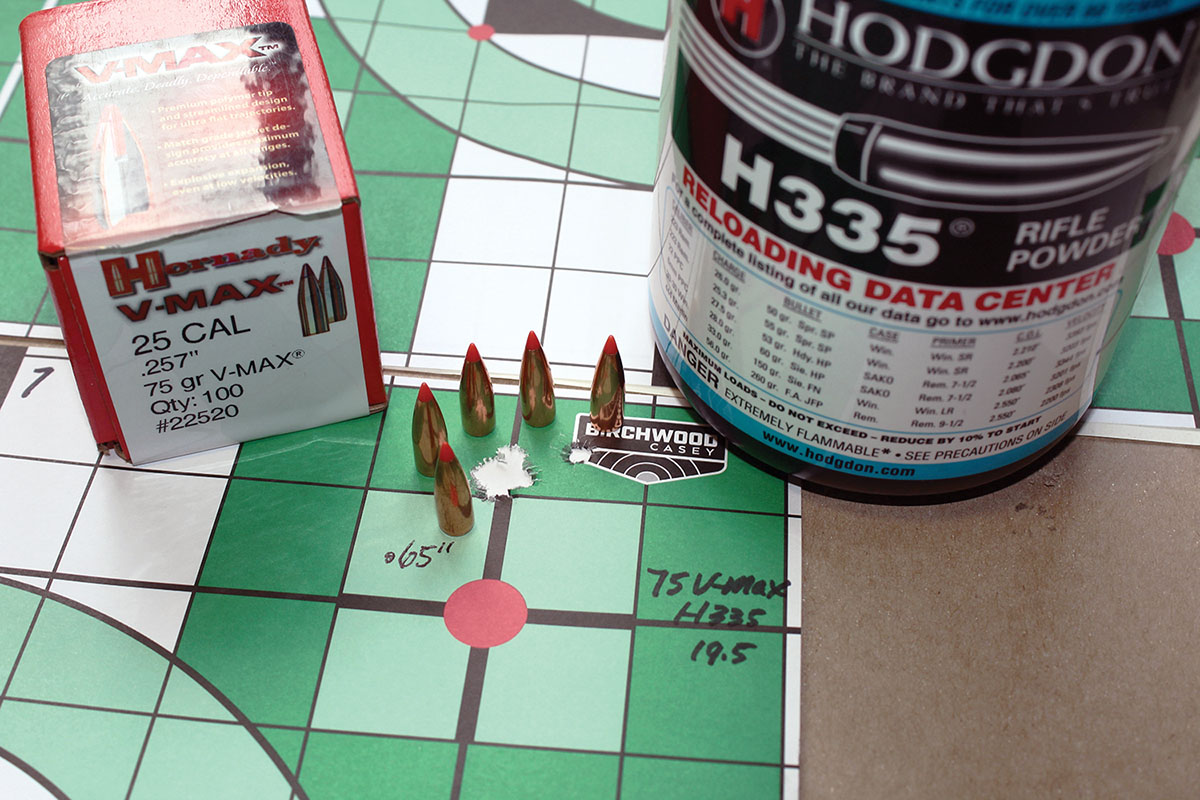
    A Hornady 75-grain V-MAX bullet loaded with 19.5 grains of H-335 showed great promise, with five shots at 100 yards grouping into .65 inch despite a single flier.
    A Hornady 75-grain V-MAX bullet loaded with 19.5 grains of H-335 showed great promise, with five shots at 100 yards grouping into .65 inch despite a single flier.
    The Hornady 75-grain V-MAX was also designed to provide explosive terminal performance on small varmints, with ample mushrooming assured even at 256 Winchester velocities. Its .290 BC (likely lower at 256 velocities) provides flattened long-range trajectories. I also had the opportunity to field test these bullets on Belding’s ground squirrels in eastern Oregon using 19.5 grains of Accurate 2015 and found they expanded conspicuously better than the BlitzKings at 256 Winchester velocities. Accurate 2015 was the obviously better choice for this bullet (not included in load table). The best showing with the tested load lineup was 13 grains of
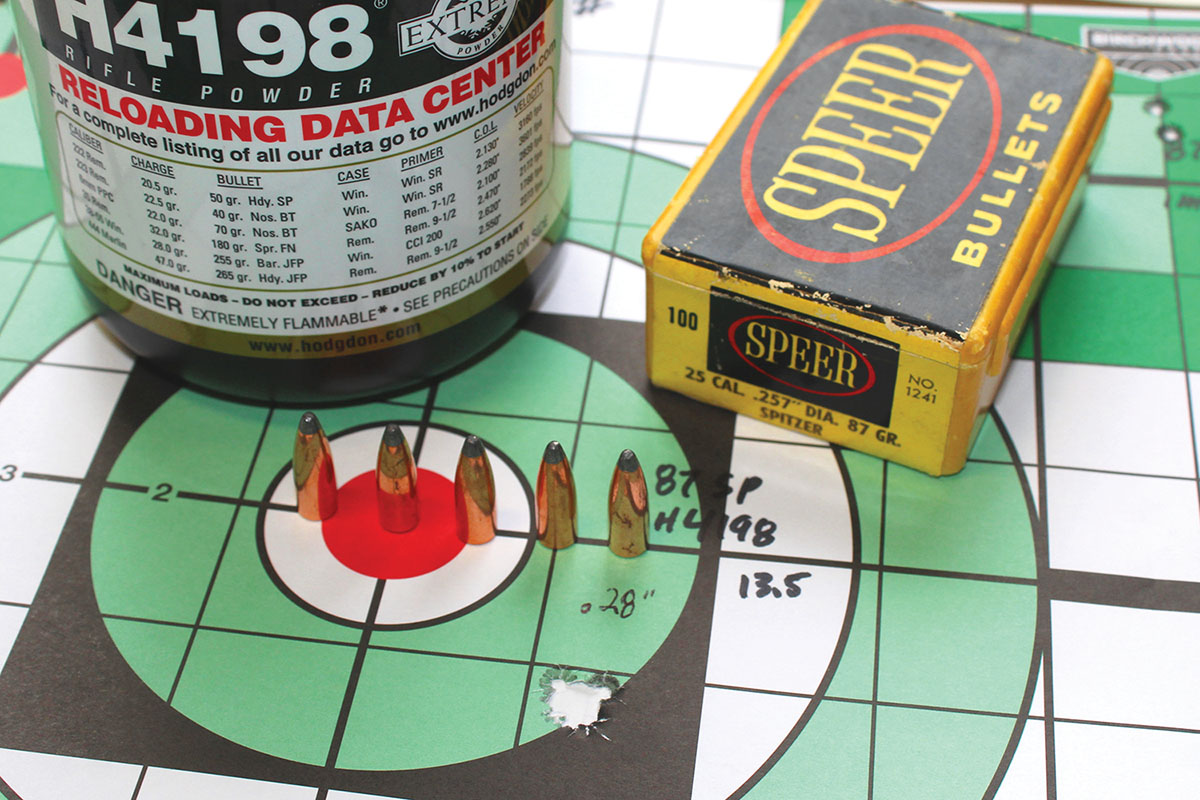
    The best group assembled with the .256 Winchester Magnum test rifle included 13.5 grains of Hodgdon H-4198 over a Speer 87-grain SP. The five-shot, 100-yard group measured .28 inch at 1,836 fps.
    The best group assembled with the .256 Winchester Magnum test rifle included 13.5 grains of Hodgdon H-4198 over a Speer 87-grain SP. The five-shot, 100-yard group measured .28 inch at 1,836 fps.
    IMR-4227 at 2,043 fps (.58 inch group) and including a fairly decent extreme velocity spread. The second-best group with this bullet resulted from 19.5 grains of Hodgdon H-335 at a faster 2,233 fps for a .65-inch group. These were the best of the loads tested with this bullet, with most of the others hovering around an inch.

    Speer’s classic 87-grain softpoint with a .300 BC offers more punch on larger predators like tough coyotes. An initial test load of 13.5 grains of IMR-4227 confirmed stabilization and produced worthwhile groups, but it proved a touch sticky during extraction from the Martini action despite the lack of any primer-related pressure signs. That became my maximum load and also this powder’s most accurate charge, producing a .45-inch group pushed to 2,052 fps. The best group of this entire series resulted from 13.5 grains maximum of Hodgdon H-4198, logging only 1,836 fps but printing a .28-inch group. Unfortunately, increasing velocity opened groups quickly with this powder. I wouldn’t expect violent expansion from this bullet at any of these velocities, but view it as an ideal pelt-shooting option.

    If forced to keep just one powder on hand for loading the 256 Winchester Magnum, the choice would be simple: Accurate 2015. This powder produced good accuracy and top velocities without sticky extraction and with low extreme velocity spreads. Hodgdon’s H-4198 runs a very close second, if not a dead-even tie, with some of this trial’s tightest groups and equal velocity. IMR-4227 deserves kudos, but pressures spiked quickly and it is getting more difficult to find on sporting goods shelves these days. Pistol powders like Hodgdon H-110, Alliant 2400 and Accurate No. 9 turned in many decent groups, but I don’t like the way pressures mount with only small charge changes in this cartridge.

    I came away with a lot of respect for this forgotten cartridge. It gets the job done for 80 percent of the varmint shooting most of us do, meaning ranges out to 150 yards. It’s mild-mannered, but hard-hitting and just flat-out fun to shoot.


    Wolfe Publishing Group