6.5-284 Winchester
Testing Loads for an Old Wildcat
feature By: Rob Behr | April, 19
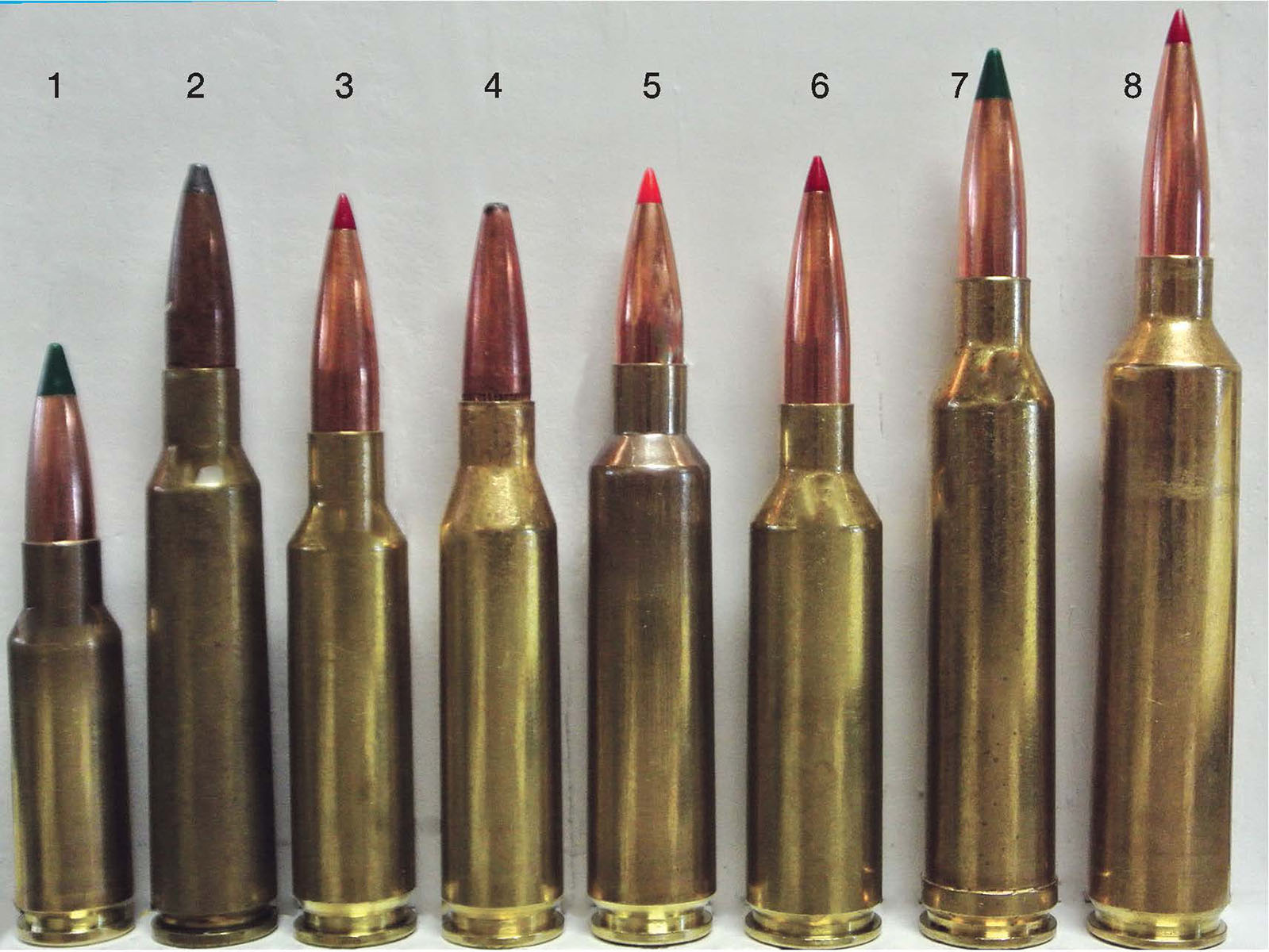
When Winchester released its 284 cartridge in 1963, it was intended to provide 270 Winchester performance in a modern lever action called the Model 88, and the trim semiautomatic Model 100. The 284 case body was broad, measuring .500 inch just above the extractor groove and tapering to .475 inch at the shoulder. Winchester’s engineers wisely added a rebated .473-inch rim to the cartridge, making it readily adaptable to most popular actions. With 66 grains of water capacity, the 284 Winchester was within one grain of the 270 Winchester, but it could be chambered in short-action rifles. On paper, the 284 looked like another homerun for Winchester, but it failed to find a place with shooters. Savage and Browning also offered the chambering for a time, but finding the same demand as Winchester, quietly dropped the cartridge from their lineups.
The 284 Winchester’s main problem, it was said, was its case length. At 2.170 inches, it was .155 inches longer than the 308 Winchester, the cartridge that set the size parameter for short-action rifles. In order to load cartridges into a standard short-action magazine, the maximum cartridge length had to be no more than 2.800 inches. This meant the 284 was tied to lighter, shorter bullets. Longer bullets had to be seated deeply into the case at the cost of powder capacity and velocity. For Winchester, the cartridge proved to be a commercial flop, but for wildcatters it was a gift.
With its .473-inch case head, it was an easy match to any action that used cartridges derived from the 30-06, including standard Mauser actions. With a supply of rifles ready for new barrels, wildcatters experimented with the 284 case. The fruits of their labor included two notable wildcats, the 6.5-284 and the 6mm-284, the latter of which produced high velocity and good accuracy but suffered from shortened barrel life that is typical of over-bore cartridges. The 6.5-284 is much better balanced when used with heavier bullets and quickly gained a reputation for accuracy on the 1,000-yard line.
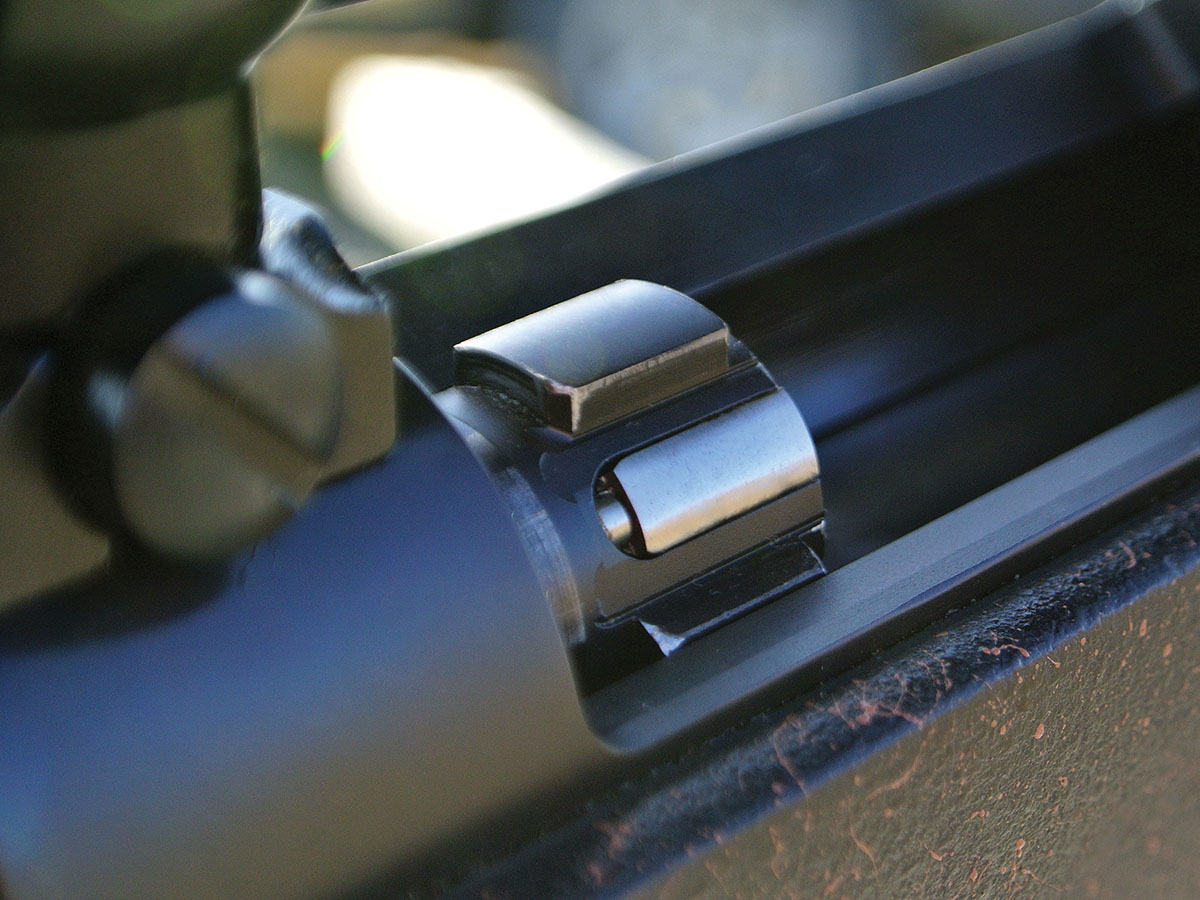
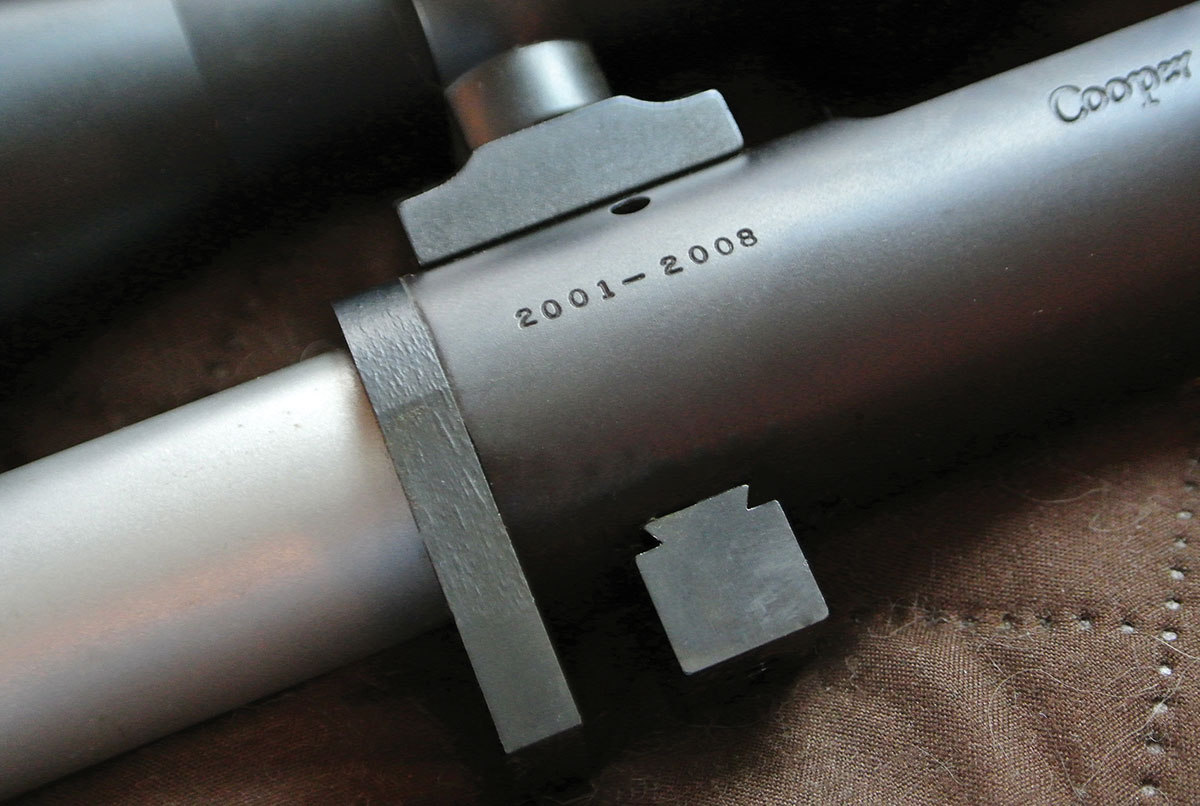
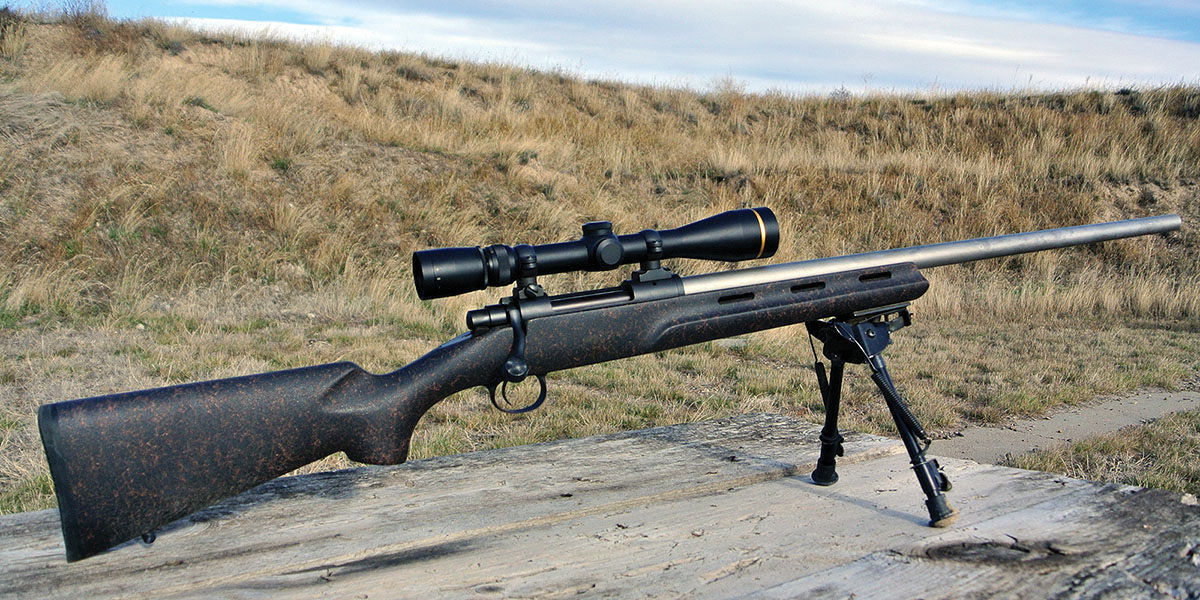
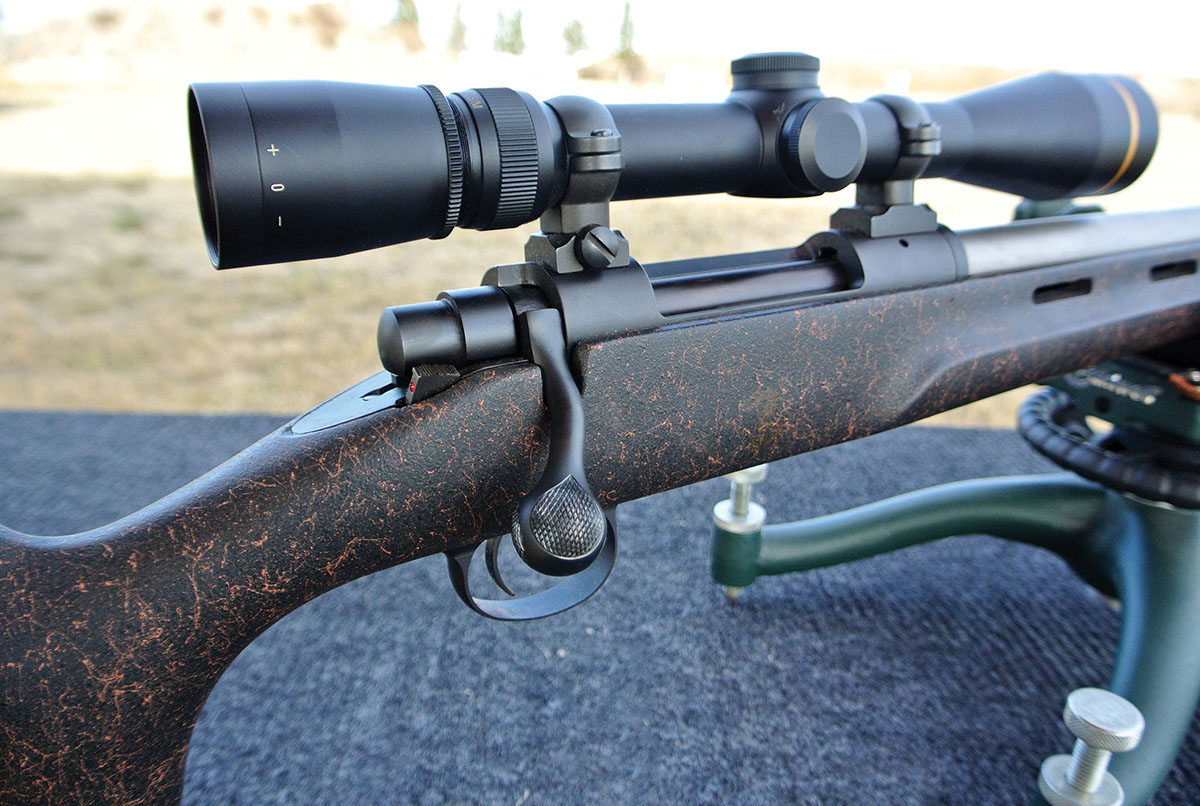
The Model 52 had just come into production the year before and featured a spade-type recoil lug captured between the barrel and receiver. Previous Cooper models, including the Model 22, used a monolithic recoil block fitted into a dovetail on the receiver. The front take-down screw mated into that block, securing the action. Machinist Randy Craft had built the rifle with an additional Model 52 recoil lug. It is an odd-looking affair, but the combination was rock solid and produced great accuracy. I later found out that the rifle had been passed from department to department, where each group added some custom touch to make the rifle unique. It was a tremendous gift.
With long, sleek bullets and target-rifle accuracy, the Model 22 has been an extraordinary long-range hunting rifle. I was content to leave it in this role until my son Jack asked me about using it for prairie dog hunting. He had shot the rifle several times at the range and had come away impressed with the accuracy and low recoil. He liked it so much, in fact, that he began referring to it as his. Strong fatherly admonitions and hard stares haven’t changed his mind. The only thing working against his hope of one day owning the rifle is the portion of my will that stipulates it is to be buried with me.
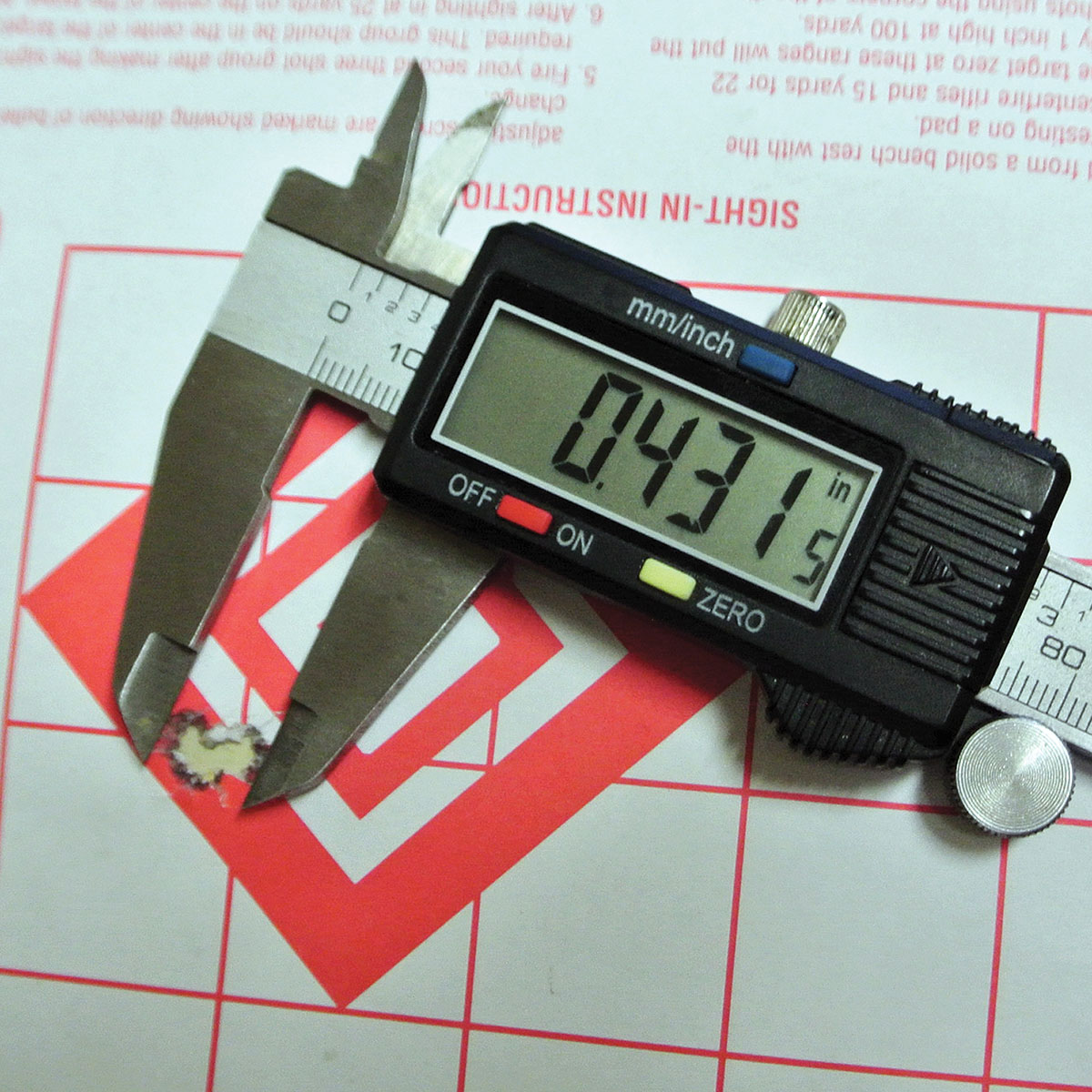
Simply comparing the cartridge overall length of a dummy round built to touch the rifling told the tale. It is one of the original 6.5-284 Winchester chambers cut with what had been Cooper’s standard Pacific Tool and Gauge reamer. Compared to 6.5-284 Norma chambers standardized by C.I.P. in 1999, the rifle’s chamber has a very short leade. Things were beginning to look promising. Varmint bullets were probably not going to face a long jump into the rifling or the problems with accuracy caused by excessive freebore.
Ideally, a case that headspaces on the shoulder, like the 6.5-284, would have a slight crush fit between the datum point on the shoulder and the bolt face. This tight fit generally allows a clean, symmetrical bullet release into the leade and promotes better accuracy. Factory cases, because they are manufactured small enough to allow reliable fit within in a variety of chamber dimensions, often do not fit tightly within the chamber. In extreme instances they may only headspace under the extractor. Loose-fitting cartridges may expand unequally within the chamber, negatively impacting the bullet’s alignment with the leade and bore. With longer bullets, the interaction between the bullet while it is still in the case mouth and the leade, which acts as a funnel guiding the bullet into the bore, tends to correct any small misalignment. For shorter bullets that must span a longer distance before they enter the rifling, misalignment may cause the bullets to enter the bore off their ballistic axis, causing excessive precession in flight, and larger groups.
After fireforming, I consulted with Jack to see where he wanted this experiment to lead. His options were fast varmint bullets or heavier, slower bullets with good ballistic coefficients (BC) and greater long-range potential. Surprising nobody who has a 17-year-old son at home, his choice was explosive, midrange performance.
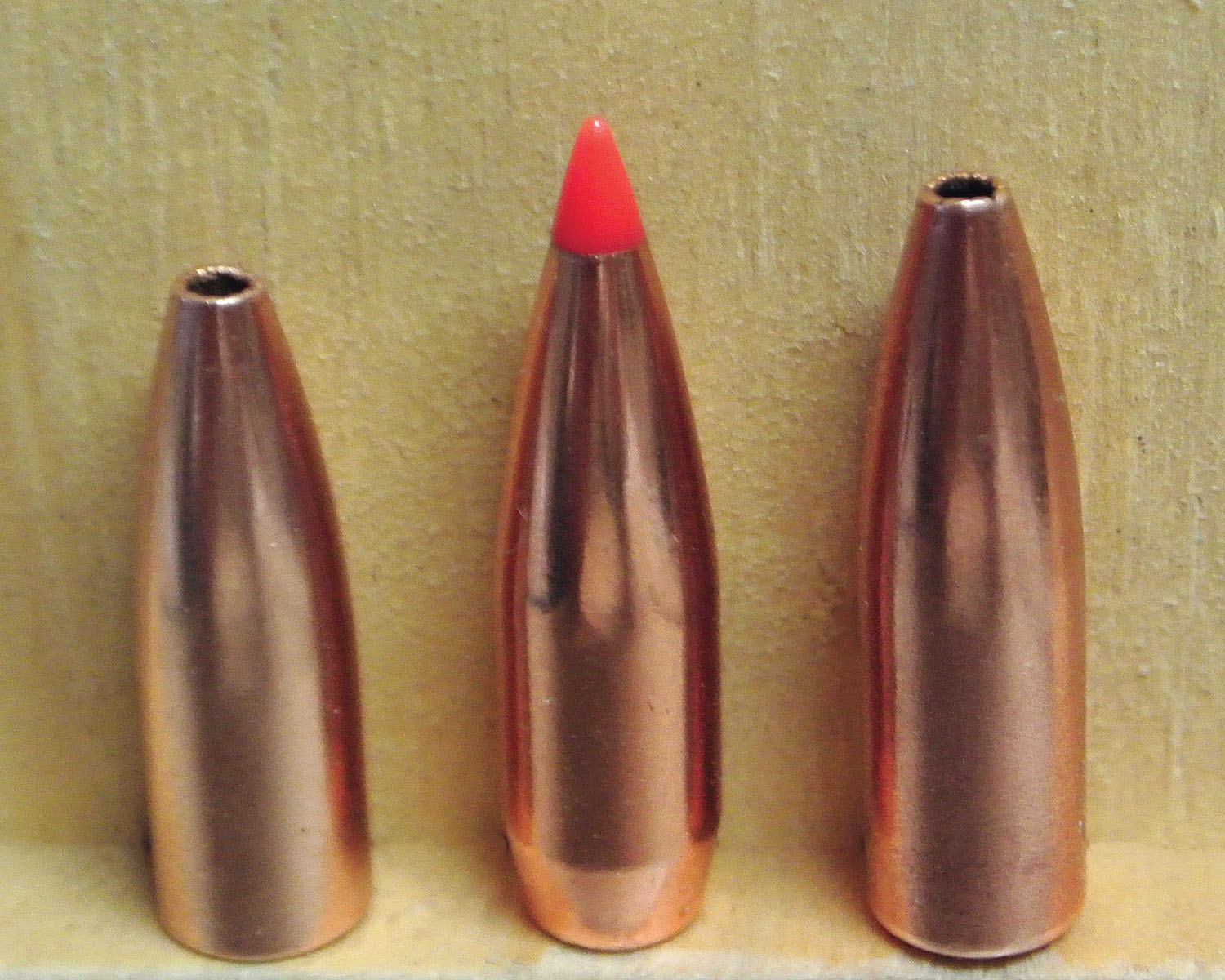
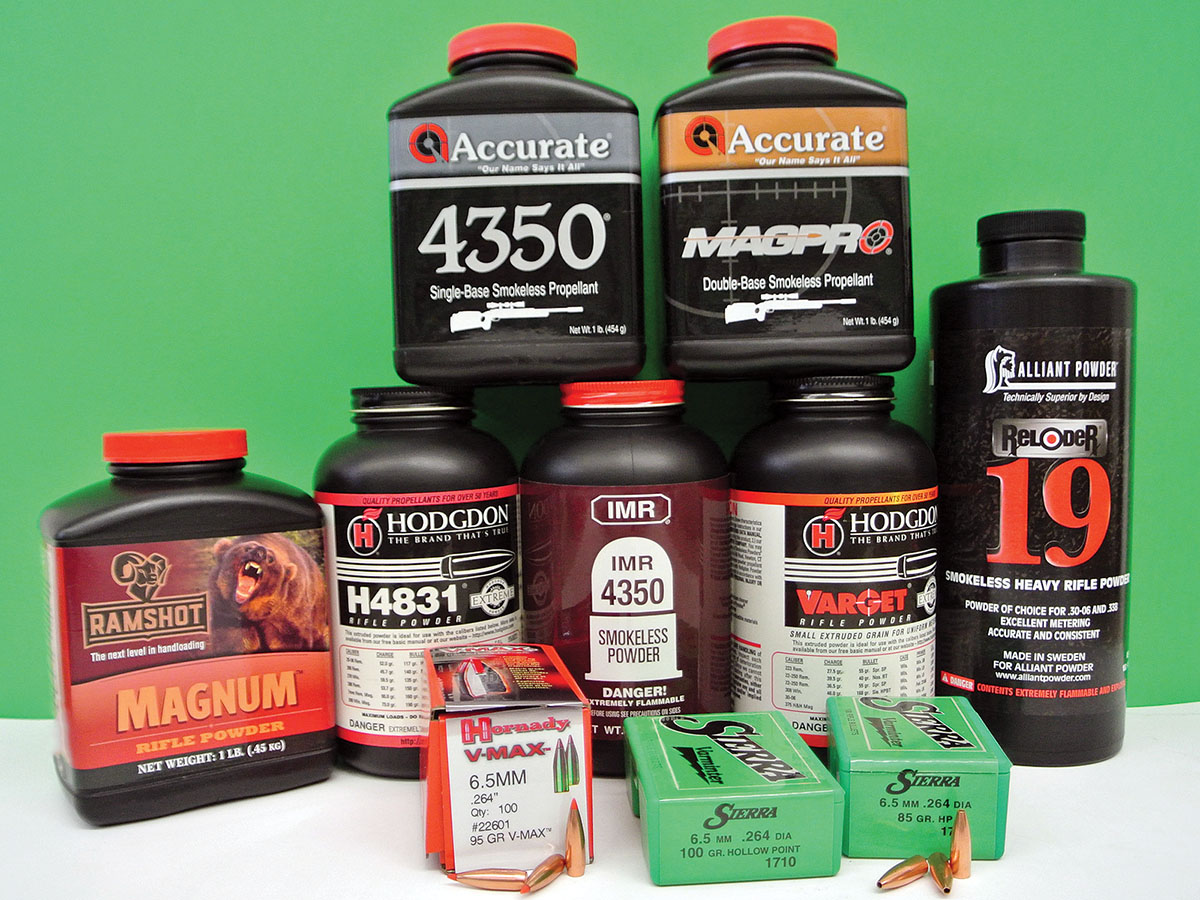
It turns out there aren’t that many .264-inch bullets designed for varminting. The last decade has seen a tremendous surge in interest in 6.5mm rifles in the U.S., but fans are more interested in long-range performance from longer, heavier bullets. The only bullets I found listed for varminting were made by Sierra and Hornady.
Sierra’s 85-grain Varminter hollowpoint is a dedicated varminting bullet introduced in 1960. Back then, the 6.5 market was a bit narrower, mainly filled by surplus military rifles like the 6.5x55 Swedish Mauser, the 264 Winchester Magnum and a few wildcats found in single-shot pistols. The Sierra bullet is flat-based and thin-jacketed for rapid expansion, even at the moderate velocities generated by the 6.5 TCU in a T/C Contender pistol. At .836 inch, it is short in comparison to most 6.5mm bullets, but it has a bearing surface of more than .375 inch that provides broad seating options. At .225, the little Sierra’s BC seems unimpressive, but it is a bullet intended for speed, accuracy and explosiveness at moderated ranges rather than 1,000-yard competition.
Never a company to miss a marketing niche, Hornady also produces a varmint bullet in the V-MAX line. The company’s 95-grain V-MAX is a modern boat-tail design that offers a stark contrast to the older Sierra bullet. At 1.033 inches, it is longer than the Sierra offering and features a considerably higher G1 BC of .365. Hornady suggests the bullet provides explosive expansion at only 1,600 fps, which would make it ideal for the 6.5 Grendel as well.
The Sierra 100-grain Varminter hollowpoint was the heaviest bullet I found listed as a dedicated varminter. Like the lighter hollowpoint, it was introduced in 1960. At .944 inch in length, the Sierra has a slightly higher BC of .259, and a longer bearing surface. Of the three bullets, this one appealed to me most. It looks like a flatbase match bullet, and the extra weight and length seemed promising.
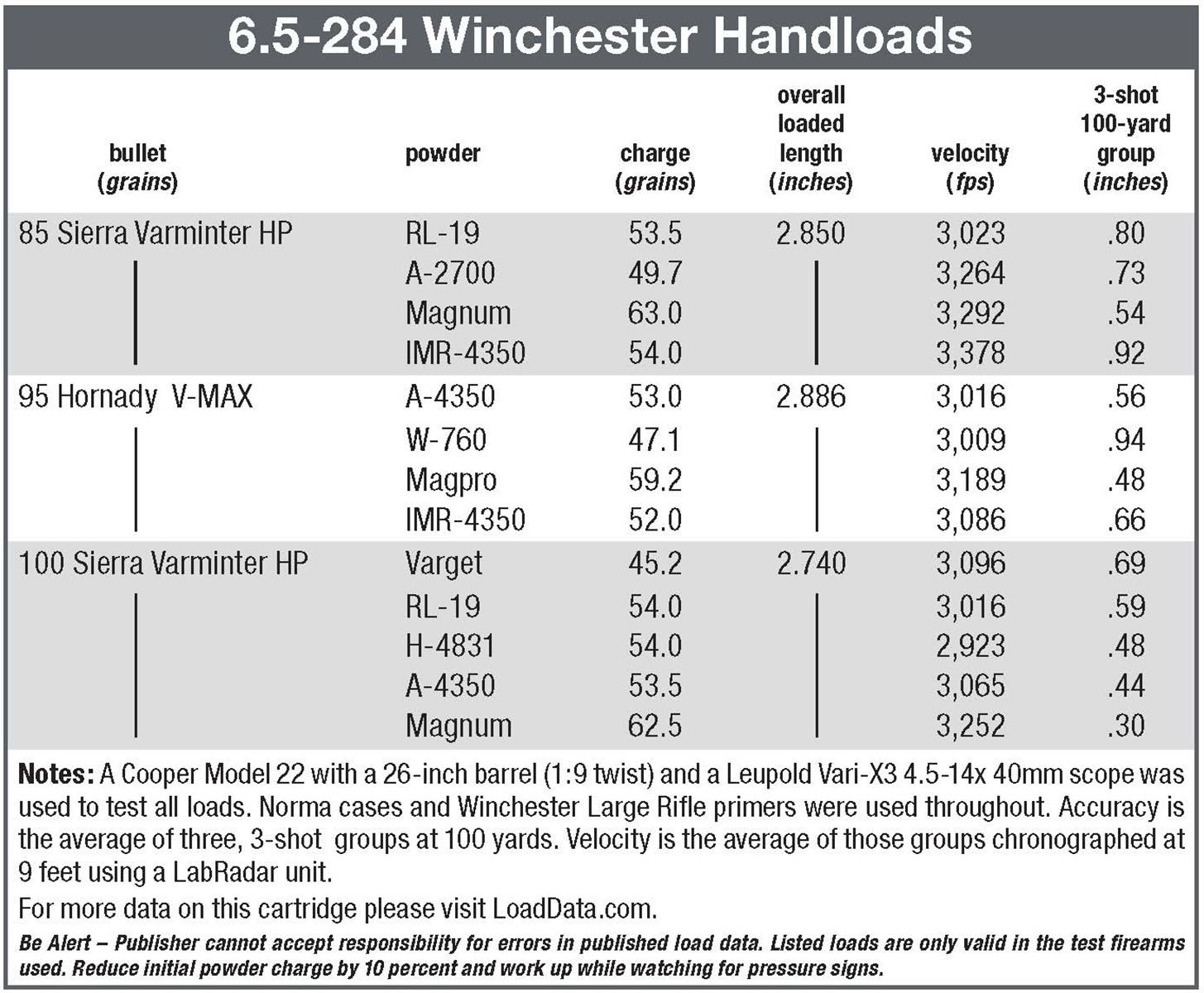
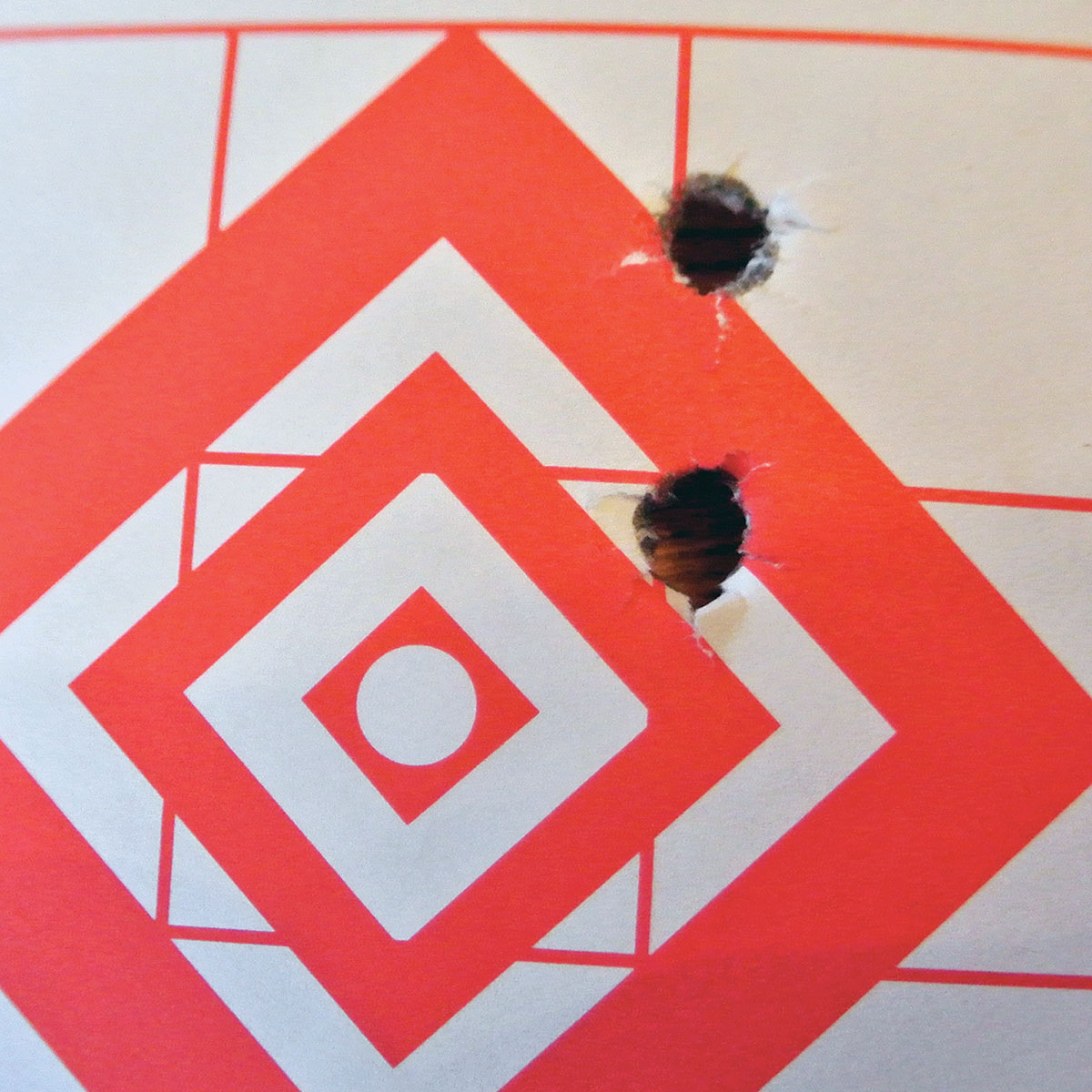
As the lightest bullet tested, it was no surprise that the 85-grain Sierra was the fastest of the bunch. The first three-shot group using 60 grains of Ramshot Magnum produced an unusual two-hole group with two bullets passing through the bottom hole and one through the top. The group measured .615 inch. The second test made a similar two-hole, three-shot group. This is a distinctive Cooper rifle trick that indicated the rifle was loose in its bedding. Upon reflection, I remembered I hadn’t fully torqued the screws after disassembling the rifle for photographs. I had only snugged them up and meant to use a torque wrench to set the tension; that was the end of my shooting morning.
That afternoon I tested four powders that all looked like a good fit for the light Sierra bullet. IMR-4350 was the velocity king with an average of 3,378 fps. I had hoped for 3,400 fps as an arbitrary velocity goal, and IMR-4350 came the closest to producing those numbers without any external signs of excessive pressure. It was also one of the least accurate loads I tested, averaging just under an inch at 100 yards. An Alliant Reloder 19 load had been suggested by a friend of mine as an accuracy load in his Cooper Model 22. That load proved to be disappointing, producing neither accuracy nor velocity.
The best accuracy I achieved was with 63 grains of Ramshot Magnum. It produced a .540-inch group at almost 3,300 fps. Sixty-five grains of Magnum raised the velocity to 3,418 fps but opened the group size up to .860 inch.
Switching to the Hornady 95-grain V-MAX offered a ray of hope in terms of accuracy, but velocities were never as high as I had hoped. Winchester 760, in retrospect, was probably too fast for this combination and produced extreme velocity spreads in excess of 125 fps. Both the Accurate and IMR-4350 loads proved more accurate and offered noticeably smaller extreme velocity spreads. Accurate Magpro, with its compact spherical grains and slower burn rate, was the only powder that was able to consistently produce groups of less than half an inch. In a theme that repeated throughout testing, slow spherical powders offered the highest velocities and produced the tightest groups.
Accuracy from the 100-grain Sierra bullet was simply outstanding. Even Hodgdon Varget, which is very fast for this application, turned in acceptable groups. With slower powders, accuracy was on par with any of the match bullets I have used in this rifle over the years. Ramshot Magnum was the winner in both accuracy and velocity, producing a group measuring .162 inch with a 62.5-grain charge.
Jack can have his 6.5-284 Winchester varmint rifle now. It is certainly accurate enough to do the job, and the bullets are wickedly explosive. Now all the little raider has to do is make it past the booby traps that will guard my tomb.
Just before this issue went to press, we were informed the Sierra 85-grain Varminter HP had unfortunately been discontinued. -Ed.