Magnum Rimfire Cartridges
Comparing the 17 HMR and 22 WMR
feature By: Layne Simpson | April, 19

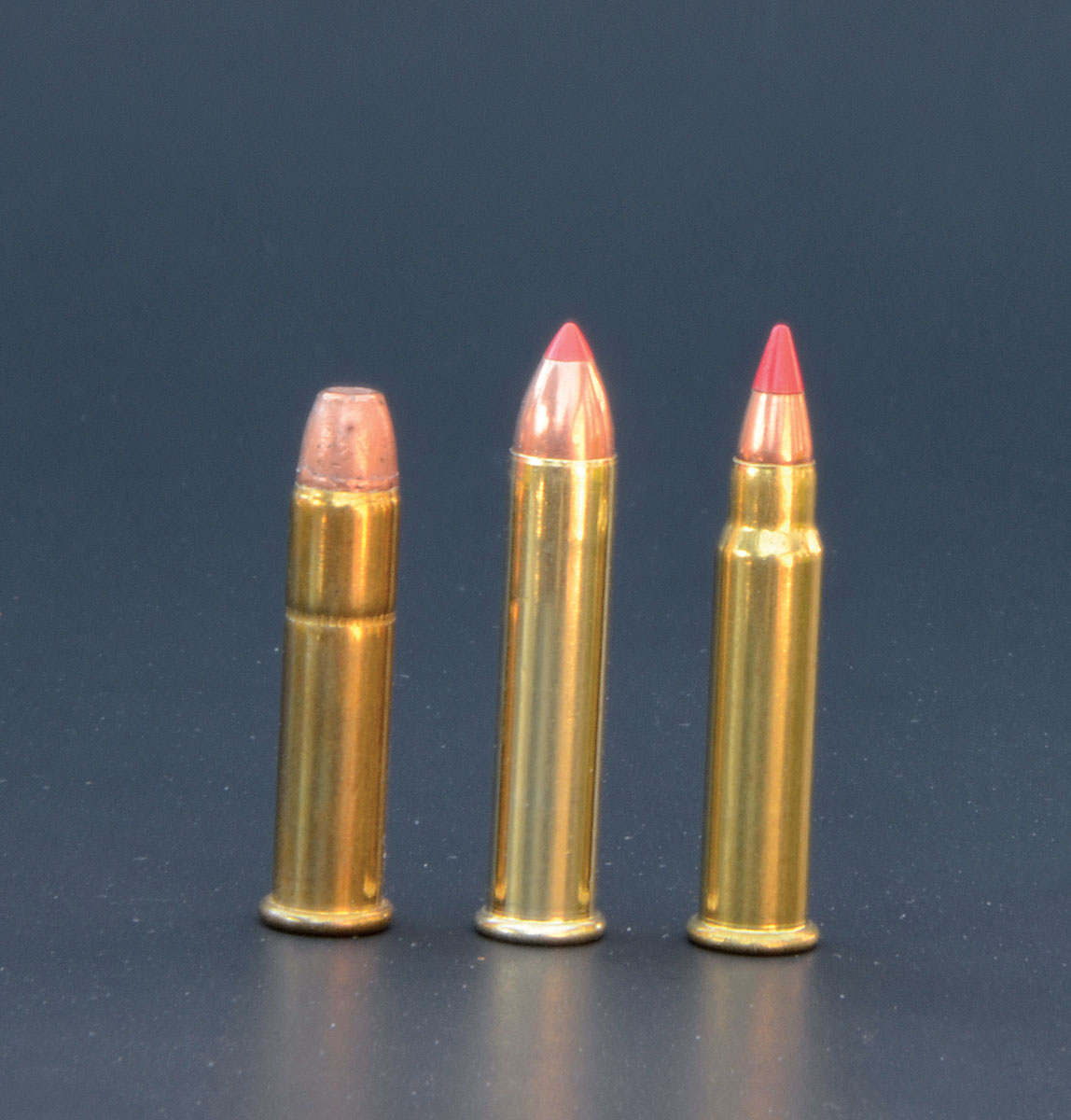
The 22 WMR was created by lengthening the case of the 22 Winchester Rimfire (22 WRF). The 22 WRF was developed specifically for the Browning-designed Winchester Model 1890 slide-action rifle and was loaded with a .224-inch, inside-lubricated lead bullet weighing 45 grains. Muzzle velocity was 1,450 fps. A Super Speed loading with a Kopperclad 40-grain hollowpoint bullet at 1,475 fps came a bit later. Respective energy ratings at the muzzle and at 100 yards were 210 and 123 foot-pounds (ft-lbs). The cartridge was also loaded by Remington with a 45-grain bullet at 1,450 fps, but the company called it the 22 Remington Special. At the time, the 40-grain bullet in high-velocity 22 Long Rifle ammunition was given energy ratings of 158 and 97 ft-lbs at the muzzle and at 100 yards. In addition to delivering a tad more punch to the target, the 45-grain bullet at higher velocity from the 22 WRF offered more penetration. The 22 WRF is still alive and well at Winchester, where it is presently loaded with a 45-grain, Lubaloy-coated, flatnose bullet at 1,300 fps.
Moving now to the 17 HMR, it came close to having a different name. Back in 1990, I shot prairie dogs with Dick Cantu of Precision Imports. At the time, his company was importing Mauser Model 201 rifles chambered in 22 WMR and 22 Long Rifle. The rifle I shot most was very accurate, and it was chambered for an experimental cartridge made by Federal by necking down the 22 WMR case to .17 caliber. It was loaded with a 25-grain hollowpoint bullet, and its maximum “drop-them-in-their-tracks” effective range proved to be around 150 yards. Beyond that, the little bullet failed to expand enough to consistently prevent prairie dogs from making it back to their dens. The cartridge did not have an official name so when writing about it in 1992, I called it the 17 FMR. I never learned why Federal did not take the cartridge to market but was told unofficially that failure of Remington’s earlier 5mm Rimfire Magnum to gain a toehold, along with lackluster sales of 22 WMR ammunition at the time, had a lot to do with the final decision.
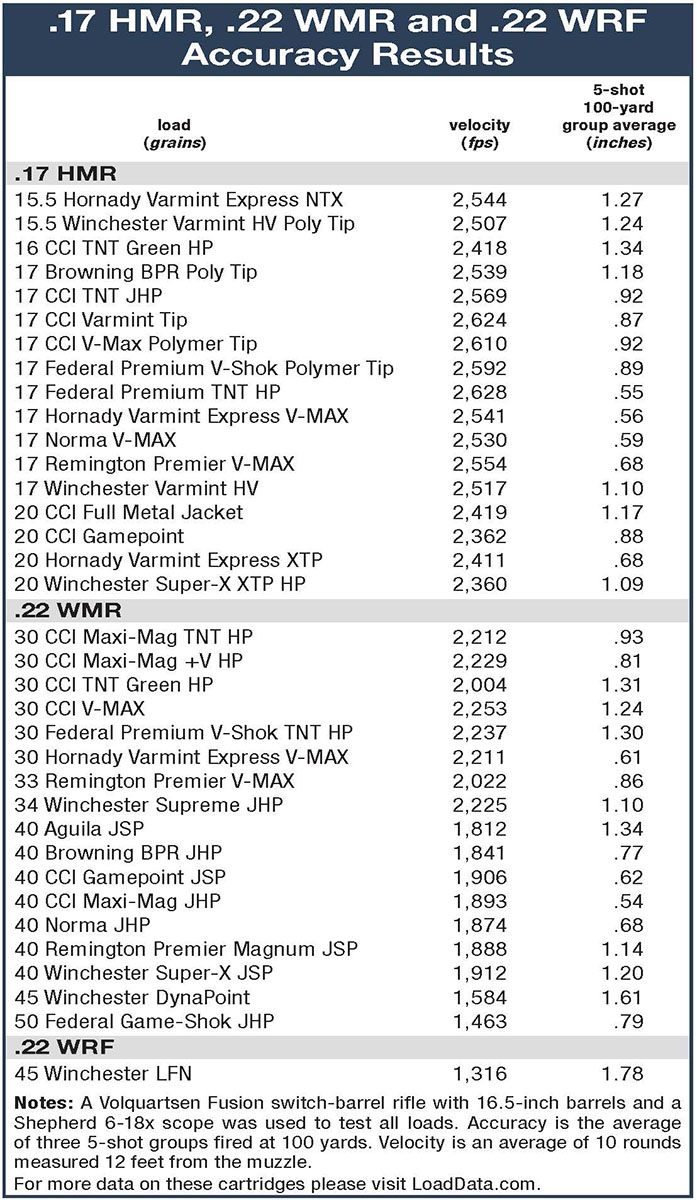
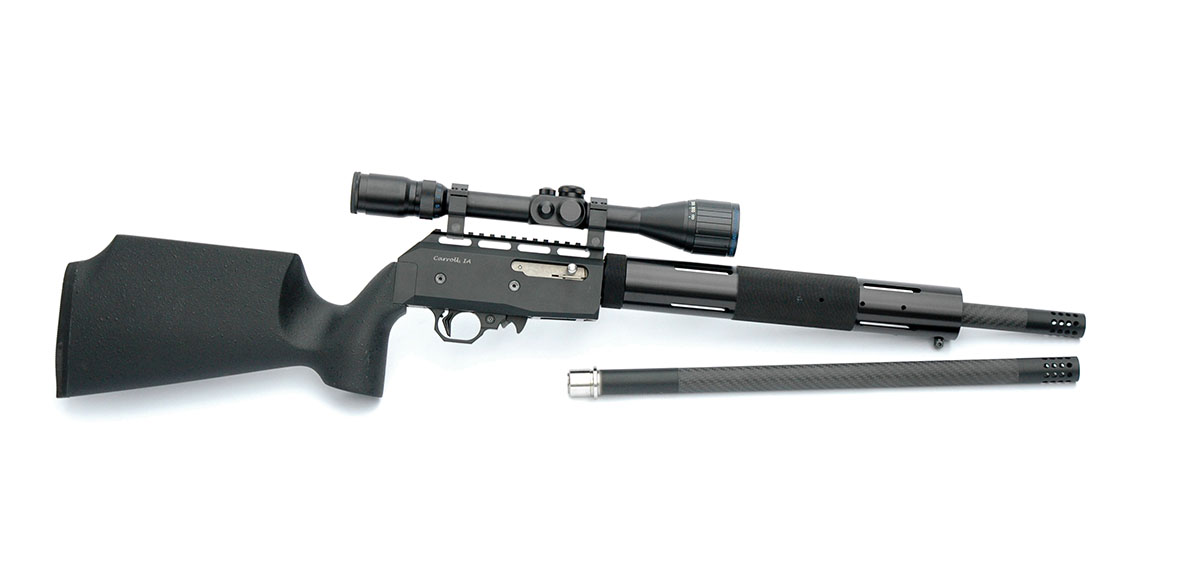
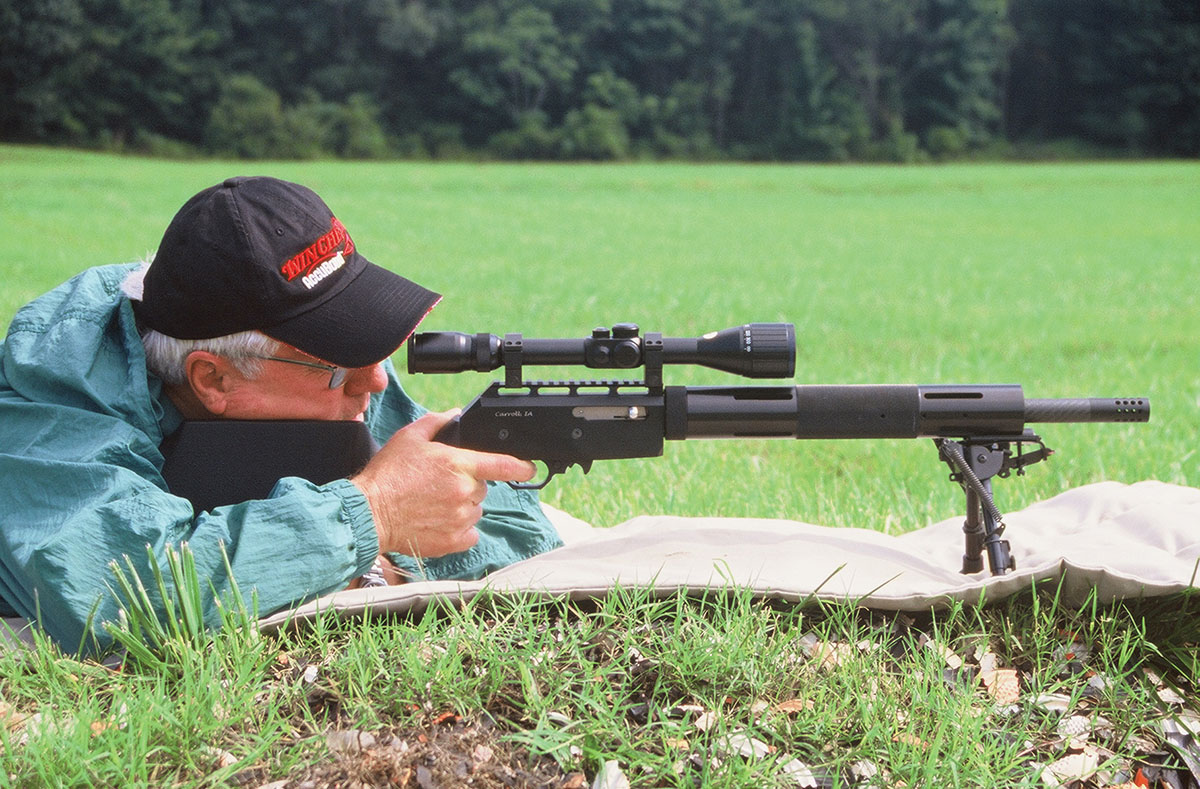
Tom Volquartsen was first to offer an autoloading rifle in 17 HMR and 22 WMR that worked satisfactorily, and his secret was no secret at all. Whereas other companies modified existing rifles designed for the 22 Long Rifle cartridge, Volquartsen designed a rifle specifically for the two magnum cartridges. I have a couple of his standard rifles in 17 HMR and 22 WMR, and while both are tack drivers, the Fusion is the one I have used most because its quick-switch barrels allow me to compare the performance of both cartridges on varmint shoots without taking along two rifles. Barrels are fast and easy to change; unscrew the AR-15-style aluminum barrel shroud from the receiver, remove the barrel by pulling it forward, install the other barrel, reattach the barrel shroud and keep on shooting. Possibly due to tighter bores, both barrels often deliver higher velocities than longer barrels. As an example, velocity of the Hornady 30-grain V-MAX from the 20-inch barrel of my Ruger 77/22M 22 WMR is 2,161 fps versus 2,211 fps from the 16.5-inch Volquartsen barrel.
My Fusion weighs 9.75 pounds with a Harris folding bipod and a Shepherd 6-18x scope. The trigger breaks at 36 ounces and seems lighter due to its crispness and wide finger lever. Like all Volquartsen rifles, the Fusion uses the rotary magazine made by Ruger for its rimfire rifles, and it is guaranteed to shoot five-shot groups smaller than an inch at 100 yards. Regardless of whether I am using the rifle in the field or accuracy-testing ammunition from a benchrest, it always has the Harris bipod attached.
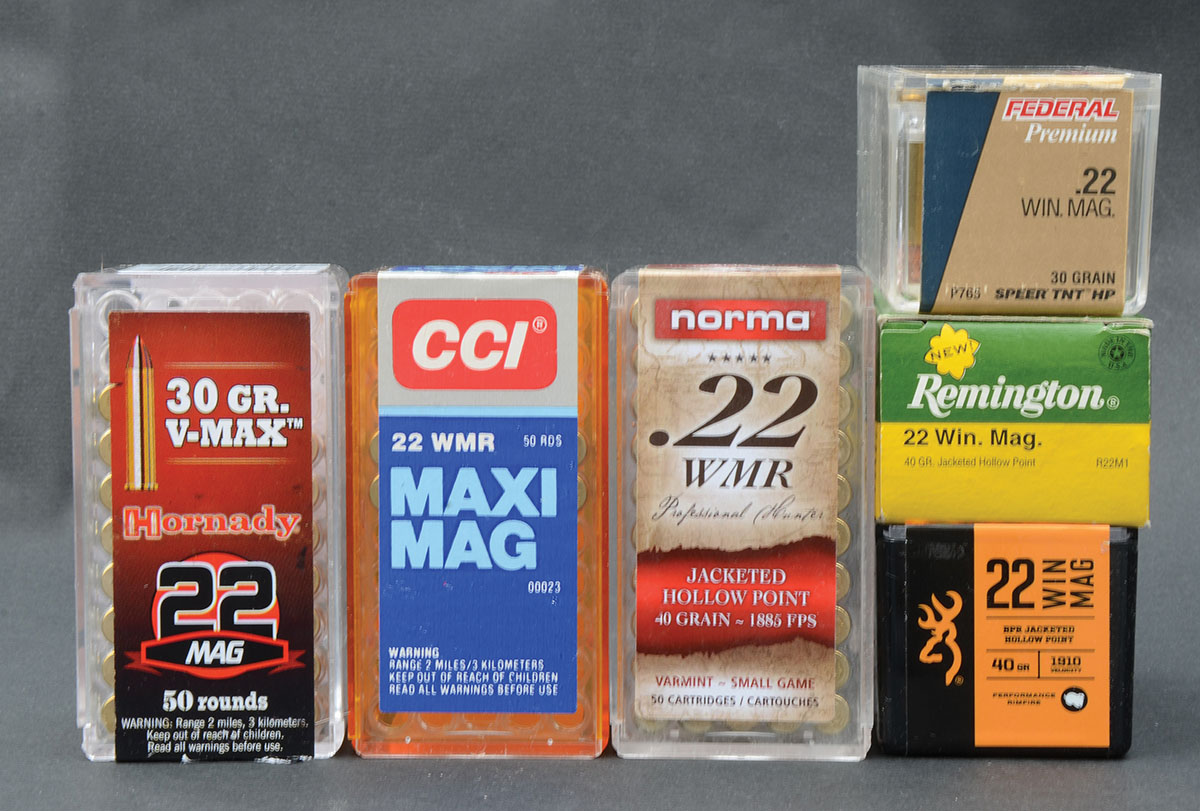
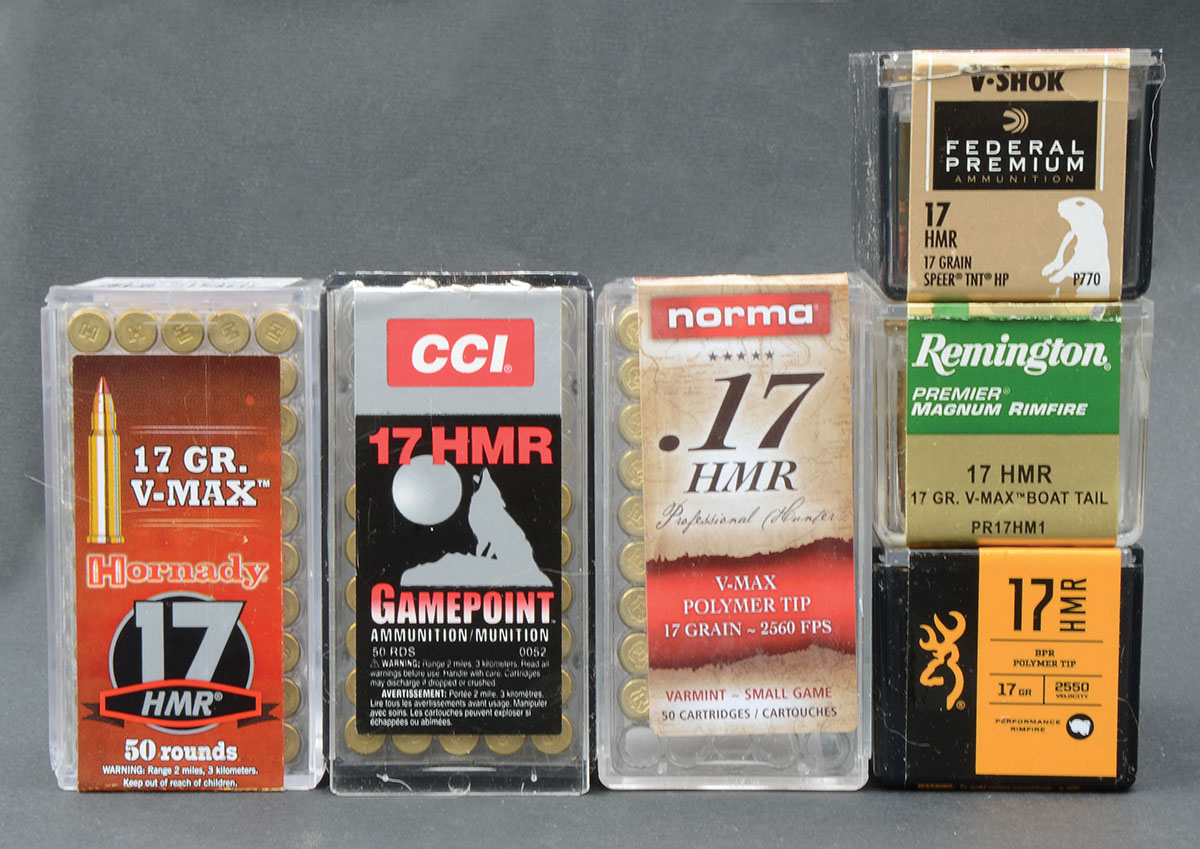
The bullets of both cartridges are quite sensitive to wind and while the 17 HMR has an edge, the actual difference between the two is greatly dependent on which bullets are compared. In the 17 HMR the 17-grain V-MAX is hard to beat and is far superior to any 22 WMR 40-grain loads I have tried. But switch to the 30-grain V-MAX in the 22 WMR, and while the 17 HMR remains a better wind-bucker, the difference is not great. While recently shooting prairie dogs with several friends in Kansas, a couple of us decided to compare the two cartridges by setting up paper targets at 200 yards. A Kestrel anemometer indicated a fairly consistent crosswind velocity of 12 mph. Average drift of the 30-grain V-MAX from the 22 WMR was about 4 inches more than for the 17-grain V-MAX from the 17 HMR.
Higher velocity gives the 17 HMR an edge in bullet expansion at the outer fringes of its effective range. When the 17-grain V-MAX exits the muzzle at 2,550 fps, it is still moving along at 1,375 fps at 200 long paces. Launch the 30-grain V-MAX from the 22 WMR at 2,200 fps and it arrives at the same distance with just over 1,000 fps remaining. The 22 WMR does have an edge in residual energy, with the CCI 40-grain Gamepoint delivering 102 ft-lbs at 200 yards. Depending on the load, the 17 HMR ranges from 55 to 75 ft-lbs at that distance.

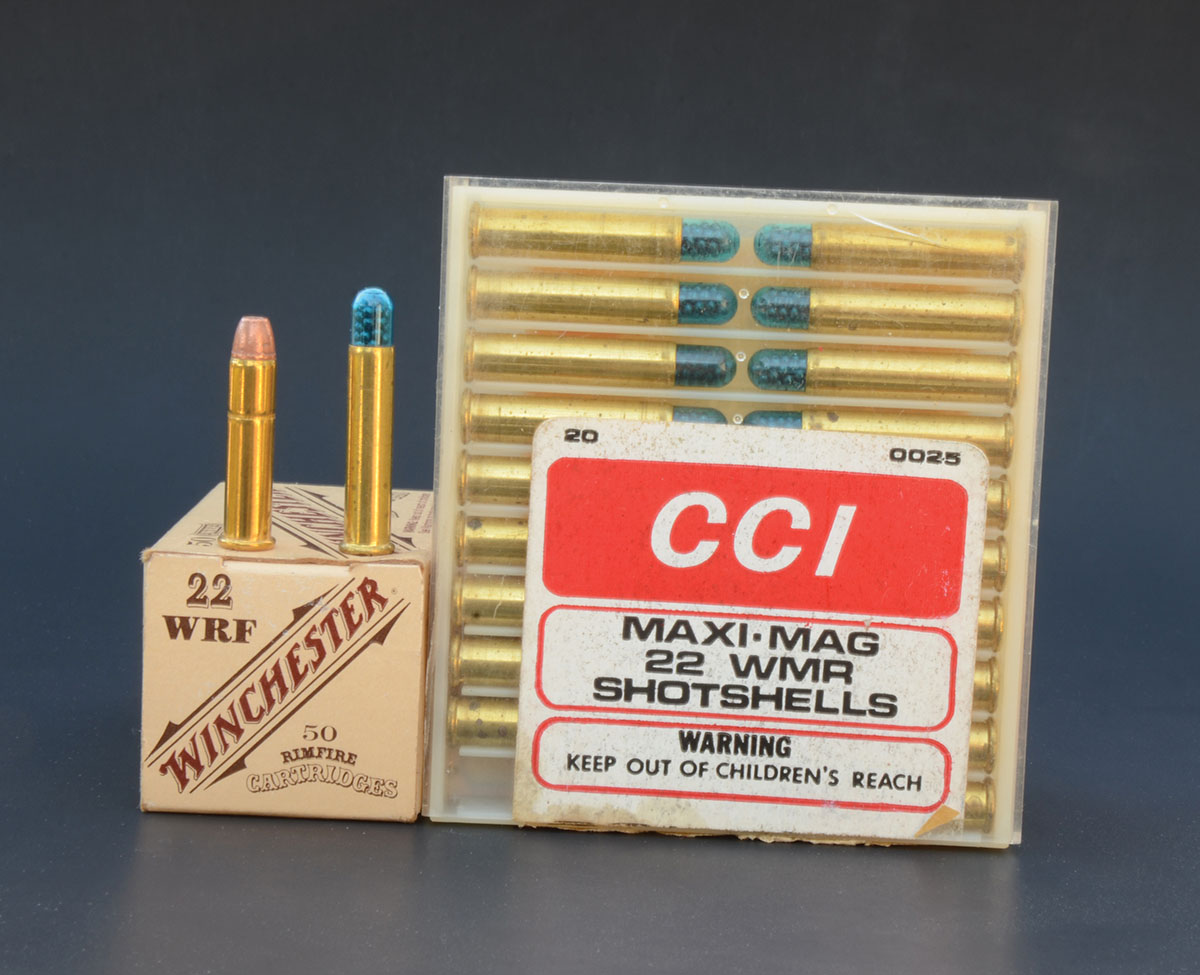
I enjoy shooting both cartridges, but for people who for whatever reason must choose between the two, first deciding what the rifle will be used for is a good place to start. If the rifle will be mostly used for harvesting cottontails, gray squirrels, grouse and other small game for the pot, the availability of 22 WRF ammunition from Winchester gives 22 WMR rifles a big edge in versatility because it damages less edible meat than 22 WMR ammunition. On the downside, the 22 WRF is loaded by Winchester to lower chamber pressure than 22 WMR and will not reliably cycle some autoloaders. It functions both of my Volquartsen rifles most of the time, although bolt travel can be rather sluggish. This is not an issue with single-shot rifles and other types of repeaters.
The 22 WMR loaded by CCI with a 40-grain Gamepoint bullet is intended for bagging small game, but due to its higher velocity, it is still more damaging to what will go into the pot than the 22 WRF. CCI and Hornady offer 17 HMR 20-grain hollowpoint loads at reduced velocities, but at fairly close range they still spoil more of the stew than the 22 WRF – unless you and your rifle are good enough to stick to headshots. The 22 WRF is also loaded by CCI, but its 45-grain jacketed hollowpoint is not as accurate in my 22 WMR rifles. I have a couple of revolvers in 22 WMR, and since CCI warns against using that load in anything but rifles, I don’t go to the trouble of keeping it on hand.
A retired friend of mine who lives in a southern state spends a lot of his time pestering coyotes. In addition to shooting them during daylight, he also hunts a great deal at night. When asked how many he calls in and bumps off each year, his standard reply is “a few hundred.” Most of the farms he hunts are small by western standards, and since houses are not too far apart, he prefers to use a cartridge with the softest report possible. But since he prefers to not leave dead coyotes behind for the landowners to have to bury or haul off, he needs a cartridge that kills quickly with a bullet behind the shoulder and into the lungs, making them easy to retrieve. Coyotes in his area tend to prefer wooded country where shots are seldom beyond 75 yards, and since he is an excellent caller, many are inside 50 paces when he pulls the trigger of his Henry Repeating Arms lever-action 22 WMR. After trying a number of different loads, he settled on the CCI 40-grain Gamepoint. He has tried the 17 HMR but considers the 22 WMR to be far more reliable.
I have taken many turkey gobblers through the years, most with shotguns but a few with rifles in 22 WMR. When peppering the head and neck of those birds with a shotgun, most drop in their tracks, but I don’t recall a single one that did not flop around like crazy prior to calling it quits. In contrast, every turkey I have bagged with a 40-grain expanding bullet from the 22 WMR dropped dead with no bouncing around or wing flapping. Bullet placement is important. Visualize a softball surrounded by a bucketful of feathers and you have the vital area. I take only broadside shots and move the intersection of the crosshairs about two-thirds up the body and about 3 inches forward of the leg prior to pulling the trigger. Not many states allow the use of a rifle on turkeys, so check the regulations of where you will be hunting prior to heading to the field.
The 22 WMR has something not often mentioned in its favor. My mother, who was an avid gardener, was often plagued by chipmunks, and my father had a fun way of taking care of the problem. A neighbor’s house was fairly close, so Dad used something that was fairly quiet and ricochet-free. His pest medicine was a bolt-action Marlin Model 25MG Garden Gun with a smoothbore barrel and the CCI 22 WMR load with 52 grains of No. 12 shot. I never knew how the barrel of his gun was choked, but do know that whether sitting still or running, any chipmunk that allowed him to get within a dozen paces was destined for that big daisy patch in the sky. I have taken several with that load in my Ruger Single Six, but at closer distances.
So which of the two cartridges do I prefer and for what? For hunting edible small game and for shooting larger varmints, I am convinced a rifle in 22 WMR is the better choice. On the other hand, if the rifle is to be used only for shooting ground squirrels, crows and other small varmints, the 17 HMR wins by a country mile. The best plan? Have at least one rifle chambered for each of the two cartridges.