6.5 Grendel Varmint Loads
Handloads for Bolt Rifles
feature By: John Haviland | April, 19
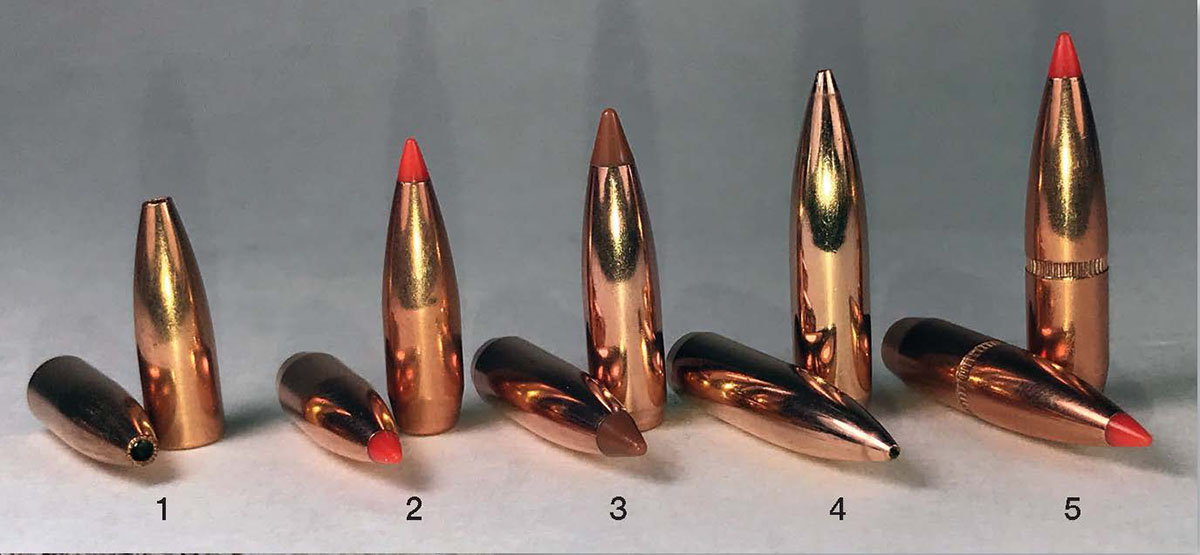
The selection of true 6.5mm varmint bullets is rather thin. Hornady and Sierra each make one. Still, I’ve been shooting varmints with fine success the last few years with various 100-grain bullets that are probably considered more suitable for target shooting and deer.
The Grendel was originally considered a cartridge for AR-type firearms. However, a bolt-action rifle provides the most versatility because there is no worry about the correct amount of gas to cycle the action. Plus, most bolt actions chambered for the Grendel are based on short actions that are trim and light.
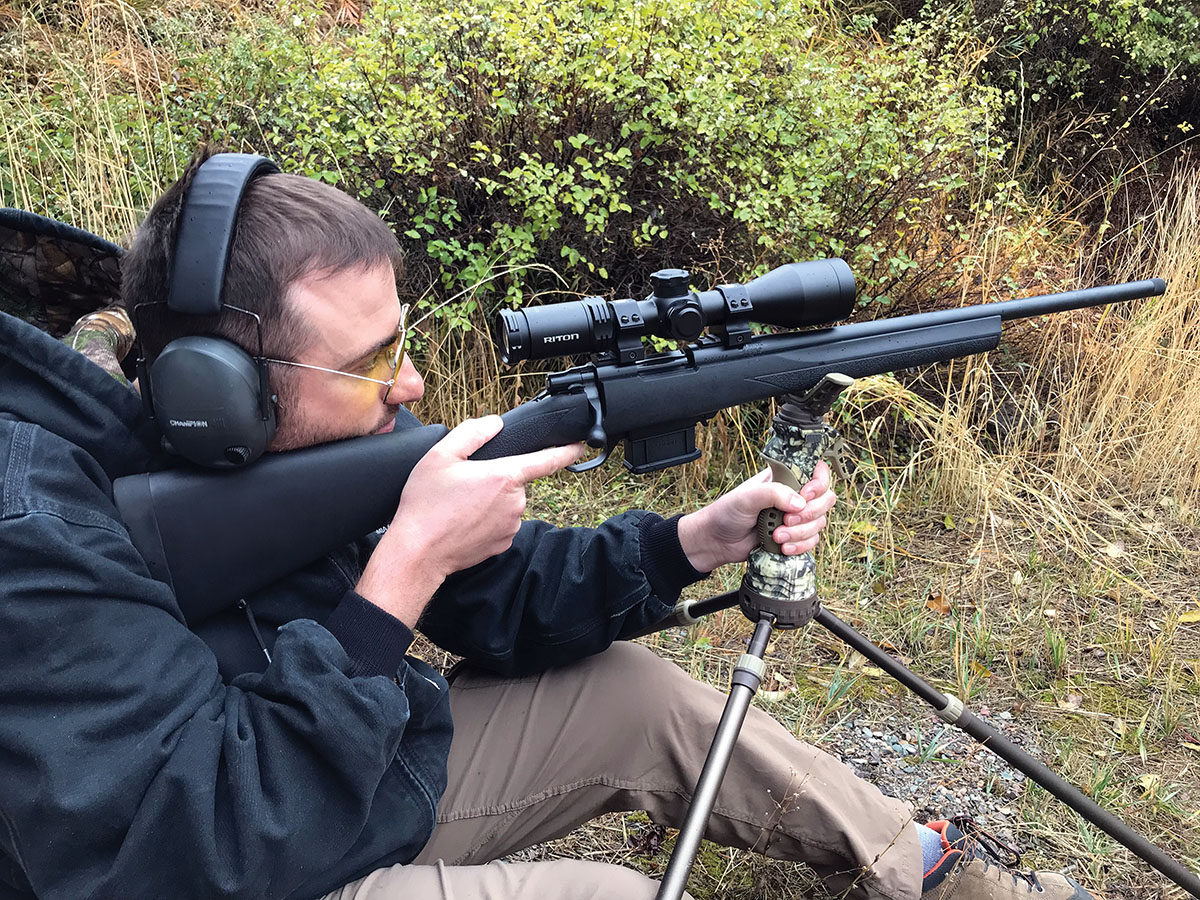
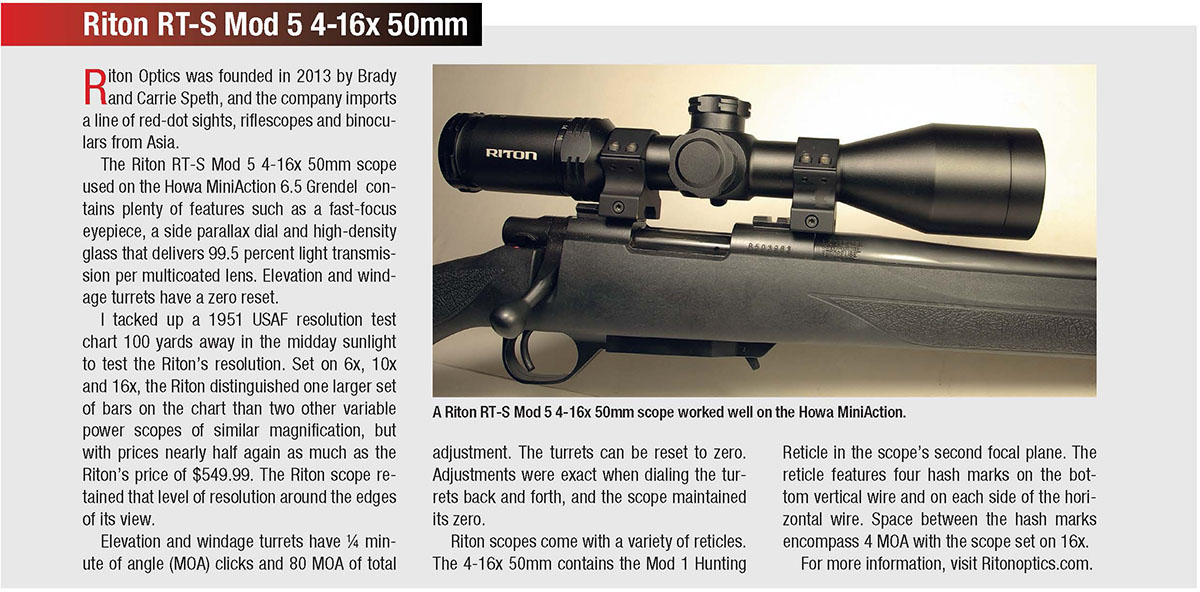
For this project I had the delight of choosing one of three barrel options for the Howa MiniAction. The Lightweight has a 20-inch No. 1 contour barrel and weighs 5.7 pounds. The Standard includes a 22-inch No. 2 contour barrel and weighs 6 pounds, and the Heavy Barrel weighs 6.4 pounds with a thick 20-inch barrel and a 5⁄8x24 threaded muzzle. I picked the Heavy Barrel and mounted a Riton RT-S Mod 5 4-16x 50mm scope on the rifle. The whole outfit weighed 8 pounds, 5 ounces.
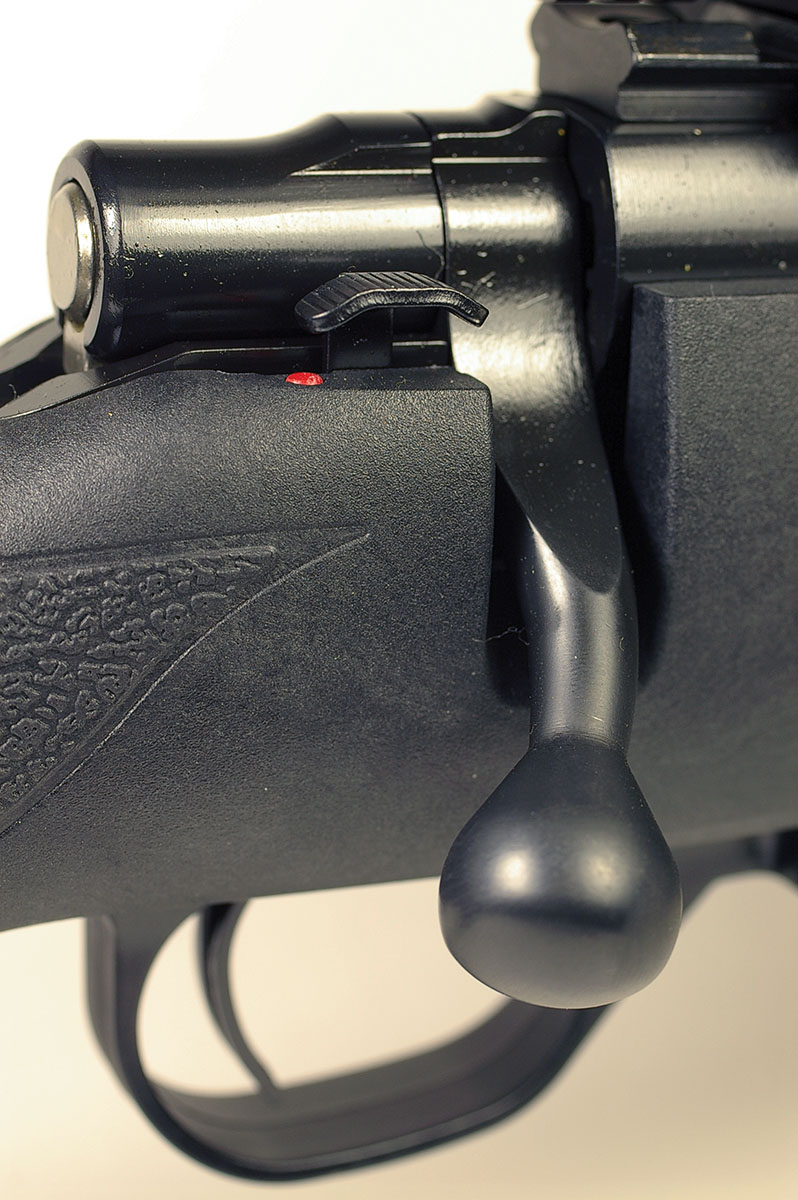
The Howa Actuator Controlled Trigger (HACT) is a two-stage design. One pound of finger pressure takes up the trigger’s slack. An additional 1.75 pounds of pull trips the sear. The trigger has no creep or overtravel. The Howa manual does not mention if the trigger is adjustable. In fact, a glob of glue covers the trigger’s adjustment screws. The three-position safety is at the right rear of the receiver. The safety is engaged and the bolt is locked shut with the safety tab in the rear position. The safety remains engaged and the bolt can be opened with the tab in the middle position. The safety is off with the tab pushed all the way forward.
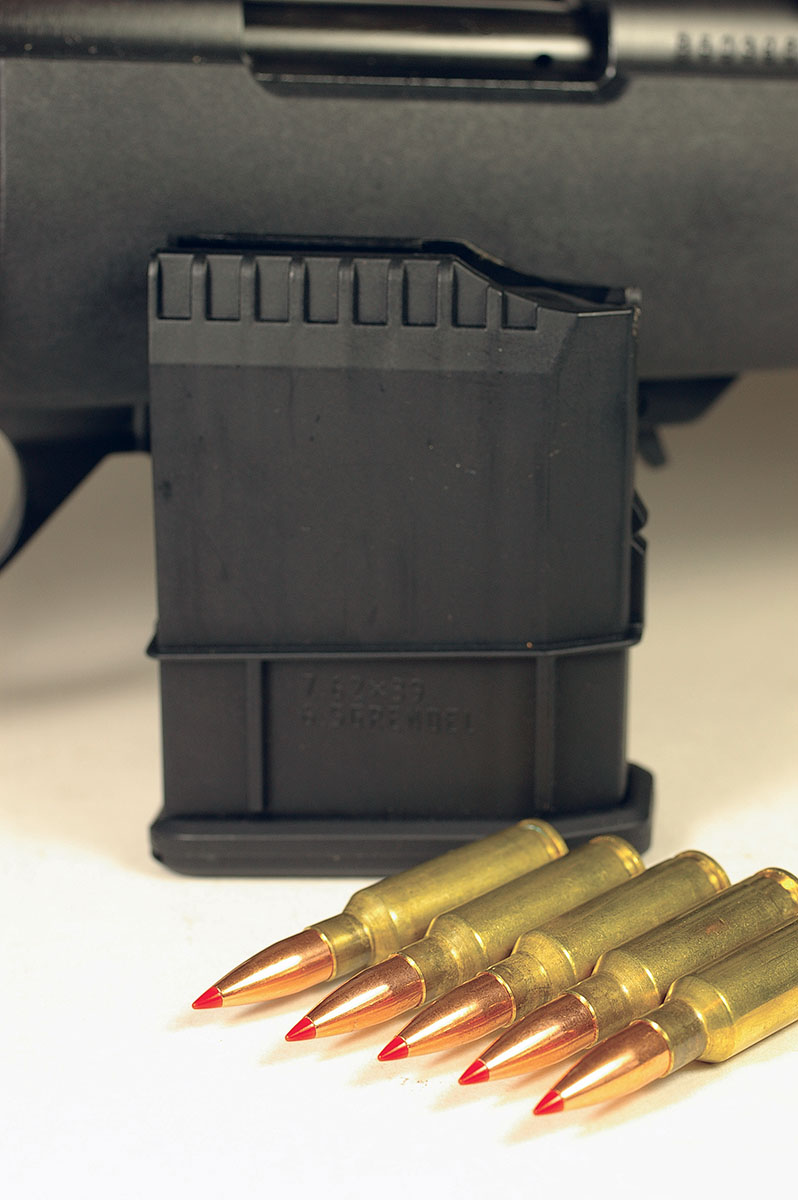
The magazine frame and trigger guard are one piece of polymer. A five-round detachable magazine is standard, with a 10-round magazine as an option. The magazine will accept cartridges up to 2.300 inches in length. A release button protrudes from the front of the frame. I inadvertently hit the button a few times and the magazine dropped out.
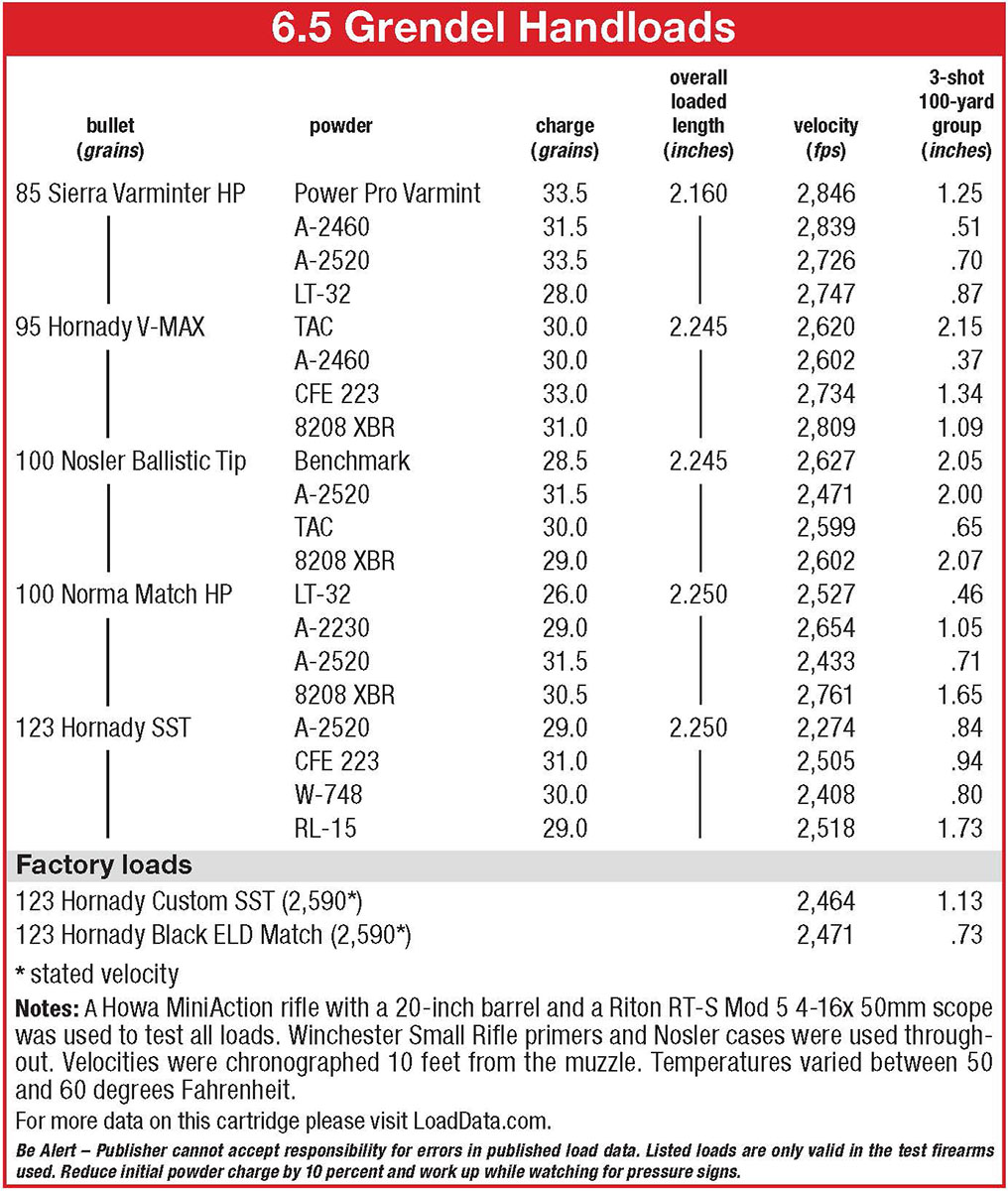
The 6.5 Grendel delivered on that promise with Hornady Black ammunition loaded with 123-grain ELD Match bullets. The Howa also lived up to the pledge with at least one powder/bullet combination of all the handloaded bullets listed in the accompanying load table.
According to Accurate Powder, its LT-32 was developed mainly for benchrest competitors who shoot the 6mm PPC cartridge. The PPC’s case and the Grendel case are very similar in size. Accurate states LT-32 delivers shot-to-shot consistency. Extreme velocity spread was 11 fps with LT-32 shooting Sierra 85-grain Varminter bullets, and 23 fps with Norma 100-grain Match bullets. A week later, I again shot 15 of the Norma bullets with 26.0 grains of LT-32. Extreme velocity spread was 18 fps. LT-32 powder was dropped from a measure directly into cases. Accurate 2460, Benchmark and TAC powders also produced low extreme velocity spreads.
Those minimal velocity spreads may also be due to powder charges filling the case to about the bottom of the shoulder. With a cartridge length of 2.245 inches, the bases of Hornady 95-grain V-MAX bullets sit at the bottom of the case neck. The bases of Norma 100-grain Match bullets are positioned at the bottom of the shoulder, and the bases of Hornady 123-grain SST bullets, with a cartridge length of 2.250 inches, sit slightly below the bottom of the shoulder. The result is powder columns are held tightly in place to provide uniform ignition.
The diminutive Grendel shoots bullets somewhat slower compared to other cartridges. Yet the relatively high ballistic coefficient (BC) of 6.5 bullets gives the Grendel a slight boost in retained downrange energy and trajectory.
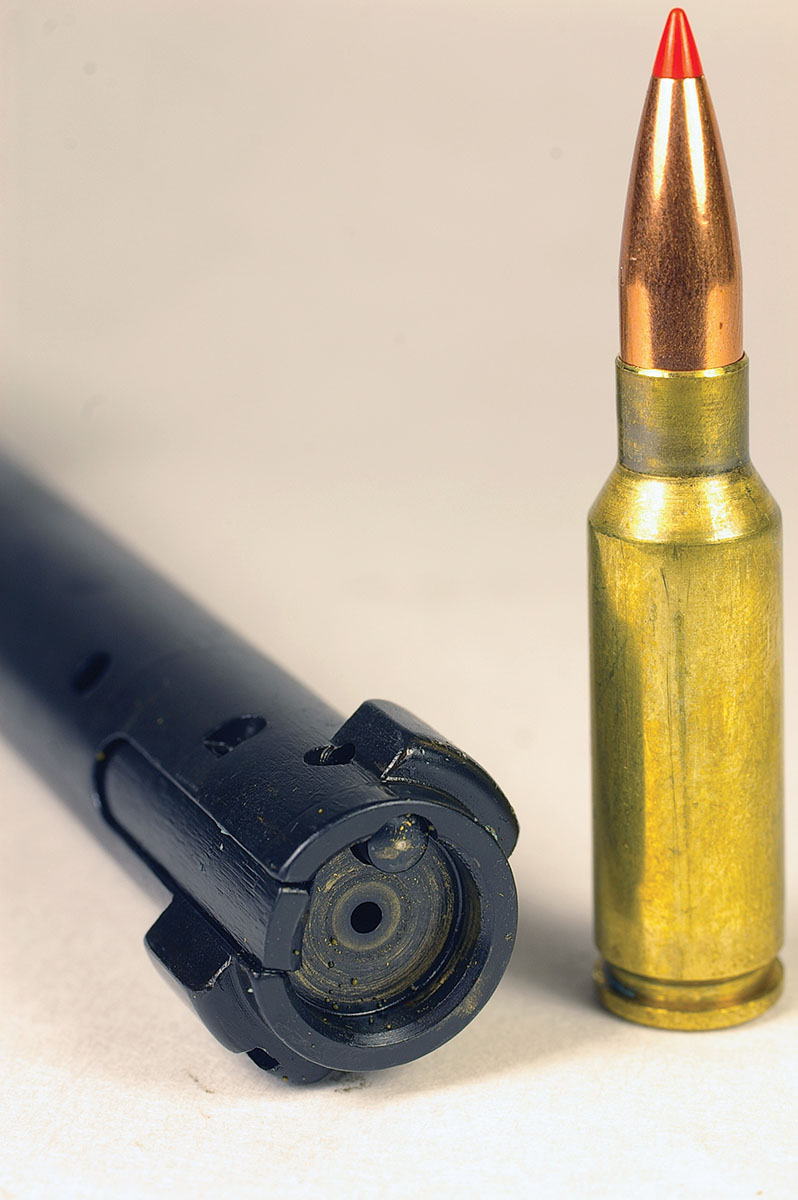
The Grendel’s downrange ballistics compare favorably to the 223 Remington. Hornady’s 6.5-caliber 95-grain V-MAX bullet has a G1 BC of .365 while the BC is .267 for the Nosler .22-caliber 55-grain Ballistic Tip. The 223 shoots those Ballistic Tips at 3,300 fps from the muzzle while the Grendel shoots V-MAX bullets at 2,800 fps. The 223’s additional velocity results in 7 inches less drop at 400 yards than the Grendel’s bullet. The 6.5 bullet, though, carries about an additional 300 foot-pounds compared to the .22-caliber bullet way out there.
Let’s compare the Grendel with the 250 Savage, another mild cartridge. Nosler 6.5mm 100-grain Ballistic Tip bullets have a BC of .350. At a top velocity of 2,627 fps from the Howa’s 20-inch barrel, Ballistic Tips dropped 16 inches at 300 yards and 36 inches at 400 yards with the rifle zeroed at 100 yards. In comparison, .25-caliber 100-grain Ballistic Tips have a .393 BC. Ballistic Tips fired from the 250 at 2,900 fps drop 12 inches at 300 yards and 27 inches at 400 yards. That 9-inch less drop at 400 yards requires the 250 to burn 20 percent more powder than the Grendel.
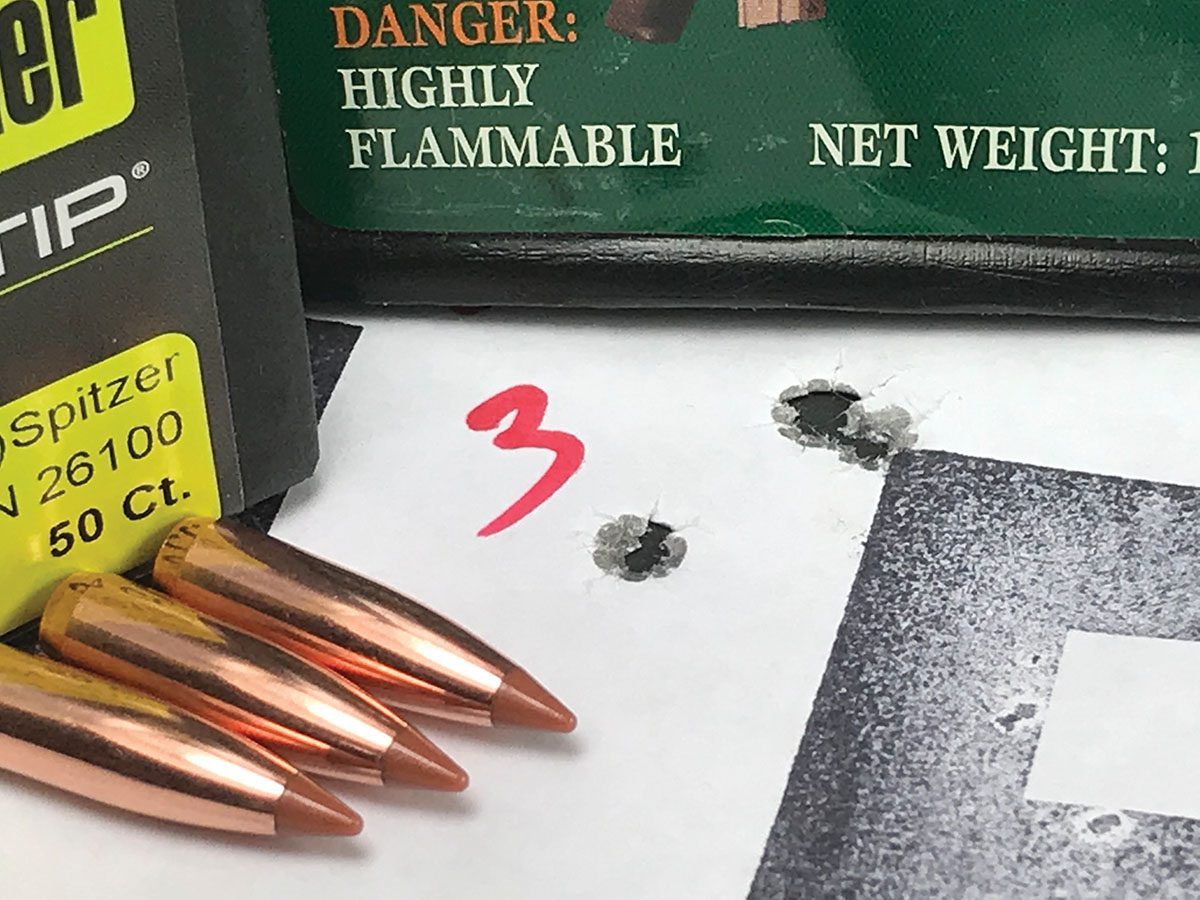
Three-shot groups were fired with the Howa because the company states three-shot groups in its accuracy guarantee. That is an insufficient test for meticulous handloaders who prefer five- and even 10-shot groups as the true trial of a rifle’s accuracy potential.
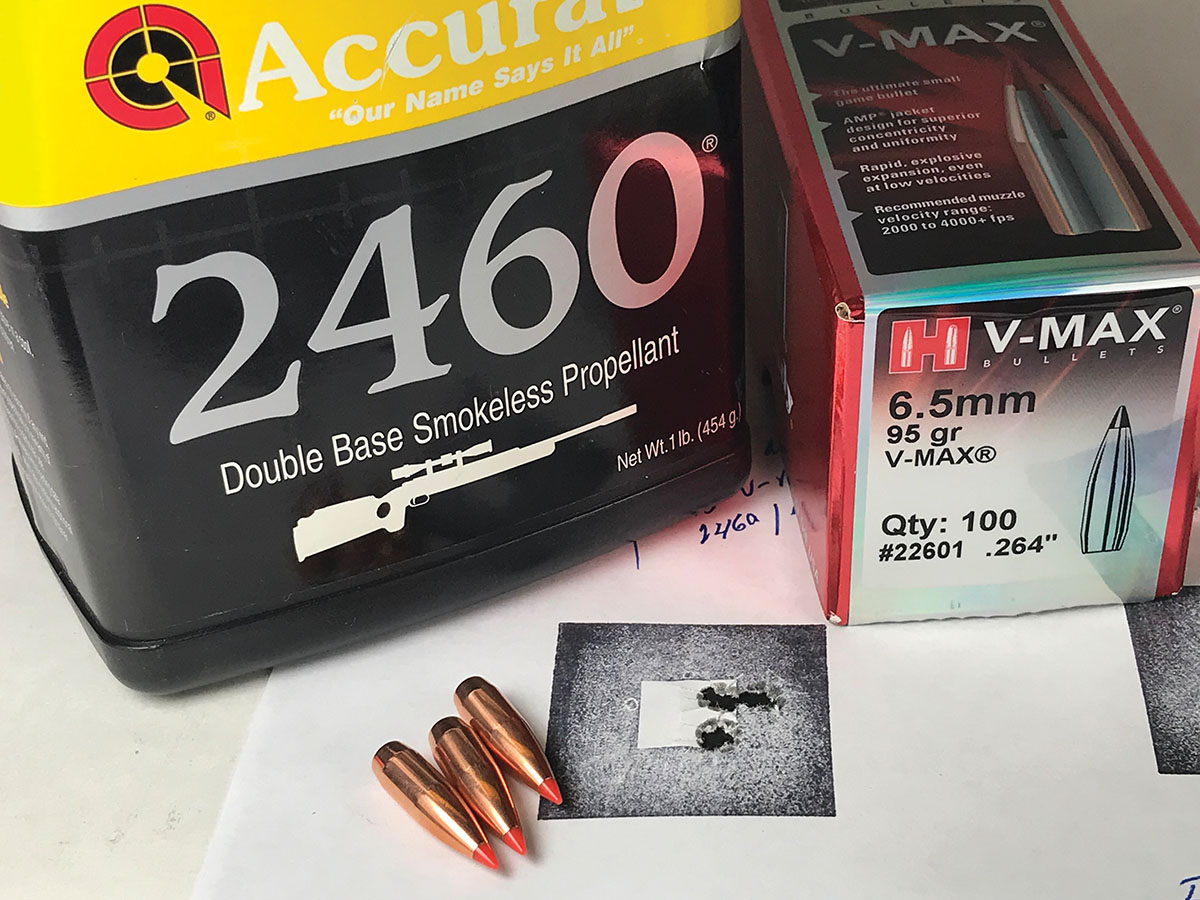
The Howa provided a three-shot group at 100 yards that measured .37 inch with handloads using Hornady 95-grain V-MAX bullets and Accurate 2460 powder. I fired three more of the V-MAX bullets, and they provided a .75-inch group. My son was with me another day and doing his best to shoot any available 6.5 Grendel cartridges. All that remained were 15 cartridges loaded with Hornady 95-grain V-MAX bullets and A-2460 powder. Thomas fired five of the cartridges, and the bullets cut one small hole at 100 yards. As fast as he could load the magazine and shoot, he fired five more bullets that somewhat enlarged the hole. Five additional shots resulted in a hole that measured 1.29 inches. So it’s safe to say the Howa shot 21 bullets in 1.29 inches.
A perfect way to enjoy a sunny spring day is to take my 6.5 Grendel for a walk after ground squirrels and marmots. Mostly I shoot Sierra 85-grain Varminter bullets or any brand of 100-grain bullet available. Ground squirrels are about the size of a can of pop. I have a habit of overestimating range. To compensate, the scope is set so bullets hit an inch above aim at 100 yards. With that setting, bullets hit on aim at 150 yards, drop about 4 inches at 200 yards and roughly 7 inches at 250 yards.
One morning, I sat on a hillside overlooking a flat of sprouting alfalfa. Ground squirrels ran through the short grass and dug new burrows. The 6.5 recoiled just enough to hinder the view through the scope, but the view was back in plenty of time to see a gopher take a hit, or dirt kick up from a miss. I shoot pretty well out to 250 yards.
In the afternoon I went up into the foothills to look for marmots perched on rock ledges. I kept behind the ridges to narrow the distance, just like stalking a mule deer buck.
The 6.5 definitely carried enough clout to knock the marmots clear off their perches. Four marmots were shot, and that was enough; afternoon had turned to evening and the end of a perfect day.